TL;DR
- Specialty cutouts in stone countertops usually cost $50 to $150 for standard sink openings, $100 to $250 for cooktops, and $150 to $400 or more for complex shapes like farmhouse aprons, radius corners, and decorative openings.
- Price tracks material hardness, cutout complexity, blade wear, and labor time.
- Quote every cutout line by line.
- Never bury them in slab square footage.
Why do specialty cutouts cost extra on stone countertops?
A cutout is more than a hole. Every opening in a slab needs a skilled operator to set up the cut, run a wet saw or CNC router along a precise path, polish the exposed edge (sometimes to match the perimeter profile), and pull it off without cracking a slab that might be worth $800 or more. Miss the line by an eighth of an inch on a farmhouse sink and the apron front won't sit flush. That's a $2,000 problem.
Material hardness alone drives a lot of the cost. Diamond blades and CNC tooling wear faster on quartzite and some engineered stones than on softer marbles. A shop with a full schedule can burn through a blade segment every few jobs on hard quartzite. That wear is real money, and most fabricators who don't price cutouts separately are quietly eating it out of margin, right up until they can't.
Then there's time. A basic undermount sink cutout on a straight-run granite slab might take 20 minutes on a CNC table. A 36-inch farmhouse sink with a curved apron front, cut on a bridge saw with hand-finishing at the inside corners, can take 90 minutes or more. Labor is usually the single biggest line item in a fabrication shop, often $45 to $85 per hour depending on region and skill level [1]. When a 'simple' cutout eats an hour of a senior fabricator's time, pricing it at a flat $50 is a guaranteed loss.
What is a standard sink cutout and what does it cost?
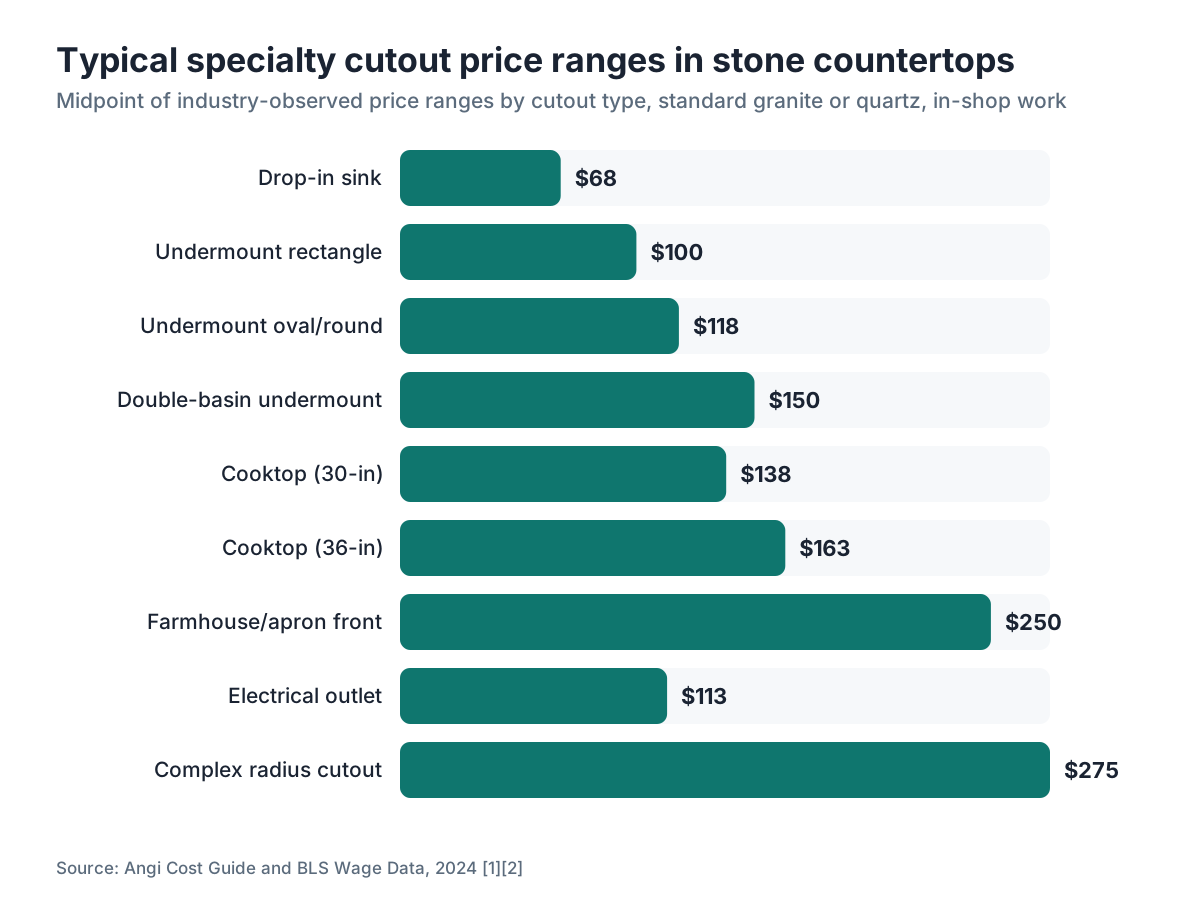
A standard undermount sink cutout is a rectangular opening with slightly radiused corners, sized to the sink template. Most fabricators treat it as the baseline and price it that way. The common range is $50 to $150, with the middle ($75 to $100) most typical for granite and quartz [2].
Drop-in sinks are often cheaper to cut because the rim covers the edge, so no polished interior is required. Undermount sinks need a finished edge on the underside of the opening, which adds polish time. If the customer wants the sink edge to match the perimeter profile exactly (a full ogee or a dupont, say), that's a real upcharge, because the fabricator has to run a profile wheel inside a tight radius.
Some shops price by sink type rather than by the clock. That structure looks like this:
| Sink Type | Typical Cutout Price Range |
|---|---|
| Drop-in (any size) | $50 to $85 |
| Undermount rectangle | $75 to $125 |
| Undermount oval/round | $85 to $150 |
| Farmhouse/apron front | $150 to $350 |
| Double-basin undermount | $100 to $200 |
These are ranges observed across the trade, not published government rates. Your local market and shop overhead will push them up or down. High-cost metros (New York, San Francisco, Boston) run 20 to 40% above the midpoints here [1].
Homeowners, ask one question every time: is the sink cutout included in this quote, or itemized separately? Many fabricators fold one standard undermount cutout into the base quote, then charge for anything past that. Others itemize from the start. Neither is wrong. You just need to know which one you're reading before you compare bids.
How do fabricators price cooktop and range cutouts?
A cooktop cutout runs $100 to $250 depending on material and size, and it differs from a sink cutout in a few ways that matter. The opening is often larger, the corners are usually square or barely radiused, and the customer typically wants the edge left raw or lightly eased rather than polished, because the cooktop trim ring covers it. Sounds easier. It isn't. A bigger opening puts more stress on the slab during the cut, and a cooktop lands toward the center of a run rather than the perimeter, which is the worst possible place to remove material.
Center-of-slab cutouts carry genuine cracking risk, especially in veined stone or slabs with natural fissures. Fabricators working with marble countertops or heavily veined granite countertops will sometimes decline to cut a cooktop opening in a bad slab location, or charge a risk premium. That's a sound business call, not an upsell.
Typical cooktop pricing breaks down like this:
| Cooktop Size | Typical Cutout Price Range |
|---|---|
| 30-inch electric/gas | $100 to $175 |
| 36-inch electric/gas | $125 to $200 |
| 36-inch induction (tight tolerance) | $150 to $250 |
| Downdraft cutout (separate) | $75 to $150 |
Induction cooktops sometimes need tighter tolerances than gas models because the trim ring has less overlap. If you're spec-ing induction, pull the installation manual before templating and confirm the required opening and the allowable gap. A cut that's 3/16 of an inch too wide on an induction unit can leave a visible gap the trim ring won't cover.
Fabricators, pricing cooktop cutouts at a flat rate regardless of material is a mistake. Hard engineered stones and quartzite need slower feed rates, more blade passes, and they chew through tooling faster. Build a material multiplier into your cutout pricing the same way you do for edge profiles.
What counts as a 'specialty' cutout and how much more do those cost?
Past sinks and cooktops, a specialty cutout is any opening that needs non-standard tooling, real hand-finishing, or a fabricator's judgment instead of a repeatable template. The common ones:
Farmhouse sink openings. These require cutting the front face of the cabinet-side overhang to accept the apron. The cut is structural, it often sits where the slab has less support, and finishing the exposed vertical face to match the perimeter profile takes time. Prices run $150 to $350, and higher for very large or curved aprons.
Radius or curved cutouts. A round pot-filler hole is simple. A decorative curved cutout for a vessel sink with a specific ogee interior edge is not. Any cutout where the inside edge needs a profile wheel run in an arc adds serious time. Expect $150 to $400 for complex radius work.
Multiple adjacent cutouts. A prep sink plus a main sink plus a cooktop in one run multiplies both the labor and the cracking risk. Each opening weakens the stone between them. Some fabricators add a structural integrity fee when the span between cutouts drops below 6 inches of stone.
Electrical outlet or USB cutouts. Small rectangular openings for flush-mount boxes show up on a lot of islands now. They look minor and aren't. They need precise sizing, a polished interior edge, and careful bit selection to avoid chipout on the bottom face. Figure $75 to $150 each.
Outdoor grill cutouts. Cutting stone for an outdoor kitchen grill island uses the same techniques, but the slab is often thicker (1.5-inch or 2-inch) and the access is worse. Outdoor cutout pricing runs 25 to 50% above the indoor equivalent.
How should a fabricator build a cutout pricing model?
The cleanest approach is two parts: a base labor rate for the time the cut actually takes, plus a material-and-tooling surcharge that reflects blade wear and cracking risk. Here's how that plays out.
Start by timing your real cutouts. Not what you think they take. Time them with a stopwatch across 20 jobs. Most shops that do this find their average undermount sink cutout takes 35 to 45 minutes including setup, cutting, polishing the edge, and cleanup. At $60 an hour shop labor (a fair midpoint for a mid-sized shop in 2024) [1], that's $35 to $45 in labor before tooling.
Tooling cost per cutout is harder to pin down because it swings with blade quality and material. A diamond blade for wet cutting might run $80 to $200 and last 20 to 80 linear feet depending on hardness [3]. Run that math against your job mix and you get a per-cutout tooling figure. For most shops it lands at $5 to $25 per cutout on standard materials, and $20 to $60 on hard quartzite or dense engineered stone.
Add overhead (a percentage of fixed costs per labor hour) and a margin, and you've got a price you can defend. Sounds tedious. It is, once. Software that tracks cutout time and links it to job costing makes it repeatable. SlabWise, for example, lets fabricators add cutout line items to quotes with per-item pricing, so the cost shows up for the customer and gets tracked against real shop time.
One habit separates experienced shops from newer ones. They charge for every cutout, including the ones that feel 'quick.' A 15-minute electrical outlet cutout is still 15 minutes of a skilled person plus tooling wear. Price it.
Does the stone material type change the cutout price?
Yes, and by a lot. Hardness sits on the Mohs scale, and harder stone is both more expensive to cut and more likely to crack during the process [4]. Here's a rough map of common materials to cutout difficulty:
| Material | Mohs Hardness (approx.) | Relative Cutout Difficulty |
|---|---|---|
| Marble | 3 to 4 | Low to moderate |
| Limestone | 3 to 4 | Low to moderate |
| Soapstone | 1 to 2 | Low |
| Granite | 6 to 7 | Moderate to high |
| Quartzite | 7 to 8 | High |
| Engineered quartz (Cambria, etc.) | 7 | Moderate to high |
| Porcelain slabs | 7 to 8 | High |
Marble is soft enough that cutouts go fast, but it chips easily at inside corners, so the operator still has to work carefully. Soapstone (see how to clean soapstone countertops for care context) is the softest common countertop stone and cuts quickly. Porcelain sits at the far end: very hard, very brittle, and close to zero forgiveness if blade speed or feed rate drifts. Porcelain cutout pricing should run 30 to 60% above the granite equivalent at minimum.
Engineered quartz like Cambria countertops falls mid-scale on hardness but has consistent density, no natural voids or fissures, which actually makes it more predictable to cut than natural stone of similar hardness. Some fabricators price engineered quartz cutouts a touch below equivalent-hardness natural stone for exactly that reason.
Homeowners comparing bids: if you're quoting quartzite or porcelain and one fabricator's cutout price is way below another's, ask about it. It might mean they price accurately and cut efficiently. It might also mean they're underpricing and plan to eat the loss somewhere else, possibly in cut quality.
What affects cutout pricing beyond material and labor?
Several job-specific factors move cutout prices up or down independent of the stone:
Slab position. A sink cutout near the edge of a slab, where the stone has support, is less risky than the same cut centered in a big island with nothing under the cut zone. Cracking risk during the cut is real, and experienced fabricators price for it.
Edge profile matching. If the cutout edge has to match the perimeter profile (a full bullnose, an ogee, a waterfall), that's extra polishing time with profile wheels inside a constrained opening. It can add $50 to $150 to any cutout.
Access at installation. Sometimes a cooktop cutout has to happen on-site after the slab is set because of the cabinet layout. On-site cutting is messier, slower, and harder to nail precisely. Expect a 50 to 100% premium for on-site cutouts over shop work [1].
Number of cutouts on the job. Some shops offer a small per-job discount at four or more cutouts. Some don't. It's reasonable to ask. Don't expect it as standard.
Rush timing. A job that needs cutting and delivery in 48 hours instead of the standard 7 to 10 days often carries a rush fee on every line item, cutouts included. That's fair.
For fabricators managing countertop installation schedules, price on-site cutouts high enough to cover the real cost of sending a truck, a wet saw, a water containment setup, and a skilled operator to a job site for what might be a 30-minute cut. The travel and setup alone usually beats the cut time.
How do cutout prices compare across different countertop materials?
Step back for a second and look at cutouts across every countertop material, more than stone. Homeowners still choosing a material should know cutout pricing is one area where stone isn't always the priciest option.
Laminate countertops and Formica countertops have very low cutout costs because a jigsaw handles most openings. Solid surface like Corian countertops cuts easily with router bits and can be repaired if a cut goes slightly wrong. Butcher block countertops are also router-cut and cheap to modify.
Stone, engineered stone, and porcelain need wet diamond tooling, which is the main cost driver. Among stone options, quartzite and porcelain cost the most to cut. Standard granite and engineered quartz sit in the middle. Soft stones like soapstone and limestone cost the least but can chip at corners.
On total project cost, specialty cutouts are rarely a big share of a stone countertop job. A full kitchen with two cutouts might add $200 to $400 to a $3,000 to $6,000 project. The trouble starts when both sides treat cutouts as an afterthought and nobody prices them right until the invoice lands.
How should homeowners read a cutout line item on a quote?
Look for cutouts as their own line item. If they aren't there, ask: is the sink cutout included, and is the cooktop cutout included? A quote that folds everything into a single square-footage price can look competitive while missing these charges entirely, with the plan to add them later.
What a well-built stone quote shows:
- Slab material (price per square foot and total square footage)
- Edge profile (per linear foot)
- Sink cutout (itemized, with edge finish noted)
- Cooktop cutout (itemized if applicable)
- Any additional cutouts (itemized)
- Delivery and installation
- Any site-specific charges
If a fabricator can't or won't break these out, that's a yellow flag. Not proof of anything shady, but it makes comparison shopping harder and disputes more likely if something's missing from the scope.
For kitchen countertops specifically, where the average job has at least one sink and often a cooktop, get every cutout confirmed in writing before you sign. The conversation costs nothing. The missing line item at the end of the job costs patience, and sometimes money.
What is the right way to handle cutout disputes between fabricators and homeowners?
Cutout disputes almost always trace back to one of three things: the cutout wasn't in the original quote and the homeowner didn't know to ask, the quote said 'standard' but the actual work was specialty-level, or the fabricator found mid-job that the material or position added complexity.
The cleanest way to head off all three is to quote every cutout by type and name. Don't write 'sink cutout included.' Write 'one 33-inch undermount single-basin cutout with eased interior edge, positioned at left end of run.' That sentence takes 20 seconds to type and kills three kinds of argument.
Fabricators, if you find mid-job that a cutout will be harder than quoted (cracked slab, changed sink model, position moved by the cabinet installer), stop and call the customer before you cut. A five-minute phone call beats the fight that follows a surprise invoice line.
Homeowners, if a fabricator comes back with an unexpected cutout charge after the job, ask to see the original quote language and ask exactly what was different. A legitimate extra comes with a clear reason. 'That took longer than we expected' isn't enough on its own. 'The cooktop cutout had to be done on-site because the plumber's stub-out blocked shop access, which adds X to the labor' is.
Shops running job-costing software can pull actual time logs for a given cutout and show the customer what happened. That kind of transparency is increasingly expected, and the shops that can produce it have fewer fights.
Frequently asked questions
Is a sink cutout always included in a granite countertop quote?
Not always. Some fabricators include one standard undermount sink cutout in their base price; others treat every cutout as a separate line item. Ask before you sign. The safest move is to get every cutout confirmed in writing by type (undermount vs. drop-in), size, edge finish, and whether it's included or billed separately. A verbal confirmation is worth very little once an invoice shows up.
How much does a farmhouse sink cutout cost in granite or quartz?
A farmhouse (apron-front) sink cutout typically runs $150 to $350 in granite or engineered quartz, higher for very large or curved apron profiles. It costs more than a standard undermount because the apron face requires cutting the front edge of the slab overhang, often with hand-finishing to match the perimeter profile. Some fabricators add a structural risk fee if the cut location sits in a high-stress area.
Can a cooktop cutout cause a stone slab to crack?
Yes. A cooktop cutout usually sits toward the center of a run, which is the structurally weakest place to remove material. Slabs with natural fissures, heavy veining, or inclusions carry higher cracking risk. Good fabricators template carefully, mark fissure locations before cutting, and sometimes reinforce the underside with epoxy or mesh before a center cutout. If your slab has visible veining running toward a planned cooktop location, discuss it before anyone cuts.
Why does porcelain cost more to cut than granite?
Porcelain rates around Mohs 7 to 8 and is extremely brittle, with almost no tolerance for vibration or feed-rate errors during cutting. Granite has some crystalline flex; porcelain will chip or shatter at a cutout edge if blade speed or water cooling is slightly off. That brittleness means slower feed rates, more passes, sharper (and pricier) tooling, and a higher skill premium. Expect porcelain cutout pricing to run 30 to 60% above granite for the same opening.
How do fabricators price electrical outlet cutouts in stone islands?
Flush-mount electrical outlet cutouts in stone run $75 to $150 each. They look small but need precise sizing (outlet boxes have tight tolerances), a finished interior edge to prevent chipping, and careful bit selection to avoid spalling on the underface. Faster than a sink cutout, slower than they look. Many fabricators undercharge until they track the real time. Price them as their own line item, not a rounding error.
Does the edge profile on a cutout affect the price?
Yes, meaningfully. A raw or eased cutout edge (as under a cooktop trim ring) adds little. An edge that must match the perimeter profile (bullnose, ogee, dupont) requires running a profile wheel inside a constrained opening, which takes far longer than the same profile on a straight outside edge. Expect to add $50 to $150 per cutout when interior edge profiling is required. Confirm whether it's included before the fabricator starts.
Is it cheaper to have the cutout done in the shop or on-site?
Shop cutouts are almost always cheaper. In-shop work uses fixed CNC or bridge-saw infrastructure, better lighting, and better slab support, and it produces cleaner results. On-site cutouts require hauling wet-cutting gear, containing slurry, and working in a tight space, which can easily double the effective labor time. Many fabricators charge a 50 to 100% premium for on-site work. If you can, confirm cutout locations during templating so everything happens in the shop.
How do I compare cutout prices across multiple fabricator quotes?
Ask each fabricator to list every cutout as its own line item with a description of what's included (size, edge finish, material, in-shop vs. on-site). Then compare line by line, not on total price. A quote that looks $300 cheaper might be missing the cooktop cutout entirely. Also ask what happens if a cutout turns out harder than expected. A shop with a clear change-order policy beats one that surprises you at the end.
What is a reasonable profit margin for cutouts in a fabrication shop?
Most fabrication shops target 40 to 60% gross margin on labor-and-materials items, cutouts included. So if a cutout costs $45 in labor and $10 in tooling, the shop price should be roughly $110 to $165 before overhead markup. Shops that price cutouts near cost are subsidizing them with slab margin, which works until a job has six cutouts and thin slab profit. Tracking cutout costs separately in job costing is the only way to know if you're making money on them.
Do double-basin sink cutouts cost twice as much as single-basin?
Not usually twice, but more. A double-basin undermount cutout needs two separate cuts plus the divider bridge between them, and the combined opening is larger, which adds structural stress. Most fabricators price a double-basin cutout at 1.4 to 1.7 times a comparable single-basin, roughly $100 to $200 vs. $75 to $125 for a single. Get it specified in your quote rather than assuming single-basin pricing applies.
Are cutout prices negotiable?
Sometimes, less than you'd hope. Labor and tooling costs are real, and a fabricator who discounts cutouts below cost is either making it up elsewhere or setting up for quality shortcuts. The room that does exist is on bundled jobs: with four or more cutouts, ask about a multi-cutout discount. Some shops offer one. On a single-cutout job, the price is usually the price. Spend your negotiating energy on slab selection and edge profiles, where there's more margin to work with.
How does cutout pricing work for outdoor kitchen countertops?
Outdoor grill and sink cutouts run 25 to 50% above indoor equivalents. Outdoor stone is often thicker (1.5-inch or 2-inch slab vs. standard 3/4-inch or 1.25-inch), so there's more material to cut. Access is often harder, forcing on-site work with portable equipment. And outdoor stone is frequently quartzite or a dense granite chosen for weather resistance, both harder and rougher on tooling. Get outdoor cutout pricing as a separate line item, not lumped into slab square footage.
What should I do if a cutout chip or crack appears after installation?
Small chips at the interior corners of a cutout can often be filled with color-matched epoxy or a clear stone adhesive. Cracks that run from a cutout edge toward the slab edge are more serious and need a structural assessment before use. Contact the fabricator right away and document the damage with photos before the countertop gets loaded or disturbed. Many fabrication contracts have a defect-reporting window (often 30 days), so don't wait. Whether it's the fabricator's responsibility or a material defect depends on where and how the crack started.
Sources
- U.S. Bureau of Labor Statistics, Occupational Employment and Wage Statistics: Stone Cutters and Carvers (SOC 51-9194): Median hourly wages for stone cutters and related fabrication trades, supporting $45 to $85/hour shop labor range by region
- HomeAdvisor (Angi), Cost Guide: Countertop Installation: Industry-observed range of $50 to $150 for standard undermount sink cutouts in stone
- Occupational Safety and Health Administration (OSHA), Crystalline Silica page and Publication 3183 on silica dust control: Wet-cutting requirements and blade use guidance in stone fabrication, supporting blade cost and wear rate context
- U.S. Geological Survey (USGS), National Minerals Information Center (Mohs hardness reference): Mohs hardness values for granite (6 to 7), quartzite (7 to 8), marble (3 to 4), and related countertop stone materials
- National Stone, Sand and Gravel Association (NSSGA), Stone Industry Statistics: Stone fabrication industry context and material processing references
- Natural Stone Institute (formerly Marble Institute of America), Fabrication Standards: Industry standards for cutout dimensions, edge finishing, and structural guidelines for stone countertop openings
- U.S. Census Bureau, American Housing Survey: Kitchen renovation and countertop replacement frequency and cost data supporting project cost context
- National Kitchen and Bath Association (NKBA), Kitchen and Bath Market Index: Average kitchen countertop project values and material prevalence supporting cutout pricing in context of overall project cost
- Tile Council of North America (TCNA), porcelain tile standards: Porcelain hardness and brittleness characteristics supporting higher cutout pricing for porcelain slabs vs. granite
- U.S. Small Business Administration, Manage Your Finances (pricing your products and services): Gross margin targeting (40 to 60%) for labor-and-materials service businesses supporting fabricator margin guidance
Last updated 2026-07-11