
TL;DR
- A vessel sink cutout usually adds $50 to $150 per opening to a countertop fabrication quote, on top of the base slab price.
- The exact number depends on material hardness, cutout shape (round vs.
- rectangular), edge finish inside the opening, and whether a faucet hole is included.
- Fabricators should price cutouts as a discrete line item, not fold them into square-footage rates.
What is a vessel sink cutout and why does it cost extra?
A vessel sink sits on top of the countertop surface instead of dropping into it. So the countertop needs a relatively small hole, usually 1.5 to 1.75 inches in diameter for the drain, sometimes larger depending on the basin. Some vessel sinks use a much wider decorative opening, 10 to 14 inches across, that needs a finished edge on the interior ring rather than a rough cut.
The extra cost comes from a few real things. Every cutout is a separate CNC toolpath or wet-saw operation, and it ties up machine time. An interior edge on a round or rectangular opening is harder to polish than a straight perimeter edge because the router has to work in a tight arc. And stone can crack along a cutout if the geometry is off, which means the fabricator is carrying some risk of a remade slab. That risk gets priced.
Here's the takeaway for homeowners. The countertop for a vessel sink bathroom is not cheaper than a standard undermount or drop-in setup just because the sink isn't embedded in the stone. The countertop work is comparable, and it sometimes costs more, because the drain-only cutout is a small, precise circle that the machine has to execute carefully.
How much does a vessel sink cutout cost in 2025?
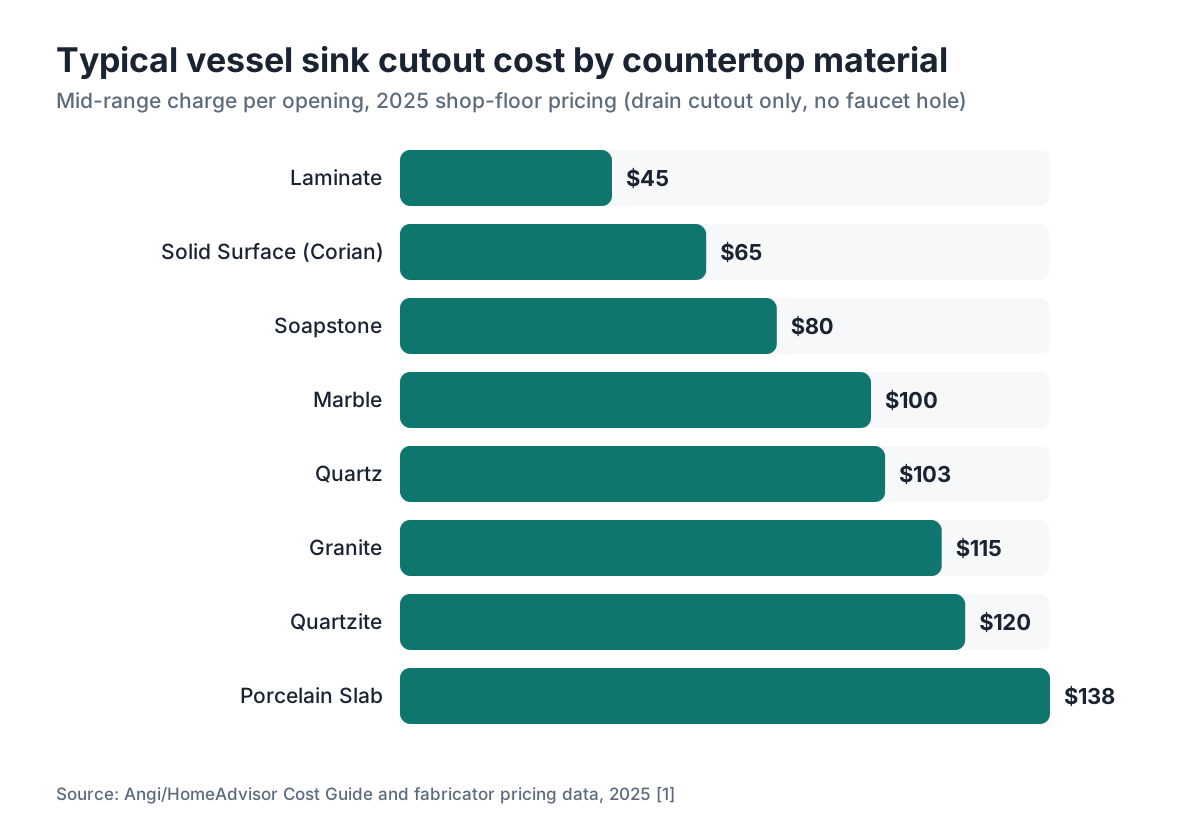
Most fabrication shops charge $50 to $150 per cutout opening for a vessel sink, with the spread driven almost entirely by material and edge finish [1]. Here's how that range breaks down in practice:
| Material | Typical cutout charge | Notes |
|---|---|---|
| Laminate | $30, $60 | Router cut, no polish needed |
| Quartz | $75, $130 | CNC required; polished edge adds cost |
| Granite | $80, $150 | Hard material, higher blade wear |
| Marble | $70, $130 | Softer than granite but delicate; chip risk |
| Quartzite | $90, $150 | Among the hardest natural stones |
| Soapstone | $60, $100 | Softer; easier to cut but hand-finished |
| Porcelain slabs | $100, $175 | Very hard, high blade consumption |
These are shop-floor figures pulled from publicly posted price lists and industry forums as of 2025. Nobody publishes a national average with statistical rigor, so treat the midpoints as useful anchors, not gospel.
A faucet hole, if drilled separately (many vessel setups use a deck-mount faucet through the stone), adds another $25 to $50 per hole. Drilling through stone takes a diamond core bit and 10 to 20 minutes of careful, wet work. Don't let that line surprise you on the invoice.
What factors actually change the price of a vessel sink cutout?
Material hardness is the biggest driver. On the Mohs scale, granite sits around 6 to 7, quartzite can reach 7, and engineered quartz is similar [2]. Harder materials wear down diamond blades faster and slow the CNC feed rate, which flows straight into machine time and tooling cost. Laminate, by contrast, cuts with a standard router bit and needs no wet polishing.
Cutout shape matters a lot. A simple round drain hole (the most common vessel sink cutout) is the easiest geometry. A rectangular cutout with tight inside corners takes plunge cuts and careful corner routing, and it's more likely to chip or crack if the stone has any internal tension. Expect rectangular cutouts to run $20 to $40 higher than round ones in the same material.
Edge finish on the interior opening is the variable most homeowners don't ask about until they see the invoice. A raw, unpolished cut is invisible on a drain-only vessel opening because the sink basin covers it. But a larger decorative opening, where the stone edge shows around the vessel base, needs to be polished or at least honed to match the perimeter edge. That polish step on a curved interior can take 15 to 30 minutes by hand and usually adds $30 to $60.
Thickness matters too. A 3cm slab (the standard for most stone countertops) takes slightly longer to cut through than a 2cm slab. Most shops don't charge a separate thickness premium for cutouts, but some do, especially on 4cm mitered pieces.
Quantity changes the math. If a customer has a double vanity with two vessel sinks, the second cutout is usually cheaper because the machine is already set up and the template is done. Some shops price the second cutout at 50 to 75 percent of the first.
How do fabricators calculate vessel sink cutout pricing?
There are three approaches shops use, and each has real tradeoffs.
The flat fee per opening is the most common. The shop has a published price list: round drain cutout in quartz costs $95, polished edge costs $40 more, faucet hole costs $35. The customer sees a clear line item. It works because it's transparent and easy to quote remotely.
The time-and-materials approach charges actual machine and labor time. If a cutout takes 25 minutes of CNC time at a $120/hour machine rate, that's $50 in machine cost before labor and overhead. Some shops add a markup of 1.5x to 2x on top. This method is accurate but hard to quote before the job starts, since actual cut time varies.
The bundled square-footage rate folds cutout cost into the per-square-foot price. You might see a shop charging $85/sqft for quartz installed that "includes one sink cutout." This is common in high-volume shops. The problem is it hides the real cost and makes it hard to compare quotes when one shop bundles and another itemizes.
For fabricators, itemizing cutouts as a separate line is better practice for two reasons. It protects margin: if the customer adds a second vessel sink after the initial quote, there's no ambiguity about what that costs. And it makes your quotes easier for customers to compare against competitors, because the base slab price looks competitive and the cutout charge is justified by scope.
Shops running quoting software can set cutout pricing as a configurable option tied to material type, so the correct charge appears automatically when a vessel sink is selected. SlabWise, for instance, lets fabricators define per-cutout fees by material and edge profile so nothing gets missed on the invoice.
How does vessel sink cutout pricing compare to undermount sink cutouts?
An undermount cutout is usually more expensive than a vessel drain cutout, because the undermount opening is much larger and the interior edge has to be polished. That's the honest answer fabricators give when homeowners ask.
A standard undermount kitchen sink opening runs roughly 26 to 30 inches long and 16 to 18 inches wide. That's a lot of interior edge to polish. A vessel sink drain cutout is 1.5 to 2 inches in diameter. The vessel cutout is a fraction of the work.
But if the vessel design uses a large decorative opening, say a 12-inch circle with a polished chamfered edge visible around the base, the labor approaches undermount territory. In that case, the pricing should too.
A typical undermount kitchen sink cutout in granite runs $150 to $300 depending on shape and finish [1]. A vessel drain cutout in the same material runs $80 to $150. So the vessel opening usually lands 40 to 60 percent cheaper than an undermount cutout, not because it's easier in every sense, but because there's far less linear edge to finish.
For bathroom countertops with multiple vessel sinks, compare the total cutout cost against an equivalent undermount setup before assuming vessel is cheaper. By the time you add two drain holes plus two faucet holes, you might land within $50 to $100 of an undermount quote.
Does the countertop material change how a vessel sink cutout is done?
Yes, and significantly. The fabrication method varies by material, which is part of why pricing varies.
For natural stone (granite, marble, quartzite, soapstone), cuts are made wet with diamond tooling on a CNC bridge saw or waterjet, then edges are hand-polished or machine-polished with progressive grits. The wet environment protects the stone and the operator. Granite and quartzite are the most abrasive on tooling. If you're sourcing granite countertops or marble countertops, expect the higher end of the cutout range.
For engineered quartz (Silestone, Cambria, etc.), CNC is standard. Quartz is consistent in density and cuts predictably, which is why shops can quote a fixed price with confidence. Cambria countertops use a proprietary quartz composite that's among the harder engineered options, which can push cutout time slightly longer.
For laminate and Formica, a jigsaw or router does the cut in minutes. No wet work, no diamond tooling. Laminate countertops and Formica countertops have the lowest cutout charges by a wide margin, often under $50.
For Corian and similar solid surface, cuts are made with standard woodworking tools and the interior edge is sanded and buffed. Corian countertops have one advantage here: a chip can be repaired so the fix disappears into the surface, which lowers the risk premium.
Porcelain slab is the most demanding material for any cutout. It's extremely hard, brittle, and prone to chipping at cut edges. Many fabricators charge a premium or require waterjet cutting rather than CNC routing for porcelain. Budget $100 to $175 per opening.
What should a homeowner's quote line items look like for a vessel sink countertop?
A clear, itemized quote for a vessel sink bathroom countertop should have at least these distinct lines:
- Slab material cost (priced per square foot, include actual square footage used plus waste factor)
- Fabrication labor (sometimes bundled with material, sometimes separate)
- Edge profile on the perimeter (eased, beveled, bullnose, ogee, etc., each priced differently)
- Vessel sink drain cutout (per opening, specifying shape and diameter)
- Interior edge finish on cutout if visible (polished, honed, raw)
- Faucet hole(s) (per hole)
- Template/measurement fee if charged separately
- Delivery and installation
- Backsplash if applicable
If a fabricator hands you a single total with no line items, ask them to break it out before you sign. This isn't about distrust. It's about knowing what you're getting and being able to compare quotes apples to apples.
For a typical single-sink bathroom vanity in quartz, a reasonable installed total in 2025 runs $400 to $900 for the countertop alone, depending on slab size, edge complexity, and regional labor rates [3]. The vessel sink cutout itself should show up as a $75 to $130 line within that total.
If you're getting quotes, use the countertop installation guide to understand what the installation process involves and which parts of the quote cover which work.
Can a homeowner do a vessel sink cutout as DIY, and does it save money?
Technically yes. Practically, it depends heavily on the material.
For laminate, a DIY vessel sink cutout is straightforward. A jigsaw with a fine-tooth blade, a hole saw for the drain opening, and some patience get the job done. Mistakes are recoverable because laminate is cheap. This is a legitimate DIY option for people with basic tool skills.
For natural stone or engineered quartz, DIY is a much higher-stakes call. Diamond blades rated for granite cost $30 to $80 for a decent 4-inch blade, and you'll likely burn through one per cut without experience [4]. You need a wet saw or an angle grinder with water cooling, diamond core bits for the drain hole, and polishing pads in multiple grits if you want a finished edge. The tool investment for a one-time job easily runs $150 to $300, often more than just paying a shop.
The real risk is cracking the slab. A stress crack from a bad cutout can propagate across the entire countertop, and that's a several-hundred-dollar mistake. Professional fabricators carry the cost of remakes as a business risk. You carry it personally.
My honest take: if the countertop is laminate, go ahead and DIY the cutout. If it's any form of stone, pay the shop. The $80 to $150 cutout charge is cheap insurance against a ruined slab.
How do regional labor rates affect vessel sink cutout pricing?
Fabrication is local work, and labor rates swing hard across the US. The Bureau of Labor Statistics tracks wages for stone cutters and slabbers under SOC code 51-9195 [5]. As of the most recent BLS Occupational Employment and Wage Statistics release, the median hourly wage for stone cutters nationally sat around $20 to $22 per hour, but the range runs from roughly $15 in lower-cost regions to $30 or more in metros like San Francisco, Seattle, and New York [5].
Shop overhead, real estate costs, and local competition all stack on top of raw labor. A fabrication shop in Manhattan has fundamentally different fixed costs than one in rural Tennessee, and that difference flows into every line item, including cutout charges.
As a rough rule, expect fabrication prices (cutouts included) to run 20 to 40 percent higher in high cost-of-living metros than in mid-size cities, and 10 to 20 percent lower in rural markets. This tracks with how the broader construction trades price out.
Getting three local quotes is still the best way to calibrate your market. Online price calculators can ballpark the number, but they can't account for local labor dynamics.
How should fabricators handle vessel sink cutout pricing in their quoting software?
The most common mistake fabricators make is treating cutouts as an afterthought, tacking a round number onto the end of the quote instead of building it into the pricing structure. That creates inconsistency: one estimator charges $80, another charges $120, and the shop can't track which jobs are actually profitable.
The right approach is to define cutout pricing as a configurable product option tied to material type. Your quoting tool should let you select "vessel drain cutout" as an add-on and have the correct charge populate automatically based on the countertop material. This stops undercharging on hard materials and overcharging on easy ones.
For shops that fabricate a mix of materials, a simple tiered structure works well:
- Tier 1 (laminate, solid surface): $35 to $60 per opening
- Tier 2 (quartz, marble): $75 to $130 per opening
- Tier 3 (granite, quartzite, porcelain): $90 to $175 per opening
Add a separate line for polished interior edge if the opening is decorative rather than drain-only. Add another line for each faucet hole. Keep it clean.
SlabWise's quoting module is built around exactly this kind of itemized option logic, so fabricators can define these tiers once and apply them the same way across every job without manual calculation. If you run a shop and want to see how that works in practice, a demo is worth 20 minutes of your time.
Document your cutout pricing in your estimating guide and train every person who touches quotes to use the same structure. Consistency here is where margin either holds or leaks.
Are there building code or plumbing requirements that affect vessel sink cutout sizing?
The cutout itself isn't directly regulated by building codes in most places. The drain connection behind the countertop is. But the cutout size has to match the drain assembly the plumber will use.
The International Plumbing Code (IPC), which most US states have adopted in some form, requires that waste pipes for lavatories have a minimum trap arm diameter of 1.25 inches, though 1.5 inches is standard practice [6]. The drain body that passes through the countertop on a vessel sink is typically 1.25 to 1.5 inches in diameter, so a 1.75-inch cutout is the standard spec most fabricators use, giving a small clearance margin.
Some vessel sink manufacturers specify their own required cutout size, and those specs should be followed exactly. Check the sink's installation documentation before the countertop is fabricated. Getting this wrong means either re-drilling (risky in stone) or shimming the drain assembly (messy and possibly out of compliance with the sink warranty).
Faucet holes, if the faucet mounts through the stone, are typically drilled to 1.375 inches (35mm) to accept a standard faucet shank. Some European faucets use a 1.5-inch (38mm) hole. Confirm with the faucet manufacturer before the stone is drilled.
For bathroom countertop planning, the kitchen countertops guide covers sink cutout sizing logic that applies to bathroom vanity tops too, since the fabrication principles are the same.
What questions should you ask a fabricator before signing the contract?
Ask these before anything goes to production:
Is the vessel sink cutout a separate line item on my quote, or is it included somewhere else? If it's buried, ask them to pull it out so you can see it.
What diameter is the drain cutout, and does it match my sink's installation spec? Have your sink's manual handy.
Will the interior edge of the cutout be polished, honed, or raw? Does it matter for my specific sink (many drain-only openings sit fully under the drain flange)?
How many faucet holes are included, and where will they be drilled? One hole vs. three holes is a real difference in both layout and cost.
What happens if the stone cracks during the cutout? Is there a warranty or remake policy, and does it cost you anything?
If my sink design changes before fabrication starts, how does that affect the cutout charge?
For fabricators, writing the answers to these questions into your customer-facing documentation cuts callbacks and change-order disputes. Put it in the quote PDF, more than in conversation.
Frequently asked questions
How much does a vessel sink cutout add to the cost of a countertop?
Expect to pay $50 to $150 per opening, depending on material and whether the interior edge needs polishing. Harder stones like granite and quartzite land at the higher end. A separate faucet hole, if your vessel faucet mounts through the stone, adds another $25 to $50. Budget $100 to $200 total for a single-faucet, single-drain vessel sink setup in natural stone.
Is a vessel sink cutout cheaper than an undermount sink cutout?
Usually yes. An undermount sink opening is much larger, with 4 to 6 feet of interior polished edge, while a vessel drain cutout is typically 1.5 to 2 inches in diameter. Undermount cutouts in granite run $150 to $300. A vessel drain cutout in the same material runs $80 to $150. The gap narrows if the vessel opening is large and decorative with a visible polished edge.
What size hole does a vessel sink need in the countertop?
Most vessel sinks need a drain cutout of 1.5 to 1.75 inches in diameter to accept the drain body and allow minor alignment adjustment. Always check the sink manufacturer's installation documentation for the exact spec before the countertop is fabricated. Getting the diameter wrong can force a risky re-drill or leave a visible gap around the drain flange.
Do fabricators charge more for round vs. rectangular vessel sink cutouts?
Yes, rectangular cutouts typically cost $20 to $40 more than round ones. Tight inside corners on a rectangle require careful plunge cuts and slower CNC work, and they carry a higher risk of chipping or cracking the stone. Fabricators price that risk into the cutout charge. Round drain openings are the simpler geometry and the more common setup for vessel sinks.
Can I install a vessel sink on a laminate countertop and do the cutout myself?
Yes, and it's one of the more reasonable DIY countertop projects. A jigsaw with a fine-tooth blade handles laminate cleanly. Mark the center, drill a pilot hole, and cut to your marked circle or rectangle. Laminate countertops are forgiving and cheap to replace if something goes wrong. This is not a recommendation for stone; DIY stone cutouts carry real risk of cracking the slab.
Does the countertop edge profile affect vessel sink cutout pricing?
The perimeter edge profile doesn't directly affect cutout pricing, but the interior edge finish on the cutout does. A polished or beveled interior ring on a decorative vessel opening adds $30 to $60 to the cutout charge because it takes hand-polishing with progressive diamond pads. A raw cut interior on a drain-only opening that will be covered by the drain flange costs nothing extra.
How many faucet holes does a vessel sink countertop need?
Most vessel sink setups use a single-hole deck-mount faucet, so one faucet hole drilled through the stone. Some designs use a wall-mount faucet, which needs no countertop holes at all. Three-hole faucet configurations are rare with vessel sinks. Confirm your faucet style before fabrication; adding or moving a hole after the stone is cut requires re-drilling, which is possible but risky in hard stone.
What is the standard faucet hole size for a stone countertop?
The standard faucet hole for US faucets is 1.375 inches (35mm) in diameter, which accepts the shank of most single-hole faucets. Some European faucets require 1.5 inches (38mm). Diamond core bits in those sizes are what fabricators use. Confirm the spec with your faucet manufacturer before the countertop goes into production, not after.
Can a fabricator add a vessel sink cutout to an existing countertop after installation?
It's possible but a lot more expensive and risky than doing it during fabrication. The countertop is already glued and secured, so the fabricator works in a confined space with limited access to brace the stone. Cracking risk is higher. Expect to pay 1.5 to 2 times the normal cutout charge for field cutting, plus a risk acknowledgment that the shop may not warranty the result.
Does countertop thickness affect vessel sink cutout cost?
Thickness has a minor effect. A 3cm slab takes slightly longer to cut through than a 2cm slab, but most shops don't charge a separate thickness premium for standard cutouts. The exception is extra-thick mitered or laminated tops (4cm or more), where some fabricators add $20 to $40 for the longer cut time and higher blade wear. Ask your fabricator if their quote assumes 2cm or 3cm.
How do I compare vessel sink cutout quotes from different fabricators?
Ask each fabricator to itemize the cutout as its own line with the drain hole size, edge finish, and any faucet holes listed separately. Then compare line by line, not by total. A shop with a lower total might be leaving out the polished interior edge or the second faucet hole. Apples-to-apples comparison requires identical scope. If one quote is bundled and another is itemized, ask the bundled shop to break it out.
What countertop materials are hardest to cut for a vessel sink opening?
Porcelain slab is the most demanding, followed by quartzite and granite. Porcelain is extremely brittle at cut edges and typically requires waterjet cutting rather than CNC routing to avoid chipping. Quartzite sits around 7 on the Mohs hardness scale and wears diamond tooling quickly. These materials carry the highest cutout charges and the highest remake risk if something goes wrong during fabrication.
Is the cutout included in the per-square-foot countertop price?
Sometimes, but not always. High-volume shops often include one cutout in their base square-foot rate. Specialty or custom shops typically itemize it. Always ask. If the base rate includes a cutout, find out what type it assumes (round drain-only vs. large decorative opening) because a cutout charge may still apply if your actual sink needs something different. Read the quote carefully before signing.
Sources
- HomeAdvisor (Angi), Countertop Cost Guide: Typical countertop cutout charges including sink openings range from $50 to $150 per opening depending on material
- USGS National Minerals Information Center: Quartz hardness is approximately 7 on the Mohs scale; granite typically ranges 6 to 7
- RSMeans Building Construction Cost Data (Gordian), Countertop unit costs: Installed bathroom vanity countertop costs in 2025 range approximately $400 to $900 for a single-sink unit depending on material and region
- Occupational Safety and Health Administration, OSHA Silica Standard for Construction: Wet cutting of stone is required to control respirable silica dust; diamond blades rated for stone cost $30 to $80 for 4-inch diameter
- U.S. Bureau of Labor Statistics, Occupational Employment and Wage Statistics, Stone Cutters and Slabbers (SOC 51-9195): Median hourly wage for stone cutters and slabbers nationally was approximately $20 to $22; range extends from ~$15 in lower-cost areas to $30+ in high-cost metros
- International Code Council, 2021 International Plumbing Code, Section 709 (Fixture Drain Sizing): The IPC requires minimum 1.25-inch trap arm diameter for lavatories; 1.5-inch is standard practice, informing the 1.75-inch vessel sink drain cutout standard
- Natural Stone Institute, Standards and Technical Resources: Interior cutout edges on natural stone countertops should be finished to match the perimeter profile for decorative openings; drain-only openings may be left unpolished
- National Kitchen and Bath Association: NKBA planning guidelines address lavatory placement and countertop clearances relevant to vessel sink installations
- U.S. Bureau of Labor Statistics, Producer Price Index, Stone Product Manufacturing: Stone fabrication input costs including diamond tooling and abrasives are tracked under PPI for stone product manufacturing, supporting regional cost variation claims
- CDC / NIOSH, Silica in Engineered Stone and Stone Fabrication: Stone cutting produces respirable crystalline silica dust requiring wet cutting methods; relevant to DIY cutout risk assessment
Last updated 2026-07-09