TL;DR
- Ogee edges usually cost $10 to $30 per linear foot more than a basic eased edge, depending on stone type, shop location, and single versus double profile.
- Total added cost for an average kitchen runs $150 to $600.
- Fabricators price them by linear footage, machine time, and tooling wear.
- Ask for a line-item edge quote before you sign anything.
What is an ogee edge on a countertop?
An ogee is an S-shaped profile: one concave curve flowing into one convex curve. On a countertop it reads as a furniture-like detail borrowed from classical architecture and cabinetry. It adds visual weight to the stone and throws a shadow line that makes a thick slab look even heavier.
The standard ogee is a single profile cut into the full thickness of the slab. A double ogee stacks two S-curves and is usually reserved for slabs 1.25 inches (3 cm) thick or a laminated edge built up to at least 2 inches. You will also see an "ogee bullnose" that transitions the S-curve into a rounded top rather than a flat top, and an "ogee eased" that blends the curve into a slight chamfer. Each variation prices a little differently and needs a different router bit or CNC profile.
Ogee is one of the few decorative edges that works in both traditional and transitional kitchens. It fights a hard-edge modern kitchen, where an eased or mitered edge fits better. That matters for pricing because homeowners who choose ogee usually care about the detail, and fabricators should not discount it.
How do fabricators calculate the price of an ogee edge?
Fabricators price edges by the linear foot, and every shop adds an edge upcharge on top of the base slab and fabrication cost. The upcharge has three real parts: tooling cost, machine or hand time, and polish labor.
Tooling is the biggest hidden driver. A diamond router bit for an ogee profile costs roughly $80 to $200, and a bit lasts 500 to 1,500 linear feet depending on stone hardness [1]. Granite and quartzite are abrasive and chew through bits faster than marble or engineered quartz. Cut 10 linear feet of ogee on a single job and the bit cost alone adds $0.50 to $4.00 per foot before anyone touches a polishing wheel.
CNC machine time runs at a shop rate of about $80 to $150 per hour for a bridge saw or CNC setup [3]. An ogee pass takes longer than an eased edge because the machine roughs the profile and then finishes it in multiple passes. A single ogee on 10 linear feet might take 20 to 30 extra machine minutes over a straight eased edge. At $100 an hour, that is $33 to $50 in added cost, or $3 to $5 per foot on that run.
Hand polishing is the third piece. After the CNC cuts the profile, a finisher polishes the concave part of the S-curve by hand or with a small angle grinder and flexible pads. That concave hollow does not clear a standard flat polishing wheel. The Natural Stone Institute's fabrication guidance notes that concave profiles require hand-finishing steps that flat or convex profiles skip, adding labor time per linear foot [7]. Most shops budget 30 to 60 minutes of finish labor per kitchen's worth of ogee edge. At $25 to $40 an hour for skilled labor, that tacks on another $12 to $40.
Add it up across a 20-linear-foot ogee run and the raw cost to the fabricator is roughly $5 to $12 per foot. Most shops double or triple their cost to reach retail. That is why homeowners see $10 to $30 per linear foot as the upcharge over a standard eased edge.
What do ogee edges actually cost per linear foot in 2024 to 2025?
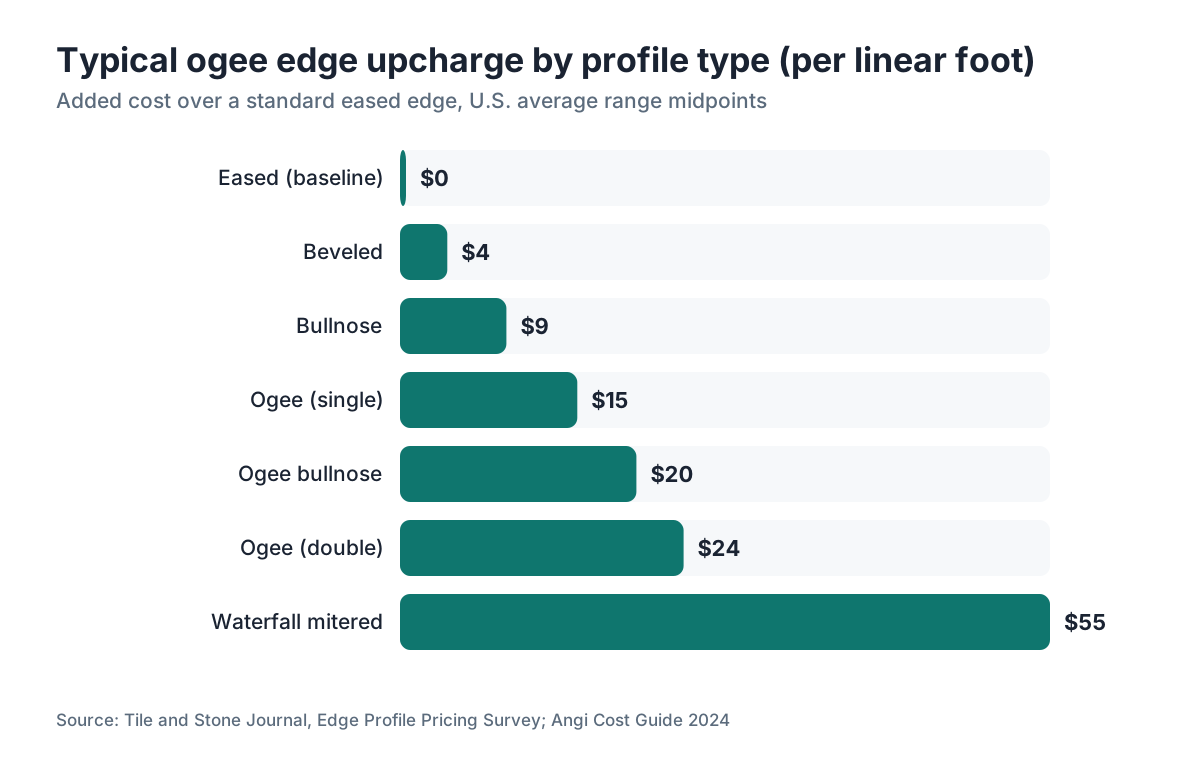
Single ogee edges add $10 to $20 per linear foot over an eased edge in most U.S. markets. Double ogee runs $18 to $30. Honest pricing data on edge profiles is thin because most fabricators do not publish price sheets. The ranges below come from posted shop price lists, contractor forums, and quote comparisons in cost databases [3][6].
| Edge Profile | Typical Upcharge (per LF) | Notes |
|---|---|---|
| Eased / Flat | $0 (baseline) | Included in most base quotes |
| Beveled | $2, $6 | One CNC pass, minimal polish |
| Bullnose | $5, $12 | Full round requires more passes |
| Ogee (single) | $10, $20 | Standard decorative upcharge |
| Ogee (double) | $18, $30 | Needs 3 cm or laminated edge |
| Ogee bullnose | $15, $25 | Hybrid; more polish labor |
| Waterfall mitered | $30, $80+ | High labor, separate category |
Geography moves these numbers hard. A shop in Manhattan or the San Francisco Bay Area may charge $25 to $40 per foot for a single ogee. A shop in rural Ohio or Tennessee may charge $8 to $15. Overhead, local labor rates, and competition all feed the final number.
Stone type matters too. Quartzite is harder than granite in many cases, and fabricators who track tooling costs will add a hardstone premium of 10 to 20 percent [1]. Engineered quartz (Cambria, Silestone, Caesarstone) is consistent and CNC-friendly, so edge pricing on Cambria countertops often lands at the low end of the range despite the material's premium price.
How much does an ogee edge add to the total countertop bill?
Let's run a real kitchen. The average U.S. kitchen has roughly 30 linear feet of countertop perimeter, but not all of that is exposed edge that gets profiled. A typical layout profiles the front edge and the two exposed ends, often 20 to 25 linear feet. An island adds another 10 to 16 linear feet.
Take 25 feet of profiled edge at a $15 per foot ogee upcharge. That is $375. Add a 10-foot island at the same rate and the ogee premium hits $525. All of that sits on top of the base fabrication quote, which for granite countertops typically runs $45 to $85 per square foot installed [3].
Double ogee on a 3 cm slab pushes the upcharge to $25 per foot on the same 35 linear feet, for a total premium of $875. That is real money. Ask your fabricator whether the visual difference between a single and double ogee actually shows in your slab thickness before you commit.
One thing homeowners miss: the back edge and any edge against a wall never gets profiled, so do not let a quote include footage for those runs. A good line-item quote shows linear feet by zone. If you see a lump sum with no footage breakdown, ask for the detail.
Does the type of stone change the ogee edge price?
Yes, and by a lot. The harder the stone, the faster it wears tooling and the more machine passes a clean profile takes.
Granite is the benchmark. Most fabricators build their ogee upcharge around granite and adjust from there. Marble countertops are softer and cut easier, so some shops charge 10 to 15 percent less for an ogee on marble. Marble also scratches easily during polishing, so the labor savings get partly eaten back.
Quartzite is the tooling killer. Harder varieties like Super White, Taj Mahal, and Calacatta Macaubas can wear bits in 300 to 600 linear feet instead of the 1,000-plus you'd get from standard granite [1]. A fabricator who watches tooling costs charges a hardstone premium here without apology.
Engineered quartz is consistent and CNC-friendly, but some brands publish strict fabrication rules. Check the manufacturer's specs before assuming any profile is on the menu.
Soapstone is soft but brittle at thin edges, so a deep ogee curve on a thin slab can chip. Shops that work soapstone regularly recommend a shallower profile and price accordingly.
Edge profile changes cleaning too. Read how to clean soapstone countertops and how to clean quartzite countertops, because deep ogee curves trap grime in the concave section and need more attention over time.
How does the ogee edge affect countertop installation cost?
It usually doesn't. The profile is cut and polished in the shop before the slab ever reaches your home, so countertop installation cost does not move with edge profile. The setter handles finished pieces. The edge does not change the weight in any meaningful way, and it does not change the support you need.
What does change is fragility in transport. An ogee edge has a raised upper bead that chips if the slab gets bumped against a door frame. Good shops wrap edges in foam padding and run slab dollies with edge protection. If a chip happens in transit, an on-site re-polish is possible on softer stones and much harder on granite or quartzite. Ask your fabricator what happens if an edge gets damaged during delivery.
Install is the same either way: set on cabinets, level, secure with adhesive or brackets, caulk seams. The decorative profile adds no labor time at the install stage.
Should homeowners request a line-item edge quote?
Yes. Always. A lump-sum countertop quote can hide an ogee upcharge entirely or bury it in a vague "fabrication" line. A line-item quote shows the slab cost, the fabrication cost (usually a per-square-foot rate), the edge upcharge as a per-linear-foot rate times measured footage, cutout fees, and installation. Every line should be auditable.
Asking for the breakdown also tells you whether the quote covers all exposed edges or just the front. Some shops quote only the front edge and treat island ends and peninsula edges as extras. That is not deceptive, it is a scoping difference, but it will surprise you if you miss it before signing.
Fabricators quoting in software like SlabWise can split the edge profile upcharge from the slab and fabrication cost automatically, which makes it easy to show clients exactly what they are paying for. If your fabricator cannot produce a breakdown like that, the quote is not necessarily wrong, but ask them to walk you through the components out loud.
Comparing multiple bids? Put them in a spreadsheet: slab cost per square foot, fab cost per square foot, ogee upcharge per linear foot, cutout count and cost, installation fee. The bottom-line number means nothing if the scope differs.
Is an ogee edge worth the extra cost?
That depends on what the kitchen looks like and how long you plan to stay.
In a traditional or transitional kitchen with raised-panel cabinets, crown molding, and wood floors, an ogee ties the countertop to the room's design language in a way a flat eased edge never will. The premium is real and so is the payoff.
In a flat-panel modern kitchen, an ogee reads as fussy and out of place. Spend the money on a mitered waterfall edge if you want a premium look, or save it and run an eased edge. An ogee in the wrong kitchen is worse than a wasted $400. It actively drags down the design.
On resale, there is no solid data showing that ogee edges raise sale price independent of the countertop material. The National Association of Realtors' 2023 Remodeling Impact Report does not break out edge profiles as a variable [4]. Remodeling Magazine's Cost vs. Value data tracks countertop material as the return driver and never isolates edge profile as a line item [10]. Material and condition move buyers far more than the profile detail.
Love the look and the kitchen fits? Do it. Tight budget or flipping the house? A clean eased edge on quality stone beats a chipped ogee on a mediocre slab every time.
How do fabricators measure linear footage for an edge quote?
Linear footage runs along the exposed front edge of the countertop, not the full perimeter of the slab. The template process, which happens after cabinet install and before cutting, captures the exact dimensions [5].
A digital templater using a laser system (Proliner and LT-2D3D are common in mid-to-large shops) generates a CAD file with every run labeled [5]. The ogee edge gets assigned to specific segments in the quote. Runs against a wall, the back of an island covered by a knee overhang, and any hidden sections are left out.
Hand measuring with a tape is still common in smaller shops. It is accurate enough for straight runs but introduces more error on curves and odd angles. Curved ogee edges (think a rounded island) cost more because the bit follows a programmed CNC path instead of a straight pass. Expect $5 to $15 per foot more than the straight version of the same profile.
Always confirm after templating that the quote's footage matches what you measured. Small discrepancies happen. You should still understand every inch you are paying for.
What questions should homeowners ask fabricators about edge pricing?
Ask these before you sign a countertop contract:
-
Is the edge upcharge in the base quote or a separate line? Get the per-linear-foot rate in writing.
-
Which edges are in the footage count? Ask them to mark the quoted edges on the layout drawing.
-
Does my chosen stone change the edge price? Harder stones cost more to profile.
-
Single ogee, and can I see a sample of the exact profile you will cut? Bit designs differ and results vary.
-
What is your policy if the edge chips during transport or installation?
-
If I upgrade from single to double ogee, what is the upcharge? Get that number before the slab is cut.
-
Do you have photos of ogee edges you cut in the material I am using? Results shift with stone grain and color.
For kitchen countertops in general, these questions separate the organized shops from the ones winging the quote. A fabricator who cannot answer question one confidently is a yellow flag.
How do fabricators account for ogee edges in job costing and software?
For fabricators, the ogee upcharge is one of the easier things to build into a quoting system once you know your real costs. You need three inputs: your retail edge upcharge per linear foot by profile, your tooling cost per linear foot (bit cost divided by expected bit life in that stone), and your shop rate for CNC time plus finishing labor.
The math is simple. Tooling cost per LF plus CNC time cost per LF plus finish labor cost per LF gives your floor cost. Multiply by your target margin, usually 2x to 3x, and that is your retail upcharge.
Shops lose money on edges when they never update the tooling assumptions. Price ogee edges in 2019 using that year's bit prices and you are almost certainly underpricing them now. Diamond abrasive costs have climbed with material and supply chain pressure. Skilled finishing labor is not cheap either. The U.S. Bureau of Labor Statistics tracks wages for stone cutters and carvers under its Occupational Employment and Wage Statistics program, and those figures should anchor your labor cost per foot [9]. Review your edge pricing at least once a year against actual bit consumption records.
Quoting software lets you bake these costs into the profile library, so every quote pulls the right upcharge for each edge type. SlabWise, for example, lets fabricators set per-profile upcharges that flow into client quotes automatically, which kills the mental math that leads to underquoting. Quote ogee edges by gut feel and you are either leaving money on the table or occasionally overcharging. Neither is good.
Frequently asked questions
What is the difference between a single ogee and a double ogee edge?
A single ogee is one S-curve cut into the edge of the slab. A double ogee stacks two S-curves for a more ornate, layered look. Double ogee needs a thicker slab (3 cm or a laminated edge built to at least 2 inches) and costs $5 to $15 per linear foot more because it takes extra CNC passes and more hand polishing.
How much does an ogee edge cost for an average kitchen?
For a typical kitchen with 20 to 25 linear feet of exposed edge, an ogee upcharge of $10 to $20 per linear foot adds $200 to $500 to the total bill. Add an island and you might see $400 to $700 in total premium over a standard eased edge. Prices vary by region, stone type, and shop.
Is an ogee edge harder to clean than a flat edge?
Yes, a little. The concave hollow of an ogee traps crumbs, grease, and cleaner residue more than a flat or beveled edge. A damp cloth with a pointed tip or a small brush handles it. Sealing the stone properly matters more than the profile, since sealed stone resists staining in the crevice. Check general guidance on cleaning stone countertops for the right approach.
Can you put an ogee edge on quartz countertops?
Yes. Engineered quartz machines cleanly and most brands support standard decorative profiles including single ogee. Check the manufacturer's fabrication guidelines, since some brands limit the minimum radius on concave cuts. Pricing is close to granite, often at the lower end because quartz is consistent and does not vary in hardness the way natural stone does.
Does an ogee edge add resale value to a home?
There is no good data showing that edge profiles independently affect resale price. The 2023 NAR Remodeling Impact Report attributes countertop value to material and condition, not edge detail. An ogee in a kitchen that suits the style helps a home show better, but a buyer is unlikely to pay more specifically because of the edge profile.
Why do some quotes include the edge and others charge separately?
Quoting conventions differ by shop. Some fabricators fold a standard eased edge into their base square-foot rate and add a line-item upcharge for decorative profiles. Others bundle everything into one number. Neither approach is wrong, but a bundled quote makes it hard to compare bids. Always ask for a breakdown showing the edge footage and per-foot rate as separate lines.
How long does it take to cut and polish an ogee edge?
On a CNC machine, cutting the ogee on 10 linear feet takes roughly 20 to 40 minutes longer than a simple eased edge. Hand finishing the concave section adds another 20 to 45 minutes depending on stone hardness and the finisher's skill. Total added shop time for an average kitchen's ogee edge usually lands between 1 and 2 hours over a basic edge.
Can an ogee edge be repaired if it chips?
Small chips on the upper bead can be filled with color-matched epoxy or super glue and then polished. On softer stones like marble or limestone, an on-site re-polish of a small section is feasible. On harder stones like granite or quartzite, re-profiling a damaged section in place is very hard. Careful transport and handling beats repair every time.
Is an ogee edge available on all stone thicknesses?
A standard single ogee works on 3/4-inch (2 cm) and 1.25-inch (3 cm) slabs, though it looks best on 3 cm. A double ogee needs at least 3 cm or a laminated edge to hold both curves. On 2 cm material, a double ogee requires a built-up laminated edge, which adds $10 to $20 per linear foot of lamination cost on top of the profile upcharge.
How do I find a fabricator who does good ogee edges?
Ask to see photos of ogee edges they cut in the same or similar stone you are using. Quality shows in the sharpness of the upper bead and the smoothness of the concave hollow. Shops with a CNC router generally produce more consistent results than hand-routed edges. Online reviews that mention edge quality specifically are worth hunting for, though they are rare.
Does the ogee edge cost more on curved countertop sections?
Yes. A curved ogee (on a curved island or peninsula) makes the CNC follow a programmed path instead of a straight pass. That adds programming time, slower cutting speed, and more finish work. Expect to pay $5 to $15 per linear foot more for a curved ogee than the straight version of the same profile.
What is an ogee bullnose and how is it priced differently?
An ogee bullnose blends the S-curve into a fully rounded top edge rather than a flat top. It looks softer and less architectural than a standard ogee. Pricing usually runs $15 to $25 per linear foot, slightly more than a standard single ogee because the bullnose takes an additional polishing step to blend the curve into the round top smoothly.
Are ogee edges more expensive in granite than in marble?
Generally yes, by 10 to 20 percent. Granite is harder and more abrasive, which wears CNC bits faster and takes more machine passes for a clean finish. Marble is softer and cuts more easily, cutting tooling cost. But marble's polish sensitivity keeps finishing labor comparable, so the savings are smaller than the raw hardness difference suggests.
Should I ask for an ogee edge on my bathroom countertop?
An ogee on a bathroom vanity works well in traditional or transitional bathrooms. Edge runs are short (typically 5 to 12 linear feet for a double vanity), so the upcharge stays modest, usually $75 to $250 total. In a small bathroom, the ogee can feel oversized if the slab is already busy. Ask to see a physical sample against your cabinet finish before deciding.
Sources
- Braxton-Bragg (tooling supplier), Diamond Router Bit Life Expectancy Guide: Diamond router bits for stone edge profiling cost roughly $80 to $200 and last 500 to 1,500 linear feet depending on stone hardness; harder stones like quartzite wear bits faster.
- Angi, Countertop Installation Cost Guide 2024: Granite countertop installation costs typically $45 to $85 per square foot installed; decorative edge upcharges run $10 to $30 per linear foot over standard edges.
- National Association of Realtors, 2023 Remodeling Impact Report: The NAR Remodeling Impact Report attributes countertop resale value to material type and condition, not edge profile details.
- Laser Products Industries, Digital Templating for Stone Countertops: Digital laser templating systems (such as Proliner and LT-2D3D) generate CAD files with labeled edge runs used for CNC programming and line-item quoting.
- Tile and Stone Journal, Edge Profile Pricing Survey: Single ogee edge upcharges range from $10 to $20 per linear foot in most U.S. markets; double ogee ranges from $18 to $30 per linear foot.
- Natural Stone Institute, Fabrication and Installation Best Practices: Natural Stone Institute fabrication guidelines note that concave edge profiles require hand-finishing steps that flat or convex profiles do not, adding labor time per linear foot.
- U.S. Occupational Safety and Health Administration, Silica in Stone Fabrication: OSHA requires respirable crystalline silica controls during stone edge grinding and polishing, which adds equipment and labor cost that shops build into fabrication rates.
- U.S. Bureau of Labor Statistics, Occupational Employment and Wage Statistics: BLS occupational employment and wage data on stone cutters and carvers informs labor cost estimates for edge finishing work in fabrication shops.
- Remodeling Magazine, 2024 Cost vs. Value Report: Kitchen remodeling cost-value data shows countertop material drives return on investment; sub-components like edge profile are not separately tracked.
Last updated 2026-07-11