TL;DR
- Unusual angles and custom cuts add real labor and waste to every countertop job.
- Expect a 20 to 60% premium over a plain rectangular layout, driven by material, cut count, and how much slab ends up in the bin.
- Fabricators price these jobs on actual slab consumed (always more than finished area), plus per-cut charges, plus CNC or hand-tool time.
Why do unusual angles make countertops cost more?
Two things drive the cost: waste and time. A plain rectangular counter cuts cleanly from a slab with small offcuts. The moment you add a 45-degree corner, a bay-window angle, a curved peninsula, or an octagonal island, the geometry forces the fabricator to orient pieces in ways that leave big triangles and wedges of dead stone on the shop floor.
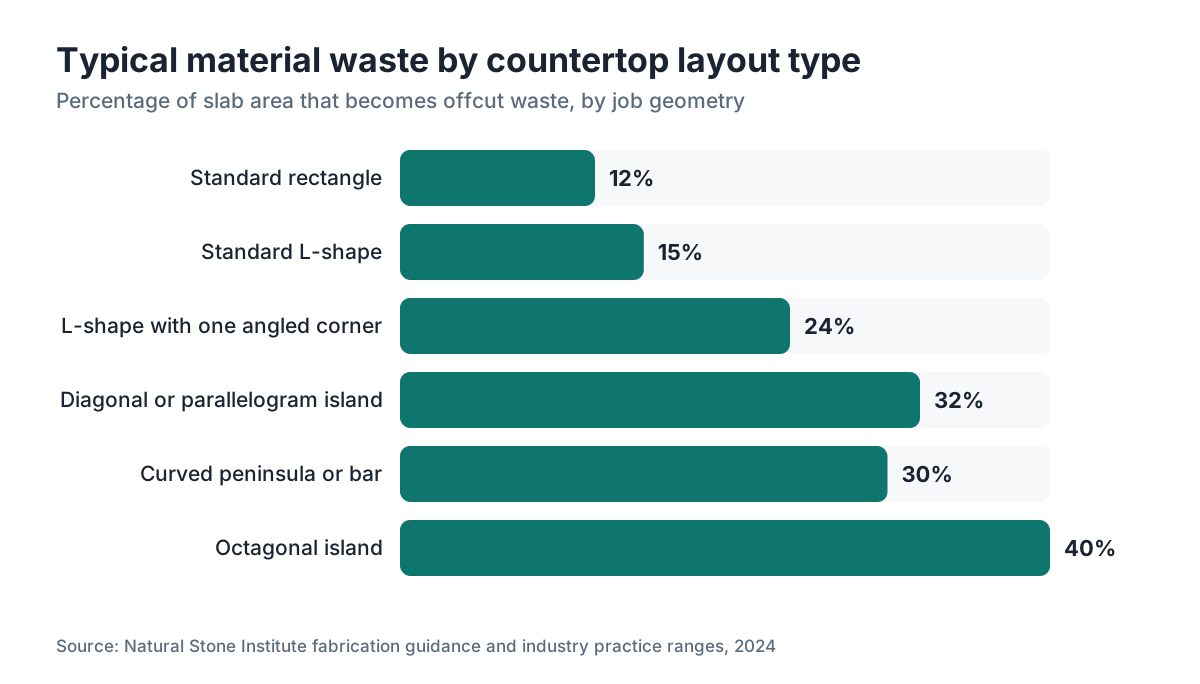
Material waste comes first. On a simple L-shape, a good layout artist gets waste down to 10 to 15% of the slab. Add a 30-degree angled wall or a curved front edge and that number jumps to 30 to 40% on that section alone. Stone is priced and bought by the square foot, so you pay for the whole slab even when a third of it becomes scrap.
Labor comes second. Straight cuts fly on a bridge saw. Angled cuts mean rotating the piece, resetting stops, and often two or three test passes before the real cut. A compound miter where two surfaces meet at a non-standard angle can eat 30 to 45 minutes of an experienced cutter's time on a piece that would otherwise take five. CNC routers repeat complex curves better, but programming time is real and machine time costs money.
Then there's fitting risk. A square corner gets shimmed and caulked. An odd angle off by even 1.5 degrees shows a visible gap or needs grinding on-site, and neither of those was in the original quote.
What types of cuts and angles actually trigger a price premium?
Not every non-rectangular cut costs the same. Here's how most shops rank the difficulty, from cheap to painful.
Miter cuts at standard angles (45 degrees). A 45-degree outside corner is common enough that most shops keep stops set for it permanently. The premium is modest, usually $15 to $40 per linear foot for a mitered edge versus a simple eased or beveled edge. The cut is fast. The material loss is what you pay for.
Angled walls and non-90-degree corners. Kitchens in older homes turn up 87- or 94-degree corners all the time. The fabricator has to template precisely, then cut a matching angle. Expect $50 to $150 per angled corner beyond square, depending on how hard the material is.
Diagonal or parallelogram countertops. An island set at 45 degrees to the cabinets is a design statement that costs real money. Every piece cuts diagonally across the slab, which raises material waste by 20 to 35% and adds 1 to 2 hours of layout time [1].
Curved edges and radius corners. A radius corner on laminate is nearly free. A full bullnose radius on granite or quartzite needs a CNC profiler and careful setup. Tight inside curves are worse, because the saw can't finish the cut and the fabricator has to plunge-cut or core-drill. Shops often charge $75 to $200 per curved section on natural stone.
Compound miters (two planes meeting at an odd angle). These show up in waterfall edges that turn a corner, or on angled hood surrounds. A compound miter on stone is one of the hardest cuts in the shop. Many fabricators price these by the hour ($85 to $150/hour) rather than by the piece, because the time swings so much.
Cutouts in difficult locations. A sink cutout near an angled end, or a cooktop cutout that lands partly over a seam, multiplies risk. The cutout charge might be $75 to $150. But if the positioning weakens the slab and it cracks, the whole piece gets recut.
How do fabricators actually calculate the price on these jobs?
Most shops layer three components: material cost, fabrication labor, and margin. Unusual angles touch all three.
Step 1: Template and measure. No price is firm without an accurate template, either a physical luan template or a digital scan from a laser device. Many shops charge $75 to $200 for templating on complex jobs, sometimes credited back if you award the work. Digital templating with tools like Proliner or Laser Products Industries systems drops field measurement error under 1mm, which matters a lot when nothing is square [2].
Step 2: Lay out on the slab digitally. The fabricator, or their software, arranges the cut pieces on a virtual slab to minimize waste. A rectangular job lays out fast. An angled job may need pieces rotated 30 or 45 degrees, which throws off the slab's veining direction and leaves large triangular offcuts. The layout decides how many square feet of raw slab the job actually eats.
Step 3: Price material on actual slab consumed, not finished area. This is where homeowners get confused. You may have 28 square feet of finished countertop, but if the layout burns 40 square feet of slab because of angled waste, you pay for 40 square feet. The shop only absorbs some of that if it can resell the offcuts, which it usually can't for odd triangles.
Step 4: Add per-cut and per-operation charges. Each angled cut, each radius, each cutout, and each special edge profile carries its own charge. A good quote lists these line by line. If yours doesn't, ask for an itemized breakdown.
Step 5: Add a complexity or risk margin. Experienced shops add 10 to 20% to complex jobs as a buffer for the extra fitting time that almost always shows up. This isn't padding. It reflects real statistical risk. If the buffer goes unused, some shops credit it back or apply it toward future work.
Shops running quoting software can crank through this in a few minutes per job. SlabWise, for example, lets fabricators input the actual polygon shape of each piece, auto-calculates slab consumption from real nesting, and surfaces per-cut costs automatically, which keeps quotes honest on complex work instead of leaning on gut feel.
Here's a sanity check for homeowners. The total price on a job with multiple unusual angles should land at 1.3 to 1.6 times what a square-footage-only estimate suggests. If a shop quotes the exact same rate per square foot as a rectangular job, they either haven't thought it through or plan to absorb the loss, and a shop absorbing a loss tends to cut corners somewhere.
How much does material choice change the cost of unusual cuts?
Hardness and brittleness are the big variables. Here's how common countertop materials behave when the cuts get weird.
| Material | Relative cut difficulty | Typical waste % on angled layout | Risk of cracking on complex cuts |
|---|---|---|---|
| Laminate | Low | 10 to 20% | Very low |
| Solid surface (Corian, etc.) | Low-medium | 12 to 22% | Low |
| Quartz (engineered) | Medium | 18 to 30% | Low-medium |
| Granite | Medium-high | 20 to 35% | Medium |
| Marble | High | 22 to 38% | Medium-high |
| Quartzite | High | 22 to 40% | High |
| Ultra-compact (Dekton, Neolith) | Very high | 25 to 45% | Very high |
Laminate and solid surface cut with standard woodworking tools, and a compound angle isn't much harder than a straight cut. Natural stone needs diamond blades, water cooling, and slower feed rates. Quartzite and ultra-compact surfaces punish you the most. They're among the hardest materials a fabricator will cut, and the force needed to push through them means more blade wear, more setup time, and a real chance a complex cut leaves a micro-fracture that surfaces months later.
For granite countertops, the main added risk on unusual angles is a long diagonal cut crossing the natural fissure lines in the stone, which can trigger a spontaneous crack during or after cutting. A good fabricator reads the slab's weak points before committing to a diagonal layout.
For marble countertops, same story, and the lighter color makes any adhesive repair more visible. Shops that run a lot of marble often charge a 15 to 25% premium for complex cuts, because a cracked piece hurts twice: replacement cost and schedule.
Laminate countertops and Formica countertops forgive the most on unusual angles. A skilled installer cuts a compound miter with a router and a jig, and the scrap cost stays low. Complex geometry on a tight budget? Laminate deserves a serious look.
What is the price difference between a simple and complex countertop job?
Let's put real numbers on it. These ranges come from fabricator cost surveys and industry pricing guides, not one authoritative study, so read them as directional [3].
A plain rectangular kitchen countertop in mid-grade granite (30 square feet, two straight runs, one sink cutout, eased edge) runs $1,500 to $2,400 installed in most U.S. markets across 2024 to 2025. That's roughly $50 to $80 per square foot all-in.
The same kitchen with one angled corner (say a 120-degree peninsula corner), one curved section on a breakfast bar, and a cooktop cutout near an angled end runs $2,100 to $3,600 for the identical finished square footage. The premium lands at $600 to $1,200 on a $2,000 base job, which is 30 to 60%.
Go more extreme (an octagonal island in quartzite, waterfall edge on two sides, custom radius on the corners) and the premium can top 80 to 100% over a plain rectangular island in the same material. Most of that is waste and programming time, not edge profit.
Here's the part that surprises people. The fabricator's margin on complex work isn't necessarily fatter in percentage terms. Many shops find angled and curved jobs earn less per hour than clean rectangular work, because unpredictable fitting time eats the margin. The higher price reflects higher cost, not a richer markup.
How should homeowners get an accurate quote for a job with unusual angles?
Get a professional template done before you ask for a final price. That's the single most useful move you can make. A quote built on a rough sketch or your own tape-measure numbers on an angled kitchen is a guess, and any honest fabricator will tell you the same.
Here's what a solid quoting process looks like on a complex job.
-
Initial walk-through and rough estimate: the fabricator visits, spots the angles, notes material and edge choices, and gives you a range, not a fixed price. This visit is often free or carries a small trip charge.
-
Template: once you've settled on material and you're serious, a templater comes out and captures every angle precisely. Digital templating beats physical luan on complex work [2].
-
Final quote: the shop lays out the job digitally, calculates real slab consumption and cut operations, and hands you a line-item quote. This price shouldn't move unless the scope moves.
Red flags on an unusual-angle quote: a single per-square-foot price with no line items for special cuts, no mention of waste or material consumption, no templating step before the final number. Those signal a shop that hasn't reckoned with the complexity, and you'll likely eat change orders later.
Get at least two quotes. On a standard job, quotes cluster tight. On a complex angled job, the spread between low and high can hit 30 to 50%, because shops have very different labor costs, slab buying relationships, and appetites for risk. The lowest quote isn't automatically wrong, but make the low bidder walk you through their waste calculation and cut charges out loud.
What specific charges should a fabricator itemize on a complex job?
A transparent quote for an unusual-angle job should break out these lines at minimum.
Material cost: Total slab square footage consumed (more than finished countertop area), times the slab cost per square foot. Buying a specific slab? The quote should name it and its cost.
Waste factor: Shown as a separate line, or baked into the slab consumption number. Either way, you should be able to see how many square feet of slab versus finished countertop you're paying for.
Fabrication labor: Sometimes a per-square-foot fab rate, sometimes broken out. On complex jobs, asking for cost per cut operation gives you far better transparency.
Special cut charges: Angled cuts, radius cuts, compound miters, cutouts. Each listed with quantity and unit price.
Edge profiles: Standard edges (eased, bevel, bullnose) usually fold into the base fab rate. Specialty profiles (ogee, dupont, triple pencil) carry per-linear-foot upcharges, often $10 to $25/LF extra.
Seam locations and quantity: Every seam needs grinding, polishing, and color-match epoxy. On angled layouts, seams fall in awkward spots that demand more hand-finishing. A per-seam charge of $75 to $150 is normal.
Template fee: Itemized separately if it applies.
Installation labor: Separate from fabrication. On angled jobs, install runs longer because shimming and scribing to walls is harder when nothing's square.
Delivery: Sometimes included, sometimes a flat $50 to $150.
Building your own pricing system as a fabricator? The Stone Fabricators Alliance and the Natural Stone Institute (which absorbed the Marble Institute of America) both publish cost guidance for member shops [4].
How do fabricators handle waste when pricing diagonal or angled layouts?
Waste is the piece of pricing that confuses homeowners most and trips up green fabricators.
On a rectangular countertop, waste is simple: you need X square feet finished, add 10 to 15% for straight cuts and small errors, and that's your slab requirement. Most shops fold this into their base square footage price automatically.
Angled or diagonal layouts get calculated job by job through digital nesting. Nesting software drops the cut shapes onto a virtual slab and finds the tightest arrangement. Whatever's left over is the waste percentage. On a diagonal island, the triangular offcuts at the ends of each diagonal piece are pure loss. Cut the island at 45 degrees and the waste triangle at each end runs half the width times half the length, which alone can be 25 to 35% of the slab consumed by that piece.
Some shops have a policy for offcuts: pieces over a set size (often 2 square feet) go into a remnant rack for resale or future small jobs. That can shave the effective waste cost they pass to you, but it's never guaranteed. Ask whether your shop runs a remnant program and whether they credit offcut value into your quote.
For fabricators, the honest position is that digital nesting should drive waste on every complex job, not a gut-feel percentage. The gap between a 20% estimate and 35% actual waste on a 50-square-foot slab is 7.5 square feet of stone. At $25/SF slab cost, that's $187 of surprise material cost coming straight out of margin because the quote was wrong.
Can you reduce the cost of unusual-angle countertop jobs by changing the design?
Yes, and the savings are sometimes big. Design choices that look purely visual carry real cost in the shop.
Standardize corner angles. If your wall reads 87 degrees, ask your fabricator whether scribing the cabinets to create a true 90-degree counter return beats cutting the stone at 87 degrees. Often it does.
Cut the number of radius sections. A curved breakfast bar is beautiful and pricey. A faceted bar with three or four angled flat sections gets close to the look for a fraction of the cost, because straight cuts are fast.
Weigh diagonal island placement carefully. Want a 45-degree island? Ask whether the geometry lets the slab lay out efficiently. A fabricator who runs the nesting layout before you commit can show you exactly how much extra slab you're buying, and you decide with real numbers in front of you.
Keep seams away from angled cuts. A seam near an unusual angle needs precise angle matching on both pieces, which doubles the fitting difficulty. If the design forces a seam, ask whether it can move to a straight section.
Match material to complexity. Wild geometry? Ask whether a cheaper material does the job. A complex curved island in Cambria countertops or engineered quartz costs much less than the same shape in exotic quartzite, because material cost and brittleness both climb with premium stones.
The rule I'd follow: every angled or curved feature that's purely decorative, not functional, deserves a cost check before you commit. Your fabricator should be able to show the price difference between the curved and straight version of any feature. If they can't, that's a hole in their quoting process.
How do fabricators charge for templating and design time on complex jobs?
Templating on a complex job costs money, even when the quote makes it look free.
Physical (luan) templating runs $75 to $200 for a typical kitchen, often credited toward the job. On a complex angled kitchen, the templater may spend 2 to 3 hours on-site instead of 45 minutes, so some shops charge $150 to $300 and don't credit it back if the job dies. That's fair. The time is real.
Digital templating with a Proliner or similar laser device costs more up front (the devices run $20,000 to $60,000) but delivers measurement accuracy that sharply cuts fitting problems on complex work [2]. Shops that own digital templating often charge $150 to $250 for a complex template, and it tends to pay for itself in re-cuts avoided.
Design consultation time, when a fabricator or draftsperson sits with you to work through layout options, sometimes bills separately at $75 to $150/hour on complex projects. More often it disappears into overhead and shows up as slightly higher shop rates. If you're asking a fabricator to explore multiple layouts before you decide, treat that as valued time. Offer to pay for it and you'll get better service and straighter answers.
For genuinely unusual geometry (a commercial bar top, an angled reception desk, a complex outdoor kitchen), ask for a paid design and templating phase as a separate contract before the fabrication quote is final. It protects both sides: you get an accurate price built on real measurements, and the fabricator gets paid for the discovery work whether or not the job proceeds.
What should fabricators know about job costing these projects after the fact?
Pricing a complex job before it runs is estimation. Knowing whether you actually made money takes job costing after the fact, and most small shops are weak here.
Track these metrics on every unusual-angle job: actual hours templating, actual hours programming (if CNC), actual bridge saw time, actual hand-grinding and fitting time on-site, material consumed versus material quoted, and blade wear (complex cuts chew tooling). Track them and within a handful of complex jobs you'll have real data on where your quotes run consistently low.
The most common place shops bleed money on angled jobs is on-site fitting time. A complex angled kitchen quoted at two hours of install often takes four, because walls aren't truly parallel, angles that measured right in the template sit slightly off in the physical cabinets, and every adjustment drags when nothing's square. A 1.5x multiplier on install labor for complex jobs is a reasonable starting point until your own numbers say otherwise.
Blades and tooling get underestimated too. A standard diamond blade for a bridge saw might last 400 linear feet in soft marble. On ultra-compact materials with complex cut sequences, the same blade might last 80. Tracking blade consumption by material and cut type takes discipline and pays off in accurate per-cut pricing.
Shops running quoting and job management software can attach real time logs and material usage to each job and compare them to the estimate automatically. That comparison is how you build pricing on reality instead of optimism. The Natural Stone Institute's annual financial benchmark survey gives industry-level context on margins and labor costs to calibrate your own numbers [4].
Frequently asked questions
How much extra does an angled countertop corner cost compared to a square one?
Most fabricators charge $50 to $150 per angled corner beyond a standard 90-degree cut, depending on the material and how far the angle deviates from square. A 45-degree outside miter is common enough to sit near the low end. A compound miter or an odd angle like 67 degrees runs at the high end, or gets priced by the hour at $85 to $150/hour.
Do I pay for wasted stone on my countertop quote?
Yes. Nearly all fabricators price material on slab consumed, not finished countertop area. On a rectangular layout, waste is typically 10 to 15%. On a diagonal or heavily angled layout, waste can reach 30 to 40% of the slab. That extra material shows up in your quote whether it's itemized or buried in a higher per-square-foot rate.
Why are curved countertop edges so expensive on natural stone?
Cutting a true radius in granite, quartzite, or marble takes CNC profiling equipment and careful setup. The machine time alone may be 30 to 60 minutes per curved section. Tight inside curves are worse, because a saw can't finish the cut in one pass. Most shops charge $75 to $200 per curved section on natural stone, plus any extra material the curve geometry consumes.
Is it cheaper to use engineered quartz instead of granite for an oddly shaped countertop?
Usually, yes. Engineered quartz has more consistent hardness than natural granite, which lowers the risk of cracking on complex cuts. It also tends to carry lower slab prices at mid-grade. Cut complexity costs about the same, but you save on material and dodge the chance of an expensive re-cut from a natural fissure in the stone.
Should the fabricator charge for templating before giving a final quote on an angled job?
Yes, and that's a good sign. A fabricator who quotes a complex angled job from a sketch is guessing. Accurate templating costs $75 to $300 depending on complexity and whether digital tools are used. Many shops credit it back if you proceed. If a fabricator refuses to template before giving a firm price, the price will almost certainly change later.
How do I know if a countertop quote is fairly priced for unusual cuts?
Ask for an itemized quote showing slab square footage consumed, finished square footage, and per-cut charges listed separately. Compare the slab consumption number to your finished area. A ratio of 1.1 to 1.15 on a simple layout is normal. If the job has multiple angles and the ratio is still 1.1, the fabricator likely underestimated waste and will either return with a change order or eat a loss.
What is a compound miter on a countertop and why does it cost so much?
A compound miter is a cut where two non-parallel planes meet at an angle that isn't 90 degrees in either the horizontal or vertical plane. Waterfall edges that wrap an angled corner are a common example. The geometry has to be calculated precisely, the stone repositioned mid-cut, and the fit checked repeatedly. Many shops charge $150 to $350 for a single compound miter joint, or price the whole operation by the hour.
Can I save money by simplifying the design of an angled kitchen island?
Absolutely. Replacing a fully curved island front with three or four angled flat sections can save $300 to $800 on a mid-size granite island, because straight cuts are fast and waste is lower. Even shifting a 45-degree angled corner to a 90-degree corner can wipe out significant material waste. Ask your fabricator to run the nesting comparison before you lock the design.
How long does it take to fabricate a countertop with multiple unusual cuts?
A plain rectangular kitchen might take 4 to 8 hours of shop time including templating review, cutting, and edge profiling. A kitchen with two angled corners, one curved section, and an angled cutout can take 10 to 16 hours or more. Add programming time if CNC work is involved. That labor gap is the core reason complex jobs cost more, even at the same square footage.
Do fabricators charge more for installation on angled or unusual countertop layouts?
They should. Installation on an angled layout takes more time because nothing lines up predictably. Scribing to angled walls, shimming pieces level, and fitting seams that aren't at standard corners all add time. Expect installation labor to run 1.25 to 1.75 times the rate of a comparable square job, often shown as a higher flat fee rather than an explicit multiplier.
What digital tools do fabricators use to price and cut unusual angles accurately?
Digital templating devices from companies like Prodim (Proliner) or Laser Products Industries capture wall angles and countertop shapes to under 1mm accuracy. Nesting and quoting software then lays the cut pieces on a virtual slab to calculate real material consumption. CNC bridge saws read the digital cut files directly, cutting human error on complex angles. These tools reduce re-cuts and make pricing more accurate.
Is an octagonal or hexagonal kitchen island significantly more expensive than a rectangular one?
Yes. An octagonal island needs eight angled cuts, and the diagonal orientation of the pieces on the slab creates heavy triangular waste at the ends of each cut. Expect material waste of 30 to 45% and cut charges for each of the eight mitered joints. The premium over a rectangular island of the same footprint in the same material is typically 40 to 70%, sometimes higher in hard stone like quartzite.
How do I verify that a fabricator's waste estimate is accurate on my angled job?
Ask to see the digital nesting layout, which shows your cut pieces arranged on the slab with the waste areas clearly visible. Any shop using modern quoting or CAD software can export this as a simple diagram. If the fabricator can't show you the layout, they're estimating waste from experience rather than calculating it from your actual geometry, which is less reliable on complex jobs.
Are there countertop materials that are not worth using on complex angled designs?
Ultra-compact surfaces like Dekton and Neolith look great but stay brittle under complex cuts. A long diagonal cut across a 12mm Dekton slab has a real chance of fracturing that the same cut in granite or quartz doesn't. If your design is very complex, talk through fracture risk with your fabricator before committing to an ultra-compact material. A re-cut in these materials is expensive.
Sources
- Natural Stone Institute, Technical Manuals and Guidelines: Diagonal and angled slab layouts increase material waste substantially compared to rectangular layouts due to the geometry of offcuts.
- Prodim USA, Proliner Digital Templating Systems: Digital laser templating captures wall angles and countertop shapes to under 1mm accuracy, reducing fitting error on complex cuts.
- HomeAdvisor (Angi), Countertop Installation Cost Guide: Installed granite countertops typically cost $50 to $100 per square foot all-in for standard layouts in U.S. markets.
- Natural Stone Institute, Annual Financial Benchmark Survey: The Natural Stone Institute publishes annual financial benchmarks for fabrication shops including labor cost and margin data.
- Marble Institute of America (now Natural Stone Institute), Fabrication Best Practices: Seam placement and cut orientation relative to natural stone fissures affect fracture risk on complex cuts.
- U.S. Bureau of Labor Statistics, Occupational Employment and Wage Statistics: Labor cost benchmarks for stone fabrication and installation trades in the United States.
- U.S. Geological Survey, National Minerals Information Center: Raw dimension stone pricing and production volume data for granite, marble, and quartzite in U.S. markets.
- Stone Fabricators Alliance, Pricing and Business Resources: The Stone Fabricators Alliance provides cost guidance and pricing frameworks for member fabrication shops.
- National Kitchen and Bath Association (NKBA): NKBA design guidelines address angled kitchen layouts, island placement, and countertop design considerations.
- U.S. Small Business Administration, Business Guide: Job costing and margin tracking guidance applicable to custom fabrication businesses.
- Occupational Safety and Health Administration (OSHA), Crystalline Silica: Complex stone cuts require extended saw operation time, increasing worker exposure to crystalline silica dust and requiring appropriate controls.
Last updated 2026-07-09