TL;DR
- Slab material costs swing 20-40% based on origin, quarry output, and shipping.
- Fabricators protect margins by writing material pass-through clauses, buying the slab at deposit, and splitting labor from material on every quote.
- Homeowners get the most accurate number by picking a specific slab before they sign, then paying a deposit to freeze the material price.
Why do slab prices keep changing?
Stone is a commodity, and commodities move. Granite, marble, quartzite, and engineered quartz all travel a supply chain that starts at a quarry, usually overseas, and ends on your kitchen counter. Every link in that chain carries a price, and those prices never sit still.
The U.S. imports most of its finished stone. The U.S. Geological Survey tracks dimension stone imports in its Mineral Commodity Summaries, with Brazil, India, China, and Italy as the top sources [1]. A tariff, a port backup, a currency swing, or a quarry going quiet shows up in slab prices within weeks.
Quartz is not immune. Engineered quartz is roughly 90-94% ground natural stone bound with polymer resin. The resin is petroleum-derived, so quartz prices track oil markets to a degree. Brands like Cambria countertops source their stone in the U.S., which buffers some of that, but most imported engineered quartz still eats the same shipping and tariff pressure as natural stone.
Freight is the big lever. Container rates from Asia to the U.S. West Coast ran near $1,500 in early 2020, blew past $20,000 at the peak of the 2021-2022 disruption, then settled back toward $3,000-$5,000 through 2024, per the Freightos Baltic Index published by the Federal Reserve Bank of St. Louis [2]. Those swings inflate or deflate the landed cost of any slab that crosses an ocean.
Season adds one more layer. Spring and summer are peak remodel months. Distributors carry more inventory then and sometimes hold prices steady to move volume, but a popular material in short supply can spike in April and get marked down in January. Nobody has clean public data on the exact size of this seasonal swing. Fabricators report it anyway, year after year.
How much can slab prices actually vary?
Wide enough to matter on almost every job. Basic granite from a domestic distributor in a slow month might cost a fabricator $8-$12 per square foot for the raw slab. A premium imported quartzite or a book-matched marble can land above $90-$120 per square foot before a single cut [3].
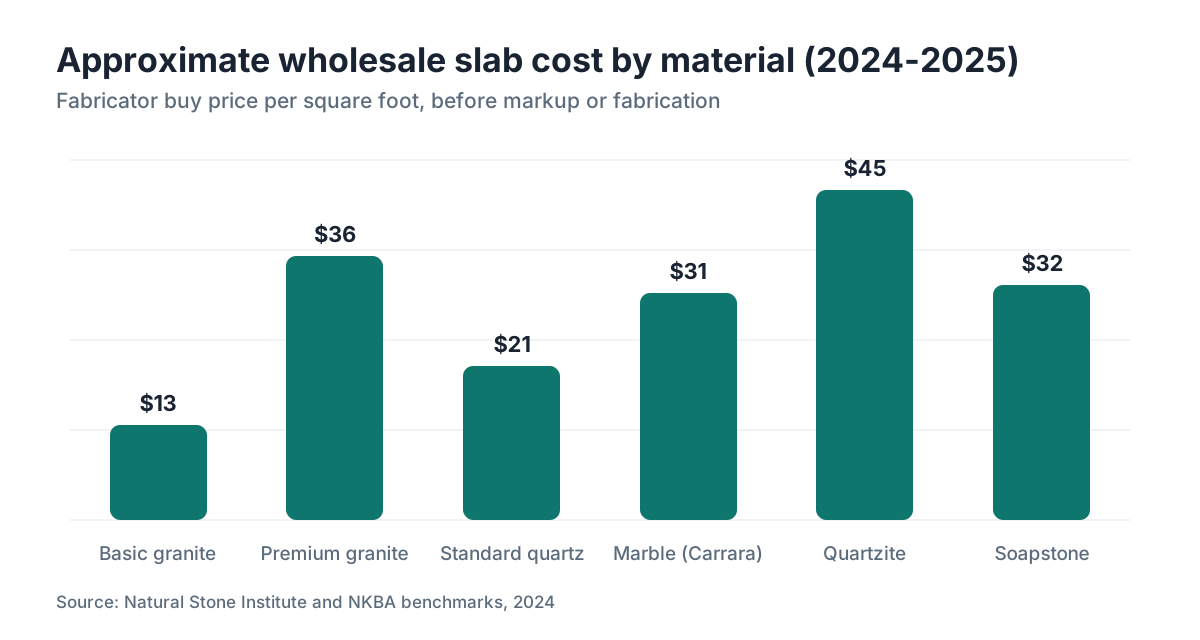
The table below shows approximate wholesale slab cost ranges for common materials in 2024-2025. These are fabricator buy prices, not installed retail.
| Material | Low end ($/sq ft) | High end ($/sq ft) | Typical installed retail |
|---|---|---|---|
| Granite, basic | $8 | $18 | $50-$80 |
| Granite, premium/exotic | $18 | $55 | $90-$160 |
| Quartz (engineered), standard | $14 | $28 | $55-$100 |
| Marble, Carrara | $22 | $40 | $80-$130 |
| Quartzite, popular colors | $25 | $65 | $90-$180 |
| Soapstone | $20 | $45 | $75-$140 |
The retail ranges fold in fabrication, edge work, cutouts, and installation on top of the stone. They also carry a typical material markup of 30-60% over the buy cost, which is how a shop pays for purchasing risk, warehouse space, and the slab that cracks on the saw [4].
Here's the part that hits the P&L. A fabricator quoting the same 45-square-foot island in January versus June, or in a heavy-tariff year versus a quiet one, might pay $300 more for the slab alone. No buffer means that $300 comes straight out of margin.
What are the main pricing models fabricators use?
Three broad approaches, and each moves risk between the shop and the customer in a different direction.
Fixed price rules residential work. The fabricator quotes one number, the customer signs, and the shop eats any cost increase before install. Clean for homeowners, dangerous for shops on long lead times. A kitchen quoted in February that doesn't template until June carries six weeks of price exposure with nothing to cover it.
Cost-plus passes material through at whatever the shop actually pays, then adds a fixed fabrication fee and margin on labor. More honest, but most homeowners hate an open-ended number. So shops go hybrid: a fixed labor rate, a material estimate, and a clause saying the slab price locks only when the customer pays the deposit and the shop buys the stone.
Material at time of deposit is the cleanest protection for a fabricator. The contract says material cost is confirmed once a deposit lands and the specific slab is pulled or ordered. If the customer sits on the quote for two months and prices rise, the number updates before work starts. The Marble Institute of America (now part of the Building Stone Institute) has long recommended deposit-at-material-commitment language in residential contracts for exactly this reason [5].
Larger shops sometimes run tiered pricing. Slabs they physically own get a locked price. Slabs they have to order carry distributor pricing plus a stated markup. Choose from shop stock, get a fixed number. Want something special, carry more of the risk yourself.
Model aside, the math that protects margin never changes. Know your true material cost. Know your fabrication cost per square foot. Never price below the sum of both plus a real waste factor.
How do fabricators calculate a quote when material costs are uncertain?
Start with square footage. Fabricators measure the job in net square feet (the actual countertop area), then add a waste factor to reach gross square footage, which is what they actually buy. A standard residential kitchen runs 15-25% waste. Corner cuts, a centered pattern match, or multiple sink cutouts push it toward 30% [4].
Multiply gross square footage by your actual slab cost, not a guess. Don't own the slab yet? Call the distributor for today's price on that exact material. Last month's number is a trap. In a volatile year, slab cost can move $3-$8 per square foot in six weeks.
A simple example. A kitchen has 52 net square feet. At 20% waste, you price 62 gross square feet. If the slab runs $28 per square foot at the distributor today, material is $1,736. Add fabrication (typically $18-$35 per square foot for standard edges and cutouts, depending on your market and labor), overhead allocation, and target margin. That sum is the quote.
Most shops lose the discipline right here: updating slab cost before the quote goes out. Shops with pricing software or live distributor feeds (tools like SlabWise pull material costs straight into the quote) catch the change before it bites. Shops working from memory or a stale pricebook find out on invoice day.
Long timelines change the play. Big kitchens, commercial work, multi-phase remodels. Quote a range, state the current material price in writing, and add a clause that reprices the material line if the quote is accepted more than 30 days out.
What should a fabricator's contract say about price changes?
A contract that protects the shop needs a clear material cost line, a price-lock trigger tied to the deposit, and an escalation clause for long timelines.
The material cost line states the per-square-foot cost of the slab at time of quoting. Something like "Material: Calacatta Gold quartz at $32.00/sq ft, 62 gross sq ft, $1,984." That builds a paper trail and makes plain what the customer pays for material versus labor.
The price-lock trigger might read: "Material pricing is based on current distributor cost at time of quote. Prices are locked upon receipt of deposit and purchase of material. Quotes are valid for 30 days from date of issue." One sentence. It has ended a lot of arguments. Without it, a customer who waits two months to sign can fairly claim the quote still holds.
The escalation clause is rare in residential work and standard in commercial. It says that if material cost rises past a set percentage (commonly 5-10%) between quote and order, the contract price adjusts. The U.S. General Services Administration uses economic price adjustment clauses (FAR 52.216-2 through 52.216-4) in construction contracts for the same purpose [6].
Talk to a licensed attorney in your state before you rely on any of this as legal protection. Contract law varies by jurisdiction, and a clause that holds up in Texas may need different wording in California.
How can fabricators protect their margin when buying slabs speculatively?
Some shops buy ahead to lock a good price or hold a popular color. Smart when it's disciplined. Expensive when it isn't.
The thing that separates profitable speculation from a warehouse full of dead money is knowing your carrying cost. Buy a slab at $28 per square foot and let it sit six months, and you've paid for storage space, tied up working capital, and taken the risk that the color falls out of favor or the corner gets chipped by a forklift. The real cost is higher than $28.
A rough rule: carrying cost for a slab in a fab shop runs 1.5-2.5% of material value per month once you count financing, storage, and damage risk. A $1,200 slab held six months costs you an extra $108-$180 before you sell a square foot.
Buying ahead pays off when you can name a material you move consistently, when you have storage without a real overhead bump, and when a signal points to a coming increase (a fresh tariff announcement, a supplier price letter, a shipping snarl). It does not pay off as a vague hedge against uncertainty.
For granite countertops and other high-volume stone, plenty of fabricators keep a small standing stock of their best sellers, enough for two to four jobs, and reorder as they burn through it. That smooths out spot volatility without a big speculative bet on the table.
How do tariffs and trade policy affect slab prices specifically?
This is where prices move fast and with almost no warning. U.S. tariffs on stone products from China have been in place since 2018 under Section 301 of the Trade Act of 1974, per the Office of the United States Trade Representative [7]. They started at 10-25% on finished stone and were later raised. Chinese granite, quartz, and marble jumped in price or left the U.S. market, and demand shifted toward Brazilian, Indian, and European stone.
Engineered quartz took the hardest hit. Many entry-level and mid-range quartz brands bought their slabs from Chinese plants. After 2018 those products got much more expensive, and some brands moved manufacturing to the U.S., Vietnam, or elsewhere to duck the tariff. The U.S. International Trade Commission publishes reviews of these trade actions that document the price impact on downstream buyers [8].
For a fabricator, the practical read is simple. When a new tariff drops or an old one changes, prices on affected materials adjust within 60-90 days as distributor inventory turns. Got a job with a two-month timeline and a material on the tariff watch list? Call your distributor and get a price hold in writing.
The Building Stone Institute publishes member alerts when tariff changes hit stone categories [5]. Signing up costs nothing and has saved fabricators real money.
What should homeowners do to get accurate pricing?
The single most useful move a homeowner can make is picking a specific slab before asking for a quote. Not a category, not "something that looks like marble," but an actual material from an actual product line. "Calacatta Gold quartz in 3cm" or "the Blue Bahia granite we saw at your warehouse" gives the fabricator a real cost to work from.
Vague requests generate padded quotes. When a fabricator doesn't know what you want, they build in a buffer, because they've been burned by customers who upgrade to pricier stone after the number is set. Hand them a specific material and you get a tighter number.
Get at least three quotes on the same scope. Spell out the exact material, the square footage (measure it yourself so you know the baseline), the edge profile, the cutout count, and whether install is included. Quotes that leave out installation are almost impossible to compare cleanly. The countertop installation guide covers what the install line usually includes.
Ask each fabricator how long the quote is good and what happens if you delay. A good one tells you 30 days, and that the material price locks when you pay your deposit. If someone says the price is good forever, they're either burying a fat buffer in the number or not pricing risk at all, which means trouble absorbing an increase later.
For budget planning on a kitchen countertops project, add 10-15% to the quoted material cost as contingency. That covers a price bump between quote and install, a surprise second slab, or a switch if your first pick sells out.
Is a low quote a good sign, or should you be suspicious?
A quote well below the others for the same scope deserves a second look, not a celebration.
Sometimes low is legitimate. The fabricator already owns your material at an older buy price. They run leaner overhead, a smaller shop, a rural location, fewer employees. They're hungry and shaving margin to win the job. All of that puts real money back in your pocket.
Sometimes low hides a problem. They quoted a thinner slab (2cm instead of 3cm) without mentioning it. They dropped installation or haul-away. They priced a lower grade of the stone you picked, where the veining wanders more and the color range runs wider than the showroom sample. Or they made a math error they'll catch mid-job, which turns into a renegotiation you didn't ask for.
Ask the low bidder to walk the quote line by line. Material, fabrication, edge work, cutouts, installation, and any travel or delivery charge should each stand on its own line. If they can't or won't break it out, that tells you plenty.
For a sense of the floors: marble countertops typically run $80-$130 per square foot installed for standard Italian Carrara, and laminate countertops run $15-$40 per square foot installed. Any quote well under those floors on the relevant material deserves a hard look before you sign.
How do fabricators handle jobs where the slab price changes between quote and install?
This is one of the most common fights in the trade, and the outcome almost always comes down to what the contract says.
No escalation clause and no price-lock trigger leaves the fabricator two options: absorb the increase or call the customer for an awkward conversation. Most residential customers push back hard when a shop tries to raise the price after a signed contract, no matter what the market did. That's fair from their side. It's also exactly why the contract language carries so much weight.
With a clear escalation provision ("prices are subject to adjustment based on distributor pricing at time of material purchase"), the talk gets easier. The fabricator shows today's distributor invoice, points to the clause, and asks for the difference. Most customers accept it when the paper is clear.
For a job already moving, where the first slab is bought and the issue is a second slab needed for a bigger layout, the fix is to buy all the material at deposit, not piecemeal. Buy your second slab three weeks after the first and you're exposed to a fresh price.
The Building Stone Institute has noted that clear contract terms are the most effective way to head off price disputes before they turn into legal ones [5]. A one-paragraph price-lock clause costs nothing to add and earns its keep every time prices move.
Are there materials that hold prices more steadily than others?
Materials made and distributed domestically swing less, because they skip ocean freight and foreign currency exposure. That's a genuine edge for U.S.-made engineered products, certain butcher block countertops cut from domestic hardwood, and soapstone from Virginia quarries.
Among stone, quartzite and single-source exotic granites are the most volatile. Supply is genuinely thin, and a hot color can sell out across the U.S. market in a quarter and drag prices up fast. Basic granite in popular colors (think Santa Cecilia or Ubatuba) holds steadier, because several quarries produce lookalike material and U.S. distributors sit on deep inventory.
Engineered quartz from major U.S. and European brands (Cambria, Silestone, Caesarstone) shows moderate volatility. These companies set pricing in annual or semi-annual catalogs, so fabricators get notice before a change. The catch is that catalog resets can raise prices 5-15% at once. The upside is you're not watching spot prices every week.
Formica countertops, Corian countertops, and other manufactured surfaces follow the same pattern: manufacturer-set price lists updated on a schedule, with less exposure to raw commodity swings. For anyone trying to keep pricing uncertainty low on a long project, they belong in the conversation alongside stone.
What's the right markup on materials for a fabricator to stay profitable?
Material markup alone is not how profitable shops think about pricing. The real question is whether the total job price, after material, fabrication, overhead, and waste, hits a target gross margin.
A common benchmark is a 30-50% markup on raw slab cost for residential fabricators, which works out to a gross margin of 23-33% on the material component [4]. Shops go higher on exotic and specialty stone and lower on high-volume commodity material they buy in bulk.
The number that matters more is total gross margin per job. Most healthy residential shops target 40-55% gross margin on the whole project (revenue minus direct labor and material, before overhead). Below 35% gross margin, a shop usually can't cover overhead and still book a net profit.
Fabricator benchmarks from the Building Stone Institute suggest material cost in a well-run shop should land around 35-45% of total revenue [4]. If your material is running higher than that as a share of revenue, you're either buying too expensively or not marking up enough.
Waste is the hidden killer. Price 50 net square feet, consume 70 because of breakage, bad cuts, or sloppy layout, and you've paid for 20 extra square feet straight out of margin. Accurate waste estimation, backed by job costing on past work, is one of the clearest lines between shops that make money and shops that scrape by. Nesting and pricing tools that model slab yield before a job starts (like the ones built into SlabWise) cut waste-driven margin erosion directly.
Frequently asked questions
How long is a countertop quote typically valid?
Most fabricators quote a 30-day validity period on residential jobs. After that, material cost may have moved and the shop needs to reprice. Some extend to 60 days for large projects, usually with a note that material prices are subject to update. If a fabricator offers an indefinitely valid quote, ask exactly how they handle a price increase before deposit.
Should I pay a deposit to lock in my countertop price?
Yes, in most cases. Paying a deposit so the fabricator buys your specific slab is the best way to freeze the material price. Most shops require 50% at signing and 50% at installation. The deposit triggers the slab purchase, which locks your material cost. Without a deposit, you hold a quote, not a price lock.
Why did my countertop quote go up between when I first called and when I was ready to sign?
Distributor pricing moved between your first call and your decision to commit. Material costs, especially for natural stone, can shift $2-$8 per square foot in weeks because of shipping rates, tariffs, or inventory changes. A fabricator using a 30-day quote expiration is being accurate, not opportunistic. Ask for a written note showing which material changed and by how much.
What is a material pass-through clause in a countertop contract?
It's a contract term that lets the fabricator bill you the actual slab cost at time of purchase instead of the estimate from the quote. Often paired with a cap or a defined review step, it keeps the shop from absorbing a price spike alone. It's standard in commercial work and increasingly common in residential contracts.
Do tariffs on Chinese stone still affect countertop prices?
Yes. Section 301 tariffs on Chinese stone products, in place since 2018, remain in effect and cover quartz, granite, and marble imported from China. They range from 25% and above on finished stone. The effect shows up in the price of Chinese-made engineered quartz, which costs notably more in the U.S. than it did before 2018.
How do I know if I'm being overcharged on the material portion of my countertop?
Ask the fabricator to state the material cost per square foot separately from fabrication. Then call a local stone distributor and ask what that material costs at the counter today. A typical fabricator markup over wholesale runs 30-50%. If your quote implies a markup well above that, ask for the reason. Sometimes a higher markup reflects real carrying cost or a rare material.
Is quartz cheaper than granite right now?
It depends on the specific product and where you are. Entry-level engineered quartz and basic granite often price similarly at the installed level, both in the $50-$80 per square foot range. Premium quartz from name brands can run $90-$150 installed. Exotic granite overlaps that range. Neither is universally cheaper. Get quotes on specific materials, not categories.
How much waste should a fabricator build into a countertop quote?
A standard residential kitchen with simple layouts usually carries 15-25% waste. Corner cutouts, pattern matching, curved edges, or one very large slab push it toward 30%. If your quote shows gross square footage well above net, ask the fabricator to explain the waste factor. It should make sense given the layout complexity.
Can a fabricator change the price after I've signed a contract?
Only if the contract allows it. A signed fixed-price contract generally binds both parties unless there's an explicit escalation clause. If the fabricator tries to raise the price without contract support, you can hold them to the original figure or negotiate. This is why reading the price-lock and escalation language before you sign matters so much.
What's the cheapest countertop material that holds up well?
Laminate (Formica and similar) runs $15-$40 per square foot installed and holds up fine in normal residential use. It's not heat-proof the way stone is, but modern laminate is far more durable and realistic-looking than older versions. Butcher block is another low-cost option with real longevity if you maintain it. Both are worth pricing if budget is the main constraint.
Should fabricators charge more during busy season?
Many do, at least indirectly. Spring and summer are peak demand, so fabricators quote longer lead times and negotiate less. Some raise shop rates in peak season outright. From the homeowner side, getting quotes in January or February often means faster turnaround and slightly more competitive pricing than shopping in April or May.
How do I compare quotes if one includes the slab and one doesn't?
Ask the fabricator who left out the slab for a complete quote including material. Or get a slab cost from a stone distributor, add it to the fabrication-only quote, and compare that total to the all-in quote. Make sure both quotes use the same material grade, thickness, and edge profile before you compare numbers.
Does slab thickness affect price significantly?
Yes. Three-centimeter slabs cost more than 2cm slabs in both material and fabrication. The material difference alone can run $5-$15 per square foot depending on the stone. Three-centimeter is now standard for most residential countertops because it skips the buildup edge and looks more substantial. If a quote specifies 2cm on a stone application, confirm that's intentional.
Sources
- U.S. Geological Survey, Mineral Commodity Summaries: Stone (Dimension): The U.S. imports a large share of finished dimension stone including granite, with Brazil, India, China, and Italy as major sources
- National Kitchen and Bath Association (NKBA), Material Pricing Benchmarks: Wholesale slab costs and installed retail ranges for granite, quartz, marble, quartzite, and soapstone
- Building Stone Institute, Fabricator Business Operations Guidelines: Typical fabricator markup on raw slab cost is 30-50%; waste factors for residential kitchens range 15-30%; material costs should represent 35-45% of total revenue in a well-run shop
- Natural Stone Institute (formerly Marble Institute of America / Building Stone Institute), Residential Contract Best Practices: Deposit-at-time-of-material-commitment contract language is recommended; clear contract terms are the most effective way to handle price disputes; member alerts are published when tariff changes affect stone categories
- U.S. General Services Administration, Federal Acquisition Regulation: Economic Price Adjustment Clauses (FAR 52.216-2 through 52.216-4): The U.S. GSA uses economic price adjustment clauses in construction contracts to allow price adjustment when material costs change beyond a threshold
- Office of the United States Trade Representative, Section 301 Tariffs on China: Section 301 tariffs on Chinese stone products including finished granite, quartz, and marble have been in effect since 2018 at 25% and above
- U.S. International Trade Commission, Publication Series on Section 301 Trade Actions: Annual reviews document the price impact of China Section 301 tariffs on downstream purchasers of stone products including quartz and granite
- National Association of Home Builders (NAHB), Remodeling Market Index and Cost Data: Spring and summer are peak residential remodeling seasons; countertop material and labor costs are tracked in remodeling cost benchmarks
- U.S. Bureau of Labor Statistics, Producer Price Index: Cut Stone and Stone Products (PCU327991): The BLS Producer Price Index for cut stone and stone products tracks wholesale price changes over time for dimension stone fabrication
Last updated 2026-07-10