TL;DR
- Apartment countertop pricing differs from house work because of elevator fees, tight access, building rules, and high-volume contractor pressure.
- Expect material costs of $20, $200 per square foot depending on slab choice, plus $10, $30 per square foot in fabrication and install.
- Add 15 to 30% for apartment-specific logistics.
- Fabricators should protect margin by itemizing every surcharge rather than burying it in a flat rate.
Why apartment countertop pricing is different from a house job
A kitchen countertop job in a single-family house is pretty straightforward. You template, you cut, you haul in slabs, you install. Apartments add complexity at almost every step, and that complexity costs real money you have to account for before you write the bid.
Buildings have freight elevator windows. You may have a 2-hour slot on a Saturday morning and zero flexibility. If the elevator is booked or your driver shows up late, you're rescheduling at your cost. That constraint doesn't exist in a house.
Building management often requires certificates of insurance at specific limits, sometimes $2 million general liability or higher, before you can even badge in. If your current policy is at $1 million, you either upgrade or lose the job. Neither option is free.
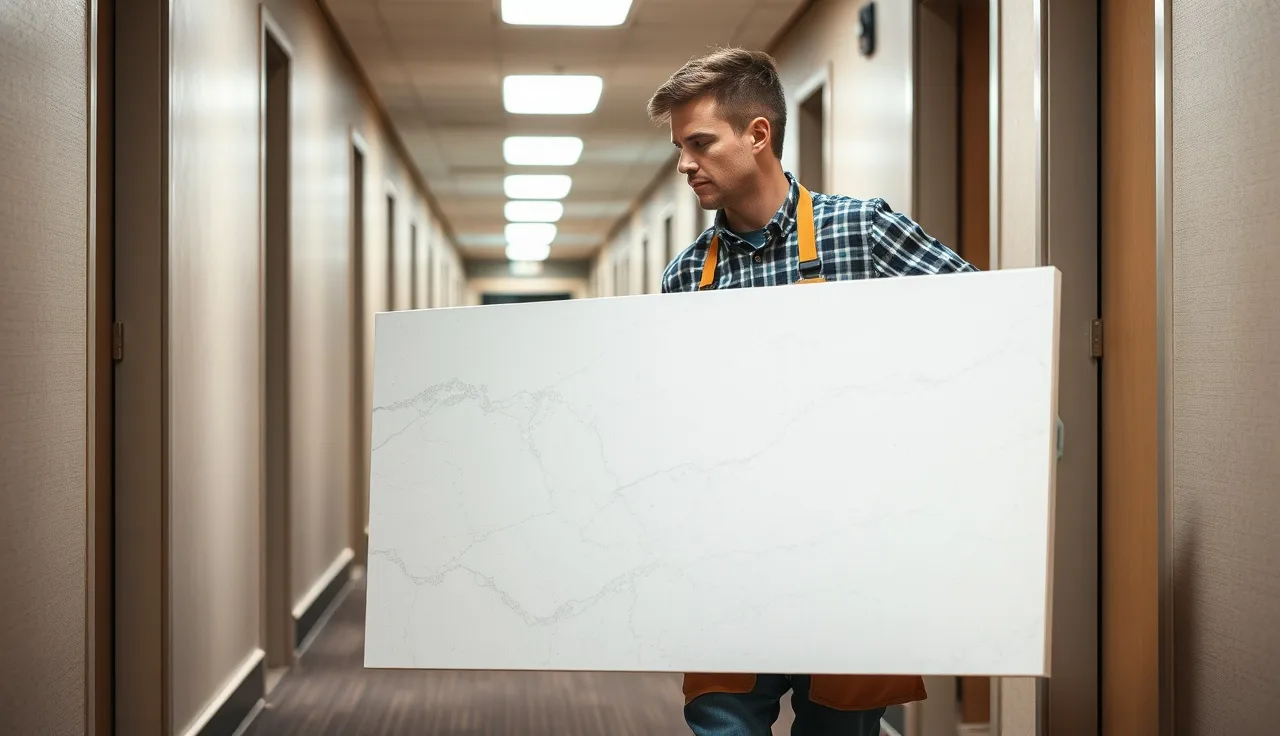
Then there's the physical reality of a high-rise. A 96-inch slab won't fit in most residential elevators. You're either cutting slabs smaller at the shop (which means more seams and more template precision), using a service entrance with a hand truck and padding, or renting equipment. All of that is labor and time.
Apartment work often comes bundled. A property manager or GC wants 10 units done in a building, all the same material, all on a tight schedule. That volume sounds attractive. It usually comes with a demand for a discount that can crush margin if you don't price the logistics correctly from the start.
What does countertop material cost per square foot in an apartment renovation?
Material is the biggest variable in any countertop bid, and apartments don't change the underlying slab price. What they change is which materials actually make sense given access constraints and the buyer's goals.
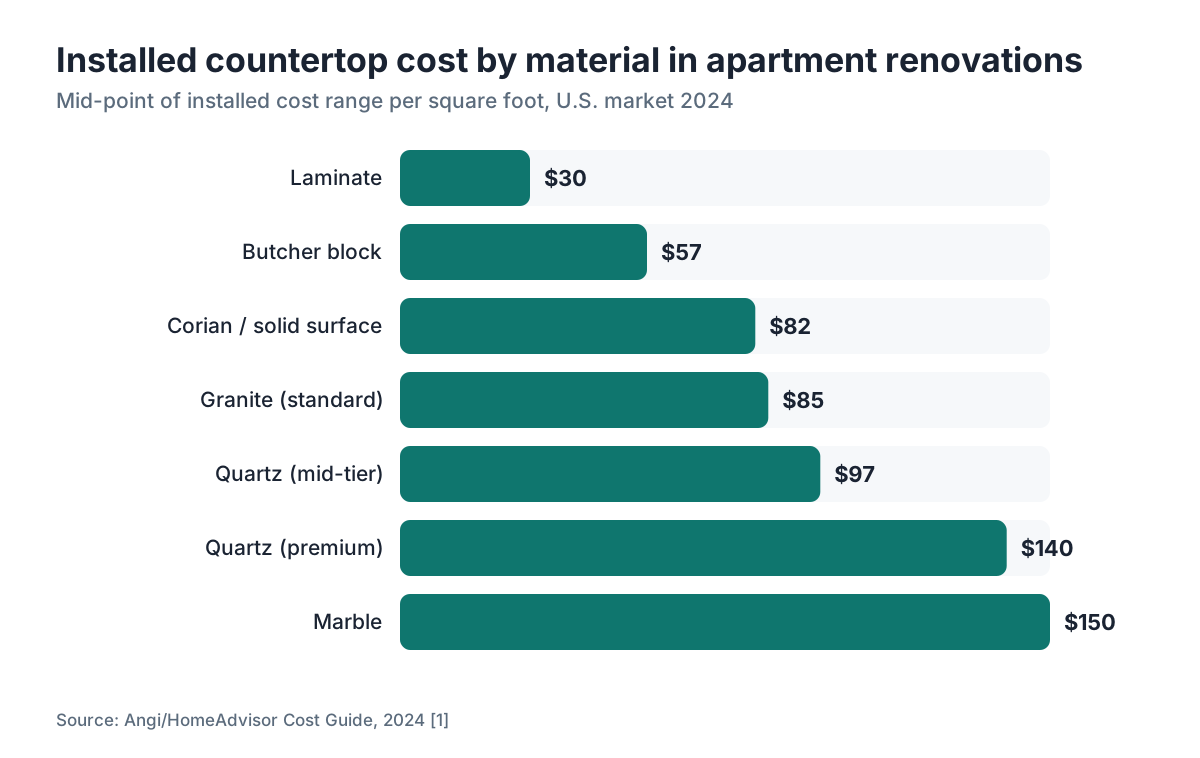
Here's a realistic snapshot of installed countertop costs by material, reflecting mid-2024 U.S. market pricing from multiple fabricator surveys and industry sources [1][2]:
| Material | Material cost (per sq ft) | Installed cost range (per sq ft) |
|---|---|---|
| Laminate (Formica, etc.) | $3, $10 | $20, $40 |
| Butcher block | $10, $40 | $30, $85 |
| Corian / solid surface | $45, $65 | $65, $100 |
| Quartz (mid-tier) | $50, $70 | $75, $120 |
| Granite (standard) | $40, $60 | $60, $110 |
| Quartz (premium, e.g., Cambria) | $70, $120 | $100, $180 |
| Marble | $60, $150 | $100, $200+ |
For apartment work, laminate countertops and butcher block countertops are common in investor-owned rentals because the economics make sense: the landlord needs something durable enough to last several tenant cycles, not something they'd put in their own home. Granite countertops and mid-tier quartz dominate mid-market condo renovations. Premium materials like marble countertops or Cambria countertops show up in luxury buildings where the owner expects to sell or rent at the top of the market.
Here's the honest advice for fabricators. Don't let a property manager push you into a cheap material quote and then expect house-level quality control. Laminate installs fast, but if the building access is difficult, your labor cost is the same as it would be for quartz. The material savings don't translate to install savings.
How much should you add for apartment-specific logistics and access fees?
This is where most fabricators undercharge. Apartment logistics surcharges are real costs, and they belong as line items on the quote, not absorbed into your margin.
Here's what typically adds cost in apartment installs:
Freight elevator scheduling. Some buildings charge a fee directly, often $150, $500 per reservation window depending on the building [3]. Even if the building doesn't charge, your crew's time waiting for an elevator slot or a security escort is billable time.
Service elevator or stairwell carries. If a piece is above the freight elevator's capacity or the elevator is out of service, every piece goes up by hand. Figure an extra 1 to 2 hours of labor per trip depending on floors.
Building protection requirements. Many co-ops and condo buildings require floor protection, wall corner guards, and elevator pads. Some supply them. Many don't. Budget $50, $200 in materials if you're supplying.
COI upgrades. If the building requires a $2M general liability certificate and you're currently at $1M, expect to pay $300, $800 per year for the policy upgrade [4]. On a one-off job, that cost gets allocated to the bid.
Parking and hauling. No driveway means street parking, permit fees, or a dedicated parking spot the GC has to arrange. In dense urban markets, permit fees run $50, $200 per day [5].
Small-run delivery minimums. If the apartment job is 25 square feet of quartz, your supplier may charge a small-order or restocking fee. This is negotiable with suppliers you have volume relationships with, but one-off jobs often absorb $100, $300 in delivery charges.
A practical rule of thumb: add $200, $600 per apartment unit in logistics surcharges as a floor, then adjust up for high-rises, union buildings, or markets where COI requirements are aggressive. Some fabricators in New York and San Francisco add 20 to 30% to their standard installed rate just for the building-access complexity [3].
For countertop installation on multi-unit jobs, the efficiency gain from repetition (same layout, same material, same building) usually offsets about half the logistics premium. You'll get faster at units 5 to 10 than you were at units 1 to 2.
How do you handle multi-unit apartment bids without destroying your margin?
Property managers and GCs love to say "we have 20 units" right before asking for a 30% discount. The volume is real. So is the risk that you've just locked yourself into a job where every unit costs you more than you priced.
Here's how to structure a multi-unit bid the right way.
First, do a real site visit before quoting. One apartment unit does not always represent all of them. Units on different floors may have different ceiling heights, different plumbing configurations, or layout quirks that change template time significantly.
Second, quote per unit, not as a lump sum. Lump sums let the buyer negotiate the total without either of you understanding which cost drivers are responsible for what. A per-unit price with a schedule is much easier to defend and easier to adjust if scope changes.
Third, build a volume discount that reflects your actual efficiency gains, not their purchasing power. If units 1 to 5 take you a full day each and units 6 to 20 take you 6 hours each because your crew has learned the building, you can pass on maybe 10 to 15% on the back half. Giving 25% across the board because they asked for it is a margin problem.
Fourth, write a change order clause into the contract. Apartments have surprises: old cabinets that aren't level, plumbing that isn't where it should be, walls that are out of square. If you eat those surprises on unit 1, you'll eat them on all 20. A clear written clause that defines what triggers a change order protects you without making you look difficult.
SlabWise's quoting workflow is one tool fabricators use to build per-unit templates that carry logistics line items automatically, so you're not rebuilding the math on every multi-unit bid. Worth a look if you're doing more than a handful of apartment jobs a month.
What profit margin should a fabricator target on apartment countertop work?
Industry benchmarks from the Marble Institute of America and countertop-specific financial surveys suggest healthy fabricator gross margins on installed countertop work run 35 to 50% on residential jobs [6]. Apartment work tends to compress that to 25 to 40% because of the logistics overhead and the buyer's negotiating position.
If you're below 25% gross on a multi-unit apartment job, you're probably not accounting for all your costs. The usual culprits are unbilled labor waiting for elevator access, template revisions because the space is tighter than expected, and COI costs treated as overhead instead of job costs.
Net margin (after all overhead) on apartment work at well-run shops runs 8 to 15%, according to fabricator benchmarks published by the Tile, Terrazzo, Marble, and Mosaic Association and referenced in trade discussions [6]. That's a tight band. You don't have much room to give back on price before the job stops making sense.
Here's a realistic margin structure for a 30 sq ft apartment kitchen countertop in a mid-tier quartz:
- Material cost: $55/sq ft x 30 = $1,650
- Fabrication labor: $25/sq ft x 30 = $750
- Install labor: $15/sq ft x 30 = $450
- Logistics surcharges (elevator, COI allocation, parking): $350
- Total cost: $3,200
- Target sell price at 40% gross margin: $5,333
- Realistic market price in competitive metro: $4,500, $5,000
That gap is where apartment work gets hard. If the market is paying $150, $167/sq ft installed and your costs are $107/sq ft before logistics, you're fine. But if a competitor without a COI upgrade is underbidding you at $130/sq ft, you either explain the value difference or walk away.
How do apartment countertop sizes and layouts affect the quote?
Most apartment kitchens are small. A standard apartment kitchen runs 15 to 30 square feet of countertop, compared to 40 to 80 square feet in a typical suburban house [10]. That sounds like less work, but the economics are often worse because the per-square-foot overhead (template time, delivery, setup) is spread over fewer billable square feet. See our guide to kitchen countertops for layout basics.
Quote minimums exist for a reason. Many fabricators set a job minimum of $800, $1,500 regardless of square footage, because a 12 sq ft bathroom vanity on a 15th floor takes just as long to schedule and deliver as a 30 sq ft kitchen counter. If you don't have a minimum, you'll end up with jobs where gross revenue barely covers your truck and labor.
L-shaped and galley kitchens dominate apartments. L-shapes require a mitered or seamed corner, which adds $150, $300 in labor. Galleys often have two separate runs with no corner, which is faster, but may require two delivery trips if the pieces are long.
Watch for appliance cutouts and sink configurations. Undermount sinks are common in renovated apartments, and each cutout takes 30 to 60 minutes of CNC or hand time. A standard undermount cutout adds $100, $200 to the job. Cooktop cutouts are similar. If the template reveals a non-standard cooktop size or an off-center sink, price accordingly.
Small bathrooms are often part of apartment reno packages. A 5 to 8 sq ft vanity top seems trivial, but if it needs a custom shape (angled walls are common in older buildings) and has an undermount bowl, you're looking at 2 hours of shop time minimum. Don't price it like a stock piece.
Should fabricators charge differently for luxury versus investor-grade apartment jobs?
Yes, and for more than just the material difference.
Investor-grade apartment work (Class B or C rental properties, fix-and-flip investors, workforce housing renovators) is high-volume, low-margin, time-sensitive work. The buyer wants the cheapest acceptable result, fast. Laminate and Formica countertops are common. Corian countertops or solid surface show up when the investor wants something better than laminate without paying stone prices. Margins here are thin because competition is intense and buyers shop hard on price.
Luxury apartment work (new high-rise condos, co-op renovations in expensive buildings, short-term rental units in premium markets) is a different animal. The buyer is spending $800, $2,000 per square foot on the full renovation, and a $200/sq ft countertop is a rounding error. Premium materials, tighter tolerances, and more complex edge profiles are expected. Your quote should reflect the precision that work demands, not a commodity rate.
The pricing mistake fabricators make is treating all apartment work as one category because it's multifamily. A 40-unit workforce housing renovation in a suburban garden complex is a different business than 2 units in a downtown luxury tower. Build separate quote templates for each segment, with different logistics assumptions, different material defaults, and different minimum margins.
One practical signal: if the GC or property manager asks you to match a competitor's price on a luxury job, that's a red flag. Shops doing luxury building work compete on quality and reliability, not price. If price is the only lever, you may be talking to the wrong buyer.
What building requirements do fabricators need to know before bidding apartment work?
Getting caught by building requirements after you've written a bid is expensive. The right time to learn the rules is before the quote goes out.
Call the building management office and ask these questions directly:
What are the renovation hours? Many residential buildings restrict contractor work to weekdays 9am, 5pm, or ban power tools on weekends. If your install crew works Tuesday through Saturday and the building only allows Monday through Friday, that scheduling constraint affects your labor cost.
What COI limits are required? Get the certificate requirements in writing. Some buildings want an additional insured endorsement naming the building or management company. That endorsement can take 24 to 48 hours from your insurance broker and sometimes costs a fee.
Is there a freight elevator, and how do you book it? In some buildings the super handles this informally. In others, there's a formal reservation system with deposit requirements. Know this before you promise a delivery date.
Are there restrictions on adhesive or silicone products? A small number of buildings, especially LEED-certified ones or older buildings with air quality rules, restrict VOC-emitting products. Standard silicone caulks and epoxy adhesives are usually fine, but some products get flagged [7].
Does the building have a union labor requirement? In certain metro markets, buildings managed by union-affiliated entities may require union labor for any on-premises work. This is more common in New York, Chicago, and Los Angeles. Non-union shops can sometimes work with a registered union sponsor, but it adds cost and lead time.
All of this belongs on a pre-bid site checklist, not a post-bid surprise list.
How do lead times and scheduling affect apartment countertop pricing?
Apartment renovations often run on aggressive timelines. A landlord between tenants loses rent every day the unit sits empty. A condo buyer closing in 60 days wants the renovation done in 45. That urgency has a price.
Standard fabrication lead times for custom stone countertops run 1 to 3 weeks from templating to install, depending on shop backlog and slab availability [8]. If a client needs it in 5 business days, you're looking at a rush fee. Reasonable rush premiums run 15 to 25% on fabrication labor. Some shops charge a flat rush fee of $200, $500 per job.
Template-to-install timing matters more in apartments because the unit may not be ready for templating until cabinets are fully set, and cabinets in an apartment reno often run late. If you template and then the client pushes install back 3 weeks, your slab sits in inventory. Build a clear cancellation and delay policy into your contract: something like a 10 to 15% restocking or hold fee if install is delayed more than 2 weeks past the agreed date.
For multi-unit jobs, phased scheduling usually beats trying to do all units at once. Doing 4 to 5 units per week lets you template the next batch while installing the current one, which keeps the shop running efficiently and gives the GC flexibility if some units aren't ready. Price phased schedules with a small premium (5 to 10%) over a single continuous run, because the logistics overhead repeats with each phase.
How should homeowners buying an apartment condo think about countertop costs?
If you're renovating an apartment you own or just bought, the pricing dynamics differ from what a fabricator faces, but knowing the fabricator's cost structure helps you evaluate quotes and avoid getting overcharged or choosing a lowball bidder who cuts corners.
A reasonable installed price for mid-tier quartz in a Manhattan or San Francisco apartment is $120, $200 per square foot all-in, because the logistics overhead in dense urban markets is real and legitimate [1][3]. If someone quotes you $75/sq ft installed for quartz in a high-rise, ask exactly how they're handling delivery, elevator fees, and their COI. The answer tells you a lot.
For lower-cost options, laminate countertops installed in an apartment run $20, $50 per square foot and are a genuinely reasonable choice if you're renting the unit out or planning to sell in a market where granite and quartz aren't standard expectations. Don't let a contractor shame you into a more expensive material than the project economics justify.
Get at least 3 quotes, and make sure each covers the same scope: material, fabrication, delivery, install, disposal of old countertops, and any permits your building requires. Comparing a quote that includes disposal to one that doesn't is apples to oranges.
Check your building's alteration agreement before you sign anything with a fabricator. Some buildings require management approval for any countertop work, especially if it involves plumbing disconnection and reconnection. Getting fined or forced to undo work because you skipped the approval process is expensive and avoidable [9].
What are the most common pricing mistakes on apartment countertop bids?
Fabricators and homeowners both make pricing mistakes on apartment jobs, usually for different reasons.
For fabricators, the biggest errors are these.
No logistics line item. If elevator fees, parking, and COI costs are buried in overhead instead of quoted explicitly, you can't recover them on the bill without an awkward conversation. Line items protect you.
Using house-job assumptions for square footage minimums. A 20 sq ft apartment kitchen is not the same economics as a 20 sq ft island top in a house. The house island is probably part of a 60 sq ft total job. The apartment kitchen may literally be 20 sq ft total. Your minimum job charge should reflect that.
Not accounting for seams from slab size limitations. Full slabs are typically 55 to 65 inches wide and 100 to 130 inches long [8]. In an apartment where pieces have to go up in an elevator, you may not be able to bring a full slab. Extra seams mean more labor and sometimes more waste.
For homeowners, the most common mistake is not reading the full quote scope carefully. A low bid that skips old countertop removal, sink reconnection, or debris haul-away can easily end up costing more than a higher bid that includes everything.
Another mistake is skipping the building approval process. Many co-op and condo buildings require board or management sign-off on renovations, sometimes including a refundable damage deposit from the contractor [9]. Finding this out after the work starts causes real problems.
If you want to sharpen your quoting process, SlabWise offers a software demo built around this exact job-costing structure, designed to help fabricators break out logistics, material, and labor as separate cost centers per job.
Frequently asked questions
How much does it cost to install countertops in an apartment?
Installed apartment countertop costs run $20, $50 per square foot for laminate, $60, $120 for granite or mid-tier quartz, and $100, $200 or more for premium stone like marble or high-end quartz. Dense urban markets (New York, San Francisco) add 20 to 30% over those ranges because of elevator access, parking fees, and higher COI requirements. A typical 25 sq ft apartment kitchen runs $1,500, $5,000 installed depending on material and location.
Do fabricators charge extra for apartment buildings versus houses?
Most experienced fabricators do, and should. Apartment-specific costs include freight elevator fees ($150, $500 per booking window), higher insurance certificate requirements, restricted work hours, parking permits, and the extra labor of carrying material through service entrances or stairwells. These add $200, $600 per unit in real costs a house job doesn't have. A fabricator who doesn't itemize these is either eating the cost or hasn't thought through the pricing carefully.
What is a fair quote for a multi-unit apartment countertop job?
Multi-unit jobs should be quoted per unit with a clear schedule, not as a lump sum. A reasonable volume discount reflects actual efficiency gains, typically 10 to 15% on the back half of a large run once the crew knows the building. Discounts over 20% across all units usually mean the fabricator is betting on efficiency that may not materialize. Ask for a per-unit breakdown and a written change order clause for surprises like unlevel cabinets or non-standard plumbing.
What countertop materials work best in rental apartments?
For landlord-owned rentals, laminate and mid-tier quartz offer the best cost-to-durability ratio. Laminate ($20, $50/sq ft installed) resists stains and is cheap to replace. Mid-tier quartz ($75, $120/sq ft installed) holds up to tenant turnover and appeals to renters in competitive markets. Butcher block is popular in renovated units but needs sealing and is vulnerable to water damage near sinks, which matters in rentals with unpredictable tenant behavior.
How do you price a countertop job minimum for small apartment kitchens?
A job minimum of $800, $1,500 is reasonable for apartment work regardless of square footage. A 12 sq ft galley kitchen counter in a high-rise takes the same scheduling, delivery, and logistics effort as a 30 sq ft counter. Without a minimum, small apartment jobs often lose money. Fabricators should state the minimum clearly in their quote template and explain it if asked.
Can you get same-week countertop installation in an apartment?
Rarely, and you'll pay for it. Standard fabrication lead times run 1 to 3 weeks from templating to install. Rush fabrication (5 to 7 business days) carries a 15 to 25% premium on labor, sometimes plus a flat fee of $200, $500. The fabricator also has to work around the building's elevator booking schedule, which may not have same-week availability. Planning 2 to 3 weeks ahead is realistic for most apartment countertop jobs.
Do I need building approval to replace countertops in a condo or co-op?
Often yes. Co-op alteration agreements frequently require board or management approval before renovation work begins, especially work involving plumbing (disconnecting and reconnecting a sink). Condo bylaws vary but many require notification and sometimes a contractor damage deposit. Doing work without approval can result in fines or mandatory reversal. Check your alteration agreement or house rules before signing anything with a fabricator.
What insurance does a countertop fabricator need for apartment building access?
Most residential buildings require general liability insurance of $1, $2 million per occurrence. Some add a requirement for workers' compensation coverage and an additional insured endorsement naming the building or management company. Get the building's COI requirements in writing before quoting. If your current policy limit is lower than required, a policy upgrade costs $300, $800 per year and that cost should be allocated to the job.
How does apartment countertop sizing affect fabrication cost?
Apartment kitchens typically run 15 to 30 square feet versus 40 to 80 in a suburban house. That smaller size spreads the per-job overhead (template time, delivery, setup) over fewer billable square feet, making the per-square-foot cost higher. Elevator size constraints also sometimes prevent full slabs from being brought up intact, forcing additional seams and cuts that add $150, $300 per seam in labor.
What is the profit margin fabricators should target on apartment countertop work?
Gross margins on installed countertop work benchmark at 35 to 50% for residential projects. Apartment work typically compresses that to 25 to 40% because of logistics overhead and buyer negotiating pressure. Net margin at well-run shops runs 8 to 15%. Jobs below 25% gross margin usually indicate unbilled logistics costs or too-deep volume discounts. Fabricators should track apartment jobs separately from house jobs to see the real margin difference.
How do I compare countertop quotes for an apartment renovation?
Make sure every quote covers the same scope: material, fabrication, delivery, install, old countertop removal, and plumbing disconnection/reconnection if applicable. Ask each bidder how they handle elevator fees, building COI requirements, and disposal. A quote missing any of those line items will look cheaper but may not be. Get quotes from at least 3 fabricators and ask each one to walk you through what's included.
Are there VOC or environmental restrictions on countertop adhesives in apartment buildings?
Most buildings don't restrict standard silicone caulks and epoxy adhesives used in countertop installation. A minority of LEED-certified buildings or older buildings with air quality rules may flag high-VOC products. The EPA's Indoor Air Quality guidelines reference VOC limits in building materials, and some building management offices apply those standards to renovation contractors. Ask building management directly before quoting if this is a concern.
What should a homeowner watch out for with low-bid countertop quotes in apartments?
Low bids often exclude elevator fees, old countertop removal, plumbing reconnection, or haul-away. They may also reflect a shop without the COI limits your building requires, meaning they can't actually do the work once management reviews their paperwork. Ask every bidder for a written scope of work and a copy of their certificate of insurance before signing. The cheapest quote that can't get into the building isn't a deal.
Sources
- HomeAdvisor (Angi), Countertop Installation Cost Guide: Installed countertop cost ranges by material, $20, $200+ per square foot depending on material type
- U.S. Bureau of Labor Statistics, Consumer Price Index, Household Furnishings: Labor and materials price index trends for residential improvement categories
- National Kitchen and Bath Association, NKBA Professional Resource Library: Apartment and high-rise installation complexity factors including elevator scheduling and access fees cited in trade research
- U.S. Small Business Administration, Business Insurance: General liability insurance policy costs and typical coverage tiers for small contractors
- U.S. Small Business Administration, Business Guide: Local permit and licensing costs for small contractors operating in urban markets
- Marble Institute of America, Stone Industry Benchmarking: Gross margin benchmarks for installed countertop fabrication work, 35 to 50% residential; net margin 8 to 15%
- U.S. Environmental Protection Agency, Indoor Air Quality and VOCs: VOC limits in adhesives and sealants relevant to LEED and air-quality-restricted buildings
- Marble Institute of America, Dimensional Stone Design Manual: Standard slab dimensions: 55 to 65 inches wide, 100 to 130 inches long; standard fabrication lead times 1 to 3 weeks
- New York State Attorney General, Cooperative and Condominium Resources: Co-op and condo alteration agreement approval requirements and contractor damage deposits
- U.S. Census Bureau, American Housing Survey: Average kitchen countertop area in single-family homes versus multifamily units; typical apartment kitchen sizes 15 to 30 sq ft
Last updated 2026-07-11