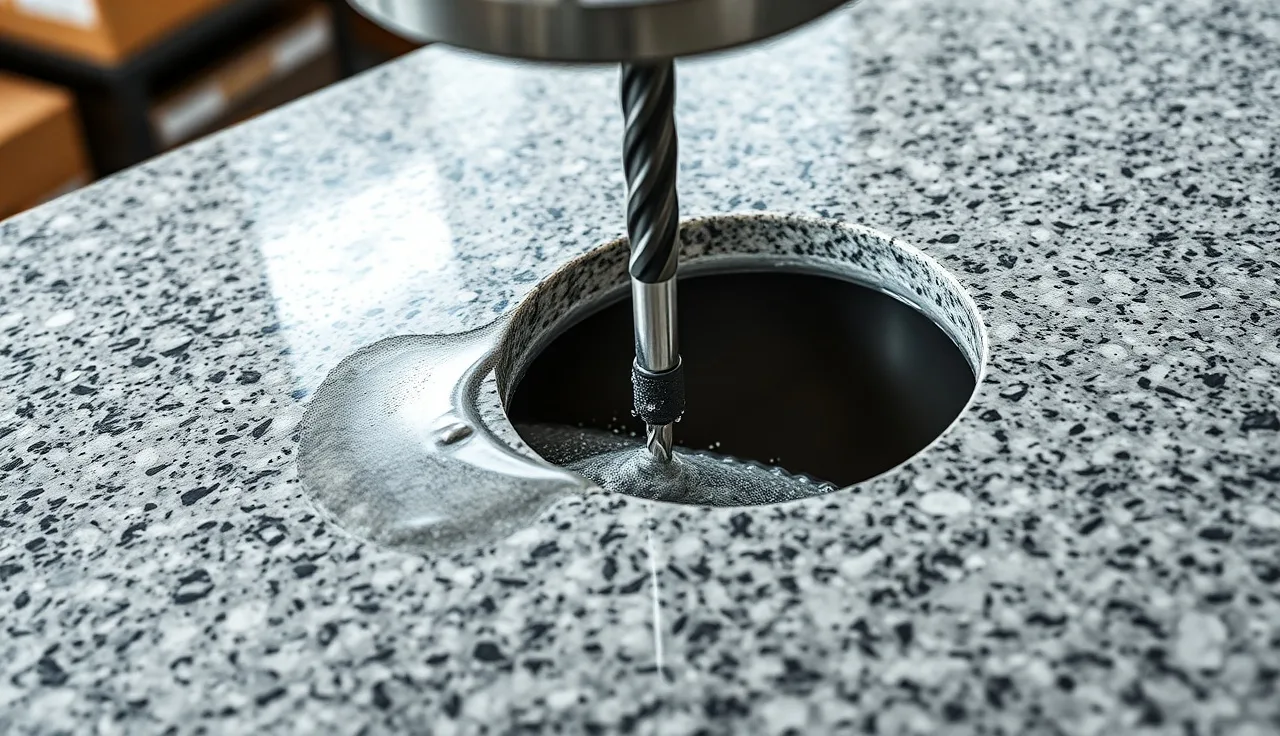
TL;DR
- Use a diamond-core hole saw (1-3/8" for a standard faucet), keep the bit wet the whole time, run your drill under 600 RPM, press lightly, and never let water stop flowing over the cut.
- Skip any one of those and you risk a crack that runs through the full slab.
- Laminate and solid surface forgive more and cut dry.
Why do countertops crack when you drill them?
Stone cracks for one reason more than any other: heat. A spinning bit grinds through granite or quartz and throws off friction fast. If that heat has nowhere to go, it drives a thermal shock crack out from the hole. These are not surface scratches. They run through the full thickness of the slab, and short of replacing the piece, you do not fix them.
Engineered quartz (Silestone, Caesarstone, Cambria) is actually more fragile under heat than natural granite in one way. The resin binders holding the quartz aggregate together soften and delaminate before the stone itself fractures [1]. Marble and quartzite scratch easier than granite but carry natural cleavage planes, so once a crack starts it can travel a long way.
The second failure mode gets less attention: vibration and sideways force. Let the bit walk on entry, or push hard and let it chatter, and you get micro-fractures around the rim. You might not see them at first. Then chipping shows up around the faucet base after a year of hot water cycling through. Drill slow and hold the bit dead perpendicular, and most of that risk disappears.
Pressure from underneath matters too. Slabs are heavy and stiff, but an overhang or a section spanning a cabinet void has no support right under the drill point. The slab flexes as you press. Support it from below before the bit ever touches stone.
What drill bit do you need to cut a faucet hole in stone?
You need a diamond-core hole saw. Not a carbide hole saw, not a twist bit, and not the bi-metal blades sold for wood and drywall. A diamond-core bit is a steel tube with industrial diamond bonded to the cutting edge. The diamonds grind the stone instead of slicing it the way a blade cuts wood, and grinding runs hot. That is exactly why cooling drives everything else.
A standard single-hole faucet almost always needs a 1-3/8" (35 mm) opening. Widespread faucets take three separate 1-3/8" holes, and some bridge faucets want more clearance. Measure your faucet shank before you buy a bit. Most faucet instructions print the required hole diameter on page one.
Diamond-core bits come in two main styles:
- Wet/dry diamond hole saws: thin wall, built for a continuous water feed. They cut faster and stay cooler. Good ones from Bosch, Dewalt, or Rubi run $15 to $40 each [2].
- Vacuum-brazed diamond bits: a denser diamond layer, slower cut, a little more tolerant of brief dry contact, but still need water on stone over 3/4" thick. Often sold for tile and countertops both.
Do not put a worn-out bit on a final countertop. A glazed diamond bit drags instead of cuts, so you press harder, and that raises both heat and vibration. Replace bits after 10 to 15 holes in hard stone, sooner if the cut slows down.
For laminate countertops and solid surfaces like Corian, a standard carbide hole saw or a sharp jigsaw does the job dry. No water. The steps below are for stone and engineered quartz.
What speed should your drill run at for stone?
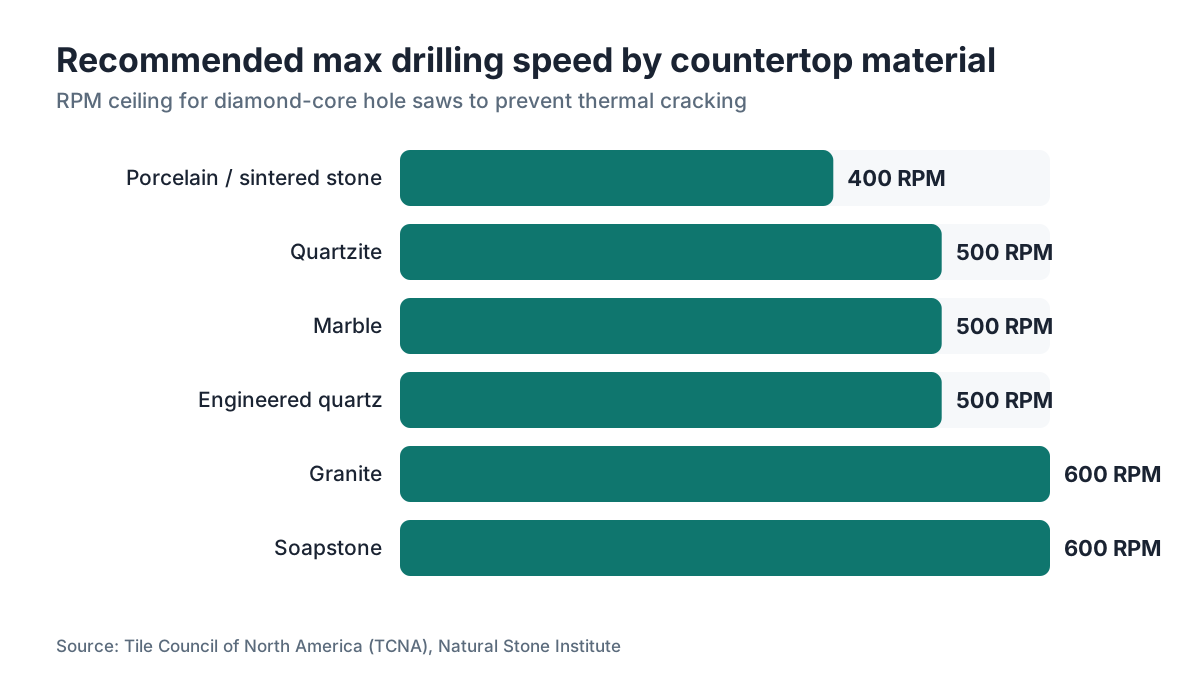
Keep the RPM low. For granite, quartz, and marble, most manufacturers and fabricators call for 300 to 600 RPM [3]. That is far below the 2,000-plus RPM you might run on wood or drywall. The logic is plain: lower speed means less heat per second, and less heat per second means you can drill longer before the bit or the stone overheats.
A corded drill on its lowest setting usually runs 400 to 500 RPM at full trigger. That works. A cordless drill on low gear works too, as long as you can hold a steady slow speed. Variable-speed drills are best because you can feather the trigger.
Angle grinders and rotary tools spin too fast. Do not fit them with a hole saw and go at stone.
Pressure is the other lever. You want steady, moderate downward force, enough to keep the diamonds biting, not so much that the bit stalls or skips. Let the bit do the work. If the drill strains or the bit bounces, ease off. Done right, the whole thing feels controlled and almost boring.
How do you keep the bit wet while drilling?
Water is the coolant. It pulls heat off the cutting edge and flushes slurry out of the kerf so the diamonds keep biting fresh stone instead of re-grinding their own waste. It also knocks down the silica dust, which OSHA regulates under its construction silica standard, 29 CFR 1926.1153, and which requires "wet methods" or equivalent controls when cutting, grinding, or drilling stone [8].
Shops use a drill press with a continuous water feed. In a kitchen you can get the same result with a water dam. Press a ring of plumber's putty onto the surface around the drill point, forming a reservoir about 1" tall. Fill it before you start and top it off through the whole cut. The bit stays submerged the entire time.
Or have a helper trickle water into the reservoir while you drill, or flood the area with a spray bottle. Some fabricators tape a garden hose fitting near the hole. The delivery method matters less than the outcome: the cutting edge never runs dry.
A few specific warnings:
- Do not run a corded drill near standing water. The dam keeps water contained. With a cordless drill the risk is lower, but keep water off the battery and motor housing.
- Swap the water if it gets hot to the touch. Hot coolant is not cooling anything.
- When the hole is done, flush the slurry off right away. Dried granite slurry scratches finished surfaces.
On engineered quartz like Cambria countertops, Cambria's own installation guidance says any cutting or grinding has to be done wet, both to protect the warranty and to keep the resin from scorching [1].
Step-by-step: how to drill a faucet hole in a stone countertop
Here is the full sequence, start to finish.
Step 1: Mark and measure twice. Check the hole location against your sink cutout, the faucet deck plate size, and anything structural below. Standard faucet placement sits 2" to 4" behind the sink rim, centered side to side unless the faucet says otherwise. Mark the center with a pencil or paint marker.
Step 2: Support the slab. If the drill point sits over open cabinet space, put a 2x4 or solid block under the slab directly beneath the mark. Press on it. The slab should feel solid, not springy.
Step 3: Build your water dam. Press a ring of plumber's putty around the mark, about 1.5" across, firm to the stone. Pour in about 1/2" of water. Watch for leaks. Re-press the seal if it drips.
Step 4: Give the bit a place to catch. Diamond-core bits have no pilot tip and will walk on polished stone. Lay a piece of masking tape under the bit for grip, or tap a tiny dimple with a center punch (go easy, you want a catch point, not a crack). Some kits include a plastic centering guide that drops inside the core bit and rests on the surface.
Step 5: Start at an angle, then go vertical. This is a pro trick. Start the bit at roughly 45 degrees so only one edge of the rim touches stone first. Once you cut a small groove, straighten to vertical. That stops the bit from skating across the surface.
Step 6: Drill at 300 to 600 RPM with steady, light pressure. Do not rush. A 1-3/8" hole through 3/4" granite runs 3 to 8 minutes with a sharp bit [3]. Keep the water topped up. If the slurry turns brown or the water gets hot, stop, cool everything two minutes, then resume.
Step 7: Ease off near breakthrough. As the bit nears the bottom of the slab, back off the pressure hard. This is when the underside chips. Some fabricators drill 80% through from the top, then finish from the bottom, which leaves a clean edge on both faces.
Step 8: Clean up. Pull the putty dam. Rinse away the slurry. Dry the area and inspect the rim. Light chipping hides under the faucet base. A real crack needs professional assessment before you go further.
For countertop installation in new construction, do all the drilling on sawhorses or a padded bench before you set the stone. It is far easier and far safer than drilling in place.
Does the process change for different stone types?
Yes, and the differences matter.
Granite is hard (Mohs 6 to 7) and drills predictably with a sharp diamond bit at low speed. It shrugs off brief water interruptions better than the others, but keep it wet anyway.
Marble and quartzite scratch easier (marble sits around Mohs 3 to 5) but cleave along natural crystal planes. Use the lightest pressure you can and never let the bit chatter on these. Marble countertops near a fresh hole also need sealing right away, because the new cut edge is porous and drinks up stains on contact.
Engineered quartz (Silestone, Caesarstone, Cambria, MSI Q Premium) uses a heat-sensitive resin binder. The NSF/ANSI standard for solid surface materials [4] and every manufacturer guide say the same thing: no dry cutting. Treat it like natural stone. Full water cooling, low speed.
Soapstone is soft enough (Mohs 1 to 2) that some fabricators cut it with carbide, but a diamond bit still leaves a cleaner edge. The how to clean soapstone countertops guide covers its odd properties in more depth.
Porcelain and sintered stone (Dekton, Neolith) rank among the hardest countertop surfaces, sometimes topping granite on hardness tests [5]. These want the sharpest diamond bits, the slowest speeds, and zero lateral pressure. A worn bit on porcelain cracks the surface every time.
| Material | Mohs Hardness | Recommended RPM | Water Required? | Notes |
|---|---|---|---|---|
| Granite | 6 to 7 | 300 to 600 | Yes | Most forgiving of the natural stones |
| Quartzite | 7 | 300 to 500 | Yes | Cleavage planes; very light pressure |
| Marble | 3 to 5 | 300 to 500 | Yes | Seal the cut edge right after |
| Engineered quartz | ~7 (aggregate) | 300 to 500 | Yes | Resin scorches; dry cutting voids warranty |
| Soapstone | 1 to 2 | 400 to 600 | Recommended | Carbide works, diamond is cleaner |
| Porcelain/sintered | 7 to 8+ | 300 to 400 | Yes | Sharpest bit; no lateral force |
| Laminate | N/A | Any | No | Carbide hole saw or jigsaw |
| Solid surface (Corian) | N/A | Any | No | Standard carbide tools fine |
Can you drill a faucet hole in an already-installed countertop?
You can, but it is harder than drilling before install and the room for error shrinks. The slab is fixed, which kills some movement, but access is awkward, the water dam is tough to seal on an uneven surface, and debris rains into the cabinet.
The core steps hold: water dam, low speed, light pressure, steady pace. A few extra precautions apply:
- Shut off the water supply to the sink first. Slurry and drilling water drip into the cabinet, so put towels or a small bucket underneath.
- Use a cordless drill. A corded drill and standing water at a kitchen sink is a risk you do not need.
- With an undermount sink, the area near the rim has no support below. Prop a brace or an adjustable rod up from the cabinet floor to the underside of the stone at the drill point.
If heavy veining runs toward your planned hole, think about whether you can shift the faucet slightly to dodge it. Veins in marble and some granites are planes of different mineral composition, and they can be weak points.
Not confident about a step? Hiring a fabricator to drill on-site is a fair call. A pro with a wet drill press attachment usually knocks it out in 20 minutes. Shop labor for this runs $75 to $150 depending on region. Cheap insurance against a cracked slab.
What do you do if the stone cracks while drilling?
Stop right away. Do not push through the crack. More drilling vibration turns a small crack into a big one.
Read the crack. A hairline crack at the surface that does not go through the full thickness can be injected with color-matched epoxy and then hides under the faucet base. Fabricators use two-part stone epoxy (FossilCal or Tenax Tefill-type products) for exactly this. The repair holds structurally, but the crack stays visible on close inspection anywhere the faucet does not cover it.
A through-crack that radiates away from the hole toward a sink or edge is a different animal. That section of stone is compromised. A fabricator can sometimes cut clean at the crack and swap just the damaged section, but on an ordinary kitchen countertop, that repair often costs about as much as a new section.
Photograph the damage before you call your fabricator or supplier, especially if the slab is newly installed and you want to sort out whether a flaw in the stone caused the crack.
Should a homeowner do this themselves or hire a pro?
Honest answer: if the countertop is already installed and hard to replace, hire a pro. The cost of a cracked slab dwarfs the $75 to $150 a fabricator charges for a single hole.
Drilling a slab that is still on sawhorses before install? The stakes drop. You have room to practice, the slab is accessible, and a mistake has not yet committed you to a finished kitchen. That is a reasonable DIY job if you buy a quality diamond bit, follow the steps above, and go slow.
Hire out without a second thought when you have:
- Marble or quartzite (cleavage risk runs high)
- Porcelain or sintered stone (no forgiveness for imperfect technique)
- Heavy veining running toward the hole location
- No way to keep the bit properly cooled
- A countertop pricey enough that you cannot sleep after drilling it yourself
For granite countertops, a careful DIYer with a good bit and patience can pull this off. Granite forgives the most of any natural stone. For engineered quartz, I lean toward professional drilling unless you are very comfortable, partly because most quartz carries a transferable warranty that installation practices can affect.
Fabricators running shop and quoting tools like SlabWise can usually add a faucet hole line item to an existing job for very little, so ask whether they can fold it into the price when they quote your countertop.
What are common mistakes that lead to cracked countertops during drilling?
Here is the short list of what actually goes wrong.
Dry drilling. The top cause. Even 30 seconds of dry contact at full speed makes enough heat to crack some materials. Fill the water dam, keep it filled, and never let it run dry.
Too much speed. Someone grabs a drill, cranks it to the fastest setting because faster feels efficient. It is not. High RPM means high heat. Stay under 600.
Too much downward pressure. Pushing hard barely speeds the cut on stone. It raises heat, invites chatter, and flexes the slab. Light and steady wins.
Starting on a smooth surface with no guide. The bit has no pilot tip and skates across polished stone. Use the angle-entry technique or a centering guide.
No support underneath. Drilling over open cabinet space lets the slab flex under pressure. Support it every time.
A worn or wrong bit. A glazed diamond bit drags instead of grinds, so you press harder and make more heat. A carbide hole saw on granite works for a minute, then overheats.
Stop-and-start with no cooling. Repeated starts and stops with no water cycle the stone through heat and partial cooling, and that stress adds up. If you have to stop, cool everything and re-establish the water dam before you go again.
For homeowners weighing options broadly, the kitchen countertops guide covers which materials are easiest to work with across the whole install.
How do fabricators price faucet holes, and can you request them pre-drilled?
Yes, and request them pre-drilled at the shop whenever you can. A shop with a fixed drill press, continuous water feed, and a skilled operator produces cleaner results than field drilling in a finished kitchen.
Pricing swings by region and shop. A typical faucet hole add-on runs $30 to $75 per hole during fabrication, and $75 to $150 as a field visit after install [6]. Some shops fold one faucet hole into the base countertop price. Others line-item everything. Ask outright.
If your shop runs jobs through software like SlabWise, faucet holes, sink cutouts, and other specialty operations show up as individual line items, so you can see exactly what you are paying for before you sign.
For tricky faucet setups (bridge faucets needing custom spacing, pot fillers on an offset, farmhouse sinks with integrated decks), send the faucet template or spec sheet to your fabricator before they cut. Getting three-hole spacing wrong on an already-polished slab is an expensive mistake.
If you are pricing a renovation and want to know how faucet holes fold into the total, the countertop installation guide lays out what fabricators include and exclude in standard pricing.
Frequently asked questions
What size hole saw do I need for a standard kitchen faucet?
Almost all single-hole kitchen faucets need a 1-3/8" (35 mm) hole. Some older or commercial-style faucets call for 1-1/2". Check the instructions that came with your faucet before buying a bit. Widespread faucets with separate handles need three holes at the same diameter, usually spaced 8" center to center.
Can I use a regular drill bit to drill granite?
No. Standard high-speed steel or cobalt twist bits will not cut granite and overheat almost instantly. Carbide-tipped masonry bits can start a hole but dull fast and run hot. The only correct tool for a clean hole in granite, quartz, or marble is a diamond-core hole saw used wet at low speed.
Do I need a drill press or can I use a handheld drill?
A handheld drill works fine if you hold it steady and vertical. The main risks are bit wander at the start and slight tilting under pressure. Use the angle-entry technique to start, then straighten once you have a groove. A drill press is better if you own one, but most DIY faucet holes get done with a handheld drill just fine.
How long does it take to drill a faucet hole in granite?
With a sharp diamond bit at 400 to 600 RPM, a 1-3/8" hole through 3/4" granite runs 3 to 8 minutes. Thicker slabs (1-1/4") take longer, sometimes 10 to 15 minutes. If it is dragging well past that, the bit is dull or you are using too little pressure. Never try to speed it up by pushing harder.
What happens if my diamond bit runs dry for a few seconds?
A few seconds of dry contact is not always fatal, but it spikes the bit temperature. Stop, cool the bit and stone to room temperature (at least 5 minutes), refill the water dam, and resume. Check for surface cracking before continuing. Dry contact is cumulative: several short dry spells do the same damage as one long one.
Can I drill a faucet hole in quartz countertops without voiding the warranty?
Most engineered quartz makers require that cutting and drilling happen by a certified fabricator using wet methods to keep the warranty. Cambria, for one, specifies wet cutting in its install guidelines. Check your manufacturer's install document. Even where DIY drilling is technically allowed, any crack or delamination from drilling will not be covered.
Is it safe to use a corded drill near water when drilling a countertop?
It carries real risk. The water dam keeps water in a small reservoir, which reduces exposure but does not remove it. Many pros switch to a cordless drill for in-place drilling to avoid the issue entirely. If you use corded, keep the cord and tool body well clear of the reservoir and any wet surfaces, and plug into a GFCI-protected outlet.
How do I drill a faucet hole in a countertop without chipping the bottom edge?
Drill about 80% through from the top, then finish from the bottom up. That stops the bit from punching through the underside with force and chipping the lower face. Or slow your pressure way down as you feel the bit near breakthrough. A piece of masking tape on the underside also helps reduce minor surface chipping.
What do I do about the stone dust and slurry after drilling?
Rinse the area with clean water right away. Stone slurry (fine abrasive grit in water) scratches polished surfaces if it dries and then gets wiped away dry. Wet-wipe with a soft cloth, then rinse again. Check the cabinet interior below for dripped slurry and wipe it before it dries onto cabinet finishes.
My countertop has a hairline crack near the new faucet hole. Is it structural?
Depends on the crack's path. A hairline crack that circles the rim and stays within the zone the faucet base will cover is cosmetic and can be stabilized with stone epoxy. A crack radiating out toward a sink cutout, edge, or seam is structural and needs professional review before you install the faucet and run water. Have a fabricator look at it in person.
How much does it cost to have a fabricator drill a faucet hole?
Rates vary by region, but most fabricators charge $30 to $75 per hole during the original fabrication job and $75 to $150 for a standalone field visit after install. Some shops include one hole in the base price. Always ask during your initial quote, because retrofitting a hole later costs more and carries more risk than drilling before install.
Can I drill a faucet hole in a butcher block countertop?
Yes, and it is far easier than stone. Use a standard carbide hole saw (1-3/8" for most faucets) with a cordless drill at normal speed. No water needed. Go slow enough that the wood does not burn. Back the wood with a scrap piece to prevent blowout underneath. After drilling, seal the hole edges with food-safe mineral oil or whatever finish the countertop uses.
Does the thickness of the countertop affect how I drill it?
Thicker slabs take longer and build more cumulative heat, so water cooling matters even more. Standard countertops run 3/4" or 1-1/4" thick. For 1-1/4" slabs, plan to refill the water dam at least once mid-drill and allow more time to cut through. The technique stays the same. Just be patient and keep the water flowing.
Sources
- Cambria, Installation and Care Guide: Engineered quartz manufacturers including Cambria specify wet cutting and drilling to prevent resin scorching and to maintain warranty coverage.
- Bosch Tools, Diamond Hole Saw Product Specifications: Diamond-core hole saws for stone in the 1-3/8" size range are available from major tool brands in the $15 to $40 price range.
- Tile Council of North America (TCNA), Handbook for Ceramic, Glass, and Stone Tile Installation: Recommended drilling speed for hard stone and tile materials is 300 to 600 RPM; a sharp diamond bit through 3/4" granite typically takes 3 to 8 minutes.
- NSF International, NSF/ANSI 51: Food Equipment Materials: NSF standards for solid surface and countertop materials address fabrication practices including cutting and drilling requirements for materials used in food preparation areas.
- Dekton by Cosentino, Technical and Installation Guide: Sintered stone surfaces like Dekton have hardness ratings that exceed granite, requiring the sharpest diamond tools and lowest feasible RPM to avoid cracking during drilling.
- Natural Stone Institute, Natural Stone Installation Guidelines: Field drilling and add-on hole operations by stone fabricators typically carry a price premium over shop fabrication due to mobilization and access constraints.
- OSHA, 29 CFR 1926.57: Ventilation (Silica Dust in Construction): Wet drilling of stone suppresses respirable silica dust, which OSHA regulates under construction silica standards; dry cutting of stone without controls violates OSHA silica rules.
- OSHA, Crystalline Silica (construction standard 29 CFR 1926.1153): OSHA's silica standard for construction (29 CFR 1926.1153) requires wet methods or equivalent controls when cutting, grinding, or drilling stone, concrete, or masonry.
- CDC/NIOSH, Silica (Preventing Silicosis in Construction Workers): Wet cutting and drilling of stone significantly reduces airborne crystalline silica dust compared to dry methods, protecting workers and occupants.
- Natural Stone Institute, Fabrication Best Practices: The Natural Stone Institute recommends diamond tooling and continuous water cooling for all cutting, grinding, and hole-drilling operations in natural stone fabrication.
Last updated 2026-07-11