TL;DR
- A granite drainboard usually adds $200 to $600 to a countertop quote.
- The price tracks size, groove complexity, and whether the fluting is CNC-routed or hand-carved.
- Fabricators bill the extra square footage at the standard slab rate, then add a machining charge for the grooves and their finishing.
- Ask for an itemized line so the drainboard cost is visible and you can compare shops.
What exactly is a granite drainboard, and why does it cost more?
A granite drainboard is a section of countertop, usually beside the sink, with parallel grooves cut into the stone so water runs off the surface and into the sink instead of pooling. It can be built into the main slab or made as a separate removable piece. Integral drainboards are far more common in granite work.
The extra cost is machining time, not material. The slab costs the same per square foot flat or grooved. Those grooves need a CNC router, or a skilled hand with an angle grinder and specialty bits, to cut each channel to a consistent depth (usually 3/16 to 1/4 inch) at a precise angle so gravity moves the water. That work runs 30 to 90 minutes of equipment and labor depending on the number of grooves, their length, and how hard the stone is. Softer granites cut fast. Dense, quartzite-like granites chew through bits.
Then the shop has to re-polish the flat lands between grooves and ease the groove edges so they feel smooth. That finishing step is real labor. Skip it and you get sharp ridges that scratch cast iron and shred sponges.
So a drainboard quote is really three things stacked together: slab square footage at the standard rate, the CNC programming or hand-cutting time (a flat fee or a per-linear-foot rate), and the finishing labor. Every shop bundles those differently. That is why two quotes for the same drainboard can read completely differently on paper even when the bottom line is close.
How do fabricators calculate the square footage for a drainboard?
The slab is billed at the full bounding rectangle of the drainboard section, same as any other countertop area. A drainboard 18 inches wide and 24 inches long is 3 square feet of granite, billed at whatever the shop charges per square foot for that stone. The grooves do not shrink the billable area. The shop still cuts that piece from the slab and cannot reuse the material.
Most shops set a project minimum anyway, often 15 to 25 square feet. So a small drainboard on a large kitchen install may add nothing to the material cost if you are already well past the minimum. On a bathroom vanity or a bar, the minimum can drive the whole price.
A separate removable insert is a different animal. The fabricator cuts an independent piece with its own setup, polishing on all four sides, and often a different edge profile. That is where you see $300 to $700 for a standalone unit, because the labor-to-material ratio on a small piece is brutal. A 12-by-18-inch insert is only 1.5 square feet of slab but takes nearly the same setup as a full section.
One question to ask: is the drainboard scribed to the sink cutout? If the grooves run right to the sink opening, the fabricator has to CNC the angle against a curved or straight sink edge, which adds time. A flat ledge between the last groove and the sink is simpler and cheaper.
What do shops charge per linear foot for the drainboard grooves?
Groove machining gets priced three ways: a flat add-on fee for the whole drainboard, a per-linear-foot rate per groove, or a per-linear-foot rate for the entire drainboard run. No industry-wide standard exists, so the variation is wide.
Shops that itemize by groove charge roughly $2 to $6 per linear foot per groove. Picture an 18-inch-wide drainboard with 10 grooves each running 22 inches. That is about 18.3 linear feet of groove, landing the machining charge at $37 to $110 at those rates. Sounds cheap. But most shops do not price that granularly. They set a flat fee of $150 to $400 for the drainboard as a whole, which covers actual machine time, bit wear, and programming overhead.
Hand-carved drainboards cost more. A craftsman spending 2 to 3 hours hand-routing at $85 to $120 an hour adds $170 to $360 in labor before finishing, and the result is often less consistent than CNC work. Some people like the slightly organic look of hand carving on natural stone, so shops that offer it charge a premium for it.
Custom groove patterns are their own line. Herringbone or fan-shaped grooves need custom CNC programming and typically add $100 to $250 on top of the base drainboard fee. Straight parallel grooves are always the cheapest option, every time.
What is a realistic total price range for a granite drainboard?
Here is what to expect in 2024 dollars, based on typical US fabrication shop pricing. These are installed prices unless noted.
| Drainboard type | Typical added cost | Notes |
|---|---|---|
| Integral parallel grooves, standard granite | $200, $400 | CNC-routed, 12 to 24 in. wide section |
| Integral parallel grooves, premium/hard granite | $300, $550 | More bit wear, slower cutting |
| Separate removable insert, standard granite | $300, $700 | All four sides polished, small-piece premium |
| Custom groove pattern (herringbone, fan) | Add $100, $250 | On top of base drainboard cost |
| Hand-carved grooves | Add $100, $300 | Depends on shop hourly rate |
These ranges fit shops in mid-to-high cost-of-living markets. Rural shops or high-volume discount fabricators may come in lower. Boutique shops in major metros can blow past the top end. Nobody tracks this nationally in any rigorous way, so treat these as a reasonable benchmark, not a published standard.
Project context changes how the number feels. Granite countertops run roughly $40 to $100 per square foot installed for standard grades, with premium slabs going higher [1]. Add a drainboard to a $3,000 granite install and you bump the total 7 to 20 percent. Add the same drainboard to a $10,000 premium install and it is a 2 to 7 percent increase. Same dollars, very different sting.
About the alternatives: a laminate countertop with a built-in drainboard sometimes comes as a stock item and costs a fraction of granite fabrication [2]. If the drainboard is purely functional and looks are secondary, that is worth knowing before you commit.
How does edge profile choice affect drainboard pricing?
The edge where the drainboard meets the sink, the front counter edge, and the wall edge all need profiles, same as any countertop section. Standard edges like eased or beveled usually come in the base quote. Decorative profiles like ogee, waterfall, or dupont add $10 to $20 per linear foot.
On a drainboard, the groove-to-sink-edge transition is worth a conversation. Some shops run the grooves all the way to the polished sink cutout, which takes careful CNC work to avoid chipping where each groove ends. Others stop the grooves an inch back and leave a small flat. The full-to-edge look is cleaner and costs a bit more in machine time.
A farmhouse or apron-front sink can help you here. The drainboard runs to the apron rather than to a sink cutout, which simplifies the edge work and can shave a little off the machining cost compared to an undermount setup.
Thickness matters too. A standard 3/4-inch (2 cm) slab has less material to give for groove depth, so shops often recommend 1.25-inch (3 cm) slabs for drainboards. If your kitchen is quoted in 2 cm and you want a drainboard, ask about upgrading that section to 3 cm and what it costs, usually $5 to $15 per square foot for the material upgrade.
How should homeowners read a drainboard line item on a countertop quote?
A drainboard should always show up as its own line on the quote so you can see what you pay for machining versus material. Most homeowners get a single line: "countertops installed, $X." That is fine for a plain job. It is not fine when custom work like a drainboard is buried inside it.
A well-built drainboard quote shows three things. Slab material cost, per square foot, with the drainboard area counted in the square footage. A separate machining charge labeled something like "drainboard fabrication" or "groove routing." And finishing or polishing, if the shop breaks that out. Edge profiles for the drainboard section should be itemized by linear foot.
Get a lump sum with no breakdown? Ask them to separate the drainboard charge. Any reputable fabricator can do it in about five minutes. If a shop refuses, or says "it is all included," you lose the ability to comparison-shop that line and you have no way to check the work scope if a dispute comes up.
Shops running quoting software can generate these breakdowns automatically. Tools like SlabWise let fabricators itemize custom operations like drainboard routing as separate cost components on a quote, which keeps the homeowner conversation clean. Ask your shop whether their software can do it. The answer tells you something about how they run the place.
One thing to watch. Some shops price groove routing as a "cutout fee," since it is technically a material removal step like a sink cutout. Not wrong, but it hides the real cost. A standard undermount sink cutout runs $50 to $150. A drainboard machining fee should be more than that. So if a shop quotes you $75 and calls it a cutout fee, push back and ask exactly what is included.
Does the type of granite affect drainboard pricing?
Yes, more than most homeowners expect. Granite is not a uniform material. Mohs hardness across granite varieties runs from about 6 to 7.5 [3], and that spread matters a lot for CNC bit wear and cutting time.
Softer granites like Uba Tuba or Baltic Brown cut quickly and predictably. Dense stones that edge toward quartzite in composition, like some Azul Bahia or Blue Pearl variants, wear bits faster and need slower feed rates, which adds machining time. A shop may charge the same base fee for both, or it may run a premium tier for hard stones. Ask which.
Heavy veining or large feldspar crystals can also cause trouble. Groove walls may chip slightly where they cross softer inclusions. A good CNC operator adjusts speed and coolant flow to hold that down, but there is always some risk on busy-patterned stone. The fabricator should tell you if your specific slab is likely to fight back before quoting a flat price.
Comparing other natural stones? Soapstone is much softer and carves easily, though how to clean soapstone countertops and keep them looking right long-term is a separate conversation. Marble is softer than granite but stains fast in a wet drainboard application, which is exactly why granite is the default for integral drainboards.
Can homeowners get an accurate quote without visiting a stone yard?
For a standard drainboard on a simple layout, mostly yes. Give the fabricator three numbers: the drainboard width (the dimension parallel to the sink, usually 12 to 24 inches), the depth (front edge to wall, same as your counter depth), and either the number of grooves you want or a note to use standard spacing. From those, a shop can quote the machining charge accurately without setting foot in your kitchen.
What they cannot quote without a site visit or template: the exact square footage of your full countertop run, any tricky corners or transitions near the drainboard, and whether your cabinets are level enough for a proper drain angle. Leveling matters. If the cabinets are not flat, the groove angle may not drain right, and the fabricator needs to know that before cutting.
The template visit is standard for granite work and is usually baked into the quoted price, though some shops charge $50 to $150 for templating separately [4]. During templating, the crew confirms the sink model and rough-in dimensions, which affects how close the grooves can run to the cutout.
For a rough budget before you pick a fabricator, use the table ranges as your planning figure. A placeholder of $300 to $400 added to your granite quote covers a standard integral drainboard for most mid-tier projects.
How do granite drainboard prices compare to other countertop materials?
Drainboards in different materials carry very different cost structures, so this question comes up a lot.
Butcher block is the most common alternative. A butcher block countertop section with integral grooves can sometimes be routed at the mill for a smaller upcharge than granite because wood machines faster. The catch: wood drainboards need regular oiling and do not love a constantly wet sink, so you trade a lower upfront cost for ongoing maintenance.
Laminate, including Formica countertops and similar products, sometimes comes with pressed-in drainboard patterns on stock sheets, which can cost almost nothing extra if the sheet already has the pattern. Custom-routed laminate drainboards are rare because the material chips at groove edges.
Corian and other solid surface materials can be thermoformed with drainboard grooves and machine easily. A Corian countertops drainboard section typically adds $150 to $350, a bit less than granite, because the material is softer and more consistent.
Quartz engineered stone (like Cambria) is harder to machine than Corian but roughly on par with granite for CNC work. Cambria countertops with drainboards run similar to granite, about $200 to $500 added, though Cambria's warranty terms should be checked before any non-standard fabrication, since custom operations can affect coverage.
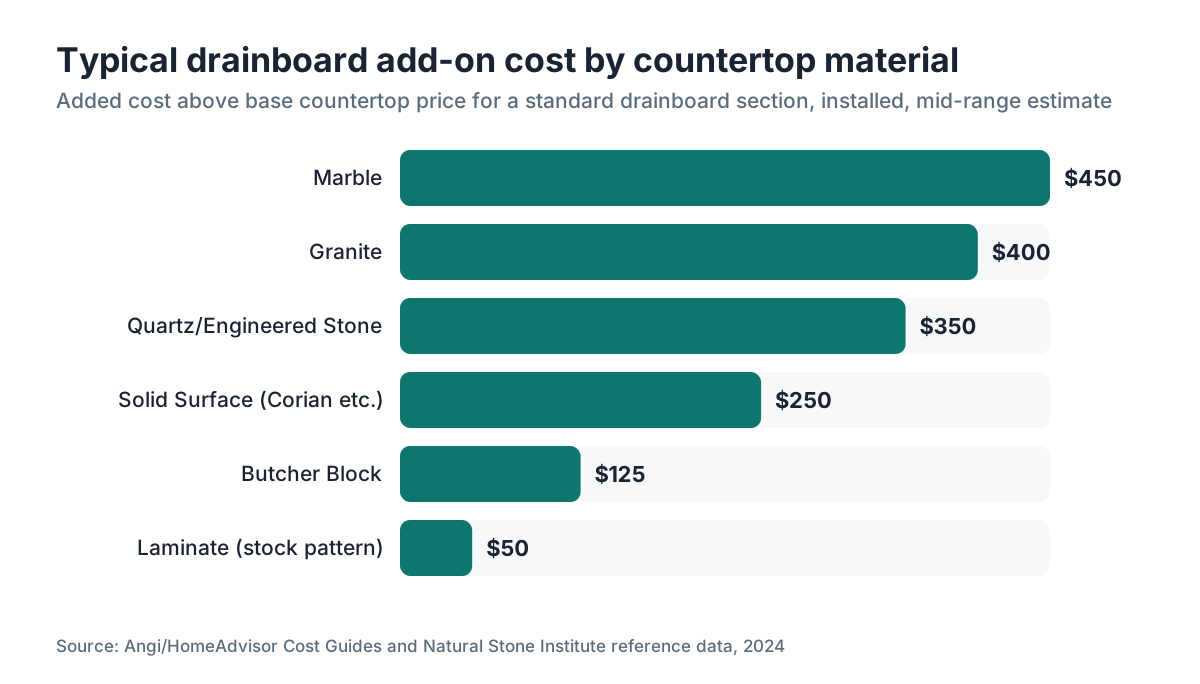
Material comparison for drainboard add-on cost:
| Material | Typical drainboard add-on |
|---|---|
| Granite | $200, $600 |
| Quartz/engineered stone | $200, $500 |
| Marble | $250, $650 |
| Solid surface (Corian etc.) | $150, $350 |
| Butcher block | $50, $200 |
| Laminate (if available as stock) | $0, $100 |
What questions should you ask a fabricator before accepting a drainboard quote?
A handful of questions will tell you fast whether a shop knows drainboards and whether the quote is complete.
First: is the machining a flat fee, per groove, or per linear foot? A flat fee is fine, but you want to know what triggers an upcharge. Does adding two grooves cost extra? What if you want them longer?
Second: what is the groove depth and spacing? Standard is 3/16 to 1/4 inch deep, spaced 1 to 1.5 inches apart. A fabricator who cannot answer this on the spot has probably not done many drainboards.
Third: what is the drain angle? Done right, the counter in the drainboard zone slopes very slightly toward the sink, typically 1/8 inch per foot. Some shops build that into the groove angle and set the slab on a level cabinet. Others shim the cabinet. Know which method they use.
Fourth: does the quote include finishing and polishing of the groove walls? Some shops include it, some charge extra. The groove walls should match the surface finish of the rest of the counter.
Fifth: what is the warranty on the drainboard work specifically? Granite is tough, but grooves can chip at the edges over time. A shop confident in its work will warranty the fabrication for at least a year.
For the rest of the picture, including what else happens during a granite install, see countertop installation.
Are there any permit or code requirements for a granite drainboard?
In most jurisdictions, no. A countertop drainboard is a finish material, not a plumbing fixture, so it does not require a permit on its own [5]. The drain from the sink still has to meet local plumbing code, but the stone surface draining into that sink is just a countertop feature.
Where code can touch the work: if you are also replacing the sink, adding a disposal, or moving drain lines, those steps often need a plumbing permit depending on your municipality. The countertop work itself, drainboard included, usually falls under the permit for a larger renovation if permits are pulled, or counts as permit-exempt routine replacement in most states.
If the drainboard is part of a bigger kitchen remodel that needs a building permit, your countertop contractor should be licensed as your state requires. Licensing rules for stone fabricators vary a lot by state [6]. California, for example, requires a C-54 tile contractor license or a C-61 specialty license for countertop work. Texas has no state-level license requirement specific to countertop fabricators, though local jurisdictions may differ [9].
The honest answer: for a straight countertop replacement with a drainboard, you almost certainly do not need a permit. Still, check with your local building department if you are unsure, because the cost of skipping a required permit is always worse than the cost of pulling one.
How do fabricators use software to quote drainboards accurately?
Drainboards are a good example of where generic quoting methods fall apart. A fabricator working from a spreadsheet or a handwritten price sheet has to remember to add the surcharge, calculate the right square footage, and avoid double-counting. Miss any of those and the quote is either too low (a loss) or too high (a lost sale).
Shops running dedicated fabrication quoting software can set up drainboard routing as a configurable operation with its own inputs: machine time, bit cost per linear foot, labor rate, and a fixed setup charge. When the estimator adds a drainboard to a project, the software figures the add-on automatically from the dimensions entered for that counter section.
Revision tracking helps too. A homeowner asks "what if I make the drainboard 6 inches shorter?" The estimator changes one dimension and the machining charge recalculates instantly. That kind of responsiveness builds trust in the number.
SlabWise is one tool built for this workflow. Shops that want to see how drainboard and custom operation pricing works in a quoting environment can request a demo. Good software should handle edge cases like drainboards as easily as it handles a straight counter run.
For a homeowner, the takeaway is simple. Ask your fabricator if they can show you the itemized drainboard charge. If they can, they are probably running a system that tracks costs carefully. If they cannot, you are working off a gut-feel number, which might be fine or might be a sign of a shop that runs loose.
Frequently asked questions
How much does a granite drainboard add to the cost of a countertop?
Expect to add $200 to $600 to your countertop quote for a standard integral granite drainboard with parallel grooves. The range tracks the size of the section, the hardness of the granite, and whether your shop charges a flat machining fee or prices by groove or linear foot. Custom groove patterns or hand-carved work push the cost higher.
Is a granite drainboard worth the extra cost?
For kitchens with heavy sink use, yes. An integral granite drainboard kills the rubber mats, stops water from pooling, and adds a clean look that holds up for decades. Maintenance is light: keep the grooves clear of debris and re-seal with the rest of the counter once a year. If you rarely air-dry dishes by the sink, the functional case is weaker, but the visual appeal still counts.
What is the standard groove depth and spacing for a granite drainboard?
Most fabricators cut grooves 3/16 to 1/4 inch deep and space them 1 to 1.5 inches apart center-to-center. Exact dimensions vary by shop and preference. Deeper grooves drain faster but leave less material between them, which can be a concern on 2 cm slabs. A 3 cm slab gives more room to work on groove depth.
Can any granite be used for a drainboard, or are some stones better?
Most granites work fine. Harder, denser varieties take longer to machine and may cost a little more to fabricate, but they also hold groove edges crisply over time. Steer clear of very porous granites in wet applications unless you are committed to regular sealing. Ask your fabricator which slabs in their yard they have machined drainboards from, since hands-on experience with a specific stone beats specs alone.
Does a granite drainboard need a special seal or treatment?
No special sealer is needed. Use the same penetrating sealer you apply to the rest of the granite, typically once a year for most granites, though denser stones may need it less often. The grooves are not a weak point for sealing as long as the applicator works the product into the groove walls and not only across the flat surface.
How long does it take to fabricate and install a granite drainboard?
Fabrication adds 30 to 90 minutes of machine time to the shop schedule. The total project timeline usually does not change, because the drainboard is cut in the same shop session as the rest of the countertop. Installation day timing is unchanged. The main schedule risk is a late drainboard request, added after the CNC program is already set up, which may push the machine time to another day.
Can an existing granite countertop be retrofitted with a drainboard?
Technically yes, but it is expensive and risky. The granite has to come off the cabinets, go to the shop, get machined, get refinished, and reinstall. The removal and reinstall cost often beats the drainboard machining cost, and there is a real chance of cracking during removal of an already-installed slab. Planning the drainboard at initial installation is almost always cheaper.
What is the difference between an integral drainboard and a separate drainboard insert?
An integral drainboard is machined into the main slab and is permanent. A separate insert is a standalone piece of granite that sits on the counter next to the sink and lifts out. Inserts cost $300 to $700 as a standalone piece because all four edges need finishing and small pieces carry a steep labor-to-material ratio. Integral drainboards are more common in kitchen granite work.
Does the sink style affect drainboard pricing?
Yes. Undermount sinks with a curved cutout make the grooves terminate against a curved edge, which takes more careful CNC work and can add $50 to $100 to the machining charge. Farmhouse and apron-front sinks with a straight front edge simplify the groove termination. Drop-in sinks sit on top of the counter, so the drainboard never has to meet a cutout edge at all.
How do I know if the drainboard angle is set correctly?
The surface in the drainboard zone should slope toward the sink at roughly 1/8 inch per foot. Test it after installation by pouring a small cup of water on the drainboard and watching it run toward the sink. If it pools or runs toward the wall, the angle is off. Fix it before final acceptance, because correcting it later means pulling the slab back to the shop.
Are there building codes that apply to granite drainboards?
No specific code governs the countertop drainboard surface itself in most US jurisdictions. It is treated as a finish material, not a plumbing fixture. If your project also moves drain lines or adds a disposal, those plumbing changes may need a permit depending on your municipality. Check with your local building department if you are unsure about your specific project scope.
Why do two shops quote such different prices for the same drainboard?
Shops structure drainboard pricing differently. Some use a flat fee, some price by groove, and some fold the cost into a higher overall square footage rate. Equipment varies too. A shop with a fast CNC router and standard granite toolpaths may charge $200, while a smaller shop doing it by hand may charge $450 for the same result. Always ask for an itemized breakdown so you can compare like for like.
Sources
- HomeAdvisor (Angi), Granite Countertop Cost Guide: Granite countertops run roughly $40 to $100 per square foot installed for standard grades
- U.S. Consumer Product Safety Commission, Home Improvement Overview: Laminate countertop drainboard sections are available as stock items from suppliers and cost significantly less than natural stone fabrication
- USGS, Minerals Information: Granite hardness on the Mohs scale ranges from approximately 6 to 7.5 depending on mineral composition
- National Kitchen and Bath Association, NKBA Professional Resource Library: Templating visits for countertop fabrication are standard practice and may be charged separately at $50 to $150 depending on the shop
- International Code Council, International Residential Code, Plumbing Fixtures provisions: Countertop drainboard surfaces are finish materials not classified as plumbing fixtures and do not require a plumbing permit on their own
- California Contractors State License Board, License Classifications: California requires a C-54 tile contractor license or C-61 specialty license for countertop fabrication and installation work
- EPA WaterSense, Residential Water Efficiency: Proper slope on drainboard surfaces of approximately 1/8 inch per foot supports effective drainage toward the sink
- Texas Department of Licensing and Regulation: Texas has no state-level license requirement specific to countertop fabricators, though local jurisdiction requirements may apply
- Tile Council of North America, TCNA Handbook for Ceramic, Glass, and Stone Tile Installation: Penetrating sealers are the standard treatment for granite countertops including drainboard sections, recommended annually for most granite types
Last updated 2026-07-10