TL;DR
- Bookmatching from a single slab means sawing the stone into two thinner pieces along one cut, then flipping one so the fresh faces meet and the veins mirror.
- The block has to be thick enough to yield two usable slabs after the saw kerf, usually 68 mm or more for two 3 cm finished tops.
- Layout, vein reading, and a tight seam are the whole job.
What is bookmatching and why does it start at the slab, not the shop?
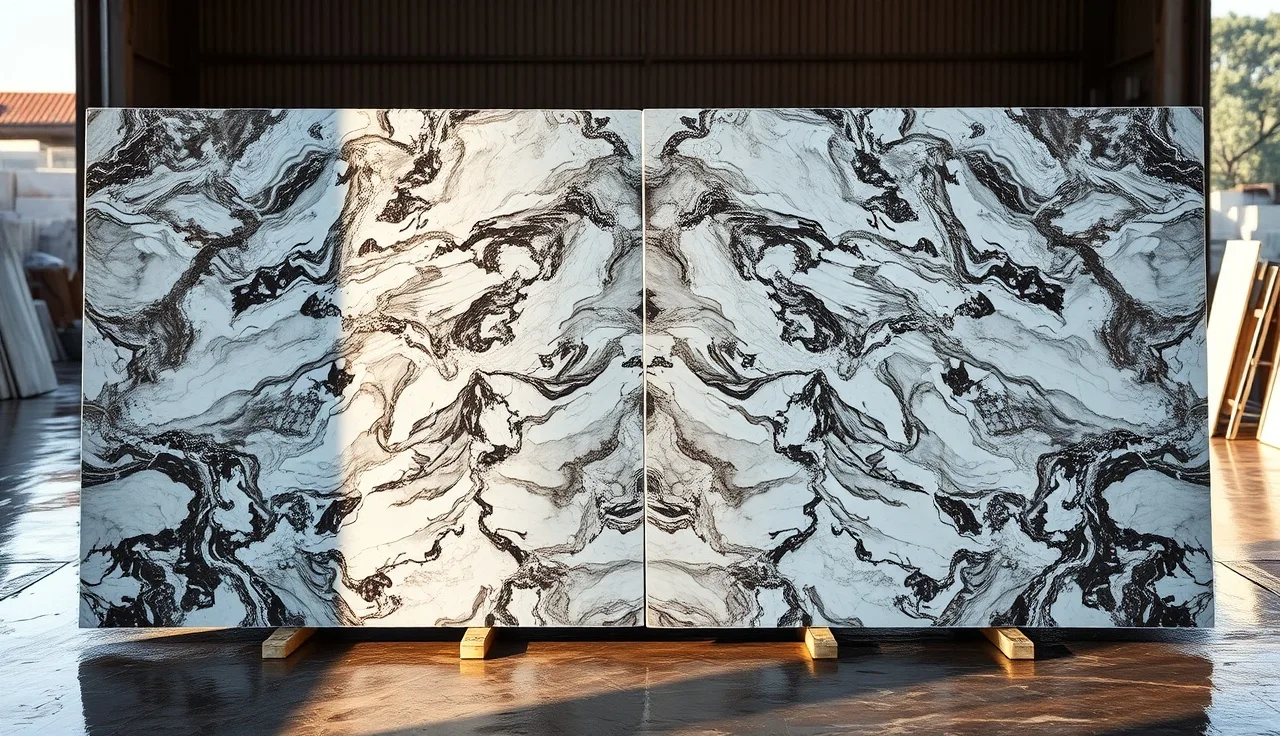
Bookmatching opens a piece of stone like a book, so two cut faces show veining that mirrors itself across a center seam. The name comes from woodworking, where figured veneers were literally opened like pages. The principle is the same in stone. [1]
When you bookmatch a countertop from a single slab, you take one block of material and saw it into two thinner slabs. Lay those two pieces side by side with their cut faces up and the veins run symmetrically across the join. On heavily veined marble, quartzite, and some granite, the effect can stop people in the doorway.
Here is the part homeowners miss. The choice to bookmatch has to happen before you buy the slab, or at the very latest before anyone touches it in the shop. You need enough thickness to yield two finished pieces after the saw eats its share. A standard quarry-cut slab arrives at 2 cm or 3 cm finished. To get two 2 cm finished slabs from one block, you need raw material starting around 5 cm to 6 cm, once you account for the saw kerf (typically 4 mm to 6 mm on a bridge saw blade) and the surfacing loss on both new faces. [2]
That is why quarries and distributors sell "bookmatching pairs" as their own product. They already made the primary cut at the quarry or the processing plant, polished both new faces, and sold you the set. Cutting your own pair from a single thick slab is a different job. It needs a gang saw, a large bridge saw, or a wire saw that can handle the full thickness.
What thickness slab do you need to produce a bookmatched pair?
The math here does not bend. Before you plan the cut, nail down three numbers: the finished thickness you want for each slab, the saw kerf width, and how much the surfacing (grinding and polishing) will take off each newly exposed face.
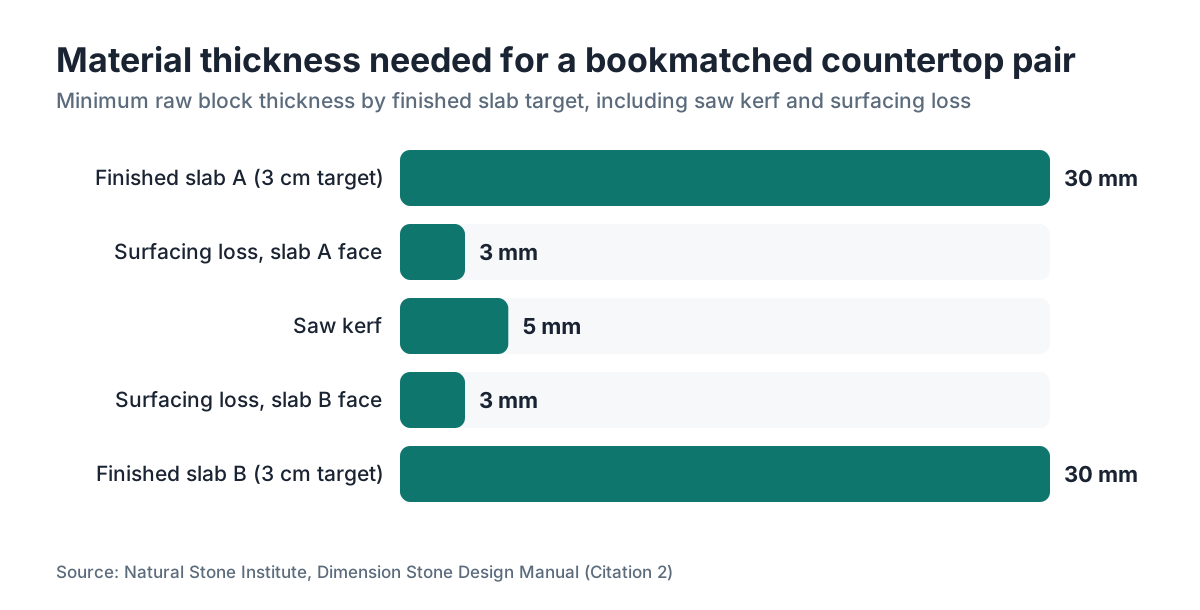
For a standard 3 cm (roughly 1.25 inch) finished countertop, here is the stack:
| Component | Typical value |
|---|---|
| Finished slab A thickness | 30 mm (3 cm) |
| Surfacing loss, slab A cut face | 2 to 3 mm |
| Saw kerf | 4 to 6 mm |
| Surfacing loss, slab B cut face | 2 to 3 mm |
| Finished slab B thickness | 30 mm (3 cm) |
| Total raw block minimum | 68 to 75 mm (roughly 7 to 7.5 cm) |
For 2 cm finished slabs the numbers are gentler, but 2 cm tops are uncommon in North American residential work. Two 3 cm finished slabs realistically need a raw block around 75 mm thick. Most quarried blocks come in at 200 mm or more, so this is usually doable at the quarry stage. A standard 3 cm slab from a distributor is already finished on both faces and cannot be bookmatched again without dropping below usable thickness. [2]
Buying from a distributor and want to bookmatch? Ask straight out for a "book-cut pair" or an unfinished thick slab. Some distributors keep raw or "gangsaw" slabs at 6 cm or more for exactly this.
How do fabricators read veining to plan the cut line?
Reading the slab is the part that separates a jaw-dropping result from a shrug. Veins in natural stone are three-dimensional structures running through the rock at angles that may not match the slab face at all. Cut through the block and the pattern you expose depends entirely on the angle of that cut against the vein orientation inside. [3]
Step one is wetting the slab completely. Water darkens the stone and shows the veining close to its final polished state. Most fabricators keep a bucket and a sponge brush at the yard for this. The wet surface tells you where the major vein lines run and how bold they are.
Step two is imagining the cut. The primary bookmatching cut always runs parallel to the existing polished face. That gives you two slabs that mirror each other at the cut plane. If the veins travel through the slab at a steep angle, the pattern on the two new faces will look different from the polished face you see in the yard. This catches homeowners off guard. The original surface is one cross-section of the veins. The bookmatched interior faces are a different cross-section, deeper in the rock.
Step three is marking the layout. With chalk or a wax pencil, mark the cut line on the edge of the slab. On a wide island, mark the seam location on the top face too, so everyone agrees where the halves will meet. The seam should land where the vein pattern makes the join read as logical. Centered on an island is usually ideal. A seam that runs into a sink or cooktop cutout can vanish nicely.
Step four is a mock layout with cardboard or digital templating. If the kitchen is already templated, cut cardboard mockups of both pieces to scale, wet the slab, lay them down, and rotate them until the veins read the way you want. Some shops photograph this and send it to the customer for approval before any blade touches stone. [4]
What equipment cuts a slab in half for bookmatching?
A standard bridge saw with a 14-inch or 16-inch diamond blade makes the primary bookmatching cut on slabs up to about 50 mm thick, depending on the machine's cutting depth. Most fabrication-grade bridge saws (Baca Systems, Park Industries, Comandulli) cut 50 to 80 mm at full depth. Check the spec sheet before you assume anything. [5]
For thicker blocks you are looking at a wire saw or a gang saw. Wire saws run a continuous diamond-embedded wire around guide wheels and slice through material of almost any thickness, though they cost real money and are rare in small shops. Gang saws are quarry equipment, not a shop tool.
Here is the practical reality for most fabricators. If you buy a 6 to 7 cm block from a distributor, a well-tuned bridge saw set up for a horizontal cut can handle it. The cut runs with the slab lying flat and the blade tracking horizontally through the side edge. Some shops stand the slab on edge and run a vertical cut instead, which works if the slab is stable and the saw has the clearance.
CNC waterjet machines cannot do this cut in practice. They cut from above, not through the full thickness in a horizontal plane.
After the primary cut, each new face gets surface-ground and then polished to match the original finish. That happens on a multi-head polishing line or by hand with angle grinders and progressively finer diamond pads, usually running from 50-grit up through 3000-grit or higher depending on the stone. [6] Marble and softer stones polish faster than granite or quartzite.
How do you orient the two halves so the veins actually mirror each other?
This is where the book analogy gets literal. After the cut you have two slabs. Slab A carries its original top face (already polished) and a new bottom face (freshly cut, waiting for polish). Slab B is the same in reverse.
To build the mirror, you flip one slab. The usual method:
- Lay slab A flat, original polished face up. This becomes the left side of the countertop.
- Take slab B, which sat directly below slab A in the original block. Rotate it 180 degrees around the seam axis. Not around a vertical axis. Around the horizontal axis that runs along the seam edge. This flip is what creates the mirror.
- The cut faces of both slabs now point up and sit next to each other at the seam.
Some layouts use a "book fold" around the vertical axis instead, which gives a different symmetry. A horizontal flip gives you a true reflection across the seam. A vertical rotation gives rotational symmetry, not a strict mirror. Most designers want the true mirror, so the horizontal flip is the standard move.
After the flip, wet both slabs and push them together at the seam. Step back. The veins should meet at the seam and radiate outward symmetrically. If they don't line up, the cut wasn't exactly parallel to the vein plane, or the original slab had some bow. A small miss can sometimes come out with a slight rotation of one slab. A big miss means the effect will be quiet rather than loud, and the customer should see that before the job moves another inch.
How do you cut and seam a bookmatched countertop accurately enough to hide the joint?
Once the slabs are oriented, the seam edge decides whether the match looks professional or nags at you. A visible gap or a color shift at the seam line kills the whole effect.
The seam edge on each slab has to be cut on the bridge saw or CNC to a straight line within about 0.5 mm over the length of the seam. On a 96-inch island, that means the two edges together land within 1 mm of a perfect pair when pushed home. Most good bridge saws hold this easily if the table is calibrated and the fence is true. [5]
After the saw cut, the seam edges get polished or lapped to clear the saw marks. Many fabricators run the seam edge through a profile machine for a flat (eased or square) edge and a consistent finish. The seam edge profile should match the field edge of the top.
At install, the two halves join with color-matched epoxy or polyester seam adhesive. The adhesive gets tinted to match the stone's background color, spread on one edge, and the pieces are pressed together. Suction cups and seam setter clamps hold them while it cures. After curing, a razor blade takes the excess and the seam is hand-polished flush.
The best seams, on a well-bookmatched slab, are nearly invisible, because the vein pattern pulls the eye across the seam instead of down onto it. On a plain, low-vein stone, seams show no matter how well you cut them. Bookmatching actually helps hide seams, which is one reason designers spec it on big islands where a seam is coming anyway. [4]
Quoting a bookmatching job? Seam labor typically runs $50 to $150 per linear foot depending on shop and region, on top of the standard fabrication price. [7]
Does bookmatching work on all stone types?
Not equally. The showstoppers in design magazines almost always feature heavily veined marble (Calacatta, Statuario, Arabescato) or high-movement quartzite (Taj Mahal, Fantasy Brown, Macaubas). These stones carry bold, continuous veins that read clearly across the seam. [8]
Speckled granite (think Ubatuba or Baltic Brown) gives you no real bookmatch, because the pattern is random at a small scale. The two halves look like the same stone, not a mirror. If a customer asks for a bookmatched granite island, be honest before they pay the premium.
Engineered quartz (Silestone, Cambria, and similar) cannot be bookmatched from a single slab in the traditional sense, because the pattern comes from aggregate mixed into a polymer binder. There is no internal vein structure to reveal. Some engineered lines now sell factory-bookmatched pairs where the surface pattern is printed or arranged to suggest symmetry, but that is a product, not a fabrication technique. [9]
Onyx and some highly figured travertines bookmatch beautifully but are fragile. They often need mesh backing or lamination to a substrate before handling, which adds cost and hassle.
Quartzite is the sweet spot for most residential bookmatching. Strong, consistent veining. Good hardness (Mohs 7 or above). It polishes well after the cut. [3]
What does a bookmatched countertop cost compared to a standard installation?
There is no single industry price list, and costs swing hard by region, material, and shop. With that said, here is where the added money actually goes.
The slab is the biggest variable. A bookmatching pair bought pre-cut from a distributor typically runs 1.5 to 2.5 times the price of a single standard slab of the same material, because they already made the cut, polished the new faces, and are selling a matched set rather than a commodity slab. [7]
Having a shop cut a thick raw block instead? Add $200 to $600 for the saw setup and the cut (depending on slab size and complexity), plus the polishing on the new faces. Polishing a fresh face on a large slab can take 2 to 4 hours of labor.
Fabrication labor is mostly the same as a standard job, with two additions: extra templating time to plan the vein match ($100 to $200) and the seam work at install (see seam cost above).
Total premium over a standard single-slab top: roughly 30% to 60% more for the whole job, depending on whether you bought a pre-cut pair or had the cut made. On a $4,000 marble island, expect the bookmatched version to land at $5,200 to $6,400. These numbers are rough and regional. Get itemized quotes.
Shops that do a lot of bookmatching track material yield and labor per job closely. Software like SlabWise can model the cut layout on a digital slab and verify yield before anyone touches the stone, which keeps mistakes off expensive material.
For comparison, a standard marble countertops installation averages $60 to $100 per square foot installed in most U.S. markets, before any bookmatching premium. [7]
What are the most common mistakes when cutting a bookmatched countertop?
The mistakes break into three phases: planning, cutting, and installation.
Planning. Not wetting the slab before layout is the classic. Dry stone hides vein direction and intensity. Picking a slab where the veins run nearly perpendicular to the cut plane is another trap, because the bookmatched faces will show a weaker, different pattern than the face you fell in love with. Trace the vein direction on the edge of the slab before you commit to anything.
Not confirming the seam location with the homeowner before cutting is a process failure that turns into an argument later. The seam on a bookmatched island should live in a drawing, get signed off by the customer, and get photographed at layout.
Cutting. Letting the slab flex during the horizontal cut produces a wavy surface that polishes unevenly. Support the slab fully along its length on foam or rubber-coated stands. A cut that wanders 2 mm across 8 feet leaves a seam gap no adhesive can fill cleanly.
Rushing the polish on the new faces. The cut surface is rough and has to climb through every intermediate grit before final polish. Skip grits and you leave micro-scratches that jump out under raking light. [6]
Installation. Joining the halves without a dry fit first. Always push the two pieces together dry, adjust the vein alignment, photograph it, and get approval before the adhesive goes on. Epoxy cures fast and the window to fix anything is short.
Not sealing the seam edge before installation on porous stones like marble. An unsealed edge wicks adhesive into the stone and can leave a dark shadow line at the seam that shows even after cleanup.
How do digital templating and layout tools help with bookmatching?
Digital templating changed how bookmatching gets planned. A laser or structured-light templating system (LT-55, Prodim, or similar) captures the kitchen as a point cloud or DXF file in under an hour. That file goes into the shop's layout software, where the fabricator overlays the countertop shapes on a digital image of the slab. [5]
For bookmatching, the fabricator imports images of both slab halves (shot in the yard after wetting), overlays the shapes, and checks that the vein pattern aligns at the seam before any stone gets cut. This catches mismatches you can't see in a yard mock-up, because you can't always wrestle two heavy slabs side by side on the ground.
Shops using SlabWise can run the nesting layout digitally to confirm yield from both halves and flag whether the cuts leave enough margin. That is the difference between a $2,000 slab and $2,000 of scrap.
For homeowners, digital templating also produces the signed layout drawing that documents seam location and vein orientation. That is the customer-approval record you want in writing before cutting. [4]
For the full installation workflow, see countertop installation.
Can you bookmatch two separate slabs from the same block instead of cutting one slab yourself?
Yes, and for residential projects this is the more common route. When a quarry processes a block, it runs the whole thing through a gang saw that makes many parallel cuts at once, producing a "book" of matched slabs. Adjacent slabs from the same book (often labeled with sequential numbers at the distributor) are close matches, though not perfect mirrors, because each cut is a new cross-section slightly offset from the last.
True bookmatching pairs from a distributor are consecutive slabs from the same book, ideally the two halves around one gang-saw cut. That makes them as close to mirrors as the quarry can produce. Ask the distributor for the slab sequence numbers and ask to see both slabs side by side before you buy.
The upside of a pre-cut pair: both faces are already polished, the thickness is standard, and you skip the in-shop cutting. The downside: the join between the two slabs carries more than two gang-saw kerfs of material lost, plus any bow or variation between them, so the vein alignment at the seam can be less precise than a single-block cut.
For high-end work, some importers offer "book-cut and book-matched" pairs where the primary cut was made at the processing plant, both new faces were polished right away, and the pair stayed together through shipping. These cost the most and give the most precise mirror. [8]
Working with granite countertops or marble countertops and want to bookmatch? Talk to your distributor about consecutive-slab pairs in stock before you buy anything.
How should homeowners evaluate a bookmatching job before they sign off?
Before the stone is cut, ask for a wet-slab photo or an in-person walk through the yard with the two halves positioned the way they will install. The veins should meet at the intended seam line and radiate outward so the join reads as intentional. You are looking for continuity, not perfection. Natural stone varies, and a near-mirror is the realistic goal, not a mathematically exact reflection.
At templating, confirm the seam location in writing. On a kitchen island the seam usually centers, but if there is a sink or prep sink, it can sometimes shift to run through or near the cutout, where it hides better. Ask your fabricator where they recommend it and why.
At installation, do a dry fit with both pieces in position before the adhesive is mixed. This is your last chance to judge the vein alignment with your own eyes, in the actual room, under the actual light. Raking light from a window shows an edge mismatch far more clearly than any photo. If something looks off, say so before the epoxy comes out.
After installation, the seam should be tight enough that you have to hunt for it. Run a fingertip across it. A good seam is flush. If you feel a ledge, the two pieces sat at different heights when the epoxy cured, and that lip catches crumbs and moisture over time. A small height difference (under 0.5 mm) can be hand-polished flush. Anything more should be fixed before you accept the countertop.
Care after installation follows the material type. For quartzite, see how to clean quartzite countertops. For marble or softer stones, how to clean stone countertops covers the sealing and cleaning basics that apply whether or not the slab was bookmatched.
Frequently asked questions
Can you bookmatch a countertop from a standard 3 cm slab you already own?
No. A finished 3 cm slab is already at final thickness and cannot be split again without leaving pieces thinner than any practical countertop (roughly 10 mm per half after saw kerf and surfacing loss). Bookmatching needs either a pre-cut pair from a distributor or a raw block that starts at 68 mm or thicker.
How much extra does a bookmatched countertop cost?
Plan on 30% to 60% more than a standard single-slab installation of the same material. The premium comes from slab cost (matched pairs are priced higher), the extra cut and polishing labor if you have the cut made in shop, and the seam work at install (typically $50 to $150 per linear foot of seam). Get an itemized quote, not a blanket surcharge.
What stones bookmatch best?
Heavily veined marbles (Calacatta, Statuario), quartzites with bold linear movement (Taj Mahal, Macaubas), and figured onyxes give the most dramatic results. Speckled granites with random crystalline patterns show little to no bookmatching effect. Engineered quartz cannot be bookmatched in the traditional fabrication sense.
Where should the seam go on a bookmatched island?
Centered on the island is the most common choice, because it puts the seam on the axis of symmetry, which is also where the vein pattern mirrors. If the island has a prep sink, running the seam through or beside the cutout works well, because the cutout breaks up the seam visually. Confirm the location in a signed drawing before fabrication begins.
Is the seam between two bookmatched halves weaker than the rest of the countertop?
An epoxy-joined seam on a properly supported countertop is stable for normal use. The seam should not bear point loads or serve as a cutting surface (true of any stone top). The adhesive is not as strong as the stone in tension, so avoid spanning the seam across an unsupported gap wider than about 6 inches without extra substrate support.
Can engineered quartz be bookmatched?
Standard engineered quartz (Cambria, Silestone, Caesarstone) has a manufactured random or printed pattern and cannot be bookmatched by cutting a slab in half. Some manufacturers now offer pre-made bookmatched panel pairs where the surface pattern was designed for symmetry at the factory, but those are bought as a product, not made in a fabrication shop.
How do I know if the vein pattern will actually mirror after the cut?
Wet the slab and use a chalk line or straight edge to mark the intended cut on the edge. Trace the major veins at both surfaces. If the veins exit the top face at roughly the same angle and position as they exit the bottom face along the cut line, the two new faces will produce a strong mirror. If the veins shift a lot from top to bottom, the match will be partial. A skilled fabricator can tell you this before any cutting.
Does bookmatching affect how the countertop needs to be sealed or maintained?
No. Sealing and maintenance for a bookmatched top match any countertop of that material. Seal the seam along with the field after installation. The epoxy in the seam is non-porous and needs no sealing, but the stone on either side does if it is a porous material like marble or unsealed quartzite.
How long does it take to fabricate and install a bookmatched countertop?
Add roughly one to two extra days to a standard fabrication timeline. The primary cut and face polishing take half a day to a full day depending on slab size and equipment. Layout approval adds time if the customer needs to see the wet slabs before sign-off. Installation runs similar to a standard job plus 30 to 60 minutes for the seam setup and cure wait.
What is the difference between bookmatching and vein matching?
Vein matching aligns veins at a seam so they read continuously, but without the mirror symmetry. You might vein-match two separate slabs of the same material where the veins happen to line up. Bookmatching specifically means one slab (or a gang-saw pair) opened like a book to produce a symmetrical, mirrored pattern. Vein matching is easier. Bookmatching is the premium version.
Do fabricators charge extra for the digital layout approval step?
Some fold it into standard quoting. Others bill $100 to $200 as a separate layout or design consultation fee. Given how expensive a slab mistake is, paying for a documented digital layout approval is worth it. Ask for the layout drawing as a PDF you can sign off on before any cuts are made.
Can you bookmatch a backsplash to match the countertop?
Yes, and it looks striking. The backsplash slab should come from the same block or the same quarry book as the countertop halves, cut to continue the vein pattern up the wall. This is sometimes packaged with a waterfall edge. Coordinate the layout before any cuts so the vein lines flow continuously from countertop to wall.
What should I ask my fabricator before agreeing to a bookmatched countertop?
Ask five things. Can I see the two halves wet and positioned together before you cut anything? Where exactly will the seam go, and can I see it on a drawing? What will the seam look like if the veins don't align perfectly? What is the cut-to-delivery timeline? What happens if one slab cracks during cutting? Get the answers in writing.
Sources
- Natural Stone Institute (formerly Marble Institute of America), Stone Glossary: The term bookmatching in stone fabrication refers to opening a piece of material like a book to reveal mirrored interior faces.
- Natural Stone Institute, Dimension Stone Design Manual: Standard finished slab thicknesses of 2 cm and 3 cm and the saw kerf loss of 4 to 6 mm associated with bridge saw diamond blades.
- USGS, National Minerals Information Center: Vein and mineral orientation in dimension stone is three-dimensional and varies with block position in the quarry.
- Natural Stone Institute, Dimension Stone Design Manual: Customer sign-off on layout drawings and seam location is recommended before fabrication begins on matched-slab projects.
- Park Industries, Bridge Saw Product Specifications: Fabrication-grade bridge saws typically achieve cutting depths of 50 to 80 mm depending on blade diameter and machine model.
- Natural Stone Institute, Care and Cleaning of Natural Stone Surfaces: Diamond polishing of stone cut faces requires progression through grits from approximately 50 to 3000 or higher to achieve a consistent polish.
- Angi, Countertop Installation Cost Guide: Marble countertop installation averages $60 to $100 per square foot installed in the U.S.; seam labor ranges $50 to $150 per linear foot.
- Natural Stone Institute, Purchasing Natural Stone: Book-cut and book-matched pairs are sold by importers as premium matched sets where both new faces were polished at the processing plant.
- Natural Stone Institute, Engineered Stone Guidance: Engineered quartz does not have internal vein structure and cannot be bookmatched in the traditional fabrication sense; some manufacturers offer pre-designed symmetrical panel products.
- U.S. Geological Survey, Dimension Stone Statistics and Information: Quartzite and marble are among the most commonly imported dimension stone types used in U.S. residential countertop fabrication.
Last updated 2026-07-11