TL;DR
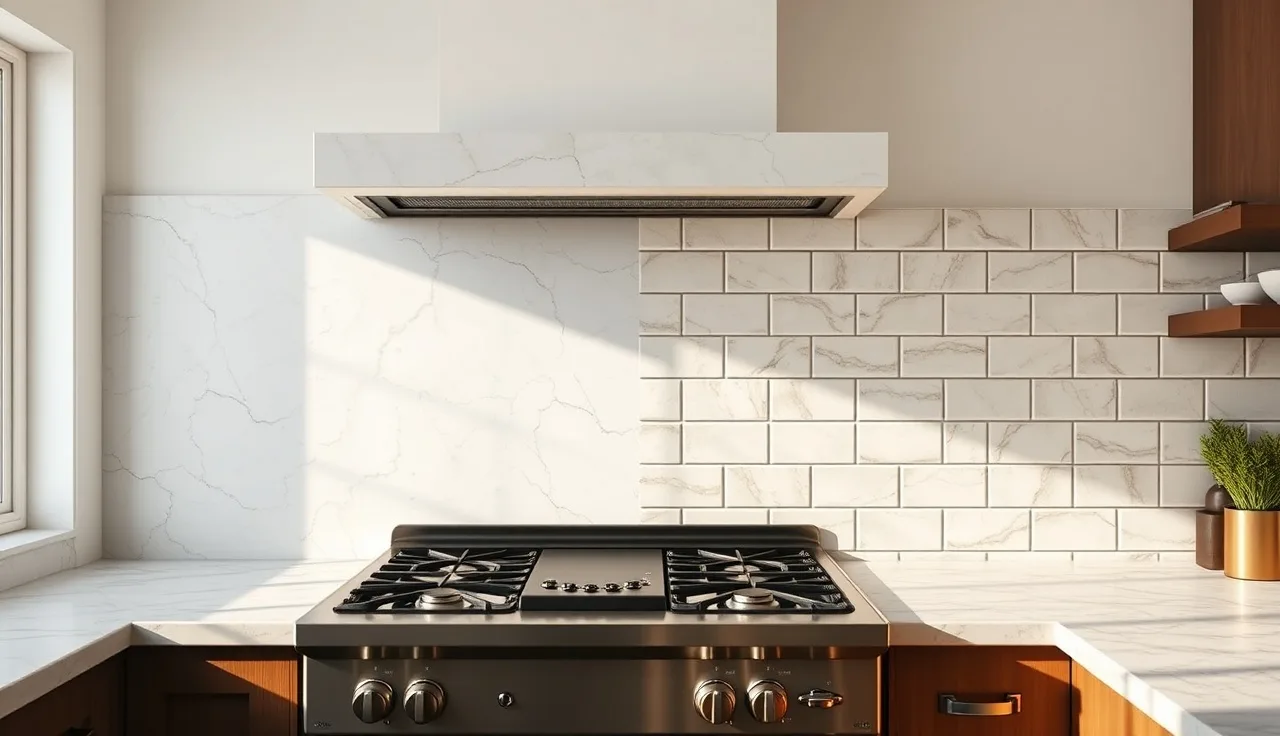
- A full-height stone slab backsplash typically costs $60, $150 per square foot installed.
- A tile backsplash runs $10, $40 per square foot installed.
- The gap comes from material cost, fabrication difficulty, and the cutting skill required.
- Both add value.
- The right choice depends on your remnant situation, layout complexity, and how much grout you want to live with.
What does a full-height stone backsplash actually cost?
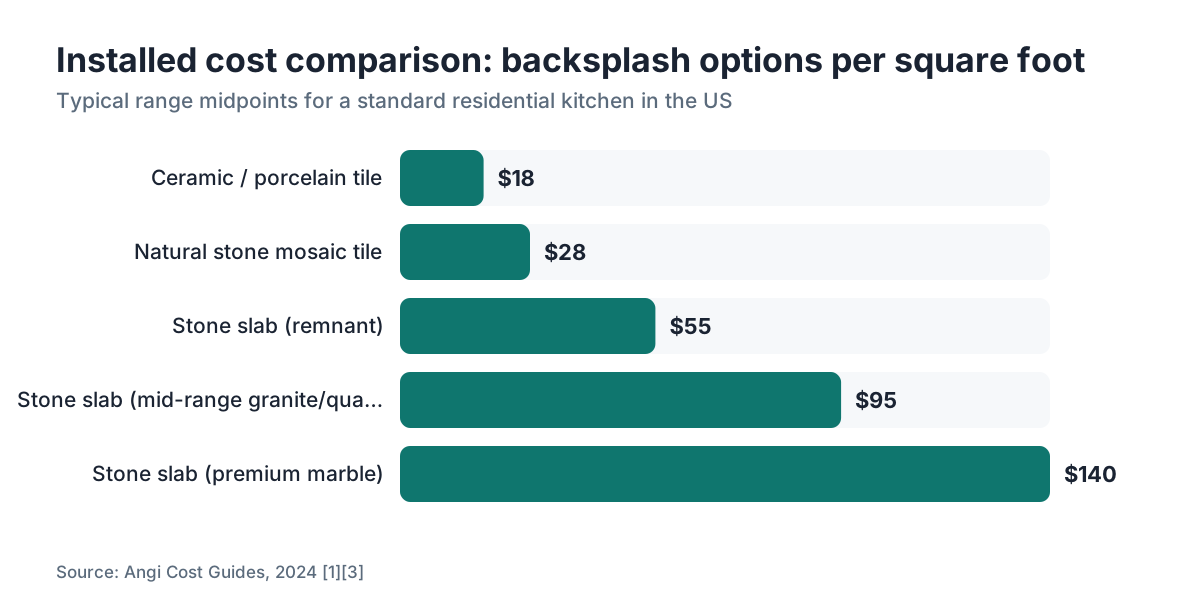
The honest installed price for a full-height stone slab backsplash is $60 to $150 per square foot, with most kitchens landing between $80 and $120 [1]. That range is wide because the material itself is the biggest swing factor. A builder-grade granite remnant might get you to $60 per square foot all in. A book-matched Calacatta marble slab pushing $200 per square foot at the slab yard will blow past $150 easily once you add fabrication and install.
The math homeowners miss is that a full-height backsplash is more than material. You're paying for the stone, the fabrication (cutting outlets, switches, and window sills to tight tolerances), delivery, and the installer's time to handle 400-plus-pound slabs safely. Labor alone for a stone backsplash install generally runs $15, $30 per square foot in most US markets [2]. That's separate from the stone price.
For a typical kitchen with 30 square feet of backsplash space, a mid-range quartz or granite slab backsplash runs $2,400 to $4,500 installed. A premium marble version of the same kitchen can hit $6,000 or more.
What does a tile backsplash cost by comparison?
Tile backsplash pricing is $10, $40 per square foot installed for most residential kitchens [3]. That breaks down to roughly $2, $15 per square foot for tile material and $7, $25 per square foot for labor. The labor range is real. Subway tile set in a running bond on a flat wall is fast and forgiving. Small mosaic or large-format tile on a crooked wall takes measurably more time.
Standard 3x6 ceramic subway tile costs about $2, $5 per square foot at retail. Natural stone mosaic tile (travertine, marble, or slate chip) runs $8, $20 per square foot. Handmade zellige or imported terracotta can reach $30, $40 per square foot in material alone before a single trowel hits the wall.
For that same 30-square-foot kitchen, expect $300 to $1,200 installed using typical ceramic or porcelain tile. Upgrade to a stone mosaic and you're at $750 to $1,800. Tile is cheaper almost always, but the gap narrows fast once you go upscale.
Grout is not free, either. Budget $30, $60 for grout and thinset on a standard 30-square-foot tile job, and add $50, $100 if you want an epoxy grout that actually resists staining long-term [4].
How do you measure square footage for a backsplash quote?
Measure every wall section from the countertop surface to the upper cabinet bottom (or to the ceiling if there are no upper cabinets). Width times height gives you the gross square footage for each section. Add them up.
Then subtract openings you won't be covering: windows (measure the glass opening, not the frame), vent hoods that sit flush to the wall, and any appliance alcoves. On a tile quote, subtract openings only if they're larger than about 1 square foot. Smaller cutouts rarely change tile quantity enough to matter because of breakage allowance.
For a stone slab quote, those cutouts matter more because they affect how the fabricator lays out cuts on the slab. A window centered in a backsplash section might force the fabricator to cut two separate pieces instead of one, adding joint lines and cost.
Full-height backsplash runs from the countertop to the upper cabinet, usually 18 to 22 inches [9]. Floor-to-ceiling versions (when there are no upper cabinets, like a range hood wall) can be 8 to 9 feet tall. Those tall sections need the fabricator to seam multiple pieces, which adds labor and requires careful color and vein matching. A visible backsplash seam shows far more than a countertop seam hiding under a toaster, so factor in premium labor when the backsplash section runs over 55 inches tall [5].
What drives up the cost of a stone slab backsplash specifically?
Material grade is the biggest driver. The same white-veined look costs dramatically different amounts depending on whether you're buying quartzite, marble, or engineered quartz.
Fabrication difficulty is next. Outlet cutouts in a stone slab are slow, careful work. Each one needs a router or angle grinder pass, clean edges, and a fit that doesn't crack the panel. A kitchen with 8 outlets and 4 switches in the backsplash zone costs more to fabricate than a clean run with two outlets. Budget roughly $15, $25 per electrical cutout in stone [1].
Seams cost money too. Stone panels wider than about 60 inches or taller than about 55 inches need to come from multiple pieces. Every seam adds labor for color-matching, cutting, and epoxy. A book-matched look (where two mirrored slabs create a symmetrical vein pattern) requires that the fabricator buy and cut the slabs together, which often means purchasing two slabs to yield one backsplash.
Weight is a real factor on installation day. A three-quarter-inch thick stone panel weighs roughly 12 pounds per square foot [10]. A 10-square-foot section above the range is 120 pounds on the wall. Proper substrate prep (usually cement board or a well-anchored drywall surface) and industrial adhesive are not optional. Skimp there and the panel eventually fails.
Stone type affects price for two reasons: raw material cost, and how hard the stone is to work. Quartzite dulls blades faster and takes longer to polish edges than softer marbles. See our guide to quartzite care if you're weighing that material.
How do fabricators price a stone backsplash job differently from a countertop?
Most fabricators price a backsplash as a separate line item from the countertop, even when it's the same material. The labor profile is different. Backsplash panels are thinner, lighter, cut differently, and installed on a vertical surface where gravity works against you the whole time.
Typical fabricator pricing models for a stone backsplash include a per-square-foot rate for the material, a per-linear-foot rate for edge finishing (exposed edges above the counter, side returns), and a per-cutout rate for outlets and switches. Some shops also charge a minimum job size, often $300, $500, because a two-square-foot accent piece behind a range takes nearly as long to template and fabricate as a 15-square-foot run.
Fabricators who use quoting software can line-item these costs clearly: material square footage, cutouts, edge profiles, and labor as separate inputs. If a fabricator hands you a single number with no breakdown, ask for the line items. You need to know what happens to the price if you add a window or remove two outlet cutouts.
If you're a fabricator building these quotes yourself, tools like SlabWise let you input backsplash area, cutout counts, and edge linear footage separately, so your margin doesn't disappear because you forgot that six-outlet splash in the quote.
For homeowners comparing quotes, the line-item structure helps you compare apples to apples. One shop might include edge finishing. Another might not. The base number means nothing without knowing what's in it.
Is a stone backsplash cheaper if you use a remnant from your countertop?
Yes, often by a lot. When your countertop slab leaves usable pieces after fabrication, those remnants can cover part or all of a standard 18-to-22-inch backsplash run. The fabricator already paid for that stone, so the remnant is either going in the scrap pile or sold at a discount. Using it for your backsplash saves the cost of a new slab.
A fabricator will usually price a remnant backsplash at just the fabrication and labor cost, sometimes $15, $40 per square foot less than a full-slab purchase [1]. On a 30-square-foot backsplash, that's $450, $1,200 saved. The catch is that you're constrained to whatever the remnant yields. If the remnant only covers the main run and you wanted a side wall too, you'll pay full price for that piece or accept a different material there.
This is the strongest argument for pricing the backsplash at the same time as your countertops. Fabricators who know the full job upfront can plan the nesting layout to leave as much usable stone as possible after the countertop cuts. Add the backsplash as an afterthought six months later, and that remnant is gone.
For granite countertops especially, remnant backsplashes are common because granite slabs are wide enough that 20-inch-tall panels cut easily from the offcuts of a standard 2cm or 3cm slab.
How does tile backsplash labor cost compare to stone installation labor?
Tile installation labor runs $7, $25 per square foot for most residential jobs [3]. Stone slab backsplash installation labor runs $15, $30 per square foot [2]. On paper the ranges overlap. In practice the two jobs rarely hit the same labor rate for the same kitchen.
Why? Tile setters work fast on a good field run. An experienced tiler can set 30 square feet of standard subway tile in under two hours once the wall is prepped. The same 30 square feet in stone slab needs two people (the weight alone demands it), careful positioning before the adhesive grabs, and precise level checks because there's no grout joint to absorb small inconsistencies.
Grout work after tile adds time that stone doesn't need. A tile job isn't done when the last tile goes up. You wait 24 hours for thinset cure, then grout, then clean, then wait again, then seal if you used a sanded or unsanded cement grout. A stone slab, once it's set and the seams are done, is essentially complete.
Around outlets and switches, tile setters cut individual tiles with a tile saw or angle grinder. Stone fabricators make those cuts in the shop before installation. Both add time, but the shop-cut approach on stone usually gives cleaner edges because the fabricator has a full wet saw setup, not a job-site angle grinder.
What are the long-term maintenance cost differences between the two options?
Grout is where tile loses the cost comparison over time. Cement grout in a kitchen backsplash absorbs oil, steam, and food splatter. Most grout in a kitchen backsplash needs resealing every one to three years, and even with sealing, discoloration happens [4]. Epoxy grout resists stains and doesn't need sealing, but it's harder to install and costs more upfront.
Stone slab backsplashes need sealing too, just less often. A quality penetrating sealer on a granite or quartzite backsplash can last three to five years between applications [6]. The vertical orientation means less direct exposure to liquids than a horizontal countertop, so stone backsplashes often hold up better than stone countertops against staining.
Marble is the exception. Marble countertops and marble backsplashes both etch when they contact acidic liquids (tomato, wine, citrus). On a backsplash behind a cooking range, steam and splatter from acidic foods will etch marble over time. If you want the white-and-gray veined look without that maintenance headache, engineered quartz or a quartzite with similar veining is a more practical choice.
Grout replacement, if it gets bad enough, runs $5, $10 per linear foot. A full kitchen backsplash regrout can cost $200, $600 or more depending on size and access [3]. Stone backsplashes don't need regrout because there's no grout to replace, though seam re-epoxying on a stone backsplash is possible and much cheaper.
Which option adds more resale value to a home?
This is an honest area of uncertainty. No large-scale study cleanly isolates the resale impact of a stone backsplash versus tile. Remodeling Magazine's Cost vs. Value report tracks whole kitchen remodels, not individual components, so we can't cite it for backsplash value specifically [7].
What real estate professionals generally say (practitioner consensus, not hard data) is that a stone slab backsplash matching the countertop material creates a visual cohesion that buyers respond well to in the $500,000-and-up price tier. Below that price point, tile is expected, and a slab backsplash may not return its cost.
Remodeling Magazine's 2024 Cost vs. Value data shows an average 49.5% recoup on a mid-range kitchen remodel nationally [7]. That applies to the whole project. The backsplash is a small slice of it. If you're spending $3,000 more to upgrade from tile to stone on the backsplash alone, expect to recover less than that $3,000 at resale unless the home sits in a market where buyers specifically value luxury finishes.
The stronger reason to choose a stone slab backsplash is that you'll live with it. Grout maintenance is real. A continuous surface that wipes clean is genuinely easier to keep up. Put a dollar value on that based on how long you plan to stay in the home.
How do you compare quotes and avoid getting overcharged?
Get at least three quotes for any backsplash over $500 total. The spread across quotes can be 30 to 50% for the same job. Usually that reflects different overhead structures, different material sourcing, and different assumptions about difficulty, not one shop being dishonest.
When you get a quote, ask for it broken into at minimum these components: material cost per square foot, fabrication labor, edge finishing (per linear foot, specify the profile), cutout charges (per opening), and installation labor. Some shops bundle material and fabrication. That's fine, but ask what the bundle per square foot is.
For tile quotes, the breakdown should include tile material, thinset and grout materials, labor (per square foot), and any demo or substrate prep if the existing wall needs work. Many tile quotes exclude demo, so what looks like a low number climbs once they see the old tile that has to come off first.
For stone slab backsplashes specifically, ask whether the quote includes templating. Some shops charge a separate $75, $150 templating fee. Others fold it into the fabrication price. If you're getting countertops from the same shop, templating usually covers both in one visit.
For a look at how countertop installation quotes typically break down, including what to watch for in a contract, that's worth reading before you sign anything.
What are the situations where tile is clearly the better choice?
Tile wins when the wall has significant irregularities. Old plaster walls, out-of-plumb studs, and walls with multiple offsets are easier to tile than to panel with stone. Tile setters float the wall surface flat. Stone installers need a reasonably flat substrate or the panel cracks.
Tile also wins when you want detailed pattern work: herringbone, Moroccan encaustic, hand-painted art tiles, or custom mosaic insets. Stone slab is a monolithic look. If your design direction is pattern-forward, tile is the medium that delivers it.
Budget kitchens strongly favor tile. If you're spending $2,000 on laminate countertops or formica countertops, putting in a $4,000 stone backsplash creates a visual mismatch and a financial imbalance. The backsplash should make sense relative to the rest of the kitchen investment.
Rentals and flips almost always favor tile. Ceramic and porcelain tile is durable, and replacement is cheap and simple if a tile cracks. Replacing a damaged stone slab panel is a big job because you have to source matching stone, re-fabricate, and re-install. For an investment property, that repairability matters.
And if the budget is under $15 per square foot all-in, tile is your only real option. Stone slab at that price point doesn't exist outside the thinnest possible remnant scenario.
What are the situations where a full-height stone slab backsplash is worth the premium?
Stone slab makes the most sense in three situations. First, when you already have slab countertops in the same material and the remnant is available. The visual continuity is strong and the remnant discount makes the economics work. Second, when the kitchen has a simple layout with few outlets and no awkward soffits, so fabrication difficulty stays manageable. Third, when easy cleaning genuinely matters to you and you're willing to pay for it. A wiped-clean stone surface behind a range is meaningfully easier to maintain than grouted tile.
If you're doing kitchen countertops in quartz or cambria countertops or any premium engineered stone, the matching slab backsplash is worth pricing out seriously. Many quartz manufacturers will confirm their material can be used vertically as a backsplash, and the engineered surface is harder to stain than natural stone, so the maintenance argument gets even stronger.
For butcher block countertops or other non-stone surfaces, a coordinating tile backsplash often makes more design sense than a stone slab. The material contrast reads as intentional rather than mismatched.
Here's the honest test at the end of the quoting process. Price both options with full line items. Add a realistic maintenance cost estimate over ten years. Then decide whether the look and the practical benefits of the stone slab justify the premium. For many kitchens at the higher end of the market, they do. For a lot of kitchens, good tile well installed is the smarter spend.
Frequently asked questions
How many square feet of backsplash does a typical kitchen have?
Most standard kitchens have 25 to 40 square feet of backsplash area once you account for windows, the range hood wall, and upper cabinet sections. Open-concept kitchens with no upper cabinets on a range wall can have much more. Measure each section separately (width x height), subtract openings larger than 1 square foot, and add the sections together for your total.
Can you use the same stone for the countertop and the backsplash?
Yes, and it's one of the most common reasons homeowners choose a stone slab backsplash. Using the same material creates visual continuity, and the remnant from the countertop job often covers part or all of the backsplash area at a reduced cost. Confirm with your fabricator during the countertop quote so they can plan the slab layout to maximize usable remnant area.
Does a full-height stone backsplash need grout?
No. A stone slab backsplash has only the seams between panels (if any) and the joint at the countertop surface. Fabricators fill seams with color-matched epoxy or silicone caulk, not grout. The countertop-to-backsplash joint is typically caulked with a flexible silicone bead to allow for slight movement. That's the entirety of the joint work. There's no grout field to seal or regrout later.
How thick should a stone backsplash slab be?
Most stone backsplash panels are cut from 3/4-inch (2cm) or 1-1/4-inch (3cm) slab material, the same thickness used for countertops. Some fabricators use thinner slabs (3mm to 6mm porcelain or quartzite veneer) to reduce weight on larger backsplash sections. Thinner panels are lighter and easier to handle but require a very flat substrate and careful adhesive application.
What is the cheapest full-height stone backsplash option?
Using a granite or quartz remnant from your countertop job is typically the cheapest path to a stone slab backsplash. Builder-grade granite in neutral colors (Santa Cecilia, Venetian Gold, or similar) remnants can yield a fabricated and installed backsplash at $45 to $65 per square foot. The constraint is color and pattern availability since you're working with what the fabricator has on hand.
Is tile or stone backsplash harder to clean behind a range?
Stone slab is easier to clean behind a range. A damp cloth wipes a smooth stone surface completely, with no grout lines to trap grease and cooking residue. Grout behind a range discolors faster than anywhere else in the kitchen and is the most common complaint homeowners have about tile backsplashes. Epoxy grout resists staining better than cement grout but is harder to install and costs more upfront.
How long does it take to install a tile backsplash vs a stone slab backsplash?
Tile installation takes one to two days for a standard kitchen: roughly half a day to set the tile, a waiting period of 12 to 24 hours for thinset to cure, then grouting and cleanup on day two. A stone slab backsplash install is faster on the day itself, often three to five hours once the panels arrive from the shop, but requires a prior templating visit and a fabrication lead time of one to two weeks.
Do I need to seal a stone backsplash?
Most natural stone backsplashes (granite, marble, quartzite, soapstone) benefit from a penetrating sealer applied after installation and periodically thereafter. Granite and quartzite sealers typically last two to five years on a vertical surface. Engineered quartz backsplashes do not need sealing. Check the stone care guidelines for your specific material. A quick water bead test (water should bead, not soak in) tells you when resealing is due.
Can a homeowner install a tile backsplash themselves to save money?
Yes, tile backsplash is one of the more accessible DIY tiling projects for a patient homeowner. Basic subway tile on a flat wall needs a tile saw or snap cutter, thinset, grout, and about a weekend. Expect to spend $50, $100 on tools if you don't own them. The savings over professional installation can be $200, $600 on a standard kitchen. Complex patterns, large-format tile, or out-of-plumb walls are harder and forgive less error.
What happens to the price if I want the backsplash to go all the way to the ceiling?
Floor-to-ceiling stone backsplashes cost more for two reasons: you need significantly more material, and tall panels often require seams because no slab covers 9 feet vertically without a joint. Each seam adds labor for matching and finishing. On a 9-foot ceiling section 10 feet wide, expect to pay 30 to 50 percent more per square foot than a standard 18-to-22-inch backsplash run, depending on how many seams are required and how visible they'll be.
How do fabricators handle outlet and switch cutouts in a stone backsplash?
Fabricators make outlet and switch cutouts in the shop using a router or CNC machine before installation. Each cutout is typically charged as a line item, often $15 to $25 per opening. The template (either a physical template or a digital scan) captures exact outlet positions so the cuts land precisely. On installation day, the panel drops into place with outlets pre-cut, unlike tile where cuts happen on-site piece by piece.
Will my fabricator warranty a stone backsplash the same way they warranty a countertop?
Warranties vary by shop and are rarely standardized in the stone fabrication industry. Most fabricators warranty their labor on a countertop for one year against defects in workmanship. Stone backsplashes often carry the same labor warranty, but the material warranty depends on the stone supplier. Ask specifically whether the backsplash is covered under the same terms as your countertop, and get it in writing before the job starts.
What tile or stone backsplash options work best with quartz countertops?
Matching the countertop material is the cleanest look and often the most cost-effective if a remnant is available. For a contrast approach, light subway tile (ceramic or porcelain) pairs with almost any quartz color without competing visually. Large-format porcelain tile in a complementary tone is another strong option that keeps grout lines minimal. Avoid busy pattern tiles if the quartz already has significant veining, since the two patterns compete.
Sources
- HomeAdvisor / Angi, Stone Backsplash Cost Guide: Full-height stone slab backsplash installed cost range $60, $150 per square foot; fabrication cutout charges $15, $25 per opening; remnant pricing typically $15, $40 per sq ft less than full slab purchase
- Bureau of Labor Statistics, Occupational Employment and Wage Statistics, Tile and Stone Setters: Stone and tile installation labor market wage data supporting $15, $30 per square foot labor cost range for stone slab backsplash installation
- HomeAdvisor / Angi, Tile Backsplash Cost Guide: Tile backsplash installed cost $10, $40 per square foot; labor $7, $25 per square foot; regrout cost $5, $10 per linear foot
- Tile Council of North America, Grout Installation and Sealing Guidelines: Cement grout in kitchen applications requires resealing every one to three years; epoxy grout is stain-resistant and does not require sealing
- Marble Institute of America (now Marble, Granite, and Stone Association), Fabrication Standards: Stone slab panels over approximately 55 inches in height typically require seaming and premium labor for vein and color matching
- Natural Stone Institute, Care and Maintenance of Natural Stone: Penetrating sealers on natural stone vertical surfaces such as backsplashes typically last three to five years between applications
- Remodeling Magazine, Cost vs. Value Report 2024: Mid-range kitchen remodel nationally averages 49.5% cost recoup at resale in 2024
- U.S. Bureau of Labor Statistics, Consumer Price Index, Household Furnishings: Building material and household furnishing price trends used for context on stone and tile material cost ranges
- National Kitchen and Bath Association, Design and Specification Guidelines: Standard backsplash height between countertop and upper cabinet is typically 18 to 22 inches in residential kitchen design
- Occupational Safety and Health Administration, OSHA Construction eTool, Masonry and Stone Work: Natural stone slab weighs approximately 12 pounds per square foot at 3/4-inch thickness, requiring two-person lift and proper substrate for backsplash installation
Last updated 2026-07-11