TL;DR
- Pricing veined-stone countertops means three things: slab yield loss (often 30-50% waste on a bookmatched island), a vein-run or bookmatch premium on labor, and buying two or three slabs where plain stone needs one.
- Expect a 15-40% total project premium over an equivalent non-veined job.
- Pattern scale and seam count drive the number.
Why does veined stone cost more to fabricate than solid stone?
A veined marble and a solid black granite can carry the same price per square foot at the yard. The marble still costs a lot more to install. The gap has almost nothing to do with the sticker on the slab. It comes from everything that happens between delivery and final polish.
Veined stone forces the fabricator to care about direction. Every cut gets planned so the vein flows like it means to. On a single-run kitchen with one seam, that's maybe 30 to 45 minutes of extra layout. On a perimeter kitchen with an island, a waterfall edge, and a mitered sill, it's four to six hours of layout and positioning before a blade touches the stone.
Yield loss is the other big one. Cut solid stone and you nest pieces tight, the way a tailor cuts fabric with the grain but never worries about matching a print. Veined stone often leaves big sections of a slab unused so the pattern keeps flowing across a seam. A fabricator who pays $900 for a slab and burns 45% of it to land a clean bookmatch has really paid $1,636 for the stone he can use. That number goes straight into the quote [1].
Experienced CNC operators and hand fabricators at US shops run $65 to $120 an hour, per federal wage data [2]. A modest two-hour layout premium adds $130 to $240 before any other cost shows up.
What is vein matching and what are the main types fabricators price differently?
Vein matching is a catch-all for several techniques, and each one prices differently. Here's how they break down, cheapest to most expensive.
Straight vein run: The fabricator orients cuts so the vein runs one consistent direction across every surface, usually parallel to the longest wall. This is the baseline for veined stone. It adds a little layout time and no special slab positioning. Most shops fold it into a standard quote for any veined material with no separate line item.
Seam matching: Pieces sharing a seam get cut so the vein carries across the joint as naturally as possible. That means planning cut lines around where the vein falls, more than where the math wants the seam. A seam landing on a bold vein diagonal is much harder to hide than one tucked into a quiet zone of the stone. Seam-match work usually adds $50 to $150 per seam in layout and grinding time.
Bookmatch: Two adjacent slabs from the same lot open like a book, mirroring the pattern across a center seam. It's common on big islands and feature walls. It looks stunning when it lands. It can also double your slab cost, because you need two slabs from the same sequential batch and you may use only half of each. Aligning a bookmatch and grinding the seam to near-invisible adds $200 to $600 on a typical island, depending on shop rates and vein complexity [3].
Mitered vein match (waterfall edge): A waterfall island wraps stone from the counter over the edge and down to the floor in one continuous run. Getting the vein to flow around a 90-degree miter with no visual break is punishing work. The miter alone costs $30 to $60 per linear foot at most shops. A vein-continuous miter may need cutting and dry-fitting two or three times, which pushes total miter labor to $80 to $150 per linear foot [3].
Book-and-butt (four-way match): Rare in homes. Four pieces cut from sequential slabs so the pattern radiates from a center point. You see it in hotel lobbies and high-end commercial jobs. In residential work it almost never pencils out.
How much extra slab do you actually need to order for a veined stone job?
The standard fabrication rule is to order 10 to 15% extra for waste, overages, and future repairs. That rule falls apart on veined stone with matching. You have to think differently.
Straight vein run with no seam matching? 15 to 20% overage covers it. Seam-matched perimeter counters? Budget 20 to 30%. A bookmatched island can need two full slabs to cover what one slab would cover in plain stone, depending on island size and slab dimensions.
A standard natural stone slab from a US distributor runs roughly 55 to 65 square feet of surface, though sizes swing a lot by origin [4]. A 30-square-foot island that needs bookmatching can easily eat 60 to 70 square feet of material, because you have to use the mirrored halves of each sequential slab and the leftovers can't go anywhere else without breaking the match.
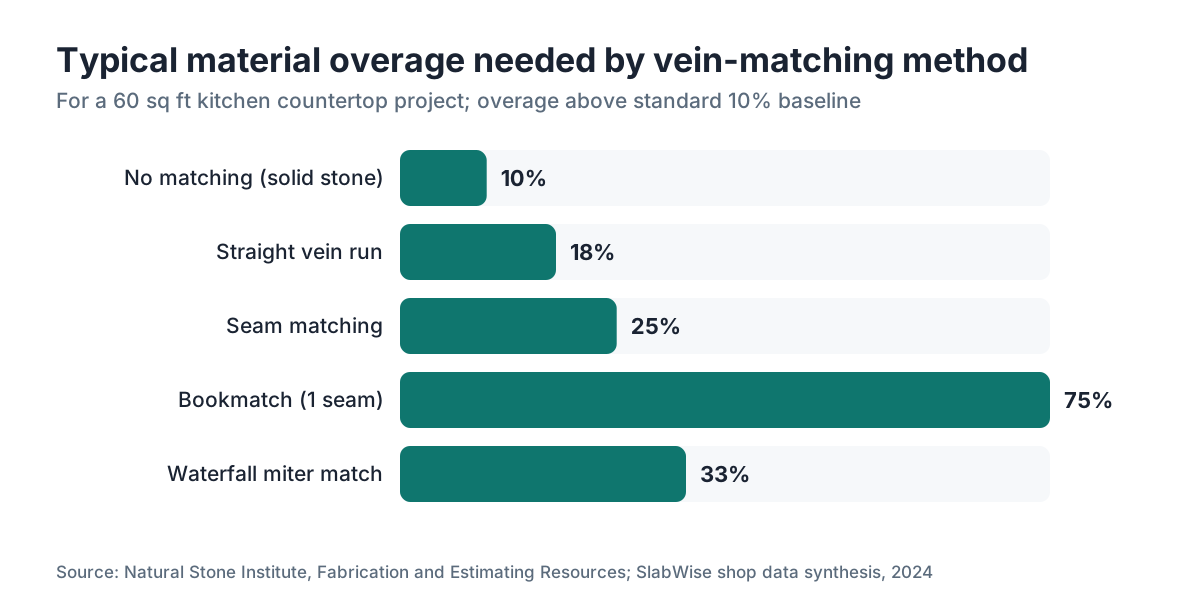
Here's how overage scales with matching type on a typical 60-square-foot kitchen.
| Matching type | Typical material overage needed | Notes |
|---|---|---|
| No matching (solid stone) | 10-15% | Standard waste factor |
| Straight vein run | 15-20% | Adds orientation constraint only |
| Seam matching | 20-30% | Must plan cuts around vein position |
| Bookmatch (1 seam) | 50-100% extra | May require 2 slabs for 1 slab's area |
| Waterfall miter match | 25-40% extra | Depends on drop height and vein angle |
One thing for homeowners: if a fabricator says bookmatching your island needs a second slab, that's not padding. That's just how pattern math works.
How do fabricators calculate the actual quote for a veined stone job?
A solid veined-stone quote has six cost components. Miss any one and you're either underpricing the job or losing the bid to someone who cut a corner you didn't spot.
1. Material cost at true yield. Take the slab price, divide by usable square footage after the matching method, then multiply by the project's cut area. If a slab costs $800 and you'll realistically use 38 of its 60 square feet because of vein constraints, your effective material rate is $21.05 a square foot, not the $13.33 you'd get assuming full use.
2. Fabrication labor. Price the cutting, edging, and polishing at your shop rate, then add a vein-match upcharge for the specific technique. A flat fee per seam ($75 to $200) beats an hourly estimate for seam matching. Customers understand it, and it holds crews accountable.
3. Layout and templating time. Veined stone needs more template precision than solid stone. Digital template files need vein-direction annotations. Hand templates need orientation marks that survive the trip back to the shop. Add $50 to $100 for a veined-stone layout premium on any job above basic complexity.
4. Miter or waterfall labor. Price this as a separate line: linear footage times your miter rate, with a vein-match multiplier of 1.5 to 2.0x over your standard miter rate when the vein has to stay continuous.
5. Delivery and installation. Veined slabs run heavier and more fragile than engineered stone. Natural marble and quartzite (see /articles/marble-countertops and /articles/granite-countertops for material specifics) need more careful handling than quartz or laminate (/articles/laminate-countertops). Two-person crews and specialty carriers can add $100 to $200 to install cost on large slabs.
6. Contingency. Price 5 to 10% contingency on veined natural stone. Cracks along vein lines happen. A slab that looked flawless at the yard can reveal a fissure right at the miter cut. If you don't use the contingency, return it or credit the next job. If you don't price it, you eat the replacement cost.
Shops doing high volumes of this work often run quoting software that tracks yield by material and applies the right waste factor per job automatically. SlabWise's quoting module lets you set per-material yield assumptions so the slab math reflects your actual shop experience, not a generic 15% waste factor.
What does a typical veined stone premium look like in dollar terms?
Real numbers help. These ranges come from 2023-2024 fabrication pricing discussions and regional cost surveys, not one authoritative study, so read them as reference points rather than hard benchmarks [2][3].
A standard non-veined granite or quartz kitchen (40 square feet, two seams) runs roughly $2,000 to $3,500 installed in most US metro markets, material and labor included [5].
The same footprint in a heavily veined marble or quartzite with seam matching: $2,800 to $4,500 installed. That's a 20 to 35% premium for mid-complexity matching.
A bookmatched 30-square-foot island in Calacatta marble with a vein-continuous waterfall edge: $3,500 to $7,000 for the island alone, depending on slab cost and local rates. On a complex waterfall, the slab may be only 35 to 45% of the total because labor dominates.
These premiums stack. A kitchen with seam-matched perimeter counters plus a bookmatched, waterfall-edge island can run 40 to 60% above the equivalent non-matched job. That's not gouging. That's the real cost of making stone look like it grew in one piece.
How should a fabricator explain vein matching costs to a homeowner?
The biggest source of sticker shock on veined stone is simple. Homeowners see a slab price at the yard, run the math in their head, and land on a number that has nothing to do with the final quote. The gap is almost always yield plus matching labor.
The cleanest fix is to show the math on the quote. Instead of a lump sum for material, break it out: "Slab cost: $X. Usable yield for this matching method: Y%. Effective material cost: $Z/sqft." That kills the argument before it starts.
Photos help too. A shot of the raw slab on the shop floor with the cut lines drawn on it makes the waste obvious in about two seconds. No explanation beats that picture.
Be honest about limits. Even a perfect seam match on natural stone leaves a visible seam. The goal is a seam that reads as natural, not one that disappears. Overpromise here and you'll pay for it at installation.
Homeowners pricing their own project: get quotes from at least two fabricators, and ask each to itemize the matching method, the slab count, and whether a second slab comes from the same sequential batch. Those three questions tell you fast whether the shop planned the job or just threw a number over the fence.
Does slab lot and batch selection affect the price?
Yes, and this is where homeowners get blindsided late in the process.
Any serious vein matching needs slabs from the same lot, ideally sequential slabs cut from the same quarry block. Distributors sell slabs in bundles, and those bundles are your best source of sequential material. When you need two slabs for a bookmatch and only one is left from the original bundle, you either accept a non-matching companion slab (which defeats the point) or you chase a matching slab from another distributor at a much higher price.
Rare patterns, high-movement marbles like Calacatta Borghini or Statuario, and some quartzites have thin availability. A slab that ran $900 six months ago can be $1,400 today if the bundle sold down. Locking in the second slab at selection time is almost always cheaper than hunting one later [4].
Fabricators who do a lot of this work tell customers to reserve both slabs before the contract is signed. Some shops charge a reservation fee, usually $100 to $200, that credits back to the final invoice. Pay it. It's cheap insurance.
How does the vein scale and pattern type affect pricing?
Not all veining prices the same. Fine, consistent veining (think a subtle Arabescato) is far more forgiving than bold, wide veins that jump six inches across a slab (think a statement Breccia Capraia). The larger and more irregular the vein, the harder it is to hide a seam in a quiet zone, and the more slab you sacrifice for a clean match.
Pattern scale also drives how many slabs you need to get a visual repeat across a long run. A vein that repeats every 8 inches is manageable. A vein cutting corner to corner, like some exotic marbles, leaves very few good seam options per slab.
Here's a working rule: sort the vein pattern into low, medium, or high movement, then pull the matching waste factor from the table in the slab ordering section above. High-movement stones always get the 30%-plus overage treatment. No exceptions.
Engineered stones like Cambria (/articles/cambria-countertops) or Corian (/articles/corian-countertops) fake the veined look without the matching problem, because the pattern is manufactured to tile or repeat. If a customer's heart is set on a dramatic vein but the budget is fixed, have that conversation honestly. Don't underprice natural stone and regret it later.
What do digital templating and nesting tools do for veined stone jobs?
Digital templating captures the real outline of a customer's countertop space. Nesting software then lays those outlines onto a digital slab to find the tightest cut layout. For solid stone, nesting is pure geometry. For veined stone, it's geometry plus orientation, and that's where the right tools earn their keep.
Good nesting software lets you assign a vein direction to the slab and a required grain direction to each piece, then finds layouts that honor both. Without that, you're eyeballing it on the shop floor, which takes longer and misses yield you could have saved by rotating a piece a few degrees.
Vein annotation on digital templates cuts install errors too. A clear arrow showing vein direction and which edge is the show face means the installer can't flip a piece on a busy day. That matters, because reversing a veined piece is either a grind-and-re-polish repair or a full replacement.
Run several veined jobs a month and your quoting system's yield tracking should link back to actual material used per job, so you can check whether your waste assumptions hold. If you keep burning 35% more slab than your 20% factor predicts, your quotes are bleeding money on material and your estimates need a rework. SlabWise's nesting and quoting tools are built around this per-job yield feedback, which pays off most for shops doing heavy patterned natural stone work.
How does countertop installation complexity change for veined stone?
Installation is where all the planning gets tested. A seam that looked perfect in the shop can close up or open a hair during install, depending on substrate flatness, adhesive squeeze-out, and cabinet leveling. Every shift moves the vein alignment with it.
Good installers dry-fit every piece before any adhesive, especially on bookmatched and miter-matched work. Dry fitting adds 30 to 60 minutes to install time and isn't optional on high-end veined stone. Shops that skip it are gambling with your money.
Substrate prep matters more on veined stone, because movement after install can crack the stone along fissures that run parallel to a vein. Cabinets need to sit within 1/8 inch of level across the run [6]. If the GC didn't get there, the installer shims before the stone goes down, not after.
On waterfall islands, the miter joint usually gets epoxied and clamped before the island moves into final position. Some installers use color-matched epoxy with stone dust mixed in to fill a hairline gap. Matching that fill color is a real skill, and shops that do it well charge for it.
The question to ask at the site visit: "Will you dry-fit before adhesive?" A no or a hesitation tells you a lot about the shop's process on complex work. See also: countertop installation for a full breakdown of the install process.
What should a homeowner's quote for a veined stone job actually include?
A complete quote for a veined stone job spells out, in writing, at least these items:
- Material: slab count, slab source (distributor name ideally), price per slab, and whether the slabs come from a sequential bundle.
- Matching method: which technique (seam match, bookmatch, miter match) and at which seams.
- Waste factor assumed, and what happens if a slab breaks mid-job (who pays for the replacement).
- Fabrication labor broken out from material.
- Edge profile specified, especially if it interacts with the vein (a beveled edge on a bold diagonal vein needs extra care).
- Installation scope: does it cover old-top removal, substrate prep, dry fit, and cleanup?
- Seam placement: the quote should say where seams fall, not only how many there are.
If the whole quote is one line reading "supply and install marble countertops: $X," that's not enough to judge whether the price is fair or whether anyone thought the job through. Push for the breakdown.
Homeowners can pull a fast ballpark from an online instant quote tool before approaching fabricators. It gives you a baseline for judging whether the bids you get are reasonable for your market and material.
Frequently asked questions
How much more does bookmatching cost compared to regular stone installation?
Bookmatching typically adds $200-$600 in labor for a standard island seam, plus the cost of a second slab if needed. Because you may use only half of each slab to get the mirror effect, material costs can effectively double. Total project premiums for bookmatched work commonly run 30-60% above equivalent non-matched installations, depending on slab price and shop rates.
Can any veined stone be bookmatched, or only certain types?
Any stone sold in sequential bundles from the same quarry block can theoretically be bookmatched. In practice, stones with strong, consistent movement bookmatch best: Calacatta marble, Statuario, some quartzites, and certain exotic granites. Stones with chaotic or very fine patterning don't produce a compelling mirror and usually aren't worth the cost premium of a true bookmatch.
Do fabricators charge more for a diagonal vein pattern versus a straight one?
Yes, usually. A diagonal vein running corner to corner gives you fewer clean seam options, forces more waste, and is harder to orient consistently across pieces. Most experienced shops build this into the waste factor rather than a separate line item, but you should ask how they handle diagonal-vein stones when you request a quote.
How do I know if two slabs are from the same quarry batch for matching?
Ask the distributor for the bundle number or block ID. Reputable distributors track slab origin to the quarry block, and slabs from the same block carry the most consistent patterning. Sequential slab numbers within a bundle (say, slabs 3 and 4 of bundle 12) are the best candidates for bookmatching. Never accept "these look similar" in place of actual batch documentation.
Is a visible seam unavoidable in veined stone countertops?
Seams in any stone countertop are always visible to some degree under raking light. The goal with matching is to place the seam where the vein pattern pulls the eye away from the joint, and to align the vein across it so it reads as continuous. A well-executed matched seam in natural marble is far less noticeable than a misaligned one, but calling any seam invisible overstates what's achievable.
What edge profile works best with heavily veined stone?
Simpler profiles work better with dramatic veining. A straight eased edge or a slight bevel keeps the vein as the visual focus. Complex profiles like ogee or dupont pull attention to the edge shape itself, which can fight a bold vein. Mitered waterfall edges with a continuous vein are the exception: the miter's complexity is intentional and the vein flowing through it is the whole point.
Can engineered quartz or Cambria replicate veined stone without the matching cost?
Yes. Engineered stones are manufactured with repeating or large-format patterns that need no batch matching. Cambria and similar brands offer convincing veined looks, and seams in these products can go wherever geometry dictates. You lose the one-of-a-kind character of natural stone, but you gain predictable pricing and no slab yield risk. For budget-conscious remodels, it's a legitimate trade-off worth considering.
How does vein matching affect the templating process?
Digital templates for veined jobs need to capture vein direction, each piece's orientation relative to the slab, and which edges are show faces. Templaters should mark the template with a directional arrow aligned to the stone's primary vein before leaving the site. That information has to survive intact from template to shop floor; without it, a CNC operator can't guarantee correct orientation at cut time.
What happens if a slab cracks during fabrication of a matched set?
If a slab cracks along a vein during cutting, you need a replacement from the same bundle. If none is available, the matching plan may have to change entirely, which hits both cost and timeline. This is why experienced fabricators build a contingency (typically 5-10% of job value) into quotes for natural veined stone. Make sure your contract spells out who bears the replacement slab cost if fabrication damage occurs.
Does the number of seams in a veined stone job always increase cost?
More seams mean more chances for vein mismatch and more labor to align them, so yes, seam count drives cost. But sometimes adding a seam in a strategic spot (a subtle zone of the vein rather than across a bold diagonal) actually lowers overall difficulty and waste. An experienced fabricator discusses seam placement with you as part of design, more than reports how many seams the job requires.
How long does it take to fabricate a veined stone job compared to solid stone?
A standard solid-stone kitchen moves through a shop in one to two days of fabrication time. A comparable veined job with seam matching adds half a day to a full day of layout and alignment work. A complex bookmatched island with a miter-matched waterfall can take two to three days for that piece alone. Lead times of two to four weeks from template to install are common for complex veined work.
Should I pay a slab reservation fee to hold matching slabs?
If your fabricator recommends reserving a second slab from the same bundle for a bookmatched or seam-matched job, pay it. Distributor inventories turn over fast, and popular veined stones in desirable sizes sell quickly. A $100-$200 reservation fee credited to your final invoice is cheap insurance against having to redesign your matching plan because the companion slab sold while you were deciding.
Can I mix veined stone with solid stone in the same kitchen to save money?
Yes, and it's a common cost-saving move. Put a high-movement veined marble on the island (the showpiece) and a quieter, cheaper solid or lightly veined stone on the perimeter counters. That drops total matching complexity and material cost. It works best when the two stones share a color tone. Your fabricator can advise on combinations that read as intentional rather than mismatched.
Sources
- Natural Stone Institute, Fabrication and Estimating Resources: Material yield loss from vein-match cutting can significantly increase effective cost per usable square foot compared to gross slab price.
- U.S. Bureau of Labor Statistics, Occupational Employment and Wage Statistics: Stone Cutters and Carvers: Fabrication labor rates for stone cutters and carvers in the US range across regional markets, informing the $65-$120/hour shop-rate range cited.
- Natural Stone Institute, Tile and Stone Installation Standards (ANSI A108): Bookmatch and miter-match labor benchmarks referenced for typical residential countertop projects.
- Marble Institute of America / Natural Stone Institute, Dimension Stone Design Manual: Standard slab dimensions for natural stone from US distributors average approximately 55-65 square feet of surface area, varying by stone origin.
- HomeAdvisor (Angi), True Cost Guide: Countertop Installation: Typical installed cost for a standard 40-square-foot non-veined granite or quartz kitchen countertop runs $2,000-$3,500 in US metro markets.
- Tile Council of North America, TCNA Handbook for Ceramic, Glass, and Stone Tile Installation: Cabinet substrate should be within 1/8 inch of level across the run before stone countertop installation to prevent post-install movement and cracking.
- U.S. Geological Survey, National Minerals Information Center: Natural dimension stone market pricing and supply chain data relevant to slab availability and lot tracking.
- National Kitchen and Bath Association, Cost vs. Value Report and Design Guidance: Premium countertop materials and installation complexity factors cited in residential kitchen project cost discussions.
- American Institute of Architects, Masonry and Stone Specifications (MasterSpec Section 04 43 00): Specification guidance for natural stone installation tolerances and matching requirements in commercial and residential construction.
Last updated 2026-07-11