
TL;DR
- Countertop fabricators join buying groups to pool purchasing power with other shops, getting supplier discounts of roughly 10 to 30% on slabs, tooling, and consumables.
- The process involves finding a group that fits your material mix, applying, meeting minimum volume requirements, and paying dues.
- Most fabricators recoup dues within the first one or two large slab orders.
What is a buying group for countertop fabricators?
A buying group is an organization that pools the purchasing volume of many independent fabrication shops so they can negotiate pricing as if they were a single large buyer. Instead of your shop buying 40 slabs a month and getting whatever the distributor's standard rate is, the group bundles your volume with hundreds of other shops and pulls pricing closer to what a regional chain or big-box installer would get.
The mechanics vary. Some buying groups are co-ops where members own shares and share rebates at year-end. Others are for-profit groups that negotiate contracts and take a cut or charge membership dues. A few are trade association programs where the buying benefits come bundled with education, insurance access, and networking.
For most fabrication shops doing between $500,000 and $5 million in annual revenue, the two biggest cost categories are materials (stone slabs, quartz, porcelain) and tooling (blades, polishing pads, router bits). Buying groups address both. The savings on a single truckload of granite countertops slabs can outrun a year's worth of dues in one transaction.
The model is old. Hardware co-ops like Do it Best and Ace Hardware have run on this structure for decades [1]. The countertop and stone industry adapted it more recently, mostly through the Marble Institute of America (now merged into the Natural Stone Institute) and through regional distributor programs.
How much can fabricators actually save through a buying group?
It depends heavily on what you buy, how much you buy, and how well the group has negotiated your specific categories. The range people cite in the industry is 10 to 30% off standard distributor pricing on materials, with tooling discounts sometimes higher because blade and pad manufacturers have more margin to give.
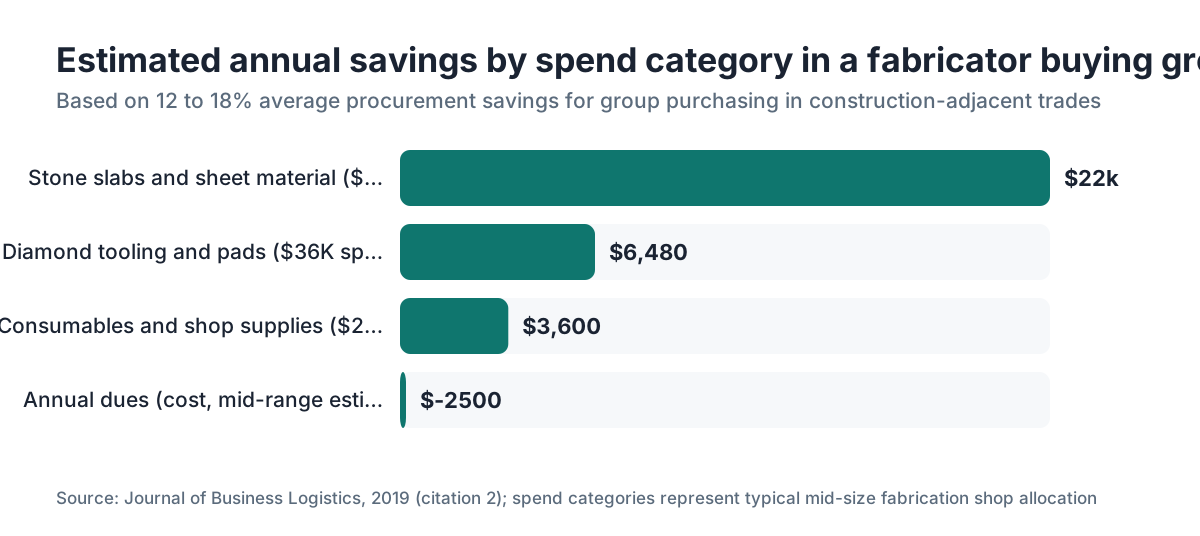
The Natural Stone Institute and similar trade bodies don't publish audited savings figures publicly, so the numbers circulating in fabricator forums are self-reported. That's worth flagging. Nobody has good, peer-reviewed data on average fabricator buying-group savings. The closest analog comes from broader wholesale distribution research: a 2019 study in the Journal of Business Logistics found that group purchasing organizations in construction-adjacent trades reduced member procurement costs by an average of 12 to 18% on commoditized inputs [2]. Stone slabs are not fully commoditized, but tooling and consumables are, and the tooling savings tend to land in that range.
Here's the practical math. Say your shop spends $300,000 a year on materials and tooling, and the group saves you 15% on half of that spend (because not every supplier participates in the program). That's $22,500. Annual dues for most fabricator buying groups run $1,000 to $5,000 a year. The return is obvious if you actually use the programs.
The trap is joining, paying dues, and then not changing your purchasing behavior. Savings are not automatic. You have to route purchases through the contracted suppliers, submit for rebates on time, and sometimes commit to volume minimums that require some planning.
What are the main buying groups available to stone and countertop fabricators?
The landscape has shifted over the last decade, so let's be specific about what exists as of mid-2025.
Natural Stone Institute (NSI) is the primary trade association for fabricators working in natural stone. It merged the Marble Institute of America and the Building Stone Institute in 2019. NSI runs a member benefits program with negotiated rates on insurance, equipment, and some supplier categories. It's not a pure buying group, but the purchasing benefits are real [3].
Precision Stone Network and similar regional fabricator networks have run buying-group-style programs, though their structures change over time. These tend to be tighter groups of 30 to 100 shops in one geographic region.
Distributor loyalty programs are not buying groups technically, but they work the same way. Companies like MSI, Arizona Tile, and Dal-Tile run tiered volume programs where shops that hit quarterly purchase thresholds get retroactive rebates or price tier bumps. These stack on top of any group membership.
ISFA (International Surface Fabricators Association) focuses on fabricators working across multiple surface categories, including marble countertops, quartz, and solid surface. ISFA runs member discount programs and supplier partnerships [4].
Custom buying groups sometimes form on their own when a cluster of fabricators in a non-competing geography decide to issue a combined RFQ to distributors. This is the DIY version. More administrative work, no dues.
For shops doing significant volume in engineered stone, Cambria countertops, or other branded products, note that branded manufacturers often lock distribution pricing regardless of group membership. Branded quartz pricing is less flexible than natural stone.
What are the typical requirements to join a fabricator buying group?
Requirements vary by group, but the common thresholds look like this:
| Requirement | Typical Range |
|---|---|
| Annual revenue (minimum) | $250,000 to $1,000,000 |
| Years in business | 1 to 3 years |
| Annual dues | $1,000 to $5,000 |
| Volume commitment | Varies; some groups require routing 70 to 80% of specific category spend through contracted suppliers |
| Insurance | General liability minimum $1M per occurrence is nearly universal |
| Application / references | 2 to 3 trade references common |
Some groups also require that you not be in direct geographic competition with an existing member at the same tier. This protects members' local markets and is one reason regional groups stay small.
The insurance requirement is worth pausing on. If your shop is underinsured or running without a current certificate of insurance, fix that before any credible buying group accepts you. The NSI publishes guidance on appropriate coverage levels for fabrication operations [3].
A few groups require that you carry a certain SKU mix or handle specific materials. A group focused entirely on natural stone probably doesn't want a shop whose revenue is 90% laminate countertops and formica countertops, because the supplier contracts won't benefit that member anyway.
How do you find buying groups that are actually accepting new members?
The NSI and ISFA membership directories are the logical starting point. Both associations list member benefits programs openly on their websites, and their annual trade shows (StonExpo/Marmomacc Americas for NSI, the ISFA Conference for ISFA) are where buying group administrators actively recruit [3][4].
Regional stone distributor reps are an underused resource. Your slab distributor's sales rep usually knows which local fabricator networks exist and who runs them. They have every reason to tell you, because if the group routes volume to them, everyone wins.
Fabricator forums and Facebook groups surface current recommendations faster than any directory. The Stone Fabricators Alliance group has tens of thousands of members. Search for buying group threads from the last 12 to 18 months. Older threads may reference groups that have dissolved or restructured.
Trade show floors are where the real conversations happen. Walk the NSI show or Coverings [8] with specific questions about group purchasing and you'll connect with the right people faster than any email chain.
What is the application process like?
Most buying groups run a simple application, but it moves slower than people expect. Plan on 4 to 8 weeks from initial inquiry to approved membership for established groups.
The typical steps:
- Submit an application with business information: years in operation, annual revenue range, material categories, number of employees, and your current primary suppliers.
- Provide trade references. These are usually distributors or manufacturers you currently buy from, not customer references.
- Submit a certificate of insurance showing coverage at or above the group's minimum.
- Pay the application fee (sometimes rolled into first-year dues, sometimes a separate $100 to $500 fee).
- Attend an orientation call or webinar covering the supplier contracts, rebate submission process, and compliance rules.
For co-op structures, there may be a share purchase, typically $500 to $2,500, which you'd theoretically get back if you leave the co-op. Co-ops organized under IRS cooperative rules can distribute patronage dividends to members, which carry their own tax treatment [7].
The slowest part is usually waiting for the group's board or membership committee to meet and vote. Many groups do quarterly reviews. Apply in October and you may not be active until January.
Be honest on the application about your volume. Groups that require minimum purchase commitments through specific suppliers will notice if your actual spend is a fraction of what you claimed. Getting kicked out of a buying group for misrepresenting volume is embarrassing and sometimes costs you access to contracted pricing mid-year.
How do fabricators actually capture the savings once they're in?
Joining is step one. Getting the savings takes deliberate process changes inside your shop.
First, get the contracted supplier list and compare it against your current supplier roster. Some of your existing suppliers may already be on the list, meaning you can switch purchasing to the contracted account right away. Others won't be, and you'll need to decide whether the group's contracted alternative is a real option for your quality and delivery needs.
Second, figure out whether the savings come upfront (you pay a lower price at the time of order) or as a back-end rebate (you pay standard price and file for reimbursement quarterly or annually). Back-end rebates require documentation: invoices, purchase records, sometimes a rebate claim form. Shops that don't track purchases carefully lose rebates they already earned. This is where shop management or quoting software helps, since purchase data that feeds your job costing can also generate the reports you need for rebate claims.
Shops running countertop installation operations alongside fabrication have another angle: some groups include rebates on installation hardware, adhesives, and transport supplies, more than slabs.
Third, consolidate purchasing. Splitting slab purchases across five distributors to keep relationships warm is a common habit, and it kills your group purchasing volume. The group only counts purchases through contracted suppliers. Buy 40% through the contracted distributor and 60% through your old preferred house, and you're leaving savings on the table.
Tools like SlabWise's job management and quoting module let you tag purchases by supplier at the job level, which makes it far easier to pull the documentation buying groups need for rebate claims. Tracking this in a spreadsheet across 200 jobs a year is genuinely painful.
What are the downsides and risks of joining a buying group?
Buying groups are not a free lunch. Here's what actually goes wrong.
Supplier quality drift. The contracted supplier may offer lower prices but weaker slab selection, slower delivery, or worse defect rates. If your business runs on sourcing unusual stone or quartzite slabs that clients request by lot, a group contract that only covers commodity SKUs doesn't help you and may push you toward lower-margin materials.
Volume commitments you can't meet. Some groups require routing a minimum percentage of your spend through contracted suppliers. If business slows or a project needs a material the contracted supplier doesn't carry, you may fall below the threshold and lose your tier pricing mid-year.
Administrative overhead. Tracking purchases, filing rebate claims, keeping documentation, renewing contracts annually. This is real work. In a two-person shop, the owner is often doing it at 10pm. If the savings are $8,000 a year and the admin costs you 40 hours, the effective rate on that effort is $200 an hour. That might still be worth it, but it isn't zero cost.
Group instability. Smaller regional buying groups sometimes dissolve, lose key contracts, or restructure. Reorganize your purchasing around a group's contracts, watch the group fold, and you're renegotiating from scratch with suppliers who know you left them.
Dues with no engagement. This is the most common failure. Shops pay dues, get busy, never change their purchasing, and cancel after year two having saved nothing. A buying group is a purchasing program that needs active management.
Are buying groups worth it for small fabrication shops?
For shops under $250,000 in annual revenue, most established buying groups won't take you anyway, and the ones that will may not have negotiated contracts worth the dues. The math just doesn't work at very low volumes.
The sweet spot is shops doing $500,000 to $3 million a year with a consistent material mix, mostly natural stone, quartz, or porcelain. At that level, the savings potential is real and the administrative overhead is manageable.
For shops above $5 million a year, the calculus shifts again. At that volume, you often have enough individual purchasing power to negotiate directly with distributors and manufacturers. A buying group may still add value through insurance programs, equipment financing rates, or tooling discounts, but the primary materials savings may be smaller than what you can get on your own. Census SUSB data for cut stone and stone product manufacturing (NAICS 327991) shows most firms in this category have fewer than 20 employees and revenue under $5 million, so the vast majority of shops sit right in that sweet-spot band [10].
Shops specializing mostly in butcher block countertops or Corian countertops or other non-stone surfaces face a narrower set of group options, since most buying groups are built around the stone supply chain. ISFA is the better starting point for multi-surface shops.
My honest take: if you're doing $750,000 or more in revenue and buying mostly natural stone or engineered quartz, run the numbers against your current pricing. Call your distributor, ask what the group contract rate would be on your last three months of purchases, and compare. If the savings cover dues with room to spare, join and commit to the purchasing changes.
How do buying groups interact with manufacturer direct programs and distributor relationships?
This is where it gets complicated, and fabricators sometimes get tripped up.
Most buying group contracts are with distributors, not manufacturers directly. The manufacturer sells to the distributor at a fixed price, and the distributor offers the group a negotiated rate below their standard list. So you're not bypassing the distributor. You're getting better pricing through them because the group has guaranteed the distributor volume. Group purchasing arrangements like this are generally legal under antitrust law as long as members aggregate buying power without coordinating on resale pricing or dividing markets [6].
Some manufacturers run their own fabricator loyalty programs separately. MSI's Strata program is one example. These programs are not always compatible with buying group contracts, so you might have to choose which one to optimize for on that manufacturer's products.
Your personal distributor relationship matters more than people admit. If you've been a reliable customer for a rep who goes to bat for you on allocation of rare material, swapping your purchasing to a group-contracted account at a competing distributor branch may cool that relationship. That's a real trade-off, not a theoretical one.
The cleanest approach is to stack compatible programs where you can: use the buying group contract at your primary distributor (if they participate), keep the manufacturer's fabricator loyalty program, and hold your secondary distributor relationship for specialty sourcing. Not every material category needs to run through the group contract.
What questions should you ask before joining any buying group?
Before writing a check or signing an agreement, get specific answers to these:
- Which suppliers have active contracts right now, and what is the discount structure (upfront vs. rebate, and what percentage)?
- What are the volume minimums, and what happens if I fall below them mid-year?
- How many active members are in the group, and what's the geographic distribution?
- What is the rebate claim process, and what documentation do I need to submit?
- What is the group's renewal rate, and how long has the current management run it?
- Are there exclusivity clauses that restrict me from using non-contracted suppliers?
- What happens to my dues if I leave or the group dissolves mid-year?
- Can I talk to two or three current members before I apply?
That last one matters most. Current members will tell you whether the savings are real and whether the administration is manageable. Any group that won't give you references from current members is a red flag.
Read the membership agreement carefully before signing, especially the sections on volume commitments, exclusivity, and what counts as a breach. Some groups have clawback provisions and will bill you for the difference between what you were supposed to purchase and what you actually bought. That's unusual, but it exists [5].
How do buying groups handle tooling and equipment, more than slabs?
Tooling is the underappreciated category in most buying group programs. Diamond blades, polishing pads, router bits, and saw coolant are high-frequency, high-cost consumables. A busy shop might burn through $2,000 to $4,000 in blades and pads a month. A 15 to 20% discount on that spend compounds fast.
Several buying groups have negotiated direct contracts with tooling manufacturers like Weha, Tenax, or Alpha. The contracts usually work as upfront pricing adjustments, not back-end rebates, because the order quantities are smaller and the admin cost of processing a rebate is high relative to the savings per transaction.
Equipment financing is another benefit some groups offer. Access to equipment loans or leases at preferential rates through group-affiliated lenders can matter a lot when you're looking at a $150,000 CNC bridge saw or a $60,000 waterjet. Even a 1 to 2 point rate improvement on a 5-year loan on $150,000 of equipment saves $7,000 to $15,000 in interest.
Don't overlook the shop supply categories either. Safety equipment, cleaning chemicals, and stone care products often have group pricing available. These are small per-unit savings, but they require zero change in purchasing behavior if your current supplier already participates.
Frequently asked questions
How much do buying group dues cost for countertop fabricators?
Annual dues for most fabricator-focused buying groups run $1,000 to $5,000 per year. Co-op structures may also require a one-time share purchase of $500 to $2,500. Some distributor-affiliated programs have no formal dues but require purchase volume commitments instead. Trade association programs like NSI or ISFA bundle buying benefits with membership fees that typically run $500 to $2,500 annually depending on company size.
Can a fabricator join more than one buying group at the same time?
Technically yes, and some larger shops do. The practical constraint is whether your purchasing volume is high enough to meet minimums in multiple groups at once. Some groups have exclusivity clauses within specific supplier categories, so read membership agreements carefully. Stacking a national group with a regional co-op is the most common multi-group approach, since they usually have different supplier rosters.
Do buying groups work for fabricators who specialize in quartz or engineered stone?
Partially. Branded quartz lines like Silestone, Cambria, or Caesarstone generally have controlled distribution pricing that group contracts can't move much. Unbranded or private-label engineered stone has more pricing flexibility. Tooling and consumable discounts apply regardless of what surface you're fabricating. Shops whose revenue is mostly branded quartz get less benefit from group slab contracts but can still capture tooling and supply savings.
How long does it take to get approved for a fabricator buying group?
Most established buying groups take 4 to 8 weeks from application submission to active membership approval. The slowest step is usually waiting for a membership committee to meet and vote, which many groups do quarterly. Smaller or informal regional groups move faster, sometimes in 2 to 3 weeks. Applying at the start of a quarter improves your odds of being approved before the next review cycle.
What is the difference between a buying group and a trade association for fabricators?
A trade association like the Natural Stone Institute or ISFA offers education, certification, standards, industry advocacy, and member benefits including some purchasing programs. A buying group is built specifically to aggregate purchasing volume for pricing negotiations. Some associations include buying group programs as a membership benefit. Others are purely educational and advocacy-focused with no purchasing component. Many shops join both for different reasons.
What volume of purchases do you need to benefit from a fabricator buying group?
Most established buying groups require minimum annual revenues in the $250,000 to $1,000,000 range, though the savings don't really outrun administrative overhead until you're doing $500,000 or more in annual material and tooling spend. At lower volumes, your individual negotiating power with local distributors combined with manufacturer loyalty programs may outperform what a group contract can offer.
Are there buying groups specifically for small fabrication shops?
A few regional co-ops explicitly serve smaller shops and have lower minimum requirements. The ISFA network includes smaller multi-surface shops. Informal regional networks, sometimes organized through distributor reps or local trade groups, may have no formal minimum. If you're below most group thresholds, the practical alternative is partnering with one or two non-competing local fabricators to issue joint RFQs to distributors, which creates ad hoc group purchasing power without formal dues.
What documentation do fabricators need to submit rebate claims?
Typically: copies of invoices from the contracted supplier showing the purchased products, quantities, and amounts; a completed rebate claim form provided by the group; and sometimes a summary spreadsheet linking purchases to jobs or purchase orders. Groups usually require claims within 30 to 60 days of quarter-end. Missing the submission window forfeits the rebate. Keeping purchase records organized by supplier throughout the year is the only way to make this manageable.
Can fabricators lose their buying group membership, and for what reasons?
Yes. Common reasons for termination or suspension include failing to meet contracted volume minimums for multiple consecutive periods, misrepresenting revenue or purchase volumes on the application, letting insurance coverage lapse below required minimums, or violating exclusivity provisions by routing purchases away from contracted suppliers. Some groups also have conduct provisions related to how members represent the group to suppliers.
Do buying groups negotiate pricing on equipment like CNC saws and waterjet machines?
Some do, though it's less universal than material and tooling contracts. The larger groups and trade associations sometimes have preferred financing rates or package pricing with equipment manufacturers. Equipment financing rate improvements through group-affiliated lenders can be meaningful on large purchases. A 1 to 2 percentage point rate reduction on a $150,000 CNC over five years cuts total interest cost by roughly $7,000 to $15,000, which is real money.
How do I find out if my current distributor participates in any buying group contracts?
Ask your distributor sales rep directly. Reps generally know which groups their company has contracts with and can tell you whether your purchasing could route through an existing group account. Alternatively, when evaluating a specific buying group, the group administrator should provide a current list of contracted distributors and suppliers. Cross-referencing that list with your existing supplier relationships is the fastest way to estimate your first-year savings.
What is the Stone Fabricators Alliance and does it run a buying group?
The Stone Fabricators Alliance (SFA) is primarily a fabricator community and networking organization with a large active social media presence, especially on Facebook. As of mid-2025, it works more as a peer information-sharing network than a formal buying group with negotiated supplier contracts. Its community forums are one of the best places to find current member recommendations for active buying groups and regional co-ops worth exploring.
Can a buying group membership help with pricing on shop supplies and safety equipment, more than slabs?
Yes, and this is an underused category. Many buying group contracts cover consumables, safety equipment, and shop supplies at negotiated rates. Because these purchases are frequent and the unit savings per order are small, they're easy to overlook. But a 15% discount on $30,000 a year in consumables is $4,500, which can cover the cost of annual dues by itself. Ask the group specifically which non-slab categories have active contracts.
Sources
- Do it Best Corp, About Us: Hardware co-ops like Do it Best aggregate purchasing volume of independent retailers to negotiate pricing as a single large buyer, a model adapted to other trades.
- Journal of Business Logistics, Wiley Online Library: Group purchasing organizations in construction-adjacent trades reduced member procurement costs by an average of 12 to 18% on commoditized inputs, per 2019 research.
- Natural Stone Institute, Membership Benefits: NSI (formed from the 2019 merger of the Marble Institute of America and Building Stone Institute) runs member benefits programs including insurance and supplier negotiations, and publishes guidance on fabrication shop insurance minimums.
- International Surface Fabricators Association (ISFA), Member Benefits: ISFA runs member discount and supplier partnership programs for fabricators working across surface categories including quartz, solid surface, and natural stone.
- U.S. Small Business Administration, Buying Cooperatives: SBA guidance on cooperative purchasing notes that some group purchasing agreements include volume commitment clauses with financial remedies for shortfalls.
- Federal Trade Commission, Antitrust Guidelines for Collaborations Among Competitors: Group purchasing organizations are generally legal under antitrust law when they aggregate buying power without coordinating on resale pricing or market allocation.
- IRS, Cooperative Organizations Tax Treatment (Publication 542): Purchasing co-ops organized as cooperatives may distribute patronage dividends to members, which have specific tax treatment under IRS rules.
- Coverings Trade Show, Exhibitor and Attendee Information: Coverings is an annual tile and stone industry trade show where distributor and buying group programs are actively marketed to fabricators.
- U.S. Census Bureau, Statistics of U.S. Businesses, Stone Fabrication NAICS 327991: NAICS code 327991 (cut stone and stone product manufacturing) covers countertop fabrication businesses; Census SUSB data shows the majority of firms in this category have fewer than 20 employees and revenue under $5 million.
Last updated 2026-07-11