
TL;DR
- The International Surface Fabricators Association (ISFA) offers the Certified Fabricator designation for countertop and surface professionals.
- You apply through ISFA's member portal, pass a written exam covering fabrication standards, and pay fees that typically run $400, $600 depending on membership status.
- The process takes most applicants one to three months from application to certificate.
What is ISFA and why does its certification matter?
ISFA, the International Surface Fabricators Association, is the main trade body for the countertop fabrication industry in North America. It was founded in 1991 and represents fabricators, material suppliers, and equipment manufacturers who work with solid surface, stone, quartz, and related materials. [1]
The ISFA Certified Fabricator (CF) designation signals to builders, designers, and homeowners that a shop has demonstrated knowledge of industry standards, safe fabrication practices, and professional business conduct. That matters more than it used to. General contractors and kitchen designers increasingly filter vendor lists by credentials, and a CF designation is one of the few third-party signals available in this trade.
ISFA also publishes fabrication standards that material manufacturers reference. Cosentino, for example, trains its approved fabricators partly around ISFA guidelines. So even shops that never pursue formal certification are often already working inside ISFA's framework without knowing it.
Is the credential required to operate? No. Most states have no mandatory licensing for countertop fabrication beyond a general contractor's license or business registration. But "required" and "useful" are two different things, and in competitive markets, the CF designation is a real differentiator.
Who is eligible to apply for ISFA certification?
ISFA does not publish a rigid prerequisite list the way a medical board would, but the application is built for working fabricators with real shop experience. The exam content assumes familiarity with templating, cutting, seaming, edge profiles, adhesives, and installation, so someone who has never fabricated a slab will struggle.
ISFA expects applicants to be active in the trade. Their materials reference "industry professionals," and the exam covers scenarios that need hands-on context to answer correctly. A reasonable benchmark: at least one to two years of fabrication experience before sitting the exam.
ISFA membership is separate from certification but strongly encouraged. Members get access to study resources, reduced exam fees, and networking that makes the whole process easier. Non-members can still certify, but they pay higher fees and have fewer prep materials available.
Shop owners who want to certify multiple employees should know that ISFA issues the credential to individuals, not businesses. Each person sits their own exam. A shop can market itself as having "ISFA Certified Fabricators on staff," but the shop itself does not hold a corporate certification in the same way.
There is no published age minimum, but applicants need to be employed in the trade and able to show active involvement in surface fabrication work.
What does the ISFA certification exam cover?
The ISFA Certified Fabricator exam is a written test covering the technical and business knowledge a professional fabricator is expected to have. Based on ISFA's published study materials and curriculum outlines, the content falls into several broad areas: [2]
- Material knowledge: properties of natural stone (granite, marble, quartzite, soapstone), engineered quartz, solid surface, laminate, and ultra-compact surfaces
- Fabrication techniques: seaming, edging, cutouts for sinks and cooktops, templating methods, CNC vs. hand fabrication
- Safety: silica dust exposure and OSHA regulations, wet cutting requirements, PPE standards
- Installation: support requirements, adhesive selection, dealing with out-of-level cabinets
- Business practices: customer contracts, warranties, liability
- ISFA standards: the association's published fabrication quality standards, including their Countertop Standards document
The silica dust section deserves special mention. OSHA's permissible exposure limit for respirable crystalline silica is 50 micrograms per cubic meter of air as an eight-hour time-weighted average, and ISFA exam questions reflect these regulatory requirements. [3] Fabricators who have not reviewed OSHA's silica rule (29 CFR 1926.1153 for construction, 29 CFR 1910.1053 for general industry) before sitting the exam often find those questions harder than expected.
ISFA does not publish a specific question count or passing score. Reports from fabricators who have taken it describe a multiple-choice format running two to three hours. Prep materials from ISFA, including their countertop standards publications, are the best study guide.
What are the steps to get ISFA certified?
Here is the process as ISFA describes it, in plain order:
Step 1: Join ISFA or decide to apply as a non-member. Membership fees vary by company size; individual/technician memberships run roughly $200, $300 per year as of recent published rates. [1] Members get discounted exam fees and access to the member library of standards documents.
Step 2: Get ISFA's countertop standards and study materials. Their Countertop Standards book is the primary source document for exam content. Non-members can buy it; members access it through the portal. Read it cover to cover. Seriously.
Step 3: Submit your certification application. Applications go through ISFA's website. You provide your contact information, employment details, and pay the application fee. ISFA reviews applications and schedules your exam access.
Step 4: Schedule and sit the exam. The exam is administered online through ISFA's testing system, so you can take it from your office or home. That is a real convenience compared to trade certifications that require travel to a testing center.
Step 5: Pass and receive your certificate. Passing candidates get a certificate and a listing in ISFA's certified fabricator directory, which is publicly searchable. Failing candidates can typically retake, though confirm ISFA's specific retake policy and any waiting period directly with the association.
Step 6: Maintain your certification. ISFA certification is not lifetime. Renewal involves continuing education and a renewal fee on a cycle ISFA specifies (see the renewal section below).
Total elapsed time from starting the application to receiving your certificate: most fabricators who come in prepared report four to eight weeks. If you need time to study the standards document first, budget two to three months.
How much does ISFA certification cost?
Cost transparency is one area where ISFA's public website is thinner than it could be, so the figures below reflect published information and the ranges reported by fabricators who have gone through the process. Treat these as solid ballparks and confirm current pricing directly with ISFA before budgeting.
| Cost item | ISFA member | Non-member |
|---|---|---|
| ISFA annual membership (individual) | N/A | ~$200, $300/yr |
| Certification exam fee | ~$200, $300 | ~$350, $450 |
| Countertop Standards document | Included or discounted | ~$75, $150 |
| Renewal fee (every 2 to 3 years) | ~$100, $150 | Higher |
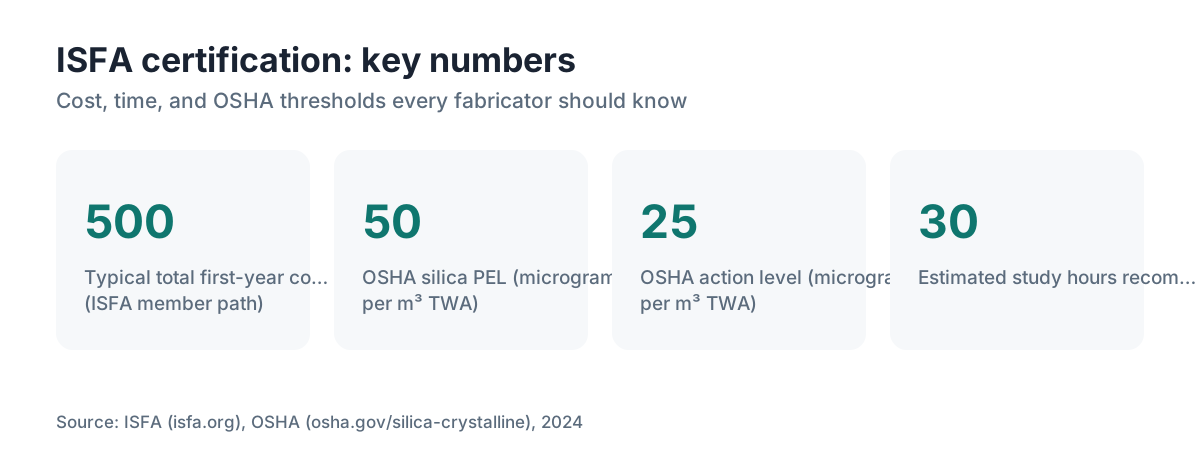
| Estimated total first year | $400, $600 | $500, $750 |
These ranges are based on ISFA's published membership and product pricing. [1] If you plan to certify more than one or two people, the math strongly favors a shop-level ISFA membership before paying individual non-member exam fees.
One thing that surprises fabricators: the biggest cost is not the fee, it is the study time. The ISFA standards document is detailed, and fabricators who skip serious prep and lean on shop experience alone report more difficulty with the exam than they expected. Budget at least 20 to 30 hours of actual study time.
How do you renew ISFA certification?
ISFA certification needs periodic renewal to stay active. The association uses a continuing education model: certified fabricators accumulate continuing education units (CEUs) through ISFA-approved courses, webinars, and events, then pay a renewal fee at the end of the certification period. [2]
The exact renewal cycle and CEU requirements have shifted over the years as ISFA has updated its programs, so check the current requirements directly with ISFA rather than relying on secondhand information. Generally, renewal has run on a two-to-three year cycle with a fee in the $100, $200 range for members.
ISFA runs webinars, its annual SURFACES conference, and other educational events that count toward CEUs. Attending SURFACES, one of the larger trade shows for the flooring and surface industries, usually covers a big chunk of the continuing education requirement in a single trip. [4]
Miss the renewal deadline and your certification lapses. ISFA may allow a grace period for reinstatement, but a lapsed certification is not shown as active in their directory, which is the main public-facing benefit for client-facing marketing. Staying current is worth the administrative effort.
Mark your renewal date in your calendar the day you receive your certificate. Two or three years moves faster than it seems.
Is ISFA certification worth it for a fabrication shop?
Honest answer: it depends on who your customers are.
If your shop does volume work for big-box retailers or tract home builders who award contracts entirely on price, the CF designation probably will not move revenue. Those buyers are optimizing for cost and turnaround, not credentials.
If you target custom kitchen remodels, luxury residential work, commercial interiors, or design-build firms, then yes, the credential pays off. Architects and interior designers are trained to look for credentials. A CF badge on your website and proposal letterhead is a credibility signal that costs a few hundred dollars and some study time but sets you apart from the majority of local shops that have none.
The ISFA standards training also has real operational value separate from the credential itself. Fabricators who go through the study process often catch gaps in their seaming or substrate requirements that they had been doing by habit rather than by standard. The exam forces you to actually read the specs that material manufacturers reference.
For shop owners specifically: getting yourself certified is one thing, but the bigger business case is getting your lead fabricator or production manager certified. That person controls output quality, and a credentialed lead gives you something concrete to advertise.
For newer fabricators building a career: ISFA certification on a resume is a genuine differentiator when applying to shops. It shows you take the trade seriously, which matters to employers who are tired of training people with no baseline knowledge of standards.
How does ISFA certification compare to other countertop industry credentials?
The countertop fabrication space has a handful of credential programs, and it helps to understand how they differ before committing time and money.
ISFA Certified Fabricator (CF): The broadest credential, covering stone, engineered surfaces, solid surface, and laminate fabrication. Run by an independent trade association. Relevant for shops that work across multiple materials.
NSI (Natural Stone Institute) Accreditation: NSI offers an accreditation program specifically for stone fabrication businesses, not individuals. It involves a facility audit, documentation review, and is more rigorous than a written exam. NSI accreditation is widely recognized in the architectural and design community, particularly for high-end commercial projects. [5]
NKBA (National Kitchen and Bath Association) credentials: NKBA offers certifications like the Certified Kitchen Designer (CKD) and Certified Bath Designer (CBD), which are aimed at designers, not fabricators. Some fabricators who run design-build shops pursue NKBA credentials to serve both roles. [6]
Manufacturer training programs: Cosentino (Silestone/Dekton), Cambria, and other manufacturers run their own fabricator certification programs. These tend to be material-specific and are sometimes required to be listed as an authorized fabricator for that brand. They complement ISFA rather than replace it.
OSHA 10 or OSHA 30: Not fabrication-specific, but OSHA cards are recognized across construction trades and demonstrate safety training. Given the silica dust risk in stone fabrication, an OSHA 10 is cheap ($150, $200 and 10 hours online) and worth having for every shop employee. [9]
ISFA CF is the most practical general-purpose credential for an individual fabricator. NSI accreditation is the gold standard for the business as a whole, particularly for commercial stone work. Most serious shops eventually pursue both.
What does ISFA's silica dust guidance mean for certification prep?
Silica dust is the biggest occupational health issue in stone fabrication, and ISFA takes it seriously enough that it shows up prominently in exam content and in their published standards.
Crystalline silica is present in granite, quartz, quartzite, and engineered stone at varying concentrations. Engineered quartz can be over 90% crystalline silica by weight. Dry cutting and grinding generate respirable particles fine enough to lodge permanently in lung tissue, causing silicosis, an irreversible and potentially fatal disease. [7]
OSHA's silica standard for general industry (29 CFR 1910.1053) requires employers to establish a written exposure control plan, implement engineering controls (wet cutting, local exhaust ventilation), provide respiratory protection when controls are insufficient, conduct air monitoring, and offer medical surveillance for exposed workers. The permissible exposure limit (PEL) is 50 micrograms per cubic meter as an eight-hour TWA, with an action level of 25 micrograms. [3]
For ISFA exam prep, know these numbers. Know the difference between a half-face respirator and a full-face respirator, and which NIOSH ratings (N95, P100) apply to silica dust. Know what wet cutting actually requires (continuous water flow, more than a damp sponge). The exam questions on this topic tend to be specific and do not reward vague familiarity.
Beyond the exam, this knowledge matters for your shop's legal compliance. Cal/OSHA in California has added requirements on top of the federal rule, including specific engineering controls for fabricating engineered stone that are more stringent than the federal standard. [8] If your shop is in California, read the Cal/OSHA requirements separately.
How should a fabricator prepare for the ISFA exam?
The most effective prep plan is straightforward, even if it takes discipline to follow.
Get the ISFA Countertop Standards document and read it thoroughly. This is not optional. The exam is built around this document. Do not skim it. Take notes on dimensions, tolerances, seam placement rules, and edge profile specifications.
Review OSHA's silica standard. Download the OSHA 1910.1053 standard summary and the OSHA Quick Card on silica. Both are free at osha.gov. [3]
Know your materials. Review the properties of the main countertop materials: granite, marble, quartzite, soapstone, engineered quartz, solid surface, laminate. Hardness (Mohs scale), porosity, recommended sealers, seaming methods. If your shop only works in stone, you still need to know solid surface basics for the exam.
Brush up on the business practices sections. Contracts, warranty language, and customer communication show up on the exam. These sections feel softer than the technical content but are easy points if you have read the ISFA guidance.
Use ISFA's member resources if you are a member. Webinars, the member forum, and study guides in the portal add context that the standards document alone cannot provide.
Study with a colleague if you can. Explaining material properties or OSHA requirements out loud to someone else is one of the fastest ways to find gaps in your own knowledge.
For shops that manage quoting and production with software, having your job data organized before studying can help: you will recognize real problems in the exam scenarios faster. SlabWise's quoting and nesting tools, for instance, make it easy to pull historical job data that puts the standards concepts in concrete terms, which some fabricators find useful as a study anchor.
Plan for a minimum of 20 to 30 hours of focused preparation. Fabricators who treat this like a professional exam, rather than a quick formality, pass on the first attempt at a much higher rate.
Where can I find ISFA's certified fabricator directory?
ISFA maintains a public directory of certified fabricators on their website at isfa.org. Once you pass the exam and your certification is active, your name (and optionally your shop) appears in this directory, which homeowners, designers, and contractors can search by location. [1]
This directory is one of the main practical benefits of keeping an active certification. It works as a low-cost lead source: people searching for qualified fabricators in their area find you without any extra marketing spend on your part.
To get the most from the listing, make sure your profile is complete with your location, contact information, and the materials you work with. An incomplete listing wastes the exposure.
For homeowners reading this: the ISFA directory is a legitimate way to find fabricators who have shown knowledge of industry standards. It is not a guarantee of quality on any specific job, but it is a meaningful filter that beats scrolling random reviews. If you are comparing fabricators for a kitchen countertop project, a CF designation is a useful data point alongside references and seeing examples of their work.
Fabricators should also list their ISFA certification on their website, Google Business Profile, and proposal templates. The credential only earns trust if people can see it.
What are common mistakes fabricators make during the certification process?
A few patterns show up over and over among fabricators who struggle with the exam or the application.
Underestimating the exam. The ISFA exam is not a formality. Fabricators who have been in the trade for 15 years sometimes fail on the first attempt because they relied on habit and skipped study. The exam tests knowledge of written standards more than general competence.
Not reading the standards document. This is the single biggest mistake. The document is dense, and many fabricators buy it and then skim it or skip sections that do not match their shop's primary materials. The exam does not care which materials you usually work with.
Ignoring the OSHA silica content. Regulatory compliance questions are on the exam and they are specific. The 50 microgram PEL, the 25 microgram action level, the written exposure control plan requirement, these are numbers worth memorizing.
Letting certification lapse. Once certified, some fabricators miss renewal deadlines and let the credential go inactive. A lapsed certification is invisible in the directory and provides no marketing value. Calendar reminders on the day you receive the certificate are cheap insurance.
Earning the credential and then hiding it. Getting certified and never mentioning it to customers, designers, or on your website is the most avoidable waste. Put it on your website, your email signature, your proposals, and your Google Business Profile within a week of receiving the certificate.
Certifying the wrong person. Some shop owners send an employee who is not customer-facing or production-critical, thinking it satisfies a checkbox. The credential does the most business good when it belongs to the person whose expertise is actually relevant to client conversations.
Frequently asked questions
How long does it take to get ISFA certified?
Most applicants complete the process in four to eight weeks if they are already prepared. If you need significant study time first, budget two to three months from starting your prep to receiving the certificate. The application and exam are both handled online, so there is no travel or scheduling lag with a physical testing center.
Do I need to be an ISFA member to get certified?
No. Non-members can apply for and take the ISFA Certified Fabricator exam. ISFA members pay lower exam fees and have access to the study materials and standards documents through the member portal, which makes the process easier and cheaper. If you plan to certify more than one person, a shop membership is almost certainly worth the annual cost.
How much does the ISFA Certified Fabricator exam cost?
Exam fees for ISFA members run roughly $200, $300; non-members pay approximately $350, $450. Factor in the cost of the ISFA Countertop Standards study document ($75, $150 for non-members) and annual membership if you join. Total first-year cost typically lands between $400 and $750 depending on membership status and how many credentials you add.
What materials does the ISFA exam cover?
The exam covers all major countertop materials: natural stone (granite, marble, quartzite, soapstone), engineered quartz, solid surface, laminate, and ultra-compact surfaces. Even if your shop specializes in one material, the exam tests knowledge across all of them. Fabricators who only work in stone sometimes get tripped up by solid surface and laminate questions.
Is there a practice exam or study guide for the ISFA certification?
ISFA does not publish a standalone practice exam as of their current program materials. The primary study tool is ISFA's Countertop Standards publication, which the exam is built around. ISFA members also have access to webinars and member forum discussions that help with exam prep. OSHA's free silica resources at osha.gov are essential supplemental reading.
How often do I need to renew my ISFA certification?
ISFA certification operates on a renewal cycle that has generally been two to three years, with renewal requiring continuing education units and a renewal fee in the $100, $200 range for members. ISFA-approved events, webinars, and the annual SURFACES trade show generate CEUs. Check directly with ISFA for the current cycle and CEU requirements, as these details have been updated over the years.
Does ISFA certification cover silica dust safety requirements?
Yes. The exam includes content on OSHA's respirable crystalline silica standard, including the permissible exposure limit of 50 micrograms per cubic meter (8-hour TWA), engineering control requirements, written exposure control plans, and respiratory protection. This is one of the areas fabricators who skip formal study find most difficult. Review 29 CFR 1910.1053 before sitting the exam.
How does ISFA certification compare to NSI accreditation?
ISFA Certified Fabricator is an individual credential awarded after a written exam. NSI accreditation is a business-level program requiring a facility audit and documentation review. NSI is more rigorous and more recognized for high-end commercial stone work. ISFA is more accessible and covers all surface types. Serious shops often pursue both over time: ISFA for individual credentialing, NSI for the business.
Can a shop owner certify the entire team through ISFA?
ISFA issues the Certified Fabricator credential to individuals, not companies. Each person must apply and pass the exam separately. A shop can advertise having ISFA Certified Fabricators on staff, which is a meaningful claim to designers and contractors, but the business does not hold a single certification that covers all employees. Budget for individual fees per person being certified.
Will ISFA certification help me win more jobs?
It depends on your market. Custom residential, luxury remodel, commercial interiors, and design-build clients respond well to credentials. High-volume commodity work driven purely by price typically does not. The ISFA directory also works as a passive lead source. For fabricators targeting design professionals, the credential is a genuine differentiator; for commodity shops, the value is in the standards training more than the badge.
What OSHA regulations apply to stone countertop fabrication?
OSHA's respirable crystalline silica standard applies: 29 CFR 1910.1053 for general industry (shop fabrication) and 29 CFR 1926.1153 for construction (installation). The permissible exposure limit is 50 micrograms per cubic meter as an 8-hour TWA. Employers must have a written exposure control plan, implement wet cutting or exhaust ventilation, offer medical surveillance, and provide proper respirators. California has additional Cal/OSHA requirements for engineered stone.
Is ISFA certification recognized outside the United States?
ISFA is a North American association and its certification is most recognized in the U.S. and Canada. It is not a formal international credential like ISO certification. For fabricators in other countries, local trade associations may offer equivalent programs. That said, U.S.-based architects and designers working on international projects do recognize ISFA credentials, so it has value for shops with cross-border clients.
What is the difference between ISFA membership and ISFA certification?
Membership is a business or individual subscription to ISFA that provides access to resources, events, standards documents, and a member directory listing. Certification is a separate credential earned by passing the exam. You can be a member without being certified, or certified without being a current member (though certification requires passing ISFA's exam). Membership makes certification cheaper and easier to maintain.
Sources
- International Surface Fabricators Association (ISFA), isfa.org homepage and membership information: ISFA was founded in 1991 and is the primary trade body for the countertop fabrication industry; membership and certification programs are described on the site.
- ISFA, Certification and education program overview: ISFA offers the Certified Fabricator designation with a written exam covering fabrication standards, materials, safety, and business practices, with renewal via continuing education.
- OSHA, Occupational Exposure to Respirable Crystalline Silica (29 CFR 1910.1053): OSHA's permissible exposure limit for respirable crystalline silica is 50 micrograms per cubic meter as an 8-hour TWA, with an action level of 25 micrograms; employers must maintain a written exposure control plan.
- SURFACES trade show, Informa Markets: SURFACES is one of the major annual trade shows for the flooring and surface industries and is an ISFA-recognized continuing education event.
- Natural Stone Institute (NSI), Accreditation program: NSI offers a business-level accreditation program for stone fabricators involving facility audits and documentation review, widely recognized in the architectural and commercial design community.
- National Kitchen and Bath Association (NKBA), Certification programs: NKBA offers the Certified Kitchen Designer (CKD) and Certified Bath Designer (CBD) credentials, which are design-focused rather than fabrication-focused.
- NIOSH, Silicosis fact sheet and health effects of respirable crystalline silica: Respirable crystalline silica particles from dry cutting stone can lodge in lung tissue and cause silicosis, an irreversible and potentially fatal disease.
- California Division of Occupational Safety and Health (Cal/OSHA): Cal/OSHA has adopted requirements for fabricating engineered stone that are more stringent than the federal silica standard, including specific engineering controls.
- OSHA, Outreach Training Program (OSHA 10-Hour, General Industry): OSHA 10 training for general industry costs approximately $150, $200 and takes 10 hours online; it covers hazard recognition and safety standards applicable to fabrication shops.
- OSHA, Respirable Crystalline Silica in Construction (29 CFR 1926.1153): 29 CFR 1926.1153 applies to construction operations including countertop installation, with the same 50 microgram PEL and action level as the general industry standard.
Last updated 2026-07-11