
TL;DR
- Verify the fabricator's contractor license with your state board, confirm general liability and workers' comp insurance with an actual certificate, and read Google and BBB reviews for repeated complaints rather than star averages.
- Ask for three references from jobs finished in the last 90 days.
- Confirm permits when the job touches plumbing or electrical.
- Get everything in a written contract with exact material specs before any money moves.
Why does it matter which fabricator you pick?
The slab is maybe 40 to 55% of your countertop budget. The fabricator controls the rest: the cut, the edge, the seams, the template accuracy, and whether the whole thing survives the trip from shop to kitchen. A bad cut on a $6,000 slab can crack it. A fabricator who vanishes after taking your deposit leaves you holding stone you can't install and a hole where your kitchen used to be.
Home improvement fraud is one of the most common consumer complaints the FTC tracks. The agency's home improvement guidance points to advance-fee fraud, shoddy work, and unlicensed contractors as the patterns people report over and over [1]. Countertop work lands in that category in most states because it attaches permanently to your home.
Good fabricators are common. That's the good news. The vetting takes about two hours, and it's the best two hours you'll spend on this project.
How do you verify a fabricator's contractor license?
Every state has a contractor licensing board, and almost all of them put a free license lookup online. Search "[your state] contractor license lookup" and you'll land on the right portal in two clicks. California uses the Contractors State License Board (CSLB) at cslb.ca.gov [2]. Florida uses the Department of Business and Professional Regulation (DBPR). Texas uses the Texas Department of Licensing and Regulation (TDLR).
Four things to confirm: the license exists, it's active (not expired or suspended), the licensee or business name matches the quote, and the license class covers the work. In California, countertop fabricators usually work under a C-54 (ceramic and mosaic tile), a C-61/D-12 (synthetic countertops), or a broader B (general building) license depending on the material [2]. Other states slice it differently.
If a fabricator tells you countertop work needs no license, don't take their word for it. Check the state board yourself. Some states exempt work under a dollar threshold (often $500 or $1,000 in total project cost), but a full kitchen countertop replacement almost never falls under that number [3].
Here's the trap most people miss. Check whether the license belongs to the company or just to a qualifier. If the qualifier left and the license was never updated, the company may be operating illegally even though a valid license number still shows up on paper.
What insurance should a fabricator carry?
Two policies matter. General liability covers damage to your property during the job: a dropped slab that cracks your floor, a saw that nicks a cabinet, a water line clipped during the sink cutout. Workers' comp covers their crew if someone gets hurt on your property. Without it, an injured worker can name you in a claim.
Ask for certificates of insurance, not a verbal yes. A real certificate (ACORD 25 is the standard form) lists the insurer, policy number, coverage limits, and expiration date. General liability for a countertop shop should run at least $1,000,000 per occurrence, and many solid shops carry $2,000,000 [4]. Workers' comp rules vary by state and headcount, but any shop with employees should have it. A sole proprietor working alone may be legally exempt depending on the state.
Call the insurer and confirm the certificate is current. Five minutes. A fabricator who bristles at that request just told you something useful.
Some fabricators work as subcontractors under a general contractor or kitchen designer. In that case the GC's policy may cover the work, but get that confirmed in writing before the job starts.
How do you read online reviews to actually learn something useful?
Star ratings on their own are close to useless. A 4.7 across 12 reviews tells you far less than a 4.3 across 400. Volume matters because it's harder to fake and it captures more crews, more materials, and more job types.
Read the negative reviews for repetition. One angry customer who wanted free re-dos is noise. Four reviews over two years all describing cracked seams after six months is a pattern. Watch how the shop replies, too. A fabricator who answers complaints like an adult is a different animal from one who argues, ghosts, or posts oddly similar canned rebuttals.
Check more than one platform: Google, BBB (bbb.org), Houzz, Yelp, and Angi. The BBB rating by itself isn't enough, since it reflects how a business handles complaints rather than the quality of the work, but the file shows you whether there's a complaint history and how it was handled [5]. It also shows how long the business has been accredited, which hints at tenure.
For shops that do commercial work, pull up the Google Maps reviews tied to any address they list. A fabricator working out of a real facility with a verifiable address is more accountable than one running from a home address or a P.O. box.
Then ask for three references from jobs finished in the last 90 days. Recent references show you the current crew, not what the shop was doing three years ago with different people. If they stall or offer only old references, ask why.
What should you look for when you visit the fabrication shop?
You're allowed to ask to see the shop, and a confident fabricator says yes. Here's what to look at once you're standing on the floor.
Equipment condition. A CNC bridge saw or waterjet that's maintained looks nothing like one that's been run into the ground. You don't need to be a machinist to tell whether the tools are clean and organized or the floor is chaos. Equipment shape shows up directly in cut precision, edge consistency, and how tight your seams sit.
Slab storage. Stone should stand upright in A-frames with padding between slabs, not stacked flat (which invites fractures) and not leaning at steep angles. Ask whether your slab can be tagged and set aside once you approve it. Good shops do this without being asked [6].
Staff tenure. Ask how long the lead fabricator and the install crew have been there. High turnover tracks with inconsistent quality. If the owner templates everything but a rotating cast of subs does the install, you want to know that.
Work in progress. Are the edges on pieces sitting around consistent and smooth? Are the seams on finished slabs tight? Your eyes will tell you plenty.
What should a legitimate fabricator's contract include?
A written contract is not optional. Any fabricator working on a handshake or a vague email chain is handing you real risk. Here's what a solid one covers.
Material spec: the exact slab brand, color name, lot or bundle number, thickness, and finish. Not "white quartz" but "Calacatta Gold Quartz, 3 cm, polished, Lot #XXXXX."
Edge profile: the specific profile name (eased, beveled, ogee, waterfall, and so on) with a drawing or photo if possible. Verbal edge agreements cause more disputes than almost anything else in this trade.
Seam placement: where the seams fall, drawn on the template. Seam location affects both the look and the strength, especially around sink cutouts.
Installation date and timeline: a realistic schedule plus what happens if materials run late.
Payment terms: most legitimate shops take 50% at signing and the balance at completion or delivery. Anyone asking for 100% upfront is a red flag.
Warranty terms: what's covered (fabrication defects, edge chips, seam separation) and for how long. The industry norm is one year on workmanship. Natural stone carries no manufacturer warranty, but engineered brands like Cambria back the material itself for years [7].
Change order process: what happens if you switch the edge profile or add a section after the template.
If the shop hands you its own form, read every line. Watch for limitation-of-liability clauses that try to cap their exposure at the cost of the slab alone, cutting out your labor and any property they damage.
Are there certifications or trade memberships that mean something?
A few carry real weight. The Natural Stone Institute (formerly the Marble Institute of America and the Building Stone Institute) runs a fabricator accreditation program built around a facility audit. An NSI-accredited shop has been evaluated on equipment, training, quality control, and environmental practices [8]. That's genuinely harder to get than paying a membership fee.
The Countertop Industry Consortium (CIC) is a smaller group focused on fabrication standards, including silica dust safety. Membership there signals at least some engagement with professional practice.
In my opinion, NSI accreditation is the credential most worth looking for. It's uncommon (roughly 120 accredited fabricators across North America as of NSI's last published list), so its absence doesn't disqualify a shop, but its presence is a real positive signal [8].
Less meaningful stuff: generic "5-star" badges on a website, local Chamber of Commerce membership (nice, but nothing to do with fabrication quality), and manufacturer-sponsored awards. A "Caesarstone Preferred Fabricator" tag, for example, is partly a sales-volume designation.
Some states require continuing education for contractor license renewal, which at least keeps the licensee exposed to current code and practice. Check your state board's renewal rules.
What are the clearest red flags that a fabricator is not trustworthy?
Some of these feel obvious afterward. They're worth listing out because high-pressure sales moments push people to rationalize things they'd normally reject.
They can't give you a license number or say which board issued it. Legitimate contractors know their number cold.
They push you to sign today with a discount that expires by tomorrow. Classic pressure tactic. Good shops have full order books and don't need it.
They want full payment upfront. Don't do it. Consumer protection offices in most states warn against this specifically [1].
Their price is way below every other quote. Undercutting by 15% is competitive. Undercutting by 40% usually means a thinner slab, uninsured sub-labor, or a material swap after you sign.
They can't give you a physical shop address. A fabricator who measures at your house and "has a shop" they can't quite locate is worth walking away from.
No written contract, or a contract that lists only a price with no material specs.
They can't name their stone supplier. Reputable shops buy from established distributors (MSI, Arizona Tile, Stone Source, and the like) and have no reason to hide it.
Reviews mention the company operating under different names or a recent rebrand. Sometimes that's innocent. Combined with other flags, it can point to a trail of complaints under an old name.
How do you compare quotes fairly across multiple fabricators?
Get at least three quotes. That's the only honest way to know whether a price is fair for your market.
The hard part is that countertop quotes rarely line up cleanly. One shop quotes 3 cm slab. Another quotes 2 cm with a mitered edge to fake the look of 3 cm (same appearance, less material). One folds in the sink cutout; another bills it separately. One hauls off your old countertop; another leaves it for you.
So hand every shop the same spec sheet: material (same brand and series for engineered stone, or same stone type and origin for natural), thickness, edge profile, square footage, sink model, and whether they remove the old top. Only then do the numbers mean anything side by side.
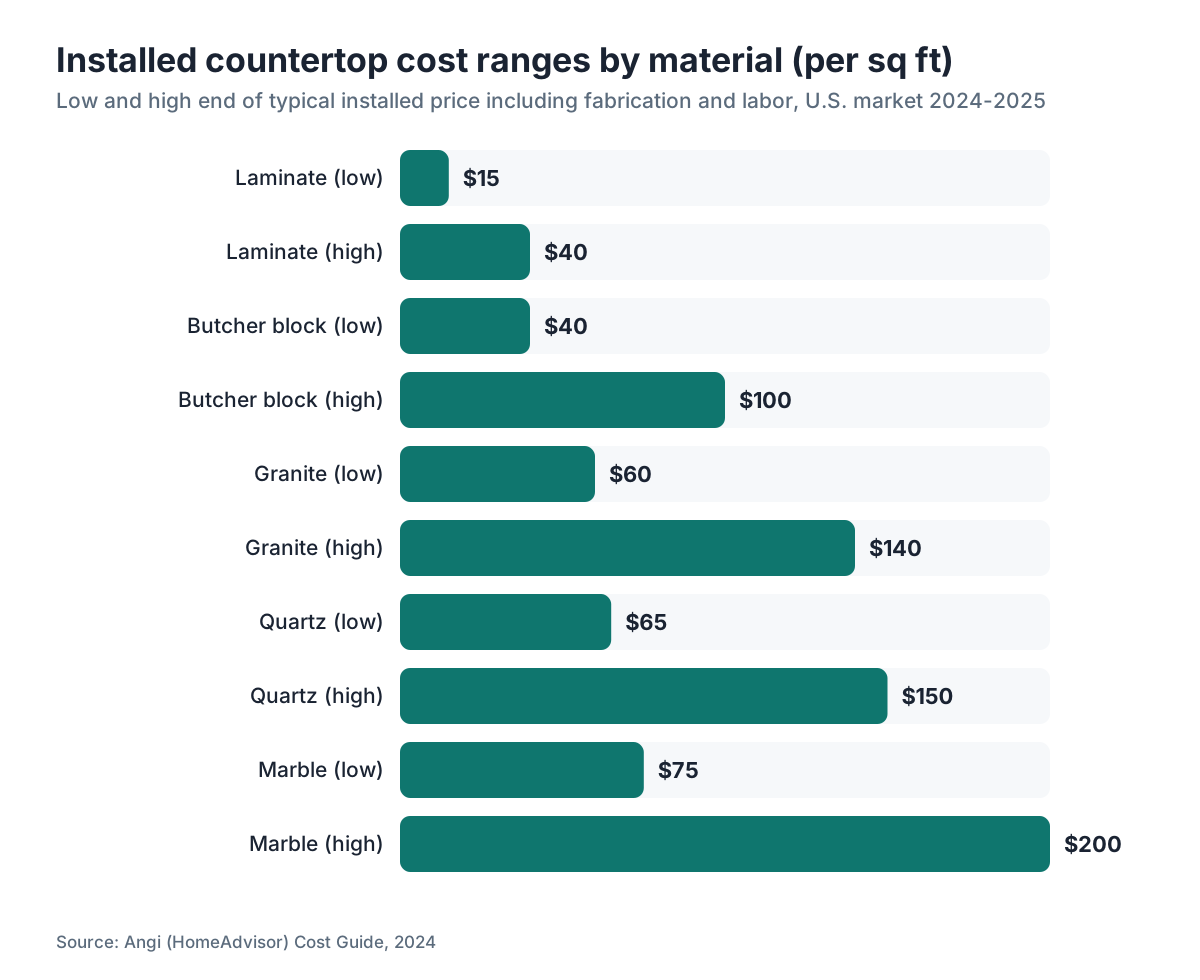
Average installed costs for 2024 to 2025 fall roughly in these ranges depending on material and market [9]:
| Material | Low (installed, per sq ft) | High (installed, per sq ft) |
|---|---|---|
| Laminate | $15 | $40 |
| Butcher block | $40 | $100 |
| Quartz (engineered) | $65 | $150 |
| Granite (natural) | $60 | $140 |
| Marble (natural) | $75 | $200 |
| Quartzite (natural) | $80 | $220 |
The ranges are wide because regional labor, material selection within each category, and shop overhead swing hard. A quote at the top of the range in rural Iowa, or at the bottom in coastal California, both deserve a second look.
Shops running modern quoting software tend to produce cleaner, itemized documents. SlabWise, for example, breaks out slab cost, fabrication, edge pricing, and installation separately, which makes comparison easier on your end. If a quote is one line item and a total, ask for the breakdown.
For more on what drives kitchen countertop pricing, including material comparisons for granite, marble, and laminate, those guides give you better footing before you ever talk to a shop.
Should you pull your own permit, or does the fabricator do it?
Most countertop replacements in an existing kitchen don't need a building permit. You're swapping a surface, not moving walls, plumbing, or electrical. There are exceptions.
When the countertop is part of a bigger remodel with new plumbing (a relocated sink), new electrical (under-cabinet circuits), or structural changes, the overall project almost always needs permits. Who pulls them matters, because the permit ties to the licensed contractor doing that work. If a fabricator is also doing rough plumbing (rare, but it happens in small markets), they need the license and the permit for it.
Your local building department is the authority here. Most have an online lookup or will answer a quick call. The International Building Code (IBC) and its residential counterpart (IRC) set structural requirements, but the actual permit triggers are decided at the local jurisdiction level [10].
If a fabricator tells you to skip a permit your building department says you need, that's a problem twice over: you can be fined, and unpermitted work can snag a future home sale.
For the day-of details, countertop installation walks through what to expect from template through completion.
How do you handle a dispute if the work is already done badly?
Document everything first. Dated photos of every defect, ideally before you pay the final balance. Use email, not text, so there's a paper trail. Put your concerns in writing and give the fabricator a fair chance to fix them, because most states require you to let the contractor cure the problem before you can pursue other remedies.
If they go silent or refuse to fix legitimate defects, here are your options, roughly in order of effort:
BBB complaint: low effort, sometimes gets a response, creates a public record.
State contractor licensing board complaint: more serious for the fabricator because it puts the license itself at risk. California's CSLB, for one, can suspend or revoke a license for unsatisfactory workmanship [2].
Small claims court: for amounts under your state's cap (often $5,000 to $12,500) this is realistic without an attorney. Bring your written contract, your photos, and your written communications.
Consumer protection complaint through your state AG: right for evidence of fraud, like misrepresented materials or a phantom license.
If you paid by credit card, a chargeback is available for goods or services not delivered as agreed. Under the Fair Credit Billing Act the window is typically 60 days from the billing statement, though card issuers often allow longer [11].
What questions should you ask a fabricator before you sign anything?
Here's a working list, grouped by what each answer tells you.
"Can I see your contractor license number and which board issued it?" A confident shop answers in ten seconds.
"Can you send me a certificate of insurance for general liability and workers' comp?" This tells you whether they're insured and whether they'll be straight with you about it.
"Who does the templating, and is it the same person who does the install?" A gap between the template and install crews is a common source of errors.
"Where do you buy your stone?" They should name a distributor without pausing.
"Can I see the actual slab before you cut it?" Good shops accommodate this, and it protects both sides.
"What's your seam placement policy?" They should explain how seam decisions get made and whether you get a say.
"What's your warranty, and what exactly does it cover?" Get this in writing.
"Have you worked with this specific material before?" This matters a lot for quartzite, soapstone, and other stones that behave differently under the saw than standard granite or quartz.
"How do you handle damage during installation?" How they answer a hypothetical tells you how they'd handle the real thing.
Answer these directly and without irritation, and that's a good sign. Treat them as an insult, and that's information too.
Shops running well-organized operations, including those using quoting tools like SlabWise to manage orders and material tracking, tend to give cleaner answers here because their paperwork is already in order.
Frequently asked questions
How do I find out if a countertop fabricator is licensed in my state?
Search "[your state] contractor license lookup" to reach your state licensing board's verification tool. California uses the CSLB at cslb.ca.gov, Florida uses the DBPR, Texas uses the TDLR. Enter the company name or license number and confirm the license is active, not expired or suspended, and that the class of license covers countertop or finish work.
Is a countertop fabricator required to be licensed?
In most states, yes, if the total project cost exceeds the state's licensing exemption threshold (usually $500 to $1,000). A full kitchen countertop job almost always exceeds this. Requirements vary by state, so check with your state contractor licensing board directly. Hiring an unlicensed contractor in a state that requires a license can void your ability to file a complaint or pursue remedies.
What insurance should a countertop fabricator carry?
General liability (at least $1,000,000 per occurrence) covering property damage, and workers' compensation covering their employees. Ask for an ACORD 25 certificate of insurance naming you as certificate holder, then call the insurer to verify it's current. Fabricators who refuse to provide a certificate are either uninsured or close to it.
How much deposit is normal to pay a countertop fabricator?
A 50% deposit at contract signing with the remaining 50% due at installation or completion is standard. Some shops ask for 60 to 70% upfront when ordering a specialty or custom slab. 100% upfront is a red flag. Never pay the full balance before you've inspected the finished installation.
What does a countertop fabrication contract need to include?
At minimum: the exact slab brand, series, color, thickness, and lot number; edge profile with a visual reference; seam location plan; installation date; payment schedule; warranty terms and what they cover; and a change order process. Verbal agreements about edges, seams, or material upgrades cause the most disputes after the fact.
How do I spot fake reviews for a countertop fabricator?
Look for reviews posted in tight clusters (five in one week, then nothing for months), generic language with no job-specific detail, reviewer profiles with no other review history, and reviews where the name matches someone who also reviewed the owner's other business. Cross-check Google, BBB, and Houzz. Real reviews mention specific materials, installers by name, or job details.
What is the Natural Stone Institute fabricator accreditation?
The Natural Stone Institute (NSI, formerly the Marble Institute of America and Building Stone Institute) runs a facility accreditation program that audits shops on equipment, worker training, quality control, and safety. Accredited shops have passed an on-site evaluation. As of NSI's last published list, roughly 120 fabricators in North America hold this accreditation. It's the most meaningful third-party credential in stone fabrication.
Should I visit a countertop fabricator's shop before hiring them?
Yes, especially for a large project or when you're uncertain. Ask to see the shop and check slab storage (upright in A-frames), equipment condition, and finished work waiting for delivery. Any fabricator who won't let you visit or who has no fixed shop address warrants extra scrutiny. You can tell a lot about workmanship by looking at edges and seams on pieces already fabricated.
How do I compare countertop quotes from different fabricators?
Give every fabricator identical specs: same material brand and series, same thickness, same edge profile, same square footage, same sink model, and same scope (removal of old top, yes or no). Otherwise you're comparing different products at different scopes. Ask for an itemized breakdown rather than a total. A quote that bundles everything into one number makes comparison nearly impossible.
What are the biggest red flags when hiring a countertop fabricator?
No license number, no physical shop address, 100% deposit required upfront, a price dramatically lower than every other quote, pressure to sign the same day, no written contract, and refusal to provide a certificate of insurance. Any one alone might be explainable. Several together mean you should move on.
What can I do if a countertop fabricator does bad work?
Document defects in photos before making final payment. Put your concerns in writing and give the fabricator a chance to remedy the work (most states require this). If it stays unresolved, file a complaint with your state contractor licensing board (which can suspend their license), file a BBB complaint, or pursue small claims court for amounts under your state's cap. If you paid by credit card, a chargeback may be available within 60 to 120 days.
Do countertop replacements require a building permit?
Usually no, for a straight countertop swap in an existing kitchen. Permits become required when the project involves moving plumbing, adding electrical circuits, or structural changes. Your local building department is the authoritative answer. If a permit is required and the fabricator tells you to skip it, that's a problem: you can be fined, and unpermitted work can complicate a home sale.
How long should a countertop fabricator's warranty last?
One year on workmanship (fabrication defects, edge chipping under normal use, seam separation) is the industry norm. Engineered stone makers like Cambria offer separate material warranties that can run 10 years to lifetime on the slab itself. Natural stone carries no manufacturer warranty since it's a natural product. Get the warranty terms in writing and confirm exactly what triggers a covered repair versus what counts as normal wear.
Is it safe to use a countertop fabricator who works as a solo operator without employees?
It can be. Solo fabricators sometimes do excellent work with lower overhead. Verify a few things: they still need a contractor license in most states, their general liability insurance should be in force even without employees, and you want to know who actually does the install (are they bringing a helper who's covered under their policy?). References and a shop visit matter even more with a sole operator, since there's less infrastructure to fall back on.
Sources
- Federal Trade Commission, Home Improvement Scams consumer guidance: Advance-fee fraud, shoddy workmanship, and unlicensed contractors are the top patterns in home improvement contractor complaints reported to the FTC.
- California Contractors State License Board, License Classifications: California CSLB has disciplinary authority to suspend or revoke contractor licenses for unsatisfactory workmanship; countertop fabricators typically operate under C-54, C-61/D-12, or B license classifications.
- California Contractors State License Board, Unlicensed Contractor FAQ: Many states exempt contractor licensing requirements for projects under a dollar threshold (often $500-$1,000 total), but full kitchen countertop replacements almost always exceed this threshold.
- Insurance Information Institute, Contractor Insurance Requirements: General liability coverage for contractors should be at least $1,000,000 per occurrence; many reputable shops carry $2,000,000 aggregate coverage.
- Better Business Bureau, How BBB Ratings Work: BBB ratings reflect a business's response to customer complaints, not independent quality assessments; the BBB file also shows complaint history and accreditation tenure.
- Natural Stone Institute, Fabrication Best Practices: Stone slabs should be stored upright in A-frame racks with protective padding between slabs; flat stacking risks fracture.
- Cambria, Warranty Information: Cambria offers a limited lifetime warranty on its engineered quartz products covering manufacturing defects.
- Natural Stone Institute, Accredited Fabricator Program: NSI's fabricator accreditation program evaluates shops on equipment, training, quality control, and environmental practices; roughly 120 fabricators in North America hold accreditation.
- HomeAdvisor (Angi), Countertop Installation Cost Guide 2024: Average installed countertop costs range from $15-$40/sq ft for laminate, $60-$140 for granite, $65-$150 for engineered quartz, and $75-$220 for marble and quartzite as of 2024-2025.
- International Code Council, International Residential Code (IRC): Building permit requirements for residential renovations are set at the local jurisdiction level under the IRC framework; countertop replacements without plumbing or electrical changes typically do not require permits.
- Consumer Financial Protection Bureau, Disputing Credit Card Charges: Under the Fair Credit Billing Act, consumers can dispute credit card charges for goods or services not delivered as agreed; the dispute window is typically 60 days from the billing statement date, though card issuers often allow longer.
Last updated 2026-07-11