
TL;DR
- Most countertop fabrication shops net 8 to 15% on revenue.
- The margin moves live in five places: accurate job costing, material yield above 78%, quoting that's fast enough to win better customers, tighter CNC and install labor, and a shift toward higher-margin stone and add-on services.
- None of it requires more volume.
- Most of it is tightening what you already do.
What profit margins do countertop fabrication shops actually run?
Most shops run gross margins of 35 to 55% and net margins of 8 to 15%. Where you land depends on shop size, material mix, and whether the owner pulls a market-rate salary or buries profit in their own paycheck. Those numbers track with the Kitchen & Bath Industry Association's business performance work, which puts net operating income for specialty fabricators in that same 8 to 15% band [1].
High performers clear 20 to 25% net, and they do it year after year. The gap between average and excellent is not volume. A shop doing $1.5M a year sometimes beats a shop doing $5M, because margin is a math problem, not a size problem.
Three places margin disappears: material you paid for but cut into the dumpster, labor hours you never priced right, and jobs you won at the wrong number because your quote was a guess. Fix those three and the bottom line moves fast.
What is the typical cost structure inside a fabrication shop?
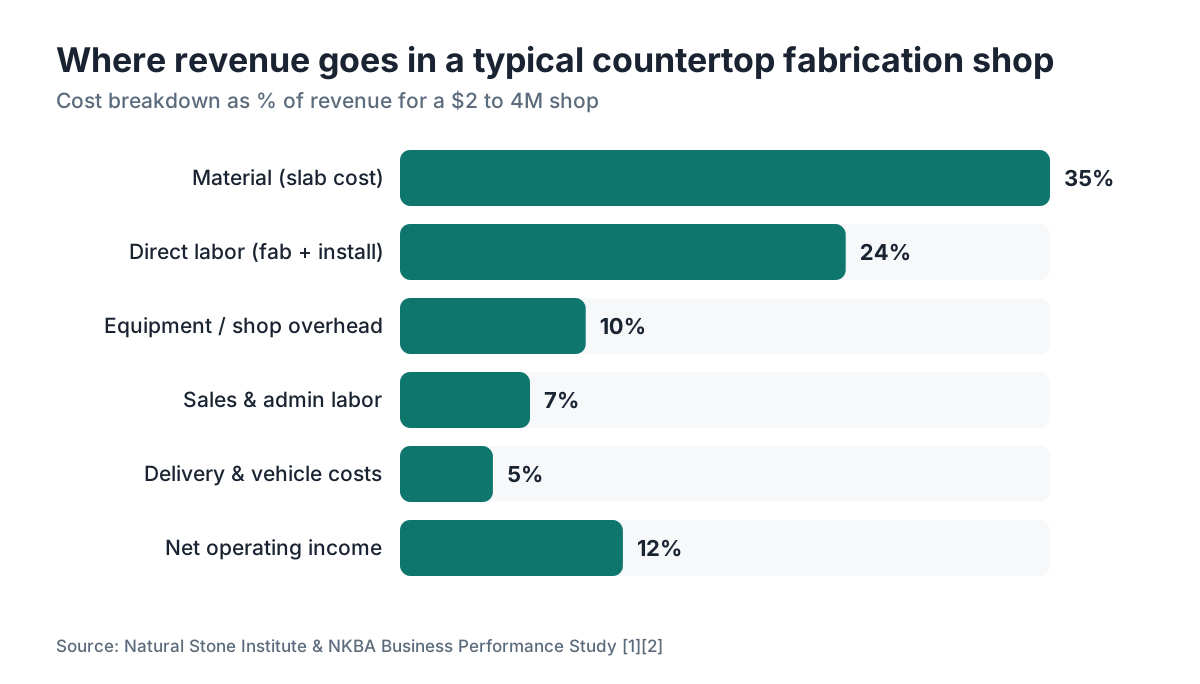
You can't fix margin until you know where the money goes. Here's how costs stack up for a mid-size stone shop doing $2 to 4M a year:
| Cost Category | % of Revenue (typical range) |
|---|---|
| Material (slab cost) | 30 to 40% |
| Direct labor (fabrication + install) | 20 to 28% |
| Equipment / shop overhead | 8 to 12% |
| Sales & admin labor | 5 to 8% |
| Delivery & install vehicle costs | 3 to 6% |
| Net operating income | 8 to 15% |
Material and labor together eat 50 to 68% of revenue in most shops [1]. Look there first. The other line items matter, but those two dwarf everything else.
One thing wrecks benchmarking: a lot of small owners count their own draw as profit. If you're the primary fabricator paying yourself $60K when a replacement hire costs $90K, your real net is lower than your P&L says. Run the numbers with a market-rate salary for every role you personally fill before you celebrate a good month.
How does material yield affect fabrication margins, and what's a good target?
Material yield is the share of each slab you sell as finished countertop instead of scrap. At $8 to 20 per square foot for slab cost on granite or quartz, a 10-point yield bump on a $2M shop is worth roughly $60,000 to $100,000 in recovered cost a year. That math is the whole reason CNC nesting software exists.
Practitioners commonly cite 70 to 78% yield for shops doing mostly manual layout, and 80 to 88% for shops running optimized nesting on every job [2]. Your ceiling depends on job mix. Lots of small L-shapes on big slabs is hard. Long straight runs are easy money.
Three things kill yield quietly. Cutlist errors from manual templates force re-cuts. Bad remnant tracking means you buy a fresh slab for a 6-square-foot island when a remnant already covered it. And nobody owns the number. If you don't measure yield per job, you won't improve it.
A remnant program can also make money. Shops sell remnants for $100 to $400 a piece for bathroom vanities or laundry rooms. That turns recovered cost into actual income instead of a disposal fee.
The EPA's Sustainable Materials Management program treats construction and demolition material, which includes stone offcuts in commercial jobs, as a recoverable resource stream worth tracking [3]. For a shop, tracking it is discipline before it's anything green.
Why is inaccurate job costing the #1 margin killer for most shops?
Most shops with a margin problem don't have a pricing problem. They have a cost-visibility problem. They quote off what they charged last time for something that looked similar, win the job, do the work, and never check whether that specific job made money.
Job costing means tracking, for every job: actual slab cost, fabrication hours by task, install hours including drive time, consumables (blades, pads, water), and delivery. Run that against your quote and you learn which job types pay and which ones you're quietly subsidizing.
The National Association of Home Builders has found in its small-business finance work that firms without job-level cost tracking are far worse at predicting their own net margins than firms that track systematically [4]. Countertop fabrication behaves the same way.
What surfaces once shops start costing jobs: edge profiles run 2 to 3x longer than estimated, especially ogee and waterfall edges on thick material. High-rise or tight-access installs run 40 to 60% longer than standard. Leathered quartzite and exotic granites chew through blades faster than standard quartz. None of that shows up in a quote built from memory.
Tools that link the quote directly to job-cost tracking close the loop for you. SlabWise ties quote line items to real-time cost tracking, so you see job-level margin before you invoice, not six weeks later at the bookkeeper's desk.
How do you price countertops to protect margins without losing the job?
Lose a job, and the instinct is to drop your price next time. Usually wrong. The real question is whether you lost to a competitor with lower costs, or to one who's underpricing and headed out of business.
Pricing discipline starts with your cost floor per job type. Fully loaded: material, direct labor, overhead allocation, and a real margin target. If that number is $68/sq ft installed and a competitor sits at $55, you're not losing to efficiency. You're losing to someone with cheaper slabs, cheaper labor, or no profit.
For most residential work, price compression comes from the quote experience more than the number. Shops that quote slow, vague, and asterisk-heavy lose to shops that quote fast and clear, even at the same price. A homeowner who gets a clean itemized quote in 24 hours often picks that shop over one that sends a ballpark three days later, price aside.
One tactic that works: quote edge profiles, cutouts, and specialty work as line items instead of hiding them in the square-foot rate. Two things happen. Your base rate looks transparent and competitive, and the customer sees exactly where cost comes from, which kills the "can you knock something off" conversation.
The Natural Stone Institute (formerly the Marble Institute of America) publishes sales guidance noting that itemized pricing transparency lines up with higher close rates in the premium segment [5].
Which countertop materials have the best margins for fabricators?
Materials are not equal on margin, and the answer is more than "sell more quartz" or "stick to granite."
Quartz from Cambria, Silestone, or MSI comes with predictable slab dimensions, consistent hardness, and stable pricing, which makes it easy to cost accurately. Margin on quartz is often strong because the material is predictable, not because the markup is fatter. Cambria countertops carry premium retail pricing that supports better margins when you're an authorized dealer.
Granite is the most price-competitive material because it's been the volume leader for 20 years and homeowners comparison-shop it hard. But exotic granites with heavy movement or unusual origin run $15 to 25/sq ft more in slab cost and often $20 to 40/sq ft more at retail, so the absolute dollar margin can be better even when the percentage isn't. The granite countertops guide breaks down how pricing shifts by origin and grade.
Marble and real quartzite carry strong retail pricing, and the homeowners buying them are usually less price-sensitive. The catch: hard quartzite eats tooling, and marble needs careful handling and seam placement to dodge callbacks. Price that in.
Laminate stays thin unless you run volume or pair it with install labor you can bill. Formica countertops are worth doing when your templating and install crew would otherwise sit idle, and the broader laminate countertops picture is the same story.
| Material | Typical retail range (installed, $/sq ft) | Fabrication complexity | Tooling cost | Margin profile |
|---|---|---|---|---|
| Quartz (standard) | $65 to $120 | Low-medium | Low | Good |
| Granite (commodity) | $45 to $85 | Medium | Medium | Tight |
| Granite (exotic) | $80 to $150+ | Medium | Medium | Good |
| Marble | $75 to $130 | Medium-high | Medium | Good if accurate |
| Quartzite | $85 to $160 | High | High | Good if priced right |
| Laminate | $25 to $55 | Low | Low | Thin |
| Butcher block | $40 to $90 | Medium | Low | Moderate |
Butcher block countertops earn a spot too: low tooling cost, a natural add-on for kitchen remodels, and margins that hold up when you price the finishing and install right.
How does labor efficiency on the shop floor affect your bottom line?
Labor is the second-largest cost in most shops and the hardest to control, because it flexes in ways material doesn't. A 10% gain in shop labor efficiency on $2M of revenue at 25% labor cost drops $50,000 straight to net.
The usual leaks: a CNC sitting idle while it waits on a toolpath nobody programmed ahead, job sequencing that has two techs fighting over the same machine, and installs where a two-person crew burns an hour in traffic or waits on a GC who wasn't ready.
On the floor, the number that matters is square feet of finished product per labor hour. If you run 12 to 15 sq ft per hour on standard straight runs and drop to 6 to 8 on complex jobs, you need to know that before you quote the complex job. Track it per job type, never as a shop average.
Install crew utilization is where the most money leaks. A crew that drives 45 minutes each way and spends 2 hours on-site is not as profitable as the same crew doing two jobs in one neighborhood. Route planning sounds trivial, but in a shop running 15 to 20 installs a week, consolidating routes saves 8 to 12 hours of drive time. That's a free install day every week.
For countertop installation, charge for complexity. Second-floor installs, tight spaces, and tear-out of existing tops all cost real time. Line-item them or you lose that margin on every job where they show up.
What add-on services can increase revenue per job without adding equipment?
The highest-margin move most shops can make needs no new equipment. It's pulling more revenue out of jobs you already have on the calendar.
Sealing is the clearest one. Charge $75 to $150 for a professional seal on a natural stone job. It takes under 20 minutes and costs maybe $8 to 12 in material. That's $60 to $120 of gross profit per job with zero new overhead. Plenty of shops give it away or never mention it.
Undermount sink prep, the cutout plus clip install, usually gets bundled into a flat fee that ignores real time. A proper cutout with a polished edge on a 9cm apron-front farmhouse sink runs 45 to 60 minutes. Price it that way.
Templating and design consultation get underpriced because shops treat them as sales cost, not billable work. Charge $75 to $150 for a template visit and credit it toward the job. That filters out tire-kickers, recovers cost on deals that don't close, and reads as professional instead of desperate.
Removal and haul-away of old countertops is real labor and disposal cost, yet most shops eat it or do it at cost. A fair charge is $150 to $350 depending on scope. Homeowners expect to pay for it.
For stone shops, cleaning and sealing maintenance packages, annual or biannual, create recurring revenue from past customers. They already trust you, and the work slots into slow periods. See how to clean stone countertops for what a professional service program covers.
How can faster, more accurate quoting increase your margins?
Quoting speed and accuracy are margin issues before they're sales issues. Follow the chain. Slow quotes lose time-sensitive buyers. Lose those, and you chase volume harder. Chase volume, and you drop price to fill the calendar. Fast, accurate quotes let you stay selective instead.
Accuracy carries the same weight. When a quote takes 40 minutes to build by hand, estimators rush. They apply square-footage averages to jobs with complicated cutouts, assume standard edges, and forget the backsplash or the waterfall panel. Every omission becomes either a callback dispute or margin you swallow on install day.
Shops that move quoting off spreadsheets and onto software typically cut build time from 30 to 60 minutes down to 8 to 15 minutes per job [2]. That compounds. Three estimators quoting 50% faster handle twice the volume, or the same volume with fewer estimator hours.
SlabWise is built for this workflow, tying digital templates, material costs, nesting estimates, and margin targets into one quote process. That's us, and of course we'd say that, but the point holds no matter which tool you pick.
The quality signal matters too. A homeowner who gets a clean itemized PDF with a rendered layout says yes at your price more often than one holding a handwritten estimate off a yellow pad. Perceived professionalism pulls perceived value up with it.
How do you reduce callbacks and warranty costs that eat into margins?
One callback can wipe out the margin from two to four average jobs. The crew drives out, material may get re-cut, and shop time burns on work you already got paid for.
The common causes: seam placement the customer never approved in writing, edge-profile misunderstandings, cracks during install on fragile material (marble with long spans is the classic), and out-of-tolerance measurements that leave gaps at the wall.
Digital templating with laser or structured-light systems cuts measurement callbacks sharply. A laser system runs $5,000 to $15,000, and it pays back fast when a single re-fabrication costs $400 to $1,200 in slab, labor, and scheduling [2].
Preinstall sign-off on a seam map and layout drawing is the cheapest callback tool there is. It costs a PDF and a five-minute conversation. Shops that get written sign-off on seam placement before cutting report far fewer seam disputes.
On fragile material, reinforcement (mesh backing, support spans) should be standard process, not an upsell. Build it in and you kill a whole class of callbacks. The Occupational Safety and Health Administration also publishes handling and lifting guidance for heavy stone panels that reduces breakage in transit when crews actually follow it [6].
What operational benchmarks should a fabrication shop track every week?
If you don't measure it, you can't improve it. Most owners know their revenue but have no weekly read on the numbers that actually drive margin.
Five numbers worth watching every week:
- Revenue per shop labor hour (target: $80 to $120 for a mid-range shop, $120+ for premium)
- Material yield per job (target: 78%+ with optimized nesting)
- Quote-to-close rate (target: 40 to 55% residential; under 30% usually means a pricing or process problem)
- Average job margin (target: 45 to 55% gross; spot-check 3 to 5 jobs a week against real costs)
- Callback rate (target: under 3% of jobs; over 5% is a process problem)
Quote-to-close deserves a note. Very high (above 65%) and you're probably underpricing. Very low (below 25%) and you likely have a pricing, presentation, or responsiveness problem. The sweet spot is winning roughly half of competitive situations, which reads as competitive but not desperate.
The Small Business Administration recommends small manufacturers track a set of key performance indicators regularly and use them to set targets [7]. Weekly beats monthly for a production shop, because problems compound fast when jobs move from quote to install in 5 to 10 days.
How does your customer mix affect countertop shop profitability?
Customers are not equal, and most shops learn this the slow way. The most profitable mix leans toward general contractors and kitchen designers who bring steady volume and rarely fight on price, plus direct homeowners who self-select into premium materials.
The least profitable customer is usually the price-sensitive homeowner comparing three bids on a standard granite kitchen. They take more sales time, more hand-holding, and they're likelier to dispute minor seam or color variation after install. Not a reason to turn them away, but a good reason not to build your whole business at the bottom of the market.
GC and designer relationships take time to build, then compound. A designer who specifies your shop on every kitchen remodel is worth $150,000 to $400,000 in annual revenue with almost no sales cost once it's established. That's a different margin world than winning individual homeowners on Google Ads.
For kitchen countertops, the remodel segment is dominated by GC and designer-referred work in the $10,000 to $25,000 ticket range. That's where relationship-building pays.
Some shops keep a lower-price laminate or entry stone option specifically to serve GCs who need a full range, while protecting premium pricing on natural stone. That tiered approach holds the relationship when a project can't afford full stone, and it feeds volume that keeps the install crew busy.
What financial habits separate high-margin shops from average ones?
The operational stuff above matters. But shops that live above 20% net share a few financial habits that average shops skip.
First, they price to a target margin instead of a cost-plus reflex. They know what they need to make before they quote, and they walk away from jobs that miss the floor. Walking away takes practice, because an empty calendar is scary, but it's almost always right.
Second, they review job-level margin after every job closes, not once a quarter. When a job lands below target, they find out why before the next similar job gets quoted the same way. That's the feedback loop that separates shops that get smarter from shops that repeat the same mistake for years.
Third, they run material purchasing tight. They know their average days of slab inventory, they have a written remnant policy, and they don't let the yard fill with slow-moving exotic material that ties up cash. Working capital stuck in unsold slab is a real cost that never shows on the income statement and absolutely drags on margin.
The IRS Small Business and Self-Employed Tax Center covers cash-basis versus accrual accounting for small manufacturers [8]. For a shop buying material 30 to 60 days before billing, accrual gives a far more accurate job-level margin picture than cash basis.
Finally, high-margin shops almost always have a bookkeeper or controller who isn't the owner. When the owner keeps the books, financial review slips during busy stretches, which is exactly when you most need to know whether the volume you're chasing actually pays.
Frequently asked questions
What is a good net profit margin for a countertop fabrication shop?
Most shops run 8 to 15% net. High performers consistently hit 20 to 25%. The gap is almost always in job-costing accuracy, material yield, and avoiding low-margin work, not in doing more volume. A shop doing $1.5M with real discipline can outperform a $4M shop running sloppy numbers.
How much does poor material yield actually cost a fabrication shop?
On a shop doing $2M in revenue at 35% material cost, a 10-point yield improvement from 70% to 80% recovers roughly $70,000 in slab cost per year. That goes straight to the bottom line. Tracking yield per job and using nesting software are the two fastest ways to move the number.
Should a countertop shop charge for templating?
Yes, in most cases. Charging $75 to $150 for a template visit, credited toward the job if it closes, filters out homeowners collecting quotes with no intent to buy. It recovers cost on deals that don't close and reads as professional. The objection rate is lower than most shops expect.
How do callbacks affect countertop shop profitability?
A single callback typically costs $400 to $1,200 in labor, material, and scheduling depending on scope. If your callback rate is above 3% of jobs, you're burning real margin. Written customer sign-off on seam maps before cutting and digital templating are the two highest-ROI fixes.
What's the best material mix for maximum profitability?
Exotic granites, quartzite, and branded quartz usually deliver the best absolute dollar margins, because retail price scales faster than tooling cost. Commodity granite is the most price-competitive. Laminate stays thin unless you run volume. The key is pricing complexity accurately, not avoiding complex materials.
How important is quoting speed to winning profitable jobs?
Very. Shops quoting in under 24 hours close at higher rates than shops taking 3 to 5 days, and they tend to close at asking price rather than after negotiation. Speed signals professionalism and shrinks the window for a competitor to get there first. Moving from spreadsheets to software typically cuts build time from 30 to 60 minutes to 8 to 15 minutes.
What's the ideal quote-to-close rate for a countertop fabrication shop?
Around 40 to 55% for residential work. Above 65% and you're likely underpricing and leaving margin on the table. Below 25% and the problem is usually price, response time, or presentation quality. The close rate is a diagnostic, not a vanity metric.
How can a countertop shop build recurring revenue?
Sealing and maintenance packages for past natural stone customers are the most practical option. You already have the relationship and the technical credibility. Annual or biannual sealing programs slot into slow periods, cost little to deliver, and create repeat touchpoints that lead to referrals and future remodel work.
Is it better to grow volume or improve margins in a countertop shop?
Improve margins first. Adding volume to a shop at 10% net just makes more work for the same reward. Getting to 20% net before you scale means every new revenue dollar is twice as valuable. The discipline required to run tight margins also leaves you better prepared to handle growth without chaos.
What labor metrics should a countertop shop track?
Revenue per shop labor hour is the single most useful number, with $80 to $120 as a mid-range target and $120+ for premium shops. Track it by job type, not as a shop average. Also watch install drive time as a share of total install hours; above 25% means route planning is costing you real money.
How do designer and GC relationships affect fabricator margins?
A lot, and in your favor. A designer or GC relationship that brings steady volume with minimal sales effort produces margins well above one-off homeowner work. The customers arrive pre-sold on quality, the jobs are better specified, and there's little price negotiation. Two or three strong trade relationships can shift a shop's overall margin by several points.
What's the ROI on laser templating equipment for a fabrication shop?
Laser templating systems run $5,000 to $15,000. A single avoided re-fabrication costs $400 to $1,200. If the system prevents even 10 to 15 re-fab events a year, it pays for itself in year one. The bigger win is customer satisfaction and the callback drop that follows, which compounds through referrals.
Sources
- National Kitchen & Bath Association, NKBA Business Performance Study: Average net operating income for specialty countertop and stone fabricators is typically in the 8 to 15% range of revenue
- Natural Stone Institute, Technical Manuals and Industry Benchmarks: Material yield benchmarks of 70 to 78% for manual layout and 80 to 88% with optimized nesting; quoting time reduction from 30 to 60 minutes to 8 to 15 minutes with software
- U.S. EPA, Sustainable Materials Management: Construction and demolition material waste including stone offcuts represents a major recoverable resource stream under the EPA's sustainable materials management framework
- National Association of Home Builders, Small Business Finance and Job Costing Guidance: Small construction firms without job-level cost tracking are significantly less accurate at predicting their own net margins than those with systematic tracking
- Natural Stone Institute, Pricing and Sales Practices Guidance: Itemized pricing transparency correlates with higher customer close rates in the premium stone segment
- U.S. Occupational Safety and Health Administration (OSHA): OSHA handling and lifting guidance for heavy stone panels reduces breakage during transit and install when followed
- U.S. Small Business Administration, Manage Your Finances: SBA recommends small manufacturers track key performance indicators regularly and use them to set targets
- IRS, Small Businesses and Self-Employed: IRS guidance on cash-basis vs. accrual accounting for small manufacturers; accrual gives more accurate job-level margin picture for shops with 30 to 60 day material lead times
- U.S. Bureau of Labor Statistics, Occupational Employment and Wage Statistics: Labor cost data and wage benchmarks for stone fabrication and installation occupations
- U.S. Census Bureau, Annual Survey of Manufactures: Revenue, cost, and margin data for the stone product manufacturing sector (NAICS 3279)
Last updated 2026-07-11