
TL;DR
- A fabrication shop safety plan must address OSHA's silica standard (29 CFR 1926.1153 or 1910.1053), machinery guarding, wet cutting protocols, PPE requirements, emergency response, and employee training.
- OSHA can fine shops up to $16,550 per serious violation.
- This guide walks through every required element, in plain language, so you can build a working document rather than a shelf ornament.
Why does a countertop shop need a written safety plan in the first place?
The short answer: OSHA requires it, and the hazards in a fabrication shop are genuinely severe.
Countertop fabrication combines three of the most dangerous categories in manufacturing: airborne silica dust, high-speed cutting tools, and heavy material handling. Engineered stone (quartz) products can contain 90 percent or more crystalline silica by weight [1]. When you cut, grind, or polish those slabs without controls, you generate respirable silica particles small enough to reach the deep lung and cause silicosis, an irreversible and potentially fatal lung disease. OSHA's permissible exposure limit (PEL) for respirable crystalline silica is 50 micrograms per cubic meter of air as an 8-hour time-weighted average [2].
Silica is only part of it. Bridge saws run blades at thousands of RPM, CNC routers have moving gantries that can trap a limb in seconds, and a full slab of granite weighs 15 to 20 pounds per square foot. A 10-foot by 5-foot slab can top 1,000 pounds. Drops cause crush injuries. Blade contact causes amputations.
A written safety plan does three things. It forces you to think through every hazard before someone gets hurt. It gives employees a reference they can actually read rather than relying on verbal folklore. And it gives you documentation if OSHA shows up. Verbal safety programs are not compliant under 29 CFR 1910.1053 [2].
What does OSHA actually require for a fabrication shop safety plan?
OSHA does not publish a single "fabrication shop safety plan" template. What exists is a set of standards that collectively dictate what your written program must contain.
The two silica standards matter most. For general industry shops (most fabrication facilities), 29 CFR 1910.1053 applies. For shops doing construction work at jobsites, 29 CFR 1926.1153 applies. Both require a written exposure control plan whenever a task is expected to produce exposures at or above the action level of 25 micrograms per cubic meter [2]. That plan must name the tasks that create silica exposure, the controls you use, and how you will restrict access to high-exposure areas.
Hazard communication comes next. OSHA's Hazard Communication Standard (29 CFR 1910.1200) requires a written Hazard Communication Program covering all chemicals on-site, including adhesives, sealers, and cleaning agents. Your shop needs a current Safety Data Sheet for every chemical and a way to make those sheets accessible to workers on every shift [3].
Machinery safety falls under 29 CFR 1910.212 (general machine guarding) and, for lockout/tagout procedures, 29 CFR 1910.147. Any equipment with an energy source that could harm a worker during maintenance must have a written lockout/tagout procedure [4].
Personal Protective Equipment gets its own written program under 29 CFR 1910.132, which requires a documented hazard assessment certifying which PPE is needed for each task [5].
Emergency response rounds out the set. 29 CFR 1910.38 requires a written Emergency Action Plan for any workplace with more than 10 employees. If you have 10 or fewer, the plan can be oral, but written is always safer from a liability standpoint [6].
Here is a quick reference for the standards that most directly affect a fabrication shop:
| Standard | Topic | Written Program Required? |
|---|---|---|
| 29 CFR 1910.1053 | Respirable silica (general industry) | Yes, if tasks reach action level |
| 29 CFR 1910.1200 | Hazard communication / SDS | Yes |
| 29 CFR 1910.147 | Lockout/tagout | Yes |
| 29 CFR 1910.132 | PPE hazard assessment | Yes |
| 29 CFR 1910.38 | Emergency action plan | Yes (10+ employees) |
| 29 CFR 1910.212 | Machine guarding | No separate written plan, but guarding must exist |
| 29 CFR 1926.1153 | Respirable silica (construction) | Yes, if applicable |
How do you structure the document itself?
A safety plan is a collection of sub-programs bound together, not one monolithic document. The cleanest structure puts a one-page cover sheet up front naming the employer, the effective date, and who is responsible for the plan, followed by numbered sections that can be updated independently.
Here is the section order that works well for a fabrication shop:
- Scope and purpose (one paragraph)
- Roles and responsibilities (who enforces what)
- Silica Exposure Control Plan
- Hazard Communication Program with SDS binder index
- PPE hazard assessment and selection guide
- Lockout/tagout procedures, one page per machine
- Machine guarding inspection checklist
- Material handling (slabs, A-frames, vacuum lifts)
- Wet cutting and ventilation requirements
- Housekeeping (no dry sweeping, HEPA vacuums only)
- Medical surveillance program
- Training records
- Emergency Action Plan
- Incident reporting and investigation
- Plan review schedule
Keep each lockout/tagout procedure on its own laminated sheet posted at the machine. That is actually required: 29 CFR 1910.147(c)(4)(ii) says procedures must be available in the work area [4].
Date every page. OSHA inspectors look for documents that are clearly out of date or that list equipment no longer on the floor, because those are signs the plan is filed and forgotten rather than actually used.
What goes in the silica exposure control plan?
This is the most technically demanding section. The silica exposure control plan must identify every task in your shop that generates respirable silica and specify the engineering controls or work practices you use to keep exposure at or below the PEL of 50 micrograms per cubic meter [2].
OSHA's 1910.1053 appendix tables list "specified exposure control methods" for common tasks. For wet methods (wet cutting with a continuous water supply that keeps the blade and work piece wet), OSHA generally presumes compliance for tasks like cutting stone with a wet-method saw, as long as you follow the specified controls [2]. That means you do not need air monitoring as long as you actually use the specified method correctly.
For tasks not covered by the appendix tables, you either conduct air monitoring or apply a higher-order control like a local exhaust ventilation (LEV) system and verify its performance.
Your plan should list, for each task:
- Task name (e.g., "wet bridge saw cutting of engineered quartz")
- Frequency and duration
- The engineering control used (wet method, LEV, enclosed cab)
- Required PPE (minimum: half-face respirator with N95 or P100 filters for uncontrolled tasks)
- How often controls are inspected
Medical surveillance is part of the silica standard. If any employee is occupationally exposed to silica at or above the action level for 30 or more days per year, you must offer a medical examination within 30 days of initial assignment and then every three years [2]. The exam includes a chest X-ray, pulmonary function test, and a TB symptom review. You pay for it.
OSHA published a Small Entity Compliance Guide for the silica standards that walks through each requirement in plain English. It is a useful supplement to writing this section of your plan [7].
How do you write lockout/tagout procedures for shop equipment?
Lockout/tagout (LOTO) is the procedure that prevents a machine from energizing while someone is cleaning or maintaining it. OSHA 29 CFR 1910.147 calls for a written procedure for each machine with more than one energy source or more than one lockout point [4].
For a typical fabrication shop, that means individual LOTO procedures for: the bridge saw, each CNC router or waterjet, the edge polisher, the sink cutout machine, overhead cranes or gantry systems, and the dust collection system (which has electrical and pneumatic energy sources).
A LOTO procedure for a bridge saw, for example, should specify:
- The machine name and location
- All energy sources (120V or 240V electrical, pneumatic, hydraulic if any)
- The location of each disconnect or valve
- The sequence of steps to de-energize
- The type of lock and tag to use
- How to verify zero energy state (test the start button after locking out)
- Steps to re-energize after maintenance
Post the laminated procedure on the machine. Give every authorized employee their own lock with a unique key. Never share locks. If multiple workers are on the machine at the same time, each one applies their own lock under a group lockout hasp.
OSHA says the standard's purpose is to prevent "the unexpected energization, startup, or release of stored energy from machines or equipment" [4]. Put that quote verbatim in your LOTO section introduction. It anchors the procedure to regulatory intent and tells an inspector you know why the rule exists.
What PPE is required in a stone fabrication shop?
PPE is the last line of defense, not the first. Your plan should say that out loud. Engineering controls (wet cutting, LEV, machine guarding) come first; PPE supplements them.
That said, a fabrication shop needs substantial PPE. Your written hazard assessment, required under 29 CFR 1910.132(d), must document the hazards for each work area and specify the PPE selected [5].
For most fabrication tasks, the assessment will land here:
| Task | Eyes | Hearing | Respiratory | Hands | Feet | Head |
|---|---|---|---|---|---|---|
| Wet saw cutting | Safety glasses + face shield | Ear plugs (85+ dB) | N95 minimum if controls used; P100 if not | Cut-resistant gloves | Steel-toe boots | Hard hat if overhead work |
| CNC/waterjet operation | Safety glasses | Ear plugs | N95 minimum | Cut-resistant gloves | Steel-toe boots | N/A |
| Dry grinding (avoid) | Safety glasses + face shield | Ear plugs | P100 half-face respirator required | Cut-resistant gloves | Steel-toe boots | N/A |
| Chemical sealing/adhesives | Safety glasses | N/A | Chemical cartridge respirator (per SDS) | Chemical-resistant gloves | Steel-toe boots | N/A |
| Slab handling | Safety glasses | N/A | N/A | Leather or cut-resistant gloves | Steel-toe boots | Hard hat in staging area |
A noise survey is smart for any shop running multiple machines at once. If any task exceeds 85 dBA as an 8-hour TWA, you are required to run a hearing conservation program under 29 CFR 1910.95, which includes annual audiometric testing [8]. Bridge saws routinely exceed 90 dBA at the operator position.
For respirators, any shop requiring employees to wear respirators must have a written Respiratory Protection Program under 29 CFR 1910.134, including medical evaluation, fit testing, and training [9]. This is separate from the silica plan but tightly connected to it.
How do you handle slab handling and material storage safety?
Slab handling injures more fabrication workers than blade contact does. A slab that slips off an A-frame or tips during transport can cause crush injuries, broken feet, and fatalities.
Your plan should document:
A-frame and slab rack standards. Racks must be rated for the load, anchored or counterweighted so they cannot tip, and kept on level, dry floor. Overloading a rack is one of the most common causes of a catastrophic slab drop. The manufacturer's load rating must be posted on or near each rack.
Vacuum lifter inspection. Vacuum cups and seals degrade. Your plan should require a daily pre-use check of each vacuum lifter: test the vacuum level, inspect cups for cracks or deformation, and verify that the battery or compressor is charged before lifting any slab overhead. Never use a vacuum lifter with a marginal vacuum reading on engineered stone, which tends to have a less porous surface than granite and can release suction faster if a seal fails.
Two-person rules. No slab over a defined weight (commonly 75 to 100 pounds) should be moved by one person. State this explicitly and train supervisors to enforce it.
Safety footwear in all material-handling zones. Steel-toed boots with puncture-resistant soles are the floor standard, not optional.
Forklift and pallet jack operations require operator certification under 29 CFR 1910.178 for powered industrial trucks [10]. If anyone in your shop moves slabs with a forklift or pallet jack, they need documented training and a three-year recertification cycle.
What does the emergency action plan section need to cover?
The Emergency Action Plan (EAP), required under 29 CFR 1910.38, must address how employees respond to fires and any other foreseeable emergencies in your facility [6].
A fabrication shop's foreseeable emergencies include: fire (adhesive, solvent, or electrical), chemical spill (sealers or bonding agents), severe laceration or crush injury, and power failure during CNC or crane operation.
At minimum, your EAP must contain:
- Evacuation procedures and a floor plan with evacuation routes and assembly point
- Names or job titles of employees who have special roles during an emergency
- Procedures to account for all employees after evacuation
- Rescue and medical duties for designated employees
- How to report fires and emergencies (posted phone numbers for 911, poison control, nearest hospital with trauma capability)
- Contact information for the nearest medical provider
Post the evacuation map at each exit. Mark the location of fire extinguishers, the first aid kit, and the eyewash station on that map. OSHA requires eyewash stations to be accessible within 10 seconds of any area where a worker might have a corrosive chemical splash (OSHA cites the ANSI Z358.1 standard in its enforcement guidance).
Review the EAP with every new hire before they start work, not during orientation paperwork at a desk. Walk them through the route physically.
How do you document training and keep records?
A safety plan without training records is a plan OSHA will treat as unimplemented.
The silica standard requires that every employee who might be exposed receive training on: the health effects of silica, the specific tasks in your shop that create exposure, the engineering controls and work practices used, and how to use and maintain their PPE [2]. Training must happen before initial assignment and whenever there is a change in duties that creates new silica exposure.
For each training session, your log should capture: the date, the topics covered, the trainer's name and qualifications, and each employee's printed name and signature. Keep those records for the duration of employment plus three years [2].
Lockout/tagout training records must document that each authorized and affected employee was trained on the specific procedures for the machines they operate or work near [4].
Forklift operator training records must include the date of training, the date of evaluation, and the name of the person who performed the evaluation [10].
Store originals in a physical file. A digital copy (cloud backup) is smart because paper in a shop environment degrades faster than you expect. Tools like shop management software, including options like SlabWise that handle production documentation, can also carry safety record fields, though a dedicated HR or safety binder remains the compliance standard.
OSHA can request records during an inspection. Having them organized and dated is the single fastest way to resolve an inquiry without escalation.
How often do you need to review and update the safety plan?
Annual review is the practical standard, but several triggers require earlier updates.
Update immediately when: you add new equipment to the shop (new bridge saw, CNC, waterjet), you change materials (start cutting a new engineered stone product with different silica content), a workplace incident occurs (near-miss or injury), or OSHA issues a citation that identifies a gap in your current plan.
The silica standard requires that the written exposure control plan be reviewed at least annually and updated whenever a new task creates exposure or when new information on silica health effects becomes available [2].
The simplest approach is to schedule a 90-minute review every January. Bring your safety officer or a senior fabricator. Walk the floor with the written plan in hand. Check that every machine listed still matches what is actually on the floor. Check that every control described (wet cutting, LEV, vacuum lifter inspection steps) matches current practice. Sign and date the review on the cover sheet.
If you have had zero incidents all year, that review still matters. Conditions drift. Water supply to a blade gets partially blocked. LEV filters go unchecked. A new hire has been skipping the wet cutting procedure because nobody corrected them on day one. The annual review catches drift before it becomes an injury or a citation.
Building the review into your calendar rather than treating it as optional is the difference between a safety plan that reduces harm and one that checks a box.
What are the most common OSHA violations in fabrication shops?
OSHA's National Emphasis Program on Silica, updated in 2020, specifically targets stone fabrication shops [11]. Inspectors who come in under that program know exactly what to look for.
The most frequently cited violations in stone fabrication inspections, based on OSHA enforcement data, cluster around:
- No written silica exposure control plan (or a plan that does not cover engineered stone products)
- Dry cutting or grinding without controls
- No medical surveillance program for exposed workers
- Missing or incomplete lockout/tagout procedures
- No written hazard communication program
- No documented PPE hazard assessment
- Inadequate machine guarding on saws and routers
- No respiratory protection program despite requiring respirator use
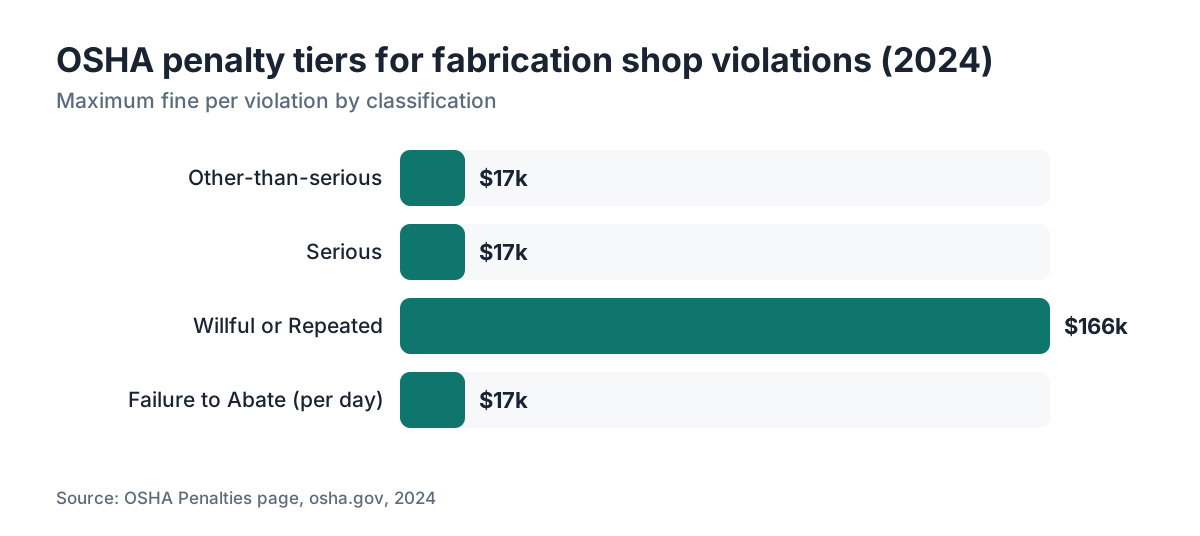
OSHA's current penalty structure (adjusted for inflation as required by law) sets serious violations at up to $16,550 per violation, and willful or repeated violations at up to $165,514 per violation [12]. A single inspection that finds a missing silica plan, no LOTO procedures, and absent hazard communication training can easily generate penalties above $50,000.
The practical reality is that most shops that get cited are not negligent operations. They are busy shops that let documentation fall behind the pace of actual work. The plan exists in the owner's head; it is just never written down. That gap is exactly what a written safety plan closes.
Where can you find templates and free resources to build your plan?
You do not need to write every section from scratch.
OSHA's website has a free Small Entity Compliance Guide for the silica standard [7] and a model Hazard Communication Program available through its publications catalog. OSHA also runs a free on-site consultation program, separate from enforcement, where a consultant visits your shop and helps identify gaps without triggering penalties. That program is administered by each state and funded federally [13].
The Natural Stone Institute (NSI) has published safety resources specific to the stone industry, including silica awareness materials. Their website at naturalstoneinstitute.org is a starting point for industry-specific guidance.
OSHA's silica in stone fabrication information page includes links to engineering control evaluations conducted by NIOSH, the research arm of CDC, which studied wet cutting and local exhaust ventilation effectiveness in real fabrication settings [14].
For machine-specific LOTO procedures, equipment manufacturers should provide a LOTO section in the operator manual. If yours does not, contact the manufacturer directly. Using manufacturer-documented energy sources as the basis for your LOTO procedure is both accurate and defensible.
For shops that want a peer review, the OSHA 10 or OSHA 30 construction or general industry courses cover hazard recognition and give whoever completes them a working vocabulary to evaluate your plan critically. Sending a senior employee through an OSHA 30 course and then having them audit your written plan before you finalize it is a practical quality check that costs under $200 per person.
If your shop tracks jobs, materials, and production in software, keeping safety documentation alongside production records makes audits less disruptive. SlabWise's shop management module is built around fabrication workflows and can be a natural home for equipment checklists and training record links, though you will still need a physical binder for signed originals.
Building a compliant safety plan takes a concentrated day or two of focused work. Maintaining it takes maybe four hours a year. That is a small investment against the cost of a serious injury, an OSHA citation, or a workers' compensation claim that can run into six figures before litigation.
Frequently asked questions
Does a small fabrication shop with only 3 employees need a written safety plan?
Yes. The OSHA silica standard (29 CFR 1910.1053) requires a written exposure control plan based on the hazard, not headcount. The only employee-count threshold in OSHA standards is the Emergency Action Plan, which can be oral for shops with 10 or fewer employees. Every other written program requirement applies regardless of shop size.
How do I know if our shop is covered by the general industry silica standard or the construction silica standard?
If your shop is a fixed manufacturing facility, 29 CFR 1910.1053 (general industry) applies. If you cut or grind stone at a construction jobsite, 29 CFR 1926.1153 (construction) applies. Many fabricators fall under both: general industry for the shop and construction for field work. Write separate exposure control plans for each context, since the specified controls and tables differ between the two standards.
Can wet cutting eliminate the need for respiratory protection entirely?
For tasks listed in OSHA's Table 1 of 29 CFR 1910.1053 or 29 CFR 1926.1153, using the specified wet method with a continuous water supply satisfies the engineering control requirement and generally does not require additional respiratory protection. But if the water supply is intermittent, the blade is worn, or the task is not on Table 1, you need air monitoring or respirators. Do not assume a running water line means full compliance without checking Table 1 specifically.
How much does it cost to get an OSHA on-site consultation for our fabrication shop?
It is free. OSHA's On-Site Consultation Program, funded by federal grants and delivered through state agencies, sends consultants to small and medium businesses at no charge. Consultants identify hazards and recommend corrections without issuing citations or sharing findings with enforcement staff. The program is separate from OSHA's inspection arm. Find your state's program through OSHA's website at osha.gov.
What respirator filter type is required for cutting engineered quartz?
OSHA's respiratory protection standard (29 CFR 1910.134) requires that respirators be adequate for the exposure level. For silica dust without engineering controls, a half-face air-purifying respirator with P100 (HEPA) filters is the commonly selected option. N95 filtering facepieces are used where engineering controls reduce exposure significantly but not fully. Your shop's exposure monitoring data or a certified industrial hygienist determines which is sufficient. P100 is the conservative, defensible default.
How often does a fabrication shop employee need silica training?
OSHA's silica standard requires training before initial assignment and whenever duties change in a way that creates new or different silica exposure. There is no fixed annual retraining interval in the standard, but many safety professionals recommend annual refreshers as a best practice. Training must cover health effects of silica, shop-specific exposure tasks, engineering controls in use, and correct PPE use. Keep signed training logs for the duration of employment plus three years.
What are the OSHA penalties for a fabrication shop that has no silica plan?
A missing written silica exposure control plan is typically classified as a serious violation. Current OSHA penalties (2024) go up to $16,550 per serious violation. If OSHA finds the same violation on a second inspection, it becomes a repeated violation at up to $165,514. A single inspection finding multiple serious violations (no silica plan, no LOTO procedures, no hazard communication program) can produce total penalties well above $50,000.
Do we need medical surveillance for employees who only do dry grinding occasionally?
Medical surveillance is triggered when an employee is occupationally exposed to respirable crystalline silica at or above the action level of 25 micrograms per cubic meter for 30 or more days per year. Occasional dry grinding can easily meet that threshold. If there is any doubt, air monitoring is the only way to know. Until you have monitoring data showing exposure below the action level, assume surveillance is required and offer the medical exam.
Can I download a free OSHA-compliant silica exposure control plan template?
OSHA does not publish a fill-in-blank silica plan template, but its Small Entity Compliance Guide for the silica standard walks through every required element in plain language and is a close functional substitute. OSHA's website at osha.gov has the guide, plus enforcement memos that clarify ambiguous requirements. The Natural Stone Institute also publishes stone-industry-specific safety materials that can supplement OSHA's general guidance.
What is a lockout/tagout procedure and which machines in a fab shop need one?
A lockout/tagout (LOTO) procedure documents how to de-energize a machine so it cannot start during maintenance or cleaning. Under 29 CFR 1910.147, any machine with a hazardous energy source needs one if workers could be injured by unexpected startup. In a fabrication shop, that covers bridge saws, CNC routers, waterjets, edge polishers, overhead cranes, dust collection systems, and any machine with hydraulic or pneumatic energy in addition to electrical.
How do I document a PPE hazard assessment to satisfy OSHA?
OSHA 29 CFR 1910.132(d) requires a written certification that names each work area assessed, the hazards identified, and the PPE selected. The document must be signed and dated by the person who performed the assessment. A simple table listing each shop task, the hazards present (impact, laceration, chemical, dust, noise), and the PPE specified for each task is sufficient. Update it whenever you add tasks, change materials, or change equipment.
Does our safety plan need to cover delivery drivers and installers as well as shop workers?
Yes, if they are your employees. OSHA protections apply to all employees, not only those in the shop. Installers at job sites are covered by the construction silica standard if they cut or grind stone on-site. Delivery drivers handling slabs need training on slab handling, PPE for hand injuries and crush hazards, and forklift safety if applicable. Subcontractors you do not directly employ are responsible for their own OSHA compliance, but your safety plan should address how you manage subcontractor activity on your property.
What should we do immediately after a workplace injury in the shop?
Provide first aid or call 911 first. Then secure the scene to prevent a second injury. OSHA requires employers to report any work-related fatality within 8 hours and any work-related in-patient hospitalization, amputation, or loss of an eye within 24 hours, using OSHA's 24-hour reporting hotline (1-800-321-OSHA) or online. Document the incident, preserve evidence, and conduct a root cause investigation. Record the injury on your OSHA 300 log if your shop is not exempt from recordkeeping.
Sources
- OSHA, Hazard Alert: Worker Exposure to Silica during Countertop Manufacturing, Finishing, and Installation: Engineered stone countertop products can contain 90 percent or more crystalline silica by weight
- OSHA, 29 CFR 1910.1200 Hazard Communication Standard: Requires a written Hazard Communication Program and Safety Data Sheets accessible to workers on every shift
- OSHA, 29 CFR 1910.147 Control of Hazardous Energy (Lockout/Tagout): Requires written LOTO procedures for machines with more than one energy source or lockout point; procedures must be available in the work area; standard purpose is to prevent unexpected energization, startup, or release of stored energy
- OSHA, 29 CFR 1910.132 Personal Protective Equipment General Requirements: Requires a written certification documenting the hazard assessment and PPE selected for each work area, signed and dated
- OSHA, Small Entity Compliance Guide for the Respirable Crystalline Silica Standard for General Industry: OSHA published a plain-language compliance guide walking through all requirements of 29 CFR 1910.1053
- OSHA, 29 CFR 1910.95 Occupational Noise Exposure: Hearing conservation program required when 8-hour TWA noise exposure equals or exceeds 85 dBA; includes annual audiometric testing
- OSHA, 29 CFR 1910.134 Respiratory Protection Standard: Written Respiratory Protection Program required for any workplace mandating respirator use; must include medical evaluation, fit testing, and training
- OSHA, 29 CFR 1910.178 Powered Industrial Trucks: Forklift operator training and evaluation required before operation; recertification every three years
- OSHA, National Emphasis Program on Respirable Crystalline Silica, CPL 03-00-023: OSHA's National Emphasis Program on Silica, updated 2020, specifically targets stone fabrication shops for inspection
- OSHA, OSHA Penalties: Serious violations carry penalties up to $16,550 per violation; willful or repeated violations carry penalties up to $165,514 per violation (2024 rates)
- OSHA, On-Site Consultation Program: Free on-site consultation for small and medium businesses; findings not shared with enforcement arm
- NIOSH, Engineering Controls for Silica Dust in Stone Countertop Fabrication: NIOSH studied wet cutting and local exhaust ventilation effectiveness in real fabrication shop settings
Last updated 2026-07-11