TL;DR
- Most homeowners spend $1,500 to $5,500 to replace kitchen countertops, with the national average around $3,000.
- Material is the biggest variable: laminate runs $800, $2,000 installed while granite or quartz typically lands between $2,500 and $7,000.
- Labor, edge profiles, sink cutouts, and demo add $300, $1,500 on top of slab cost.
What does it cost to replace kitchen countertops?
The honest answer is a range, and anyone who gives you a single number without seeing your kitchen is guessing. Contractor cost surveys put the typical project between $1,500 and $5,500 for a standard kitchen with 30 to 50 square feet of surface. The national average lands around $3,000 all-in, though that figure skews toward mid-grade materials like quartz or entry-level granite. [1]
Four things move the number: the material you pick, the total surface area, the complexity of the layout (corners, curves, a peninsula), and the local labor market. A simple galley kitchen with a laminate swap can come in under $1,000. A large L-shaped kitchen with a waterfall quartz island and a farmhouse sink cutout hits $8,000 or more without much effort.
Don't forget demolition and disposal. Pulling out your old tops costs $150, $500 depending on material and weight. Thick granite slabs need two people and a truck. Laminate demo is fast and cheap. If your cabinets need shimming or leveling once the old tops come off, add another $100, $300. These line items never appear in the material quotes you get at a stone yard, but they land on your invoice all the same.
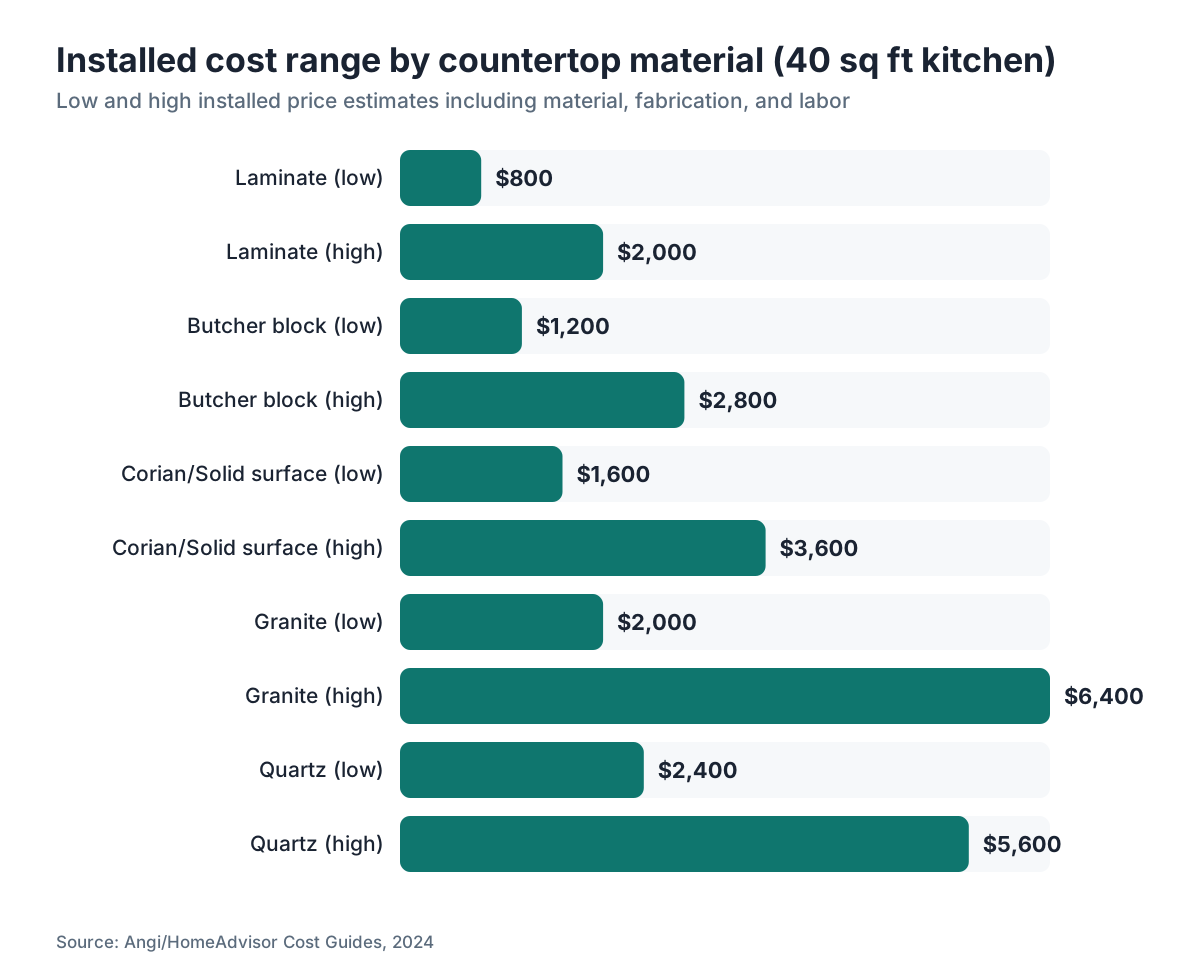
The table below gives a quick snapshot of installed cost ranges by material for a 40-square-foot kitchen, which is roughly average for a U.S. home. [2]
How much does each countertop material cost installed?
| Material | Installed cost (40 sq ft) | Per sq ft installed | Notes |
|---|---|---|---|
| Laminate | $800, $2,000 | $20, $50 | Fastest to install; lowest durability |
| Tile (ceramic/porcelain) | $900, $2,500 | $22, $62 | Grout lines need maintenance |
| Butcher block | $1,200, $2,800 | $30, $70 | Needs sealing; susceptible to water |
| Corian/solid surface | $1,600, $3,600 | $40, $90 | Seams sand invisible; scratches buff out |
| Quartz (engineered) | $2,400, $5,600 | $60, $140 | Most popular material right now |
| Granite (natural stone) | $2,000, $6,400 | $50, $160 | Huge variation based on slab grade |
| Marble | $2,800, $8,000 | $70, $200 | Etches easily; highest maintenance |
| Quartzite | $3,200, $8,800 | $80, $220 | Harder than marble; still needs sealing |
| Soapstone | $2,400, $6,000 | $60, $150 | Develops patina; oil regularly |
| Dekton/porcelain slab | $3,200, $7,200 | $80, $180 | UV and heat resistant; harder to fabricate |
A few things to know about these ranges. The low end assumes stock or remnant material, a straightforward layout, and competitive local labor. The high end assumes premium slab selection, complex fabrication (mitered edges, multiple cutouts, waterfall edge), and coastal or metro labor rates. [3]
Granite is worth pausing on. Entry-level granite (often called "Level 1" or builder grade) can be cheaper than many quartz options. Exotic granites from Brazil or India with dramatic movement run $150, $200 per square foot installed. The average cost to replace kitchen countertops with granite sits around $75, $100 per square foot installed, which works out to $3,000, $4,000 for a 40-square-foot kitchen. [3]
Quartz is now the most-installed countertop material in U.S. kitchens, mostly because it comes in consistent colors and needs no sealing. [8] Brands like Cambria sit at the higher end of the quartz price range. If you're comparing specific brands, see our guide to Cambria countertops and the broader kitchen countertops overview for a side-by-side of all the main options.
Laminate gets a bad rap, but modern laminate has improved a lot. Formica's textured finishes look credible from a few feet away, and the savings are real. If you're in a rental, flipping a house, or stretching a tight budget, laminate countertops and Formica countertops deserve a serious look.
What factors change the total cost the most?
Surface area is the obvious one. Measure your existing countertops: length times depth (usually 25.5 inches for standard base cabinets) converted to square feet. Add 10 to 15% for waste and cuts. That's your rough square footage. Fabricators charge per square foot for material and either lump labor into that rate or quote it separately.
Edge profiles matter more than most homeowners expect. A basic eased or beveled edge is usually included in the base price. An ogee, waterfall, or mitered edge adds $10, $30 per linear foot. On a kitchen with 25 linear feet of edge, that's $250, $750 extra. Nobody warns you until you're staring at the final quote.
Sink and faucet cutouts are almost always extra. A standard undermount sink cutout runs $100, $200. A farmhouse (apron-front) sink cutout is more work and costs $150, $300. Cooktop cutouts add similar amounts. If you have a complex layout with multiple cutouts, these fees compound fast.
Backsplash height counts if you're doing a full slab backsplash. Some homeowners run the countertop material up the wall 4 to 18 inches, which adds square footage and fabrication time. A 4-inch slab backsplash is cheap. A full 18-inch slab backsplash on a 10-foot run adds $400, $1,200 depending on material.
Local labor rates swing by a factor of two or more across the country. A fabricator in rural Tennessee quotes very differently than one in San Francisco. As a rough rule, coastal metros (New York, LA, Seattle, Boston) run 30 to 60% higher on labor than mid-size inland cities. [4]
Seam location and count matter for both looks and cost. Natural stone slabs max out around 10 feet wide. If your run is longer, you're getting a seam. Good fabricators minimize seams and hide them in low-visibility spots (corners, near the sink), but layouts with more seams take longer to template and install.
What does labor cost for countertop installation?
Labor for countertop installation generally runs $35, $85 per hour depending on region, or fabricators bundle it into a per-square-foot rate of $10, $30 for installation only, on top of material. [4]
A standard kitchen install takes two people about half a day, so four person-hours. At $60 an hour that's $240 in labor. But that assumes ideal conditions: cabinets are level, no plumbing surprises, easy access. Real kitchens have quirks. Out-of-level cabinets, tight doorways, or a slab that has to travel through a narrow hallway all add time.
Templating is sometimes billed separately. A fabricator will either come to your home and template (measure precisely with a physical template or a digital laser tool) or ask you to provide measurements. Digital templating is faster and more accurate. It's a visit that takes 45 to 90 minutes. Some shops charge $75, $150 for the template visit. Others roll it into the job. Ask upfront.
Plumbing disconnection and reconnection is usually not in a countertop quote. You either handle it yourself or hire a plumber. A plumber charges $75, $150 to disconnect and reconnect a sink and faucet, more if the valves are old and seize up. Budget for it.
For a detailed breakdown of the install process from start to finish, including what to ask your fabricator, see our guide on countertop installation.
How much does removing old countertops cost?
Demolition and disposal runs $150, $500 for most kitchens. [12] The range depends on what's coming out. Old laminate tops are light and come off with a utility knife and a pry bar. Thick granite slabs, especially ones set in mortar decades ago, take real labor and a vehicle that can carry the weight.
Some fabricators include demo in their quote. Many don't. Read the scope of work carefully. If demo isn't listed, ask whether they're doing it and what it costs. Showing up with no plan for getting the old tops out is a common source of project-day surprises.
Disposal fees vary by municipality. Landfills that take construction debris often charge by weight. Stone is heavy: a 40-square-foot granite countertop at 3 centimeters thick weighs roughly 400 to 500 pounds. Some hauling companies charge $100, $200 just for the trip plus per-pound fees. [12]
Donating is an option. Habitat for Humanity ReStores accept used countertops in good condition. [10] If your old laminate or even old granite is in decent shape, call your local ReStore before you pay for disposal. They'll sometimes arrange pickup.
Does changing countertops increase home value?
It's a fair question before you spend $5,000. The honest answer depends on your baseline and your market.
Remodeling Magazine's Cost vs. Value report tracks resale returns on home improvement projects. A mid-range kitchen remodel (countertops, appliances, and cabinets together) returns roughly 49 to 80 cents per dollar spent at resale, depending on region and year. [6] Countertop replacement isn't tracked on its own, but appraisers generally agree that swapping worn, dated tops brings a home to market standard, which prevents a price concession, rather than adding a premium. Going from builder-grade laminate to quartz typically recoups 50 to 80% of the cost in home value. Going from one quartz to a fancier quartz almost never pays off.
The stronger case for replacement is quality of life. If your countertops are cracked, stained, or just ugly and you're staying in the house for five more years, the math changes. Enjoying your kitchen every day has real value even if it never shows up on a closing statement.
Renovating specifically to sell? Bring the kitchen to the neighborhood's standard rather than exceeding it. Match the countertop tier to the price point of similar homes in your area and stop there.
Can you replace countertops without replacing cabinets?
Yes, and it's one of the best-value kitchen upgrades around. Cabinets are expensive: a full replacement runs $5,000, $30,000 depending on kitchen size and cabinet grade. [11] Countertop replacement alone is a fraction of that and changes the whole look of the room.
The constraint is physical fit. New countertops attach to the top of your existing cabinet boxes. As long as those boxes are structurally sound and level (or can be shimmed level), almost any material can go on them. Stone fabricators deal with out-of-level cabinets all day and scribe or shim to fit.
Watch out for one specific issue. If your existing countertops were post-form laminate with an integrated backsplash (the curved lip that runs up the wall), removing them can leave a gap or raw drywall behind. You'll need a tile backsplash, a slab backsplash, or at least some patching and paint. Budget for it.
Appliances are a separate concern. If you're moving to a thicker material (say, from 1.5-inch post-form laminate to 1.25-inch stone at standard 3 cm), check that your dishwasher still fits under the cabinet with the new top on. It usually does. Confirm before the slabs get cut.
How long does a countertop replacement take from start to finish?
Plan for two to four weeks from first contact with a fabricator to installation day. The timeline breaks down like this:
Material selection and quote: 1 to 7 days. If you know what you want, this is fast. If you're hitting multiple stone yards to compare slabs, give it a week.
Template appointment: usually scheduled 3 to 10 days after you sign a contract and put down a deposit. Busy shops run longer.
Fabrication: 3 to 10 business days after templating. Most shops run 5 to 7 days for natural stone or quartz. Faster lead times show up for simple jobs or stock remnants.
Installation: half a day for a typical kitchen. You need to clear your counters, disconnect your sink, and be home to let the crew in.
Start to finish, four weeks is realistic during busy seasons (spring and fall). Winter runs faster. If a shop promises a one-week turnaround, ask how they pull it off, because templating plus fabrication in one week usually means a slow shop or a simple job.
Your kitchen stays usable during fabrication because the old tops stay put until installation day. On installation morning, you'll be without a sink for several hours to overnight, depending on when your plumber can reconnect.
How can you save money on countertop replacement?
The single biggest lever is remnants. Fabricators pile up leftover slab pieces from other jobs and sell them cheap to clear space. A small kitchen can often be built entirely from remnant material at 30 to 60% off slab cost. Call local shops and ask what remnants they have before you commit to a material. Some keep an online inventory.
Choose a simpler edge profile. The standard eased edge is free or close to it. Every step up in profile complexity costs money. If you love a waterfall edge or a stacked mitered edge, price it out, but know you're paying for those extra fabrication hours.
Do your own demo. Removing the old tops yourself isn't hard for most materials. Pull the cabinet doors, shut off the water, disconnect the drain and supply lines, unscrew any clips from underneath, and pry. YouTube walks you through the specifics for your countertop type. You save $150, $400.
Get three quotes. Labor rates and material markups vary a lot between shops even in the same market. Three quotes give you a real sense of local pricing and sometimes turn up a shop pricing below market because they're slow that month.
Consider a mid-tier material. The gap between entry-level granite and high-end quartz is $40, $80 per square foot installed. On a 40-square-foot kitchen, that's $1,600, $3,200. A well-chosen entry-level granite slab is beautiful and durable. Spending more doesn't always buy you a better kitchen.
Want a quick sense of your specific project before calling shops? SlabWise's instant quote tool takes your square footage, material, and edge profile and returns a ballpark number with no sales call.
What questions should you ask a countertop fabricator before hiring?
Most homeowners ask about price and material, then stop. These are the questions that separate a smooth project from a frustrating one.
Is templating included, and how do you template? Digital laser templating beats older paper templates on accuracy. Accuracy matters with stone because a bad slab cut is expensive.
What's included in demo and disposal? Get explicit confirmation on who removes the old tops and where they go.
Who does the installation, your crew or a subcontractor? Some fabricators outsource installs. That's not automatically bad, but you want to know.
What's your current lead time from template to install? This gives you scheduling reality.
How do you handle out-of-level cabinets? A good fabricator has a clear answer involving scribing, shimming, or adjusting.
What's the warranty on fabrication defects? Stone yards typically don't warranty the stone itself (that's the quarry's territory), but seams, cuts, and edges should be guaranteed.
Can I see the actual slab before you cut it? For natural stone, always pick your specific slab. Website photos are not the slab you'll get.
Ask for references or photos from similar recent jobs. Any established shop has them.
Is DIY countertop replacement realistic for homeowners?
For some materials, yes. For stone, almost never.
Laminate countertops are the most DIY-friendly. Post-form laminate (the curved one-piece type) comes in stock sizes from home improvement stores for $100, $300 for a full run. Cutting it to length with a circular saw, scribing it to the wall, and sealing the cut ends is a day's work for a competent DIYer. Custom laminate sheets glued to a plywood substrate take more skill but are still doable. [7]
Butcher block is another realistic DIY option. The slabs are heavy but work with ordinary woodworking tools. Sealing, oiling, and finishing is straightforward. Home improvement stores stock standard widths and lengths.
Granite, quartz, marble, and other stone slabs are not a DIY project. The slabs are brutally heavy (a 3 cm quartz slab at 40 square feet weighs 400-plus pounds), require a bridge saw or waterjet for precision cuts, and need diamond tooling for edge profiles. The risk of cracking a $1,500 slab on your kitchen floor is real. Hire a fabricator.
Solid surface (Corian) sits in the middle. It works with woodworking tools, but joining pieces invisibly takes practice. Some very experienced DIYers pull it off. Most shouldn't try.
For stone care once you've chosen, our guides on how to clean stone countertops and how to clean quartzite countertops cover the maintenance side. [9]
How do you get an accurate quote for replacing your countertops?
Sketch your countertop layout on paper. Measure every run: length and depth. Note where appliances sit and what cutouts you need (sink type, cooktop, and so on). Count your corners. Measure any island separately. This sketch is what you'll hand to three different fabricators, and giving all three the same information makes their quotes actually comparable.
Know your material preferences before you call. Have a first and second choice. Saying "I'm thinking quartz or entry-level granite in white or light gray" gives a shop enough to ballpark quickly.
Ask for an itemized quote, not a lump total. You want material cost per square foot, edge profile cost, cutout fees, demolition, and installation broken out. When you compare quotes side by side, you'll spot the differences immediately.
For fabricators running their own shops, software like SlabWise handles the quoting and nesting side, which means accurate material estimates and faster quote turnaround. If your shop still does quotes by hand on spreadsheets, the demo is worth 20 minutes.
Visit the stone yard in person for natural stone. Slabs vary. The same SKU of "Bianco Romano" granite looks different from slab to slab. Pick your specific piece, mark it, and confirm in writing which slab goes to your job.
Frequently asked questions
What is the average cost to replace kitchen countertops?
Most kitchen countertop replacements cost between $1,500 and $5,500 installed, with a national average around $3,000. That covers a typical kitchen with 30 to 50 square feet of surface using mid-range materials like quartz or standard granite. Your number shifts with material choice, kitchen size, edge complexity, and local labor rates.
How much does it cost to replace kitchen countertops with granite?
Granite installation runs roughly $50, $160 per square foot, putting a 40-square-foot kitchen at $2,000, $6,400. Entry-level granite (builder grade, Level 1) sits on the low end and is sometimes cheaper than basic quartz. Exotic imported granites with heavy movement hit the top of the range. Get quotes for specific slabs, more than the material category.
How much does quartz countertop replacement cost?
Quartz runs $60, $140 per square foot installed, or $2,400, $5,600 for a 40-square-foot kitchen. Brand matters: entry-level engineered quartz from a local distributor starts around $60 installed; premium brands like Cambria run $100, $150. Quartz needs no sealing and holds up to heavy use, which is why it's the most popular countertop material in U.S. kitchens right now.
Can I replace just part of my kitchen countertop?
Technically yes, but it's rarely a good idea with natural stone. Slabs vary in color and veining, so a new section almost never matches the old one perfectly. Laminate and solid surface patch more successfully. If budget is the constraint, replacing the most visible run (usually the perimeter by the sink) and leaving an island for later is a reasonable middle path.
How long does countertop replacement take?
From first contact with a fabricator to installation day, plan for two to four weeks. Template appointments happen 3 to 10 days after you sign a contract, fabrication takes 5 to 10 business days, and installation is half a day. The kitchen stays usable through fabrication because the old tops stay in place until installation morning.
Does replacing countertops add value to your home?
Replacing worn or dated countertops prevents a price concession at sale rather than adding a premium. Appraisers and agents generally estimate 50 to 80% cost recoupment on countertop upgrades. The strongest case is bringing your kitchen to neighborhood standard. Upgrading from one high-end material to a fancier one almost never pays off at resale.
What is the cheapest way to replace kitchen countertops?
Laminate is the cheapest full replacement at $20, $50 per square foot, or $800, $2,000 for a typical kitchen. For stone, buying remnants from a local fabricator can cut 30 to 60% off slab cost. Doing your own demo saves another $150, $400. A basic edge profile and skipping a slab backsplash keep the total down too.
Do I need to hire a plumber when replacing countertops?
Yes, unless you're comfortable disconnecting and reconnecting sink supply lines and the drain yourself. Most countertop fabricators won't touch plumbing. A plumber charges $75, $150 to disconnect and reconnect a standard sink. If your shut-off valves are corroded or haven't moved in years, budget more. Plan the plumber for installation-day morning and afternoon.
Can countertops be replaced without replacing cabinets?
Yes. It's one of the best-value kitchen upgrades precisely because cabinets cost $5,000, $30,000 while countertops cost a fraction of that. As long as cabinet boxes are structurally sound and can be shimmed level, any countertop material works. The main issue is filling the wall gap left behind when you remove post-form laminate with an integrated backsplash.
What countertop material lasts the longest?
Quartzite, granite, and porcelain slab (Dekton and similar) are the hardest and most durable options. Quartzite and granite are stone and essentially permanent if properly sealed. Dekton is sintered ceramic and highly resistant to UV, heat, and scratching. Quartz is durable but can fade under prolonged UV exposure. Laminate has the shortest lifespan at 10 to 15 years of normal use.
How do I find a good countertop fabricator?
Ask for referrals from neighbors or your general contractor. Search for Natural Stone Institute member shops in your area. Get three quotes with itemized scopes of work. Visit the shop if you can; a busy, organized fabrication floor usually signals a real business. Ask to see the actual slabs going into your job before anyone cuts them.
What edge profiles cost extra on stone countertops?
Basic eased and beveled edges are usually included or cost $5, $10 per linear foot. Ogee, dupont, and waterfall edges run $15, $30 per linear foot extra. Mitered edges (for a thick or stacked look) can add $30, $60 per linear foot because they take more slab material and machining time. On a kitchen with 25 linear feet of edge, the difference can be $375, $1,500.
Is butcher block a good alternative to stone countertops?
For the right kitchen, yes. Butcher block installed costs $30, $70 per square foot, below most stone options. It's warm, workable, and repairable (sand out scratches, re-oil). The downsides are real: it can warp around sinks if not sealed and maintained, and it shows wear faster than stone. It works especially well as an island surface paired with stone perimeter tops.
Sources
- HomeAdvisor (Angi), Countertop Installation Cost Guide: National average countertop replacement cost approximately $3,000 for a typical kitchen
- U.S. Census Bureau, American Housing Survey: Average U.S. kitchen countertop surface area and kitchen size benchmarks
- HomeAdvisor (Angi), Granite Countertop Cost Guide: Granite countertop installation costs $50, $160 per square foot installed; average around $75, $100 per square foot
- Bureau of Labor Statistics, Occupational Employment and Wage Statistics: Construction Trades: Regional labor rate variation for construction and installation trades; coastal metros 30 to 60% above national average
- Remodeling Magazine, Cost vs. Value Report 2024: Mid-range kitchen remodel returns roughly 49 to 80% of cost at resale depending on region
- This Old House, How to Install Laminate Countertops: Laminate countertop installation is accessible to competent DIYers; post-form laminate available in stock sizes at home improvement stores
- National Kitchen and Bath Association, Kitchen Design Survey: Quartz is the most installed countertop material in U.S. kitchens; popularity driven by consistency and low maintenance
- Natural Stone Institute, Stone Care and Maintenance: Natural stone slabs require sealing; quartzite and granite are among the hardest and most durable natural stone countertop options
- Habitat for Humanity ReStore, Donation Guidelines: Habitat for Humanity ReStores accept used countertops and building materials in good condition; sometimes arrange pickup
- HomeAdvisor (Angi), Kitchen Remodel Cost Guide: Full cabinet replacement costs $5,000, $30,000 depending on kitchen size and cabinet grade; countertop replacement alone is a fraction of that cost
- HomeAdvisor (Angi), Countertop Removal Cost: Countertop demolition and disposal costs $150, $500 depending on material weight and local disposal fees
Last updated 2026-07-09