TL;DR
- 2cm stone (about 3/4") costs less per square foot but needs a plywood substrate and has fewer edge profile options.
- 3cm stone (about 1-3/16") is self-supporting, works with most any edge profile, and has become the North American standard for kitchen countertops.
- For most kitchens, 3cm is the better long-term choice.
What do 2cm and 3cm actually mean in real measurements?
Stone thickness is measured in centimeters, not inches, because the natural stone industry standardized on the metric system globally. Two centimeters converts to about 0.79 inches, usually rounded to 3/4 inch in conversation. Three centimeters is roughly 1.18 inches, often called 1-1/4 inch on job sites.
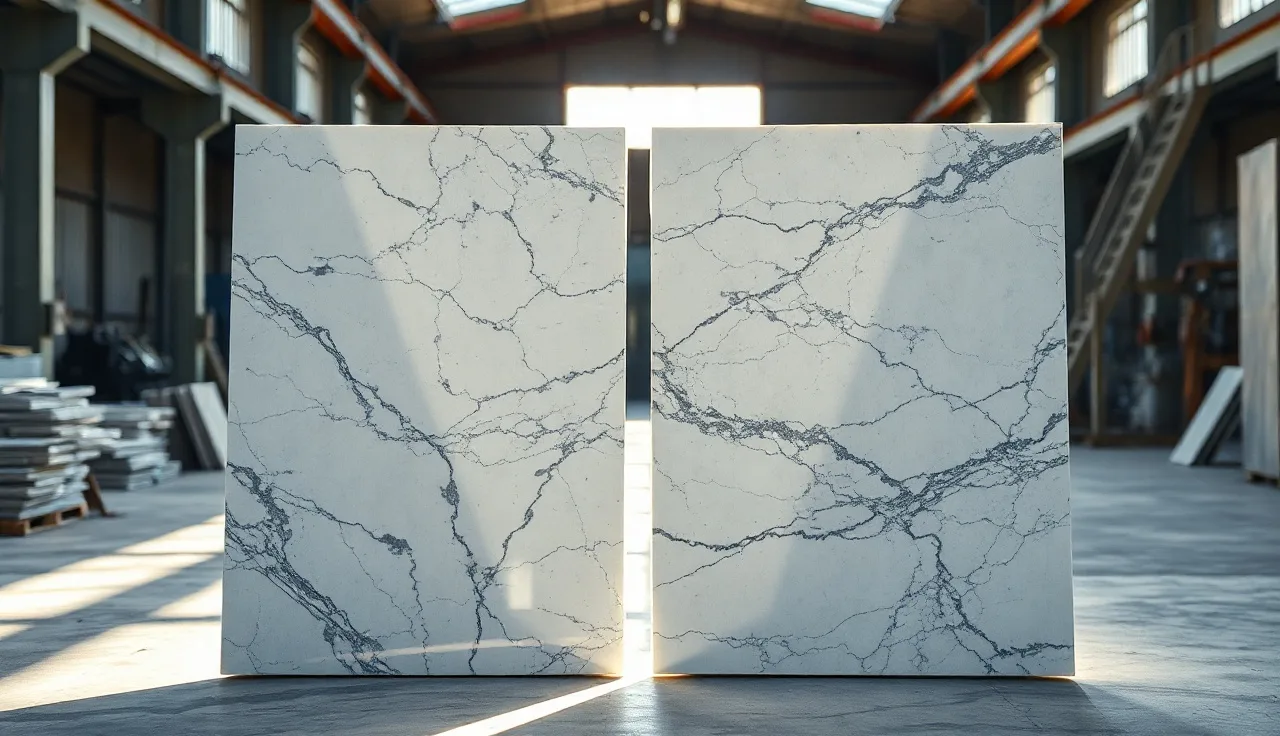
Those numbers sound close. Pick up a 3cm slab next to a 2cm slab and the difference stops being abstract. The 3cm slab is heavier, stiffer, and feels like a structural part rather than a veneer.
A third thickness exists but rarely comes up in residential work: 1.2cm (about 1/2 inch). That gauge shows up almost exclusively in vertical applications like wall cladding, backsplash panels, and furniture insets. If a salesperson mentions it for kitchen counters, ask questions.
The Marble Institute of America (now part of the Natural Stone Institute) has long tracked these thicknesses as the industry's two primary residential countertop gauges [1]. When fabricators say "two-cent" or "three-cent" they're using shorthand for these exact measurements.
How much does thickness affect the price of a countertop?
This is the question most homeowners really want answered, and the honest answer is: it depends on the material and your region, but 3cm typically adds $5 to $15 per square foot over 2cm in the same stone [2].
A few things drive that gap. A 3cm slab uses more raw material, weighs more to ship, and takes more time and tooling to cut edge profiles. A 2cm slab needs a separate plywood or MDF substrate glued underneath before installation, which adds labor and material cost back into the equation.
Once you factor in the substrate, the real-world price difference between 2cm and 3cm often shrinks to $3 to $8 per square foot installed. Nobody has perfect national data on this. The figures above reflect typical ranges reported by fabricators in the Natural Stone Institute's cost surveys and regional supplier price lists, but local labor markets shift these numbers a lot [2].
For a 40-square-foot kitchen countertop, that installed difference might be $120 to $320. Real money. Also a one-time cost on something you'll own for 15-plus years.
Does 3cm stone really not need plywood underneath it?
Yes, with a caveat. A 3cm stone slab is rigid enough to span standard cabinet box widths (typically 24 inches deep) without flexing under normal loading. The stone sits directly on the cabinet tops with no substrate required. Most fabricators set it with a few dabs of silicone or construction adhesive, but the stone itself does the structural work.
2cm stone doesn't have that rigidity over a standard span. Without a substrate, it can flex enough to crack, especially at cutouts for sinks and cooktops where the stone is already stressed. The standard fix is a 3/4-inch plywood layer glued to the underside of the stone before installation [3].
That substrate has a side effect that matters for kitchen design: it raises the finished countertop height. A 3/4-inch plywood plus 2cm stone gives you about 1.55 inches of total thickness at the edge, which is almost identical to 3cm stone visually. Some fabricators add a laminated edge strip to 2cm to fake the 3cm look. That's a legitimate technique, not a cheat, but homeowners should understand what they're getting.
The plywood substrate also creates a moisture trap in wet kitchens if the stone isn't sealed tightly at the backsplash. Not a dealbreaker. It's a maintenance consideration that disappears entirely with 3cm.
Which edge profiles work with each thickness?
Edge profile selection is where the thickness decision gets visually concrete. With 3cm stone, nearly any profile a fabricator can cut is available: eased, beveled, bullnose, ogee, waterfall, dupont, chiseled, and more. The extra thickness gives the router or CNC machine real material to work with.
With 2cm stone, you're working with roughly 40% less material at the edge. Simple profiles like eased and flat-polish work fine. A full bullnose on 2cm looks thin and a bit fragile. An ogee is often physically impossible without laminating a second piece of stone to the face of the edge to build up the profile, which adds cost and shows a seam line if the color match isn't perfect.
Fabricators who work with 2cm regularly will tell you the laminated edge technique is solid when done right. But "when done right" is doing some work in that sentence. It requires a good color match, precise adhesive work, and a skilled fabricator. On a highly veined stone like Calacatta marble or a dramatic quartzite, matching the laminated piece is genuinely difficult.
If a homeowner has their heart set on a thick mitered waterfall edge or a deep ogee, 3cm is the path of least resistance. Trying to hit those looks with 2cm usually costs more than just upgrading the stone thickness in the first place.
Is 2cm or 3cm better for specific countertop materials?
Material matters here, and the right answer varies.
Granite: The industry moved almost entirely to 3cm for granite countertops in North America over the past two decades. You can still find 2cm Brazilian granite at some discount importers, but most domestic fabricators won't stock it. The material is dense and relatively brittle, so 3cm gives meaningful protection against cracking at cutouts.
Quartz (engineered stone): Brands like Cambria countertops and other major manufacturers produce slabs in both thicknesses, but most North American residential lines default to 3cm. Cambria's residential slabs are 1-1/4 inch (3cm) as their standard [4]. 2cm quartz shows up more often in European imports and commercial applications.
Marble: Marble countertops are available in both thicknesses. Italian marble was traditionally sold in 2cm, which is why you still see 2cm marble in older homes and why Italian-sourced slabs sometimes come that way. Softer marble benefits from the extra rigidity of 3cm, especially in high-use kitchens.
Quartzite and soapstone: Both are typically available in 3cm for residential counters. Soapstone in particular can be soft enough that thinner material risks chipping at edges more easily.
For kitchen countertops in general, 3cm is the de facto standard. 2cm still makes sense in specific applications: laundry rooms, light-use bars, bathroom vanities with undermount sinks (where the cabinet top provides additional support), and anywhere budget is genuinely tight.
How does thickness affect weight and cabinet support requirements?
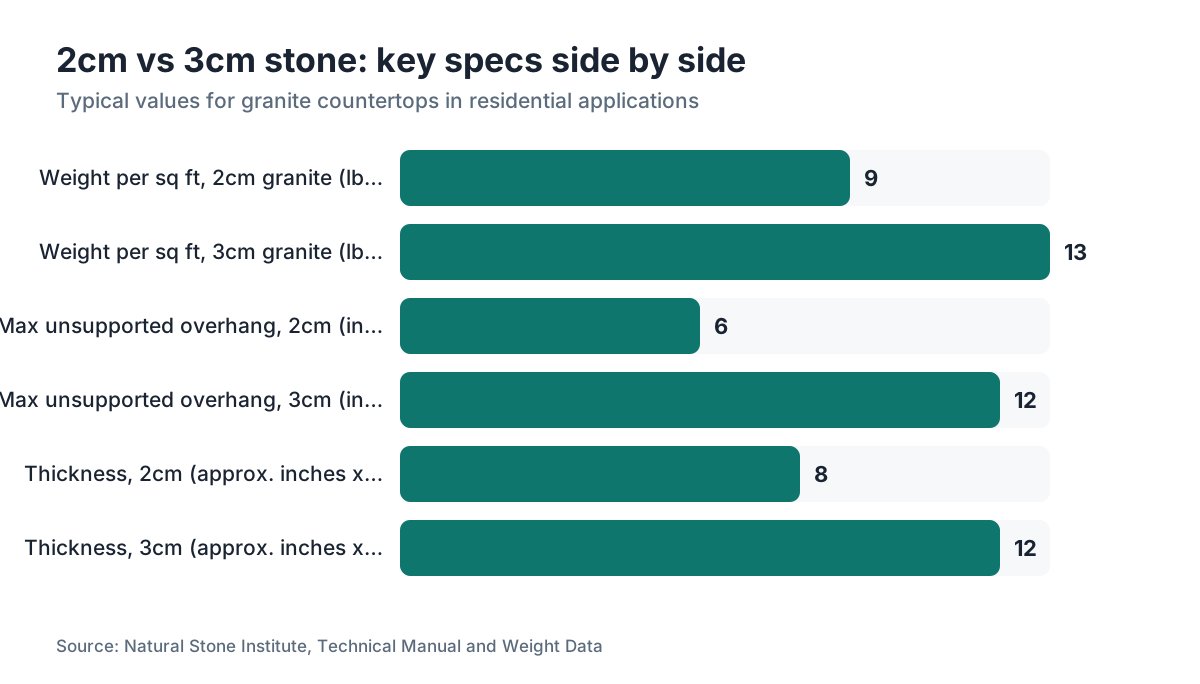
Stone is heavy regardless of thickness. Granite runs about 13 pounds per square foot at 3cm and about 9 pounds at 2cm [5]. For a 40-square-foot kitchen, that's roughly 520 pounds vs 360 pounds. Both need solid cabinet construction.
The Natural Stone Institute recommends that cabinets supporting stone countertops have a continuous perimeter rail and adequate box construction to handle the load without racking [1]. Most standard frameless and face-frame cabinet boxes from major manufacturers meet this threshold, but very old cabinets (pre-1980s construction) or site-built boxes made with thin particleboard may need reinforcement regardless of stone thickness.
Island overhangs are where weight and thickness combine into a real engineering question. The standard rule of thumb from fabricators is that 3cm stone can cantilever up to 10-12 inches without support, while 2cm should not exceed 6 inches unsupported [3]. Anything past those limits needs corbels, knee walls, or steel support brackets regardless of thickness.
A longer overhang for bar seating (typically 12-15 inches) almost always requires either 3cm stone with steel support or an engineered bracket system. This isn't optional. Unsupported stone at those spans has failed badly enough that most fabricators write overhang limits right into their installation agreements.
Does 2cm or 3cm look better on a finished countertop?
Honestly, once a countertop is installed and you're standing in the kitchen, most people can't tell 2cm from 3cm at a glance if the fabricator built a laminated edge on the 2cm. The visible edge thickness looks similar.
Where the difference shows up is in the profile detail. A 3cm edge with a clean eased profile has a certain heft and confidence to it. A 2cm edge, even with a laminated buildup, can look slightly thinner at the corners depending on how the mitered seam was finished.
Design context matters too. Thick slabs (3cm) read as more substantial in kitchens with heavy cabinetry, shaker doors, and traditional or transitional styling. Some contemporary kitchens intentionally use 2cm for a lighter, floating visual effect, particularly with waterfall islands where the thinner slab reads as more architectural.
If you're doing a thick mitered waterfall edge on an island, 3cm is standard. The mitered corner creates a corner seam, and with 3cm you get a full 3cm miter on both faces. With 2cm you're mitering thinner material and the corner seam can be a weak point.
For most homeowners, the visual question is secondary to the structural and cost questions. Pick the thickness that makes structural sense, then let the fabricator's edge recommendation follow from there.
How should a fabricator explain this to a homeowner who has never heard of it?
The clearest explanation I've heard fabricators use goes something like this: "Think of 2cm like a thick floor tile that needs a backer, and 3cm like a structural shelf that holds itself up." That analogy lands fast because most homeowners already have some intuition about tile.
A physical demonstration helps more than any explanation. Keep a 6-inch sample square of each thickness on the counter at your showroom, label them clearly, and let the customer pick them up. That settles most questions in 30 seconds. The weight difference is visceral. The edge profile options become obvious when you show a sample book alongside each.
The explanation also needs to cover why the customer might be seeing price differences. If a quote shows 2cm granite at a lower line-item price, fabricators should flag the substrate cost and the edge profile limitations up front. Customers who feel surprised by those details at installation time become bad reviews.
For fabricators running estimates, tools that split stone material cost, substrate cost, and edge profile pricing into separate lines help customers make the comparison on paper. SlabWise's quoting module, for example, lets fabricators build separate line items so customers see the full cost of each configuration rather than a single opaque number, which cuts confusion and renegotiation at sign-off.
The goal is a customer who understood the tradeoff before they signed, not after.
What are the standard lead times and availability differences?
In North America, 3cm material is far more available off-the-shelf. Most slab distributors and stone yards stock the majority of their inventory in 3cm because that's what the market demands. Walk into any major stone yard in any metro area and you'll find hundreds of 3cm slabs and a much smaller 2cm section, if there's one at all.
2cm material often has to be special-ordered or sourced from importers who specialize in European-gauge stone. That can add two to eight weeks to a project timeline depending on the supplier and the specific material.
For homeowners on a renovation schedule, this is a practical concern. If the project is time-sensitive, 3cm material is almost always the faster path. If a specific 2cm Italian marble or a particular stone that only comes in 2cm is part of the design vision, build lead time into the schedule.
For countertop installation, neither thickness moves the fabrication timeline much once the slab is in the shop. CNC machining and hand finishing take roughly the same time. The difference is entirely in material sourcing.
Can you mix 2cm and 3cm in the same kitchen?
You can, and sometimes it makes sense. A common setup is 3cm on the main perimeter countertops, where structural spans and sink cutouts create the most stress, and 2cm on a bathroom vanity or a laundry room surface in the same renovation, where support is better and the look is simpler.
Mixing within a single kitchen is less common and can create odd visual inconsistencies at seams if the thicknesses ever meet. You also end up with different finished heights at the edge, which is usually noticeable and looks like a mistake rather than a design choice.
If a homeowner wants 2cm for cost reasons on a specific section, make sure the cabinets provide continuous perimeter support for that section and that any sink or cooktop cutouts have appropriate substrate reinforcement.
The short answer: mixing across rooms in the same renovation is fine. Mixing within one continuous countertop run is generally a bad idea.
Is 3cm always the right choice, or does 2cm ever win?
2cm wins in a handful of real scenarios.
Bathroom vanities with minimal overhangs and full cabinet-top support are a legitimate 2cm application. The material cost savings are meaningful at the smaller square footages common in bathrooms, and the structural concerns that make 2cm tricky in kitchens are largely absent when the stone has full support and no large cutouts.
Laundry room countertops, wet bar tops with good cabinet support, and secondary kitchen prep areas away from the main sink run are all reasonable 2cm candidates. Any application where cost matters more than edge profile options and where the structural loads are modest.
For homeowners trying to stay under a specific budget on a kitchen renovation, a fabricator might legitimately recommend 2cm in a less-expensive stone with a laminated edge treatment rather than 3cm in a cheaper material. The finish quality can actually be better that way, because you're putting the savings into the stone rather than the thickness.
The honest opinion: for a primary kitchen countertop in a home you plan to keep for more than five years, spend the extra money for 3cm. The structural margin, the edge profile flexibility, and the absence of a substrate to worry about are all worth the premium. For everything else, evaluate case by case.
Frequently asked questions
What is 3cm stone in inches?
Three centimeters converts to approximately 1.18 inches, which fabricators and suppliers typically round to 1-1/4 inch in conversation. On a finished countertop, that's the visible edge height you see from the side. It's substantially thicker than 2cm (about 3/4 inch) and that difference is visible and tactile once installed.
Does 2cm stone crack more easily than 3cm?
Without a proper plywood substrate, yes, 2cm stone is more prone to cracking, especially at sink and cooktop cutouts where the slab is already weakened. With a correctly installed 3/4-inch plywood backer, the risk drops significantly. 3cm stone is inherently more resistant to cracking at cutouts because its own rigidity distributes load more effectively without needing external support.
Do I need special cabinets to support 3cm stone?
Standard kitchen cabinets from most major manufacturers can support 3cm stone countertops without modification. The Natural Stone Institute recommends that cabinets have a continuous perimeter rail and solid box construction. Very old cabinets or those made from thin particleboard may need reinforcement. The weight difference between 2cm and 3cm adds roughly 4 pounds per square foot, which is manageable for any well-built cabinet.
Is 2cm or 3cm standard for kitchen countertops in the US?
Three centimeters is the current North American residential standard for kitchen countertops. Most US stone distributors stock their inventory primarily in 3cm. Two centimeters was more common before the late 1990s and is still the European standard, which is why older homes and some imported stones still come in the thinner gauge.
How much does upgrading from 2cm to 3cm cost?
Raw material cost for 3cm typically runs $5 to $15 per square foot more than the same stone in 2cm. But 2cm requires a plywood substrate that adds cost back in. The net installed price difference often narrows to $3 to $8 per square foot, or roughly $120 to $320 for a typical 40-square-foot kitchen. Local labor rates affect this significantly.
Can you put an undermount sink in 2cm stone?
Yes, undermount sinks are installed in 2cm stone regularly. The key requirement is a solid plywood substrate glued to the underside of the stone, and the substrate must be properly waterproofed or sealed where it meets the sink cutout. Without the substrate, 2cm stone is not thick enough to support an undermount sink reliably. With it, the installation can be just as durable as 3cm.
What edge profiles are not possible with 2cm stone?
Complex profiles that require significant material depth are either impossible or require added lamination with 2cm stone. Full bullnose, ogee, dupont, and deep-carved profiles all need more material to work with than 2cm provides. Simple profiles like eased, slightly beveled, and flat-polished edges work fine on 2cm. Fabricators can laminate a second strip of stone to the edge to build up thickness, but this adds cost and requires careful color matching.
Is 2cm stone better for bathroom countertops?
For bathroom vanities, 2cm is a more reasonable choice than in kitchens. Bathroom countertops typically have full cabinet-top support, smaller cutouts, and lower loading than kitchen countertops. The cost savings on a smaller square footage are meaningful. Edge profile limitations matter less in bathrooms where simple profiles are more common. Many fabricators will suggest 2cm for bathrooms without hesitation.
How far can 3cm stone overhang without support?
The standard fabricator guideline is that 3cm stone can cantilever up to 10 to 12 inches without corbels or brackets. Beyond that, steel support is needed. Two-centimeter stone should not exceed 6 inches unsupported. For bar-height seating overhangs of 12 to 15 inches, some form of hidden steel support or corbels is required regardless of stone thickness.
Does thickness affect how countertops are sealed or cleaned?
Thickness itself doesn't change how you seal or clean stone countertops. Sealing frequency and method depend on the stone type and porosity, not thickness. Both 2cm and 3cm granite, marble, and quartzite are sealed the same way. If your countertop has a plywood substrate (common with 2cm), keeping the backsplash junction well-sealed matters, because it stops moisture from reaching the wood.
Will a home inspector flag 2cm countertops as a defect?
No. Home inspectors don't assess countertop thickness. 2cm countertops with proper substrate installation are structurally sound and violate no building code. Thickness won't show up as a defect in any standard home inspection report. The question that could come up is whether an undermount sink is properly supported, which is a function of installation quality rather than stone gauge.
Are quartz countertops available in 2cm?
Yes, engineered quartz is manufactured in both 2cm and 3cm. Most major North American brands including Cambria produce their residential lines in 3cm (1-1/4 inch) as the standard. Some European-sourced quartz products come in 2cm. For domestic residential projects, 3cm quartz is the typical expectation from distributors, and 2cm may require a special order.
Can I use 2cm stone for a kitchen island waterfall edge?
Technically yes, but it's not ideal. A waterfall edge requires mitered corners where the horizontal countertop meets the vertical side panel. With 2cm, those mitered pieces are thinner and the corner joint is a potential weak point with less glue surface area. Visually, 2cm waterfall edges also look noticeably lighter than 3cm. Most fabricators doing waterfall designs default to 3cm for structural and aesthetic reasons.
Sources
- Natural Stone Institute, Technical Manual: Standard residential countertop gauges of 2cm and 3cm, and cabinet support recommendations for stone countertops
- Natural Stone Institute, Stone Industry Benchmark Report: Cost ranges for 2cm vs 3cm fabricated stone countertops by region
- Marble Institute of America (now Natural Stone Institute), Dimension Stone Design Manual: Overhang limits: 3cm stone up to 10-12 inches unsupported; 2cm stone up to 6 inches; plywood substrate requirements for 2cm
- Cambria, Product Specifications: Cambria residential slabs are produced at 1-1/4 inch (approximately 3cm) thickness as the standard
- Natural Stone Institute, Weight and Structural Data for Stone: Granite weighs approximately 13 lbs per square foot at 3cm and approximately 9 lbs per square foot at 2cm
- National Kitchen and Bath Association (NKBA), Kitchen & Bath Planning Guidelines: Standard countertop height and overhang guidelines for kitchen and bath design
- U.S. Geological Survey, Minerals Yearbook: Stone, Dimension: Natural stone production and trade data including granite, marble, and quartzite in the US market
- National Association of Home Builders (NAHB), Remodeling Market Index: Kitchen countertop material preferences and market share trends in US residential remodeling
- ASTM International, ASTM C615 Standard Specification for Granite Dimension Stone: Physical property standards for granite dimension stone used in countertop fabrication
- Occupational Safety and Health Administration (OSHA), Silica in Construction: Dust exposure standards relevant to stone fabrication operations including cutting of 2cm and 3cm slabs
Last updated 2026-07-10