TL;DR
- Seal marble every 6 to 12 months with an impregnating sealer, clean daily with pH-neutral soap and warm water, and wipe up acidic spills (lemon juice, wine, vinegar) within seconds.
- Etching and staining are the two main threats.
- Most damage is preventable with the right habits.
- Professional honing can restore heavily etched surfaces when home remedies stop working.
What actually damages marble countertops?
Marble is calcium carbonate. That one fact explains almost everything you need to know about caring for it.
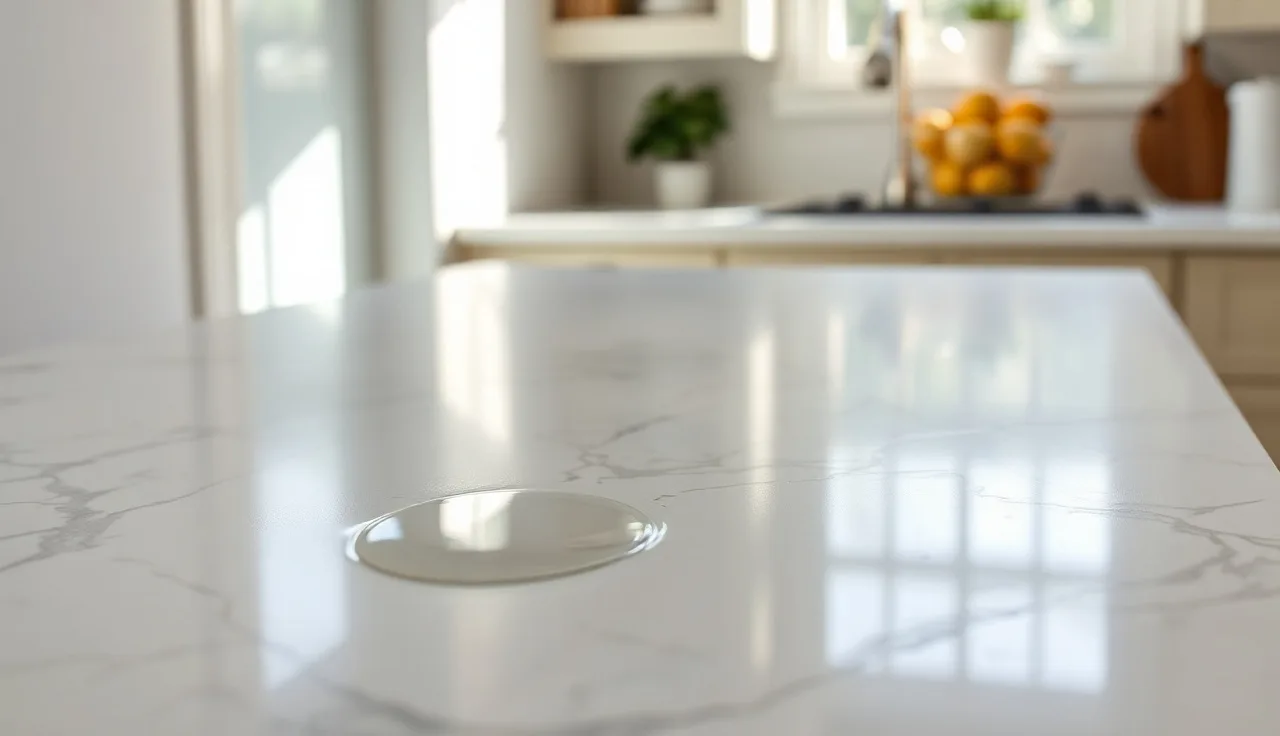
Acids react with calcium carbonate and dissolve the surface at a microscopic level. The result is called etching: a dull, rough patch where the polished finish used to be. Lemon juice, tomato sauce, wine, vinegar, coffee, and even some hand soaps are acidic enough to etch marble on contact. The damage happens in seconds, not minutes. That bottle of cleaning spray you're reaching for almost certainly contains acids or bleach that will make things worse, not better [1].
Staining is separate from etching. A stain means a colored substance has moved into the pores of the stone. Oil from cooking, red wine, and coffee are common culprits. Sealing slows this process by filling the surface pores, but no sealer makes marble stain-proof.
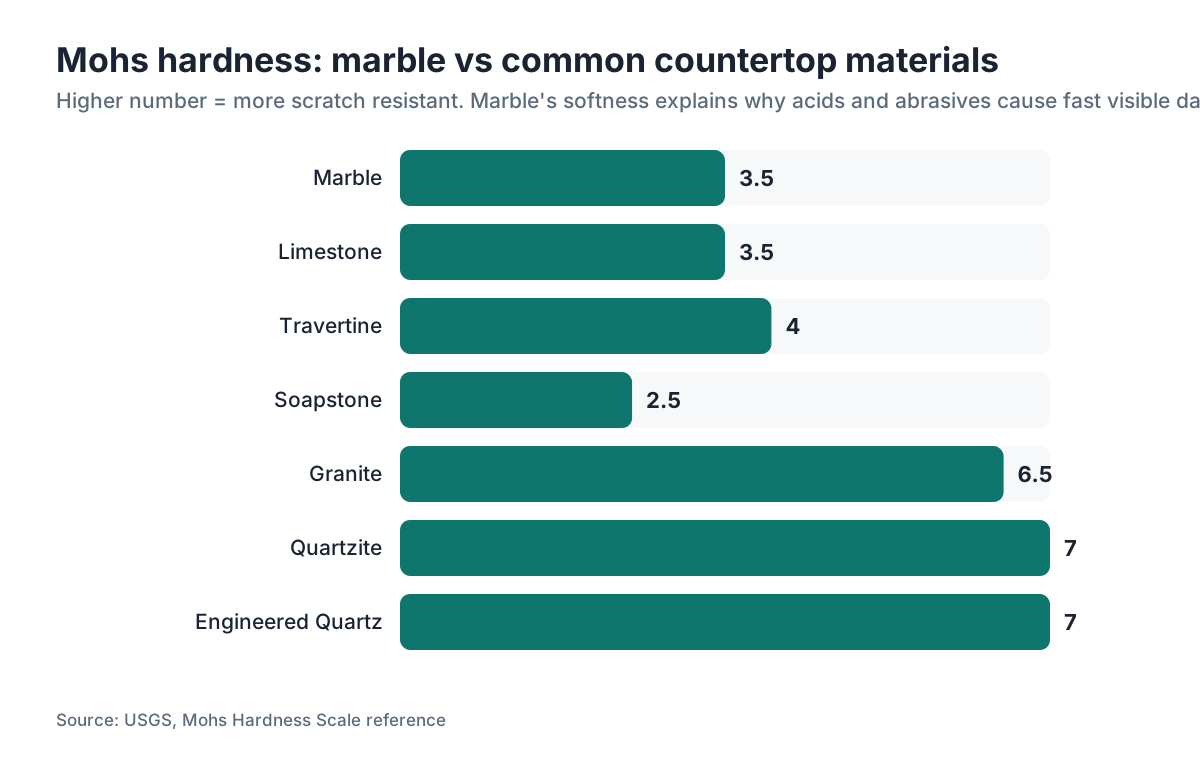
Scratch damage is less common but real. Marble sits at 3 to 4 on the Mohs hardness scale, softer than granite (6 to 7) and quartz engineered stone (7+) [2]. Dragging a cast-iron pan or a set of keys across it will leave marks.
Heat is mostly not the problem people think it is. Marble is stone; it handles heat better than many surfaces. The risk is thermal shock from putting a very cold item on a very hot slab, which can cause hairline cracks over time. In practice, a hot pan straight from the stove is more of a sealer-damaging event than a stone-cracking one. Use a trivet anyway.
How often does marble need to be sealed?
Most marble countertops need sealing every 6 to 12 months. The honest answer is: it depends on the stone's porosity, which varies a lot even within the same quarry [3].
The water test tells you where you stand. Pour a few tablespoons of water on the surface and let it sit for 10 to 15 minutes. If the marble darkens under the puddle, the sealer has worn and it's time to reseal. If water still beads, you have more time.
Statuary and Calacatta marble (dense, used in high-end kitchens) can go 12 months or longer between sealings in moderate-use kitchens. Crema Marfil and other more porous varieties may need attention every 6 months in a busy household. Honed marble is generally more porous than polished marble of the same type, because the polishing process closes surface pores slightly.
For sealer selection, use an impregnating (penetrating) sealer rather than a topical sealer. Impregnating sealers soak into the stone and don't sit on top, so they don't peel or alter the finish. Look for products specifically rated for natural stone. The Marble Institute of America recommends testing any sealer on an inconspicuous area first [4].
What is the right daily cleaning routine for marble?
Short version: pH-neutral cleaner, soft cloth, dry it off.
For everyday cleanup, warm water and a few drops of dish soap designed to be gentle (check the pH; most name-brand dish soaps are close to neutral, around 7) are fine. Wipe the surface down after cooking, after meals, and any time you see a spill. Don't let standing water sit, especially near seams.
Dry the surface after cleaning. Marble around sinks is the most vulnerable spot because it stays wet. Long-term water exposure at grout lines and seams accelerates deterioration and can cause efflorescence (white mineral deposits) over time.
Don't use the following on marble: white vinegar, lemon juice, citrus-based sprays, bleach, ammonia-based cleaners (many glass cleaners), abrasive scrubbers, or generic bathroom tile cleaners. The Marble Institute of America explicitly lists ammonia and acidic cleaners as incompatible with marble and limestone [4]. Check the ingredients, more than the marketing language on the label. "Natural" does not mean pH-neutral.
For a dedicated marble cleaner, products marketed as stone-safe and pH-neutral exist from brands like Stonetech, Black Diamond, and Miracle Sealants. These aren't required for daily cleaning if you're careful with dish soap, but they're a reasonable investment for households with expensive marble.
For other natural stone surfaces, the same pH-neutral rule applies, though the specific vulnerabilities differ. Quartzite countertops, for instance, are often confused with marble but are much harder and less reactive to acids.
How do you remove stains from marble countertops?
The tool for stain removal is a poultice: a paste that draws the staining substance back out of the stone's pores. This is the same method professional stone restorers use, and you can make it at home.
For oil-based stains (grease, cooking oil, butter): mix baking soda with water or a small amount of acetone (nail polish remover) into a thick paste. Spread a 1/4-inch layer over the stain, cover with plastic wrap, tape the edges, and let it sit for 24 to 48 hours. The poultice pulls the oil into itself as it dries. Remove it, rinse with water, and dry thoroughly. You may need two or three applications for deep stains.
For organic stains (coffee, wine, tea, food): use hydrogen peroxide (12% or less; the drugstore 3% version is safe for most white and light marbles) mixed with a small amount of dish soap or baking soda as your poultice base. Apply the same way. On dark marbles, hydrogen peroxide can bleach the stone, so test a hidden spot first.
For ink: acetone applied carefully with a cotton ball often works on light marble. Lacquer thinner for dark marble. Work carefully and rinse well.
What won't work: scrubbing harder, using a stronger acid (people try lemon juice to "cut through" the stain, which makes everything worse), or applying bleach. Bleach doesn't remove organic stains from stone; it can lighten them temporarily while damaging the sealer.
If a poultice doesn't resolve the stain after three attempts, it may be an etch rather than a stain, or the staining compound has fully mineralized into the stone. At that point a professional assessment makes sense.
What's the difference between an etch and a stain, and can you fix an etch yourself?
This distinction matters because the fix is completely different.
A stain is discoloration: the marble is the wrong color in a spot. A stain is often darker than the surrounding stone. An etch is surface damage: the finish looks dull or rough, almost like a watermark or a frosted area. Etching frequently looks lighter than the surrounding surface on polished marble, because the polished surface reflects light uniformly and the etched spot doesn't.
You can test the difference: run your finger across the spot. If it feels rough or dull compared to the surrounding stone, it's etched. If the texture is the same but the color is off, it's stained.
Light etches on polished marble can sometimes be buffed out at home with a marble polishing powder (tin oxide or aluminum oxide based). Apply the powder to a damp cloth, rub in small circles for 2 to 3 minutes, wipe clean, and see if the sheen returns. Products like Etch Remover by Marble Restoration or similar tin oxide polishes are made for exactly this. It doesn't always work, and it's easy to make uneven spots worse if you're too aggressive.
For honed marble, etching is less visible (because there's no high-gloss finish to contrast with) but still changes the texture. Light sanding with 400-grit followed by 600-grit wet/dry sandpaper can sometimes level minor etch damage, but this requires a careful hand and experience.
Heavy etching, widespread dullness, or deep scratches need professional honing and re-polishing. A stone restoration contractor will re-hone the surface with diamond abrasive pads, working through progressively finer grits, and then re-polish or apply a honed finish. Expect to pay $300 to $800 for a standard kitchen island professionally refinished, though pricing varies widely by region and contractor [5].
How do you seal marble countertops step by step?
Sealing marble is about a 45-minute project once you have the materials. Here's how to do it right.
Step 1: Clean the surface thoroughly. Any oil, soap residue, or debris will get sealed into the stone. Use your pH-neutral cleaner and let the surface dry completely. Some fabricators recommend waiting 24 hours after a deep cleaning before sealing, though 2 to 4 hours in a dry room usually suffices.
Step 2: Test your sealer on a small, hidden area first. Apply a dime-sized amount, let it sit per the manufacturer's instructions, and wipe it off. If it discolors or clouds the stone, stop and switch products.
Step 3: Apply the sealer in sections. Work in 3-to-4-square-foot areas with a clean, lint-free cloth or foam applicator. Apply a thin, even layer. More sealer is not better; excess sealer that doesn't absorb will leave a haze.
Step 4: Let it penetrate. Most impregnating sealers require 3 to 15 minutes of dwell time. Check the label. The sealer should look slightly wet on the surface but not be pooling.
Step 5: Wipe off the excess before it dries. This is the step most DIYers skip. If sealer dries on the surface, it leaves a whitish haze that's very difficult to remove. Buff with a clean dry cloth.
Step 6: Allow full cure time before using the surface. Most sealers are touch-dry in 1 to 2 hours but reach full effectiveness in 24 to 72 hours. Avoid water and cooking on the surface during that window.
For marble near a sink or on a bathroom vanity, apply a second coat 2 to 4 hours after the first for added protection at the most vulnerable spots.
If you're getting a new countertop installed and want to understand what your fabricator used (or should have used), a good fabricator will document the sealer applied. Countertop installation is a good point to ask this question and request the product name so you can match it later.
What protective habits make the biggest difference day to day?
Cutting boards. Always. Marble scratches from knives and gives no resistance to blade dulling, so both the stone and the knife lose. Keep at least one large cutting board on the counter and use it.
Trivet or pot holders under everything hot. Cast iron, sheet pans, and Dutch ovens pulled straight from the oven can hit 450 to 500°F. That won't crack your marble countertop in a single incident, but it will stress the sealer and over time can cause hairline cracking, especially near edges and at sink cutouts where the slab is thinnest.
Wipe spills immediately. Immediately means within 30 to 60 seconds for acidic liquids like citrus juice or wine. A paper towel blotted over the spill (don't wipe and spread it) followed by a quick rinse with water and a dry cloth is the entire response.
Don't put your wine glass directly on marble. Either use a coaster or train yourself to wipe the wet ring immediately. Wine rings on marble are a combination of stain (tannins) and etch (acidity).
Avoid setting anything heavy asymmetrically near unsupported spans. Marble countertops can crack under impact or point loads near seams and overhangs. A heavy mixer or stand-alone appliance should sit over a cabinet run, not over an open span.
If marble starts to feel too high-maintenance for your household, it helps to know that granite countertops and engineered options like Cambria countertops have much lower acid sensitivity. That's not a knock on marble. It's just context.
How do you care for marble in bathrooms versus kitchens?
Bathrooms are actually easier on marble than kitchens in most households. No cooking acids, no oils, lower traffic. The main threats are soap scum buildup and standing water.
Soap scum forms when minerals in hard water mix with soap and deposit on the surface. Standard soap scum removers are often acidic (they contain phosphoric or hydrochloric acid), which will etch marble. For marble vanities and shower walls, use a dedicated stone-safe soap scum remover or make a paste of baking soda and water, apply it gently, and rinse immediately. A squeegee on marble shower walls after each use dramatically reduces buildup and extends the time between deep cleans.
For marble shower floors, grout care is as important as stone care. Grout is porous and holds moisture, mold, and bacteria. Seal the grout annually with a grout sealer separate from your stone sealer. Clean with a pH-neutral cleaner and a soft brush. Never use mold-killing sprays that list bleach or acids in their ingredients.
For kitchen marble, the routine described above applies with more urgency around the cooktop and prep areas. If your kitchen has a marble island that the family uses for breakfast, a clear acrylic place mat or a silicone baking mat placed in the daily-use zone can reduce etch damage without hiding the stone.
Honed marble is genuinely a better choice for kitchen applications than polished marble from a maintenance standpoint, not because it's impervious but because etches are much less visible on a matte surface. If you're still selecting your stone, that's a real factor to weigh. For a broader comparison of natural stone options, see how to clean soapstone countertops for a material that handles kitchen acids very differently.
What cleaning products are safe for marble (and which ones will ruin it)?
This deserves a direct table because the wrong product is genuinely damaging:
| Product / Ingredient | Safe for Marble? | Notes |
|---|---|---|
| pH-neutral dish soap + water | Yes | The default cleaner. Rinse and dry after use. |
| Stone-specific pH-neutral cleaner | Yes | Best for daily use; worth having one bottle. |
| Hydrogen peroxide (3%) | Yes, with caution | Safe on light marble; test on dark marble first. |
| Rubbing alcohol (70%) | Generally yes | Useful for disinfecting; rinse after. |
| White vinegar | No | pH around 2.5; will etch on contact [6]. |
| Lemon juice / citrus cleaners | No | Highly acidic; fast etching. |
| Bleach (sodium hypochlorite) | No | Damages sealer; can discolor stone. |
| Ammonia / ammonia-based cleaners | No | Breaks down sealer; can cloud surface. |
| Most bathroom tile cleaners | No | Usually contain acid to remove hard water deposits. |
| Abrasive scrubbing pads | No | Scratches polish. Use microfiber or soft cloths only. |
| Baking soda paste | Yes, with care | Safe but mildly abrasive; use for stains, not daily cleaning. |
The underlying rule: anything with a pH below 6 or above 10 is risky for marble [1]. Neutral is 7. You can test cleaners with cheap pH strips from a pharmacy or pool supply store if you're unsure.
For stone-safe disinfection (relevant after raw meat contact), isopropyl alcohol diluted to 70% is effective against most bacteria and safe for sealed marble. Quaternary ammonium disinfectants (the active ingredient in many restaurant sanitizers) are also generally stone-safe, but check the specific product's pH. The CDC lists 70% isopropyl alcohol as effective against most common surface pathogens [7].
Fabricators who use quoting and shop management software like SlabWise often include stone care documentation with each job; if yours did, that spec sheet will usually list compatible cleaning products for the sealer applied.
When should you call a professional stone restorer?
Home care handles most marble problems. A few situations genuinely need a pro.
Widespread etching or dullness across the whole surface means the polished finish is gone. You can't restore that at home with polishing powder alone. A stone restoration contractor will diamond-hone and re-polish the surface, essentially refinishing it in place. This process is called grinding and honing, and it removes a very thin layer of the stone (typically less than 1mm for refinishing work) to expose fresh, polishable material [5].
Deep scratches that catch a fingernail need professional attention. Light surface scratches can sometimes be polished out; anything that has depth requires abrasive honing.
Cracks and chips are structural and cosmetic problems depending on location. A crack running through a seam or toward a sink cutout needs a fabricator's assessment, more than cosmetic repair. Chips at edges can be repaired with color-matched epoxy by a stone repair specialist.
Permanent stains that haven't responded to three or more poultice attempts may have mineralized into the stone, or may require stronger poulticing agents (some use diatomaceous earth and acetone) that are best applied by someone who knows the stone.
Get quotes from two or three stone restoration contractors. Ask specifically whether they carry insurance for stone damage during refinishing, and whether they offer any guarantee on the finished work. Pricing for professional honing and polishing a kitchen countertop ranges from roughly $5 to $15 per square foot for the honing work itself, before any chip or crack repair [5].
Does marble need different care if it's honed versus polished?
Yes, though the difference is smaller than most people expect.
Polished marble has a glossy, mirror-like finish. The polish comes from the final stages of factory fabrication, where the surface is buffed with progressively finer abrasives until the stone itself reflects light. Etches on polished marble are immediately obvious because the dull spot contrasts with the shiny surface.
Honed marble has a matte or satin finish, stopped before the final polishing stage. Etches are much less visible because the whole surface is already diffuse. That's the primary practical advantage.
The care routine is the same: pH-neutral cleaners, prompt acid cleanup, regular sealing. Honed marble is generally more porous than polished marble of the same type, so it may need sealing slightly more frequently. The water test is your guide either way.
One thing to know: if you try to use a marble polishing powder on honed marble, you'll get an uneven sheen rather than a restored surface. Polishing compounds are only for restoring polished finishes. On honed marble, a damaged area needs to be re-honed by a professional to match the existing finish.
For a broader look at natural stone options across a kitchen renovation, marble countertops covers the selection side, and kitchen countertops compares marble against other surface types on practical grounds.
How long does marble last with proper care?
Marble has been used as a building and countertop material for thousands of years, and that's not decorative history. It's a durability fact. Buildings like the Parthenon (construction begun 447 BC) used marble structural elements that are still standing in Mediterranean conditions [8]. Interior countertop marble in a sealed, maintained environment has an effectively unlimited service life for the stone itself.
What degrades is the finish and the sealer, not the stone. A polished surface can become dull after years of use and inadequate care, but it can be professionally restored. Chips, cracks, and staining from neglect are reversible in most cases.
The practical limit for most homeowners is not durability but tolerance. People who install marble and then find the etching and staining cycle frustrating often replace it not because the stone failed, but because the maintenance didn't match their lifestyle. That's a legitimate outcome worth considering before installation.
For lower-maintenance alternatives, laminate countertops and Corian countertops handle acids, heat, and staining with much less daily attention. Butcher block countertops have their own maintenance needs (oiling) but are far more forgiving of acidic spills. The right answer depends on how you actually cook and clean.
If you're at the point of getting pricing on marble or comparing it against alternatives, SlabWise's instant quote tool can pull current material pricing from local fabricators based on your slab choice and dimensions, which at least removes the guesswork from the cost side of the decision.
Frequently asked questions
Can I use Windex or glass cleaner on marble countertops?
No. Most glass cleaners contain ammonia, which breaks down marble sealers and can cloud the surface over repeated use. Use pH-neutral soap and water or a dedicated stone cleaner instead. If you want a streak-free finish after cleaning, buff dry with a clean microfiber cloth. That gets you the same visual result without the chemical damage.
How do I get rid of the white ring left by a water glass on marble?
White rings on marble are usually etch marks, not stains, caused by acidic beverages or even hard water deposits at the bottom of a glass. Try a marble polishing powder (tin oxide based) on a damp cloth, rubbed in small circles for 2 to 3 minutes. If the ring has color to it (red wine, coffee), treat it as an organic stain with a hydrogen peroxide poultice first, then address any remaining etch mark.
Is it safe to roll out dough on marble?
Yes. Marble stays cool and is an excellent surface for pastry work because it keeps butter from melting during rolling. Just make sure the surface is clean before you use it for food contact, and wipe it down immediately after with water. Flour is not a threat; fruit fillings and acidic pie fillings that splash and sit are. Rinse and dry the surface promptly when you're done baking.
Can marble countertops be repaired if they chip?
Yes. Edge chips on marble are repaired with color-matched epoxy or polyester filler applied by a stone repair specialist. The repair is often nearly invisible on lighter marbles and somewhat visible on heavily veined dark stones. Structural chips that compromise a sink cutout or seam need a fabricator's assessment. Very small surface nicks can sometimes be polished out if they're shallow enough not to catch a fingernail.
How do I know if my marble is actually marble or quartzite?
The acid test works: apply a drop of white vinegar to an inconspicuous spot. If it fizzes or etches within 30 seconds, it's marble or limestone (calcium carbonate reacting with acid). Quartzite will not react. Many stones sold as marble or exotic marble names (Super White, Taj Mahal) are actually quartzite and behave very differently. Your fabricator or a stone identification guide can confirm. Quartzite care differs enough that it's worth knowing which you have.
Should I seal new marble before first use?
Yes, even if the fabricator applied a sealer during installation. Installation involves significant handling, and some sealer is often abraded off or diluted by water during final cleanup. Do your own seal 48 to 72 hours after installation once the slab is fully dry. Do the water bead test first: if water still beads well, you can wait a few weeks. If it soaks in, seal immediately.
Can I use a steam cleaner on marble?
It's not recommended for regular use. Steam can penetrate the sealer, and the repeated heating and cooling cycles can stress the stone surface over time. For sanitizing marble, diluted isopropyl alcohol (70%) is safer and effective. Steam cleaning is occasionally used by professionals as part of a deep-clean before resealing, but it's a controlled application, not a routine cleaning method for a homeowner.
What happens if I spill red wine on marble and don't wipe it right away?
You'll likely get both an etch (from the wine's acidity, typically pH 3 to 4) and a stain (from the tannins and pigments absorbing into the stone). Wipe up what's there immediately, rinse with water, and dry. Then wait a day and assess: if there's discoloration, apply a hydrogen peroxide poultice. If there's dullness or roughness, try marble polishing powder after the stain is gone. Start with the stain.
Does sealing marble make it completely stain-proof?
No. An impregnating sealer slows the rate at which liquids absorb into the stone, giving you time to wipe up spills before they penetrate. It doesn't create an impermeable barrier. A sealed marble surface that sits under a pool of olive oil for an hour will still stain. Sealing is a buffer, not a shield. Prompt spill cleanup is still the primary defense against staining.
How much does professional marble polishing cost?
Professional honing and polishing for a kitchen countertop typically runs $5 to $15 per square foot for the refinishing work, with a typical kitchen ranging from $300 to $800 total before chip or crack repairs. Prices vary significantly by region and contractor. Get at least two quotes and ask specifically whether the price includes a sealer application after the work is complete, as many contractors include that in their standard process.
Can I put hot pans directly on marble countertops?
It's not a great habit. The stone itself tolerates heat well, but very hot pans can stress and degrade your sealer, leaving that spot more vulnerable to staining. Extreme thermal shock, like a 500°F baking dish on a cold marble slab, can cause hairline cracks over time, particularly near seams and cutouts. Use a trivet. It takes two seconds and preserves both the sealer and the stone's edge integrity.
Is honed marble easier to maintain than polished marble?
Honed marble shows etch marks much less than polished marble, which is a genuine daily-life advantage in a kitchen. The care routine is identical: pH-neutral cleaners, prompt acid cleanup, regular sealing. Honed marble may need sealing slightly more often because the matte surface is generally more porous than polished marble of the same type. On balance, honed is the more forgiving choice for kitchen use.
What's the best way to disinfect marble countertops safely?
Diluted isopropyl alcohol at 70% concentration kills most bacteria and viruses and is safe for sealed marble. Apply, let sit for 30 seconds, and wipe dry. Avoid hydrogen peroxide concentrations above 12% for routine disinfection on dark marble. Never use bleach-based disinfecting wipes or sprays on marble. The CDC lists 70% isopropyl alcohol as effective against most common pathogens.
Will food preparation on marble make it unsafe for food contact?
Sealed marble is food-safe for most prep. The sealer itself should be food-safe once cured; check the sealer product's documentation for cure time (usually 24 to 72 hours) before food contact. For raw meat, clean with a stone-safe disinfectant after contact and keep a dedicated cutting board for raw proteins regardless of countertop material. Marble's natural coolness makes it excellent for pastry prep specifically.
Sources
- Marble Institute of America, Care and Cleaning for Natural Stone Surfaces: Acidic and ammonia-based cleaners are incompatible with marble and limestone surfaces and damage sealers
- USGS, Mohs Hardness Scale reference: Marble rates 3 to 4 on the Mohs hardness scale; granite rates 6 to 7
- Marble Institute of America, Dimension Stone Design Manual: Sealing frequency for marble varies based on porosity of the specific stone, which differs by quarry and variety
- Marble Institute of America, Recommended Care Procedures: MIA recommends testing any sealer on an inconspicuous area first and explicitly lists ammonia and acidic cleaners as harmful to marble
- HomeAdvisor, Cost to Polish or Refinish Stone Countertops: Professional stone honing and polishing typically runs $5 to $15 per square foot, with a standard kitchen ranging $300 to $800
- USDA Agricultural Research Service, pH of Common Foods and Beverages: White vinegar has a pH of approximately 2.4 to 3.4, well below the safe range for marble surfaces
- CDC, Chemical Disinfectants: Alcohol: The CDC states that 70% isopropyl alcohol is effective against most bacteria and viruses for surface disinfection
- UNESCO World Heritage, Acropolis Athens documentation: The Parthenon, constructed beginning 447 BC, used Pentelic marble structural elements that remain standing under Mediterranean environmental conditions
- ASTM International, ASTM C503 Standard Specification for Marble Dimension Stone: ASTM C503 classifies marble as calcite, dolomite, or serpentine types, with calcium carbonate as the primary constituent in most commercial countertop marble
Last updated 2026-07-09