TL;DR
- Quartzite countertops run $60 to $200 or more per square foot fully installed in 2026, with most homeowners landing between $80 and $140.
- Slab grade, edge profile, cutouts, and your region each move that number significantly.
- Budget stone like White Macaubas starts near the low end; exotic Brazilian quartzites push well past $150 installed.
What does quartzite cost per square foot installed in 2026?
The honest installed range for quartzite in 2026 is $60 to $200 per square foot, and that wide spread is not a dodge. It reflects real variation in raw slab cost, fabrication complexity, and regional labor rates.
Most kitchen projects land between $80 and $140 per square foot all-in. A standard kitchen with roughly 45 square feet of counter space (a common U.S. average) will run $3,600 to $6,300 at that midrange. At the high end with exotic slabs and waterfall edges, the same kitchen can clear $9,000 without blinking.
To put those numbers in context: corian countertops typically install for $45 to $85 per square foot, and laminate countertops come in at $15 to $40 installed. Quartzite costs more than both because it is a genuinely hard natural stone requiring heavy diamond tooling to cut and polish. It earns that premium in durability, but you should go in with eyes open about the price gap.
Slab-only pricing (material before fabrication and install) runs roughly $30 to $120 per square foot depending on grade. Fabrication labor, delivery, and installation typically add another $30 to $60 per square foot on top of that. Some fabricators quote a single all-in number; others show the line items separately. Always ask which you are getting. [1]
What factors drive the price up or down?
Five things move the needle more than anything else.
Slab grade and origin. Quartzite is not a single stone. It is a metamorphic rock that spans a huge range of density, silica content, and visual character. Brazilian quartzites, particularly the high-demand books like Taj Mahal, Super White, and Calacatta Macaubas, command $80 to $120 per square foot for the slab alone at the distributor level. Domestic quartzite from quarries in Virginia or Georgia tends to run $25 to $50 per slab square foot. The stone you pick is usually the single biggest cost variable. [2][7]
Thickness. 2 cm (about 3/4 inch) slabs are cheaper to ship and easier to handle but need plywood underlayment added to your cabinet tops, which adds labor. 3 cm (1.25 inch) slabs are the current residential standard and typically come in at $5 to $15 more per square foot at the slab level, but they cut total project labor because you skip the underlayment step.
Edge profile. A standard eased or beveled edge is usually included in the fabrication quote. A mitered waterfall edge on an island can add $500 to $2,000 to the job depending on linear footage and complexity. Simple is fine. Waterfall is a feature, not a necessity.
Cutouts. Each sink cutout typically runs $150 to $350. Cooktop cutouts are similar. Faucet holes are $50 to $80 each. A full kitchen with a farm sink and a gas cooktop can add $600 or more in cutout charges alone.
Region. Labor rates in San Francisco or New York run 30 to 50 percent higher than mid-sized Midwest markets. Stone distributors serving coastal cities also charge more for the same slab because of higher warehouse and transport costs. If you are in a high-cost metro, budget toward the top of every range listed here. [3]
How much does quartzite cost compared to granite, marble, and quartz?
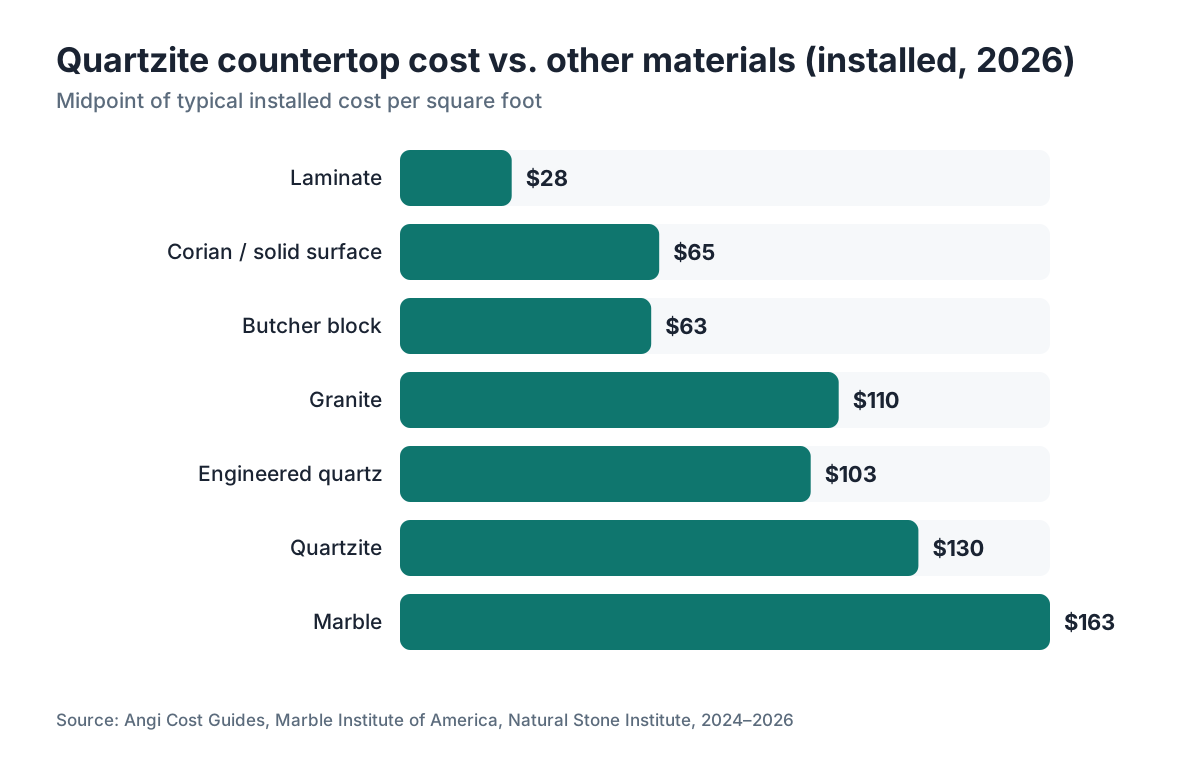
Quartzite sits above granite on average and below marble. Here is a direct comparison of installed cost ranges for the most common countertop materials in 2026, including fabrication and standard installation.
| Material | Installed cost per sq ft (2026) | Notes |
|---|---|---|
| Quartzite | $60, $200+ | Hardness varies by stone; exotic slabs push upper end |
| Granite | $45, $175 | Wide range; common colors are cheaper |
| Marble | $75, $250 | Softer, etches easily; luxury pricing |
| Engineered quartz | $55, $150 | Consistent quality; no sealing needed |
| Corian / solid surface | $45, $85 | Repairable; not heat-resistant |
| Laminate | $15, $40 | Budget option; much shorter lifespan |
| Butcher block | $35, $90 | Needs oiling; warm look |
Quartzite is denser and harder than marble, which means it resists etching better, and that matters if you cook with citrus or wine. Granite countertops are often cheaper because the global supply is massive and many colors are commodity items. Quartzite supply is tighter, especially for the Brazilian stones, which keeps prices firmer. [4][8]
Engineered quartz (brands like Cambria, Silestone, Caesarstone) overlaps quartzite in price. If budget is the primary driver, engineered quartz gives you a more predictable product at a sometimes lower cost. If you want a natural stone with visible movement and character that cannot be replicated in a factory, quartzite is the right call, but you are paying for that. Cambria countertops are worth comparing directly if you are on the fence.
Is quartzite and quartz the same thing?
No, and confusing them is one of the most expensive mistakes homeowners make.
Quartzite is a natural metamorphic rock. It starts as sandstone, gets buried deep, and recrystallizes under heat and pressure into a dense silica-rich stone. It needs to be sealed. It can etch if the silica content is lower than advertised (more on that below). It is heavy and requires skilled fabrication.
Engineered quartz is a manufactured product. It is roughly 90 to 94 percent ground quartz bound with polymer resins and pigments. It is non-porous, requires no sealing, and has consistent patterning across the slab. The Marble Institute of America distinguishes these categories clearly in its commercial stone standards. [5]
The confusion gets worse because some slabs sold as "quartzite" in showrooms are actually marble or dolomitic marble, which are much softer and will etch badly from common kitchen acids. The only reliable test before you buy: ask for the ASTM C503 flexural strength test results or at minimum request that the distributor do a simple acid test on a sample. Drop a few drops of vinegar or lemon juice on the polished surface and wait five minutes. If it etches or dulls, it is not true quartzite. [5]
This matters for cost too. Softer stones sold as quartzite may be priced as quartzite but will perform like marble. You can see more on general stone care at our how to clean stone countertops guide.
What does quartzite fabrication actually cost, and what is included?
Fabrication is the cutting, edging, polishing, and fitting of the stone before installation. It is distinct from the raw slab cost and from the installation labor of setting the stone in your kitchen.
Fabrication typically runs $25 to $55 per square foot for quartzite. The higher end reflects the stone's hardness: quartzite is among the toughest materials a shop will cut, wearing through diamond blades faster than granite and far faster than softer stones. Shops that quote quartzite at the same fabrication rate as granite are either not accounting for that blade wear or they are buying it back in upsells.
A fabrication quote should include: template (measuring your space, usually done with a digital templating system or a physical template), all cuts to shape, edge profile on exposed edges, polishing, and sink cutout (sometimes this is a line item add-on, so verify). It usually does not include delivery, installation, or any countertop removal.
For fabricators running a shop, accurate quartzite quoting is genuinely harder than granite because remnant yield varies more with the stone's natural veining patterns. Software that handles slab nesting, like SlabWise, can reduce material waste significantly on these high-cost slabs where every square foot matters.
Delivery and installation add another $5 to $15 per square foot for most markets, plus a minimum trip charge in the $150 to $300 range. Small jobs (single vanity, small bathroom) often have higher per-square-foot install costs because the trip charge dominates. [3]
How much does a typical kitchen quartzite project cost in total?
Let's run three real project sizes so you can anchor your budget.
Small kitchen, 30 sq ft of counter space: At $80 to $120 installed, that is $2,400 to $3,600. At this size the trip charge matters more, so per-square-foot cost tends toward the top of the range. One sink cutout, standard eased edge, 3 cm slab in a mid-grade quartzite like White Macaubas.
Average kitchen, 45 sq ft: This is the most common residential kitchen counter area cited in remodeling surveys. At $90 to $130 per square foot installed, budget $4,050 to $5,850. One undermount sink cutout, two faucet holes, simple edge, no waterfall. A premium Brazilian stone like Taj Mahal would push this to $6,500 to $8,000.
Large kitchen with island, 65 sq ft: At $100 to $140 per square foot, that is $6,500 to $9,100. If the island has a waterfall edge on two sides (common in current design), add $1,500 to $2,500 for the mitered edge work. Total can reach $12,000 on an exotic slab with complex edges. [9]
Remember to add countertop removal if you have existing material. Demo and disposal typically runs $2 to $5 per square foot or a flat $200 to $500 for most kitchens. Old tile countertops take longer to remove and cost more. [1][3]
Does quartzite need sealing, and what does that cost?
Yes. True quartzite is porous enough that most fabricators recommend sealing at installation and annually after that.
The initial seal is often included in the installation cost, but ask specifically. A professional sealant application at installation runs $50 to $150 as a line item if charged separately. DIY sealers like StoneTech BulletProof or Tenax Proseal cost $25 to $60 per bottle, and a standard kitchen takes one to two bottles.
How often you need to reseal depends on the specific stone and your cleaning habits. The simple test: drop water on the surface and see if it beads. If it soaks in within a few minutes, reseal. Some denser quartzites (genuinely high-silica stones) hold a seal for two to three years. Softer ones that are really dolomite sold as quartzite may need resealing every six months, which is a sign you bought the wrong stone.
The Marble Institute of America recommends using only sealers designed for natural stone and avoiding anything with acidic cleaners as a carrier. [5] More detail on day-to-day care is at our how to clean quartzite countertops guide.
What are the most popular quartzite slab options and what do they cost?
The stone name on the showroom label does not guarantee a standard price, but here is a realistic range by variety for 2026 based on distributor-level slab pricing across major U.S. markets. These are slab-only costs before fabrication or installation.
| Quartzite variety | Origin | Slab cost per sq ft | Notes |
|---|---|---|---|
| White Macaubas | Brazil | $28, $45 | Entry-level; widely available |
| Taj Mahal | Brazil | $55, $90 | Very popular; warm cream/gold tones |
| Super White | Brazil | $50, $85 | Often confused with dolomite; test it |
| Calacatta Macaubas | Brazil | $70, $110 | Strong veining; high demand |
| Sea Pearl | Brazil | $40, $65 | Wavy silver-green patterning |
| Azul Macaubas | Brazil | $65, $100 | Blue-gray tones; dramatic look |
| Cristallo | Brazil | $80, $130 | Ultra-white; top of the market |
| Virginia Mist | USA | $20, $35 | Gray-blue; domestic pricing |
Prices vary by slab lot, bundle size, and whether you buy through a distributor or a fabricator who marks up material. Buying the slab directly from a regional stone distributor and having your fabricator pick it up (or work with that distributor) can save 15 to 25 percent on the material cost alone. Ask your fabricator whether they allow owner-supplied material. Many do; some charge a small handling fee. [2]
How does quartzite compare to marble countertops on cost and durability?
Marble and quartzite look similar. They are priced similarly. They perform very differently.
Marble countertops install for $75 to $250 per square foot, which overlaps most of quartzite's range. The real difference is hardness and acid resistance. Marble is calcite-based and reacts with common kitchen acids including vinegar, citrus juice, and even some dish soaps. The result is etching: dull, slightly rough spots that show up as rings and watermarks. Quartzite (real quartzite) is silica-based and does not etch from common kitchen acids.
For a kitchen with active cooking, quartzite is a more practical choice than marble. For a bathroom vanity where acid exposure is minimal, marble is fine and the cost is roughly equivalent.
On the durability scale: quartzite rates 7 on the Mohs hardness scale, close to granite (6.5 to 7). Marble sits at 3 to 4. That gap is significant in a working kitchen. Quartzite resists scratching far better. It can chip on corners under impact like any stone, but day-to-day wear favors quartzite clearly over marble.
If you want something low maintenance that requires no sealing, engineered quartz is still the practical answer. But if you want natural stone in a kitchen, quartzite is the better choice over marble in most cases. [4][5]
How can homeowners reduce quartzite countertop costs without sacrificing quality?
There are real levers here. Some work better than others.
Buy a remnant slab. Fabrication shops often have remnants from larger jobs, slabs of 10 to 20 square feet in premium quartzite that would otherwise go to waste. A bathroom vanity or small bar countertop fits perfectly on a remnant, and you can often get premium stone at 40 to 60 percent off the full-slab price. Call local fabricators directly and ask what remnants they have.
Choose a simpler edge. An eased or slightly beveled edge looks clean and modern, and it is almost always included in base fabrication pricing. Ogee, waterfall, and chiseled edges can add $15 to $30 per linear foot or more.
Go with a more available stone. White Macaubas and Virginia Mist quartzite are genuinely good stones at a fraction of what Taj Mahal or Cristallo costs. The performance difference is minimal; the visual difference is real but subtle to most visitors. If your goal is durable natural stone, the entry-level quartzites deliver.
Skip the full-kitchen commitment for now. Quartzite the island and use a lower-cost material on the perimeter runs. A quartz perimeter with a quartzite island is a common design move that looks intentional and keeps the budget in check.
Get three quotes, not one. Fabrication pricing for quartzite varies widely. A 20 percent spread between shops on the same job is not unusual. The cheapest is not always best, but the most expensive is not always better either. Ask each shop to walk through their line items. [3]
For a broader view on kitchen countertops and how different materials fit different budgets, our overview covers all the main options side by side.
What questions should you ask before hiring a quartzite fabricator?
Not all stone shops handle quartzite equally well. It is harder to cut than granite, the slabs are expensive, and a mistake costs real money. Here are the questions that separate experienced shops from ones that will learn on your dime.
-
How many quartzite jobs have you done in the last six months? You want a shop that runs these regularly, not one treating it as a novelty.
-
What blade and tooling do you use for quartzite? Shops that know their tools know the material. Look for shops using wet-cutting diamond blades rated for hard stone.
-
Do you do digital templating? A digital template (using a tool like Laser Products' LT-2D3D or Proliner) reduces measurement errors, which is critical on slabs costing $80 per square foot at the distributor.
-
Can I see the full slab before you cut? Always inspect the actual slab that will go in your kitchen, more than a sample. Quartzite varies dramatically within a stone family. What you see in the showroom may not match what comes off the truck.
-
What is your policy if a slab cracks during fabrication? A reputable shop carries their own liability for fabrication errors. Get this in writing.
-
Is the first seal included in your install price? If not, who applies it and what product?
The countertop installation process has more detail on what a solid install scope of work should include. Fabricators using modern quoting software, like SlabWise, produce clearer line-item quotes that make these conversations much easier, and you can spot vague pricing faster.
Is quartzite worth the cost compared to cheaper alternatives?
For most kitchens, yes. But it depends entirely on your priorities.
If you plan to stay in your home for ten or more years and use the kitchen heavily, quartzite's durability makes the higher upfront cost reasonable. The cost of laminate countertops per square foot installed is a fraction of quartzite, typically $15 to $40, but laminate has a 10 to 15 year typical lifespan before it starts delaminating at seams and edges. Quartzite, properly maintained, should outlast the house.
If you are selling the home in two to three years, the math is different. Upscale kitchen remodels return roughly 60 to 70 percent of their cost in resale value according to the 2024 Cost vs. Value report from Remodeling Magazine. Premium stone can help a home show better, but you rarely recover the full premium of quartzite over granite in resale value alone. [6]
If your budget is tight, engineered quartz gives you a durable, no-seal-required surface for $55 to $150 installed, which overlaps quartzite's lower range but with more predictability. Corian countertops, at $45 to $85 per square foot installed, are repairable in ways stone is not (scratches sand out) but they are not heat-resistant and do not have the look of natural stone.
The honest answer: quartzite is worth it for buyers who want a natural stone that holds up in a kitchen and can stomach the cost. It is probably not the right choice for a rental property, a flip, or anyone who hates the idea of annual sealing. Know which buyer you are before you commit.
Frequently asked questions
What is the average cost to install quartzite countertops in a kitchen?
Most kitchens run $4,000 to $8,000 fully installed for quartzite, assuming 40 to 55 square feet of counter space and a mid-grade stone. A small kitchen with budget quartzite like White Macaubas can come in around $2,500. A large kitchen with exotic Brazilian stone and waterfall edges can exceed $12,000. The all-in per-square-foot range is $60 to $200.
How much does quartzite cost per square foot for material only?
Slab-only quartzite costs $20 to $130 per square foot at a stone distributor, depending heavily on variety and origin. Entry-level domestic quartzite like Virginia Mist runs $20 to $35. High-demand Brazilian varieties like Taj Mahal or Cristallo run $55 to $130. Fabrication and installation add another $35 to $70 per square foot on top of material.
Is quartzite more expensive than granite countertops?
Usually yes, though the ranges overlap. Granite installs for $45 to $175 per square foot depending on grade; quartzite runs $60 to $200. Common granite colors are commodity items with massive global supply, which keeps pricing competitive. Quartzite supply is tighter, especially the popular Brazilian stones, which holds prices higher. At equivalent grades the gap is roughly 15 to 25 percent in favor of granite.
How does quartzite cost compare to quartz countertops?
Engineered quartz installs for $55 to $150 per square foot, overlapping most of quartzite's range. At the low end, quartz is cheaper. At mid-range they are close. Above $120 per square foot, quartzite is usually the better aesthetic choice because you are paying for a unique natural slab. Quartz requires no sealing and has more consistent patterning; quartzite has character that cannot be manufactured.
What is the difference between quartzite and quartz countertops?
Quartzite is a natural metamorphic rock quarried from the earth. It requires sealing and can etch if it is a softer variety sold under the quartzite name. Engineered quartz is a manufactured product made from ground quartz crystals bound with resins. It is non-porous, needs no sealing, and has uniform patterning. Confusing them is common and can leave homeowners expecting quartzite performance from an impostor stone.
Does quartzite need to be sealed, and how much does sealing cost?
Yes, true quartzite is porous and should be sealed at installation and periodically thereafter, typically every one to three years depending on the stone's density. Professional application at install often runs $50 to $150 if not included in the quote. DIY sealers cost $25 to $60 and cover a full kitchen. The water-bead test tells you when resealing is needed: if water soaks in within a few minutes, it is time.
How do I know if I am buying real quartzite and not marble or dolomite?
Ask the distributor for ASTM C503 test results or do a simple acid test yourself. Put a few drops of vinegar or lemon juice on the polished surface and wait five minutes. Real quartzite will show no change. Marble and dolomitic marble will etch, leaving a dull spot. Many stones sold as quartzite in U.S. showrooms are actually softer dolomite, which looks similar but performs much worse in a kitchen.
What is the cheapest quartzite option for countertops?
White Macaubas and domestic quartzites like Virginia Mist are the most affordable true quartzite options, running $20 to $45 per square foot for material. Installed, these come in at $60 to $90 per square foot in most markets. Buying a remnant slab from a local fabricator can cut material cost by 40 to 60 percent, making premium quartzite accessible for small surfaces like bathroom vanities.
How long do quartzite countertops last?
Properly maintained quartzite countertops should last the lifetime of the home. The stone itself does not degrade. Chips and cracks from impact are possible, as with any stone, and repair quality varies by fabricator. The main maintenance requirement is periodic resealing. Quartzite rates 7 on the Mohs hardness scale, meaning it resists everyday scratching from cookware and utensils better than marble or soapstone.
Can quartzite countertops crack or chip?
Yes. Quartzite is hard but not indestructible. Corner chips are the most common damage, usually from a dropped heavy object. Cracks can occur if the substrate is uneven or if the slab takes a sharp impact. Repairs are possible but visible on close inspection. The risk is similar to granite and lower than marble. Proper installation with adequate support under spans longer than 24 inches reduces cracking risk significantly.
Is quartzite a good choice for bathroom vanities?
Yes, and it is often a more cost-effective choice than in the kitchen because vanities are small, so remnant slabs work perfectly. Acid exposure in a bathroom is lower than in a kitchen, so even the softer quartzite varieties perform well. Installed cost for a standard 60-inch double vanity typically runs $600 to $1,400 depending on the slab and edge profile.
How much does countertop removal add to the quartzite installation cost?
Removing old countertops typically adds $200 to $500 for a standard kitchen, or $2 to $5 per square foot. Old tile set in thinset over a mortar bed is the most labor-intensive to remove and can push toward $600 to $800 for a full kitchen. Laminate glued directly to plywood is the easiest and cheapest to pull. Always clarify with your fabricator whether removal and disposal are included in their quote.
What edge profile adds the most cost to a quartzite countertop?
Waterfall edges, which wrap the slab material vertically down the side of an island, add the most cost because they require precision miter cuts and significantly more material. Expect to add $800 to $2,500 for a full two-sided island waterfall. Among standard profiles, an ogee or dupont edge adds $10 to $20 per linear foot over a basic eased edge. Keeping to simple eased or beveled edges is the easiest way to control fabrication cost.
How does the cost of quartzite compare to Corian or solid surface countertops?
Corian and other solid surface materials install for $45 to $85 per square foot, well below most quartzite projects. The trade-off is performance and appearance. Corian is repairable (scratches sand out), joins with joints that disappear, and comes in many colors. It is not heat-resistant and does not have the look of natural stone. Quartzite costs more but looks better, lasts longer, and handles heat without damage.
Sources
- HomeAdvisor (Angi), Quartzite Countertops Cost Guide: Installed quartzite countertop cost range of $60 to $200 per square foot; average kitchen counter area approximately 45 square feet
- Natural Stone Institute, Stone Reference Library: Quartzite slab pricing by variety and origin; Brazilian quartzite distributor pricing ranges
- U.S. Bureau of Labor Statistics, Occupational Employment and Wage Statistics for Stone Cutters and Carvers: Regional labor rate variation for stone fabrication trades; basis for install labor cost estimates
- Marble Institute of America, Dimensional Stone Design Manual: Comparative hardness and acid resistance of quartzite versus marble; quartzite Mohs hardness approximately 7
- ASTM International, ASTM C503 Standard Specification for Marble Dimension Stone: Standard test methods distinguishing quartzite from marble and dolomitic marble by flexural strength; acid test protocol
- Zonda (Remodeling Magazine), 2024 Cost vs. Value Report: Upscale kitchen remodel returns approximately 60 to 70 percent of cost in resale value on average
- U.S. Geological Survey, National Minerals Information Center, Dimension Stone: U.S. quartzite production data; domestic quartzite quarrying in Virginia and other states
- This Old House, Countertop Cost Comparison Guide: Engineered quartz installed cost range of $55 to $150 per square foot; comparison with natural stone
- National Kitchen and Bath Association, Kitchen and Bath Design Trends Report 2024: Quartzite cited among top five countertop material selections in high-end kitchen remodels; island waterfall edge trend data
- U.S. Bureau of Labor Statistics, Producer Price Index for Stone Mining and Quarrying: Stone material price index trends 2022 through 2025 used to contextualize 2026 slab pricing ranges
Last updated 2026-07-10