TL;DR
- The physical install of countertops takes 2 to 8 hours for a typical kitchen, depending on material, edge complexity, and sink cutouts.
- The full process, from signing a contract to having usable counters, runs 1 to 6 weeks.
- Stone slabs (granite, quartz, marble) take longest because they need a separate template visit before fabrication starts.
- Laminate and butcher block move faster.
What is the full countertop timeline from order to install?
The day the installer shows up is the finish line, not the start. Before that crew arrives, several things happen in order, and each step has its own waiting period.
Here's how the sequence plays out:
- Sign the contract and pay the deposit. Most fabricators want 50% down before they schedule anything.
- Template visit. A technician comes to your home, measures precisely, and captures your layout digitally or with physical templates. This usually takes 1 to 2 hours.
- Fabrication. The shop cuts, edges, and finishes your slabs. This is where most of the wait happens.
- Scheduling the install. Once fabrication finishes, you get on the install calendar.
- Installation day.
- Plumber reconnection (if sinks and faucets were disconnected, which they usually are for stone).
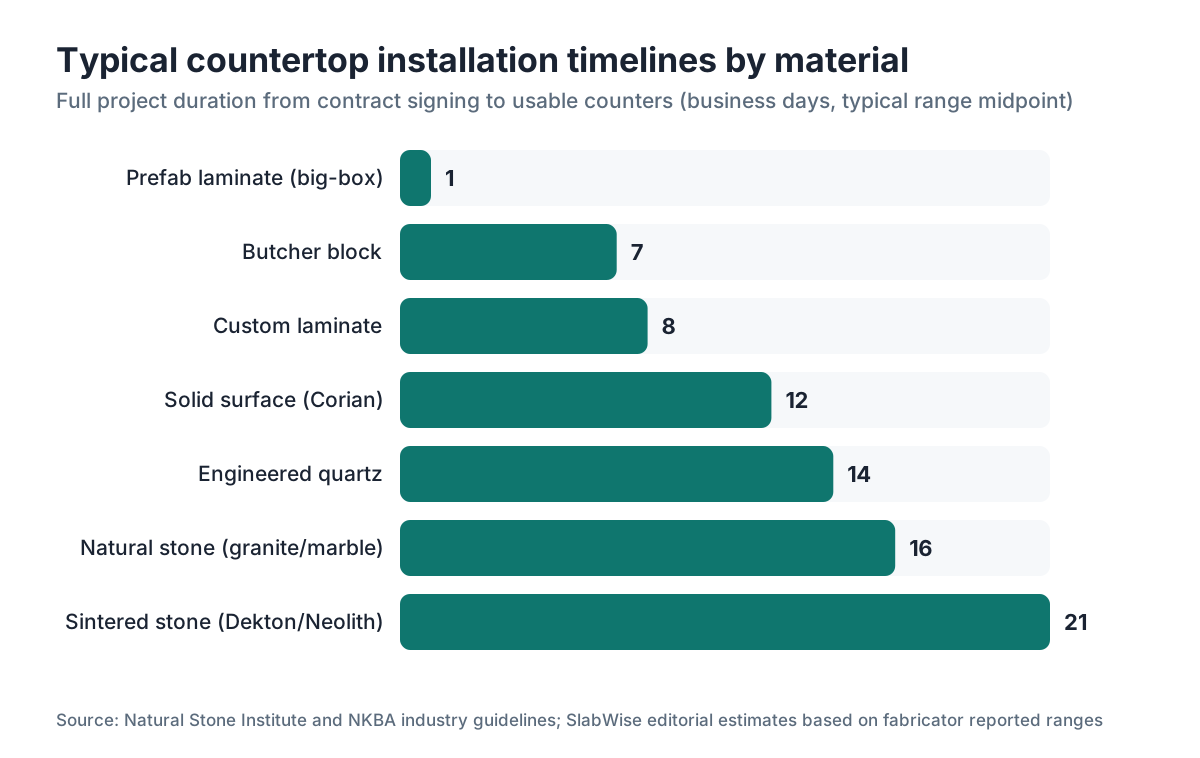
Total elapsed time from contract to usable counters runs roughly 1 week on the fast end (in-stock prefab laminate or a simple butcher block job) up to 5 or 6 weeks for a custom stone project in a busy season. Houzz's 2023 U.S. Kitchen Trends Study found that kitchen remodels ran a median of several weeks longer than homeowners expected, and countertop lead times are a common reason [1].
If a fabricator quotes 10 to 14 days from template to install, that's realistic for an uncomplicated project with in-stock material. If they say 3 to 4 weeks, that's also normal, especially from February through August when remodel demand peaks.
How long does the actual installation take on the day?
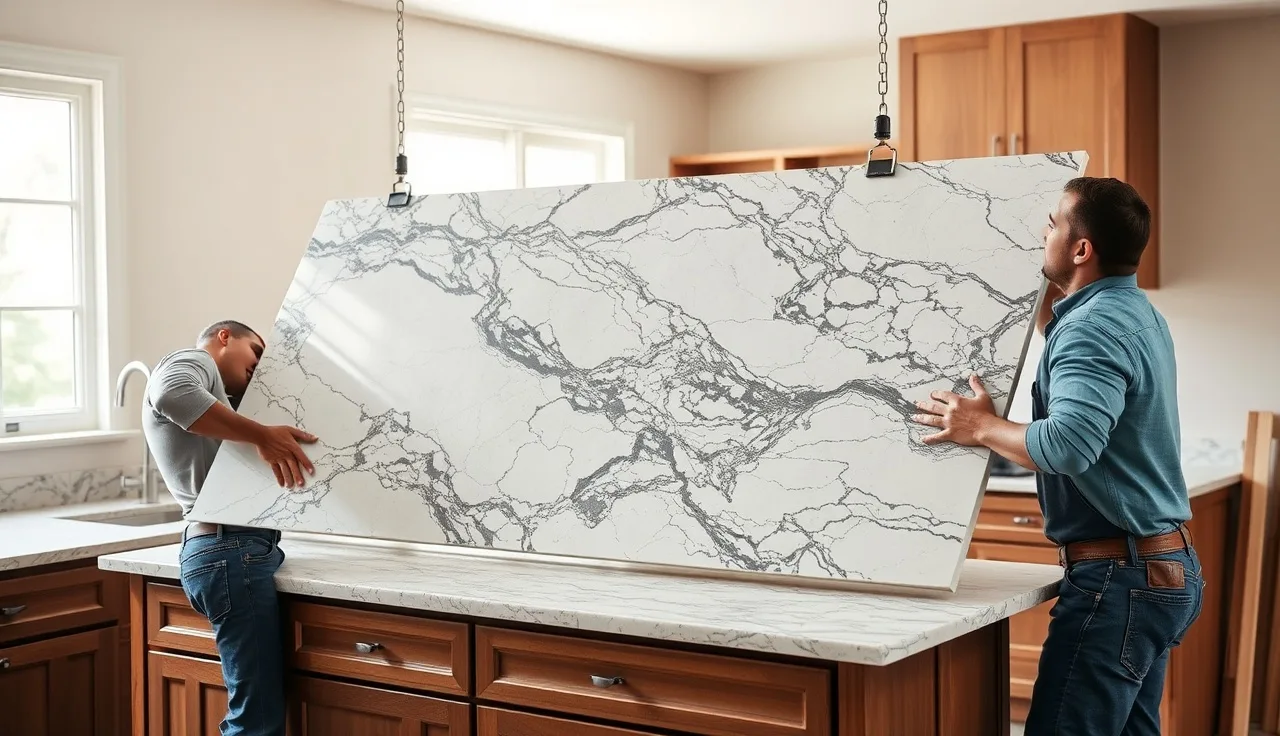
For a standard kitchen with 40 to 60 square feet of counter, plan on 3 to 5 hours for a stone install crew. Simple layouts with one or two straight runs go faster. A kitchen with an island, a peninsula, multiple seams, and a farmhouse sink apron cutout can run 6 to 8 hours.
Here's what eats the most time on install day:
- Carrying slabs. Full granite or quartz slabs weigh 18 to 20 pounds per square foot [2]. A single kitchen slab can hit 400 to 700 pounds. Getting it off the truck, through the house, and onto the cabinets without breaking anything takes time and people.
- Dry-fitting and shimming. Cabinets are rarely perfectly level. Installers shim and adjust before any adhesive goes down.
- Seaming. A well-done seam takes 30 to 60 minutes per joint to align, epoxy, and clamp.
- Sink cutout and polishing. If the cutout wasn't done in the shop, expect another 45 to 90 minutes on site.
- Silicone and cleanup. Caulking the backsplash line and wall joints, then cleaning the stone, adds 30 to 45 minutes.
Laminate and solid-surface (like Corian) installs often go faster on the day, sometimes 2 to 3 hours, because the material is lighter and the adhesive process differs. Butcher block is quicker too, typically 2 to 4 hours, since it screws down from underneath instead of needing the full epoxy-and-clamp routine.
Clear the kitchen of everything on the existing counters before the crew arrives. Move the microwave, small appliances, dishes, all of it. Crews cannot and will not move your belongings.
How long does fabrication take, and what affects the wait?
Fabrication, the cutting and finishing of your slabs, is where most of the calendar time disappears. A CNC bridge saw can cut a countertop in minutes. The shop's production queue, the time to source your specific slab, and the polishing and edge work are what stack up.
Typical fabrication timelines by material:
| Material | Typical fab time after template |
|---|---|
| Natural stone (granite, marble, quartzite) | 7 to 14 days |
| Engineered quartz (Cambria, Silestone, etc.) | 7 to 14 days |
| Laminate (custom) | 3 to 7 days |
| Butcher block | 1 to 5 days |
| Solid surface (Corian, etc.) | 5 to 10 days |
| Sintered stone (Dekton, Neolith) | 10 to 18 days |
These ranges assume the material is in stock at the local distributor. If your slab has to ship from another region or is a special order, add 1 to 3 weeks. Some quartzite and exotic marble varieties come from a single importer and carry 3 to 4 week lead times on the material alone before the shop ever touches it.
Shop workload matters too. A busy shop in peak season (spring through early fall) may have a fabrication queue of 2 to 3 weeks before your job even starts. A smaller shop in January might run it in 5 days. Ask directly: "What's your current queue?"
For fabricators, software that optimizes slab nesting (laying multiple jobs on one slab to cut waste) can compress shop time. Tools like SlabWise handle that nesting automatically, which frees technicians from manual layout work and keeps jobs moving through the queue. But even the fastest shop can't beat a slow material delivery.
If you're buying granite or marble, go to the slab yard yourself before signing. Pick and tag your slab. That kills the "we'll select a suitable slab" delay and guarantees you get the material you actually want.
How long does the template visit take, and can you skip it?
Template visits take 1 to 2 hours for most kitchens. Larger homes or complicated layouts with a butler's pantry and a laundry counter can push it to 3 hours.
You cannot skip the template visit for custom stone. Period. No reputable fabricator cuts expensive granite or quartz without physically measuring your space. Cabinet installation has tolerances, and walls are never perfectly square. The template captures the real geometry of your cabinets, not what the floor plan says they should be.
Some shops use digital templating tools (a laser scanner or a Proliner device) that capture the space in minutes and feed straight into CNC cutting software. Faster and more accurate than the old cardboard-strip method, but it still needs a site visit.
Prefab countertops are the exception. Big-box stores sell pre-cut granite and laminate in standard sizes (typically 25.5 inches deep, in lengths from 2 to 10 feet) that need no template. The tradeoff is a limited selection, basic edge profiles, and cut-to-fit work you do yourself. For a simple galley kitchen or a bathroom vanity, prefab can shrink your timeline to a few days. For anything complicated, it's not practical.
After the template visit, the fabricator usually books your install date on the spot, so you're not waiting for a callback. Ask for that install date before the templater leaves.
How long do different countertop materials take to install?
Material choice is probably the single biggest variable in how fast your project moves.
Natural stone (granite, marble, quartzite): Longest lead time. Needs a template, fabrication, and a full crew with suction cups and seaming tools. Install day runs 3 to 6 hours for a typical kitchen. Seams should cure 24 hours before heavy use.
Engineered quartz (Cambria, Silestone, Caesarstone): Same process as natural stone. The material is consistent, which can make seaming a touch more predictable, but the timeline is identical. See Cambria countertops for that brand's lead times.
Laminate (Formica, Wilsonart, and others): Fastest for custom work. A local shop can go from measure to install in under a week. Post-form laminate from a big-box store can go in the same day you buy it, in a few hours, if you're comfortable with basic carpentry.
Butcher block: Fast. The material ships quickly, install is straightforward, and a handy homeowner can DIY it in a weekend. Professional install takes 2 to 4 hours.
Solid surface (Corian, LG Hi-Macs): Mid-range on timeline and install complexity. Seams are chemically bonded and nearly invisible, but that process takes skill and adds time.
Sintered stone (Dekton, Neolith): The slowest. The material is brittle to work with, needs specialized tooling, and fabricators who handle it regularly aren't everywhere. Expect 2 to 4 weeks from template to install even in good conditions.
For laminate countertops specifically, the speed advantage is real and underrated. If your timeline is tight, take laminate seriously.
For full planning help, the kitchen countertops overview covers material tradeoffs in detail.
What can delay countertop installation, and how do you avoid delays?
Delays are common. Here's where they actually come from.
Cabinets aren't ready. The template visit can't happen until cabinets are fully installed and level [11]. If cabinet installation runs late, your countertop timeline slides by exactly that many days. This is the most common source of delay in kitchen remodels.
Slab availability. You fall for a specific lot of quartzite sitting in a warehouse two states away. Shipping takes 2 weeks. Nobody warned you. Ask your fabricator to confirm the slab is in local inventory before you commit.
Change orders. Changing the edge profile, adding a sink cutout, or swapping material after the template resets the fabrication queue. Avoid changes after the template visit.
Plumbing conflicts. Your plumber disconnects the sink the night before and finds the drain line needs rerouting. Now install gets postponed with the cabinets below sitting open. Sort plumbing scope out before countertop scheduling.
Seasonal demand. Fabrication shops run at capacity from roughly March through September in most of the country. Booking your project for November through January can cut your wait by a week or more.
Weather. Heavy slabs on a flatbed don't move in ice storms. Allow buffer days in winter.
The single most effective move a homeowner can make: lock in the template visit within 24 hours of cabinet completion, and confirm slab availability the same week you pick your material. Fabricators who run their own scheduling software can often show you real-time queue status, which takes most of the guesswork out of install-date estimates.
How long after installation before you can use the countertops?
For most stone countertops, the answer is the same day, with a few caveats.
The epoxy that joins seams cures enough to bear light pressure within 30 to 60 minutes of installation [6], but fabricators usually say wait 24 hours before setting heavy objects directly on a seam. The silicone caulk along the wall and backsplash joint takes 24 to 48 hours to fully cure [3].
Your plumber can usually reconnect the sink and faucet the same afternoon the counters go in, assuming the cutout was done right and no adjustments are needed. If the plumber has to come back the next day, you'll have a working sink within 24 hours.
Sealing is its own step. Most granite and many natural stones need a penetrating sealer applied shortly after installation. Some fabricators seal in the shop before delivery. Others expect you to seal on site. A penetrating sealer (an impregnator) takes about 20 to 30 minutes to apply and needs 24 to 72 hours to fully cure depending on the product [4]. Keep the surface dry during that window.
Butcher block gets mineral oil, not a chemical sealer. Let the first coat soak in for a few hours before you place anything on the surface. The counters are otherwise usable the same day.
Solid surface and laminate are ready to use the moment install is done. No curing time.
Can you install countertops yourself, and how does that change the timeline?
Yes for some materials. No for stone slabs.
A full granite or quartz slab is not a DIY project. The weight alone (often 400 to 700+ pounds for a kitchen) makes it dangerous without the right equipment and experience. A dropped slab destroys cabinets, floors, and people. Stone and tile setting is skilled trade work with its own tools and training [7]. The seaming process needs specific epoxy colors, clamps, and polishing technique that take years to learn. A seam done wrong is visible forever.
Materials where DIY is genuinely practical:
- Laminate (prefab sections): High school woodshop skills cover it. A jigsaw, a router with a flush-trim bit, and a Saturday morning.
- Butcher block: Screws up from below, mineral oil finish. Very DIY-friendly.
- Tile: Slow but achievable. Grout joints are the hardest part to get right.
- Formica sheet laminate on a new substrate: Contact cement and a router, but manageable.
One safety note for anyone tempted to cut stone at home: dry-cutting slabs releases crystalline silica dust, which OSHA regulates on job sites under 29 CFR 1926.1153 [9]. Professionals use wet-cutting and engineered controls for a reason. That's not gear most homeowners own.
For a DIY install, your timeline collapses on the labor side but rides entirely on your schedule. A homeowner who can commit a weekend can often finish a butcher block or laminate install in 6 to 10 hours total. The material usually ships within 3 to 5 business days.
The real risk of DIY stone isn't the install itself. It's what happens when something cracks mid-job and you need a pro to rescue it. Weigh that before you start.
How long does countertop installation take for a bathroom vanity?
Bathrooms are faster. A single vanity top with one sink cutout takes 1 to 2 hours to install once the crew is on site. The slabs are smaller and lighter, and there's usually only one or two pieces.
The fabrication timeline is the same as kitchen stone, because the template and shop processes don't change much based on size. You're still waiting 1 to 2 weeks from template to install for a custom stone vanity top. Where you save time is on installation day itself.
Prefab vanity tops (the cultured marble or cultured stone tops sold at home improvement stores) can go in under an hour with any competent plumber or handyman. The tradeoff is limited size options and a look that reads prefab.
Doing a kitchen and multiple bathrooms in one project? A good fabricator will template everything on a single visit and batch the fabrication, which saves a week or more compared to running each room as its own job.
How do fabricators schedule jobs, and how does that affect your wait?
Knowing how a shop runs helps you ask better questions and set realistic expectations.
Most fabrication shops run a linear production queue. Jobs enter after the template visit, get laid out on slabs, go to the CNC or bridge saw, then to the edge polisher, then to quality check, then onto the install schedule. A shop processing 20 to 40 jobs a week (a mid-size regional shop) typically carries a fabrication queue of 1 to 2 weeks. Larger shops can run tighter queues because they have more equipment. Smaller shops might move faster per job but have less slack when a machine breaks down.
The install schedule is separate from the fabrication queue. A shop might finish your countertop Thursday but not have an open install slot until the following Tuesday. That gap is real time you spend waiting while finished counters sit in the shop.
This is where a shop's scheduling and software matter to you as a customer. Shops that can name your exact install date at templating are better organized than the ones who call you when they're ready. Ask directly: "Once fabrication is done, how long until an install crew comes?"
For shop owners managing all this, quoting and job-tracking software (like SlabWise) helps prevent overbooking the install schedule and keeps customers informed without constant manual status calls. That discipline directly cuts how often customers hit surprise delays.
The NKBA recommends homeowners get a written installation timeline with milestone dates when signing any countertop contract [5]. If a fabricator won't commit to even rough dates in writing, treat it as a warning sign.
What questions should you ask a fabricator about the timeline before signing?
Ask these before you hand over a deposit:
- Is my slab in stock locally? If not, how long to get it?
- What's your current fabrication queue? Not "how long does it usually take," but right now, today, what's the queue?
- When can you schedule the template visit? The sooner after cabinets are done, the better.
- Will you give me an install date at templating? A shop that can't commit has scheduling problems.
- Who reconnects my plumbing, and can they come the same day as the install? Coordination here is your job unless the fabricator explicitly handles it.
- What sealer do you apply, and does it happen in the shop or on site? This changes your move-in timeline if you're waiting for a sealer to cure.
- What happens if something breaks during install? Slabs crack. Knowing the replacement policy before it happens beats learning it after.
A fabricator who answers all of these fast and in specific terms (not "usually about two weeks") runs a tight shop. Vague answers to specific questions are a soft signal of a disorganized one.
For care once your surfaces are in, see our guides on how to clean stone countertops and how to clean quartzite countertops.
Frequently asked questions
How long does it take to install granite countertops?
Granite installation takes 3 to 6 hours on the actual install day for a typical kitchen. The full timeline from signing a contract to usable counters runs 2 to 4 weeks: a few days to schedule the template visit, 7 to 14 days for fabrication, then an install appointment. Confirm your slab is in local inventory to avoid adding 1 to 3 weeks for shipping.
How long does it take to install quartz countertops?
Quartz countertops (Cambria, Silestone, Caesarstone, and similar) follow the same path as granite: template visit, fabrication, then install. Expect 2 to 4 weeks total from contract to completion. Installation day runs 3 to 5 hours for most kitchens. Engineered quartz is consistent in thickness, which makes seaming a bit more predictable, but that doesn't meaningfully shorten the overall timeline.
Can countertops be installed in one day?
Yes, on installation day itself. The physical install of most kitchen countertops takes 3 to 8 hours. But you only reach that day after the template visit and fabrication, which together take 1 to 4 weeks. Prefab laminate or prefab granite sections from a big-box store are the only way to go from purchase to installed in a single day, skipping the template and custom fabrication entirely.
How long do you have to wait after countertop installation before using the sink?
You can typically use the sink the same day, once a plumber reconnects it, which usually happens the afternoon of installation. Epoxy seams cure fast enough that the counters are stable within an hour or two. Silicone caulk along the wall joint takes 24 to 48 hours to fully cure, so avoid getting that specific area wet overnight. Most fabricators say no heavy pots or pressure on seams for 24 hours.
How long does it take to install laminate countertops?
Custom laminate takes 1 to 2 hours to install and has the shortest lead time of any countertop material, often under a week from measurement to install. Post-form laminate sections from a home improvement store can go in the same day you buy them, in 2 to 3 hours. Laminate is also one of the most DIY-friendly materials for handy homeowners.
How long does it take to install marble countertops?
Marble follows the same timeline as granite: 2 to 4 weeks from contract to install, with the actual installation taking 3 to 6 hours for a typical kitchen. Marble needs careful handling because it's softer and more brittle than granite. Ordering a rare variety? Allow extra time for slab availability, since some European marbles ship from importers and take 3 to 4 weeks to arrive.
How long does it take to remove old countertops before new ones go in?
Removing existing countertops takes 30 minutes to 2 hours depending on material and how they were attached. Laminate post-form counters often pop off in 20 to 30 minutes. Tile counters bonded to a concrete backer board take much longer and make demo debris. Most fabricators include removal in their scope. Confirm this when getting quotes, because some charge extra or exclude it.
How long does templating countertops take?
A template visit takes 1 to 2 hours for most kitchens. Shops using digital laser systems (Proliner or similar) can capture a layout in 30 to 60 minutes. Larger homes or projects covering a kitchen plus multiple bathrooms can run 2 to 3 hours. After the visit, the fabricator usually books your install date immediately, so the template appointment is the last real decision point before you wait on fabrication.
Do countertops need to be sealed after installation, and how long does that take?
Porous natural stones (granite, marble, quartzite, soapstone) typically need a penetrating sealer. Application takes 20 to 30 minutes, and the sealer needs 24 to 72 hours to fully cure depending on the product. Some fabricators seal in the shop before delivery. Engineered quartz, laminate, and solid surface do not need sealing. Ask your fabricator what they do and plan your move-in around it.
How long does butcher block countertop installation take?
Butcher block installs in 2 to 4 hours for a typical kitchen. It's one of the fastest materials to install professionally and one of the most accessible for DIY. The wood screws up from inside the cabinet, so no heavy equipment or seaming epoxy is needed. After install, apply food-safe mineral oil and let it soak in for a few hours before regular use. Full curing of an oil or wax finish takes a few days of repeat coats.
Does countertop installation include sink installation?
Usually not. Countertop fabricators cut the sink opening and may set the sink in place, but the plumbing connection (drain, water supply, faucet) is a licensed plumber's job in most jurisdictions. You coordinate the plumber separately for the afternoon of your install. Some general contractors manage this. If you're dealing directly with a fabricator, scheduling both on the same day is on you.
How long does countertop installation take for a small bathroom?
A vanity top with one sink takes 1 to 2 hours to install once the crew is on site. The timeline from contract to install is still 1 to 3 weeks for custom stone, because the template and fabrication process doesn't shrink much for smaller jobs. Prefab cultured marble vanity tops from home improvement stores can go in under an hour and need no lead time.
What time of year is fastest for countertop installation?
November through January. Fabrication shops carry shorter queues in winter because remodel activity slows down. You can often cut 1 to 2 weeks off the total timeline by dodging the spring and summer rush (March through August). If your timing is flexible, a winter install is one of the most reliable ways to get a shorter wait and more attentive crews who aren't stretched thin.
How many people does it take to install stone countertops?
Most stone crews run 2 to 3 people. Full granite or quartz slabs weigh several hundred pounds, and safe handling needs at least two experienced people using suction-cup lifters and dollies. Some larger or more complex installs (big islands, very heavy slabs) use 4-person crews. Solo installation of full stone slabs is not safe and voids most fabricator warranties on the material.
Sources
- Houzz, 2023 U.S. Houzz Kitchen Trends Study: Kitchen remodels ran a median of several weeks longer than homeowners expected, with countertop lead times a common contributor.
- Natural Stone Institute, Stone Weight Reference: Natural stone slabs can weigh 18 to 20 pounds per square foot, making a single kitchen slab 400 to 700+ pounds.
- Dow Inc., Building and Construction Silicone Technical Data: Silicone caulk used for countertop wall joints takes 24 to 48 hours to fully cure.
- Tile Council of North America, ANSI A118.10 Standard for Load Bearing Bonded Waterproof Membranes: Penetrating stone sealers require 24 to 72 hours to fully cure depending on product formulation.
- National Kitchen and Bath Association, NKBA Professional Resource Library: NKBA recommends that homeowners receive a written installation timeline with milestone dates in any countertop contract.
- Natural Stone Institute, Fabrication and Installation Guidelines: Stone countertop seam epoxy is cured enough to bear light pressure within 30 to 60 minutes of application.
- U.S. Bureau of Labor Statistics, Occupational Outlook Handbook: Tile and Stone Setters: Stone and tile installation is classified as skilled trade work requiring specialized equipment and training.
- U.S. Consumer Product Safety Commission: Stone slab fabrication involves specialized tooling and safety requirements not accessible to general DIYers.
- OSHA, Crystalline Silica Standard for Construction (29 CFR 1926.1153): Dry cutting of stone countertops is regulated under OSHA's silica standard, requiring engineered controls or wet-cutting methods at professional job sites.
- Houzz, U.S. Houzz Kitchen Trends Study: Countertops are among the most-replaced elements in kitchen renovations, selected by a large majority of renovating homeowners.
- National Kitchen and Bath Association, Kitchen Planning Guidelines: Cabinet installation must be complete and level before countertop templating can occur, per standard kitchen project sequencing.
- EPA, Renovation, Repair and Painting Program: Countertop and cabinet removal in pre-1978 homes may trigger lead-safe work practice requirements under EPA RRP rules.
Last updated 2026-07-10