TL;DR
- Countertop installation labor runs $150 to $600 for a standard kitchen, and most homeowners land near $300 to $400.
- Stone fabricators usually bundle labor into a per-square-foot price of $40 to $100 installed.
- Labor-only quotes are common for DIY slab buyers and laminate swaps.
- Material type, job complexity, and your region all move the number hard.
What does countertop installation labor actually cost?
For a typical kitchen with 40 to 60 square feet of countertop, labor alone runs $150 to $600. The wide spread is real, not hedging. A two-piece laminate drop-in on a flat base cabinet takes a couple of hours. A mitered, waterfall-edge quartz island with a farmhouse sink cutout and a peninsula can eat a full day for two people.
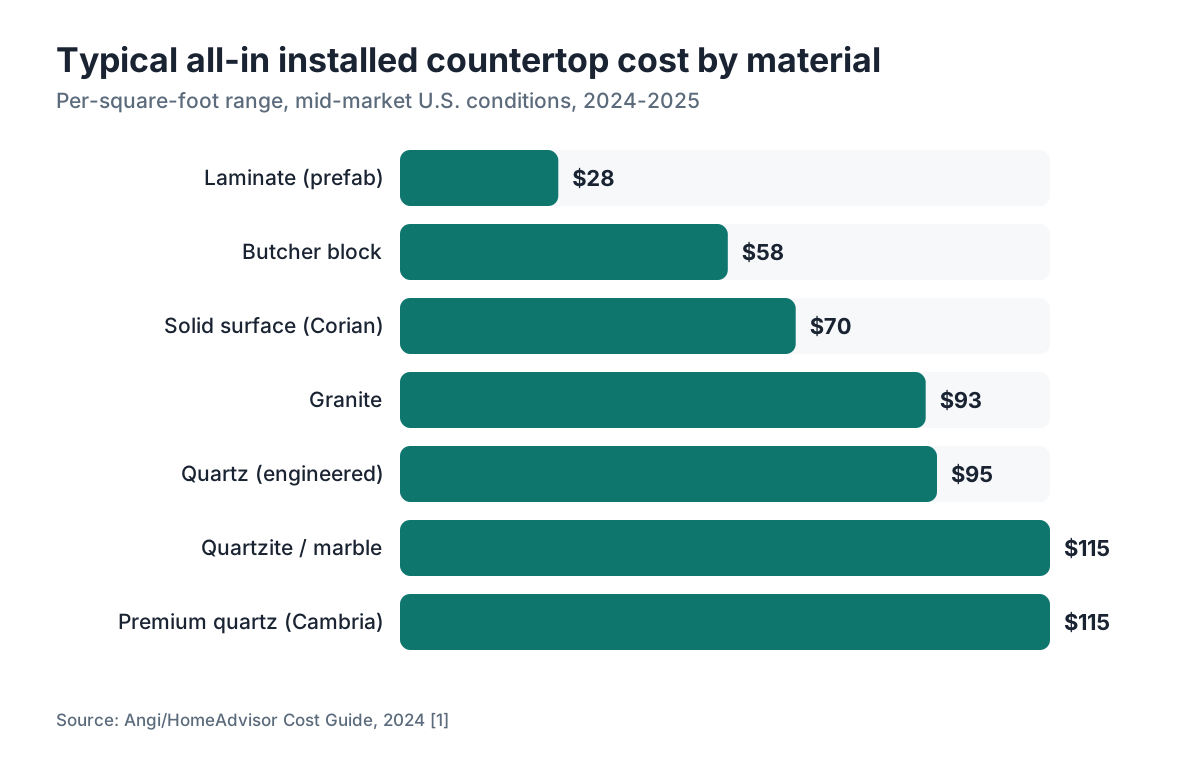
Most fabricators don't quote labor as a separate line. They quote an installed price per square foot that bundles material, fabrication, and installation. That bundled rate runs roughly $55 to $130 per square foot for granite or quartz, and $25 to $40 per square foot for laminate installed. [1] When a shop does break out labor, expect $50 to $100 per hour for stone crews and $35 to $60 per hour for laminate or solid-surface work.
Bought your own slab or remnant and just need someone to cut and set it? Labor-only quotes are common. Budget $200 to $500 for a modest kitchen, and get two or three quotes, because shops price this work very differently.
The national median for a full countertop replacement, all-in, sits around $3,000 to $4,500 for a typical kitchen, based on remodeling cost data tracked by industry sources and the U.S. Census Bureau's American Housing Survey. [2] Labor is usually 20 to 35 percent of that total.
How do installation costs break down by countertop material?
Material changes the labor math a lot. Weight, cut complexity, and who does the work all shift the number.
| Material | Typical installed price/sq ft | Labor share estimate |
|---|---|---|
| Laminate (prefab) | $15, $40 | $8, $15/sq ft |
| Butcher block | $35, $80 | $10, $20/sq ft |
| Solid surface (Corian) | $45, $95 | $15, $25/sq ft |
| Granite | $55, $130 | $15, $35/sq ft |
| Quartz (engineered) | $60, $130 | $15, $35/sq ft |
| Quartzite / marble | $70, $160 | $20, $40/sq ft |
| Cambria or premium quartz | $80, $150 | $15, $35/sq ft |
Those labor share numbers are rough. A shop with high overhead in a metro area builds more labor into every line. A small rural fabricator might carry lower material markup but the same labor hours. [1]
Laminate is the cheapest to install. Sheets are light, cuts happen with a circular saw, and nobody needs a crane or a vacuum lifter. Butcher block countertops are also DIY-accessible for confident woodworkers, though you still have to move heavy planks and cut clean sink openings.
Natural stone is heavy, often 18 to 20 pounds per square foot for 3-cm material. Granite countertops and marble countertops need two people minimum, and any piece over about 80 inches is a serious lift. Fabricators carry the liability for seams and breakage during install, which is partly why they prefer bundled contracts over labor-only jobs.
What makes one installation quote higher than another?
Six things push labor above the base rate.
Cutouts are the biggest variable. A standard undermount sink cutout adds $100 to $200 to most quotes. A cooktop cutout runs another $75 to $150. Add a prep sink and you're looking at $300 to $500 in cutout labor before a single square foot of surface.
Edge profiles matter. A standard eased or beveled edge is usually included. Ogee, waterfall, or mitered edges want more machine time and hand finishing, often $10 to $30 per linear foot. [1]
Seam count and placement add labor because each seam has to be tight, polished, and sometimes color-matched with epoxy. A long L-shaped kitchen with a peninsula might need three or four seams. Each one takes 30 to 60 minutes of skilled time.
Demo and haul-away. Pulling old countertops costs $50 to $150 depending on material and how they were fastened. Tile countertops glued to a substrate fight back harder than laminate screwed to cabinets. Some shops include demo. Many don't.
Access and site conditions. Third-floor condos, narrow stairwells, and tight corners slow everything down. Expect a $50 to $200 premium when a crew has to wrestle large slabs through hard spaces.
Substrate repairs. If the installer finds soft or uneven cabinet tops, they'll either refuse to proceed until you fix them or charge to shim and level. Budget $75 to $200 if your cabinets are old or the floor isn't level.
Is installation usually included in the fabricator's quote, or is it separate?
Almost always included when you buy material and fabrication from the same shop. That's the standard model. The fabricator templates your kitchen, cuts the stone, polishes edges, and shows up with a crew to install it. You pay one price.
Installation gets quoted separately in a few situations. You sourced your own slab or remnant. You bought a prefabricated laminate top from a home center. You're swapping an existing countertop without touching the cabinets and a handyman is doing the work. Or you're using laminate countertops or Formica countertops that never need a stone shop at all.
Big-box stores like Home Depot and Lowe's sell and install laminate and some quartz. Their installed pricing tends to land on the higher end for the material they carry, and scheduling can be slower than a local fabricator. The tradeoff is one point of contact and one warranty.
For stone, hiring a fabricator who bundles everything is usually cleaner. They know how the slab will behave during cuts, they own the warranty on seams and cracks during install, and their crews do this daily. Splitting the material purchase from the install opens a gap in accountability when something goes wrong.
How do regional labor rates affect the total price?
Labor rates track local construction wages closely. The Bureau of Labor Statistics Occupational Employment and Wage Statistics program reports that tile and stone setters (the closest BLS category to countertop installers) earned a median hourly wage of $24.10 nationally in May 2023, with state ranges from under $19 to over $35. [3] Shop owners typically charge out crews at 2 to 3 times the direct wage to cover insurance, tools, vehicles, and overhead.
In San Francisco, Seattle, or New York, expect all-in installed prices to run 30 to 50 percent above national averages. In rural Midwest or Southeast markets, prices can run 20 to 30 percent below. [4]
Here's the honest way to sanity-check a quote for your area: get three quotes from local shops. Don't lean on national cost calculators alone. They aggregate data that can be years old and doesn't capture your specific market. If your city is in a construction boom, labor is tighter and prices are up, no matter what any national chart claims.
What does templating cost, and is it included?
Templating is the measuring step. The fabricator comes to your home, maps the exact layout of your cabinets, marks sink and appliance locations, and builds a paper or digital template that drives the stone cuts. It takes 30 to 90 minutes for a typical kitchen.
Most fabricators fold templating into the overall quote at no separate charge, treating it as a pre-installation service. Some shops charge $75 to $150 for templating if you want a firm quote but haven't committed, then credit it back at signing.
Digital templating, using a laser measuring arm or a LiDAR tool, is now common at mid-size and larger shops. It's faster, it produces fewer measurement errors, and it cuts the odds of a costly miscut at the factory. A shop that offers it is usually running a tight operation.
For fabricators managing job volume, software like SlabWise handles the quoting side, connecting template measurements to slab inventory and cut layouts so the shop knows exactly what a job costs before it sends a crew. That kind of back-office accuracy matters when labor is your tightest margin.
How long does countertop installation take?
For a typical kitchen, the install itself takes 2 to 6 hours. A small galley kitchen with two pieces and no cutouts: 2 hours. A large L-shaped kitchen with an island, multiple cutouts, and waterfall edges: 5 to 8 hours, sometimes two days when seam epoxy has to cure before the next piece goes in.
The full timeline from your first call to a finished countertop is longer. Templating usually happens after cabinets are set and level. Fabrication takes 1 to 3 weeks for stone, depending on the shop's backlog. Laminate prefab from a home center can be next-day.
Plan for your kitchen to be out of service for at least 1 to 2 days: one day for demo and templating if they're sequential, then the fabrication wait, then installation day. Countertop installation timelines stretch if your material has to be ordered, if the shop is slammed, or if templating turns up cabinet problems.
Can you DIY countertop installation to save on labor?
Depends hard on the material. Laminate prefab tops and butcher block are genuinely DIY-friendly if you're comfortable with basic carpentry. You need a circular saw with a fine-tooth blade, a jigsaw for sink cutouts, some silicone caulk, and the patience to make a level install on not-quite-level cabinets.
Natural stone is a different animal. A 3-cm granite or quartz slab weighs 18 to 20 pounds per square foot. A 50-square-foot kitchen with an island can carry pieces of 200 to 400 pounds each. Moving, positioning, and setting stone without cracking it or hurting someone is no casual weekend job. Most stone fabricators won't sell you a finished slab for DIY install precisely because the breakage risk is high.
Set on DIY with stone? Granite tile (instead of full slabs) is a realistic path. Tiles are manageable, and the work is closer to standard tile setting. The tradeoff is a grout line that needs upkeep.
For solid surface materials like Corian countertops, the manufacturer requires certified installers to keep the warranty, so DIY isn't really on the table if you want the product guarantee.
Saving $300 to $600 in labor sounds great until you're staring at a cracked $1,500 slab. Be honest about your skill level.
What questions should you ask before hiring an installer?
A few questions separate good shops from the ones you'll regret.
Ask whether they carry general liability insurance and workers' compensation. If someone drops a slab on a foot in your kitchen and the shop has no workers' comp, that becomes your problem. Legitimate shops carry both. Ask for the certificate.
Ask exactly what's included. Demo of old countertops? Haul-away of debris? Plumbing reconnection after the sink goes in? (Most countertop installers don't touch plumbing. That's a separate plumber call, usually $75 to $150.) Backsplash caulk? These small items add up fast.
Ask about their templating process and what happens if there's a measurement error. Good shops eat the cost of remakes caused by their own mistakes. Get that in writing.
Ask how they handle seams. Where will the seams land, and why? Seam placement is a judgment call, and you should weigh in before anything gets cut.
Ask for references or recent project photos. Not a decade-old portfolio on their website. Recent jobs, comparable to yours.
Last, ask about the payment schedule. A reasonable deposit is 30 to 50 percent upfront, with the balance due at installation. A shop demanding 100 percent before it's even templated is waving a red flag.
Are there any permits or code requirements for countertop installation?
For a straight countertop replacement, no permit is required in virtually all U.S. jurisdictions. You're not moving walls, rerouting plumbing, or altering structure.
Here's where it gets messier: if you're doing a full kitchen remodel that pairs countertop work with electrical or plumbing changes, those other trades need permits and inspections. The countertop install itself usually doesn't trigger permit requirements, but the plumber reconnecting your sink might, depending on local code. [5]
Some jurisdictions have rules about who can perform certain work. A general contractor's license is rarely required for countertop-only installation, but check with your local building department if you have any doubt. The International Residential Code (IRC), which most states adopt with local amendments, governs residential construction but doesn't specifically require permits for countertop replacement. [6]
HOA rules are a separate thing. Some HOAs require approval for material changes visible from common areas, or set contractor access hours. Check your CC&Rs before you schedule.
How do you know if you're getting a fair price?
Three quotes is the floor. For stone, go to three local fabricators. For laminate, check a local cabinet shop, a big-box store, and a general handyman.
Look at the quote structure. An itemized quote that splits out material, fabrication, edge work, cutouts, demo, and installation signals a shop that knows its own costs. A single lump sum with no breakdown is hard to evaluate.
Per-square-foot math is your best sanity check. Divide the total quote by your square footage. If the all-in number is $85 per square foot for quartz and you're in a mid-cost market, that's reasonable. If it's $150 per square foot with no clear reason, push back or get another quote.
For fabricators who want to run tighter numbers on every job, the quoting tools in software like SlabWise price labor, material, and cutouts as separate line items so nothing gets swallowed into a vague total. That transparency lets shops compete honestly instead of low-balling to win the job.
Don't reflexively take the lowest bid. An unusually low quote sometimes means the installer plans to rush the seams, skip the caulk detail, or vanish if something goes sideways. Middle-of-the-pack quotes from a shop with real references tend to produce the best outcomes.
For a reference on fair regional wage rates, the BLS Occupational Employment and Wage Statistics database is publicly searchable and updated annually. [3]
Frequently asked questions
What is the average labor cost to install granite countertops?
Granite installation labor, when broken out separately, runs $15 to $35 per square foot or $200 to $500 for a typical kitchen. Most granite fabricators bundle labor into an all-in installed price of $55 to $130 per square foot. For a 50-square-foot kitchen, expect $2,750 to $6,500 total installed. Labor is roughly 25 to 30 percent of that.
How much does it cost to install quartz countertops?
Quartz installs at roughly the same labor rate as granite because the slabs weigh about the same and the process is identical. All-in installed prices run $60 to $130 per square foot. Premium brands like Cambria sit at the top of that range. Labor alone is usually $200 to $500 for a standard kitchen, bundled into the fabricator's total price.
Can I hire someone just for countertop installation if I already have the material?
Yes, but it's harder than it sounds. Stone fabricators are cautious about installing slabs they didn't cut because they can't control the quality. Some will do it for a labor-only fee of $200 to $500. For laminate or butcher block, a handyman can often install for $100 to $250. Be clear upfront about who owns the liability if the slab cracks during installation.
How much does countertop removal and demolition cost?
Demo and haul-away of old countertops typically costs $50 to $150. Tile countertops take the longest and cost the most to demo because they're often bonded to cement board. Laminate screwed to cabinets is quick, and sometimes it's included in the installer's quote at no extra charge. Always confirm in writing whether demo is included before signing.
Do plumbers charge extra to reconnect the sink after a countertop install?
Yes. Countertop installers set the stone and mount undermount sinks, but they don't reconnect supply lines or drains. A plumber typically charges $75 to $200 for a standard sink reconnection. Some areas require a licensed plumber even for a simple reconnect. Plan for this cost and schedule the plumber for the same day or the day after installation.
How long does it take to install kitchen countertops?
The install itself takes 2 to 6 hours for a typical kitchen. Small galley kitchens with simple layouts finish faster. Large kitchens with islands, multiple cutouts, and waterfall edges can take a full day. The total timeline from first contact to finished countertop is usually 2 to 4 weeks once you include templating and fabrication time.
What is the labor cost to install laminate countertops?
Laminate installation labor runs $8 to $15 per square foot, or $100 to $300 for a typical kitchen. Prefabricated post-form laminate is the cheapest to install. Custom laminate with built-up edges and integrated backsplash costs more to fabricate and install. Big-box stores often bundle material and installation into one quoted price.
Does countertop installation require a permit?
Almost never, for a straight countertop replacement. No structural, electrical, or major plumbing work is involved, so permits aren't required in virtually all U.S. jurisdictions. If your project includes relocating a sink drain or adding an electrical outlet, those trades may need permits. Check with your local building department if the scope goes beyond a simple swap.
What is a fair deposit to pay a countertop installer?
A 30 to 50 percent deposit at contract signing is standard. Some shops ask for more after templating and before ordering material, which is also reasonable. Paying 100 percent before any work is done is unusual and worth questioning. Get a written contract before handing over any money, with a clear payment schedule tied to project milestones.
How much does it cost to install an undermount sink during countertop replacement?
The sink cutout and undermount mounting typically adds $100 to $200 to a fabricator's quote. This covers cutting the opening, polishing the exposed edge, and bonding the sink from below. Plumbing reconnection is a separate cost. If you're adding a second prep sink, budget another $100 to $200 for that cutout.
Is it cheaper to install countertops yourself?
For laminate and butcher block, yes, DIY saves real money. Labor on those materials runs $100 to $300, and both are manageable for a careful DIYer with basic tools. For stone, the savings rarely justify the risk. A single crack in a $1,500 slab wipes out the labor savings. Solid surface warranties often require certified installers anyway.
How do countertop installation costs differ between a kitchen and a bathroom?
Bathroom vanity tops are smaller, so total labor cost is lower, typically $75 to $200. Per-square-foot labor rates often run higher for bathrooms because small, detailed jobs don't get more efficient just because they're smaller. Plumbing reconnection after a vanity top swap is also a separate cost, usually $75 to $150 for a standard faucet and drain reconnect.
What is included in a standard countertop installation quote?
A standard fabricator quote typically includes templating, fabrication, delivery, installation, and one standard edge profile. It often includes one sink cutout. It usually does not include demo of existing countertops, haul-away of debris, plumbing reconnection, backsplash tile work, or premium edge profiles. Get a written list of what's in and what's out before you sign.
How do I find a reputable countertop installer?
Start with referrals from a local cabinet maker or kitchen designer, since they work with installers regularly and know who's reliable. Check that the shop carries general liability and workers' compensation insurance. Ask for references from jobs finished in the last six months. Get at least three quotes and look for itemized breakdowns rather than single lump-sum numbers.
Sources
- HomeAdvisor (Angi) - Countertop Installation Cost Guide: Installed countertop prices range from $15 to $160 per square foot depending on material; labor is roughly 20-35% of total installed cost
- U.S. Census Bureau - American Housing Survey: National median cost data for kitchen remodeling and countertop replacement used to estimate $3,000-$4,500 typical all-in range
- U.S. Bureau of Labor Statistics - Occupational Employment and Wage Statistics, Tile and Stone Setters (SOC 47-2044): Tile and stone setters earned a median hourly wage of $24.10 nationally in May 2023, with state ranges from under $19 to over $35
- U.S. Bureau of Labor Statistics - Geographic Profile of Employment and Wages: Construction labor wages vary 30-50% between high-cost metro areas and rural markets, supporting regional price variation estimates
- U.S. Department of Housing and Urban Development - Healthy Homes and Building Codes: Countertop-only replacement generally does not trigger permit requirements; permits apply when structural, electrical, or plumbing work is involved
- International Code Council - International Residential Code (IRC): The IRC governs residential construction but does not specifically require permits for countertop replacement; most states adopt IRC with local amendments
- National Kitchen and Bath Association - Cost vs. Value and Project Data: Industry data on kitchen remodel labor breakdowns, countertop installation timelines, and standard industry practices
- Remodeling Magazine - Cost vs. Value Report 2024: Kitchen remodel cost data showing regional variation in labor rates and total installed costs for countertop replacement projects
- U.S. Bureau of Labor Statistics - Consumer Price Index, Residential Improvement Services: Construction and home improvement labor cost trends used to contextualize current labor rate estimates
- DuPont Corian - Installation Requirements and Warranty Terms: Corian solid surface warranty requires installation by certified fabricators; DIY installation voids the manufacturer warranty
Last updated 2026-07-09