
TL;DR
- Countertop installation costs roughly $40 to $120 per linear foot installed, driven by material, edge profile, cutout count, and region.
- Laminate sits near $40, $60/lf.
- Basic quartz and granite run $75, $140/lf.
- Marble and quartzite reach $90, $165/lf once edges and finishing are added.
- A 25-foot kitchen lands between $1,200 and $4,000 for mid-range stone.
What does countertop installation actually cost per linear foot?
The honest answer is a range, not a number. Most homeowners pay $40 to $120 per linear foot for countertop installation once you bundle material, fabrication, and labor. That range is wide on purpose. A prefab laminate top from a big-box store, set by a local handyman, lands around $40, $60 per linear foot. A custom quartz slab with a waterfall edge and three sink cutouts can pass $150 per linear foot.
The per-linear-foot number is how most fabricators and contractors write their quotes, so it's the right unit for comparing bids. Some shops quote per square foot instead (more on that below), which is more precise for the slab itself but tends to hide edge and labor costs. Ask every bidder to show you the breakdown. Every time.
For a standard U-shaped kitchen with 20 to 25 linear feet of counter, expect $1,200 to $4,000 installed for mid-range materials like basic quartz or granite, before premium edges or complex cutouts [1]. High-end natural stone kitchens with elaborate edge profiles regularly pass $6,000 for that same footprint.
How does cost per linear foot compare to cost per square foot?
These two units describe the same job from different angles. Square-foot pricing shows up on slab purchases and with fabricators who want their quote to track the actual stone consumed. Linear-foot pricing dominates installation quotes because it follows the perimeter of your run, and the perimeter drives labor time and edge work.
Here's the conversion. One linear foot of standard 25-inch-deep countertop equals about 2.08 square feet of surface. So a $60/linear-foot installed price works out to roughly $29/square foot for the same scope.
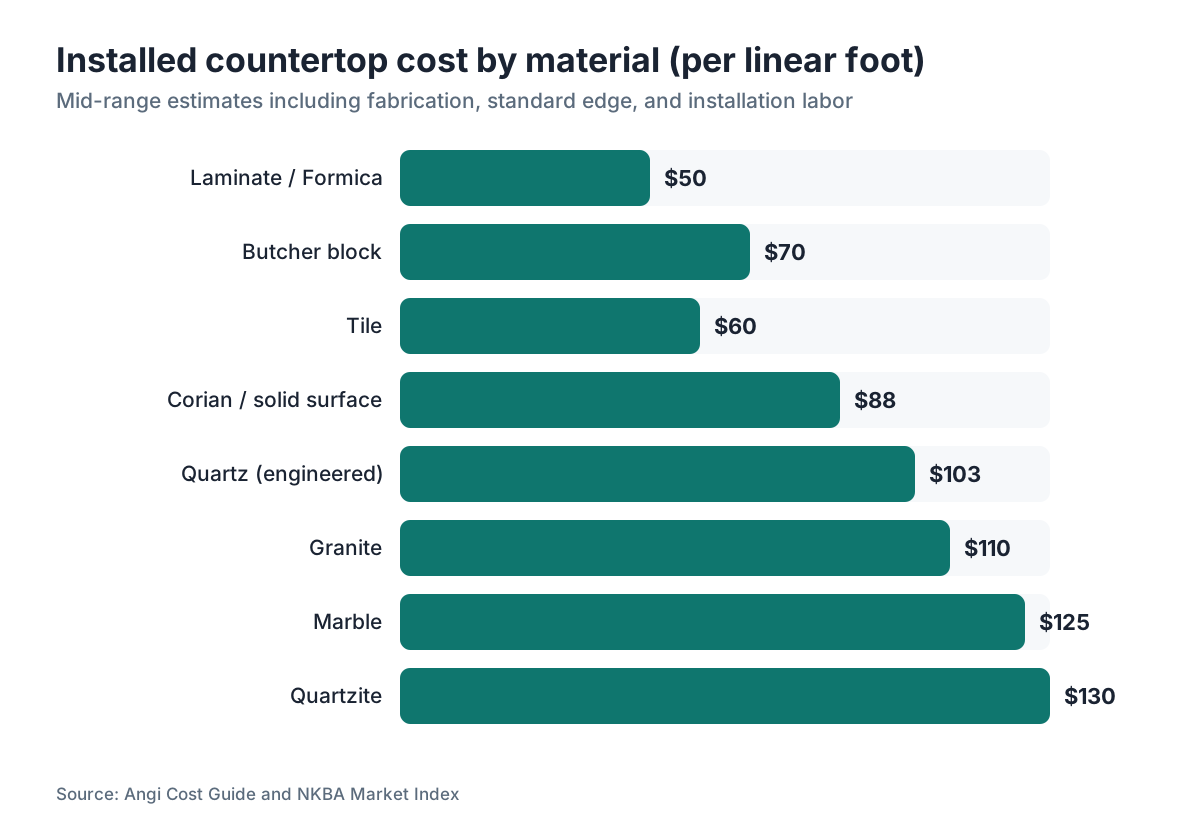
The table below shows approximate installed cost ranges for common materials in both units, based on national contractor pricing guides and fabricator market data [1][6].
| Material | Per Linear Foot (installed) | Per Square Foot (installed) |
|---|---|---|
| Laminate / Formica | $40, $60 | $19, $29 |
| Butcher block | $55, $85 | $26, $41 |
| Tile | $45, $75 | $22, $36 |
| Corian / solid surface | $65, $110 | $31, $53 |
| Quartz (engineered) | $75, $130 | $36, $63 |
| Granite (natural) | $80, $140 | $38, $67 |
| Marble (natural) | $90, $160 | $43, $77 |
| Quartzite | $95, $165 | $46, $79 |
These are installed totals, not material-only figures. Material alone runs lower by roughly 30 to 50%, depending on how much fabrication the job needs.
What drives the price difference between materials?
Material cost is the biggest lever. It isn't the only one. Three things move the final per-linear-foot number: the raw slab or sheet price, fabrication difficulty, and the edge profile you pick.
Laminate and Formica countertops are cheap because they arrive pre-finished in long strips, need almost no shop work, and take simple cuts. Butcher block countertops land mid-range because the wood is heavy and wants careful sealing, though the cutting is easy. Granite countertops and marble countertops cost more because each slab is unique and heavy, and it needs a bridge saw or CNC plus hand-polishing at every joint and edge.
Corian countertops (solid surface) sit in the middle, with one useful trick: seams can be made nearly invisible through adhesive and sanding. Engineered quartz like Cambria countertops is consistent in thickness and pattern, which speeds up fabrication, but the material price itself is steep.
Fabrication labor varies hard by region. A job that runs $90/lf installed in suburban Atlanta might run $130/lf in the San Francisco Bay Area or New York City. Shop overhead, wage rates, and delivery logistics drive that gap, not any difference in the stone itself [4].
How much do edge profiles add to the cost per linear foot?
Edge profiles are where a lot of homeowners get surprised. A basic eased edge (a slightly rounded top) is usually baked into the base price. Every step up from there costs more, and it stacks fast across 20 or more linear feet.
Edge pricing tracks two things: how hard the material is and how complex the profile is. Marble and quartzite are harder to profile cleanly than softer stones, so the same ogee costs more on those than on a softer granite. Engineered quartz machines cleanly, but some manufacturers require certified fabricators for warranty coverage, which thins out competition and holds prices up.
Approximate edge profile add-on costs per linear foot, above a basic eased or straight edge:
| Edge Profile | Typical Add-On Cost / LF |
|---|---|
| Eased / straight (usually included) | $0 |
| Beveled | $5, $12 |
| Bullnose | $8, $15 |
| Half bullnose | $8, $14 |
| Ogee | $20, $45 |
| Dupont (stepped) | $20, $40 |
| Waterfall (full slab drop) | $50, $120+ |
| Mitered (thick-look) | $30, $80 |
Marble is the classic budget shock here. A classic ogee on marble can run $35, $60 per linear foot on top of base fabrication, because marble chips easily during profiling and needs extra hand-work to hit a true high polish [3]. On a 25-linear-foot kitchen, that one ogee choice adds $875 to $1,500 to the bill.
Want a premium look on a tight budget? A mitered build-up on quartz gives you the appearance of a 3-inch slab for far less than a true waterfall drop. The fabricator stacks two pieces instead of cutting from a double-thick slab.
What does countertop installation labor cost separately?
If you supply your own slab (buying direct from an importer, say) and just hire a crew to template, cut, and set it, expect $25, $60 per linear foot for labor-only installation in most U.S. markets [10]. That covers templating, transport to the shop, fabrication cuts, delivery to your home, and setting the stone in silicone.
Some shops won't split material and labor. They buy the slab wholesale, mark it up, and quote the whole thing as one number. That's where their margin lives. For most homeowners it's a fine deal, because a full-service fabricator owns the entire job and every mistake in it.
Cutouts get billed separately no matter how the shop quotes. A sink cutout runs $100, $250 depending on sink type (undermount takes more precision than drop-in). A cooktop cutout is similar. Faucet holes usually run $25, $50 each. These are flat fees, not per-linear-foot charges, so they hurt less on a big kitchen and more on a tiny galley.
Demolition and disposal of the old counters adds $50, $150 flat in most markets. Old tile counters set in mortar can cost more to rip out.
For a walkthrough of what installation day actually looks like, see our countertop installation guide.
How much does it cost to install kitchen countertops specifically?
The kitchen eats most of the budget. A typical American kitchen has 25 to 30 linear feet of counter, counting the perimeter runs and an island if there is one [2]. Run mid-range materials against that footprint:
- Laminate kitchen countertops (25 lf): $1,000, $1,500 installed
- Quartz kitchen countertops (25 lf): $1,875, $3,250 installed
- Granite kitchen countertops (25 lf): $2,000, $3,500 installed
- Marble kitchen countertops (25 lf): $2,250, $4,000+ installed
Islands drive cost. They're often double-sided (two edge profiles), sometimes carry a waterfall end, and they need precise template work to sit square in a room that may not be plumb. A 4x8 foot island in quartz with an ogee edge on all four sides can hit $2,500, $4,500 by itself.
Our kitchen countertops guide covers durability tradeoffs by material and cooking style if you're still choosing.
What are the costs to install bathroom countertops per linear foot?
Bathrooms cost less in total but not always less per linear foot. A typical vanity top is 4 to 8 linear feet. The base fabrication rate per linear foot matches the kitchen, but the job is small, usually with one or two sink cutouts. Most fabricators charge a minimum job fee, often $300, $600, so a tiny powder room vanity can cost more per linear foot than a whole kitchen, purely because of that minimum.
Prefab vanity tops in cultured marble or quartz work for simple layouts. They run $150, $450 for a standard 49-inch or 61-inch top at home improvement stores, which beats custom stone when your dimensions line up with a stock size. Custom stone still wins for non-standard sizes, vessel sinks, or matching a slab to your kitchen.
Edge profile costs per linear foot for a vanity match kitchen pricing. The stone doesn't know which room it's headed to.
Does the region you live in change the cost per linear foot significantly?
Yes. Installation wages, slab import costs, and shop overhead vary enough that the same job runs 30 to 50% more in a high cost-of-living metro than in a rural or mid-size market.
The Bureau of Labor Statistics tracks wages for tile and stone setters (SOC 47-2044) by state and metro area. Its Occupational Employment and Wage Statistics program reports mean annual wages for this occupation from roughly $37,000 in lower-wage states to over $70,000 in states like Hawaii, Massachusetts, and California [4]. That wage spread flows straight into your installed cost per linear foot.
Slab shipping matters too. Fabricators near major import hubs (cities with big seaports or stone distribution centers, like Atlanta, Dallas, Los Angeles, and New York) often pay less for material and pass part of it on.
Want accurate local numbers? Get three quotes. That's the real answer. Online calculators give you a ballpark; your local market is the only source of truth.
What hidden costs should homeowners budget for beyond the per-linear-foot price?
The per-linear-foot quote is a starting line, not a finish line. Here are the line items that show up on final invoices and catch people off guard.
Seam count matters once your run passes about 10 feet (most slabs top out at 10 to 12 feet long). Each seam costs $100, $300 to cut, polish, and epoxy. On stone, a well-placed seam disappears and a badly placed one glares at you every morning. Ask where the seams will fall before you sign.
Sink style matters more than people expect. A farmhouse apron sink needs a cabinet modification on top of the countertop cutout, and plenty of fabricators won't touch cabinet work. That's a separate contractor call.
Plumbing reconnection after a countertop swap usually runs $150, $400 for a plumber to disconnect, cap, and reconnect. A lot of homeowners forget it entirely.
Permits are rarely required for countertop replacement alone. If you're doing a full kitchen remodel, the counter falls under that project's permitted scope. Check with your local building department. The International Residential Code does not specifically require a permit for countertop-only replacement, but local amendments vary [5].
Backsplash work often becomes necessary after a swap, because the old tile height was matched to the old counter thickness. Budget $15, $50 per linear foot for a basic tile backsplash if you need one.
Natural stone needs sealing. That adds $1, $3 per square foot, repeated every 1 to 5 years depending on the stone and the sealer [3].
How do fabricators actually calculate the price they quote you?
This is the part most homeowners never see. A quote starts with the slab purchase price (what the shop paid per square foot), adds a markup (typically 100 to 200% on material for a full-service shop), then layers in fabrication labor, edge machining, cutout fees, delivery, and installation labor.
Shops that run CNC bridge saws use software to nest the pieces, planning how many usable cuts come out of each slab and cutting waste. That nesting efficiency sets what they actually paid per usable square foot. A badly nested job wastes slab, and that waste either eats the shop's margin or lands on your invoice. Software like SlabWise runs the nesting math automatically, which is one reason digitized shops often quote faster and tighter than shops still working on paper.
Here's why this matters to you as a homeowner: it explains why quotes for the same stone swing 20 to 30% between shops. Slab cost, nesting efficiency, and overhead move the number more than the hourly labor rate does.
Fabricators tightening their quoting process should see the quoting workflow demo before the next busy season.
From the homeowner side, do two things. Bring the fabricator exact measurements (or hire them to template, which is the professional call), and ask for an itemized quote. A good shop lists slab cost, fabrication, edges, cutouts, and installation as separate lines.
How do you get an accurate quote for your countertop project?
Start by measuring your counter runs in linear feet. Go corner to corner along the wall for each run, and include the island. Add them up. That total is the basis for every bid you compare.
Decide on material and edge profile before you call anyone. Vague questions get vague answers. Say "I want quartz with a simple eased edge" and you get a real number. Say "maybe quartz, maybe marble, not sure" and you get a range too wide to use.
Get three bids from local fabricators. Not one from a big-box store and two from fabricators. Big-box contractor programs are convenient, but they lean on subcontractors and rarely match the material quality or service of a direct fabricator relationship.
For a rough estimate before you dial anyone, the SlabWise quote tool on slabwise.com takes your square footage, material, and edge profile and returns a regional ballpark. Good for sanity-checking the bids you get back.
When you compare, force every quote onto the same scope: same material grade, same edge profile, same cutout count, and the same answer on whether demo and disposal of the old counters is included.
Frequently asked questions
How much does it cost to install countertops per linear foot on average?
The national average installed cost runs $40 to $120 per linear foot for most materials, with laminate at the low end and natural stone like marble or quartzite at the high end. Material grade, edge profile complexity, cutout count, and your region all move the final number. Get itemized quotes from at least three local fabricators to find your real market rate.
Is per linear foot or per square foot a better way to compare countertop quotes?
Both work, as long as you use the same unit across every bid. Per linear foot captures edge-profile cost and perimeter labor naturally, which is why most installers use it. Per square foot is more precise for material cost. One linear foot of standard 25-inch-deep counter equals roughly 2.08 square feet, so divide per-linear-foot prices by 2.08 to compare against square-foot quotes.
What is the cost of edge profiles for marble countertops per linear foot?
Marble edge profiles add $15 to $60 per linear foot above base fabrication, depending on complexity. A simple beveled or bullnose edge runs $10, $20/lf extra. An ogee on marble costs $35, $60/lf extra because marble chips during profiling and needs hand-polishing. On a 25-linear-foot kitchen, choosing an ogee over a standard eased edge adds $875 to $1,500 to the total.
How much extra do edge profiles cost per linear foot on quartz or granite?
On quartz and granite, a basic eased edge is usually included in the base price. A bullnose adds $8, $15/lf, an ogee adds $20, $40/lf, and a waterfall or full-slab drop can add $50, $120/lf or more. Quartz machines cleanly, so profiles often cost slightly less on quartz than on harder natural stones like quartzite.
What is the average cost to install kitchen countertops in total?
A typical kitchen with 25 linear feet of counter costs $1,000 to $1,500 installed for laminate, $1,875 to $3,250 for quartz, and $2,000 to $4,000 for granite or marble at mid-range grades. Islands push costs higher because they often carry edges on all four sides and sometimes a waterfall end, which adds real fabrication time.
Do bathroom countertop installation costs differ from kitchen costs per linear foot?
The per-linear-foot rate is about the same, but bathroom jobs are small, and most fabricators charge a minimum job fee of $300 to $600. That minimum makes little powder room vanities expensive per linear foot. For standard vanity sizes, prefab cultured marble or quartz tops from a home improvement store ($150, $450) can beat custom stone on price.
What does a sink cutout add to the countertop installation cost?
Sink cutouts are billed flat, not per linear foot. An undermount cutout costs $100, $250 depending on material hardness and sink shape. Drop-in cutouts are cheaper, around $75, $150, because the rim covers the cut edge and less precision is needed. Faucet holes usually run $25, $50 each. These fees land on top of the per-linear-foot base price.
How does material hardness affect edge profile cost per linear foot?
Harder stones wear down diamond tooling faster and take longer to profile and polish. Quartzite and some granites are harder than marble on the Mohs scale, which means more tool passes and more hand-finishing. So edge profile costs per linear foot on quartzite can run 10 to 25% higher than on softer stones like marble or limestone, depending on the profile.
Can I save money by buying the slab myself and hiring separate installation?
Sometimes, with real risk. Buying your own slab can cut material cost 20 to 40% because you skip the fabricator's markup. The catch is that many fabricators won't warranty work on customer-supplied stone, and if the slab shows hidden voids or off color, the risk is yours. It works best when you buy from a reputable importer and use a fabricator you already trust.
How many linear feet of countertop does a typical kitchen have?
A typical U.S. kitchen has 20 to 30 linear feet of counter along the perimeter, plus any island. A small galley might have 10 to 15 linear feet. A large open kitchen with a big island can pass 40 linear feet total. Measure each run along the wall and add them together to get your total before you request quotes.
Does countertop thickness change the cost per linear foot?
Yes. Standard quartz and granite slabs are 3 centimeters (about 1.25 inches) thick. Thinner 2 cm slabs cost slightly less but need plywood underlayment for support, which offsets part of the savings. A mitered or laminated thick-edge build-up that mimics a 3-inch slab adds $30, $80/lf because it takes extra material and precise fabrication.
Is a waterfall edge worth the extra cost per linear foot?
Waterfall edges (the slab runs vertically down the cabinet side) are a big design statement and add real cost: $50 to $120 per linear foot of drop, plus material for the vertical piece. On a veined stone like marble, matching grain at the miter takes skilled book-matching and heavy labor. For most budgets, a standard edge with a clean apron front costs far less and still looks sharp.
Do I need a permit to replace kitchen countertops?
In most U.S. jurisdictions, no permit is required for countertop replacement alone, since it doesn't touch structure, electrical, or plumbing runs. If the counter is part of a larger permitted remodel, it falls under that permit's scope. Always check with your local building department. Requirements vary by municipality, and some cities have specific rules about kitchen work.
How long does countertop installation take from template to install?
From the templating appointment to finished installation, most jobs take 5 to 10 business days at a typical shop. Templating takes a couple of hours. Fabrication (cutting, profiling, polishing) takes 2 to 5 days depending on shop volume and complexity. Delivery and installation runs half a day to a full day. Rush service exists at some shops, usually for a premium.
Sources
- HomeAdvisor (Angi), Countertop Installation Cost Guide: National installed cost ranges by material type and typical kitchen square footage estimates
- U.S. Census Bureau, American Housing Survey: Kitchen remodel scope and average countertop linear footage data from housing surveys
- Natural Stone Institute, Natural Stone Care and Maintenance: Marble fabrication difficulty, polishing requirements for edge profiles, and recommended sealing frequency of 1-5 years
- U.S. Bureau of Labor Statistics, Occupational Employment and Wage Statistics, SOC 47-2044 Tile and Stone Setters: Mean annual wages for tile and stone setters by state and metropolitan area, ranging from approximately $37,000 to over $70,000
- International Code Council, International Residential Code (IRC): Permit requirements under the IRC do not specifically mandate permits for countertop-only replacement; local amendments vary
- National Kitchen and Bath Association (NKBA): Industry data on countertop material popularity, installed cost benchmarks, and kitchen project scopes
- Remodeling Magazine, Cost vs. Value Report: Regional cost benchmarks for kitchen remodels including countertop installation labor rates across U.S. metro areas
- Natural Stone Institute, Fabrication Standards and Best Practices: Edge profile complexity levels and fabrication time requirements for marble versus granite versus quartzite
- U.S. Bureau of Labor Statistics, Producer Price Index: Wholesale stone slab price trends affecting fabricator material costs
- U.S. Bureau of Labor Statistics, Occupational Employment and Wage Statistics: Labor rate benchmarks for stone installation tasks including template, cut, polish, and set
Last updated 2026-07-09