TL;DR
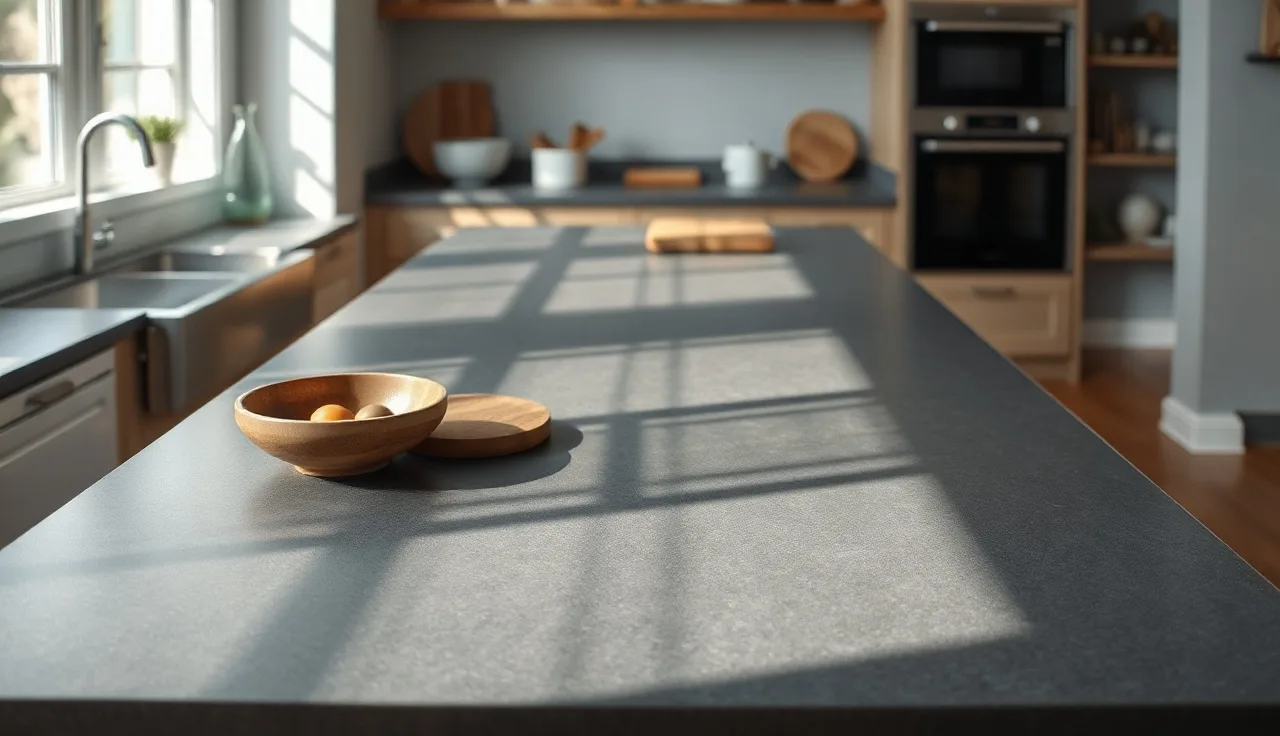
- Honed granite has a flat, matte finish instead of a polished shine.
- It costs about the same as polished granite ($40 to $100 per square foot installed), hides fingerprints and water spots better on light colors, but absorbs stains faster and needs sealing every 1 to 2 years.
- It reads softer and more handmade than polished stone, and it works beautifully in rustic, transitional, or modern-minimal kitchens.
What exactly is a honed granite finish?
Honing is a grinding process, not a coating. Fabricators run the slab through a series of abrasive belts or discs and stop before the final polishing stage, leaving the surface flat and smooth but without the reflective, glassy layer that polishing creates. The result is a consistent matte or satin sheen, sometimes described as "suede-like" depending on the grit at which the fabricator stops.
Polishing takes granite to 1,500 or even 3,000 grit, which closes and compresses the mineral surface and gives it that mirror gloss. Honing typically stops somewhere between 400 and 800 grit [1]. The stone itself is the same. Only the surface texture differs. That texture difference has real consequences for sealing, cleaning, and how the stone reads in a room.
You can hone almost any granite. Light grays, creamy whites, and veined blues all behave a little differently honed versus polished. Dark granites like Absolute Black or honed black granite countertops tend to look gunmetal or charcoal rather than jet black when matte, which many designers actually prefer because the color reads rich and deep without being flashy. Honed granite countertops are a specific choice, not a cheaper fallback.
How does honed granite look different from polished in a real kitchen?
Polished granite bounces light back at you. Walk past a polished slab on a sunny afternoon and you see a reflection of the window, your outline, the overhead pendant. It can feel formal, high-gloss, almost jewelry-like. That look works in certain spaces, but it also tends to date quickly and can feel cold in a casual kitchen.
Honed granite absorbs light instead of throwing it back. Colors look slightly lighter or more muted than the same slab polished, because you lose the depth effect that comes from light penetrating the compacted surface layer. At the same time, the movement in the stone, the crystals, the pattern, they all read more clearly because you are not fighting glare. A lot of architects prefer honed stone for exactly that reason.
Fingerprints and water spots show up differently too. On polished dark granite, every smear from a wet hand is visible from across the room. On a honed dark finish, those marks still exist but they blend in because there is no reflective contrast to make them pop. Lighter honed granites can show oily marks more than their polished equivalents because the open surface soaks up the oil rather than sitting it on top. Neither finish is maintenance-free. They just fail in different ways.
If you are comparing honed granite to something like honed marble or quartzite, the visual is similar but the underlying stone density is different. Granite is harder and less porous than marble, which matters a lot for how it holds up under honed conditions. See the marble countertops guide for a direct comparison on that front.
What does honed granite cost compared to polished?
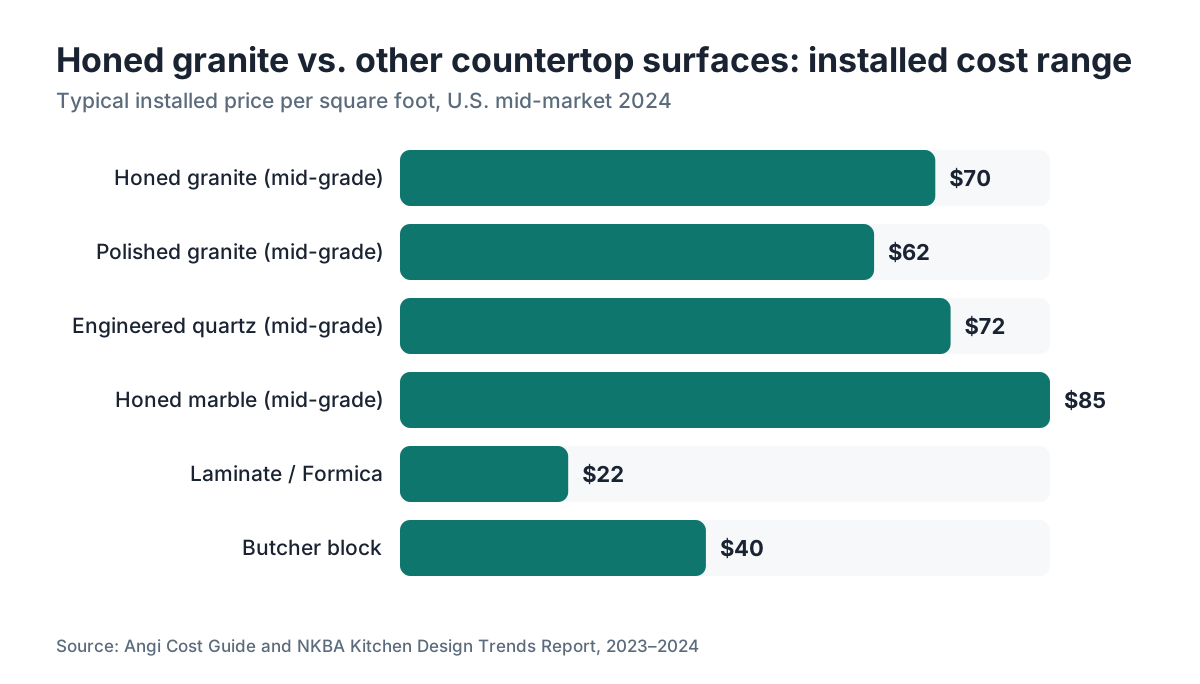
Honing adds a modest amount of shop time, roughly 15 to 30 minutes per slab depending on the fabricator's equipment and how they stage the job. In practice, most fabricators charge $5 to $15 per square foot more for a honed finish on top of their standard polished price [2]. Some shops roll the cost into their tier pricing and don't break it out separately.
Installed honed granite in a mid-range market typically runs $40 to $100 per square foot all-in, depending on stone grade, edge profile, and location. Higher-end exotic granites can push past $120 per square foot installed even before special finishes. The National Kitchen and Bath Association puts average countertop spend at roughly $3,000 to $5,000 for a standard kitchen, though that range has moved up with material and labor cost increases since 2021 [3].
Fabricators: if you quote honed jobs, the finish upcharge is easy to miss in a generic template. Tools like SlabWise let you build finish multipliers directly into the quote so the surcharge shows up automatically without a manual line-item adjustment every time.
The stone grade matters far more than the finish to your total cost. A Level 1 Absolute Black honed costs less than a Level 3 exotic honed. The finish is a small delta on top of whatever the material itself costs. Don't let the finish question distract you from the bigger cost drivers: slab thickness (2 cm vs. 3 cm), edge profiles (a laminated ogee costs more than a standard eased), cutouts for sinks and cooktops, and install complexity.
| Cost component | Typical range | Notes |
|---|---|---|
| Standard polished granite, installed | $40, $85/sq ft | Level 1 to 2 material |
| Honed finish upcharge | $5, $15/sq ft | Varies by shop |
| Exotic slab (polished or honed) | $80, $130+/sq ft | Level 3 to 4 material |
| Undermount sink cutout | $100, $250 each | Labor-intensive |
| Edge upgrade (ogee, waterfall) | $15, $40/linear ft | On top of base price |
Does honed granite stain more easily than polished?
Yes. This is the main practical tradeoff, and you should go in with eyes open.
Granite is a natural stone with microscopic pores. Polishing compresses and partially seals the surface layer, making it somewhat more resistant to liquid absorption. Honing leaves those pores more exposed. Oil, wine, and acidic liquids can penetrate a honed surface faster and deeper, which means staining is a real risk if you cook heavily or aren't diligent about wiping spills fast [4].
The good news is that sealing works. A quality penetrating sealer (sometimes called an impregnating sealer) soaks into those pores and repels liquids before they can stain. Polished granite typically needs sealing every 2 to 5 years depending on the stone's natural porosity. Honed granite generally needs it every 1 to 2 years because the open surface wears the sealer out faster [4]. Some dense granites like Absolute Black or Blue Pearl are so low-porosity that even honed they barely absorb water, but the safe default is to test and seal.
To test whether your honed granite needs sealing: put a few drops of water on the surface and wait 15 minutes. If the stone darkens where the water sits, it is absorbing liquid and needs sealer now. If the water beads, you are still protected. This is the same test that works for any natural stone, including quartzite countertops and soapstone.
For everyday cleaning, warm water and a few drops of dish soap are fine. Skip acidic cleaners (vinegar, lemon-based products) and abrasive scrubs. More detail on stone cleaning protocols is in the how to clean stone countertops guide.
What is black galaxy granite and does it work well honed?
Black Galaxy granite (sometimes called Star Galaxy) is a dark anorthosite mined mostly in the Ongole district of Andhra Pradesh, India [5]. It is one of the best-known granites in the world for one reason: a near-black base scattered with tiny gold and copper-colored specks that look like stars. Those gold specks are bronzite and chromite mineral inclusions, not metallic flakes, which is why they don't chip or flake under normal use.
Polished Black Galaxy slabs are stunning in a reflective, dramatic way. The gold specks catch light against the mirror-black background. Honed Black Galaxy slabs are a different animal entirely. The background reads as deep charcoal to dark gray rather than jet black, and the gold specks still show but with a softer, more embedded look. Some people strongly prefer honed Black Galaxy for exactly that reason: it feels warmer and less showy than the polished version while keeping the material's signature sparkle.
Black Galaxy is also one of the densest, least porous granites you can buy, which makes it genuinely well-suited to a honed finish from a maintenance standpoint [5]. It still benefits from sealing, but it is far less prone to staining than a more porous white or beige granite. If you want dramatic honed black granite countertops without a lot of sealing anxiety, Black Galaxy is a reasonable choice.
Price-wise, Black Galaxy is a mid-range granite, typically $50 to $80 per square foot installed for standard slabs, a bit more for premium material or complex layouts. The honed upcharge applies here just like anywhere else.
How do you seal and maintain honed granite?
Sealing honed granite is not complicated, but it takes consistency. The basic process: clean the surface thoroughly, let it dry completely (at least 24 hours after any wet cleaning), apply a penetrating stone sealer per the manufacturer's directions, let it absorb, wipe off any excess, and let it cure [6].
Product choice matters more than brand loyalty. Look for a penetrating impregnating sealer specifically rated for natural stone. Topical sealers (the kind that sit on the surface) can work on polished stone but are a poor choice for honed surfaces because they build up, get scratched, and peel. Penetrating sealers soak in and don't change the look or feel of the finish.
For ongoing daily maintenance, the rules are short:
- Wipe spills right away. Cooking oil and red wine are the biggest culprits for staining honed surfaces.
- Use a pH-neutral cleaner or plain dish soap. Vinegar, bleach, and citrus cleaners etch and degrade sealers.
- Use cutting boards. Honed granite doesn't scratch easily, but knife marks can create micro-grooves that compromise the finish over time.
- Retest and reseal every 12 to 18 months, or whenever the water bead test fails.
If a stain does get in, a paste poultice made from baking soda and water (for oil stains) or hydrogen peroxide and water (for organic stains) pulled over the spot overnight can draw the stain out. This works for honed granite the same way it works for honed marble or limestone. More detail is in the how to clean stone countertops guide.
Where does honed granite work best in a home?
Honed granite is a practical choice for kitchens that see hard daily use, specifically because you don't have to worry about visible scratches dulling a polished surface. Honing is already matte, so small scratches and scuffs don't change the look the way they would on polished stone. That makes it popular in farmhouse kitchens, busy family kitchens, and commercial-adjacent spaces.
Bathroom vanities are another strong use case. Water spots are less visible on honed stone than on polished, which is a real quality-of-life win for a surface you stare at every morning. The sealing requirement is no harder in a bathroom than in a kitchen, and bathrooms see far fewer oil stains.
Outdoor kitchens are trickier. Granite is one of the more weather-resistant natural stones, but honed outdoor surfaces are more open to staining from leaves, pollen, and environmental oils. For an outdoor kitchen, polished granite or a true quartzite is often the better call.
Honed granite is a poor fit if you have young kids who are hard on surfaces and you're not prepared to reseal annually. In that case, an engineered quartz surface is more practical even if it lacks the character of natural stone. Quartz options like Cambria countertops come in matte finishes that approximate the look without the sealing chore.
For kitchens with the right aesthetic, honed granite competes directly with other matte naturals like soapstone. The how to clean soapstone countertops guide lays out how that material's maintenance differs.
Can you hone granite that is already polished?
Yes, fabricators can hone an existing polished granite countertop in place, but it is a specialized job and not every shop offers it. The process involves wet-grinding the surface in stages with progressively finer diamond pads, stopping at the right grit for the finish you want. Done properly, the result is indistinguishable from a slab honed from the start [7].
The practical challenges: the job is messy and generates granite slurry that has to be contained. Edges are hard to refinish in place, especially on complex profiles. If the existing polished surface has deep chips or cracks, those won't disappear with honing and may become more visible. Installed seams can look slightly different after refinishing if the tech isn't careful to blend them.
Expect to pay $5 to $15 per square foot for in-place refinishing from a stone restoration specialist, not a general fabricator. Some restoration companies do this routinely. Search for CSRT (Certified Stone and Tile Restoration Technician) certified contractors in your area for quality assurance [7].
If you are midway through a remodel and already have polished granite on the walls (a backsplash tile) or adjacent polished surfaces, decide now whether you want them to match your new honed countertop. A slightly different finish level between a polished backsplash and a honed counter can look intentional and sophisticated. It can also look like a mistake. Look at real kitchen photos before you commit.
How does honed granite compare to other matte countertop surfaces?
Honed granite is not the only way to get a matte countertop, and it helps to know how it stacks up against the main alternatives.
Honed marble has a similar look but is softer (roughly 3 to 4 on the Mohs scale versus granite's 6 to 7) [8] and etches when acidic liquids hit it. Granite does not etch. If you cook with lemons or tomatoes or wine regularly, that difference matters enormously. Marble is more forgiving aesthetically because etching creates a worn, patinated look that some people love. Granite stays consistent.
Soapstone is naturally matte and needs no honing. It is softer than granite and develops a patina over time. Many people oil it with mineral oil to even out the color. That's a different maintenance philosophy than sealing granite, and for the right person, it is actually simpler. The how to clean soapstone countertops article covers it.
Engineered quartz in a matte finish is the lowest-maintenance option. It doesn't need sealing and resists most stains. The tradeoff is that it looks more uniform, which some people love and others find boring. It also isn't safe for very high heat without a trivet, and the surface can't be refinished if it's damaged.
Honed quartzite falls between honed granite and honed marble: usually very hard (often harder than granite), but porosity varies wildly by quartzite type. Confirm actual porosity before committing to honed quartzite for a kitchen.
For fabricators quoting mixed-finish jobs, combining polished and honed surfaces in one estimate gets complicated fast. SlabWise handles finish-level line items so you can price polished, honed, and leathered surfaces in the same job without a custom workaround.
What questions should you ask your fabricator before ordering honed granite?
A few questions save a lot of regret.
First, ask to see samples in the actual finish. A polished sample tells you nothing about what honed will look like. The color shifts. The movement shifts. Some granites look better honed. Some look muddy or flat. You need the real thing, ideally in natural light.
Ask what grit the fabricator hones to. Stopping at 400 grit gives a more matte, almost velvety result. Stopping at 800 grit gives a low-sheen satin. Both are called "honed" but they look and feel meaningfully different. Know which you are getting.
Ask about the sealing process and what product they use. Some fabricators seal in the shop before delivery. Others expect you to seal after installation. Know who is responsible and what sealer goes on so you can buy the same product for future maintenance.
Ask about lead time. Honing takes extra shop time. In a busy season, a standard polished job might turn around in 7 to 10 days while a honed job takes 12 to 15. If your timeline is tight, confirm before you order.
Finally, ask about edge options. Some edge profiles, particularly very ornate ones, are harder to hone consistently where a belt sander can't reach. A shop may upcharge or limit edge choices on honed jobs. A simple eased, bevel, or pencil edge is always straightforward. An ogee or triple waterfall on a honed countertop may need hand work and cost more.
For a full look at the installation process, the countertop installation guide walks through what to expect from template to final placement.
Is honed granite a good long-term investment?
Real estate return data for specific countertop finishes basically doesn't exist. Nobody has broken out polished versus honed in resale studies. What you get instead are general countertop upgrade return figures: the National Association of Realtors estimates that a kitchen countertop upgrade recovers roughly 80 percent of its cost at resale [9], but that figure covers all countertop types and markets and should be treated as directional, not precise.
What the data can't tell you is whether a honed finish specifically helps or hurts resale. The honest answer: it depends on the buyer pool. In a market that skews contemporary or transitional, a well-executed honed granite kitchen reads as thoughtful and on-trend. In a market that still associates granite countertops with their polished, high-gloss look, a honed finish might be unfamiliar enough to slow a sale slightly.
For your own long-term use, honed granite holds up well if you maintain it. Granite is one of the hardest natural stones commonly used for countertops [8], and the honed finish doesn't compromise that hardness. A properly sealed honed granite counter can last the life of the house without looking worn, as long as you reseal on schedule and treat it right.
The comparison to alternatives like laminate countertops or Formica countertops is straightforward: those surfaces cost less upfront and need less maintenance, but they don't refinish, they show wear at edges and seams, and they don't carry the same material character. Honed granite is a longer commitment with a higher floor.
For homeowners building a realistic budget for kitchen countertops, the honed finish is a detail-level decision inside a bigger material and layout decision. Get the material and layout right first.
Frequently asked questions
Does honed granite scratch more easily than polished?
No. The hardness of the stone itself doesn't change based on finish. Granite typically measures 6 to 7 on the Mohs hardness scale whether it is polished or honed. Scratches are less visually obvious on honed surfaces because there is no reflective gloss to create contrast around a mark. In practice, honed granite is at least as scratch-resistant as polished in daily kitchen use.
How often do you need to seal honed granite?
Test your honed granite every 12 months with the water bead test: drop a tablespoon of water on the surface and watch it. If it beads up, you still have sealer. If the stone darkens within 15 minutes, reseal immediately. Most honed granite needs sealing every 1 to 2 years, versus every 2 to 5 years for polished granite, because the open matte surface wears sealer away faster.
What is the difference between honed and leathered granite?
Honed granite is flat, smooth, and matte, made by stopping the grinding process before final polishing. Leathered granite has a textured surface created by running diamond-tipped brushes across the stone, leaving a slightly rough, pitted texture that mimics worn leather. Both are matte, but leathered is distinctly tactile while honed feels smooth to the touch. Leathering often amplifies a stone's natural color more than honing does.
Can you use honed granite in an outdoor kitchen?
You can, but it is not the best choice for most outdoor situations. The open surface of honed granite is more open to staining from environmental debris, pollen, and moisture than polished granite. Outdoor surfaces also see UV exposure and temperature swings that speed up sealer breakdown. If you want a matte stone outdoors, look at natural quartzite or a dense granite like Absolute Black with very low porosity even when honed. Seal at least twice a year outside.
Is honed black granite harder to keep clean than other colors?
It depends on what you mean by clean. Honed black granite shows light-colored debris (flour, crumbs, powders) more obviously than lighter stones. Oil and water marks are less visible on matte black than on polished black, which is a genuine daily-life advantage. Total cleaning effort is similar across colors. Use a damp microfiber cloth for daily wipe-downs and a pH-neutral stone cleaner for deeper cleaning regardless of color.
What is Black Galaxy granite and where does it come from?
Black Galaxy granite (also called Star Galaxy) is an anorthosite quarried mostly in Andhra Pradesh, India. Its defining feature is a nearly black base scattered with small gold and copper mineral specks made of bronzite and chromite. It is one of the densest, least porous granites available, which makes it a good candidate for a honed finish since the tight crystal structure limits stain absorption even without a polished surface layer.
Will honed granite look dated in 10 years?
Matte stone finishes have been used in architecture for centuries and tend to age more gracefully than high-gloss finishes, which track trends more sharply. The risk of dating is lower with natural stone in any finish than with engineered surfaces or hardware choices. Polished granite peaked in the late 1990s and early 2000s; matte and honed finishes have gained ground since around 2015 and look like a stable preference rather than a passing trend.
Can honed granite be polished later if you change your mind?
Yes. A stone restoration specialist can re-polish honed granite in place using diamond abrasive pads in progressively finer grits until the surface reaches full polish. It is the same process in reverse. Expect to pay $8 to $20 per square foot for professional stone refinishing, plus the cost to reseal after. The result is a fully polished surface. Edge profiles are harder to refinish in place on complex shapes.
Does honed granite work with farmhouse-style kitchens?
It is one of the best fits for that style. Farmhouse and transitional kitchens lean toward materials that feel substantial and natural rather than reflective and sleek. Honed granite, especially in gray, white, or warm beige tones, pairs well with wood cabinetry, shaker doors, apron-front sinks, and unlacquered brass hardware. It reads as honest material rather than a showpiece. Darker honed granites work well in more modern farmhouse interpretations.
How do you remove oil stains from honed granite?
Make a poultice by mixing baking soda with just enough dish soap and water to form a thick paste. Spread it generously over the stain, cover it with plastic wrap, tape the edges down, and leave it 24 to 48 hours. The paste draws the oil out of the stone as it dries. Remove, rinse with warm water, and dry completely. Repeat if the stain remains. For very deep stains, a commercial stone poultice with a degreasing agent works faster.
Is honed granite good for bathroom vanities?
Yes, and it is arguably a better choice there than in the kitchen for many households. Bathrooms produce fewer oil and food stains, which are the main risk factors for honed stone. Water spots, the main daily annoyance with polished vanity tops, are far less visible on a matte surface. The sealing requirement is the same as in the kitchen, roughly every 1 to 2 years. Honed granite in a bathroom feels quiet and spa-like in a way polished stone rarely does.
What edge profiles work best with honed granite?
Simple profiles look best and cost less on honed jobs. An eased edge (slightly rounded), a beveled edge, or a pencil edge all complement the understated character of a matte finish without competing with it. A waterfall edge on an island can be striking with honed stone. Very ornate profiles like ogee or dupont can look off with a matte surface and are harder for fabricators to finish consistently by machine on a honed slab, which may add cost or limit availability.
How thick should honed granite countertops be?
The same thickness rules that apply to polished granite apply to honed. For kitchens, 3 cm (roughly 1.25 inches) is the standard and preferred thickness because it doesn't require full perimeter support and looks substantial at the edge. 2 cm (about 0.75 inches) is thinner, lighter, and cheaper, but usually needs a plywood sublayer and a built-up edge to look right. The honed finish adds no structural consideration; thickness is about support and looks.
Does honed granite cost more than quartz countertops?
They overlap a lot in price. Mid-grade engineered quartz runs $50 to $90 per square foot installed. Mid-grade honed granite runs $45 to $100 per square foot installed including the honing upcharge. Premium quartz (Cambria, Silestone high-end lines) often costs more than most honed granite. Budget quartz can undercut granite at the low end. Finish type is not the deciding cost driver; stone grade, thickness, edge choice, and your local market are what move the number.
Sources
- Natural Stone Institute, Technical Bulletins: Honing typically stops between 400 and 800 grit, leaving a flat matte or satin surface without the compacted gloss layer achieved at 1,500 to 3,000 grit polishing.
- HomeAdvisor / Angi, Granite Countertops Cost Guide: Honing a granite slab typically adds $5 to $15 per square foot to the fabrication cost over standard polished pricing.
- National Kitchen and Bath Association (NKBA), Kitchen Design Trends Report: Average countertop spend for a standard kitchen remodel ranges from approximately $3,000 to $5,000, varying by material, region, and project scope.
- Marble Institute of America (now Natural Stone Institute), Care and Maintenance of Natural Stone Surfaces: Honed stone surfaces are more porous than polished equivalents and generally require resealing every 1 to 2 years compared to every 2 to 5 years for polished surfaces.
- Geological Survey of India, Dimension Stone Resources: Black Galaxy (Star Galaxy) granite is an anorthosite quarried in the Ongole district of Andhra Pradesh, India, and is characterized by bronzite and chromite mineral inclusions against a dark base.
- Natural Stone Institute, Sealers and Protective Treatments for Natural Stone: Penetrating impregnating sealers are recommended for honed natural stone; surfaces must be clean and fully dry before application and excess sealer wiped away after absorption.
- Natural Stone Institute, Stone Restoration and Certification (CSRT): In-place stone refinishing uses progressively finer diamond pads; the Certified Stone and Tile Restoration Technician (CSRT) credential identifies qualified restoration contractors.
- U.S. Geological Survey (USGS), Mineral Resources Program: Granite: Granite typically measures 6 to 7 on the Mohs hardness scale; marble measures approximately 3 to 4, making granite significantly harder and more scratch-resistant.
- National Association of Realtors, Remodeling Impact Report: Kitchen countertop upgrades recover approximately 80 percent of their cost at resale, based on NAR survey data from real estate professionals.
- Tile Council of North America (TCNA), Handbook for Ceramic, Glass, and Stone Tile Installation: Standard granite slab thickness for countertop applications is 3 cm (approximately 1.25 inches); 2 cm slabs require substrate support and built-up edges in residential kitchen applications.
- U.S. Environmental Protection Agency (EPA), Indoor Air Quality and Stone Surfaces: Natural granite countertop surfaces, including honed finishes, do not emit VOCs and pose no documented indoor air quality concerns under normal use conditions.
Last updated 2026-07-09