TL;DR
- Hardwood Reflections is Home Depot's house brand for butcher block, sold in maple, oak, walnut, and acacia.
- Panels run roughly $5, $15 per square foot uninstalled.
- They're edge-grain or face-grain, not end-grain, and they need sealing before use.
- Great for islands and budget kitchens.
- Near a busy sink, the trade-offs get real fast.
What is Hardwood Reflections, and who makes these countertops?
Hardwood Reflections is a private-label brand sold only through The Home Depot. The panels are solid wood strips glued into slabs, most often edge-grain, then sanded and boxed for retail. Home Depot does not name its manufacturing partners for this line, so there's no separate company website and no manufacturer warranty desk to call.
The brand covers a range of panel sizes, typically from 25 inches wide by 74 inches long up to 38 by 98 inches, with 1.5 inches the most common thickness. Some slabs run 1.75 inches, which gives you a little more material to sand out future damage.
Because this is big-box stock, consistency varies batch to batch. The wood is kiln-dried, but moisture content at purchase depends on how long the panel sat in a warehouse or on a store floor. That matters more than most buyers realize, and I'll get into why below.
What wood species and sizes does Hardwood Reflections offer?
The current lineup covers four species: hard maple, red oak, walnut, and acacia. Maple is the workhorse, the cheapest, and the most widely stocked. Walnut costs more and has a darker color that hides stains better early on, though it scratches about like maple over time. Acacia is an imported hardwood with dramatic grain and enough natural oil to shrug off moisture a bit better than domestic species, but it still needs sealing. Red oak shows up occasionally and I'd skip it for counters. Its open grain drinks liquids [1].
Sizes are fixed panels, not cut-to-order slabs. You buy a standard rectangle and cut it down yourself or pay someone. Common widths are 25 inches (built to overhang a 24-inch base cabinet by an inch) and 38 inches (for islands). Lengths run 74, 96, and 98 inches. If your kitchen is L-shaped or has an odd run, you'll seam two panels, and a butcher block seam only looks right with accurate joinery. Otherwise the gap shows and traps water.
For how butcher block fits the wider countertop market, see our guide to butcher block countertops.
How much do Hardwood Reflections countertops cost?
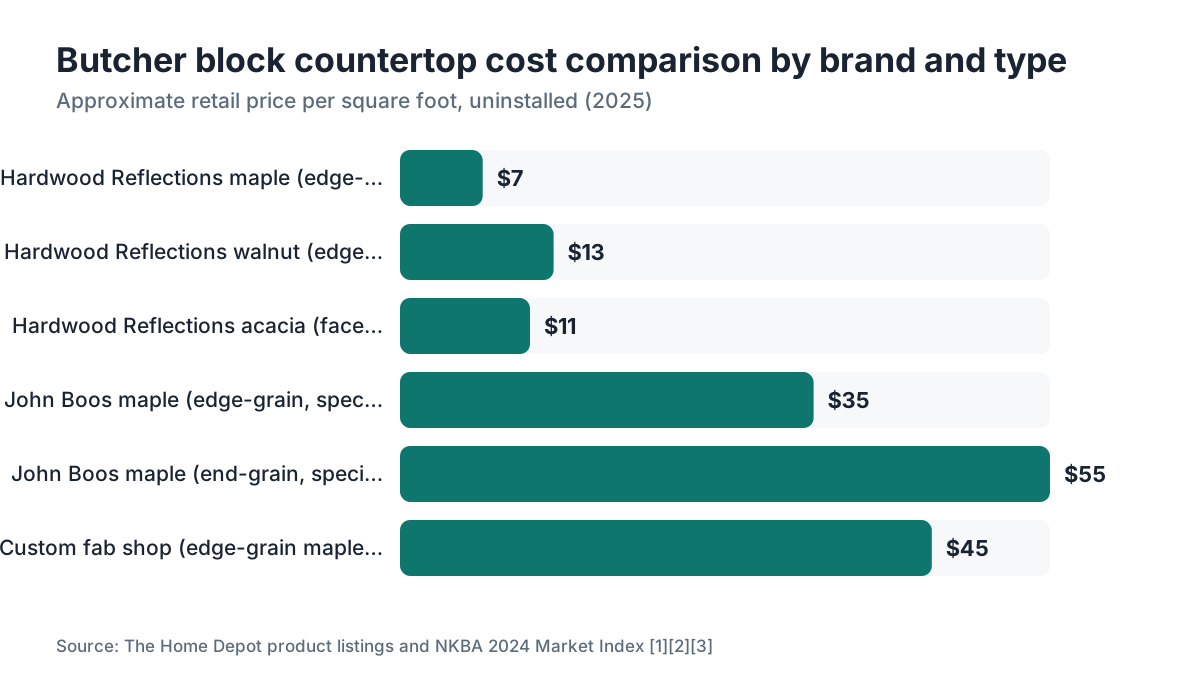
Panels run roughly $5, $15 per square foot as of mid-2025, depending on species and thickness [2]. Maple at 1.5 inches sits at the low end, around $5, $8 per square foot. Walnut and acacia push toward $12, $15. A 25 by 74-inch maple slab (about 12.8 square feet) costs roughly $65, $100 in most markets.
That price does not include:
- Cutting or shaping (a countertop shop charges $50, $150 for a basic sink cutout)
- Finishing oil or sealer ($15, $40 per quart, and you'll need several coats)
- Undermount sink work, which is fussier with wood than with stone
- Install labor if you're not doing it yourself
Installed, with basic labor and finishing, a straightforward kitchen run usually lands between $20 and $35 per square foot. That's well under installed granite at $40, $100 per square foot and engineered quartz at $50, $120 [3].
Against other budget materials, Hardwood Reflections holds its own on upfront cost. Laminate countertops and Formica countertops are the only categories that beat it on installed price with any consistency.
Edge-grain vs. end-grain: which type is Hardwood Reflections?
Hardwood Reflections panels are edge-grain, with some acacia products running face-grain. None are end-grain. That single fact shapes how you should use them.
End-grain butcher block, the kind on a traditional European chopping block where the fibers run straight up at the surface, is self-healing to a point. Knife cuts close as the fibers push back together, and end-grain is easier on your knife edges. But it's expensive to build and heavy to ship as a full countertop, so it rarely shows up at big-box retail.
Edge-grain panels show the long, narrow face of each strip. They're smooth, stable, and good-looking, but knife scars are permanent and visible. Face-grain (also called flat-grain) shows the widest face of each board. Cathedral grain patterns look great, but face-grain moves more with humidity and warps more readily.
For most people, a countertop is a surface you set things on, not a cutting board. Edge-grain handles that job fine. If you want a surface you can carve on daily without a board, buy a dedicated end-grain block or insert instead of chewing up your counter.
How do you seal and finish a Hardwood Reflections countertop?
This is where buyers get tripped up. Hardwood Reflections panels ship raw or with a thin factory oil coat that won't survive a kitchen. Apply a real finish before the counter goes into service, ideally before install, when you can coat all six sides.
You have three real finish choices:
-
Food-safe oil or oil-wax blend (mineral oil, Waterlox Original, or Danish oil). These soak into the wood and need reapplication every 1 to 6 months depending on use. They keep the wood looking natural and spot-repair easily. This is the common pick for these panels.
-
Hard film finish (polyurethane or conversion varnish). A plastic-like barrier on top. Very tough against spills, low maintenance, but when it fails it peels or chips instead of wearing evenly. Fixing it means stripping and recoating the whole surface.
-
Waterlox tung oil varnish, which sits between the two. It penetrates and builds a light film. Tougher than straight oil, more repairable than poly.
The FDA classifies pharmaceutical-grade white mineral oil as safe for food contact under 21 CFR 172.878, which is why it's the default for prep surfaces [4]. Skip raw linseed oil (not food-safe raw) and anything labeled only "wood conditioner" that might hide additives.
Application: sand to 180-grit, wipe clean, flood on oil, let it soak 20 to 30 minutes, wipe off the excess, cure 24 hours, repeat 3 to 5 times for the initial buildup. Then coat the underside and edges, or the panel absorbs moisture unevenly from below and cups.
How does Hardwood Reflections butcher block hold up over time?
Wood counters ask for more upkeep than stone or solid surface. That's the price of the low cost and the warmth. Here's the honest picture.
Scratch and dent resistance is low. Wood is soft next to stone. A dropped pot, a dragged cast iron pan, or a heavy knife block leaves a mark. The upside: those marks sand out. A belt sander and a fresh oil coat can bring back a wood counter that would be a total loss in granite. But sanding takes time, and you can't do it in place without masking off everything around it.
Water is the real enemy. Standing water near the sink works through the finish, raises the grain, stains the wood dark, and can swell the panel until it lifts off the cabinet. Undermount sinks are the riskiest setup because the cutout edge is bare grain. Most fabricators push top-mount (drop-in) sinks with butcher block, or heavy epoxy sealing on every exposed edge of an undermount cutout.
Heat resistance is low too. A hot pan straight onto oiled wood leaves a ring. Trivets aren't optional here.
Still, a well-kept wood counter in a light-use kitchen runs 20 years or more. Hard maple carries a Janka hardness of about 1450 lbf per the USDA Forest Products Laboratory's Wood Handbook, so it resists denting better than softer domestic woods [5].
For tougher surfaces, compare our breakdowns of granite countertops and marble countertops.
Is Hardwood Reflections butcher block safe for food prep?
Yes, with the right finish. Wood has some natural antimicrobial behavior. Research by Dean Cliver at UC Davis, published in the Journal of Food Protection (1994), found bacteria applied to wood surfaces were recovered in lower numbers than from plastic, partly because wood's capillary action pulls bacteria below the surface where they die off [6]. The study has caveats (knife-scarred plastic boards test worse than smooth plastic), but it holds up the claim that wood isn't inherently less sanitary than other materials.
The finish matters more than the wood. An oil-finished surface stays somewhat porous, so sanitize it with diluted white vinegar (1:1 with water) or a food-safe sanitizer, not bleach. Bleach dries and cracks wood over time. A polyurethane surface is non-porous and wipes down with mild dish soap like any hard surface.
Don't make the counter your main raw-meat prep zone, whatever the finish. Use a separate board. That's not a knock on wood. USDA guidance recommends separate cutting boards for raw meat, poultry, and seafood on any surface to hold down cross-contamination [7].
How does Hardwood Reflections compare to custom butcher block or other brands?
The sharpest comparison is against custom butcher block from a specialty fabricator or a brand like John Boos, which sells commercial and residential tops direct and through kitchen dealers.
Here's how they stack up:
| Hardwood Reflections (Home Depot) | John Boos (specialty) | Custom fab shop | |
|---|---|---|---|
| Price per sq ft | $5, $15 | $25, $60 | $30, $80 |
| Custom sizing | No (fixed panels) | Yes | Yes |
| Species options | 4 (maple, oak, walnut, acacia) | 8+ including cherry | Varies by shop |
| Construction | Edge-grain / face-grain | Edge, end, and face-grain | All types available |
| Warranty | 1 year limited | 1 year limited | Varies |
| Lead time | Same day (in stock) | 2 to 6 weeks | 2 to 4 weeks |
The price gap is real. For a plain rectangular island or a single run with no odd cutouts, Hardwood Reflections is hard to beat on value. It loses on complex layouts (L-shapes, angles, custom depths), thick profiles (2 inches and up), and premium species like cherry or hard white maple. Those jobs belong to a fabricator.
Shops running quoting software like SlabWise can price a custom butcher block job against the retail panel in minutes, so if you're fielding wood counter requests, a built-in comparison quote helps you close.
For stone and engineered options at the higher end, see Cambria countertops and kitchen countertops.
Can you install Hardwood Reflections countertops yourself?
Yes. For a straight rectangular run with no sink cutout, it's a reasonable DIY job if you're comfortable with basic carpentry. Panels weigh roughly 30 to 60 pounds each, so grab a second person for lifting.
The steps: cut to length with a circular saw (straightedge guide, fine-tooth blade to hold down tearout), finish all six sides before install, set on the cabinets, and secure from below with figure-8 fasteners or metal clips that let the wood move. Do not glue the panel to the cabinet frame. Solid wood expands and contracts with the seasons, roughly 1/8 to 3/16 of an inch across a 25-inch-wide panel over a year in most U.S. climates [5]. Glue it down and it cracks or warps.
Sink cutouts are the hard part. A drop-in sink just wants a jigsaw cut on the template line. An undermount needs the cutout edges routed smooth and sealed hard, doable with a router and the right bits. A farmhouse (apron-front) sink is the biggest job and usually worth handing to a pro, since the front cabinet face comes off and the counter gets notched.
For install mechanics across materials, the countertop installation guide covers what a pro job looks like and how to read a bid.
What are the biggest complaints about Hardwood Reflections countertops?
Reading verified Home Depot reviews and woodworking forums over the past few years, the gripes cluster around three things.
Warping tops the list. A panel stored in a humid warehouse, shipped cross-country, then dropped into a dry kitchen can cup or bow before you even install it. The fix: let the panel acclimate in the room where it'll live for at least 72 hours before cutting or seaming. Some contractors say a week. This is standard practice for any solid wood product, and the Home Depot listing does mention acclimation, but plenty of buyers skip it.
Seam appearance is the next frequent letdown. Butting two panels for an L-shaped kitchen photographs fine, but the seam shows and traps moisture. A biscuit-and-glue joint (or a full miter at the corner) filled and sanded looks much better. It also takes real woodworking skill.
Moisture damage near the sink is the third. Buyers who skip sealing the underside, skip caulking the backsplash joint, or run an undermount without epoxy on the cutout edge often see swelling and blackening inside 12 to 18 months.
None of these are really product defects. They're the predictable result of skipping steps with a natural material. But it's sold in a home improvement store, where buyers may never get that context.
How do you clean and maintain Hardwood Reflections butcher block day to day?
Daily care is simple: wipe with a damp cloth and mild soap, then dry right away. "Right away" carries the sentence. Standing water on wood, even sealed wood, is how trouble starts.
For oil-finished surfaces, reapply food-grade mineral oil or your penetrating oil every 1 to 3 months, sooner if the surface looks dry or water stops beading. The quick test: drop a few beads of water on the top. Bead up, finish is fine. Soak in, time to re-oil.
For stubborn stains, a paste of kosher salt and lemon juice lifts a lot of surface marks on oil-finished wood. Let it sit a few minutes, scrub with the grain, rinse, dry. For deeper stains, spot-sand with 120-grit and re-oil.
Keep wood counters away from bleach, ammonia, and strong alkaline cleaners. They break down oil finishes, dry the fiber, and crack the wood over time. Diluted dish soap, white vinegar cut 50/50 with water, and food-safe sanitizers are all fine.
For the general approach to cleaning natural surfaces, our guides on how to clean stone countertops, how to clean quartzite countertops, and how to clean soapstone countertops all come back to the same mindset: know your finish, match the cleaner, dry fast.
Is Hardwood Reflections butcher block worth buying in 2025?
For the right job, yes. The right job is a homeowner who wants wood, has a fairly simple layout, will do or pay for proper finishing, and gets that wood takes more upkeep than stone or quartz.
On an island, especially one away from a sink, these panels are a genuine value. You get solid hardwood at retail prices, a species range that fits most tastes, and same-day pickup. Botch a cut and you just buy another panel. You don't get that mulligan with custom stone.
I would not put it on the main sink run in a heavy-use kitchen. The moisture exposure never lets up, and the maintenance is a standing commitment. In that spot, a low-maintenance surface like Corian countertops (solid surface, repairable and non-porous) or engineered quartz takes daily abuse better.
If you're a fabricator quoting a client who's weighing Hardwood Reflections against your custom build, your work wins on fit and finish every time. You just have to close the gap on price or turn time. SlabWise's quoting tools build fast, clear quotes that show the client exactly what the extra money buys, which is often enough to move the conversation your way.
Bottom line: Hardwood Reflections is real wood at real value for the price. It's not premium. Treat it as what it is, keep up the maintenance, and it performs. Expect custom-shop fit or stone-grade durability and you'll be let down.
Frequently asked questions
Where are Hardwood Reflections butcher block countertops sold?
Hardwood Reflections is a Home Depot exclusive. You buy the panels in-store or online at homedepot.com. They are not sold through other retailers, lumber yards, or specialty kitchen dealers. In-stock sizes and species vary by location, and online orders may ship from a regional warehouse rather than your local store.
Do Hardwood Reflections countertops come pre-oiled or finished?
Most panels ship with a thin oil coat meant only for temporary protection during shipping, not for kitchen use. Apply a proper food-safe finish (mineral oil, Waterlox, or polyurethane) before installation and before the counter sees water or food. Skipping this step is the top cause of early water damage and staining.
Can you use Hardwood Reflections butcher block as an actual cutting surface?
Edge-grain and face-grain panels, which is what Hardwood Reflections makes, take light food prep, but knife cuts stay permanent and visible. For serious knife work, use a separate end-grain cutting board. End-grain is self-healing to a degree because the fibers compress around a cut rather than getting sliced clean through.
How long does Hardwood Reflections butcher block last?
With proper finishing and regular upkeep (re-oiling every 1 to 3 months for oil finishes, keeping water off the surface, protecting from heat), a well-kept panel lasts 15 to 25 years. Neglected panels near sinks without adequate sealing can show serious damage in 2 to 5 years. The wood refinishes, so surface damage sands out and the counter comes back.
What is the Hardwood Reflections warranty?
Home Depot offers a 1-year limited warranty on Hardwood Reflections countertops covering manufacturing defects. It does not cover damage from bad installation, failure to seal, water damage, or normal wear. Because the brand is Home Depot's private label, claims go through Home Depot customer service, not a separate manufacturer.
How do you cut Hardwood Reflections butcher block panels?
Use a circular saw with a fine-tooth carbide blade (60-tooth or higher) and a straightedge guide clamped to the panel. Score the cut line with a utility knife first to prevent face tearout. Cut slightly wide and finish to final dimension with a router and straight bit if you need a clean seam edge. Always seal cut edges before installation.
What's the difference between Hardwood Reflections maple and walnut?
Maple is lighter (creamy white to pale yellow), harder (Janka around 1450 lbf), cheaper, and the most stocked. Walnut is darker (chocolate brown), slightly softer (Janka around 1010 lbf), roughly $3 to $6 more per square foot, and hides some stains while showing others. Walnut is the statement piece; maple is the workhorse.
Can you install an undermount sink with Hardwood Reflections butcher block?
Technically yes, but it takes careful work. The cutout edge is exposed grain that drinks water. Route the edge smooth, then seal it with several coats of epoxy or marine-grade sealant before mounting the sink. Many fabricators and plumbers recommend top-mount sinks with wood for lower long-term risk. A poorly sealed undermount cutout shows rot and blackening within 1 to 2 years.
Is Hardwood Reflections butcher block good for a bathroom vanity?
It works well in a bathroom, which usually sees less standing water than a kitchen sink. Same sealing rules: coat all six sides before install, seal the sink cutout hard, re-oil on schedule. Many homeowners use it for powder room vanities with vessel sinks (no cutout at all) with excellent results. A bathroom with heavy daily use near a sink needs the same diligence as a kitchen.
How does Hardwood Reflections compare to John Boos butcher block?
John Boos is a specialty maker with a longer history and more construction options, including true end-grain tops. Boos panels cost roughly 3 to 5 times more than comparable Hardwood Reflections panels. For a simple rectangular run, the finished look is similar either way. Boos wins on custom sizing, species depth, and end-grain options that Hardwood Reflections doesn't offer.
Can Hardwood Reflections butcher block be painted?
Painting butcher block is unusual and not recommended for a working kitchen surface. Paint film chips and peels under food prep and stops being food-safe once scratched. For a darker look, stain before an oil or varnish finish instead. Gel stains work well on edge-grain panels. Check that any stain is labeled non-toxic and fully cured before treating it as food-adjacent.
Does butcher block countertop add value to a home?
Real estate data on this exact question is thin. Wood counters read well in rustic, farmhouse, or transitional kitchens, less so in ultra-modern or high-end listings where stone or quartz is expected. Because wood costs less than stone, it doesn't always command a resale premium. Condition is the bigger factor: a well-kept wood top is an asset, a stained or warped one is a liability.
What mineral oil should I use on Hardwood Reflections butcher block?
Use food-grade or pharmaceutical-grade mineral oil, often labeled USP mineral oil. It's the same product sold as a laxative at drugstores and is FDA-recognized as safe for incidental food contact. Skip vegetable, olive, and coconut oil, which go rancid inside the wood and stink. Howard Butcher Block Conditioner or straight pharmaceutical mineral oil from a drugstore are both fine.
Sources
- The Home Depot, Hardwood Reflections product listings: Hardwood Reflections is sold through Home Depot in maple, oak, walnut, and acacia species at standard panel sizes
- The Home Depot, Hardwood Reflections pricing (mid-2025): Hardwood Reflections panels retail for approximately $5, $15 per square foot depending on species and thickness
- National Kitchen and Bath Association, 2024 Kitchen and Bath Market Index: Installed granite countertop cost ranges of $40, $100 per square foot and engineered quartz ranges of $50, $120 per square foot reflect current market pricing
- U.S. Food and Drug Administration, CFR Title 21, Section 172.878 (White mineral oil): The FDA classifies pharmaceutical-grade white mineral oil as safe for use as a food additive and for incidental food contact on food-processing equipment and wood surfaces
- USDA Forest Products Laboratory, Wood Handbook: Wood as an Engineering Material (General Technical Report FPL-GTR-282): Hard maple has a Janka hardness of approximately 1450 lbf; solid wood panels expand and contract with seasonal humidity changes in predictable ranges that must be accommodated in installation
- Dean O. Cliver, University of California Davis, Journal of Food Protection, 'Cutting boards of plastic and wood contaminated experimentally with bacteria' (1994): Research found that bacteria inoculated onto wood surfaces were recovered in lower numbers than from plastic surfaces; wood's capillary action draws bacteria away from the surface
- USDA Food Safety and Inspection Service, Kitchen Companion: Your Safe Food Handbook: USDA guidance recommends using separate cutting boards for raw meat, poultry, and seafood to prevent cross-contamination regardless of countertop or cutting board material
- University of California Cooperative Extension, Wood Products for the Home: Hardwood species used for countertops including maple and oak are renewable domestic materials; acclimation of solid wood panels before installation is recommended practice to minimize warping
- USDA Forest Products Laboratory, Janka Hardness Values for North American Species: Black walnut Janka hardness is approximately 1010 lbf compared to hard maple at 1450 lbf, meaning walnut dents more easily under comparable impact force
- National Institute of Standards and Technology, Voluntary Product Standard PS 1-19 for Structural Plywood (wood movement reference): Dimensional movement in solid wood across the grain as a function of moisture content is a well-established property used to engineer wood installation clearances
Last updated 2026-07-09