TL;DR
- Butcher block countertops sell for roughly $30 to $100 per square foot for the slab alone, depending on wood species, construction type, and thickness.
- Big-box stores like IKEA, Home Depot, and LL Flooring stock ready-to-ship sections starting around $200.
- Custom fabricators charge more but cut to size.
- Most homeowners spend $800 to $2,000 installed for a typical kitchen.
What does butcher block actually cost per square foot?
Butcher block prices fall into three tiers: stock panels from a home improvement store, semi-custom pieces cut to your dimensions, and fully custom work from a woodworking shop or countertop fabricator. The gap between the cheapest and the priciest is wide, roughly $30 to over $100 per square foot for material alone.
Stock panels at Home Depot and IKEA run $30 to $60 per square foot for the material by itself [1]. IKEA's BADELUNDA and KARLBY series price out around $15 to $25 per linear foot at their listed widths (24 to 74 inches), which works out to roughly $30 to $45 per square foot depending on the section you buy [2]. These are edge-grain panels in maple or birch, usually 1.5 inches thick.
Semi-custom pieces from online lumber retailers and specialty countertop suppliers run $45 to $80 per square foot. You pick the species, thickness, and construction type, and they ship it cut to the rough dimensions you provide.
Fully custom work runs $70 to $100-plus per square foot for material and fabrication combined, before installation. That means a local fabricator or woodworker cuts, joins, and finishes to your exact template. The price climbs fast if you want teak, cherry, or walnut instead of maple.
Installation adds $30 to $60 per square foot in most U.S. markets. Plenty of homeowners skip that line and install it themselves, because butcher block is one of the more forgiving countertop materials to DIY [3].
Where are the best places to buy butcher block countertops?
You have five real ways to buy, and each one trades something. Cheapest at retail is IKEA. Best for complex layouts is a local fabricator. Most people land somewhere in between.
Big-box stores (Home Depot, Lowe's): Widest availability, standard sizes, fast pickup. Home Depot stocks solid hardwood butcher block in maple and acacia, 1.5-inch thickness, in widths from 25 to 50 inches and lengths up to 10 feet [1]. Prices are predictable. The catch is that sizes are fixed, so an oddly shaped kitchen means cutting on your end.
IKEA: The cheapest butcher block you'll find at a physical store. Their edge-grain birch and oak countertops sell by the section and are honestly good for the money. You can't get them in non-standard widths without modifying them yourself, and the exposed end grain on any field cut needs sealing right away [2].
Online specialty retailers: Sites like LL Flooring, BuildDirect, and dedicated countertop suppliers let you choose species, construction (edge-grain, end-grain, or face-grain), and thickness. Shipping on heavy panels can add $100 to $300 depending on order size.
Local lumber yards and hardwood suppliers: For walnut, cherry, or reclaimed wood, a local hardwood dealer is often the best price per board foot. You buy raw material and arrange your own finishing, but the savings run 20 to 30 percent versus a finished panel from a specialty retailer.
Local countertop fabricators: The most expensive option and the right one for complex layouts, multiple cutouts, or integrated sinks. A shop that works mostly in stone will sometimes farm out wood work, so a shop that specializes in wood countertops does the better job. Get at least three quotes.
For a standard 24-inch-deep kitchen run, most people buying stock product spend $600 to $1,200 on material before any installation labor. See kitchen countertops for how butcher block stacks up against every other material on total installed cost.
What are the different types of butcher block construction?
Construction matters more than most buyers realize. It drives both price and how the top holds up over 20 years. Three types make up the market: edge grain, end grain, and face grain.
Edge grain: The most common type sold in stores. Boards are glued together with the long grain facing up. It's durable, fairly stable, and looks clean. Most stock panels at Home Depot or IKEA are edge grain. This is what you want for most kitchens.
End grain: The checkerboard pattern you see on dedicated cutting boards. It's gentler on knives, and the wood fibers close back over cuts, so it absorbs less into the cut marks. It looks beautiful. It's also expensive, heavy, and prone to cracking if it isn't kept sealed and away from moisture. End-grain panels run 40 to 70 percent more than comparable edge-grain. Great choice for a prep island if you're ready to maintain it.
Face grain: Wide planks glued face-to-face. Looks the most like natural lumber with the full grain showing. It's the most likely to warp and cup, because those large faces soak up moisture unevenly. Some woodworkers swear by it. My honest take: face grain near a sink is a gamble, and the visual payoff isn't worth the maintenance worry for most homeowners.
Thickness is the other lever. Most residential countertops come in 1.5-inch or 1.75-inch slabs. Some premium end-grain pieces go to 2.5 inches. Thicker slabs weigh more, need stronger cabinet support, and cost more. Stick to 1.5 inches unless you have a specific reason to go thicker.
Which wood species should you choose and how does that affect price?
Species changes everything: hardness, color, grain, price, and how the top ages. Maple is the default. Walnut is the looker. Teak is what you buy for a wet zone. Here's the full spread.
| Species | Janka Hardness (lbf) | Relative Price | Notes |
|---|---|---|---|
| Maple | 1,450 | $ (baseline) | Most common, light color, hard-wearing |
| Birch | 1,260 | $ | Similar to maple, used heavily in IKEA panels |
| Oak | 1,290 | $, $$ | More open grain, takes stain well |
| Walnut | 1,010 | $$$ | Rich dark color, softer than maple, beautiful |
| Cherry | 950 | $$$ | Darkens to reddish-brown over time, elegant |
| Acacia | 1,700 | $$ | Very hard, distinctive grain, Home Depot carries it |
| Teak | 1,155 | $$$$ | Naturally oily, excellent moisture resistance |
| Bamboo | ~1,380 (varies) | $$ | Technically a grass, hard, eco-friendly label |
Maple is the default for good reason. It's hard (1,450 lbf on the Janka scale [4]), takes a smooth finish, and costs the least. Walnut is the upgrade pick for looks, but it's softer and shows dents faster. Teak resists moisture better than any domestic species, which earns its premium near a sink.
Bamboo needs its own note. It's a grass, not hardwood. Strand-woven bamboo can test harder than maple, but some products use formaldehyde-based adhesives in the manufacturing. If bamboo is on your list, check the adhesive specs for CARB Phase 2 compliance [5].
Are cheap butcher block countertops worth buying?
For a budget kitchen, a laundry room, or a rental, cheap butcher block is genuinely fine. The cheapest panels, under $35 per square foot, are mostly edge-grain maple or birch from IKEA or discount outlets. IKEA's birch tops have gone into millions of kitchens and hold up on basic maintenance: oil them every few months, keep standing water off, don't let the cut edges dry out.
Where cheap butcher block falls short is dimensional stability. Lower-priced panels often use narrower board strips, which telegraph seasonal movement more than premium panels with wider, better-selected boards. You'll also see more color variation across the surface. That bugs some people and not others.
The real risk in going cheap isn't the species or the construction. It's buying an unfinished panel and not sealing it properly before installation. An unfinished block that gets wet before you seal it will warp. That's not a defect. That's a preventable mistake.
Here's a comparison worth remembering. A $35-per-square-foot butcher block beats cheap laminate countertops on both durability and repairability. Laminate can't be sanded back. Butcher block can. For a busy kitchen, that's a real advantage.
For a laundry room, home bar, or secondary workspace, the IKEA or Home Depot stock panels are hard to beat. For a primary kitchen, spend the extra $15 to $25 per square foot and get a solid maple edge-grain panel from a supplier you trust.
How do butcher block countertops compare to other countertop materials on price?
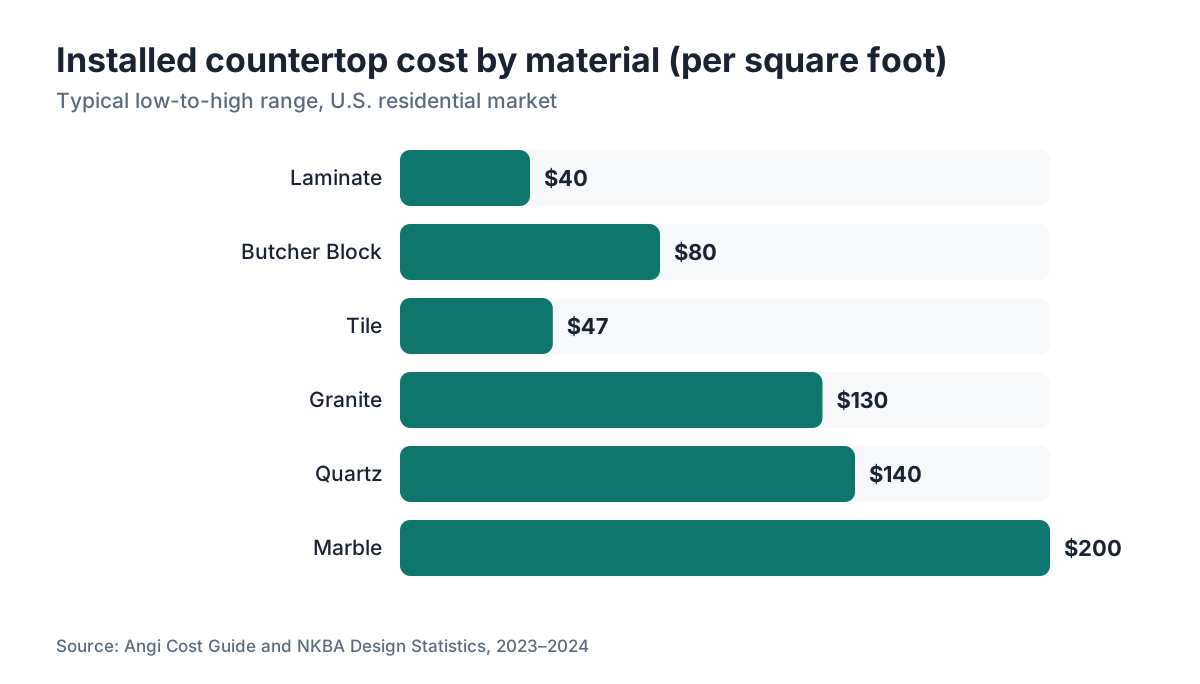
Butcher block sits in the mid-tier: cheaper than granite, marble, quartz, or soapstone, more expensive than tile or laminate. Here's where it lands on installed cost.
| Material | Installed Cost Range (per sq ft) | DIY-Friendly? |
|---|---|---|
| Butcher block | $40, $120 | Yes |
| Laminate | $20, $60 | Yes |
| Tile | $25, $70 | Moderate |
| Granite | $60, $200 | No |
| Quartz | $80, $200 | No |
| Marble | $100, $300 | No |
| Soapstone | $80, $200 | No |
These installed ranges shift with region, edge profile, number of cutouts, and whether you're doing a standard run or an island [3][10]. Compared to granite countertops, marble, or engineered quartz, butcher block usually costs less. Against tile or laminate, it costs more.
Total cost of ownership is where it gets interesting. Butcher block is the only common countertop you can resurface instead of replace. Deep scratches, stains, and burns come out with a belt sander or hand plane, then re-oiling or re-sealing. The per-square-foot price doesn't capture that.
The one place butcher block loses on cost is heat. A hot pan set straight on the wood leaves a mark. If you cook hard and don't want to think about trivets, a harder surface like quartz or granite countertops is worth the extra money.
What finish options are available and which is best?
The finish decides whether the surface is food-safe, how it looks, and how often you maintain it. Three real choices: oil, oil/wax blend, and polyurethane. For a prep island I'd use oil/wax. For a top that never sees a knife, satin polyurethane.
Pure mineral oil or food-grade oil (Howard Butcher Block Conditioner, raw linseed, walnut oil): Soaks into the wood, is food-safe right away, and needs reapplication every 1 to 3 months. The surface stays matte and shows the wood's character. This is the pick if you're using the top as an actual cutting or prep area. The FDA classifies food-grade mineral oil as generally recognized as safe (GRAS) for food contact [6].
Oil/wax blend (Boos Board Cream and similar): A step up from pure oil. The wax adds a thin film on top of the penetrating oil. Still food-safe, still needs reapplication, but less often than pure oil.
Polyurethane or conversion varnish: Creates a hard film. Most durable against water and stains, easiest to wipe down, looks more like a painted surface than raw wood. Not food-safe while curing (most manufacturers call for a 30-day cure before food contact). If you want a top you can clean like stone and you won't cut on it, this is a fair choice. It does crack eventually and is harder to repair than an oiled surface.
For a kitchen island that doubles as prep space, oil/wax is my call. For countertops that will never meet a knife, polyurethane with a satin sheen looks great and stretches the time between maintenance.
Can you install butcher block countertops yourself?
Yes, and it's one of the friendlier countertop projects for a DIYer. Wood cuts with standard tools (a circular saw, a jigsaw for sink cutouts), weighs far less per piece than stone, and needs no diamond blades or professional lifting rigs.
The tricky parts are the details. Making clean sink cutouts without tearout. Getting the cabinets dead level before you fasten anything. Managing expansion. Butcher block moves with the seasons, so you leave roughly 1/8-inch gaps at walls and attach the top with clips or elongated screw slots that let it move, rather than screwing it down rigidly through the cabinet frame. NWFA guidance on wood movement applies here: hardwood can expand or contract 1 to 2 percent in width per 4 percent change in relative humidity [7].
If your kitchen has complex angles, a peninsula, or an undermount farmhouse sink, pay a fabricator. The savings from DIY vanish the moment you make a $200 cut in the wrong spot on a $600 panel.
See countertop installation for a full breakdown of DIY versus professional cost and what each job type involves.
If you're a fabricator quoting a butcher block job and want to track square footage, waste, and material cost fast, SlabWise's quoting tools handle wood countertop jobs the same way they handle stone, with template-based pricing built in.
How do you care for butcher block countertops long-term?
Routine care is short. Wipe up spills right away, dry the surface after cleaning, and re-oil when the wood looks dry or when water stops beading (oil finishes), or when the film starts to dull and scratch (polyurethane).
For an oil-finished top, expect to reapply every 1 to 3 months in a busy kitchen. Wipe on mineral oil or an oil/wax blend with a rag, let it soak 20 to 30 minutes, wipe off the excess. Ten minutes, start to finish.
Sanding is your nuclear option, and it works. Light scratches come out with 120-grit, then 180-grit, then re-oil. Deep gouges or burns may need a belt sander or a hand plane. After sanding, the surface looks new. No other common countertop gives you that.
What ruins butcher block: standing water left at the seam between the top and the sink, a dishwasher running right beside an unsealed wood edge, and unfinished wood exposed to humidity swings during storage or install. Mold and mildew under the surface are more of a threat near sinks than anywhere else. Seal the underside and back edge before installation.
If you're comparing butcher block against stone, how to clean stone countertops covers the basics for the other side.
What should fabricators know when quoting butcher block countertop jobs?
If you're used to quoting stone, butcher block runs on a different cost structure. Material is cheaper per square foot, but the labor-to-material ratio flips because wood needs more edge work and on-site finishing than stone, and the finish schedule (oil application, cure time) adds days to the timeline.
Waste runs lower than stone. A typical stone job loses 15 to 25 percent of material to drops and breakage. Wood panels cut more efficiently, so figure 10 to 15 percent waste on a standard layout, though complex islands or angled runs push that higher.
Price the finish separately. If a customer wants an oil-finished top, that's a recurring maintenance conversation to have upfront. Poly-finished surfaces are easier to quote because maintenance is less frequent, but some customers specifically want the natural oil feel.
Seam placement matters more in wood than in stone, because wood moves. Seams that run perpendicular to the grain direction hold up better than seams along the grain. On an L-shaped run, put the seam at the inside corner where it's least visible and best supported.
SlabWise's countertop quoting software handles wood jobs with the same template-nesting logic as stone slabs. If you're quoting several butcher block projects and want to see how material layout moves the price, the demo shows exactly how that works.
For how different materials affect your quoting workflow, the butcher block countertops overview has the full material breakdown.
Are there any health or food safety concerns with butcher block countertops?
The research here is more interesting than the marketing copy. Solid wood does something plastic doesn't for bacteria, and it changed how a lot of people think about cutting surfaces.
A 1993 study by Dean Cliver at UC Davis found that bacteria drawn into cuts in a wood surface died off and did not multiply, while bacteria on plastic surfaces survived and could recontaminate from the surface [8]. That kicked off years of debate. The nuance that matters: the effect applies to solid wood, not glued-up composite. Edge-grain and end-grain butcher block made from solid wood strips show it. Heavily laminated or MDF-core products do not.
FDA guidance on food contact surfaces does not prohibit wood, but commercial food service rules vary by state and local health code [9]. In a residential kitchen, there's no regulatory bar to wood countertops or cutting boards.
Finish drives food safety. Cured mineral oil and oil/wax blends are food-safe. Polyurethane is not food-safe while curing, which most manufacturers put at 30 days for full cure. After full cure, most conversion varnishes and polyurethanes are considered safe for incidental food contact, but check your specific product's data sheet.
Formaldehyde in adhesives is worth checking on cheaper panels. CARB Phase 2 (California Air Resources Board composite wood product rules) caps formaldehyde emissions from composite wood products, and panels sold in California must comply. Outside California, confirm any panel you buy is labeled CARB Phase 2 compliant [5].
What are the best butcher block countertop options for a small budget?
If your budget is tight, here's the honest ranking. IKEA wins on price at retail. A used block off Marketplace can beat everything if you're willing to sand.
IKEA KARLBY or BADELUNDA: Edge-grain birch or oak, sold in fixed widths up to 74 inches. Sections start around $200 to $400 depending on size. These are the best cheap butcher block countertops in retail right now. They ship unfinished, so you oil or seal before installation, but the wood is consistent and the price is real.
Home Depot house brand (Unfinished Maple Butcher Block): A bit more than IKEA but available in more sizes and usually ready for same-day pickup. Good pick if you need a non-standard length and plan to cut it yourself.
LL Flooring clearance sections: Occasionally has discontinued butcher block at below-market prices. Worth a look if your timing is flexible.
Craigslist, Facebook Marketplace, Habitat for Humanity ReStore: Pre-owned or surplus butcher block shows up regularly, often from kitchen remodels. A used block that needs sanding usually beats a new cheap panel on value. A $100 used maple block plus a day of sanding and a bottle of mineral oil can outperform a $300 discount panel.
Under $35 per square foot, set expectations: the product will work, but you're getting baseline wood quality and board consistency. For a secondary workspace, a laundry room, or a rental, that's fine.
Frequently asked questions
How much does a full kitchen of butcher block countertops cost?
A typical kitchen with 40 to 50 square feet of surface runs $1,200 to $2,500 for material plus installation. Buy stock panels from IKEA or Home Depot and install them yourself, and total cost can drop to $600 to $1,200. Custom fabrication for a similar kitchen runs $2,500 to $5,000 depending on species and complexity. These ranges assume standard layouts without undermount sinks or complex cutouts.
Is butcher block cheaper than granite or quartz?
Generally, yes. Butcher block installs for $40 to $120 per square foot. Granite runs $60 to $200 installed, and quartz typically $80 to $200. The gap widens at the budget end: cheap butcher block stock panels from IKEA cost less per square foot than any natural stone option. At the premium end, exotic wood species can match mid-range granite pricing.
What thickness of butcher block is best for kitchen countertops?
Most residential kitchens use 1.5-inch thick panels. That's what Home Depot, IKEA, and most online suppliers stock. It's adequate for standard cabinet heights and doesn't add excessive weight. Some end-grain blocks go up to 2.5 inches for a heftier look, but that raises your finished counter height unless you plan the cabinet height around it.
Can butcher block be used around a kitchen sink?
Yes, but it needs more maintenance there than anywhere else. The wood must be well sealed on all faces, including the underside and the cutout edges around the sink. An oil-finished surface near a sink needs re-oiling every 4 to 6 weeks in that spot. Teak is the best species near water thanks to its natural oils. Standing water left at the seam is the main cause of failure.
How long do butcher block countertops last?
With proper sealing and routine oiling, butcher block lasts 20 to 50 years. The practical ceiling is the structural integrity of the wood itself. Surfaces can be sanded and refinished many times. The main failure modes are warping from moisture (usually an unsealed underside or a neglected sink area) and deep cracking from seasonal movement when expansion gaps weren't left during installation.
What is the best oil to use on butcher block countertops?
Food-grade mineral oil is the standard pick. It's cheap, easy to find, food-safe, and doesn't go rancid the way vegetable oils (olive, canola, coconut) can. The FDA classifies food-grade mineral oil as generally recognized as safe for food contact. Apply liberally with a rag, let it soak 20 to 30 minutes, then wipe off the excess. Commercial products like Howard Butcher Block Conditioner add carnauba wax for extra protection.
Can you cut directly on butcher block countertops?
Yes, though it leaves marks over time. End-grain butcher block is built for cutting and is the most knife-friendly surface. Edge grain handles incidental cuts well but isn't ideal as a primary cutting surface. If you use the counter as a full-time cutting board, plan to sand and re-oil periodically. Cutting on a polyurethane-finished surface will eventually expose raw wood under the film.
What is edge grain vs end grain butcher block?
Edge grain shows the long side of boards glued side by side, the most common style in retail countertops. End grain shows the cross-section of boards, creating the checkerboard pattern common in dedicated cutting boards. End grain is easier on knives, self-healing for cut marks, and more expensive (a 40 to 70 percent premium). Edge grain is more stable, easier to source, and adequate for most kitchens.
Do butcher block countertops need to be sealed?
Yes, before installation. Unfinished butcher block must be sealed on all six faces (top, bottom, four edges) before or during installation to prevent uneven moisture absorption that causes warping. The top gets maintenance re-sealing periodically. The underside and back edge only need sealing once. Skipping the underside seal is the most common DIY installation mistake with butcher block.
Where can I find butcher block countertops on clearance or at discount?
IKEA's AS-IS section sometimes has returned or damaged panels at 30 to 50 percent off. Home Depot and Lowe's run seasonal clearance on discontinued sizes. Habitat for Humanity ReStore locations often carry surplus countertops from kitchen remodels, including butcher block. Facebook Marketplace and Craigslist are worth checking in larger metros. A used panel that needs light sanding often costs less than a new budget panel.
Can butcher block countertops be used in a bathroom?
Yes, and it looks excellent on a bathroom vanity. The moisture concern is real but manageable if you seal thoroughly and keep pooled water from sitting. A polyurethane finish is more practical in a bathroom than oil, since you're not prepping food and the harder film resists spilled bathroom products. Teak is again the premium choice for moisture resistance.
How do you repair scratches or burns on butcher block?
Light scratches: sand with 120-grit, follow with 180-grit, re-oil. Deep scratches or gouges: use a belt sander or hand plane to remove material until the damage is gone, then work up through the grits and re-finish. Burns leave charred wood that sands out the same way. A localized repair takes 30 to 60 minutes. No other common countertop gives you this level of self-repair without a pro.
Is bamboo a good alternative to wood butcher block?
Bamboo strand-woven countertops can test harder than maple, but bamboo is a grass, not hardwood, and quality varies widely. Some products use formaldehyde-based adhesives. If you're considering bamboo, confirm the panel is CARB Phase 2 compliant for formaldehyde emissions. Performance-wise, quality bamboo holds up well, but the market has more product-quality variation than the domestic hardwood countertop market.
Sources
- Home Depot, Butcher Block Countertops product category: Stock butcher block panels at Home Depot run $30, $60 per square foot in maple and acacia, available in widths from 25 to 50 inches
- IKEA, Countertops product category: IKEA butcher block countertops (KARLBY, BADELUNDA series) are priced approximately $15, $25 per linear foot at listed widths in birch and oak
- Angi, Butcher Block Countertop Cost Guide: Installed butcher block countertop costs range from $40, $120 per square foot including labor, with most homeowners spending $800, $2,000 for a typical kitchen
- Wood Database, Janka Hardness Rating Reference: Hard maple has a Janka hardness of 1,450 lbf; walnut 1,010 lbf; acacia approximately 1,700 lbf
- California Air Resources Board, Composite Wood Products Program: CARB Phase 2 limits formaldehyde emissions from composite wood products sold in California; compliance verification is required for panels sold there
- U.S. Food and Drug Administration, Substances generally recognized as safe (Title 21 CFR): Mineral oil (food grade, white) is classified by FDA as generally recognized as safe (GRAS) for food contact applications
- National Wood Flooring Association, Wood and Water guidance: Hardwood can expand or contract 1 to 2% in width per 4% change in relative humidity, supporting the need for expansion gaps during countertop installation
- Cliver, D.O., University of California Davis, research on wood and plastic cutting surfaces (1993): Bacteria drawn into wood cutting surface cuts died off and did not multiply, while bacteria on plastic surfaces survived and could be recontaminated from the surface
- U.S. Food and Drug Administration, food contact surfaces guidance: FDA food contact surface regulations do not prohibit wood in residential food preparation environments; commercial food service rules vary by state and local health code
- National Kitchen and Bath Association, Kitchen and Bath design and industry statistics: Countertop material price comparisons: laminate $20, $60 installed, granite $60, $200 installed, quartz $80, $200 installed, marble $100, $300 installed per square foot
Last updated 2026-07-09