TL;DR
- Grey granite countertops run $40 to $100 per square foot installed, depending on slab rarity and edge profile.
- They're among the hardest natural stone options you can buy, shrug off heat and knife scratches, and need sealing once every one to three years.
- Kashmir White, Steel Grey, and Silver Pearl are the ones you'll see most.
- Grey works with almost any cabinet color.
What exactly is grey granite, and how does it form?
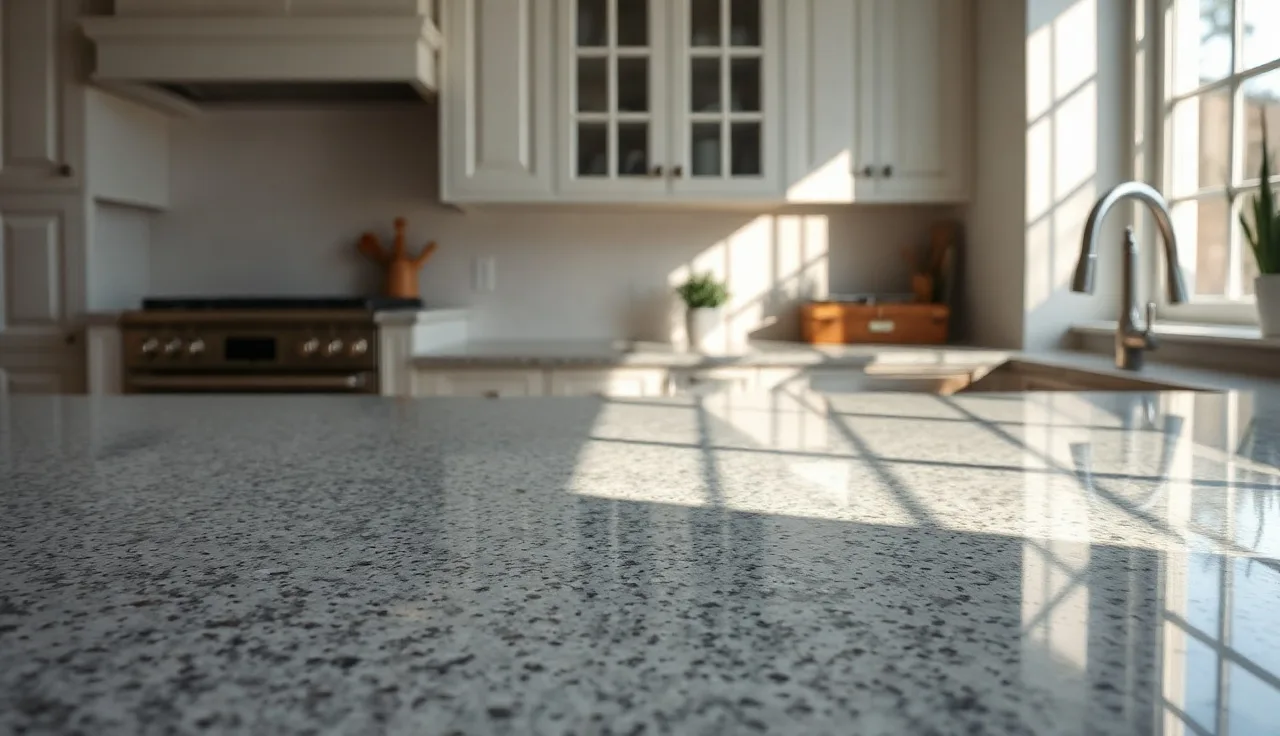
Grey granite is an igneous rock. It cooled slowly from molten magma deep underground, and that slow cooling built the interlocking crystals you see on a polished slab. The grey comes mostly from feldspar, which runs anywhere from pale silver to deep charcoal depending on the mineral ratios in the deposit. Quartz, mica, and amphibole minerals like hornblende add the white, black, and sometimes blue or green flecks that make each variety look different. [1]
No two slabs match. That's the point for most buyers, and the frustration for a few. The grey on a showroom sample tile can read lighter or darker than the full slab in the quarry yard, because the mineral distribution shifts across even a single block. Approve the actual slab, never the sample.
Grey granite gets quarried all over the world. India ships the most volume to North America, including Steel Grey and Silver Pearl. Brazil supplies several of the darker grey-and-black stones. Virginia and Georgia have domestic quarries that produce some grey granites, though the domestic stone usually costs more, and that's labor, not quality. [2]
What are the most popular grey granite varieties?
The variety name tells you what you're actually buying: the pattern, the background color, and how much movement to expect. These are the grey granites you'll run into most in North American fabrication shops.
Steel Grey is a fine-grained, nearly uniform dark grey from southern India. Almost no movement. From a few feet away it reads like a solid color. It's one of the cheapest granites on the market and usually lands at the bottom of the price range.
Silver Pearl (sold as Viscount White or Silver Cloud at some suppliers) has a lighter, medium-grey background with scattered white and black crystals. High mica content gives it a soft sparkle when polished.
Kashmir White gets classified by a lot of fabricators as grey-and-white. The background is pale grey to cream, with burgundy garnet and black hornblende crystals scattered through it. It sells year after year because it works with warm and cool cabinets both.
Bianco Antico looks a lot like Kashmir White but leans warmer, toward a taupe-grey base. Both are easy to find and priced in the middle.
Colonial White has a white background with heavy grey and black patterning. It reads grey in dim light and more white in bright sun, which makes it flexible but also unpredictable if you're chasing a specific paint chip.
New Caledonia is a mid-grey with small, even flecks and very little slab-to-slab variation. That consistency makes it popular for big projects where you need multiple slabs to match.
Titanium (or Titanium Black) sits at the dark end, close to charcoal, with faint silver veining. Quarry supply is limited, so it runs toward the top of the price range. [3]
For how grey granite fits into the wider granite category, see our guide to granite countertops.
How much do grey granite countertops cost?
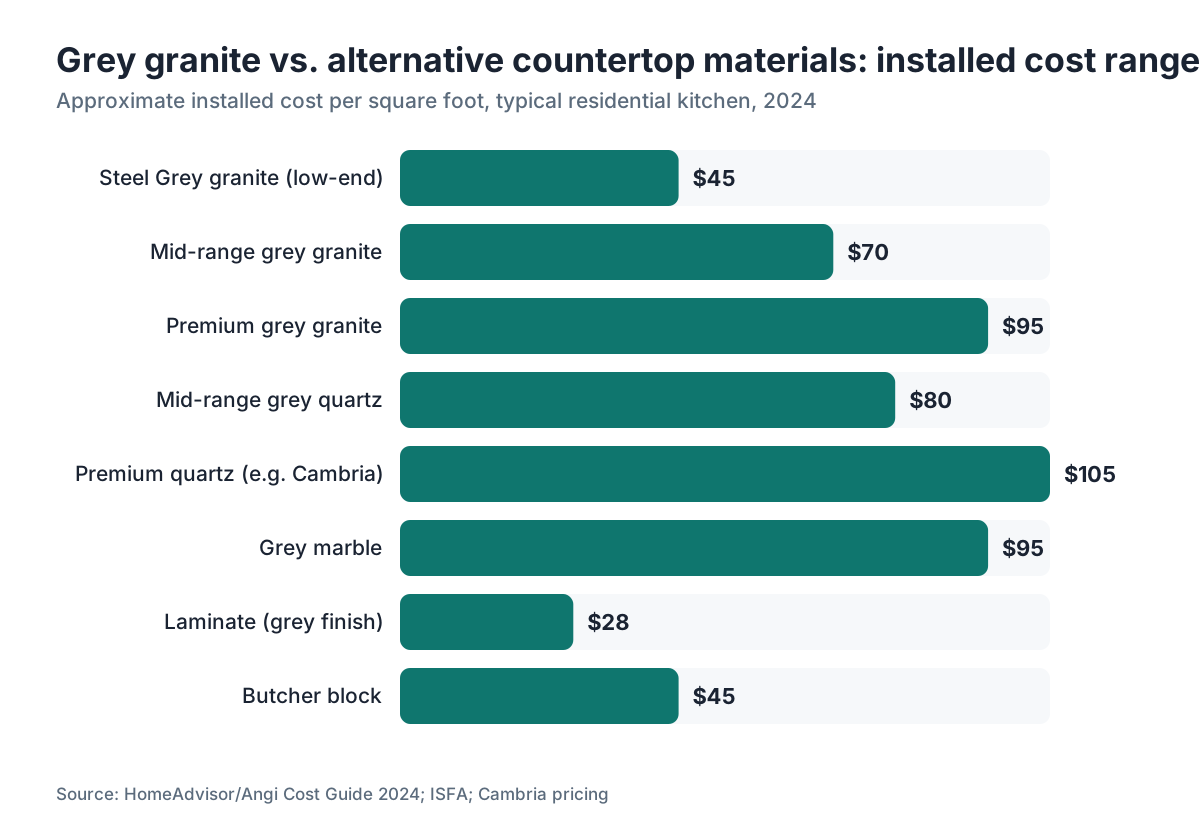
Installed cost runs about $40 to $100 per square foot for most residential jobs, and rare varieties can push past $150. [4] The range is wide because at least five things drive the final number.
- Slab grade and rarity. Builder-grade imports like Steel Grey sit at the bottom. Rare stones with unusual veining cost more, full stop.
- Fabrication complexity. A straight 25-square-foot island with a flat edge costs far less per foot than an L-shaped kitchen with curved edges, a sink cutout, and a waterfall.
- Edge profile. A basic eased edge adds nothing. An ogee or dupont edge adds $10 to $20 per linear foot at most shops.
- Thickness. Standard residential slabs are 3 cm (about 1.25 inches). Some jobs use 2 cm with a laminated front edge, which cuts slab cost but adds fabrication labor.
- Local labor rates. Installation labor in high-cost metros runs $15 to $30 per square foot. In cheaper markets it's closer to $8 to $15. [4]
Here's a rough breakdown for a typical 40-square-foot kitchen using a mid-range grey granite.
| Cost component | Low estimate | High estimate |
|---|---|---|
| Material (slab) | $600 | $1,600 |
| Fabrication (cutting, edging, polishing) | $400 | $900 |
| Sink cutout | $100 | $200 |
| Installation | $300 | $700 |
| Sealer (first application) | $50 | $150 |
| Total for 40 sq ft | $1,450 | $3,550 |
Those numbers line up with HomeAdvisor's 2024 cost data, which puts the average installed granite job nationally at roughly $3,250 for a typical kitchen. [4]
Tight budget? Laminate countertops and Formica countertops get you a grey look for $15 to $40 per square foot installed. You give up lifespan and resale perception.
How durable is grey granite compared to other countertop materials?
Granite is one of the hardest natural stones used for countertops. It rates 6 to 7 on the Mohs hardness scale, so a standard kitchen knife won't scratch it. [5] About as scratch-resistant as any kitchen surface gets. The real risks are impact chipping (worst at edges and corners) and thermal shock, which only shows up if you slam a very hot pan onto a cold slab over and over for years. Setting a hot pot down once in a while is fine.
Here's how grey granite stacks up against the usual alternatives.
| Material | Scratch resistance | Heat resistance | Stain resistance | Needs sealing? | Approx. installed cost per sq ft |
|---|---|---|---|---|---|
| Grey granite | High (Mohs 6-7) | Good | Good (sealed) | Yes, 1-3 yrs | $40-$100 |
| Quartz (engineered) | High | Moderate | Excellent | No | $50-$120 |
| Marble | Moderate (Mohs 3-4) | Good | Poor | Yes, annually | $50-$150 |
| Quartzite | Very high (Mohs 7) | Excellent | Good (sealed) | Yes, 1-2 yrs | $60-$130 |
| Soapstone | Low (Mohs 1-2) | Excellent | Excellent | Oiling only | $60-$120 |
| Laminate | Low | Poor | Good | No | $15-$40 |
The quartz question is the one fabricators field most. Engineered quartz resists stains better because it's non-porous. Granite is porous, yes, but that gets overstated as a problem. A properly sealed grey granite repels almost every kitchen spill. The practical difference: quartz can discolor from long heat exposure because of its resin binders, and granite has no resin to damage. [6]
For more on marble's performance, see our marble countertops guide.
Does grey granite need sealing, and how often?
Yes, grey granite needs sealing. How often depends on the stone's porosity, which changes by variety and finish. Polished granite is less porous than honed because polishing tightens the surface. [7]
Here's the field test that beats any calendar. Put a few drops of water on the counter and wait 15 minutes. If the stone darkens where the water sat, it's absorbing moisture and needs sealing now. If the water beads and wipes away clean, the seal is still working. The Marble Institute of America recommends this test over a fixed schedule, since porosity varies so much from stone to stone. [7]
Skip the test and once a year is a safe default for most grey granites. Dense, dark stones like Steel Grey might stretch to every two or three years. Lighter, more porous slabs might want it twice a year.
Use a penetrating (impregnating) sealer, not a topical coating. Penetrating sealers sink into the pores and repel liquid from inside the stone. They don't change how it looks. Topical sealers sit on top, can change the appearance, and wear off in patches. Most fabricators apply an impregnating sealer after install as part of the job. Consumer-grade bottles run $15 to $40 at any hardware store, enough for a full kitchen. [7]
For everyday cleaning, warm water and dish soap does it. Skip acidic cleaners (vinegar, citrus sprays) because they slowly etch the sealer and the stone over time. Our guide on how to clean stone countertops has the full product list.
What kitchen styles work well with grey granite?
Grey is one of the more forgiving stone colors because it crosses between warm and cool palettes. Not every grey granite works with every cabinet, though. The trick is figuring out whether your stone's grey leans warm (brown, taupe, or gold undertones) or cool (blue, silver, or green), then matching that to your cabinets and floor.
White cabinets: Any grey granite works. Lighter greys like Kashmir White and Silver Pearl keep the kitchen bright and open. Darker greys like Titanium or Steel Grey build a high-contrast, contemporary look that photographs well.
Dark navy or charcoal cabinets: Lighter grey granites add contrast and stop the room from feeling heavy. Steel Grey against navy can look flat, since both are dark and cool. Go with Colonial White or New Caledonia instead.
Natural wood cabinets: Warm-toned grey granites with brown or gold flecks, like Bianco Antico or Kashmir White, sit better against wood than a cold steel grey. Match the undertones of the stone to the undertones of the stain.
Painted cabinets in sage, green, or blue-grey: These trendy colors do well with a white-and-grey stone like Kashmir White or Bianco Antico. The stone holds the palette together without throwing in a competing hue.
Flooring matters too. Grey granite over grey tile needs enough contrast in tone or texture to keep the room from going monochrome. Break it up with a colored backsplash or a wood-look floor.
See our broader guide on kitchen countertops for how countertop choices play against the rest of the design.
How is grey granite fabricated and installed?
Grey granite follows the same path as any natural stone: template, cut, edge, polish, deliver, set. Here's what actually happens at each step.
Templating is where the fabricator measures your cabinets exactly, either with a physical template (strips of thin material taped together) or, more and more, with digital laser templating. This happens after the cabinets are fully installed and level. Don't template before they're in, even if they look done. Small discrepancies turn into visible gaps at the stone joints. [8]
Cutting happens on a CNC saw or bridge saw. The fabricator lays the template over the slab and cuts to shape, working around grain direction and any veins you want centered on a sink or island. This is where slab layout pays off or doesn't.
Edge profiling runs through a CNC router or a hand profiler. Grey granite takes edge profiles well because the fine crystal structure holds detail better than coarser stones.
Polishing pulls out the color depth and sparkle. Most slabs show up from the quarry already polished, but cut edges get polished to match.
Installation uses epoxy adhesive and silicone at the cabinet perimeter. Seams between slabs get filled with color-matched epoxy. Seam work on grey granite is easier than on white marble, because the grey and the crystal pattern hide small color differences in the filler. [8]
Template to install usually runs five to ten business days for most residential shops. Busy season pushes that to two or three weeks. Fabricators trying to speed up quoting and squeeze more yield out of each slab can look at SlabWise, which does nesting and quoting built for stone shops.
For a detailed look at install day, see our countertop installation guide.
What finishes are available for grey granite?
Finish changes both how the stone looks and how it holds up in daily use. Most grey granite arrives from the quarry polished, but fabricators can change that.
Polished is the glossy, mirror finish that shows the full color depth and crystal sparkle. It's the most stain-resistant finish because polishing tightens the surface. It also shows fingerprints and water spots more than the others, which some people find annoying.
Honed is a matte finish, made by stopping short of the final polishing stages. Honed grey granite looks softer and quieter. The catch: it's slightly more porous than polished, so it needs sealing more often and is less forgiving of oil-based spills.
Leathered (or brushed) has a low sheen and a slight texture, made by running diamond brushes across the polished surface. It hides fingerprints and water spots better than polished, and a lot of designers prefer it on grey stones because the texture adds depth. It costs a bit more than polished or honed because of the extra step.
Flamed and sandblasted are rougher finishes, used mostly on exterior work or floor tiles. You won't usually see them on kitchen counters.
For most grey granite kitchens, the real choice is polished versus leathered. Polished is the default and costs nothing extra. Leathered adds $5 to $15 per square foot at most shops but gives you a surface that's easier to live with if smudges bug you.
How does grey granite compare to grey quartz countertops?
This one comes up constantly, and it deserves a straight answer instead of a diplomatic dodge.
Grey quartz has one clear edge: consistency. It's manufactured from crushed quartz bound with resin, so the pattern repeats predictably across slabs. Tiling a 150-square-foot kitchen that needs six slabs to match? Quartz is genuinely easier. It's non-porous too, so it never needs sealing and handles acidic spills like tomato sauce or wine without etching. [6]
Grey granite has two clear edges: heat resistance and uniqueness. The resin binders in quartz can yellow or scorch under sustained heat. The International Surface Fabricators Association notes that hot cookware left directly on quartz can damage the resin over time, while granite handles it fine. [6] Granite also looks like a natural material because it is one. Every slab is genuinely different, which is either the whole point or beside the point depending on who you ask.
The price overlap is real. Mid-range grey quartz from brands like Cambria runs $70 to $120 per square foot installed. [9] Mid-range grey granite runs $50 to $80. Not a huge gap, but it's there. See our Cambria countertops guide for more on the premium quartz side.
Straight take: if the kitchen sees serious daily cooking, heavy pots on the counter, and you'd rather not think about sealing, grey quartz is more forgiving. If you want natural stone, grey granite is among the easiest natural stones to keep.
What are the most common problems with grey granite countertops?
Grey granite is durable, but it's not bulletproof. Here are the problems fabricators and homeowners actually hit.
Staining. The usual culprit is oil-based stuff (cooking oil, butter, hand lotion) soaking into an unsealed or under-sealed surface and leaving a dark spot. The fix is a poultice of baking soda and water or a commercial stone stain remover, left on the stain for 24 hours and wiped away. Deep stains sometimes take repeated tries. [10]
Etching. Etching is a surface dullness from acid reacting with minerals in the stone. It's much more of a marble or limestone problem than a granite one, but acidic cleaners left on granite for a long time can dull a polished finish over the years. Stick to pH-neutral cleaners.
Chipping at edges. Granite edges, especially around sink cutouts, are vulnerable to impact chips. Bullnose and ogee edges chip more easily than eased or beveled ones because they expose more stone cross-section. When a chip happens, a trained fabricator fills it with color-matched epoxy and re-polishes. It won't be invisible, but it'll be much less noticeable.
Seam visibility. Grey granite is one of the better colors for hiding seams, because the grey and black crystal patterns blend with dark-tinted epoxy. Even so, any seam in a highly polished surface reflects light a bit differently than the stone around it, and a seam in a prominent spot (the center of an island) will show under certain light. No way around that with natural stone.
Unexpected color variation between slabs. This is the one that comes from not approving actual slabs before fabrication. Two slabs from the same quarry and variety can run noticeably different in shade or pattern. Ask to see and sign off on the exact slabs going on your job before the fabricator cuts.
Is grey granite a good choice for bathroom countertops and vanities?
Grey granite works well in bathrooms, and in some ways it performs better there than in kitchens. The heat exposure that matters at a cooktop is a non-issue in a bathroom. The main concern is moisture, and a sealed granite surface handles daily water without trouble.
The practical catch is scale and slab waste. Most vanities are small, often 24 to 48 inches wide. A full slab runs 9 to 10 feet long and five feet wide. Cut your vanity top out of that and a lot of stone becomes remnant or scrap. Many fabricators keep a remnant yard where smaller pieces sell at a discount, and a vanity is the perfect job for one. Ask before you pay full slab price for a small bathroom.
Grey granite also works on shower walls and floors, though finish matters more there. A polished floor gets slippery when wet. Honed or leathered finishes give more grip underfoot. Sealing shower granite matters more than sealing counter granite, because grout joints are in the mix, and the whole surface has to keep water out consistently.
Same cleaning rules apply: pH-neutral cleaner, no vinegar-based products. See our guide on how to clean quartzite countertops for stone-care principles that carry over to granite in wet areas.
How do you pick the right grey granite slab for your project?
Picking grey granite from a small sample tile and picking it from a full slab in a yard are two different experiences. The yard visit matters.
Start by narrowing to two or three variety names based on your budget and the tone you need (warm grey, cool grey, dark charcoal, light silver). Then go to the slab yard with a photo of your cabinets on your phone. Stand slabs upright to see roughly how they'll look, but remember slabs read differently vertical versus flat, and countertops get viewed flat.
Check the following on the actual slab:
- Consistent thickness. Run a tape across several points. More than 3 mm of variation across a slab is a fabrication headache.
- No pre-existing cracks or fissures. Fissures are natural separations in the stone. A hairline fissure can be stable and purely cosmetic. A crack that opens under light hand pressure is a structural problem. Ask the yard which is which.
- Pattern match potential. If you need more than one slab (most full kitchens do), ask whether sequential slabs from the same block are available. Same block means a closer match.
- No fabrication damage. Corners and edges of slabs in a busy yard get chipped from handling. Make sure the part you need doesn't include the damaged areas.
If a fabricator handles slab procurement for you, ask for photos of your specific slab before any cutting starts. Any reputable shop will do this. Fabricators managing slab inventory and layout across multiple jobs can use software like SlabWise to visualize nesting cuts before running the saw.
Frequently asked questions
How much does grey granite cost per square foot?
Grey granite countertops typically run $40 to $100 per square foot installed in most North American markets. Budget varieties like Steel Grey sit at the low end, around $40 to $55 installed. Rarer stones with heavy veining or limited quarry supply push toward $90 to $100 or above. The final number also depends on edge profile, local labor rates, and how much fabrication complexity your layout brings.
What is the most popular grey granite for kitchens?
Kashmir White, New Caledonia, and Steel Grey are consistently among the most ordered grey granites in North American fabrication shops. Kashmir White wins on its warm grey background and scattered burgundy garnets, which pair with light and dark cabinets both. New Caledonia is popular for projects needing consistent pattern matching across multiple slabs. Steel Grey wins on price.
Does grey granite stain easily?
A properly sealed grey granite resists most kitchen stains well. Oil-based spills are the main risk, because they can soak into an under-sealed surface and leave a dark spot. The grey and darker background of most grey granite varieties also makes minor staining less visible than it would be on white or cream stone. Seal on installation, test yearly with the water drop test, and you'll have few problems.
How often should I seal grey granite countertops?
Once a year is a reasonable default for most grey granite countertops. Dense, dark-grey varieties like Steel Grey may only need it every two to three years. Lighter, more porous stones may want it twice yearly. The reliable way to judge is the water drop test: put a few drops on the surface for 15 minutes. If the stone darkens, seal it. The Marble Institute of America recommends this test over a fixed calendar schedule.
Is grey granite better than grey quartz?
It depends on your priorities. Grey quartz is non-porous, needs no sealing, and gives consistent pattern matching across slabs. Grey granite is a natural material with better heat resistance (quartz resin binders can scorch), and every slab is unique. For a kitchen with heavy daily cooking and a preference for low maintenance, quartz has real advantages. For heat resistance and natural stone appearance, granite is the better choice.
Can you put hot pans on grey granite countertops?
Yes, granite handles direct heat from pots and pans without damage, because it has no resin binders to scorch. That said, some fabricators recommend trivets as a habit anyway, mainly to protect the sealer rather than the stone itself. Rapid, repeated thermal cycling from very cold to very hot is a theoretical stress risk for any stone, but normal kitchen cooking never gets close to those extremes.
What edge profile looks best on grey granite?
Depends on your kitchen style. Eased or beveled edges suit contemporary and minimalist kitchens and keep costs down. Ogee and dupont profiles suit traditional designs. For grey granite specifically, a leathered finish with a pencil or eased edge is a combination that works almost anywhere. Bullnose edges look classic but chip a little more easily at the rounded edge, because more stone is exposed.
How thick should grey granite countertops be?
Most residential grey granite countertops use 3 cm (about 1.25 inches) slabs. That thickness is self-supporting across standard cabinet spans and doesn't need a plywood substrate. Some jobs use 2 cm slabs with a laminated front edge to fake thicker material at lower slab cost, though this adds fabrication labor. For outdoor kitchens or heavy-use spots, 3 cm is the better call.
Does grey granite work outdoors?
Grey granite is one of the better natural stones for outdoor countertops and surfaces, thanks to its density and frost resistance relative to softer stones like marble or limestone. It handles temperature cycling well. The main outdoor consideration is finish: a honed or flamed finish is safer for outdoor floors because it's less slippery when wet. Sealing still applies outdoors, and you may need to seal more often in climates with heavy rain or freeze-thaw cycles.
How long do grey granite countertops last?
With reasonable care, granite countertops last decades. Most fabricators say 25 to 50 years is realistic for well-maintained residential granite, and granite in commercial or public buildings often outlasts the buildings themselves. The main failure modes are edge chipping from impact and surface neglect over many years without sealing. Neither is a material failure. They're maintenance failures.
What's the difference between grey granite and grey quartzite?
Granite is an igneous rock (cooled from magma). Quartzite is a metamorphic rock formed when sandstone gets compressed and recrystallized under heat. Grey quartzite tends toward a softer, more layered look with less visible crystal sparkle than granite. Quartzite is generally harder than granite (Mohs 7+) and has a different look up close. Pricing is similar, though exotic quartzites can run well above comparable granites.
Can I install grey granite countertops myself?
Technically possible, practically hard. A 3 cm granite slab weighs 18 to 20 pounds per square foot. A standard 40-square-foot kitchen counter runs 700 to 800 pounds total. Moving, cutting, and setting stone without proper equipment risks injury and a cracked slab. Most DIY stone installs end with a call to a professional anyway. The cutting alone needs a wet saw with diamond blades that most homeowners don't own.
What backsplash goes with grey granite?
White subway tile is the most common pairing with grey granite because it's neutral and never fights the stone. For something more interesting, a glass tile in a soft blue or green pulls out the cooler undertones in many grey granites. If the granite already carries a lot of movement, a solid-color backsplash with a matching grout is usually better than a busy tile, which can make the kitchen feel crowded.
How do I clean grey granite countertops daily?
Warm water and a few drops of dish soap on a soft cloth is all you need for daily cleaning. Wipe dry afterward to avoid water spots, especially if you have hard water. Skip anything acidic (vinegar, lemon juice, citrus sprays) or abrasive. For tougher residue, a pH-neutral stone cleaner from any hardware store works well. See our full guide on how to clean stone countertops for product recommendations.
Sources
- U.S. Geological Survey, Mineral Resources Program: Granite: Granite is an intrusive igneous rock composed primarily of quartz, feldspar, and mica, with color variation driven by mineral ratios in the deposit.
- U.S. Geological Survey, Mineral Commodity Summaries: Stone (Dimension): India and Brazil are major exporters of dimension granite to North American markets; domestic quarries exist in Virginia and Georgia.
- Natural Stone Institute (formerly Marble Institute of America), Stone Varieties and Specifications: Grey granite commercial varieties include Steel Grey, Silver Pearl, and Kashmir White, with supply primarily from India and South America.
- HomeAdvisor (Angi), Granite Countertop Cost Guide 2024: Installed granite countertops average $3,250 for a typical kitchen nationally, with per-square-foot costs ranging from roughly $40 to $100 installed.
- National Park Service, Geology: Mohs Hardness Scale: Granite's constituent minerals (quartz, feldspar) rate 6 to 7 on the Mohs hardness scale, harder than a standard steel knife blade.
- International Surface Fabricators Association (ISFA), Quartz Surface Care and Maintenance: Engineered quartz countertops contain resin binders that can discolor or scorch from sustained direct heat, unlike natural granite which has no resin component.
- Natural Stone Institute, Care and Maintenance of Natural Stone Surfaces: The Natural Stone Institute recommends the water drop test rather than a fixed calendar schedule to determine sealing frequency, as stone porosity varies by variety and finish.
- International Surface Fabricators Association, Stone Fabrication Standards: Digital laser templating and CNC fabrication are current industry standards for residential stone countertop production; templating must occur after cabinets are fully installed.
- Cambria, Product Pricing and Dealer Resources: Cambria quartz countertops are positioned in the premium quartz segment, with installed costs typically ranging from $70 to $120 per square foot.
- Natural Stone Institute, Stain Removal for Natural Stone: Oil-based stains on granite can be removed with a poultice of baking soda and water or a commercial stone stain remover left on the surface for 24 hours.
- U.S. General Services Administration, Dimension Stone Standards: Standard residential granite countertop slabs are 3 cm thick (approximately 1.25 inches), which is self-supporting across standard cabinet spans without a plywood substrate.
Last updated 2026-07-09