TL;DR
- Green quartz countertops cost roughly $50 to $120 per square foot installed, depending on the shade, brand, and edge profile.
- They come in everything from pale sage to deep emerald and forest tones.
- Engineered quartz is non-porous, scratch-resistant, and never needs sealing, which makes it one of the most practical choices for a bold-colored kitchen surface.
What exactly is green quartz and how is it made?
Quartz countertops are engineered stone, not a naturally quarried slab. The standard formula is roughly 90 to 94 percent ground quartz crystals bound with 6 to 10 percent polymer resins and pigments [1]. The pigments are where the green comes from. A factory can dial in almost any shade, from a barely-there mint to a saturated hunter, by adjusting colorant ratios during mixing.
Because the color runs through the whole slab rather than sitting on top as a coating, a chip or scratch won't expose a differently colored core. That's a real durability advantage over painted or laminated surfaces.
The finished surface is non-porous, which the NSF/ANSI 51 food-equipment standard recognizes as a hygienically acceptable countertop material [2]. You won't need to seal it, ever. That separates it clearly from natural green stones like verde Guatemala granite or green quartzite, both of which need periodic sealing to resist stains.
If you're comparing it to natural stone, check out our overview of granite countertops to see how the porosity and maintenance stories differ.
What shades of green quartz are actually available?
The range is wider than most people expect. Here's a practical breakdown of the main shade families:
| Shade family | Description | Common brand examples |
|---|---|---|
| Sage / muted green | Soft gray-green, reads almost neutral | Silestone Posidonia Green, MSI Sparkling Sage |
| Mint / celadon | Cool, pale, slightly blue-green | Cambria Delgatie (with green undertone), various stock lines |
| Olive / warm green | Earthy, yellow-green undertone | Caesarstone 5810 Dreamy Marfil (olive veining) |
| Forest / hunter | Deep, saturated, dramatic | Silestone Verde Fun, MSI Everest |
| Emerald | Jewel-toned, high chroma | Custom-tinted or specialty series from regional suppliers |
| Veined marble-look green | White or gray background with green veining | Cambria Seagrove, MSI Calacatta Vera |
The marble-look category has grown fastest in the past few years. Brands layer printed veining over a base color using proprietary digital printing processes, so you get the visual drama of a rare green marble without the porosity or price [3].
One thing to know: not every shade ships to every market. Silestone's Posidonia Green, for example, was a limited edition tied to a sustainability campaign, and availability varies by distributor. Always check stock with your local slab yard before falling in love with a specific swatch online.
How much do green quartz countertops cost?
Installed costs for engineered quartz usually land between $50 and $120 per square foot for residential projects, though specialty or jumbo slabs can push past that [4]. The green color itself adds no premium in most lines. What moves the price is the tier (entry-level vs. premium brand), slab thickness (2 cm vs. 3 cm), edge profile complexity, and your local labor market.
Here's a rough cost breakdown for a 40-square-foot kitchen (about average for a standard U-shaped layout):
| Component | Low estimate | High estimate |
|---|---|---|
| Material (slab) | $1,200 | $2,800 |
| Fabrication (cut, polish, edge) | $400 | $900 |
| Installation | $200 | $500 |
| Sink cutout | $100 | $250 |
| Total | $1,900 | $4,450 |
These are rough ranges. Your actual quote depends on how many seams you need, what the backsplash situation is, and whether you have corners or curves that eat template time.
For fabricators building quotes on projects like this, tools like SlabWise help calculate material yield from a slab before committing to a price, which matters a lot when you're nesting an unusual color that's hard to reorder.
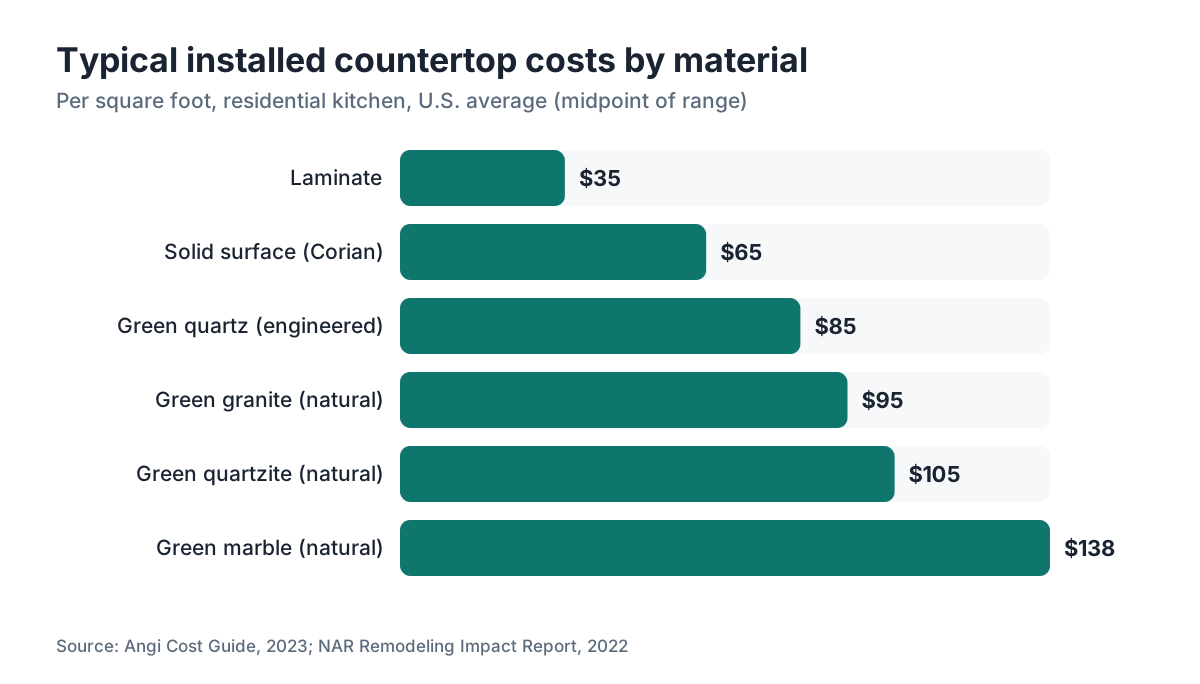
For context, laminate countertops can mimic green stone looks for $20 to $50 per square foot installed, and marble countertops in green-veined varieties often run $80 to $200 installed. Quartz sits in a good middle ground on both cost and maintenance.
How durable is green quartz compared to other countertop materials?
Quartz rates 7 on the Mohs hardness scale [5]. That puts it harder than most kitchen tools and above granite's typical range of 6 to 6.5. You can set a ceramic plate on it without worrying. You shouldn't cut directly on it (that dulls your knives and risks micro-scratches), but it holds up to normal kitchen traffic very well.
Heat is the real weak point. The polymer resin in engineered quartz can discolor or crack under sudden high heat. Manufacturers including Cambria and Silestone warn plainly against setting hot pans directly on the surface [6]. Use a trivet. This is the one place where natural stone like granite has a genuine edge.
UV exposure is another limit. Extended direct sunlight can make engineered quartz yellow or fade over time. For outdoor kitchens or counters in sun-drenched atriums, you'd be better served by a material rated for UV exposure.
Stain resistance is excellent. Because the surface is non-porous, liquids sit on top rather than soaking in. Wine, coffee, and cooking oil wipe off easily. Permanent marker and paint can be more stubborn but usually yield to a mild solvent.
For comparison, butcher block countertops need annual oiling and are far more vulnerable to water damage. Quartz's low-maintenance profile is genuinely one of its strongest arguments.
How do you clean and maintain green quartz countertops?
Daily cleaning is dead simple: warm water and a few drops of dish soap on a soft cloth. Wipe, rinse, done. NSF guidance on food-contact surfaces recommends avoiding abrasive scrubbers that can scratch polymer-bonded surfaces [2].
For dried-on gunk, a plastic scraper works fine. Don't use steel wool or scouring pads. For tougher spots like dried paint or rubber marks, a little isopropyl alcohol or a non-abrasive cleaner like Bar Keepers Friend (the soft cleanser form, not the powder) works without damaging the surface.
What to avoid:
- Strong alkaline cleaners (oven cleaner, drain cleaner) can break down the resin over time
- Bleach at high concentrations can dull the surface, though occasional diluted use is generally fine
- Abrasive scrubbing pads in any form
- Oil-based cleaners that leave a residue
No sealers. No polishes. No waxing. This is a wipe-and-go surface, which is part of why it's popular in busy households.
For a broader look at stone and stone-look surface care, our guide on how to clean stone countertops covers why different surfaces need different approaches.
What kitchen styles work best with green countertops?
Green is one of the most versatile countertop colors in actual practice, even though it sounds bold on paper.
Sage and muted greens pair naturally with white or cream shaker cabinets. The combination reads as calm and organic, fitting the aesthetic that's dominated kitchen design trends since roughly 2019. If your cabinets are cream colored, a sage quartz reads softer than a true green and can feel almost neutral.
Cream colored quartz countertops used to be the safe choice for neutral kitchens, and some homeowners now pair cream quartz perimeter counters with a green quartz island as a two-tone design. That approach lets you test a bold color in a limited area.
Deep greens like forest or emerald work well against white or very pale cabinets and against natural wood tones. Pair a hunter green quartz with brass hardware and natural oak cabinets and you'll get a result that photographs well and feels grounded.
Warm greens with olive or yellow undertones are harder to pair. They can clash with cool gray cabinets. If you're going olive, warmer whites and wood tones are safer cabinet choices.
One practical note: look at slab samples in your actual kitchen light, more than in a showroom. Green is one of the colors most affected by light color temperature. A sage that looks perfect under warm incandescent lighting can look washed out under cooler LEDs.
Which brands make the best green quartz countertops?
Several major manufacturers have consistent green offerings worth knowing about.
Silestone (owned by Cosentino) has one of the broader green palettes, including Posidonia Green (a muted teal-green tied to their sustainability line using recycled content) and older classics like Verde Fun [3]. Silestone carries a 25-year residential warranty.
Cambria is a U.S.-manufactured quartz brand known for color consistency and thicker standard slabs (often 1.25 inches vs. the 0.75-inch standard elsewhere). Its green options lean toward veined marble looks rather than solid color. Cambria countertops are worth a closer look if you want domestic manufacturing provenance.
MSI Surfaces has grown its quartz line aggressively and offers solid green options at various price points, often easier to find in stock than specialty colors from premium brands.
Caesarstone's green offerings are more limited in the U.S. market, but its quality and warranty (lifetime limited for residential) are strong [6].
IKEA stocks engineered quartz through its KALLARP and KASKER lines, and green variants show up periodically, though stock is limited and slab sizes are smaller than fabricator-grade material.
For fabricators: check your regional distributor's stock list before promising a specific color to a customer. Lead times on specialty quartz colors can run 4 to 8 weeks on back-order.
Is green quartz good for bathrooms or just kitchens?
It works fine in bathrooms. The non-porous surface is arguably a better fit for a bathroom vanity than a kitchen, because bathroom counters face fewer heat threats and the biggest enemy is moisture, which quartz handles well.
Vanity tops in sage or soft green quartz pair well with white or freestanding tubs, brushed nickel hardware, and natural wood accents. Deep green quartz on a bathroom vanity with matte black fixtures has become a fairly standard high-end bathroom look.
One size consideration: bathroom vanity tops are often smaller than kitchen counters, which means less material cost but also potentially more waste if the slab minimum at your supplier is large. Most fabricators keep remnant bins with smaller pieces at reduced cost, and a bathroom vanity is a good application for a remnant that came off a larger kitchen job.
Outdoor bars and laundry rooms are also reasonable applications with the caveat around UV exposure mentioned earlier. Keep quartz out of direct long-term sunlight.
How does green quartz compare to green natural stone options?
The main natural-stone alternatives to green quartz are verde Guatemala granite, green quartzite (Verde Butterfly is popular), green soapstone (uncommon but real), and various green marbles like Verde Alpi or Ming Green.
| Feature | Green quartz | Green granite | Green quartzite | Green marble | |---|---|---|---| | Porosity | Non-porous | Low to medium | Medium | High | | Sealing needed | No | Annually | 1-2x per year | 1-2x per year | | Heat resistance | Low (polymer) | High | High | Medium | | Scratch resistance | High (7 Mohs) | High (6-6.5 Mohs) | High | Low (3-4 Mohs) | | Color consistency | Very high | Variable | Variable | Variable | | Price (installed) | $50-$120/sq ft | $55-$130/sq ft | $60-$150/sq ft | $75-$200/sq ft | | UV stability | Low-medium | High | High | High |
Natural stone varies slab-to-slab, which is a feature for some buyers and a headache for others. If you order two slabs of verde Guatemala for a large kitchen, they may not match perfectly. With engineered quartz, batch-to-batch color consistency is tightly controlled.
For outdoor applications or areas with real heat exposure, a natural green granite is a stronger call than quartz. For a low-maintenance indoor kitchen with consistent color, quartz wins the practical argument.
Our guide on how to clean quartzite countertops covers the maintenance side of natural green stone in more detail.
What should you ask a fabricator before ordering green quartz?
A few questions will save you surprises:
-
Is this color in stock locally, or does it need to be ordered? Some greens, especially limited-edition shades, come with 4 to 8 week lead times. Know this before you schedule your installation.
-
Can I see the actual slab I'm buying, more than a sample? A 4-inch tile sample doesn't show how the veining or texture will look across a full counter run. Most yards will pull the specific slab for you to approve.
-
How will seams be placed, and will they show more on a dark solid color? On a deep, saturated green, seams can be more visible than on a light or heavily veined material because the color is uniform enough that any slight variation in polish or alignment catches the eye.
-
What edge profile is included in the quote, and what's the upcharge for others? A standard eased or beveled edge is usually included. Ogee or waterfall edges add cost, sometimes a lot.
-
What's your lead time from template to install? Standard residential fabrication usually runs 7 to 14 days from template. Busy seasons or material availability can push that out.
For the countertop installation process in general, see our countertop installation guide, which covers what to expect from template day through final set.
Does green quartz hold its value or hurt resale?
This is genuinely hard to quantify. No major real estate study has isolated countertop color as an independent variable on sale price, and anyone who gives you a confident number here is probably making it up.
What we do know: the National Association of Realtors' 2022 Remodeling Impact Report found that kitchen upgrades recouped on average about 67 percent of their cost in increased home value [7]. The report doesn't break down by color.
The practical concern is whether a bold-colored counter narrows your buyer pool. That depends heavily on local market tastes, price point, and how the rest of the kitchen looks. A sage green quartz in a well-executed kitchen will likely appeal to most buyers. A high-chroma emerald in a kitchen that doesn't support it might not.
If you're flipping or preparing to sell within a year, a neutral surface (white, gray, soft beige) is statistically safer because it appeals to the widest range of buyers. If this is a 10-year kitchen, pick what you actually love. The resale math rarely pays off the way people expect when the choice affects your daily enjoyment for a decade.
Are there environmental or safety considerations with quartz countertops?
Silica dust is the real occupational health issue in quartz fabrication, not in finished-surface use. The resin-bound quartz in a finished countertop is inert and stable. The danger is during cutting and grinding in the shop, where workers can inhale respirable crystalline silica.
OSHA's permissible exposure limit for respirable crystalline silica is 50 micrograms per cubic meter of air as an 8-hour time-weighted average [8]. OSHA has had a specific rule on silica in construction (29 CFR 1926.1153) since 2017, and the general industry rule (29 CFR 1910.1053) followed. These rules require wet-cutting or on-tool dust collection for fabricators working with engineered stone.
For finished, in-home use, there's no silica dust exposure risk to homeowners. The surface is locked in resin.
On the environmental side, engineered quartz production is energy-intensive and resin-based, so it's not a low-carbon material. Some manufacturers (Silestone's HybriQ line, for instance) have moved toward recycled quartz content and lower-emission binders [3]. If environmental footprint matters to you, ask specifically about recycled content percentages and whether the manufacturer holds any third-party environmental certification.
VOC emissions from cured resin in finished quartz slabs are generally low, but the data on specific off-gassing over time in residential settings is thin. The Healthy Building Network has catalogued some quartz products, but published research on long-term indoor VOC contribution from engineered stone countertops is limited as of this writing.
Frequently asked questions
Is green quartz a popular countertop choice right now?
Green has moved from niche to mainstream in roughly the past four years. Sage and muted greens in particular track with a broader interior design shift toward earthy, nature-adjacent palettes. Deep emerald and forest greens remain more of a statement choice. Most major quartz manufacturers now include at least a few green options in their standard lineup, which wouldn't have been true in 2018.
Will green quartz fade over time?
In indirect indoor light, no meaningful fading should happen over a normal product lifetime. Extended direct sunlight is a different story. UV exposure can make the polymer resin yellow or shift the pigment, which is why manufacturers generally advise against engineered quartz in outdoor kitchens or in direct sun. Most brands cover fade under their residential warranty for indoor applications only.
Can I put hot pans directly on green quartz?
No. The polymer resin that binds engineered quartz can discolor or crack from sudden thermal shock. Cambria, Silestone, and Caesarstone all exclude heat damage from their warranties. Use a trivet or hot pad every time. This is the single biggest limitation of quartz versus natural stone, which handles heat much better.
Does green quartz stain easily?
It's one of the most stain-resistant countertop surfaces available, precisely because it's non-porous. Red wine, coffee, turmeric, and cooking oil wipe off without leaving a mark in normal use. Permanent marker and some oil-based pigments can be more persistent but usually respond to isopropyl alcohol. Avoid strong alkalis like oven cleaner, which can damage the resin.
What cabinet colors go best with green quartz countertops?
White and off-white cabinets are the most forgiving pairing across all green shades. Cream and warm white cabinets work especially well with sage and olive greens. Natural wood tones complement forest and hunter greens. Cool gray cabinets are trickier, they can clash with warm-toned greens. Two-tone kitchens using a neutral perimeter cabinet with a green quartz island have become a popular way to introduce the color without full commitment.
How thick should green quartz countertops be?
The two standard thicknesses are 2 cm (about 3/4 inch) and 3 cm (about 1.25 inches). Three cm is more common in U.S. residential kitchens because it looks substantial without a built-up edge and is generally stronger under point loads. Two cm costs less per slab but often needs plywood substrate support. For most kitchen applications, 3 cm is the better choice unless budget is the binding constraint.
How is green quartz different from green quartzite?
They're completely different materials. Green quartz is engineered, factory-made from ground quartz bound in resin. Green quartzite is a naturally metamorphosed sandstone, quarried in slabs, highly variable in pattern, porous enough to need sealing, and heat-tolerant in a way engineered quartz is not. Quartzite is often more expensive and visually unique. Quartz is more consistent and maintenance-free. The similar names cause genuine confusion at the showroom stage.
Can green quartz be used in outdoor kitchens?
Manufacturers generally don't recommend it. Engineered quartz is not rated for UV exposure, and extended sunlight causes resin yellowing and potential color shift, which looks terrible on a green surface. Heat from outdoor grills is also a concern. If you want a green stone look outside, natural green granite handles both UV and heat without issue. Indoor applications are where quartz performs best.
What's the best way to get an accurate quote for green quartz countertops?
Measure your countertop footprint in square feet (length times width for each run), note how many sink or cooktop cutouts you need, and identify what edge profile you want. Get at least three quotes from local fabricators. Prices can vary 20 to 40 percent for identical material and scope depending on the shop. Online quote calculators can give you a ballpark, but a fabricator needs to template your actual kitchen to price it precisely.
How long do green quartz countertops last?
With normal use and basic cleaning, engineered quartz should last 20 to 30 years or more without significant degradation. Most premium brands offer 10 to 25 year residential warranties, and some (Cambria and Caesarstone) offer lifetime limited warranties. The most common reasons for early replacement are impact damage (chips from dropped cast iron) or heat damage from hot pans, both of which are preventable.
Are there budget-friendly options for green quartz countertops?
Yes. Entry-level engineered quartz from suppliers like MSI or through big-box retailers like Home Depot or Lowes (who stock select quartz lines) can bring installed cost closer to $50 to $65 per square foot. IKEA's custom countertop service also offers quartz at accessible prices, though with limits on slab size and edge options. The trade-off at lower price points is usually fewer color options and less warranty coverage.
Do green quartz countertops look good in small kitchens?
It depends on the shade. Pale sage or mint green in a small kitchen can feel fresh without making the space feel smaller, especially with good lighting and light cabinet colors. Deep emerald or forest green in a very small kitchen can feel heavy. If your kitchen is under 100 square feet, a lighter green or using green only on an island gives you the color story without the visual weight.
What's the difference between green quartz and green solid surface like Corian?
Corian and similar solid surface materials are 100 percent acrylic or acrylic-blend, with no quartz content. They're softer (scratch more easily), can be sanded and repaired in place, cost less in many configurations, and have a matte look that some prefer. Quartz is harder and more scratch-resistant but chips rather than scratches when hit hard. Corian's green color range is actually quite wide. See our guide on Corian countertops for a fuller comparison.
How do I choose between a solid green quartz and a veined green quartz?
Solid-color green countertops make a stronger graphic statement but show water spots, crumbs, and smudges more readily than veined surfaces because there's no visual noise to hide them. Veined green marble-look quartz is more forgiving in a busy kitchen and appeals to buyers who want the look of natural stone. If you have young kids or a high-traffic kitchen, a veined pattern is the more practical call even if you love the solid look.
Sources
- Marble Institute of America (now Natural Stone Institute), Dimension Stone Design Manual: Engineered quartz countertops are composed of approximately 90 to 94 percent ground quartz crystals bound with 6 to 10 percent polymer resins and pigments
- NSF International, NSF/ANSI 51 Food Equipment Materials standard: Non-porous surfaces meeting NSF/ANSI 51 are recognized as hygienically acceptable for food-contact use; abrasive cleaners are advised against on polymer-bonded surfaces
- Cosentino Group, Silestone HybriQ Technology product information: Silestone's HybriQ product line uses recycled quartz content and describes a lower-emission binder process; Posidonia Green is a limited-edition color tied to the sustainability campaign
- HomeAdvisor (Angi), Quartz Countertops Cost Guide: Installed costs for engineered quartz countertops typically range from $50 to $120 per square foot for most residential projects
- U.S. Geological Survey, Mineral Resources Program, Mohs Hardness Scale reference: Quartz rates 7 on the Mohs hardness scale
- Caesarstone, Product Care and Maintenance documentation: Caesarstone explicitly warns against placing hot pans directly on engineered quartz surfaces and offers a lifetime limited warranty for residential use
- National Association of Realtors, 2022 Remodeling Impact Report: Kitchen upgrades recouped on average about 67 percent of their cost in increased home value according to the 2022 NAR Remodeling Impact Report
- U.S. Occupational Safety and Health Administration, Silica Rule for Construction (29 CFR 1926.1153) and General Industry (29 CFR 1910.1053): OSHA's permissible exposure limit for respirable crystalline silica is 50 micrograms per cubic meter of air as an 8-hour time-weighted average; OSHA rules require wet-cutting or on-tool dust collection for fabricators
- Cambria, Product Warranty and Care Documentation: Cambria offers a lifetime limited residential warranty and explicitly warns against direct heat contact on engineered quartz surfaces
- MSI Surfaces, Quartz Product Line catalog: MSI Surfaces offers solid green quartz options at multiple price points including Sparkling Sage and Everest in their standard quartz lineup
Last updated 2026-07-09