TL;DR
- Green marble countertops run $60 to $200 per square foot installed, depending on the variety.
- They're striking but genuinely high-maintenance: marble etches from acids and scratches more easily than granite or quartzite.
- Seal it consistently, accept the patina that real stone earns, and green marble is a legitimate long-term choice.
- Want zero worry?
- It probably isn't your material.
What exactly is green marble, and where does it come from?
Green marble is metamorphic limestone, formed when heat and pressure recrystallize calcite or dolomite over millions of years. The green comes from minerals introduced during that process, most often serpentine, chlorite, or fuchsite (a chrome-rich muscovite mica). The mineral present decides whether the green reads as deep forest, sage, gray-green, or bright emerald. [1]
Most of the green marble in U.S. slab yards traces back to a handful of quarries. Verde Alpi (also called Alpine Green) comes from the Valle d'Aosta region of Italy and has a dark green background with white veining. Verde Guatemala originates in Guatemala and runs bolder, often brighter, with heavy white or black veining. Ming Green, a lighter celadon-toned stone, comes mostly from China. It's softer and more porous than the Italian stones, which matters a lot on a countertop. Rainforest Green, quarried in India, has a dramatic web of gold and brown veins over a medium-green base.
A few products sold as "green marble" are actually serpentinite, not true marble. Serpentinite is also metamorphic but comes from ultramafic rock rather than limestone. It's harder than limestone-based marble and less prone to acid etching, which matters when you're comparing countertop options side by side. [1] Ask your fabricator to confirm the stone's mineralogy if that distinction matters. They can usually tell from the supplier paperwork or a quick acid test.
Origin affects more than looks. Italian Verde Alpi is quarried in limited quantities, so prices stay high and availability jumps around. Indian Rainforest Green ships in larger volumes, so slabs are easier to find and to match if you ever need a replacement piece. For a kitchen island, that continuity of supply is a real practical concern.
What are the most popular green marble varieties for countertops?
The table below covers the varieties you'll actually find at U.S. slab distributors, with honest notes on hardness, veining, and price. Mohs hardness matters because a countertop takes daily abrasion. Marble runs 3 to 4 on the Mohs scale versus granite's 6 to 7. [2]
| Variety | Origin | Mohs (approx.) | Vein Style | Price tier (material only, per sq ft) |
|---|---|---|---|---|
| Verde Alpi | Italy | 3 to 4 | Fine white veins on dark green | $80, $150 |
| Verde Guatemala | Guatemala | 3 to 4 | Bold white/black on bright green | $70, $130 |
| Ming Green | China | 2.5 to 3.5 | Subtle, low-contrast veining | $40, $80 |
| Rainforest Green | India | 3 to 4 | Gold/brown web on medium green | $50, $100 |
| Verde Issorie | Italy | 3 to 4 | Gray-green with white fracture lines | $90, $160 |
| Irish Green | Ireland | 3 to 4 | Pale green, fossil fragments visible | $80, $140 |
Ming Green is the cheapest, and it's also the most porous and softest on this list. It shows up on bathroom vanities, where acid exposure is lower and traffic is lighter. In a kitchen where someone cuts lemon halves on the counter or wipes up vinaigrette, Ming Green is a gamble. Verde Alpi holds up better, and the price says so.
Verde Guatemala earns its own mention. The contrast between the vivid green and the white veining is loud enough that designers use it as a focal point even in commercial spaces. It usually comes in 3-cm slabs for countertops, which adds rigidity.
Want a green stone with more surface hardness? Ask your fabricator to price Verde Quartzite or Seafoam Quartzite. They look similar at a glance, and some suppliers even mislabel them, but quartzite is far harder (Mohs 7) and acid-resistant. The how to clean quartzite countertops guide walks through that distinction.
How much do green marble countertops cost?
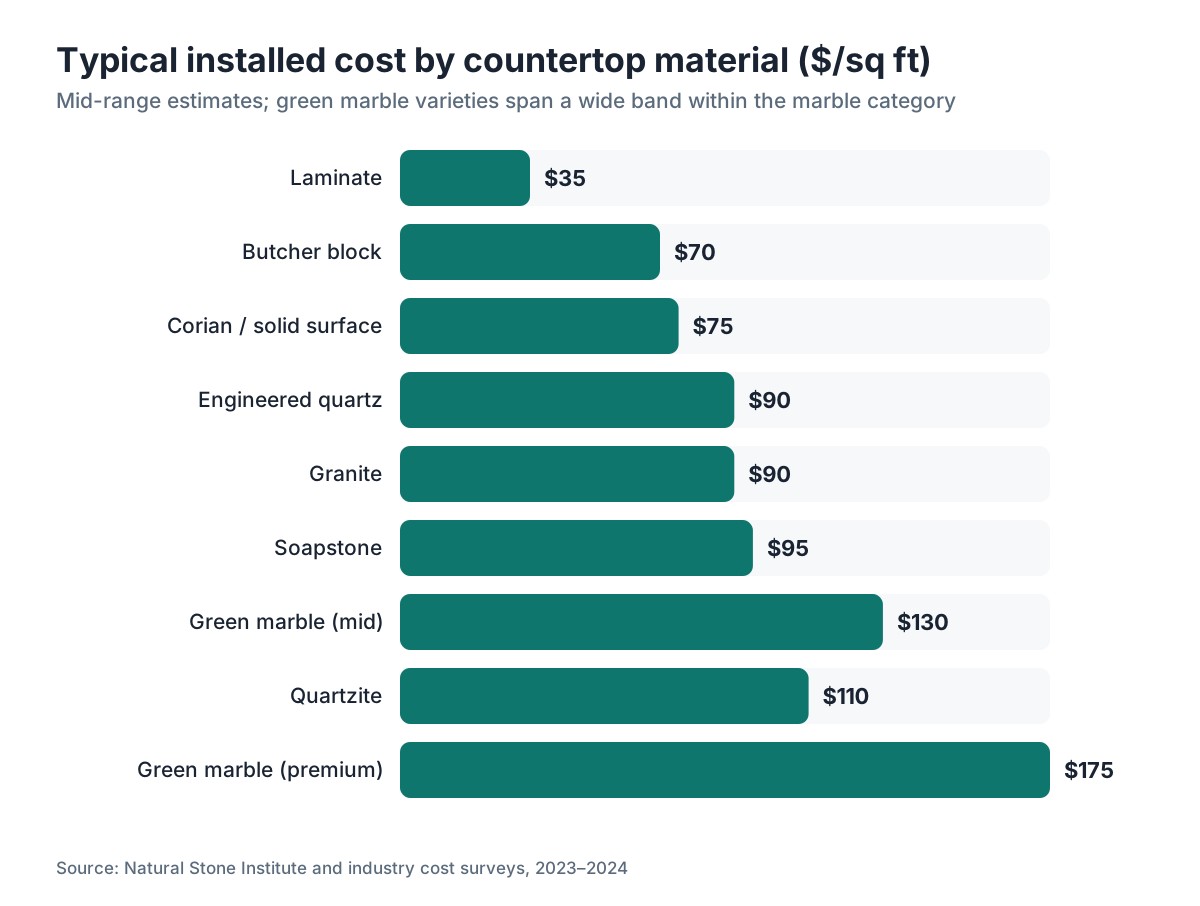
Green marble runs roughly $60 to $200 per square foot installed, and most projects land between $80 and $150 once you add fabrication, edge profiles, and installation labor. [3] The slab alone costs $40 to $160 per square foot depending on variety and where you buy.
A typical kitchen with 40 square feet of counter runs $2,400 to $8,000 installed for mid-range green marble, or $5,000 to $12,000 for a rare Italian variety with heavy waste from vein-matching. That waste factor is the sleeper cost. A heavily veined slab like Verde Alpi can need 25 to 35 percent more material than your bare square footage, because you're book-matching or orienting the veins to flow across corners. [3]
Region moves the number too. Labor costs more in coastal metros than in the midwest, and distributor markup swings widely. The same Verde Guatemala slab that goes for $70 per square foot at a wholesale yard in Atlanta might hit $110 at a boutique tile showroom in San Francisco.
Edge profiles add cost. A simple eased edge adds nothing. An ogee or waterfall edge on a 3-cm slab adds $15 to $25 per linear foot. A full mitered waterfall island in green marble, where vertical panels drop to the floor, gets expensive fast. Labor alone on a 10-foot island runs $1,500 to $3,000 depending on complexity.
For fabricators quoting marble jobs, the waste calculation and the edge pricing are where margin quietly leaks. Software like SlabWise handles slab nesting, so you can show clients exactly how much of a slab they're using and price the waste honestly.
For context, see what marble countertops cost broadly and how granite countertops compare on price and durability.
Does green marble etch, stain, and scratch more than other countertop materials?
Yes, and being honest about this upfront saves a lot of post-install regret. Marble is calcium carbonate. Any acid, including citrus juice, wine, coffee, tomato sauce, and vinegar-based cleaners, reacts with the calcite and dissolves a thin layer of the surface, leaving a dull, lighter mark called an etch. [4] This is a chemical reaction, not a stain, and sealing does nothing to stop it. Sealers block moisture and slow staining. Etching is a separate problem.
On a polished surface, etches jump out, because the dull spot fights the shine around it. On a honed (matte) surface, etches nearly disappear, because there's no gloss for them to contrast against. This is the single biggest practical decision you'll make for a kitchen marble counter. Want polished? Accept that you'll see etch marks and either re-polish now and then or embrace the patina. Want low drama? Specify honed.
Scratching is real too. Marble's Mohs hardness of 3 to 4 means a stainless steel knife (Mohs 5.5 to 6.5) can scratch it if you drag it across the surface. [2] Always use a cutting board. This isn't unique to green marble. All marble does this.
Staining is different from etching. It happens when a liquid soaks into the pores and leaves color behind. Oils, red wine, and dark liquids are the usual suspects. A good impregnating sealer slows this a lot, but no sealer makes marble stain-proof. Darker green marbles like Verde Alpi hide stains better than light-colored stones, because the color difference is smaller.
Want the look with far less worry? Engineered quartz (Cambria makes a handful of green-toned options) or sintered porcelain slabs that mimic marble are honest alternatives. The Cambria countertops guide covers one well-known engineered option.
How do you seal and maintain green marble countertops?
Sealing is simple, but it has to happen on a schedule. Apply a penetrating impregnating sealer, not a topical coating, at installation, then again every 6 to 12 months for kitchen use. [5] Here's the test to know your seal is working: drip water on the surface and watch. If it beads for 30 seconds or more, you're fine. If it soaks in fast and the stone darkens, reseal.
For daily cleaning, use a pH-neutral stone cleaner, or just warm water with a few drops of dish soap (rinse well so no soap film builds up). Never use vinegar, lemon juice, bleach, ammonia, or general-purpose household sprays. Most multi-surface cleaners run slightly acidic and will etch marble over time. [5] That's true for honed surfaces as much as polished ones, though the damage hides better on honed.
For fabricators: always hand off care instructions in writing. A short care card listing the stone type, the sealer brand you used, and a cleaning protocol cuts warranty disputes and callbacks. The Marble Institute of America (now part of the Natural Stone Institute) publishes care guidelines you can hand clients directly.
Blot spills, don't wipe them. Wiping spreads the liquid. Blotting lifts it. For an oil stain that's already soaked in, a poultice of baking soda and water (or a commercial stone poultice) pulls the stain out over 24 to 48 hours. [5]
Got a polished surface with existing etch marks? A marble polishing powder (tin oxide-based) rubbed with a soft cloth restores local gloss. For deep scratches or heavy etching across large areas, professional re-honing or re-polishing is the right call. That's a stone restoration contractor's job, not a DIY weekend.
The broader guide on how to clean stone countertops has a fuller protocol.
Is green marble a good choice for kitchen countertops versus bathroom vanities?
Honest answer: bathroom vanity yes, kitchen counter maybe, and it comes down to how much maintenance and patina the homeowner will tolerate.
In a bathroom, acid exposure is low. You're mostly dealing with water, hand soap, and the odd toothpaste smear. Sealing once a year covers it. The payoff is high, because a vanity is high-visibility and low-traffic. A Verde Alpi vanity top is hard to beat at that price point.
A kitchen changes the math. Every time someone squeezes lemon over the sink and a drop lands on the counter, decants a bottle of wine, or wipes down with a vinegar solution, acid meets a calcite surface. Some homeowners shrug at this. Chef's kitchens in old Italian farmhouses have had marble for a century, and the worn, etched, deeply patinated surface is the whole point. In that camp? Go for it.
Want your countertop to look the same in ten years as it did on install day? Marble is the wrong material. Engineered quartz, real metamorphic quartzite (not quartzose sandstone), or a quality granite countertop all handle kitchen chemistry better.
Outdoors is a flat no. Marble weathers badly. Freeze-thaw cycles and UV dull and pit the surface fast. For outdoor kitchens, granite or through-body porcelain is the answer.
Green marble also does well in lower-traffic zones: a butler's pantry, a home bar, a laundry-room folding counter. Anywhere the surface looks beautiful but never sees daily cooking prep.
How does green marble compare to other countertop materials on durability and price?
Here's a side-by-side that puts green marble next to the other popular choices.
| Material | Mohs hardness | Acid etch risk | Avg installed cost ($/sq ft) | Sealing needed |
|---|---|---|---|---|
| Green marble | 3 to 4 | High | $80, $200 | Yes, every 6 to 12 mo |
| Granite | 6 to 7 | Low | $50, $130 | Yes, every 1 to 3 yr |
| Quartzite | 7 | Very low | $70, $150 | Yes, every 1 to 2 yr |
| Engineered quartz | 7 | None | $60, $120 | No |
| Soapstone | 1 to 2 | Low (non-calcite) | $70, $120 | Oil only |
| Butcher block | N/A | N/A | $40, $100 | Oil/wax, 2 to 4x/yr |
| Laminate | N/A | Low | $20, $50 | No |
Granite is harder, more chemically resistant, and usually cheaper per square foot. [3] If the real draw of green marble is the color, ask whether a green granite, a quartzite with a greenish cast, or even a polished serpentinite gets you the look with better durability.
Soapstone is worth a look. It doesn't etch, because it's silicate-based rather than carbonate-based, and it comes in a natural gray-green family. [6] It scratches easily (Mohs 1 to 2), but scratches sand out with fine-grit paper. The how to clean soapstone countertops guide covers that tradeoff.
Butcher block at $40 to $100 per square foot installed is a fraction of green marble's cost. It has its own upkeep and you can't set hot pans on it, but for a kitchen where you want warmth instead of stone, it's worth a thought. The butcher block countertops guide goes into detail.
For homeowners chasing zero maintenance and a clean look, Corian and laminate cost far less and forgive almost everything. The Corian countertops and laminate countertops guides both make the case for surfaces that get dismissed too quickly in showrooms.
What should you ask a fabricator before buying green marble slabs?
These are the questions worth asking before you sign off on material, not after the slab is cut.
Ask for the actual quarry name and country of origin, more than the trade name. Trade names are all over the place across distributors. The same stone gets called four different things depending on who imported it.
Ask about the slab's thickness. Countertop marble comes in 2-cm and 3-cm. Three centimeter (roughly 1.25 inches) is more structurally sound, especially at unsupported overhangs. Two centimeter is fine for backsplashes and some bathroom vanities.
Ask how many slabs they have from the same lot. If you need 60 square feet and they only have one slab covering 55, you're looking at a seam and a possible color mismatch on the second slab from a different lot. Book-matched pairs from the same block are ideal, and they cost more.
Ask flat out whether the variety is serpentinite or calcite-based marble. If the distributor doesn't know, a few drops of muriatic acid (handled safely) on a hidden edge tells you: it fizzes on calcite and does nothing on serpentinite. This sets your acid-etch expectations.
Ask which edge profiles they can cut in this stone and whether any are off the table. Some marble carries natural fissures that make tight ogee or pencil-round profiles chip. A fabricator who knows their stone will tell you.
Ask about turnaround. Some varieties, especially Italian, carry 4 to 8 week lead times when the distributor has to order from an importer. Build that into your schedule alongside the broader countertop installation timeline.
How do you choose between polished and honed finishes for green marble?
Polished green marble is visually intense. The color saturation climbs, the veining pops, and the reflective surface adds depth. That's why green marble in a showroom photo looks so dramatic. The trade-off: every etch mark and water spot shows clearly against that mirror.
Honed is a matte surface, made by stopping the polishing process before the final buff. The color goes slightly quieter and the veining slightly less vivid, but etch marks turn nearly invisible, because there's no gloss for them to fight. For a kitchen or any high-use counter, honed is the smarter pick. Plenty of designers prefer the honed look on green marble anyway. It reads as more architectural and less flashy.
Leathered is a third option some fabricators offer. Diamond brushes create a lightly textured matte surface that hides fingerprints, water spots, and etch marks well. The texture also makes the surface less slippery, a small bonus near sinks. Not every shop has the tooling, so ask early.
One thing to remember: once a slab is polished, honing it takes a pro running the right tooling. You can go polished to honed, but you can't go the other way without re-polishing the whole surface. Unsure at purchase? Honed is the safer default.
What kitchen design styles pair well with green marble countertops?
Green marble is specific enough as a material that it works better in some rooms than others. Here's where it lands well.
White or cream cabinetry is the most common pairing and the safest one. Light cabinets let the green stone carry the room without competition. Verde Alpi or Verde Guatemala over shaker-style white cabinets with unlacquered brass hardware has shown up in high-end kitchens for a decade, and it holds because the contrast is strong and the brass picks up the gold undertones in the veining.
Navy or forest-green cabinetry with green marble builds a tone-on-tone effect that works when the tones differ a little (say, a cool marble against warm-painted cabinets). The risk is muddiness. This one needs a designer's eye or a very large sample before you commit.
Natural wood tones pair well because stone and wood have visual logic together. A kitchen with walnut or white oak cabinets and a Rainforest Green marble island reads as genuinely natural rather than decorative.
Green marble fights competing strong patterns, like a busy multi-color tile backsplash. Keep the backsplash simple: a neutral field tile, a white subway, or a stone mosaic that borrows one color from the marble. The counter is the pattern. Everything else stays quiet.
For a wider look at how stone counters fit into kitchen design, the kitchen countertops guide covers layout and material choices across the full range.
Are there any known health or environmental concerns with green marble?
Two questions come up often enough to answer head-on: radon and asbestos.
First, radon. Granite gets the attention here, because some granites hold trace uranium that can off-gas radon. Marble, green included, generally carries lower uranium content than granite, and the U.S. EPA has said the radon contribution from stone countertops is typically small compared to radon entering through foundations. [7] EPA guidance notes that no study has shown stone countertops to be a significant source of radon in homes. If you're still uneasy, a $15 short-term radon test kit gives you real data for your house. Testing your air beats worrying about the stone's mineral content in the abstract.
Second, serpentine content and asbestos. Some green stones, especially those quarried from serpentinite, can contain naturally occurring asbestiform minerals. This is a documented concern with certain Italian serpentinites. [8] A properly finished, sealed, intact slab poses minimal inhalation risk, but cutting, grinding, or sanding these stones (which happens during fabrication) can release fibers. Shops working serpentinite varieties should use wet-cutting methods and proper respiratory protection. OSHA's silica and mineral-fiber rules apply to stone fabrication workers. [9] For a homeowner with an installed, undisturbed countertop, the risk is very low. The concern is mainly occupational.
On the environmental side, quarrying disturbs land, but marble skips the energy-heavy manufacturing that engineered materials need. The main environmental cost is transport. Italian marble shipped to the U.S. carries a bigger carbon footprint than domestically quarried alternatives, though truly domestic green marble options are thin.
How does the installation process work for green marble countertops?
Green marble installs in the same sequence as any stone countertop, but a few steps need extra attention for this material.
Templating comes first. A fabricator measures the cabinets precisely, either with a digital laser system or a physical template made from luan board. For a heavily veined marble like Verde Alpi, where vein orientation matters, the template session is also when you mark how the veins should run. Get this right before any cutting starts. Stone is not reusable once it's cut wrong. [10]
Slab selection at the yard should happen in person whenever possible. Green marble varies a lot from slab to slab within the same variety. Bring a photo of your cabinets and flooring. Check the slab under different lighting angles. Some color and movement only shows up under low-angle light (a technique called raking the slab). Budget half a day if you're being careful.
Cutting uses a bridge saw or a CNC machine with diamond tooling and water-cooling. Water-cooling is non-negotiable for marble. Dry cutting generates heat that stresses the stone and creates micro-fractures at cut edges. [10]
Installation uses 100-percent silicone adhesive on the cabinet base and epoxy for seam adhesion. For green marble, the fabricator usually color-matches the epoxy to the stone background so the seam nearly disappears. Seams are inevitable on runs longer than roughly 9 feet. Placement matters, and a good fabricator sets them in low-visibility spots and talks through options before cutting.
Let the countertop sit undisturbed for 24 hours before use and 48 to 72 hours before the initial sealer. Once the sealer cures, the surface is ready for daily use.
Frequently asked questions
Is green marble suitable for kitchen countertops?
Green marble works in a kitchen if you'll seal it twice a year and accept that acid spills (citrus, vinegar, wine) will etch it over time. On a honed finish those marks barely show. On a polished finish they show clearly. If you want truly low-maintenance kitchen countertops, quartzite or granite hold up better to daily cooking chemistry without giving up a natural stone look.
How much does green marble cost per square foot installed?
Installed cost ranges from $60 to $200 per square foot depending on variety, edge profile, and location. Mid-range varieties like Rainforest Green or Verde Guatemala typically land at $80 to $130 installed. Rare Italian varieties like Verde Alpi or Verde Issorie push toward $150 to $200. Material waste from vein-matching can add 25 to 35 percent to the raw slab cost.
What is the most popular green marble for countertops?
Verde Guatemala and Rainforest Green are the most widely available in U.S. slab yards. Verde Alpi is the most requested premium option. Ming Green is common in bathrooms because it's affordable with soft, subtle coloring, though it's too porous and soft for a high-use kitchen. If dramatic veining is the goal, Verde Guatemala gives the highest contrast between green field and white veins.
Does green marble need to be sealed?
Yes. Green marble is porous and will absorb oils, red wine, and dark liquids if left unsealed. Apply a penetrating impregnating sealer at installation and again every 6 to 12 months for kitchen surfaces. Sealing slows staining but does not prevent acid etching. Test the seal by dripping water on the surface. If the stone darkens and absorbs within a few seconds, it's time to reseal.
How do you remove etch marks from green marble?
Light etches on a polished surface buff out with a marble polishing powder (tin oxide-based) and a soft cloth using circular pressure. Deeper etches or large etched areas need professional re-polishing. On a honed surface, etch marks are usually invisible against the matte background and need no treatment. Sealing prevents stains but does nothing for etching, which is a chemical reaction, not a surface deposit.
What is the difference between green marble and green quartzite?
Marble is metamorphic limestone with calcite as its main mineral. Quartzite is metamorphic sandstone dominated by quartz. Quartzite rates 7 on the Mohs scale versus marble's 3 to 4, and quartzite doesn't etch from acids because it lacks calcite. Some distributors mislabel quartzite as marble or the reverse. Ask for documentation or request an acid spot test on a hidden edge: calcite fizzes, quartzite doesn't.
Is honed or polished green marble better for countertops?
Honed is the more practical choice for any countertop that sees regular use. The matte surface hides etch marks, water spots, and fingerprints far better than a polished surface. Polished green marble has more visual impact and color depth, which is why it's common in bathrooms and as a statement on a low-use bar or island. Unsure? Default to honed and you'll have fewer regrets.
Can you use green marble for a bathroom vanity?
Green marble is excellent for bathroom vanities. Acid exposure is much lower than in a kitchen, mostly hand soap and water, so etching is rarely an issue. The stone looks dramatic on a vanity where the surface area is modest and visibility is high. Seal at installation and once a year after. Ming Green and Verde Alpi both look exceptional in bathrooms and hold up well under normal use.
How do I clean green marble countertops day to day?
Use warm water and a few drops of pH-neutral dish soap, then rinse and dry. Never use vinegar, lemon juice, bleach, ammonia, or general-purpose multi-surface sprays. Most household cleaners run slightly acidic and will etch marble over time. Blot spills immediately rather than wiping, which spreads the liquid. For an oil stain that's soaked in, a baking soda and water poultice left 24 to 48 hours draws most of it out.
Does a green marble countertop add resale value to a home?
Natural stone countertops generally correlate with higher sale prices, though isolating the marble effect specifically is hard. The National Association of Realtors' 2022 Remodeling Impact Report found kitchen upgrades recover a meaningful share of cost on average. Natural stone reads as a premium upgrade to buyers, but the specific color matters less than overall kitchen quality and condition. A well-maintained green marble counter reads premium; a neglected, heavily etched one does not.
Is there asbestos risk with green marble or serpentine stone?
Some green stones from serpentinite formations can contain naturally occurring asbestiform minerals. Installed and undisturbed, the risk to homeowners is very low. The real risk is occupational: fabricators cutting or grinding serpentinite without wet-cutting methods and proper respiratory protection can inhale fibers. OSHA rules cover mineral-fiber exposure in fabrication shops. If you're concerned about a specific slab, ask the fabricator for the supplier's mineralogy report.
How thick should green marble countertops be?
Three centimeter (3-cm, roughly 1.25 inches) is the standard recommended thickness for countertops. It holds up at overhangs, resists cracking during transport and installation, and needs less lamination at edges for a substantial look. Two centimeter (2-cm) is fine for bathroom vanities or backsplashes, but it requires a plywood substrate underneath for countertop use to prevent flexing and cracking.
What backsplash works best with green marble countertops?
Keep it simple. Green marble carries enough pattern and color that a busy backsplash competes instead of complements. A neutral field tile in white, cream, or gray works well. A slab of the same marble running up the wall as a full backsplash is cohesive and very popular in higher-end kitchens. White or warm-cream subway tile with tight grout joints is a reliable default that won't fight the counter.
How long do green marble countertops last?
Structurally, green marble lasts for decades and has held up in buildings for centuries. The durability question for modern countertops is really about surface appearance. With consistent sealing and careful use, a green marble counter holds its beauty for 20 or more years. Without sealing, or with frequent acid exposure, heavy etching and staining can show within a few years. The stone won't fail; the surface finish needs ongoing maintenance.
Sources
- U.S. Geological Survey, National Minerals Information Center (marble and serpentinite resources): Green color in marble comes from metamorphic minerals including serpentine, chlorite, and fuchsite; some green stones are serpentinite rather than true marble
- U.S. Geological Survey, Mohs Hardness Scale reference image: Marble rates 3 to 4 on the Mohs hardness scale; granite rates 6 to 7; stainless steel rates 5.5 to 6.5
- Natural Stone Institute, stone industry education resources: Installed marble countertop costs and material waste factors for veined slabs
- Natural Stone Institute, marble care and maintenance guidance: Acids including citrus juice, vinegar, and wine etch marble through a chemical reaction with calcite; sealing does not prevent etching
- Natural Stone Institute, cleaning and sealing stone surfaces guidance: Penetrating impregnating sealers recommended every 6 to 12 months for kitchen marble; pH-neutral cleaners required; poultice method effective for oil stains
- U.S. Geological Survey, National Minerals Information Center (soapstone/steatite): Soapstone is silicate-based and does not etch from acids; Mohs hardness 1 to 2
- U.S. Environmental Protection Agency, Radon: EPA guidance states stone countertops are not a significant source of radon in homes compared to radon entering through foundations
- National Institute for Occupational Safety and Health (NIOSH): Some serpentinite formations contain naturally occurring asbestiform minerals; occupational exposure during cutting and grinding is the primary concern
- OSHA, Crystalline Silica standards: OSHA regulations govern worker exposure to respirable mineral fibers and silica dust in stone fabrication operations
- Natural Stone Institute, fabrication best practices: Water-cooling required during diamond-blade cutting of marble to prevent heat stress and micro-fractures; templating process determines vein orientation before cutting
- National Association of Realtors, 2022 Remodeling Impact Report: Kitchen upgrades recover a meaningful share of cost on average at resale; natural stone is a recognized buyer upgrade
Last updated 2026-07-09