TL;DR
- Gray quartz countertops run $55 to $150 per square foot installed, depending on brand, edge profile, and slab thickness.
- They never need sealing, resist stains well, and come in shades from pale silver-white to near-black charcoal.
- The main trade-off against natural stone is that the pattern repeats across slabs, which a sharp eye can spot up close.
What are gray quartz countertops, exactly?
Quartz countertops are engineered stone. That means they're manufactured slabs made from roughly 90 to 94 percent ground natural quartz crystals bound together with polymer resins and pigments [1]. They are not quarried slabs of solid quartz rock. The manufacturing process is what makes them non-porous by design, which separates them from granite, marble, or quartzite.
Gray is the most popular color family in engineered quartz [12]. Part of the reason is that gray reads neutral without the warmth of beige or the starkness of pure white, and it photographs well, which matters a lot in a real-estate market where kitchen photos do heavy lifting. Manufacturers produce dozens of gray variants, from faint silver veining on a light base to solid concrete-look charcoal.
The quartz crystals give the surface real hardness. Quartz scores a 7 on the Mohs hardness scale, against granite at 6 to 7 and marble at 3 to 4 [2]. That hardness translates to good scratch resistance in daily kitchen use, though it's not scratch-proof. Ceramic and steel knives won't easily mark the surface, but a carborundum abrasive or a hard diamond-edge tool will.
One thing to keep straight: engineered quartz is not the same as quartzite, which is a natural metamorphic stone. Quartzite gets mistakenly sold as quartz in showrooms, so ask specifically whether a slab is engineered (manufactured) or natural [10]. The care and pricing are different.
How much do gray quartz countertops cost?
Installed cost in the U.S. runs $55 to $150 per square foot for material and labor combined, with most mid-range gray quartz projects landing between $70 and $110 per square foot [3]. A typical 30-square-foot kitchen counter job comes out to roughly $2,100 to $3,300 at those mid-range prices.
Several things push the number up or down:
- Slab thickness. The standard is 3 cm (about 1.25 inches). Some budget lines offer 2 cm slabs, which cost less but need a plywood substrate and look thinner at the edge. Most fabricators recommend 3 cm for kitchens.
- Edge profile. A simple eased or flat-polish edge is usually in the base price. Waterfall edges, ogee profiles, or thick mitered edges add $15 to $40 per linear foot.
- Cutouts. Each sink or cooktop cutout typically adds $75 to $200 depending on sink type. Undermount costs more than drop-in because the exposed edge needs polishing.
- Brand tier. Entry-level brands from Home Depot and Lowe's sell gray quartz at $40 to $60 per square foot for material alone, before fabrication and installation. Mid-tier brands (MSI Q, Caesarstone, Silestone) run $65 to $95 per square foot material-only. Premium brands (Cambria, Pental Quartz) reach $90 to $130 per square foot for the slab [4].
- Regional labor. Fabrication and installation labor swings hard by region. Coastal metro areas typically run 20 to 40 percent above Midwest or rural rates.
Demolition and removal of old countertops add $3 to $8 per square foot if that service isn't included. Get at least three quotes. Fabrication markup varies a lot, and a shop with efficient nesting software will usually quote tighter than one that figures waste by hand.
What shades and styles of gray quartz are available?
The gray quartz category has gotten very specific over the past decade. Manufacturers now make styles built to mimic Carrara marble, concrete, slate, and industrial aggregate. The shades break into three zones.
Light gray quartz countertops have a base that reads more white than gray in most lighting, with soft gray veining or flecking. Calacatta-style and Carrara-style patterns dominate here. These work well in small kitchens because they bounce light and make the space feel larger. They also show wet water spots and dried mineral deposits more than darker shades, which is worth knowing before you commit.
Mid-tone gray is probably the most common choice. Picture a gray sitting somewhere between a concrete sidewalk and a stormy sky, often with subtle movement. This is where most concrete-look and industrial styles live. Mid-tone gray hides crumbs and light dust better than both the light and very dark ends of the range.
Dark gray and charcoal reads almost black in low light but shows true dark gray in daylight. These slabs look striking. They also reveal every water droplet, fingerprint, and crumb. If your kitchen gets a lot of sun and you're willing to wipe down after cooking, they're a good pick. If not, it turns into a daily annoyance.
Within those zones, pattern type varies: solid or near-solid (no veining, uniform color), fine-aggregate (small flecks of lighter or darker material), veined (lines of white, silver, or gold running through the gray), and slab-look (large-format bold movement mimicking a natural stone slab). The veined styles look the most dramatic, and they also show repeating patterns most clearly, because the pattern is generated digitally and tiles across multiple slabs.
For kitchen countertops specifically, mid-tone solid or fine-aggregate gray ages best visually and asks the least of you on maintenance.
How does gray quartz compare to granite, marble, and other countertop materials?
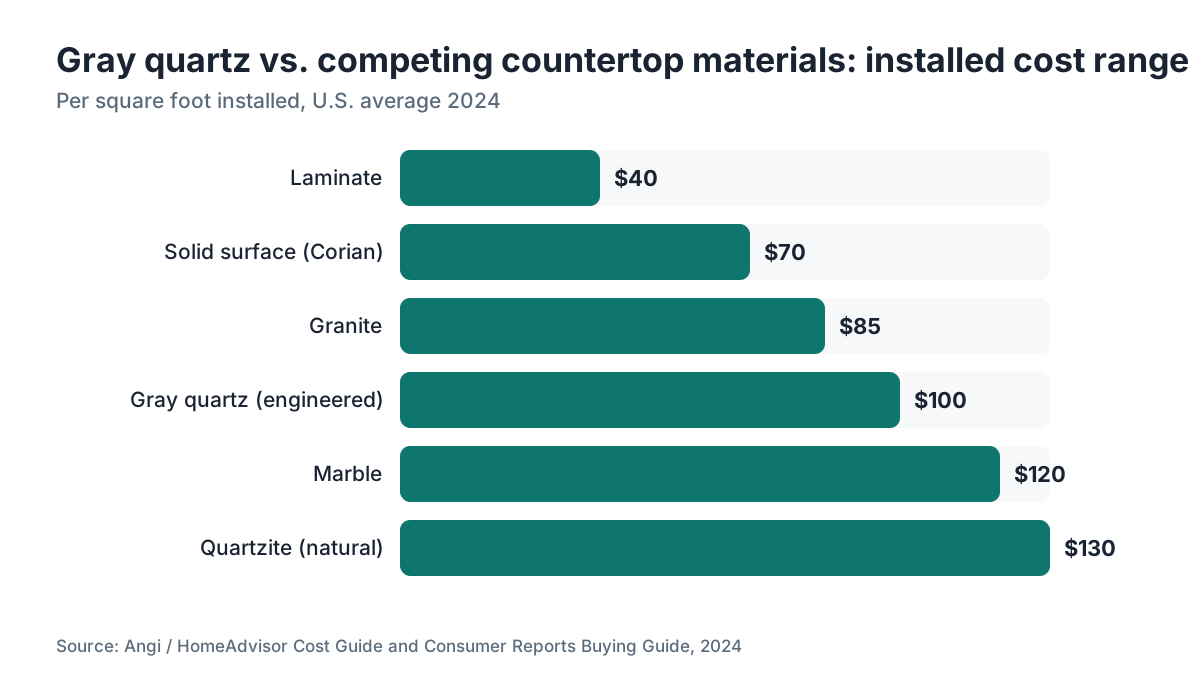
Here's a side-by-side on the materials homeowners weigh most often:
| Material | Installed cost (per sq ft) | Sealing required | Porosity | Heat resistance | Pattern uniqueness |
|---|---|---|---|---|---|
| Gray quartz (engineered) | $55, $150 | No | Non-porous | Moderate (no hot pans) | Repeating pattern |
| Granite | $45, $125 | Yes, 1 to 3x/year | Slightly porous | High | Unique slab |
| Marble | $60, $180 | Yes, 2 to 4x/year | Porous | Moderate | Unique slab |
| Quartzite (natural) | $65, $200 | Yes, 1 to 2x/year | Slightly porous | High | Unique slab |
| Laminate | $20, $60 | No | Non-porous | Low | Pattern may repeat |
| Solid surface (Corian) | $45, $95 | No | Non-porous | Low | Limited looks |
Gray quartz wins on maintenance. You genuinely do not need to seal it, ever. The resin binders close off any path for liquid absorption. Engineered quartz meets NSF/ANSI 51, the standard for food-zone surface materials, thanks to that non-porosity [5], which matters if you care about bacteria not finding a home in surface pores.
Granite is the closest competitor on price and durability. If you want a slab nobody else has, granite countertops make a strong case. If you want guaranteed maintenance simplicity, quartz edges it out.
Marble countertops etch from acids: lemon juice, wine, tomato. Quartz doesn't etch. For a kitchen where real cooking happens, that's a functional difference you'll feel.
On price, laminate countertops and Formica countertops still undercut quartz by a wide margin. If budget drives the decision, those materials have improved a lot in the gray palette. Corian countertops sit in a middle zone and are repairable by sanding in ways quartz is not.
The one place quartz consistently loses is heat. The polymer resin can discolor or crack from a hot pan set directly on the surface. Most manufacturers void the warranty for thermal shock. Use a trivet. That's not optional with quartz.
Are gray quartz countertops durable enough for a busy kitchen?
For most households, yes. Engineered quartz is among the more durable countertop materials at its price point. The hardness from the quartz content shrugs off everyday scratching from pots, utensils, and cutting boards far better than marble, solid surface, or laminate.
What quartz doesn't handle well:
- Thermal shock. Set a pot straight from a 500-degree oven onto quartz and you risk a crack or discoloration. The resin and quartz expand at different rates under sudden heat. Damage becomes likely around 300°F (150°C) of sustained contact, though brief contact with a warm pan is usually fine [6].
- UV exposure. Quartz is not rated for outdoor use. The resin binders yellow or fade with prolonged ultraviolet exposure. Several manufacturers exclude outdoor installation from their warranties outright. For a gray outdoor kitchen counter, look at porcelain or natural stone instead.
- Heavy impact. Quartz is hard but brittle, so it can chip at edges and corners from a direct blow, like a cast iron pan dropped at an angle. That same blow would chip granite too. Thick 3 cm slabs resist better than 2 cm.
- Certain chemicals. Bleach, paint strippers, and cleaners with high or low pH can break down the resin over time with repeated contact [11]. Occasional household-strength bleach diluted in water is generally fine. Don't soak the surface.
For a family kitchen with kids, daily cooking, and normal wear, gray quartz holds up. Shops that fabricate a lot of residential quartz report very few warranty claims from normal use. The claims they do see are overwhelmingly thermal shock and harsh chemical damage. Both are avoidable.
How do you clean and care for gray quartz countertops?
Daily cleaning is simple: warm water and a few drops of dish soap on a soft cloth, then a dry wipe to head off water spots [11]. That's all routine maintenance takes. The non-porous surface doesn't harbor bacteria the way porous stones can.
For stuck-on food or grease, let warm soapy water sit on the spot a minute or two to loosen it, then wipe. A plastic scraper handles hardened residue. Skip steel wool and abrasive pads, which dull the polish over time even on hard quartz.
Dried hard-water deposits show up as white cloudy spots, and dark gray quartz makes them obvious. White vinegar diluted in water (one part vinegar to three parts water) clears them, though manufacturers generally suggest limiting vinegar to spot treatments rather than routine cleaning, since acidic products aren't kind to the resin long term. Bar Keepers Friend powder (not the cream) dissolved in water and applied briefly also cuts mineral scale.
For a product-by-product breakdown on stone and engineered surfaces, how to clean stone countertops covers it well.
Here's a small edge gray has over white quartz: it hides surface dulling. Polished white quartz shows micro-scratches from abrasive cloths much faster, because there's no color variation to break up the haze. A mid-tone gray masks it. Minor point, but over years it adds up.
Which gray quartz brands are worth buying?
The engineered quartz market has consolidated. A handful of manufacturers run North American sales.
Cambria is U.S.-made (Minnesota) and the only major brand that quarries and manufactures domestically end to end. The gray palette runs deep, from pale Whitehall to dark Britannica. Cambria offers a limited lifetime warranty, the strongest in the category [7]. Price reflects it. For the specific product lines, Cambria countertops goes into detail.
Caesarstone (Israel and U.S. manufacturing) pioneered engineered quartz in North America. The concrete and industrial gray styles are well executed. Warranty is lifetime for residential use, with reasonable limitations.
Silestone by Cosentino (Spain and U.S.) added a silver-ion antimicrobial compound to some lines, which Cosentino markets under its own branding. Independent peer-reviewed verification of a real-world antibacterial benefit on countertops is thin, so treat those claims with skepticism.
MSI Q Premium Natural Quartz is a strong value play. MSI is a distributor, not a manufacturer, so it sources production and passes the savings down. The gray selection is broad, quality control is generally solid, and price per square foot comes in under the premium names.
IKEA's Råhult and similar budget options are Chinese-made and sold at very low material prices. Quality has improved, but veining patterns repeat obviously and warranty support is limited. Fine for a rental or a tight budget.
Brand matters less than the fabricator. A skilled shop with good equipment cutting a mid-tier slab beats an unskilled shop cutting a premium brand. Ask to see the fabricator's past gray quartz jobs, specifically the sink cutouts and seam locations.
What should you tell your fabricator when ordering gray quartz?
The details you spell out upfront decide whether the finished counter looks like what you pictured or something close but off. A few things to nail down:
Seam placement. Quartz slabs come in standard sizes, typically 55 by 120 inches or 63 by 130 inches depending on the brand [8]. Long counters or L-shapes will have seams. Ask exactly where the seam falls before they template. For veined or patterned gray, ask whether they'll book-match or slip-match at the seam. On a solid or fine-aggregate gray, seam location is mostly structural. On a heavily veined slab, it's aesthetic too.
Direction of veining. If your gray has linear veining, the slab can go in with veins running parallel to the wall or perpendicular to it. Both are valid. They look different. Have the fabricator lay out the slab in both orientations before they cut.
Backsplash overhang. Standard countertop depth is 25 to 25.5 inches with a 1.5-inch front overhang. Want more or less overhang? Say so explicitly.
Sink type. An undermount sink needs the cutout rim polished, which adds labor and a precise fit. Give the fabricator the actual sink model number, more than the dimensions, so they template correctly.
Fabricators who use quoting and nesting software can show you exactly how your slabs get cut before the job starts, so you see where seams land and whether there's enough slab left for a matching piece. Software like SlabWise does this digitally, so you approve layouts before any stone is cut. If your shop doesn't offer that, ask them to draw it on paper at minimum.
For the full sequence from template to final install, countertop installation walks through what to expect from the shop.
Does gray quartz work well in bathrooms and other rooms besides kitchens?
It works very well in bathrooms. The non-porous surface is an asset in a wet room, and gray quartz vanity tops are among the most common bathroom counter choices. Light gray quartz suits bathrooms especially, because the lighter value reflects the limited natural light most interior baths get.
For vanities, the main call is sink type. Vessel sinks, undermount sinks, and integrated sinks each need a different cutout and finishing approach. Undermount is the most common and the easiest to clean around.
Gray quartz also handles laundry room counters, wet bars, and fireplace surrounds, with one exception: don't run it right up against a functional fireplace face where it takes direct radiant heat. The thermal sensitivity that's a minor concern in kitchens turns into a real one next to an open flame or wood stove.
Outdoor kitchens are where quartz doesn't belong. This comes up enough to repeat. Porcelain tile or sealed granite are the better outdoor choices.
How do you pick the right shade of gray quartz for your space?
The single most reliable step: bring a large sample home before you order. Most showrooms lend 6-by-6-inch or 12-by-12-inch samples. Hold them against your cabinet color in your actual kitchen lighting at different times of day. Gray reads completely differently under cool LED recessed lights, warm incandescent pendants, and afternoon sun through a west-facing window.
A few practical rules that hold up across a lot of kitchens:
White or very light cabinets go with almost any shade of gray. Dark gray quartz against white shaker cabinets is a reliable, proven combination. Light gray quartz on white cabinets reads softer and more tonal.
Gray or blue-gray cabinets need care. A warm gray quartz next to a cool blue-gray cabinet can clash in ways a 6-inch sample won't warn you about. Get a 12-inch or larger sample if the cabinets are already painted.
Dark cabinets (navy, forest green, black) often look best with light gray or near-white quartz, which gives enough contrast to let both elements read clearly.
Undertones matter. Gray quartz comes in warm undertones (beige, brown, greige), cool undertones (blue, purple, green), and true neutral. Hold the sample next to your flooring, more than the cabinets. A gray with a green undertone next to a brown wood floor can look muddy.
Choosing grout for a tile backsplash alongside gray quartz? Mid-tone gray grout is usually the safest match. Bright white grout with a gray counter reads stark. Dark grout with a dark counter reads heavy.
For bathrooms, light gray quartz countertops are the most forgiving choice. They work with almost any tile color and keep the room feeling open.
What are the common problems and complaints about gray quartz?
The complaints that come up over and over in owner reviews and fabricator forums:
Pattern repetition. Engineered quartz is digitally patterned and printed, so the design repeats on a cycle. In a large kitchen with multiple slabs, a trained eye can spot where one slab ends and the next starts, because the pattern restarts. This bothers some people a lot and others not at all. Worth a trip to a showroom with a full kitchen vignette installed so you can judge it in person before committing.
Water spot visibility on dark gray. Charcoal and dark gray quartz shows every drop that dries on the surface. In hard-water areas, it becomes a constant wipe-down. Some people don't mind. Others find it maddening by month six.
Chips at seams and edges. Quartz is hard but brittle. Edge chips aren't common, but they happen, and they're difficult to repair invisibly. Color-matched epoxy fill is the standard fix, and it almost never disappears completely on a polished surface. Eased and beveled edges chip less readily than sharp flat-polish edges.
Color variation between order batches. If you need more material later (for a repair, an extension, or a matching bathroom vanity), an exact color match isn't guaranteed. Manufacturers update pigment formulas and quartz mix ratios. Buy 10 to 15 percent extra on the original order and keep a piece for future repairs.
Yellowing over time. Some older installations (pre-2010 manufacturing) showed resin yellowing after years of UV exposure through windows. Modern resin formulas are much improved, but a south-facing kitchen with big windows and direct sun is still worth flagging to the manufacturer so you understand the warranty coverage on UV-related color shift.
Is gray quartz a good investment for resale value?
Quartz countertops generally return more of their cost than laminate or tile on resale, though exact numbers are hard to pin down because countertop ROI is always tangled up with kitchen renovation ROI as a whole. Remodeling Magazine's annual Cost vs. Value report consistently puts mid-range kitchen remodels at roughly 70 to 80 percent of project cost recovered [9], and countertops are one of the highest-impact line items inside that.
Gray has held appeal across multiple design cycles. Beige ruled the 1990s and early 2000s. Gray took over around 2010 to 2015 and stayed relevant, though some designers expect a gradual drift toward warmer tones (greige, warm white, terracotta) in the late 2020s. Renovating to sell in the next two to three years? A mid-tone or light gray quartz is a safe, broadly appealing choice. Staying ten-plus years? Choose what you actually like.
Buyers reacting to real estate photography respond well to gray quartz, because it photographs cleanly and reads as updated without reading as trendy. That's a real advantage in a selling context.
One thing that doesn't add resale value: paying for the priciest premium-brand gray when a mid-range brand looks identical in photos and passes any buyer inspection. The name on the underside of the slab doesn't come up in most home sales.
Frequently asked questions
How much does it cost to install gray quartz countertops?
Installed cost, meaning material, fabrication, and installation combined, runs $55 to $150 per square foot in the U.S. A typical 30-square-foot kitchen project falls between $2,100 and $3,300 at mid-range prices. Edge profiles, sink cutouts, and regional labor rates push costs up or down. Get at least three quotes from local fabricators before committing.
Do gray quartz countertops need to be sealed?
No. Engineered quartz is non-porous by design. The polymer resin binders holding the quartz crystals together leave no open pores for liquid to penetrate. Sealing isn't required and won't add any protection. This is one of the clearest maintenance advantages quartz has over granite, marble, and quartzite, all of which need periodic sealing.
Can you put hot pans on gray quartz countertops?
You shouldn't. The polymer resin in quartz can discolor or crack from thermal shock when a very hot pot or pan sits directly on the surface. The risk zone starts around 300°F (150°C) of sustained contact. Most manufacturer warranties exclude thermal shock damage. Use a trivet or hot pad. This applies to every brand and shade of engineered quartz without exception.
What is the difference between gray quartz and gray quartzite?
Quartz countertops are engineered slabs made with ground quartz crystals and resin. Quartzite is a natural metamorphic rock quarried in blocks and slabbed. Quartzite needs sealing, has a unique pattern on every slab, costs more per square foot on average, and handles heat better. The two are completely different materials. Some showrooms mislabel quartzite as quartz, so ask specifically which type you're looking at.
Which gray quartz countertop brand is best?
Cambria has the strongest warranty (limited lifetime) and is U.S.-manufactured, but costs more. Caesarstone and Silestone are solid mid-premium options with broad gray selections. MSI Q is the best value with good quality control. The fabricator's skill matters as much as the brand. A quality shop cutting a mid-tier quartz outperforms a careless shop cutting a premium brand every time.
Does gray quartz show scratches easily?
Less than marble or solid surface, but it's not scratch-proof. Quartz scores a 7 on the Mohs hardness scale, so most kitchen tasks won't mark it. Abrasive cleaning pads, diamond-edged tools, or dragging rough objects across the surface can leave dull marks over time. Mid-tone gray hides micro-scratches better than white or very dark gray, because the color variation breaks up any visible haze.
Are gray quartz countertops easy to clean?
Yes. Warm water and dish soap handle daily cleaning. Dried hard-water spots on dark gray surfaces are the biggest routine annoyance, and they come off with diluted white vinegar or a Bar Keepers Friend solution. Avoid abrasive scrubbing pads. The non-porous surface means liquid won't soak in, so most spills wipe up cleanly even after sitting a while.
How long do gray quartz countertops last?
With normal use and proper care, engineered quartz countertops last 25 years or more. The limiting factors are edge chips from heavy impacts and thermal shock from hot pans. The polished surface can dull slightly over many years, but the underlying material doesn't degrade. Most major brands offer 10-year to lifetime residential warranties, which reflects manufacturer confidence in long-term durability.
What colors go with gray quartz countertops?
Gray quartz pairs with white, cream, navy, sage green, charcoal, and natural wood cabinet colors. White cabinets with gray quartz is probably the most photographed kitchen combination of the past decade. Check undertones: cool blue-gray quartz can clash with warm brown cabinets, while warm greige quartz can clash with cool gray cabinets. View a large sample in your actual kitchen lighting before ordering.
Can gray quartz countertops be used outdoors?
No. Engineered quartz isn't rated for outdoor installation. The polymer resin binders degrade and yellow with prolonged UV exposure. Most manufacturers exclude outdoor use from their warranties. For outdoor kitchens, look at porcelain slabs, sealed granite, or concrete instead. This applies regardless of brand or quartz shade.
Are light gray quartz countertops harder to keep clean than dark gray?
Different dirt shows on each. Light gray quartz countertops show dark crumbs, food stains, and wet marks from certain oils more readily. Dark gray shows water spots, dried minerals, and light dust very clearly. Mid-tone gray is the easiest to maintain visually because it hides both dark debris and light water marks reasonably well. The actual cleaning effort is similar across shades.
How thick should gray quartz countertops be?
3 cm (about 1.25 inches) is the standard for kitchens and the recommendation of most fabricators. It's strong enough to span cabinet gaps without a substrate, looks proportional at the edge, and is what most brands price their warrantied products at. 2 cm slabs cost less but need a plywood buildup underneath and look thinner. For bathroom vanities, 2 cm is more acceptable, but 3 cm stays the premium choice.
Can gray quartz countertops be repaired if they chip or crack?
Chips can be filled with color-matched epoxy resin by a stone repair specialist. The repair usually passes casual inspection but rarely disappears completely on a polished surface. Cracks are more serious; a full crack across a slab usually means slab replacement, not repair. This is why edge protection matters: eased and beveled edges chip less than sharp-polished edges, and keeping heavy impacts away from corners is worth the attention.
Is gray quartz more expensive than granite?
At similar tiers, they're close. Mid-range gray quartz runs $70 to $110 per square foot installed. Mid-range granite runs $65 to $105 per square foot installed. Premium granite from exotic origins can run higher than any engineered quartz. Budget granite slabs at remnant yards can be cheaper than any quartz. The maintenance cost equation favors quartz, since you skip the sealing products and labor.
Sources
- USGS Mineral Resources Program, Quartz Industrial Minerals: Engineered quartz countertops consist of approximately 90 to 94 percent natural quartz crystals bound with polymer resins
- USGS Mohs Hardness Scale reference, Minerals resources: Quartz scores 7 on the Mohs hardness scale; granite averages 6 to 7; marble averages 3 to 4
- HomeAdvisor (Angi) Cost Guide: Quartz Countertops: Installed quartz countertop cost in the U.S. ranges from $55 to $150 per square foot, with most projects landing between $70 and $110
- Consumer Reports, Kitchen Countertops Buying Guide: Premium engineered quartz brands reach $90 to $130 per square foot for material; entry-level brands sold at home improvement stores start around $40 per square foot material-only
- NSF International, NSF/ANSI 51 Food Equipment Materials Standard: NSF/ANSI 51 covers food-zone surface materials; non-porous engineered quartz is compatible with this standard due to absence of open pores
- Caesarstone USA, Care and Maintenance Guidelines: Direct sustained heat contact above approximately 300°F can discolor or crack engineered quartz; hot pots and pans should not be placed directly on the surface
- Cambria, Warranty and Product Information: Cambria offers a limited lifetime warranty on their engineered quartz products for residential use, the strongest standard warranty in the category
- Silestone by Cosentino, Technical Specifications: Standard engineered quartz slab dimensions are typically 55 by 120 inches or 63 by 130 inches depending on manufacturer
- Remodeling Magazine, Cost vs. Value Report 2024: Mid-range kitchen remodels return roughly 70 to 80 percent of project cost on resale according to the annual Cost vs. Value report
- Natural Stone Institute, Quartz Surface Product Information: Engineered quartz countertops are distinct from natural quartzite; the two materials have different care requirements, porosity, and price ranges
- EPA, Safer Choice Program, Cleaning Product Guidance: Recommended cleaning for non-porous engineered surfaces includes mild soap and water; harsh chemicals including high-alkalinity or high-acidity cleaners can degrade surface materials over time
- NKBA (National Kitchen and Bath Association), Kitchen Design Trends Report: Gray remains the most popular countertop color family in surveyed North American kitchen projects
Last updated 2026-07-10