TL;DR
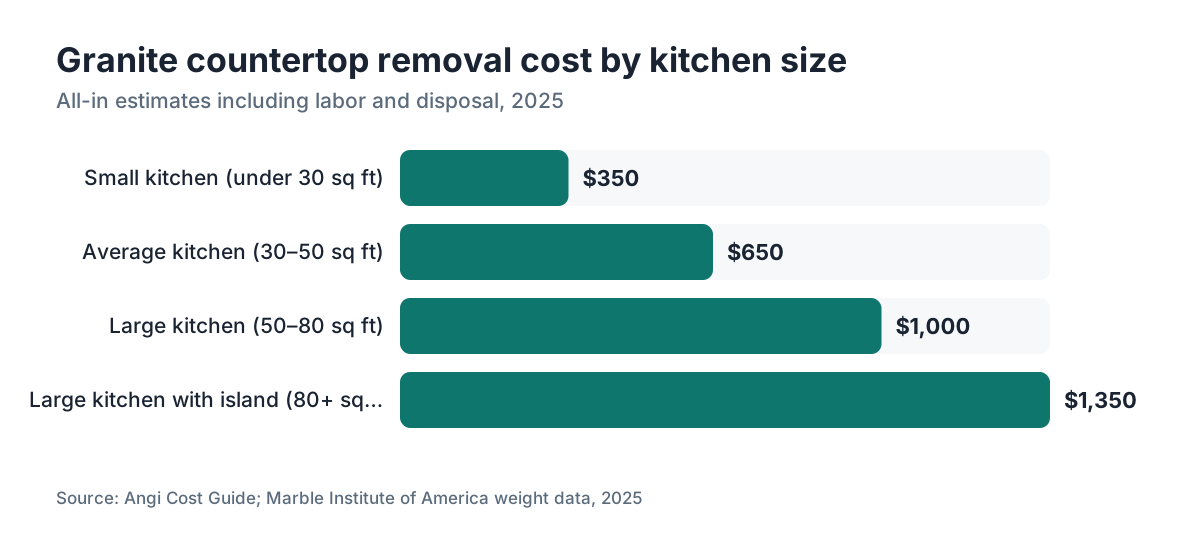
- Removing granite countertops typically costs $300 to $1,500 for an average kitchen, with most homeowners paying around $500 to $800.
- Labor runs $50 to $100 per hour, and disposal adds $50 to $200 more.
- Slab thickness, adhesive type, undermount sinks, and local dump fees drive the wide range.
- DIY is possible but carries real injury risk.
What does granite countertop removal cost on average?
For a typical kitchen with 30 to 50 square feet of granite, expect to pay $300 to $1,500 all-in for professional removal and haul-away. The middle of that range, around $500 to $800, covers most single-kitchen jobs where the counters are accessible, the slab is 3/4-inch thick, and nothing unusual is going on with the plumbing or cabinetry below.
Hourly labor rates for countertop removal generally run $50 to $100 depending on your market and who does the work. A solo handyman sits at the low end, a stone fabrication crew with the right tools at the high end. The job takes two to four hours for a standard kitchen if the old slab breaks into manageable pieces without drama.
Disposal is a separate line item most quotes bundle but some don't. Dumping granite at a transfer station or landfill costs $50 to $200 depending on weight and local tipping fees [1]. A single 30-square-foot piece of 3/4-inch granite weighs roughly 375 to 425 pounds, so weight adds up fast in large kitchens.
One honest caveat: pricing data for countertop removal specifically is thin. Most industry surveys lump it into kitchen remodel costs or countertop installation estimates. The ranges here reflect contractor quotes reported on home improvement aggregator sites and fabricator pricing guides as of 2025, not a controlled study.
What factors drive the price up or down?
Slab thickness matters more than most people expect. Standard granite is 3/4 inch (2 cm) or 1.25 inches (3 cm). A 3 cm slab weighs about 18 to 19 pounds per square foot; 2 cm runs closer to 12 to 13 pounds per square foot [2]. Heavier slabs need more people to lift safely, and that means more labor hours or a two-person minimum charge.
How the original installers attached the granite is a big variable. Most granite is set with silicone adhesive along the cabinet rail and epoxy at seams. A heavy silicone bead means the slab won't pop free easily and may need scoring with an oscillating tool, which adds time. Some older installations used construction adhesive (Liquid Nails or similar), which bonds so aggressively that the drywall or cabinet substrate often tears away with the slab.
Undermount sinks complicate everything. The sink rim is clipped and silicone-sealed to the underside of the granite. A plumber or experienced handyman needs to disconnect supply lines and drain before the countertop crew can lift the slab. That's usually a separate plumbing service call, $75 to $200, billed on top of the countertop removal quote.
Accessibility and layout matter too. A galley kitchen where counters run in a straight open run is much faster than an L-shape or U-shape with tight corners, a peninsula, or an island. Islands often require the slab to exit through a doorway that barely fits, sometimes requiring the piece to be broken intentionally to get it out, which then affects whether you can sell or donate it.
Local disposal costs vary a lot. States with higher landfill tipping fees, like California and New York, push disposal toward the top of the range [3]. Some municipalities classify granite as inert construction debris with lower tipping fees; others charge by weight at general rates.
How does the cost break down: labor vs. disposal vs. materials?
Here's a realistic cost breakdown for a 40-square-foot kitchen removal in 2025:
| Cost item | Low estimate | High estimate |
|---|---|---|
| Labor (2 to 4 hours, 2-person crew) | $150 | $500 |
| Disposal / haul-away | $50 | $200 |
| Equipment rental (oscillating tool, suction cups) | $0 | $75 |
| Plumber for undermount sink disconnect | $0 | $200 |
| Total | $200 | $975 |
Labor is the biggest chunk, usually 60 to 75 percent of the total. Disposal is the easiest place for quotes to hide surprises: always ask whether haul-away is included and whether there's a weight cap.
Equipment costs rarely appear as a separate line. A professional crew brings their own suction lifting cups, oscillating tools, and sometimes a dolly or slab cart. Hire a handyman who doesn't own stone-handling equipment and you may end up with a slower job and a higher injury risk for everyone involved.
One more cost that's easy to forget: cabinet repair. Granite that was poorly installed or aggressively glued sometimes pulls cabinet face frames or the top rail off when removed. Budget $50 to $300 for minor cabinet touch-up if you're going straight into a new countertop installation afterward.
Can you remove granite countertops yourself, and is it worth it?
DIY removal is genuinely possible. Fabricators do it. Homeowners do it. The savings can be $300 to $700 on labor alone. But granite is unforgiving of mistakes, and the physics are not trivial.
A 3/4-inch slab over a 24-inch-deep base cabinet produces a cantilever load that can snap the slab the moment the adhesive releases unevenly. Granite breaks along invisible stress lines with no warning. The edges are razor-sharp when they fracture. Suction cup lifters (rentable from equipment rental shops for around $30 to $60 per day) make the job safer and more controlled, and you really shouldn't skip them.
The basic DIY process: disconnect and cap plumbing, remove the sink if undermount, score the silicone bead at the cabinet rail with an oscillating tool, apply upward pressure with suction cups while a helper supports the end, slide the slab back from the wall, and lower it onto cardboard or moving blankets on the floor. Then you have to get it out of the house, which almost always needs two adults minimum and usually three for slabs over 60 pounds.
Disposal without a truck and a landfill account is where DIY often stops saving money. Renting a truck adds $80 to $150. Tipping fees at a transfer station run $50 to $150 depending on weight and location [1]. By the time you add rental, dump fees, and the value of your time, the savings narrow considerably. If you want to keep the granite (for a laundry room, workshop, or resale), that changes the math entirely.
For most homeowners, the honest answer is this: DIY the prep work (clear the kitchen, disconnect appliances, remove the faucet yourself to avoid plumber costs), then hire a two-person crew for the actual slab lift. That hybrid approach saves $100 to $200 while keeping the dangerous part in professional hands.
Does granite countertop removal cost more for large kitchens or islands?
Yes, directly and predictably. Labor scales with time, and time scales with square footage, number of seams, and complexity of the layout. A rough rule of thumb many fabricators use: add $50 to $100 per linear foot of countertop beyond the first 10 linear feet, or per additional section.
Islands are a specific pain point. They're often the heaviest single piece in the kitchen, sometimes 60 square feet or more on larger islands, and they sit in the middle of the room with no wall support. Getting that piece out without breaking it means planning the exit path in advance. If a doorway is too narrow, the crew has to score a controlled break, which ruins the resale value of the slab.
Large kitchens also mean more cumulative weight for disposal. A 100-square-foot kitchen with 3 cm granite produces roughly 1,700 to 1,900 pounds of slab material. Most dump trucks have a 2-ton payload limit, so that's a full load and a full tipping fee.
For comparison, replacing granite with laminate countertops or Formica countertops after removal keeps the whole project cheaper because laminate installation costs far less than stone. If you're upgrading rather than replacing in kind, removal is the fixed entry price to the whole project.
What does it cost to repair granite instead of removing it?
Sometimes removal isn't the right call. Granite countertop repair runs $75 to $600 depending on what's wrong, and for minor damage that's far cheaper than tearing everything out.
Chip repair is the most common fix. A fabricator fills chips with color-matched epoxy or UV-cured resin, then polishes it flush. That costs $75 to $250 per chip, depending on size and location (edge chips are easier than field chips near the center of a slab) [4].
Cracks are more serious. A hairline crack from settling or impact can sometimes be stabilized and filled with epoxy for $200 to $450. A through-crack that compromises structural integrity, particularly on a span without cabinet support below, may mean the slab has to come out regardless of repair cost.
Resealing is maintenance, not repair, and costs $0 to $80 DIY or $100 to $300 professionally. It doesn't fix damage but keeps staining from making existing damage look worse.
If the countertops are fundamentally sound but you want a different look, consider refinishing or resurfacing. That's not a standard service everywhere, but some restoration companies apply a new polish or honing treatment to change the surface finish without full removal.
The decision is simple. If the damage is cosmetic and isolated, repair. If the slab is cracked through, multiple pieces are lifting, or you're remodeling anyway, removal makes more sense than patching.
Fabricators running countertop installation projects sometimes offer bundled removal-plus-install pricing that beats hiring two separate contractors. Ask for that bundle quote before assuming you need to book removal on its own.
Can you sell or donate removed granite countertops?
You can, and it's worth trying before you pay disposal fees. Intact granite slabs in good condition have a real secondary market through Habitat for Humanity ReStores, Craigslist, Facebook Marketplace, and local stone yards that buy remnants.
Habitat for Humanity ReStore accepts building materials including countertops at many locations, though policies vary by chapter [5]. They'll often schedule a pickup, which cancels your disposal cost entirely. The countertop has to be in reusable condition, meaning no major cracks, and you have to get it out intact.
Private sale prices for used granite swing wildly. A 40-square-foot slab in a popular color (think Uba Tuba, Santa Cecilia, or Bianco Romano) might fetch $50 to $200. An unusual color or oversized piece could bring more. Exotic stones like Blue Bahia or Van Gogh granite in good condition occasionally sell for several hundred dollars to buyers who want something they can't find new.
The catch is logistics. The buyer usually can't pick it up while it's still installed, so you're timing a sale around your removal date. If the buyer falls through, you're stuck scrambling for disposal. A more practical approach: post it for free pickup, accept the first taker, and kill the disposal cost entirely. That often beats chasing a $100 sale that delays your project by two weeks.
Some stone yards and fabricators will take granite remnants as fill or aggregate. They won't pay you for it, but they may haul it away free, especially if you have a relationship with them through your new countertop order.
How do you get an accurate quote for granite removal?
Getting a quote that doesn't blow up is mostly about giving contractors the right information upfront. Measure your linear footage of countertop and tell them whether you have an island. Note your sink type: drop-in sinks are easy, undermount sinks add complexity and possibly a plumbing call. Tell them your slab thickness if you know it.
Ask these specific questions before you sign anything:
- Is haul-away included, and is there a weight limit before surcharges kick in?
- Will you break the slab to remove it, or try to keep it intact?
- What happens if the cabinets are damaged during removal? Are repairs included or separate?
- Do you charge extra if the adhesive is particularly aggressive?
Get at least two quotes. Removal is a commodity service in most markets, and prices vary enough that the second quote often saves you $100 to $300. If you're also getting new countertops installed, ask the new fabricator for a bundled removal quote. Many fabricators discount removal when they're doing the installation because it simplifies scheduling.
Fabricators who use quoting software like SlabWise can turn around accurate estimates faster than shops doing it by hand, which means less waiting for numbers. That's worth knowing if you're in a market with several shops competing for your job.
One thing to watch: some contractors quote removal at a low per-square-foot rate, then add disposal, sink disconnection, and cabinet repair as separate line items. Always ask for an all-in number so you can compare apples to apples.
How does granite removal cost compare to removing other countertop materials?
Granite sits on the heavier and more labor-intensive end of the spectrum, but it's not the hardest material to remove.
| Material | Typical removal cost | Notes |
|---|---|---|
| Granite (3/4" or 1.25") | $300, $1,500 | Heavy, breaks unpredictably |
| Marble | $300, $1,400 | Similar to granite in weight and process |
| Quartz (engineered) | $300, $1,200 | Slightly lighter per sq ft than 3 cm granite |
| Concrete | $400, $1,800 | Extremely heavy, often monolithic pours |
| Laminate / Formica | $50, $300 | Light, easy, low disposal cost |
| Tile (ceramic or stone) | $100, $500 | Messy, dusty, but lightweight per piece |
| Corian / solid surface | $100, $400 | Lightweight, easy cuts |
| Butcher block | $75, $300 | Often screwed down, straightforward removal |
If you're going from granite to marble countertops or another natural stone, expect similar removal cost and complexity. Going from granite to butcher block countertops or Corian countertops means the removal cost is the expensive part of the whole swap because the new material is cheaper and easier to install.
Quartz (engineered stone like Cambria countertops) removes much like granite since it's the same basic process: silicone bond, heavy slab, needs suction cups. The main difference is that engineered quartz sometimes uses more aggressive adhesive bonding, which can make separation harder.
For context on new kitchen countertops pricing, removal is typically 10 to 25 percent of the total countertop project budget, with installation and material making up the bulk.
Are there any permits or regulations for granite countertop removal?
In almost all jurisdictions, removing countertops does not require a building permit. Countertops are finish work, not structural elements, so swapping them out falls under normal home maintenance.
Two exceptions exist. First, if removing the countertop involves relocating or capping plumbing (moving drain lines, repositioning supply shutoffs), some municipalities require a plumbing permit for that portion of the work [6]. The countertop removal itself still doesn't need a permit, but the plumbing work attached to it might. Check with your local building department if you're unsure.
Second, if your home was built before 1980, know that some older adhesives and tile mastics contain asbestos. This is more of a concern with tile removal than granite slab removal, since granite countertops were rarely installed in the pre-1980 era, but it's worth knowing if you're dealing with original kitchen finishes. The EPA's guidance on asbestos in the home covers testing requirements if you suspect your materials [7].
Disposal of granite at municipal landfills is straightforward in most states since granite is classified as clean fill or inert construction debris and is not a regulated hazardous waste [3]. A few states have specific construction and demolition debris rules that affect how debris must be sorted, but granite itself causes no classification issues.
If you're in a historic district or under an HOA, those bodies may have aesthetic review requirements for visible changes, but countertop material doesn't typically require HOA approval unless it affects exterior-visible elements like an outdoor kitchen.
What should you do before the removal crew arrives?
A little prep work saves real money and keeps the job from running long. Clear everything off the countertops. Every small appliance, dish rack, and decorative item needs to come off. Then clear the cabinets below if the crew needs to move them.
Disconnect and remove the faucet yourself if you're comfortable with basic plumbing. Shutting off the supply valves, disconnecting the supply lines, and pulling the faucet body is a 30-minute job most homeowners can handle, and it means no plumber has to be on site for that piece.
For an undermount sink, don't try to remove it yourself before the countertop comes off. The sink is clipped to the granite from below, and removing clips while the slab is overhead is a recipe for dropping 40 pounds of porcelain on your head. Let the crew handle that sequence.
Create a clear path from the kitchen to the exterior. Slab sections can be 4 to 6 feet long and unwieldy. Moving furniture, rugs, and anything fragile out of the path from the kitchen to the front or back door protects your house and speeds the job.
Know where your water shutoffs are and make sure they work before the crew arrives. A shutoff that hasn't been turned in 20 years sometimes fails to close all the way. Finding that out at 8 AM when the crew is standing there is a bad way to start.
Frequently asked questions
How long does it take to remove granite countertops?
A standard kitchen removal takes two to four hours for a two-person crew. Larger kitchens with islands or complex layouts can run five to six hours. The time is mostly driven by how aggressively the granite was bonded, how many pieces need to come out, and whether plumbing disconnection is part of the same appointment.
Is it cheaper to remove granite myself or hire someone?
DIY saves $150 to $500 in labor, but adds real risk. Granite slabs are 300 to 600 pounds for a typical kitchen, break without warning along invisible stress lines, and require suction lifting equipment most homeowners don't own. Renting equipment and paying disposal fees narrows the savings to $100 to $300 in most cases. The hybrid approach (prep and plumbing yourself, hire a crew for the actual lift) often makes the most sense.
Do granite countertop removal costs include disposal?
Not always. Some contractors bundle haul-away into the quote; others charge separately. Always ask explicitly. Disposal alone runs $50 to $200 depending on slab weight and local landfill tipping fees. A 40-square-foot kitchen of 3 cm granite produces roughly 700 to 750 pounds of material, which affects disposal cost directly.
Can granite countertops be removed without damaging the cabinets?
Usually, yes, but not always. If the original installer used standard silicone adhesive, the slab lifts cleanly. Aggressive construction adhesive can pull the cabinet top rail or face frame off with the slab. Budget $50 to $300 for minor cabinet repair just in case. Experienced stone crews are better at minimizing cabinet damage than general handymen.
What happens to the old granite after removal?
Options include hauling it to a landfill or transfer station ($50 to $200 in tipping fees), donating it to a Habitat for Humanity ReStore if intact, selling it on Craigslist or Facebook Marketplace for $50 to $200, offering it free for pickup to avoid disposal cost, or asking a stone yard whether they'll take it as fill. Keeping it intact during removal maximizes your options.
Does removing granite countertops affect my home's value?
Removal alone doesn't affect value since no buyer sees empty cabinet tops as a positive. The replacement material matters. Installing new granite, quartz, or marble after removal generally maintains or improves value in mid-to-high markets. Going to a significantly cheaper material in a high-value home can affect appraisal and buyer perception.
How much does it cost to remove a granite island countertop?
Island removal typically adds $100 to $400 to the base kitchen removal cost. Islands are often the largest single piece of granite in the kitchen, sometimes 40 to 80 square feet, and sit in the middle of the room making the exit path more complicated. If the island slab can't exit through a doorway intact, the crew scores a controlled break, which ruins resale value of the piece.
Can I put new countertops directly on the cabinets after granite is removed?
Yes, in most cases. Once the granite and any remaining adhesive is cleaned off the cabinet top rail, a new countertop can go straight on. The exception is if the old granite pulled the rail away during removal, which requires carpentry repair first. Always check that the cabinet level hasn't shifted before the new template is made.
Is granite countertop removal cost tax deductible?
For a primary residence, no. The IRS does not allow deductions for home improvement costs in the year you spend them. However, the cost adds to your home's cost basis, which can reduce capital gains taxes when you sell the home. For rental properties, countertop replacement may be depreciable as a capital improvement. Consult a tax professional for your specific situation [8].
How do I find a reputable granite removal contractor?
Start with local stone fabricators, since they do this work daily and have the right equipment. Home improvement aggregator sites (Angi, HomeAdvisor, Houzz) list rated contractors with reviews. Ask any contractor for proof of general liability insurance before they start work. Get at least two quotes and ask each contractor exactly what's included in the price, especially haul-away.
How much does granite countertop repair cost compared to full removal?
Chip repair runs $75 to $250 per chip. Crack stabilization costs $200 to $450 depending on crack length and location. Resealing is $100 to $300 professionally. In all cases, repair is far cheaper than removal and replacement if the underlying slab is structurally sound. The decision point is whether the damage is cosmetic or structural.
What tools are needed to remove granite countertops?
Professionals use suction cup lifters (essential for safe handling), an oscillating multi-tool with a rigid scraper blade to cut the silicone bond, a pry bar for stubborn sections, moving blankets, and a slab dolly or hand truck. Homeowners renting equipment should expect to pay $30 to $60 per day for suction cups and $25 to $40 for an oscillating tool at a local equipment rental shop.
Will the drywall or backsplash be damaged when granite countertops are removed?
The backsplash above the countertop frequently sustains minor damage when the slab is pulled away from the wall, especially if the granite ran close to the backsplash tile. Budget $50 to $200 for backsplash repair or plan to replace the backsplash as part of the same project. The drywall behind lower cabinets is usually unaffected.
How do removal costs differ between 2 cm and 3 cm granite?
The difference is real but not enormous. 3 cm granite weighs about 50 percent more per square foot than 2 cm, which means heavier lifts, more disposal weight, and slightly more labor time. Expect 2 cm removal to come in at the lower end of quotes and 3 cm at the higher end, a difference of roughly $50 to $150 for a typical kitchen.
Sources
- U.S. EPA, Advancing Sustainable Materials Management: Facts and Figures: Construction and demolition debris disposal, including stone material, at transfer stations and landfills involves tipping fees that vary by region and material weight.
- Marble Institute of America (MIA+BSI), Dimension Stone Design Manual: Granite at 3 cm thickness weighs approximately 18 to 19 pounds per square foot; 2 cm granite weighs approximately 12 to 13 pounds per square foot.
- U.S. EPA, Construction and Demolition Debris Management: Granite is classified as inert construction and demolition debris in most states and is not a regulated hazardous waste; tipping fees vary by state and locality.
- Marble Institute of America (MIA+BSI), Stone Restoration and Maintenance: Chip and crack repair on granite surfaces involves epoxy or resin fill and polishing, with costs dependent on chip size, location, and surface profile.
- Habitat for Humanity, ReStore Donation Guidelines: Habitat for Humanity ReStores accept usable building materials including countertops, with pickup available at many locations; policies vary by chapter.
- U.S. HUD, Home Improvement and Permit Requirements: Plumbing work connected to kitchen remodeling projects, including capping or relocating supply lines, may require local plumbing permits depending on jurisdiction.
- U.S. EPA, Asbestos in Your Home: Some pre-1980 adhesives and tile mastics contain asbestos; EPA guidance covers testing and handling for suspected asbestos-containing materials in the home.
- IRS Publication 523, Selling Your Home: Home improvement costs are not deductible in the year incurred for a primary residence but do increase the cost basis of the home, potentially reducing capital gains tax upon sale.
- National Kitchen and Bath Association (NKBA), Kitchen and Bath Market Index: Industry pricing data shows countertop removal and replacement as a standard line item in kitchen remodel budgets, with removal typically representing 10 to 25 percent of total countertop project cost.
- Angi (formerly Angie's List), Cost Guide: Countertop Removal: Reported contractor quotes for granite countertop removal average $300 to $1,500 depending on kitchen size, material weight, and local labor rates.
Last updated 2026-07-09