TL;DR
- Granite countertops cost $40 to $200 or more per square foot installed.
- Most kitchens land between $2,000 and $4,500 total.
- Entry slabs start around $40/sq ft; exotic imports pass $200/sq ft.
- The four things that move your price most are slab grade, edge profile, cutout count, and your local fabricator's labor rate.
What is the average cost of granite countertops?
Installed granite runs $40 to $100 per square foot for the common grades, and the honest national midpoint sits around $60 to $75 all-in. A kitchen with 40 to 50 square feet of counter lands at $2,000 to $4,500 installed. The range is wide because granite is a natural stone pulled from quarries on several continents, and a basic domestic slab can cost a fifth of what a rare Brazilian exotic costs.
The National Kitchen and Bath Association tracks remodel costs every year and puts countertop material and installation among the top three cost items in a kitchen, usually 10 to 15% of the total project budget [1].
Budgeting today? Use $65/sq ft as your working number for a mid-grade granite with a standard edge and one sink cutout. That's not a promise. It's a defensible starting point before you've talked to a single fabricator.
Here's how granite lines up against the main alternatives:
| Material | Installed cost range (per sq ft) |
|---|---|
| Granite (entry) | $40, $60 |
| Granite (mid-grade) | $60, $100 |
| Granite (premium/exotic) | $100, $200+ |
| Marble | $75, $250 |
| Cambria quartz | $80, $150 |
| Laminate | $15, $40 |
| Butcher block | $35, $100 |
| Corian solid surface | $45, $95 |
Those are installed costs, material plus fabrication plus labor. A raw slab price on its own tells you almost nothing until you add those layers back in.
What factors drive the cost of a granite countertop estimate?
Seven things move the needle more than anything else.
Slab grade and origin. The granite industry has no universal grading standard, so "Level 1," "Level 3," and "Premium" are marketing terms that shift from one supplier to the next. What actually sets the price is rarity, veining complexity, and the quarry it came from. Domestic granites from Georgia or Vermont tend to cost less than imports from Brazil, India, or Norway. A consistent gray slab like Uba Tuba or Colonial White will almost always cost less than a dramatic blue or red exotic.
Square footage. Fabricators price by the square foot, so bigger kitchens cost more. Here's the catch: you pay for the full slab, not the net area of your counters. Sink and cooktop cutouts, corners, and the odd shapes of most kitchens mean you use only 70 to 80% of what you buy. A shop running good nesting software cuts waste and can sometimes drop your material cost.
Edge profiles. A standard eased edge (a slightly softened square) usually comes with the base price. Beveled, bullnose, and ogee edges add $10 to $30 per linear foot. A waterfall edge that pours down the side of an island can add several hundred dollars to the total.
Cutouts. Every sink cutout, faucet hole, and cooktop opening takes shop time and wears blades. Expect $100 to $250 per cutout, depending on sink type (undermount versus drop-in) and how hard the stone is.
Thickness. Most residential counters use 3 cm slabs (roughly 1.25 inches). Older 2 cm slabs cost less but need a built-up edge to look substantial. Going to 3 cm is worth it in nearly every case. Custom 4 to 5 cm slabs for restaurant or commercial work cost noticeably more.
Labor and local market. A fabricator in San Francisco or New York City charges more per hour than one in rural Ohio. Labor is roughly 30 to 40% of your installed price [2]. You can't shop that away, but you can get three quotes.
Backsplash and extras. A matching granite backsplash from the same slab adds cost. Sealing, which many fabricators do before install, may or may not be baked into the quote. Ask which it is.
How much does granite cost per square foot by grade?
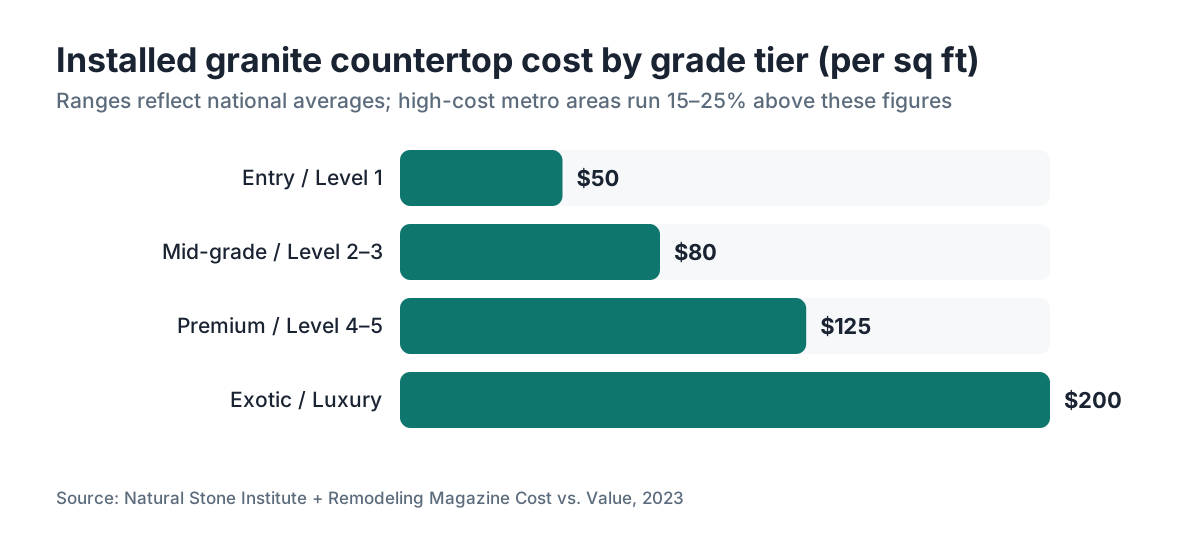
Grades give you a working framework even though the labels aren't standardized [3]. Here's what each tier tends to run and what falls into it.
| Grade tier | Material cost (per sq ft) | Installed cost (per sq ft) | Common examples |
|---|---|---|---|
| Entry / Level 1 | $15, $25 | $40, $60 | Ubatuba, Uba Tuba, Black Galaxy |
| Mid-grade / Level 2 to 3 | $25, $55 | $60, $100 | Bianco Romano, Colonial White, Giallo Ornamental |
| Premium / Level 4 to 5 | $55, $100 | $100, $150 | Blue Pearl, Santa Cecilia Premium, Baltic Brown |
| Exotic / Luxury | $100, $200+ | $150, $250+ | Lemurian Blue, Van Gogh, Blue Volga |
Material cost is what the fabricator pays for the slab or marks up from inventory. Installed cost adds templating, fabrication labor, and the install itself. Most homeowner quotes come as all-in installed numbers, which is exactly what you should ask for.
Entry-grade granite is good stone. Plenty of kitchens look great with Ubatuba or absolute black. Premium and exotic grades buy you rarity and visual drama. They do not buy you more durability.
How do fabricators calculate a granite countertop quote?
A quote starts with a template or a detailed measurement of your cabinets. The fabricator figures the net square footage of your counters, adds overhang (usually 1.5 inches past the front of base cabinets), accounts for seams, then works out how much slab they need after nesting the pieces.
The standard math goes like this:
- Total square footage of counter surface (including overhangs)
- Add 10 to 20% for waste from cuts and slab layout
- Multiply by the per-square-foot slab price
- Add fabrication labor (cutting, grinding, polishing edges)
- Add per-unit charges: edge profiles, cutouts, seams
- Add delivery and installation
- Add extras: sealing, old counter removal, plumbing disconnect
A written quote should break out material, fabrication, and installation as separate line items at minimum. If a fabricator hands you one total with no breakdown, ask for the itemized version. You need it to compare quotes fairly.
Some shops now quote from a floor plan or a template scan using software that does this automatically. If you're a fabricator reading this, SlabWise is built for that workflow and cuts the quoting errors that cost real money.
For homeowners using our kitchen countertops guide to plan a full project, the countertop quote is almost always the first number you need before the rest of the budget makes any sense.
What does granite countertop installation cost on its own?
Supplying your own slab from a stone yard? You'll pay the fabricator for fabrication and installation only, which runs $30 to $60 per square foot depending on region and job complexity [2]. Installation alone, with no fabrication, is almost never sold separately, because the slab has to be cut and finished in the shop before it ever reaches your kitchen. The two come bundled.
The install charge covers transport of the finished pieces (granite is heavy, 18 to 20 lbs per square foot for 3 cm stone), setting the pieces on cabinets, leveling, epoxying seams, and caulking the perimeter. A full kitchen install usually takes a two-person crew 3 to 5 hours [2].
Demolition and removal of your existing counters is a separate line. Most fabricators charge $150 to $400 to pull old counters, depending on material and how they're attached. Tile set in mortar? Budget toward the high end.
Plumbing reconnection, reattaching the sink after install, may or may not be included. Ask the fabricator and your plumber. Some shops handle it. Many don't.
How much granite do I need? Measuring your countertops
Measure every counter run in inches, length times width, then convert to square feet. Add overhang (1.5 inches over the cabinet face is standard, 12 inches or more over a bar seating area). Measure island tops separately.
Quick example. A 10-foot run of base cabinets, 25 inches deep plus a 1.5-inch overhang, is 26.5 inches deep. That's 10 ft x 2.21 ft, or 22.1 sq ft. Repeat for every run and add them up.
A typical U-shaped or L-shaped kitchen runs 40 to 55 sq ft. Add a large island and you might hit 70 to 80 sq ft. A small galley kitchen can be as little as 25 to 30 sq ft.
Fabricators add their own waste factor when they order slabs, so don't pad your numbers. Just measure accurately. If you're not sure, measure twice and hand your figures to the fabricator. They confirm everything during templating before ordering stone anyway.
Slab sizes vary by quarry, but a full slab usually runs 55 to 65 square feet. Some exotics come smaller, 45 to 50 sq ft, which matters if you have a large kitchen or want matching pieces with no seams.
What extra costs should I budget for?
The base quote rarely captures the whole bill. These are the line items that catch homeowners off guard.
Sealing. Granite is porous and should be sealed before use and again on a schedule after that. Many fabricators include the first seal in the install price. If yours doesn't, DIY sealer costs $20 to $50 and professional sealing runs $100 to $300. The Natural Stone Institute recommends testing your stone's absorbency before you settle on a sealing frequency [4].
Old countertop removal. Covered above, easy to forget: $150 to $400 depending on material.
Plumbing. Detaching and reattaching an undermount sink usually adds $150 to $300 to a plumber's bill. Some areas require a licensed plumber for any disconnect, even a temporary one.
Permits. In most jurisdictions, replacing countertops doesn't need a permit [5]. But if you're also moving a gas line, adding an outlet, or doing connected work, check with your local building department. The International Residential Code governs structural and utility work but doesn't specifically regulate a countertop swap [5].
Backsplash. A 4-inch granite backsplash from the same slab runs $10 to $20 per linear foot. A full tile backsplash is its own project.
Appliance disconnects. Removing and reconnecting a gas cooktop can add $200 to $500 if a plumber is involved.
Add 10 to 15% as contingency. That's not padding. That's what remodels actually do.
How does granite compare to other countertop materials in cost?
Granite sits squarely in the middle of the stone world. It costs more than laminate or Formica and less than most marbles and high-end engineered quartz. The durability-per-dollar case is strong: it resists scratches, takes heat, and with proper sealing shrugs off most stains.
Engineered quartz like Cambria usually costs more per square foot but needs no sealing, which saves on lifetime upkeep. Marble costs more and asks for more care. Butcher block is much cheaper but wants active maintenance. Soapstone and quartzite run in the same range as premium granite.
For a full breakdown of kitchen countertops with cost, durability, and maintenance side by side, that guide covers every major material.
One honest note. The cheapest option that fits your life is almost always the right one. A homeowner who skips granite because sealing worries them, and ends up happier with quartz, made the right call even if the quartz cost more upfront.
How do I get an accurate granite countertop estimate?
Three quotes, minimum. This isn't only a negotiating tactic. It's how you learn what a reasonable price looks like in your specific market. Prices swing 20 to 30% between shops in the same metro area, and more between regions [2].
Before you call fabricators, have this ready:
- Accurate measurements of every counter run (length and depth)
- A slab choice, or at least a grade and price range you're comfortable with
- The number and type of cutouts (undermount sink, cooktop, and so on)
- Your edge profile preference
- Whether old counters need removal
When the quotes come in, make sure each one is all-in installed, includes templating, and names the exact slab material. If one quote sits far below the others, ask what got left out.
Visit stone yards yourself. It's worth the drive. You'll see the actual slabs, feel the quality gap between grades, and have a sharper conversation with the fabricator. Many yards sell direct to homeowners, though you'll still need a fabricator to cut and install.
Online granite cost estimators give you a rough number, but they can't read your kitchen's layout, your local labor rates, or the slab you actually pick. Use them to sanity-check a ballpark, nothing more.
Are there ways to lower the cost of granite countertops?
Yes, and some of them actually work.
Pick a less exotic slab. Moving from an exotic import to a domestic or commonly imported granite can drop material cost $20 to $60 per square foot. The look is different, sure. It may not matter to you or to a future buyer.
Keep the layout simple. Fewer seams, straight runs, and fewer cutouts all cut fabrication time. An island with a waterfall edge on both sides costs a lot more to fabricate than a flat island top with a standard edge.
Buy remnants. Fabricators end up with slab remnants after big jobs. A small kitchen, a bathroom vanity, or a laundry room can often be done with a remnant at a steep discount. Call local shops and ask. Remnant sales rarely get advertised.
Don't pay for what you can't use. Level 4 granite in a rental or a house you're selling in two years is unlikely to earn its cost back. Remodeling Magazine's 2023 Cost vs. Value report found a mid-range kitchen remodel recoups about 85.7% of cost at resale, while an upscale remodel recoups only 57.4% [6]. Pricier stone does not lift your return.
Quote in the off-season. Shops are busiest April through October in most U.S. markets. Some offer small winter discounts when the pipeline slows. No guarantee, but worth asking.
What should a granite countertop contract include?
Before you sign, make sure the written contract spells out:
- The exact slab (material name, color, country of origin if it matters, and ideally the slab lot number)
- Total square footage being installed
- Edge profile type for each section
- Number and type of cutouts
- Seam locations (in writing or on a drawing)
- Installation date and lead time
- What demo and removal covers
- Payment schedule
- Warranty terms on fabrication and installation
The Federal Trade Commission's guidance on home improvement contracts [7] says to get a written contract for any significant work and to avoid large upfront payments, with state law often capping the deposit. Some states set their own contractor licensing rules. California, for one, requires contractors doing work over $500 in labor and materials to hold a license from the California Contractors State License Board [8].
Cracks, chips, and seam failures after install are real problems that show up. A clear contract with a warranty clause is your only recourse when something goes wrong.
Frequently asked questions
How much does it cost to install granite countertops in a small kitchen?
A small kitchen with 25 to 35 square feet of counter typically runs $1,000 to $2,500 installed, assuming mid-grade granite and a standard layout. Entry-level slabs and minimal cutouts push toward the low end. Complex edge profiles, an undermount sink, or exotic stone push higher. Get a template measurement from a fabricator for a firm number.
What is the cost difference between granite grades?
Entry-grade granite runs roughly $40 to $60 per square foot installed. Mid-grade runs $60 to $100/sq ft. Premium and exotic grades reach $150 to $250/sq ft. The grade labels (Level 1, Level 3, and so on) aren't standardized across the industry, so ask the fabricator or stone yard what actually makes a slab more expensive rather than trusting the tier number.
Does the thickness of granite affect the price?
Yes. The standard residential thickness is 3 cm (about 1.25 inches), which is what most quotes assume. Thinner 2 cm slabs cost slightly less but usually need a built-up laminated edge to look proportional. Thicker custom slabs (4 to 5 cm) are uncommon in residential work and cost more for both the material and the extra weight in handling and installation.
How much does a granite kitchen island countertop cost?
A 4x4-foot island top (16 sq ft) in mid-grade granite runs roughly $960 to $1,600 installed. A larger 4x8-foot island (32 sq ft) runs $1,920 to $3,200. Add $200 to $600 or more for waterfall sides, which look great but add real fabrication time and material. Seating overhangs barely change the stone cost but may need corbel support from a carpenter.
Is granite cheaper than quartz countertops?
At the entry level, granite is often cheaper than engineered quartz. Basic granite starts around $40/sq ft installed; most quartz starts around $60 to $70/sq ft. At the premium tier, exotic granite and high-end quartz overlap a lot. Quartz needs no sealing, which trims lifetime maintenance. Granite's natural variation makes every kitchen one of a kind, which many homeowners value.
How long does it take to get granite countertops installed?
From signed contract to install day, most residential granite jobs take 1 to 3 weeks. The rough breakdown: templating appointment 2 to 5 days after contract, slab procurement and fabrication 5 to 10 business days, and installation, usually a half-day for the crew. Custom edge profiles or rare slabs that must be ordered can stretch this to 4 to 6 weeks. Ask for a specific timeline before committing.
Do granite countertops add value to a home?
Granite reads as a positive to most buyers, but the financial return varies. Remodeling Magazine's 2023 Cost vs. Value report found mid-range kitchen remodels recoup about 85.7% of cost at resale, while upscale remodels recoup only 57.4%. Granite is unlikely to return dollar for dollar, but it helps a kitchen show well, which can shorten time on market and strengthen offers in competitive areas.
How much does granite countertop removal and replacement cost?
Removing existing counters typically adds $150 to $400 to a fabricator's quote, depending on material and attachment. Tile-set-in-mortar counters cost more to pull than laminate or existing stone. The replacement cost is whatever the new granite install runs. Budget the removal separately; plenty of homeowners forget it when comparing quotes that leave demo out.
How do I get a granite countertop estimate online?
Online estimators can generate a rough ballpark from your square footage and a material tier, but they can't read your kitchen's exact layout, your local labor costs, or the specific slab you choose. Use them for budget planning only. For a real number, book at least two templating appointments with local fabricators who will measure your space and hand you an itemized written quote.
Do I need a permit to replace granite countertops?
In most U.S. jurisdictions, swapping countertops is cosmetic work with no permit required. But if the job involves moving a gas line, changing electrical outlets, or structural changes to cabinets, those portions may need permits under your local building code or the International Residential Code. Check with your local building department if you're unsure about the scope.
What is a fair price for granite countertops per square foot?
A fair mid-grade granite install in most U.S. markets runs $60 to $90 per square foot all-in, including material, fabrication, templating, and installation. Prices under $40/sq ft usually mean entry-level stone with limited selection. Prices over $120/sq ft usually reflect premium or exotic slabs, complex fabrication, or a high-cost metro. Three local quotes will show you fast where your market sits.
Can I install granite countertops myself to save money?
Technically possible, rarely practical. Granite slabs weigh 18 to 20 lbs per square foot, need diamond blade saws to cut, and require professional polishing gear for edges. A blown cut on a $500 slab is a $500 loss. Most DIY attempts end with a call to a fabricator to fix the mess. Where you can actually save is by sourcing your own slab from a stone yard and handing the fabricator just the material.
Sources
- National Kitchen and Bath Association, NKBA Kitchen and Bath Market Index: Countertop material and installation represents roughly 10 to 15% of total kitchen remodel budget according to NKBA cost tracking.
- U.S. Bureau of Labor Statistics, Occupational Outlook Handbook: Tile and Stone Setters: Labor accounts for a significant share of countertop installed cost; stone installation wages and crew composition data inform the 30 to 40% labor share estimate.
- Natural Stone Institute, Natural Stone Industry Standards: Granite grade labels (Level 1, Level 2, etc.) are not standardized across the industry; grading varies by supplier.
- Natural Stone Institute, Care and Maintenance of Natural Stone: The Natural Stone Institute recommends testing stone absorbency to determine appropriate sealing frequency for granite countertops.
- International Code Council, International Residential Code (IRC): The IRC governs structural and utility work in residential buildings; countertop replacement itself is cosmetic and typically does not require a permit under model code.
- Remodeling Magazine, 2023 Cost vs. Value Report: A mid-range kitchen remodel recoups approximately 85.7% of costs at resale; an upscale kitchen remodel recoups 57.4%, per the 2023 Cost vs. Value Report.
- Federal Trade Commission, Hiring a Contractor consumer guidance: The FTC recommends a written contract for significant home improvement work and warns against large upfront payments, with state law often limiting deposit amounts.
- California Contractors State License Board (CSLB), License Requirements: California requires contractors performing work valued over $500 in labor and materials to hold a valid license from the CSLB.
- U.S. Geological Survey, National Minerals Information Center: Dimension Stone statistics: Granite is among the most widely quarried dimension stones in the U.S. and globally; domestic production keeps some grades less expensive than imports.
- U.S. Census Bureau, American Housing Survey: Kitchen remodeling is among the most common home improvement projects in the U.S., per American Housing Survey data on home improvement activity.
Last updated 2026-07-09