TL;DR
- Installed granite countertops run $40 to $200 per square foot, and most kitchens land between $60 and $120.
- Grade, slab origin, edge profile, and local labor drive the spread.
- Budget-tier granite starts near $40 installed.
- Exotic or book-matched slabs clear $200.
- The average U.S.
- kitchen (45 to 50 sq ft of counter) runs $2,700 to $5,400 for a mid-grade install.
What does granite countertop cost per square foot actually mean?
That per-square-foot number is almost always fabricated square feet, not the raw slab you buy from the distributor. Fabricated square footage is the finished surface area of your counters as measured on the template, and it includes the material that gets cut away for the sink hole, the cooktop opening, and the corner returns. You pay for that waste. That's normal, and every shop does it the same way. A 30-inch by 60-inch sink cutout wastes 12 to 13 square feet of slab that can't be reused on your job.
The word "installed" should mean template, fabrication, delivery, and installation, all in. Some shops quote material-only or fabrication-only numbers. Those look cheap right up until you add the rest back in. Ask one question early: is this supply-only, fabricate-only, or fully installed?
For comparison, quartz countertop cost per sf sits in a similar band, roughly $50 to $150 installed. Engineered stone often prices higher on the low end because the raw material is uniform and there's less natural variation to work around. Granite's range is wider because the material spans common quarried stone to rare single-origin slabs.
The square footage math is simple. Measure linear feet of base cabinet, multiply by your counter depth (usually 25.5 inches, which is 2.125 feet), and you have a rough starting area. Add the island. Add the return on a peninsula. A 12-foot run of standard-depth counter is about 25.5 square feet before any additions.
What is the typical price range for granite countertops by grade?
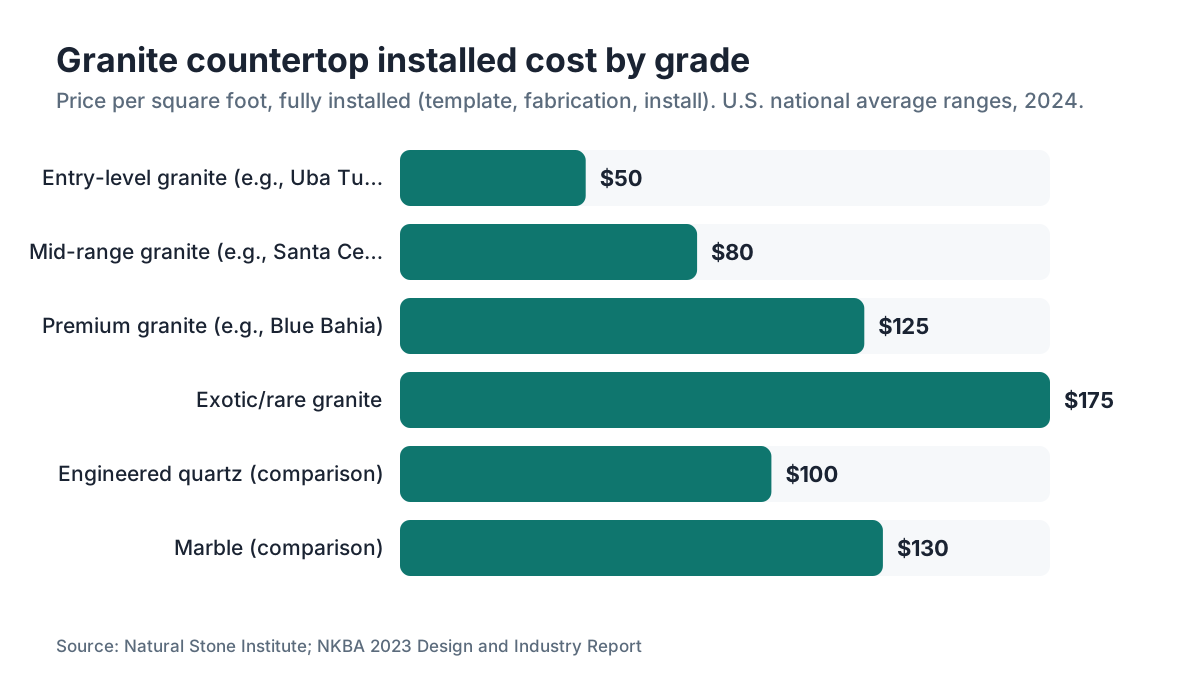
Granite sells in tiers, and the industry recognizes three broad groups: entry, mid, and premium, with exotic sitting above all of them. These tiers aren't standardized by any single body, so a "Level 2" at one yard is a "Level 3" at another. What separates them is movement complexity, rarity of veining, thickness consistency, and origin.
| Grade | Material cost (slab) | Installed cost per sq ft | Typical examples |
|---|---|---|---|
| Entry-level (Level 1) | $5 to $15/sq ft | $40 to $60 | Uba Tuba, Baltic Brown, New Venetian Gold |
| Mid-range (Level 2 to 3) | $15 to $35/sq ft | $60 to $100 | Santa Cecilia, Alaska White, Bianco Romano |
| Premium (Level 4+) | $35 to $80/sq ft | $100 to $150 | Blue Bahia, Calacatta Macaubas, Fusion White |
| Exotic/Rare | $80 to $150+/sq ft | $150 to $200+ | Azul Imperial, rare book-matched origins |
The installed numbers assume a standard U.S. shop, a single straight edge, and a basic cutout. Fabrication labor alone runs $25 to $50 per square foot in most metro markets as of 2024, with high-cost metros like New York, San Francisco, and Boston pushing the top of that.
Entry-level granite is a genuinely good product. Uba Tuba has been in kitchens for decades and holds up. It's cheap because of supply, not quality. It's quarried in huge volume in Brazil and sits in nearly every distributor yard in North America. Like the look? There's no reason to spend more. [1]
What drives the cost of granite up beyond the slab price?
The slab is usually 40 to 60 percent of your installed total. The rest is fabrication, logistics, and choices you make during the project. Here are the drivers that move the number most.
Edge profiles are the most underestimated line item on the quote. A standard eased edge (slightly rounded top) usually comes with the base price. An ogee, double ogee, waterfall, or stacked laminate edge adds $15 to $40 per linear foot. A big kitchen with 50 linear feet of exposed edge can pick up $750 to $2,000 on edge selection alone. A simple bevel or bullnose costs almost nothing extra. Tight budget? Simplify the edge first.
Cutouts cost money every time. A kitchen sink cutout runs $150 to $300 depending on shape. An undermount adds complexity because the stone has to be ground smooth underneath. A farmhouse or apron-front sink means removing the front cabinet rail and fitting the stone to a custom front, and some shops charge $300 to $600 for that. Cooktop cutouts are $100 to $200. Faucet holes are $30 to $60 each.
Waterfall edges have gotten popular in the last few years. On a waterfall island the stone wraps down the sides to the floor, which can double or triple the material and fabrication cost of that single piece. You need matching grain direction, which sometimes means buying a second slab, and the mitered corner joint is precision work. Budget $500 to $1,500 extra per waterfall panel, per side.
Removal of your old countertops runs $100 to $400, depending on the material and how it's attached. Some shops fold it in. Some line-item it. Ask upfront.
Seams add cost and appear wherever a slab joint is required. Any run longer than about 9 to 10 feet needs a seam, because standard slabs max out there. Seam placement matters for looks and for support. Shops charge $50 to $200 per seam, and you may not have a choice about needing one.
Remnants save money. A fabricator's yard usually has offcuts from bigger jobs, and if your bathroom vanity or a small kitchen section fits one, you can sometimes pay $10 to $20 per square foot for material that would otherwise sit unused. Ask.
How does granite cost compare to other countertop materials?
Seeing granite next to its neighbors helps you decide if it's the right spend. The table below uses installed cost ranges from industry cost surveys and national remodeling data as of 2024. [2]
| Material | Installed cost per sq ft | Notes |
|---|---|---|
| Laminate countertops | $15 to $40 | Post-form is cheapest; custom laminate higher |
| Butcher block countertops | $30 to $80 | Hardwood species and thickness drive range |
| Corian countertops | $45 to $100 | Solid surface; seams can be invisible |
| Granite (this guide) | $40 to $200 | Wide range due to grade and origin |
| Quartz (engineered) | $50 to $150 | More uniform; no sealing required |
| Marble countertops | $60 to $200 | Softer, etches easily; high maintenance |
| Cambria countertops | $70 to $160 | Premium U.S.-made engineered quartz |
Granite sits in the middle of the stone market. It's harder than marble, skips the frequent sealing marble demands, and generally costs less than premium engineered quartz brands like Cambria. Against standard quartz, granite often beats it on price at the low and mid tiers, though quartz wins on consistency and zero-sealing upkeep.
For how the materials stack up inside an actual kitchen, the kitchen countertops guide covers the decision factors past price.
How much does a full granite kitchen typically cost in total?
The National Kitchen and Bath Association's 2023 Design and Industry Report put median spend on countertop materials in a major kitchen remodel at roughly $3,500 to $8,000, with granite the most commonly selected natural stone. [3] Wide range, and it makes sense given how much grade varies.
Here's a practical estimate. Measure your counter area, then use these ballpark multiples.
A small kitchen with 30 square feet of counter runs $1,200 to $3,600 installed, depending on grade. A mid-size kitchen at 45 to 55 square feet runs $2,700 to $6,600. A large kitchen or one with an island at 65 to 80 square feet runs $3,900 to $9,600 and up.
Those numbers assume one sink cutout, a standard edge, and normal site conditions. Add 15 to 20 percent for premium edges, multiple cutouts, or a waterfall island.
Location moves the total a lot. Fabrication labor in rural markets can run $5 to $15 per square foot below major metros. Slab-level material costs don't swing as hard geographically because granite ships nationally, but regional distributors carry different inventory, and that shapes which tiers are realistic for you.
Honest advice on total cost: get three quotes from local fabricators, and ask each to price the same slab if you can, or at least the same tier. Quotes that look wildly different almost always differ in what's included. Line-item every quote before you sign.
What does granite fabrication cost, separate from the slab?
If you're sourcing your own slab (buying straight from a stone yard and hiring a fabricator to process it), you need fabrication-only pricing. Fabrication labor covers templating, cutting, polishing edges, cutouts, and installation.
Fabrication-only rates run roughly $30 to $60 per square foot in most U.S. markets, metro areas at the top. That per-square-foot figure is a blended rate: CNC time, edge work, and the labor to set and support the stone on site. Cutouts and seams get charged on top as line items.
Templating is sometimes billed on its own, at $75 to $200 per job. Most shops fold it into the install quote but break it out when you're supply-only. Template is done with a digital laser system or a rigid stick template, and it sets the exact cut dimensions before the slab gets touched.
Shops running quoting software like SlabWise can build itemized quotes faster and more accurately than shops working off manual spreadsheets. That means you get clear line items instead of a lump sum. Ask for an itemized quote. Any reputable shop hands one over without a fight.
Installation labor on top of fabrication adds $150 to $400 for a typical kitchen, covering the crew time to move, set, shim, and adhere the stone. Stone is heavy. A 2 cm granite slab weighs about 12 to 13 pounds per square foot, and 3 cm (the common kitchen thickness) weighs 18 to 19 pounds per square foot. [10] A 50-square-foot kitchen carries 900 to 950 pounds of stone. That's a two- or three-person job.
Does granite thickness affect the price per square foot?
Yes, and more than most homeowners expect. Granite comes in two main countertop thicknesses: 2 centimeter (about 3/4 inch) and 3 centimeter (about 1-3/16 inch).
2 cm granite is lighter and cheaper on material, but it usually needs a plywood buildup to support it at overhangs and around cutouts. That buildup adds labor and material. It's less common in kitchens now. Most U.S. shops default to 3 cm because it's self-supporting and reads more substantial.
3 cm granite costs roughly 20 to 30 percent more in raw slab price than 2 cm from the same color family, but you skip the buildup cost. Net difference per project is often small. If a fabricator quotes 2 cm with buildup, ask for the 3 cm apples-to-apples number before you decide.
Some exotic slabs come only in 2 cm, or the distributor cuts them to 2 cm to squeeze more yield out of a thin natural block. There you don't get a choice. 3 cm is standard inventory at virtually every U.S. distributor.
Slab size matters too. Standard slabs from Brazil, India, or China (the biggest exporters to the U.S.) run roughly 9 to 10 feet by 5 to 5.5 feet. Italian or less common origins sometimes come in smaller nominal sizes. A smaller slab with the same surface area as a large one can force more seams or tighter nesting, which raises fabrication labor. [4]
Where does granite come from and does origin change the price?
Granite is quarried on every inhabited continent, but the U.S. countertop market pulls mostly from Brazil, India, China, Italy, and Norway, with smaller domestic volumes (Vermont, Georgia, and South Dakota all have active quarries). [4]
Brazilian granite leads North American distribution by volume. It runs mid- to premium-grade, well-finished, and reliably in stock. Indian granite covers the widest price range, from budget Colonial White to premium Blue Pearl. Chinese granite is often cheapest at the entry level, though quality control is less consistent. Italian and Norwegian stones (Norwegian Rose, Azul Macaubas) are genuinely rare and expensive.
Origin drives price through three channels: shipping distance and import tariffs, quarry yield (a color that takes 100 slabs to find one usable match versus one that comes out clean every time), and plain market rarity.
Tariffs are real. The U.S. has applied Section 301 tariffs on certain goods from China, and stone products from China have faced rates that shift over time. As of 2024, Chinese natural stone carried a 25 percent tariff under Section 301 of the Trade Act of 1974, administered by the Office of the U.S. Trade Representative. [5] That has pushed some buyers toward Indian and Brazilian sources. Whether it shows in your retail quote depends on whether your distributor already priced it in.
The practical answer for most homeowners: ask the stone yard to show you what's in stock at each tier, compare with your own eyes, and don't pay for a Brazilian Blue Bahia if a mid-grade Santa Cecilia would make you just as happy.
How do you get an accurate granite countertop quote?
A reliable quote takes a little prep on your end. Here's what actually works.
Measure your space before you call anyone. The numbers don't have to be perfect. A sketch with dimensions lets a fabricator give a real ballpark instead of a shrug. Count cutouts (sinks, cooktops) and note the edge situation: island edges exposed on two or three sides versus a peninsula with one exposed side.
Visit the slab yard, more than a showroom. Showrooms show small samples. A slab yard shows you the full 9-by-5 sheet, which is the only way to see how the movement reads at scale and whether the material is consistent enough to avoid a seam in a bad spot. Most distributors let the public in, or will bring a fabricator's customer through without a fuss.
Get quotes from two or three fabricators. Prices vary more than you'd guess, and not always because of quality. Overhead, volume, and what each shop includes all move the number. A quote 30 percent under the others either has something missing or comes from a shop with lower overhead giving you a real deal. Ask what's included, line by line.
Ask about the remnant yard. If your bathroom vanity fits an offcut from your kitchen slab, you can often get it for next to nothing in added material. Legitimate money saved.
Once you pick a fabricator, they'll do a hard template (rigid stick template or digital laser scan) before cutting anything. Never let a shop cut from builder's blueprints or your own measurements. Template is the one step that decides whether the fit is perfect, and a good fabricator insists on doing it themselves.
Shops using modern quoting tools like SlabWise can show you an itemized quote fast, which makes comparing shops far easier. Ask for the line items: material, fabrication per square foot, edge profile charge, cutouts, delivery, installation, and removal of the old counters.
What maintenance costs should you budget for granite after installation?
Granite is natural stone, so it's porous and benefits from sealing. Ongoing maintenance is real but small.
Sealing granite costs $40 to $80 in materials if you do it yourself, using a penetrating impregnator sealer like Miracle Sealants or StoneTech. A pro sealing service runs $100 to $200 for a kitchen. How often you reseal depends on the granite's porosity, which varies by color family. Dark, dense granites (Absolute Black, Uba Tuba) often go three to five years or longer. Lighter, open-grained stones (White Ice, River White) may want it yearly. The test is simple: drop a quarter-sized puddle of water on the stone. Beads up, you're sealed. Darkens within five minutes, time to reseal.
Chipping is the other real issue. Granite edges chip from impact. A minor chip fill by a stone restorer costs $75 to $250 depending on location and depth. Major cracks are rare in installed stone but do happen, and repair gets expensive fast, sometimes $300 to $600 or higher.
Daily care is easy. Mild dish soap and water, or a stone-safe cleaner. Skip acidic cleaners (vinegar, citrus) because they can etch the surface over time, even though granite resists acid better than marble does. For daily stone care, the how to clean stone countertops guide has the specifics.
Is granite a good investment for your home?
Remodeling return-on-investment data is genuinely hard to pin to a single material choice. The closest reliable source is the Remodeling Magazine Cost vs. Value Report, which tracks average kitchen remodel costs and resale returns nationally. Its 2024 data shows a midrange major kitchen remodel recoups about 49 percent of its cost at resale on average, and an upscale remodel recoups about 38 percent. [6] That's the whole kitchen, not countertops alone.
Granite won't return dollar-for-dollar at resale. Almost no renovation does. What it does is satisfy buyers comparing your house to others in its price range. In a market where competing listings have granite or quartz, showing up with laminate can genuinely hurt your sale. In a starter-home market, a high-end exotic slab may add nothing to the sale price over a mid-grade option.
The honest case for granite as an investment: if you're staying five-plus years, the material lasts the whole run with minimal maintenance, it won't need replacing, and you get daily use out of it. That's a reasonable return on the spend. Flipping in 18 months? A mid-grade granite or even a good laminate is smarter money.
For a wider look at how granite fits next to other options, the granite countertops overview covers durability, appearance, and long-term ownership in more depth.
Frequently asked questions
How much does granite cost per square foot for just the slab, without installation?
Raw slab-only pricing runs roughly $5 to $15 per square foot for entry-level granite, $15 to $35 for mid-range, and $35 to $150 or more for premium and exotic colors. These are distributor prices before fabrication (cutting, polishing, cutouts) or installation labor. Fabrication adds $30 to $60 per square foot on top of material, so slab-only quotes only help for comparison if you're managing your own fabrication.
What is the cheapest granite countertop option available?
Entry-level granites like Uba Tuba, Baltic Brown, New Venetian Gold, and Bianco Romano are consistently cheapest, running $40 to $60 per square foot installed in most U.S. markets. Buying a fabricator's remnant slab for a small bathroom or laundry room can drop material cost further, sometimes $10 to $20 per square foot for material alone. Quality isn't the issue with these stones. Supply volume is simply high.
How much does granite countertop installation cost for an average kitchen?
An average U.S. kitchen with 45 to 55 square feet of counter runs $2,700 to $6,600 installed for granite, depending on grade. Add 15 to 20 percent for a waterfall island, complex edges, or multiple cutouts. Installation labor itself (beyond fabrication) is usually $150 to $400 for a typical kitchen, folded into most full-service quotes. Always ask whether the quote includes template, delivery, install, and removal of the old counters.
How does granite compare to quartz in cost per square foot?
Quartz countertop cost per square foot installed runs $50 to $150 for most engineered brands, against $40 to $200 for granite. At the mid-range they're competitive. Granite wins on price at the entry level. Premium engineered quartz brands like Cambria can top exotic granite. Quartz needs no sealing and looks more consistent. Granite carries more natural variation and character. On budget alone, no clear winner across the full range.
Does granite countertop thickness (2 cm vs. 3 cm) affect cost?
Yes. 3 cm granite costs roughly 20 to 30 percent more per square foot in raw slab price but skips the plywood buildup at overhangs. 2 cm material needs that buildup, which adds labor. On a total-project basis the difference often washes out, but 3 cm is the U.S. standard for kitchen counters and what most fabricators default to. Ask for both quotes if a shop offers 2 cm, to see the real net difference.
What edge profile options are available and what do they cost?
Standard eased or slightly rounded edges usually come with the base fabrication quote. Step up to a bevel, full bullnose, or half-bullnose for $5 to $15 per linear foot extra. An ogee or double ogee adds $15 to $30 per linear foot. A mitered waterfall edge or stacked laminate profile can add $25 to $40 per linear foot or more, plus possible extra material. A 50-linear-foot kitchen edge can add $750 to $2,000 depending on profile.
How long does granite countertop installation typically take?
From signed contract to finished install is typically 7 to 14 days. Template day is one visit. Fabrication takes 3 to 7 business days in a normal shop workload. Installation takes 2 to 6 hours for a standard kitchen. Same-day turnaround shops exist but usually cost more. For the 1 to 3 days after install, avoid heavy impact on the edges while any adhesive or seam epoxy fully cures.
Does granite need to be sealed, and how much does that cost?
Most granite benefits from sealing with a penetrating impregnator sealer. DIY sealing costs $40 to $80 in product. Professional sealing runs $100 to $200 per kitchen. Frequency depends on porosity: dense dark granites may go 3 to 5 years, lighter stones yearly. Test by leaving a small water puddle on the surface for 5 minutes. If it darkens the stone, reseal. If it beads, you're covered.
Can I save money by buying my own granite slab and hiring a fabricator separately?
Sometimes, but it gets complicated. Fabricators often mark up slab material 20 to 40 percent, so buying direct from a distributor can save real money on that line. The risk: if the material has a hidden crack or color variation, responsibility gets murky when the fabricator didn't supply it. Some shops charge a premium for supply-only work. It works best for experienced buyers who know what they're seeing in a slab yard.
How do I measure countertop square footage for a granite quote?
Measure each counter section in inches: length times depth. Divide by 144 for square feet. Standard depth is 25.5 inches (including overhang), but measure your actual base cabinet depth plus desired overhang. Add all sections, island and peninsula included. Don't subtract for sink cutouts; fabricators charge for the waste. Add 10 to 15 percent overage for seam positioning and grain matching. That gives a solid estimate for your first quote conversation.
Are there seasonal price differences in granite countertop costs?
Nobody has clean national data on seasonal pricing for granite fabrication. Anecdotally, spring and early summer are the busiest seasons for kitchen remodels, and some fabricators report 3 to 6 week backlogs at peak demand. Whether that means higher prices depends on the shop. Scheduling in winter or late fall can get you faster turnaround and, rarely, a modest discount. The bigger savings come from grade choice and edge simplification, not timing.
What questions should I ask a granite fabricator before signing a contract?
Ask: Is this quote fully installed, including template, delivery, and removal of the old counters? What edge profile is included, and what do upgrades cost? How many seams, and where do they fall? What slab or slabs get used, and can I approve them before cutting? What's the warranty on fabrication and installation workmanship? How long until template, and how long after template until install? Clear answers to all of these upfront head off most disputes.
Is granite still popular, or has quartz taken over?
Quartz has taken serious market share from granite over the past decade, especially in new construction and builder-grade installs, where consistency and zero maintenance win. But granite is still the most popular natural stone countertop material in the U.S. by installed volume. High-movement granite looks and feels different from engineered quartz, and buyers who want that natural uniqueness still choose it. The two materials coexist. Neither replaced the other.
Can granite countertops be repaired if they chip or crack?
Minor edge chips can be filled with color-matched epoxy by a stone restoration pro, typically $75 to $250. Small hairline cracks get filled the same way. Major structural cracks are harder to hide and can cost $300 to $600 or more depending on location and length. Granite rarely cracks under normal use. It's usually a point impact from a heavy dropped object, or occasionally inadequate support at an overhang or cutout.
Sources
- U.S. Geological Survey, Mineral Resources Program, Natural Stone Statistics: Brazil is a primary source of granite imported into the U.S. countertop market; USGS tracks dimension stone imports by country of origin annually.
- U.S. Bureau of Labor Statistics, Consumer Price Index, Household Furnishings and Operations: Countertop and flooring material cost benchmarks used to contextualize installed price ranges across material categories.
- National Kitchen and Bath Association, 2023 Design and Industry Report: Median countertop material spend in a major kitchen remodel was approximately $3,500 to $8,000; granite remained the most commonly selected natural stone.
- U.S. Geological Survey, National Minerals Information Center, Dimension Stone Statistics: Granite is quarried domestically in Vermont, Georgia, and South Dakota, with Brazil, India, China, Italy, and Norway among major import sources to the U.S.
- Office of the U.S. Trade Representative, Section 301 Investigations: Chinese natural stone products were subject to 25 percent Section 301 tariffs as of 2024 under the Trade Act of 1974.
- Remodeling Magazine, 2024 Cost vs. Value Report: A midrange major kitchen remodel recoups about 49 percent of cost at resale nationally; an upscale remodel recoups about 38 percent on average.
- U.S. Geological Survey, National Minerals Information Center, Minerals Yearbook: Dimension stone (including granite) slab pricing and import volume data by origin country reported annually by USGS.
- Natural Stone Institute, Industry Standards and Statistics: Industry body for stone fabricators and distributors; publishes standards for countertop fabrication thickness, edge profiles, and installation best practices.
- U.S. Census Bureau, American Housing Survey: Kitchen remodel frequency and countertop replacement rates used to contextualize lifecycle investment data.
- Natural Stone Institute, Dimensional Stone Design Manual: 3 cm granite weighs approximately 18 to 19 pounds per square foot; 2 cm material weighs approximately 12 to 13 pounds per square foot, per industry fabrication standards.
Last updated 2026-07-09