TL;DR
- Granite countertops in Sterling, VA run $50 to $130 per square foot installed, driven by stone grade, edge profile, and shop.
- A typical kitchen (40 to 50 sq ft of stone) lands between $2,000 and $6,500 all-in.
- The Dulles corridor packs in fabricators, feeding off wholesale stone yards near the airport and along I-66.
- Get three quotes.
What do granite countertops cost in Sterling, VA right now?
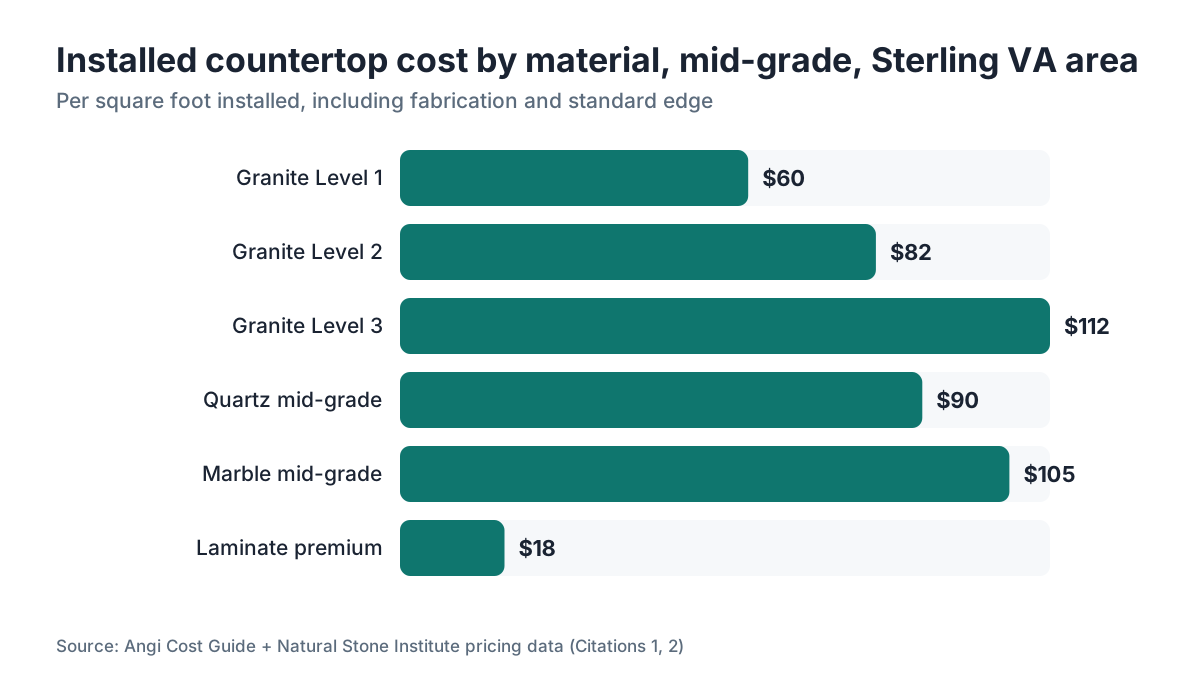
Installed granite in Sterling runs $50 to $130 per square foot. For a typical kitchen with 40 to 50 square feet of stone, that's roughly $2,000 to $6,500. The spread is that wide because granite isn't one product. Entry-level Colonial White or Uba Tuba out of Brazil or India sits at the bottom. Rare slabs, heavy figuring, or anything over half an inch thick with a mitered edge stack climbs fast.
Three cost buckets matter more than the stone itself. Fabrication labor (cutting, polishing, edge work) eats $30 to $50 of every installed dollar in Northern Virginia shops. The stone material is $15 to $60 per square foot depending on grade. Delivery and installation add another $10 to $20. Tearout of old laminate is usually its own line, $150 to $400 depending on cabinet prep.
Waste and seams move the final number too. An L-shaped kitchen with a long run often carries a seam the homeowner never priced in their head. Shops here typically bill the full slab rectangle, more than the net square footage you keep, so a kitchen that looks like 45 sq ft can invoice at 55 once you count cutouts and offcuts. Make every shop show you net versus gross square footage on the quote.
Here's the surprise: quartz countertops in Sterling VA run $60 to $120 installed, so the gap between mid-grade granite and mid-grade quartz is smaller than most people assume. The real difference is behavior. Granite needs periodic sealing. Quartz doesn't. The kitchen countertops guide lays out every material side by side. [1]
What granite grades exist and which one should you actually buy?
Buy Level 1 granite unless a specific slab makes you stop and stare. Shops and big-box stores sort granite into Level 1, 2, and 3 (sometimes A/B/C, or low/mid/premium). The label is marketing, not geology. No industry-wide standard says what makes a slab Level 2 versus Level 3. One shop's Level 3 is another shop's Level 2. The grade mostly tracks thickness, origin, movement, and what the shop paid at the wholesale yard.
Level 1 (roughly $50, $70 installed): Thin slabs, usually 3 cm, from high-volume quarries in Brazil or India. Consistent patterning, not much movement. Uba Tuba, Venetian Gold, Baltic Brown. Totally serviceable.
Level 2 ($70, $95 installed): Mid-range movement and color. Blue Pearl from Norway, Santa Cecilia, Giallo Ornamental. These are the workhorses of DC-area kitchen renovations.
Level 3 and up ($95, $130+ installed): Exotics, quartzites sometimes mislabeled as granite, large-format slabs, bookmatch pairs, Blue Bahia, Azul Aran. If you're asking whether you need this for a rental or a flip, the answer is almost certainly no.
Level 1 granite holds up mechanically just as well as Level 3. The difference is looks, not performance. Both resist scratching, both take heat, both need the same sealing schedule. Put the extra money into an edge profile you'll actually see, not an exotic stone your guests won't recognize. [2]
How do you find a reputable granite fabricator in Sterling, VA?
Start by asking whether the shop cuts stone in-house. Sterling and the broader Dulles corridor (Ashburn, Leesburg, Herndon, Chantilly) have a heavy concentration of stone fabricators, partly because of the construction volume along the Route 28 tech corridor and partly because of the wholesale yards clustered near Dulles and I-66. You have real options here, so vet in order.
First, ask whether the shop owns a CNC waterjet or bridge saw on site or farms cutting out. Shops that cut in-house have shorter lead times and tighter quality control. Second, ask about their template process. The good ones use digital templating (laser measuring or a kit like Proliner) instead of cardboard cutouts, which cuts down seam and cutout errors. Third, ask for three local references from jobs done in the last six months. Website testimonials don't count.
Ask how they price seams too. Some charge per seam ($50, $150 each is common here). Others bundle it. A kitchen with an island almost always has one seam and sometimes two. Know that before you sign.
One rule I'd hold to: if a quote comes in more than 20 percent below the median from other shops, ask exactly what's different. Usually the low bidder is quoting thinner material (2 cm instead of 3 cm), a simpler edge, or leaving out tearout. It's rarely a great deal.
Lead times here run 10 to 21 days from signed contract to installation under normal conditions. In peak remodel season (April through September) that stretches toward 30 days. A shop promising under a week deserves a hard question about why. [3]
What questions should you ask before signing a granite quote in Northern Virginia?
Ask what the price actually includes before you fixate on the number per square foot. That's where jobs go sideways. A quote missing a few line items can look $400 to $800 cheaper than it is.
Ask whether the price includes the template fee (some shops charge $75, $200 separately), sink cutout (usually $100, $200), cooktop cutout (similar), backsplash material if you want it, and haul-away of the old counters.
Ask what happens if the slab shows a visible flaw or color shift after fabrication. Good shops show you the actual slab before cutting. A shop that can't or won't let you approve the slab is telling you something.
Ask about seam placement. You want seams away from sinks and busy corners, and you want them drawn on a plan before the template is cut, not discovered on install day.
Ask about warranty. Most fabricators in this region give a one-year labor warranty on workmanship. That's standard. Some go longer. No fabricator warranties the stone against chips or cracks from impact, and that's normal.
Ask who reconnects the plumbing. Fabricators cut and set stone. They don't hook up sinks as licensed plumbers. You'll need a plumber or handyman for that step, so put it in the budget now. [4]
How does granite compare to quartz for a Sterling VA kitchen?
Granite handles direct heat better and gives you a one-of-a-kind slab; quartz skips sealing entirely and photographs consistently for listings. That's the whole comparison in one sentence, and it comes up in nearly every homeowner consultation in the DC suburbs. Here's the detail.
| Factor | Granite | Quartz |
|---|---|---|
| Cost installed (mid-grade) | $65, $100/sq ft | $70, $110/sq ft |
| Sealing required | Yes, every 1 to 3 years | No |
| Heat resistance | Excellent (direct pot safe) | Good (trivets recommended) |
| Scratch resistance | Very good | Good |
| Repair if chipped | Epoxy fill, usually visible | Manufacturer dependent |
| Each slab unique | Yes | No (engineered pattern) |
| Radon concern | Trace levels, well-studied [5] | Essentially none |
Renting the place out or selling in 2 to 3 years? Quartz is easier to maintain and has a consistent look that shoots well for listings. Staying put and want a kitchen that doesn't match your neighbor's? Granite does that. There's no universal right answer.
One Sterling-specific note: Loudoun County homes have sold well partly on kitchen updates in the $30,000, $70,000 range, and both granite and quartz stay competitive at resale. Remodeling Magazine's Cost vs. Value Report puts a minor kitchen remodel (which includes countertops) at roughly 96 cents on the dollar in the South Atlantic region, which covers Northern Virginia. [6]
For the premium engineered-stone end, see the cambria countertops article. For granite in broader context, the granite countertops guide covers the material nationwide.
Does granite have radon or radiation concerns you should know about?
The concern is real but small, and testing your home's air matters far more than testing your countertop. This comes up in Northern Virginia because the Piedmont region has pockets of elevated background radiation, and because granite is naturally radioactive in trace amounts.
The EPA looked at this directly and commissioned studies in 2008. Their conclusion, in their own words: "EPA believes that the existing data is not sufficient to conclude that the levels of radon in homes are significantly affected by the presence of granite countertops." [5] Most residential granite emits radiation well below EPA thresholds for concern.
So ventilate your kitchen the way you already do. If you have a radon mitigation system (common in parts of Loudoun and Fairfax counties, where sub-slab radon is documented), that system handles far more radon than any slab will ever produce. Test the air in your home, not the stone. [7]
If the question still nags at you, quartz has no meaningful radiation profile, and that's a legitimate reason to pick it. But skipping granite over radon while never testing your home's air is solving the smaller problem and ignoring the bigger one.
How do you maintain granite countertops in a Northern Virginia home?
Two things matter: sealing on schedule and keeping acids off the surface long-term. Granite maintenance is simpler than its reputation suggests.
Sealing: Apply a penetrating stone sealer every one to three years. Frequency depends on your slab's porosity. Run the water test. Drip a tablespoon on the surface. If it beads, the sealer is working. If it soaks in within a few minutes, reseal. Miracle Sealants 511 Impregnator or DuPont StoneTech are easy to find and fine for home use.
Cleaning: Warm water and a few drops of dish soap covers daily cleaning. The don't list is short. Skip bleach and vinegar (both etch the sealer over time). Skip abrasive scrubbers. Wipe up wine, citrus, and tomato-based food before it sits.
Heat: Granite takes heat well. You can set a hot pot on it. But thermal shock from a screaming-hot pan on cold stone can, rarely, crack a thin section or a spot near a cutout. Trivets cost nothing and kill the risk.
Chips: Granite chips at corners and edges more than people expect, usually from a heavy pot dropped on an outside corner. A stone restoration pro fills chips with color-matched epoxy. In Loudoun and Fairfax counties, that runs $150, $300 for a corner repair.
For a cleaning guide across stone types, see how to clean stone countertops. [8]
What permits or HOA rules apply to countertop replacement in Sterling, VA?
You don't need a building permit for a straight countertop swap in Sterling, which sits in Loudoun County. Replacing counters is a cosmetic improvement, not a structural or systems change. Loudoun's permit thresholds cover structural work, electrical, HVAC, and plumbing changes, not surface replacements. [9]
The exception: if your project moves a gas line, relocates a sink drain, or changes cabinetry that touches load-bearing structure, those trades can trigger permits. The countertop itself won't.
HOA rules: If your home is in one of Sterling's planned communities (Cascades and Countryside among them), your HOA likely governs exterior changes and has no say over interior countertop choices. Read your CC&Rs if you're unsure, but countertop swaps are almost never covered.
Contractor licensing: Virginia requires any contractor doing work over $1,000 to hold a Class A, B, or C license from the Virginia Department of Professional and Occupational Regulation (DPOR). [10] Ask your fabricator for their DPOR license number before signing. Any legitimate shop hands it over without blinking.
What are the best edge profiles and why does it matter for cost?
Edge profiles change durability, cleaning, and the final invoice, so understand them before you walk into a showroom. Here are the common ones in Northern Virginia kitchens.
Eased edge (flat with a small bevel): The cheapest, often baked into base pricing. Clean, modern, easy to wipe. Works in nearly any kitchen.
Bullnose (fully rounded): Soft and traditional. Common in older Loudoun County homes. A little more fabrication time than eased. Usually a $5, $15 per linear foot upcharge.
Ogee (S-curve): Decorative, formal, common in dressier kitchens. Harder to keep clean in the crevice. Adds $15, $30 per linear foot.
Mitered edge (two pieces joined at 45 degrees to fake thickness): Adds real cost, $30, $60 per linear foot, because it needs precise cutting and extra material. Creates a dramatic 4 to 5 cm look without a full 5 cm slab. Worth it only on islands where the edge shows.
Waterfall edge (stone drops vertically to the floor on one or both island ends): Popular in contemporary Northern Virginia builds. Needs extra material and careful grain matching. Adds $500, $1,500 per waterfall end.
My honest take: eased or slight bevel is right for most homeowners. It looks clean, fabricates fastest (fewer chances to blow a cut), and ages well. Spend the decorative budget on one visible island edge instead of running ogee across all 60 linear feet. [11]
How does the countertop buying process actually work, step by step?
You can't measure today and install next week, and knowing the sequence saves you from assuming you can. Here's how it goes.
Step 1, Material selection: Visit a showroom or stone yard to pick your slab. Several Dulles-area wholesale yards let homeowners walk through. Worth doing even if you buy through a fabricator, because you might fall for a specific slab and want to claim it before it sells.
Step 2, Fabricator quote: Bring rough measurements (total linear feet, note any islands). Get at least three quotes. The spread on a mid-size kitchen can hit $1,000, $2,000. That's real money.
Step 3, Template: After you sign and pay a deposit (usually 50%), a template crew comes to your house. Digital templating takes 30 to 60 minutes. Don't rush it. Everything cut after this is based on these numbers.
Step 4, Fabrication: Typically 5 to 10 business days after template. Your slab gets cut, edged, and polished.
Step 5, Installation: A crew of 2 to 3 installs in 3 to 6 hours for a standard kitchen. Cabinets have to be level and set. Plumbing has to be disconnected before they show up.
Step 6, Plumbing reconnect: On you. A licensed plumber in Northern Virginia charges $150, $350 for a sink reconnect.
For more on the install itself, see countertop installation.
Shops that quote and track jobs digitally tend to have fewer mix-ups around scope and material changes. SlabWise is quoting and nesting software built for stone fabrication shops. If you're a homeowner and your fabricator runs it, you'll probably get a cleaner itemized quote than you'd see from a shop working off spreadsheets. [12]
Is granite still popular in Northern Virginia, or is something else taking over?
Granite's national market share has slipped since its mid-2000s peak, when it was the default countertop for move-up homes. Engineered quartz passed granite in US residential sales volume around 2016, a shift tracked by the Freedonia Group's industry studies. [13] In Northern Virginia, both materials stay extremely common and both hold resale value.
What shifted is the cultural read. In 2005, granite was aspirational. Now it reads as standard. For a homeowner who wants a kitchen that pops in a competitive Loudoun County listing, dramatic quartzite or a strong quartz pattern may photograph better than Colonial White granite.
Granite never stopped being a genuinely good product, though. It's harder than most engineered stones, it takes heat without the concerns that come with resin-based quartz binders, and the natural variation means no two kitchens look alike. If you're renovating for yourself, not for resale positioning, what you like standing in the kitchen every morning matters more than trend data.
Other options worth knowing: marble countertops for a classic look with higher maintenance, butcher block countertops for warmth in a mixed-material kitchen, and laminate countertops if budget drives the decision. Each of those links covers the tradeoffs honestly.
What are the specific logistics of buying granite in Loudoun County vs. Fairfax County?
Sterling straddles the Loudoun/Fairfax line depending on the street, and that shows up in a few small ways.
Sales tax: Virginia's state sales tax is 5.3% on tangible personal property. Loudoun County adds a 1% local component, so most of Loudoun runs 6.3% total. [14] Most fabricators collect tax on materials. Some treat labor-only charges differently. Confirm how your quote handles it so nothing jumps on the final invoice.
Contractor availability: Fabricators shopped near the Dulles Greenway corridor service both counties without a surcharge. A shop based in Manassas or Rockville may tack on a travel charge. Ask before you assume the quote covers travel to your door.
Building inspection: For remodels that trigger permits (new electrical, plumbing relocation), Loudoun County's initial inspection scheduling has run 15 to 30 days in recent years, per Loudoun County guidance. [9] Plan around it if your project goes past countertop replacement.
Wholesale stone access: One practical edge of the Sterling ZIP code is how close it sits to stone importers in the Dulles and Chantilly industrial corridors. Some homeowners drive to these yards to pick slabs before hiring a fabricator. Worth doing if you have specific aesthetic requirements, because you lock in your slab before any fabricator commitment.
Frequently asked questions
How much does granite countertop installation cost in Sterling, VA?
Installed granite in Sterling, VA runs $50 to $130 per square foot depending on stone grade, edge profile, and shop. A typical kitchen (40 to 50 sq ft of stone) lands between $2,000 and $6,500 all-in, including template, fabrication, and installation. Tearout of old countertops, sink cutouts, and plumbing reconnection are usually priced separately.
How long does it take to get granite countertops installed in Northern Virginia?
From signed contract to installation, expect 10 to 21 business days in normal conditions. The sequence is: deposit paid, template visit (1 to 3 days after deposit), fabrication (5 to 10 days), then installation. During peak season (April through September), lead times can stretch to 30 days. A shop promising under a week is worth questioning.
Do I need a permit to replace countertops in Loudoun County, VA?
No permit is required for a straight countertop replacement in Loudoun County. It is a cosmetic improvement, not a structural or systems change. Permits are only triggered if you relocate plumbing, add electrical circuits, or make structural cabinet changes as part of the project. The countertop itself does not trigger any permit requirement.
What is the difference between granite and quartz countertops for a Northern Virginia kitchen?
Granite is natural stone requiring sealing every 1 to 3 years and handles heat better than quartz. Quartz is engineered, needs no sealing, and has a more consistent pattern. Mid-grade prices are close: granite runs $65, $100 installed, quartz $70, $110. Granite suits homeowners who want a unique look; quartz suits those who want lower maintenance or a rental-friendly product.
Is granite safe? Should I worry about radon from kitchen countertops?
The EPA reviewed this question directly and concluded that existing data is not sufficient to show granite countertops significantly elevate home radon levels. Loudoun and Fairfax counties do have elevated background radon in some areas, but testing your home's air addresses far more radon than any countertop produces. If radon concerns you, test the home, not the stone.
How do I find a reputable granite fabricator near Sterling, VA?
Ask whether the shop cuts in-house (not outsourced), uses digital templating, and will show you the actual slab before cutting. Request three local references from jobs completed in the last six months. Confirm the shop holds a Virginia DPOR contractor license. Get at least three quotes; a price more than 20 percent below others usually means thinner material or missing line items.
What edge profiles add the most to a granite countertop quote?
Waterfall edges (stone dropping vertically on island ends) add $500, $1,500 per end. Mitered edges add $30, $60 per linear foot. Ogee profiles add $15, $30 per linear foot. An eased or beveled edge is usually included in the base price. For most kitchens, an eased edge performs and looks just as good as decorative options at a fraction of the cost.
How often do granite countertops in a busy kitchen need to be resealed?
Every one to three years, depending on stone porosity. The water bead test tells you when: drip a tablespoon of water on the surface. If it absorbs in a few minutes instead of beading, it is time to reseal. Penetrating sealers like Miracle Sealants 511 Impregnator cost $20, $30 and take about 30 minutes to apply yourself.
What are common mistakes homeowners make when buying granite countertops?
The most common mistake is comparing quotes without confirming whether each includes the same line items (tearout, cutouts, edge profile, seams). Second is not visiting the stone yard to approve the actual slab before fabrication starts. Third is forgetting that plumbing reconnection is a separate trade. Fourth is choosing an exotic slab and then not budgeting for the extra fabrication time it requires.
Can granite countertops increase resale value in a Sterling, VA home?
Kitchen remodels in the South Atlantic region (which includes Northern Virginia) recoup roughly 96 cents per dollar spent on a minor kitchen remodel, per Remodeling Magazine's Cost vs. Value Report. Granite and quartz are both considered standard at the mid-to-upper home price points common in Loudoun County. Neither is likely to hurt resale; neither guarantees a dollar-for-dollar return above that baseline.
What is the typical warranty on granite countertop fabrication in Virginia?
Most Northern Virginia fabricators offer a one-year labor warranty on workmanship, which covers seam failures, improper cutouts, and installation defects. No fabricator warrants the stone against chips or cracks from impact, which is industry standard. The stone itself has no manufacturing defects in the traditional sense; visible flaw disputes are best resolved before cutting by approving the slab.
Does granite or quartz hold up better in a kitchen with heavy cooking use?
Both handle heavy cooking well. Granite has a slight edge on direct heat resistance because it is fully mineral with no resin binder. Quartz contains polymer resins (roughly 7 to 10% by weight) that can discolor under sustained direct heat above 150°C, though normal cooking contact is rarely a problem if you use trivets. For cutting, neither should be used without a cutting board; both dull knives and can chip at fine edges.
Are there granite alternatives worth considering for a Sterling, VA kitchen?
Yes. Quartzite (not quartz) is a natural stone that looks like marble but is harder than granite. Soapstone is dense and non-porous. Quartz engineered stone is the highest-volume alternative. If budget is the real constraint, high-quality laminate now mimics stone convincingly at $10, $20 per square foot installed. The right choice depends on your budget, maintenance tolerance, and how long you plan to stay in the house.
What size slabs do granite fabricators in the Dulles area typically carry?
Standard slab sizes from Brazilian and Indian quarries run roughly 9 to 10 feet long by 5 to 6 feet wide. Jumbo slabs from some Italian and Spanish quarries can reach 11 by 6 feet. Slab size matters for your kitchen because a larger slab means fewer seams. For a kitchen with a long run over 9 feet, ask the fabricator specifically whether they can source a jumbo slab or whether a seam is unavoidable.
Sources
- HomeAdvisor / Angi, Granite Countertop Cost Guide: Installed granite countertop costs range from roughly $50 to $130 per square foot depending on grade and region
- Natural Stone Institute, Granite Standards and Grading Overview: Granite grading levels (Level 1/2/3) are not standardized across the industry; they reflect individual shop pricing tiers
- Marble Institute of America (Natural Stone Institute), Fabrication Best Practices: Digital templating and CNC fabrication reduce field measurement errors and seam placement disputes
- Virginia Department of Professional and Occupational Regulation, Contractor Licensing FAQ: Virginia requires contractors performing work over $1,000 to hold a valid DPOR contractor license
- U.S. Environmental Protection Agency, Radiation in Building Materials, Granite Countertops: EPA states: 'EPA believes that the existing data is not sufficient to conclude that the levels of radon in homes are significantly affected by the presence of granite countertops.'
- Remodeling Magazine, Cost vs. Value Report 2023, South Atlantic Region: A minor kitchen remodel in the South Atlantic region recoups approximately 96 cents on the dollar at resale
- Virginia Department of Health, Radon in Virginia Homes: Parts of Loudoun and Fairfax counties have documented elevated sub-slab radon levels requiring mitigation consideration
- Marble Institute of America (Natural Stone Institute), Care and Maintenance of Natural Stone: Penetrating stone sealers should be reapplied every 1 to 3 years depending on porosity; the water bead test indicates when resealing is needed
- Virginia Department of Professional and Occupational Regulation, Class A/B/C Contractor License Requirements: Virginia contractors performing projects over $1,000 must hold a Class A, B, or C DPOR license
- Natural Stone Institute, Dimensional Stone Design Manual: Edge profile complexity affects fabrication time and cost; mitered and waterfall edges require significantly more material and labor than eased profiles
- SlabWise, Countertop Fabrication Quoting Software: Digital quoting software for stone fabrication shops helps produce itemized quotes that reduce scope miscommunications
- Freedonia Group, Countertops Market Study (US): Engineered quartz passed granite in US residential countertop sales volume around 2016
- Virginia Department of Taxation, Sales and Use Tax Rates by Locality: Loudoun County Virginia total sales tax rate is 6.3%: 5.3% state plus 1% local component
Last updated 2026-07-09