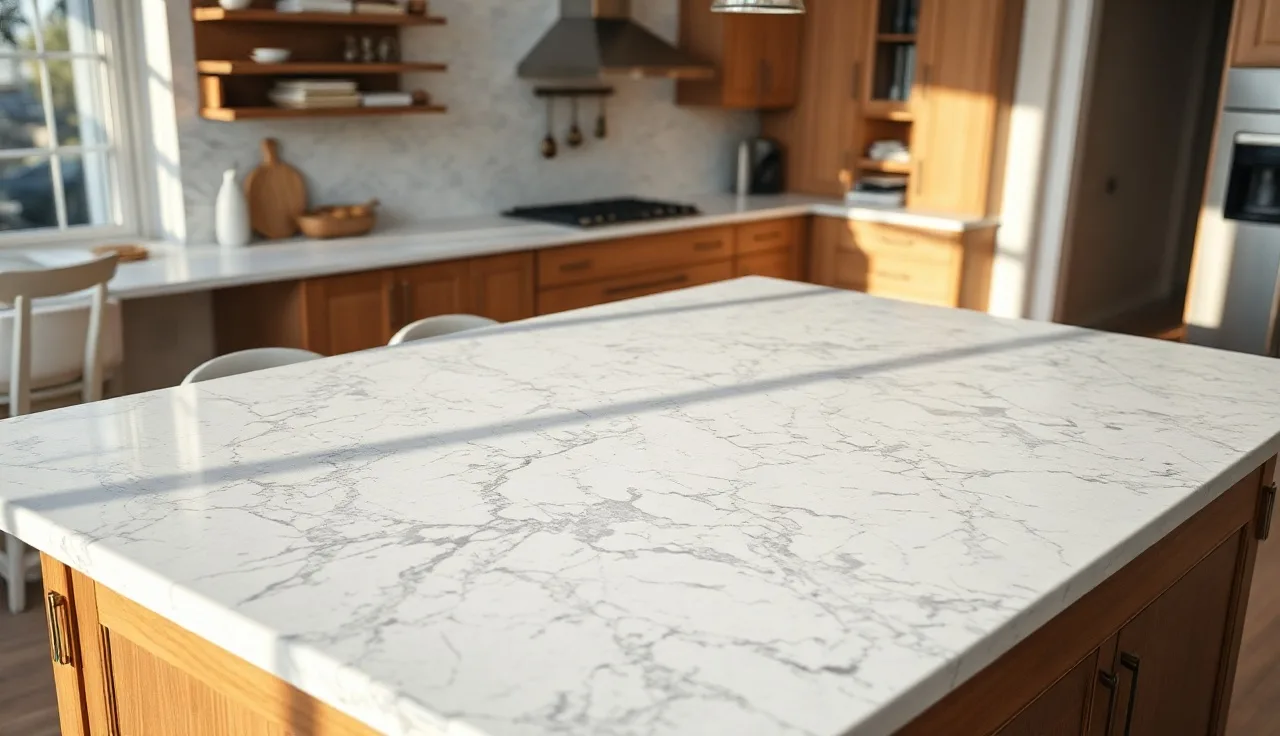
TL;DR
- Granite countertop images show a huge range of colors, vein patterns, and movement.
- Knowing what you're looking at before you shop saves money and prevents surprises.
- Slabs vary widely even inside one quarry block, so any picture is a starting point, never a promise.
- Installed granite runs $40 to $200 per square foot depending on stone rarity and edge complexity.
Why do granite countertop pictures look so different from the real slab?
A photo of granite is a flat, compressed guess at a surface that moves with light. Cameras flatten the depth, mute the sparkle, and shift color temperature depending on whether the shot used daylight, a flash, or a showroom's warm halogens. That warm showroom light is a choice. It makes creamy beiges look richer and dark blacks look more dramatic than they will over your sink.
The deeper problem is that granite is not a uniform material. It is an igneous rock that formed as magma cooled slowly underground, and the mineral mix changes as you move through a single quarry block. Quartz, feldspar, mica, and hornblende each catch light in their own way [1]. Two slabs cut from the same block can read as two different stones in a photo because one hit a mineral-rich seam and the other did not.
Stock photos make it worse. A retailer shoots their best slab, labels it 'Bianco Romano,' and posts it. Six months later your fabricator sources Bianco Romano and the slabs in the yard come in lighter, darker, or busier than that picture. Nobody lied. Natural stone just works that way.
See the actual slab you're buying, in daylight, before anyone cuts it. Pictures narrow a hundred options down to five or ten. They filter. They don't decide.
What do the main visual categories in granite pictures actually mean?
Scroll through enough granite images and a few visual families keep showing up. Learning what drives each look tells you more about how a stone lives in a kitchen than how it photographs.
Speckled or salt-and-pepper patterns. New Venetian Gold, Giallo Ornamental, and Santa Cecilia show tight, even mineral grains with no long veins. This is the look most people picture when they hear the word granite. The speckle hides seams, crumbs, and light scratches in daily use. These are also among the cheapest slabs because they come from large, consistent quarry sections [2].
Flowing veins and movement. Blue Bahia, Calacatta Macchia Vecchia, and Titanium show sweeping veins of quartz or feldspar traveling across the slab. They look spectacular in wide kitchen shots. They also fight you at the seam, and the color swing between two slabs of the same name can be extreme. Budget time to see several in person.
Solid or near-solid colors. Absolute Black from Zimbabwe or India, Verde Ubatuba, and their cousins show almost no movement. What you see is close to what you get, which makes buying at a distance less risky. One catch pictures never show: Absolute Black wears every water spot and fingerprint.
Exotic and rare patterns. Fusion White, Blue Eyes, and Van Gogh granite look almost painted in photos. These are genuinely rare materials, often available in single-digit slab counts. When a stunning image online turns up nothing local, scarcity is usually why.
| Visual Category | Example Stones | Seam Visibility | Photographic Accuracy |
|---|---|---|---|
| Speckled / salt-and-pepper | Santa Cecilia, New Venetian Gold | Low | High |
| Flowing veins | Blue Bahia, Titanium | High | Low |
| Near-solid | Absolute Black, Verde Ubatuba | Low | High |
| Exotic patterns | Fusion White, Van Gogh | High | Low |
What colors of granite are most popular in kitchen pictures?
White and gray granites run the show in kitchen pictures shared on design sites, and that tracks real buying. White Fantasy, Colonial White, and Alaska White show up constantly because they photograph cleanly against dark or light cabinets and read neutral enough for almost anyone. White and gray countertop surfaces have led NKBA member color surveys for years running [8].
Brown and gold granites like Giallo Ornamental, Venetian Gold, and Typhoon Bordeaux were the top sellers of the 2000s and early 2010s. Millions of renovation photos from that stretch are full of them. Plenty of buyers now read them as dated, which has pushed prices down on similar stones even though the material is exactly as good as it ever was.
Black granites like Absolute Black and Black Galaxy photograph hard against light wood cabinets. (Black Galaxy, with its gold flecks, is technically a gabbro, but it's sold and fabricated as granite.) You see them everywhere in modern and contemporary kitchen shots.
Blue granite is rare in photos because it's rare in the ground. Blue Bahia is the best-known blue, and its quarry output is small and inconsistent [2]. Pictures of blue granite counters often look edited even when nobody touched them.
Here's the move for fabricators: shoot every slab wet and dry. The wet state previews what a sealed surface looks like. Homeowners who only see the dry shot get blindsided by how much richer the color turns after sealing.
How much do the granite styles shown in pictures actually cost?
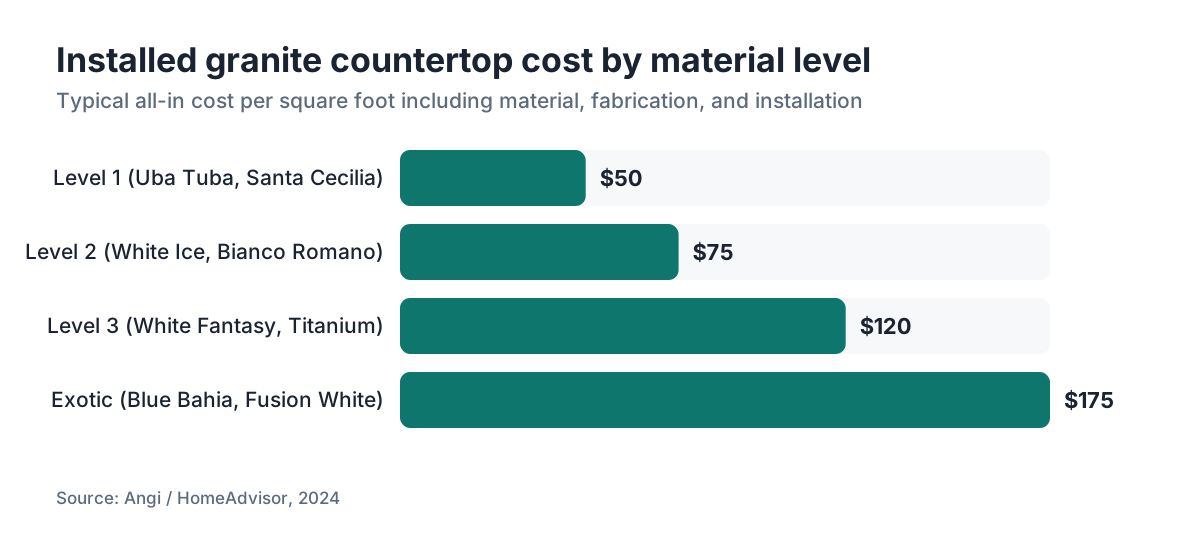
The gap between the cheap granite in a photo and the exotic one beside it is wider than most homeowners guess. Installed granite runs roughly $40 to $200 per square foot all-in, covering material, fabrication, and installation, and the top end climbs higher for rare stones and heavy edge work [3].
Level 1 or commercial-grade stones like Venetian Gold, Uba Tuba, and Santa Cecilia sit at the bottom, usually $40 to $60 per square foot installed. These are the workhorses. High quarry volume, steady supply, and plain patterns keep them cheap to source and quick to fabricate.
Mid-range granites, $60 to $100 per square foot installed, cover most whites and grays: Colonial White, Bianco Romano, River White, and other stones that are popular without being scarce. The price reflects moderate supply meeting strong demand.
High-end and exotic slabs run $100 to $200 or more per square foot installed. Blue Bahia, Fusion White, Calacatta Macchia Vecchia, and the like are priced by scarcity as much as looks. These are exactly the stones that flood your image feed, which means the pictures you see most are often the ones you can least easily afford.
Edge profiles add $10 to $30 per linear foot on top of the base, depending on complexity [3]. A simple eased edge on a mid-range speckle is a different animal from an ogee waterfall on an exotic slab. Photos almost never tell you the edge is part of the bill.
For a typical 40-square-foot kitchen, the swing from Level 1 to a high-end slab is $2,400 to $5,600 or more in material and fabrication alone, before any plumbing or electrical that comes with a full remodel.
What should you look for in pictures of granite countertops to predict daily performance?
Most kitchen pictures show granite at its Sunday best: freshly sealed, lit by a pro, wiped spotless. They almost never show the stone six months into real cooking, or how a busy pattern handles a counter cluttered with life.
Porosity matters and no photo shows it. Light-colored granites with visible pale minerals tend to be more porous than dark, dense stones like Absolute Black. More porous stones drink up oils and acids faster if they aren't sealed right. The USDA groups granite with 'non-porous to slightly porous' surfaces, and that degree of porosity drives both cleaning routine and sealing frequency [4].
Pattern scale against your kitchen size is where photos mislead hardest. A big-movement slab that looks stunning on a 12-foot island in a designer spread can read as chaos in a 25-square-foot galley. When you study pictures, hunt for shots with something of known size in frame: an appliance, a cabinet pull, a hand. That shows you how the pattern reads at human scale.
Sheen and finish are visible if you know the tells. Polished stone throws sharp reflections. Honed stone looks matte and drinks light. Leathered and brushed finishes carry a soft texture with a low sheen. Most kitchen pictures show polished granite because it photographs best, but honed and leathered finishes hide fingerprints and minor scratches better in real use [7].
Seam placement almost never shows in pictures and always matters in a kitchen. A dramatic vein needs planning to book-match or at least line up across a seam, which adds fabrication time and cost. If a photo shows one sweeping grain running across a big L-shaped counter with no seam in sight, it's either a pricey matched install or the seam is just out of frame.
How do fabricators use granite slab images for quoting and customer approval?
For a shop, slab photography is part of the job, more than marketing. A customer who approves an image and then rejects the installed counter for not matching is the nightmare, and it happens often when image handling is sloppy.
The industry best practice is to photograph each slab on intake: one dry, one wet-down, both in consistent daylight or under a calibrated light. Some shops lay slabs flat and drop a color reference card in the frame so customers can calibrate their own screen against a known standard. It costs almost nothing and it kills most 'this isn't the color I approved' fights before they start.
Digital layout tools that map a customer's actual slab onto their actual kitchen dimensions are getting standard. A customer signing off on a full-kitchen layout image before the saw runs is a different animal from one who glanced at a stock photo and said 'sure, looks fine.' This is where software that ties slab inventory photos to quoting and nesting layouts pays for itself. SlabWise is built for exactly this workflow, connecting the slab image to the quote and the cut layout so the customer sees what they're actually getting.
For homeowners, the ask is short: get a photo of your specific slab, with a scale reference, shot in daylight, before fabrication starts. Any reputable shop hands that over without blinking. A shop that won't is telling you something.
How do granite countertop pictures compare to other stone and surface options?
Granite pictures live in a specific visual lane. Marble countertops tend to show longer, more dramatic veins over softer, more translucent backgrounds, especially white Carrara and Calacatta. Marble photographs beautifully and behaves differently under a working kitchen, mostly because acid etches it.
Quartzite countertops, which are metamorphic rather than igneous, can look nearly identical to marble in photos. The mix-up is common and honest. White Fantasy and White Macaubas quartzites get called marble all the time because the veining is so similar. Quartzite is generally harder and less acid-sensitive than marble, so the label is worth pinning down.
Quartz countertops like Cambria are engineered, so their pictures show more consistency because the pattern is manufactured to spec. No slab-to-slab surprise. That predictability is exactly what some buyers want and exactly what others find flat next to natural stone.
Butcher block, laminate, Formica, and Corian each carry their own visual signature. The old tell for laminate versus granite was flatness and a visible seam. High-resolution laminate textures have closed the gap, but up close the eye still catches it.
For a full comparison of kitchen countertops by surface type, covering looks, upkeep, and cost, the real menu is wider than most people expect when they start shopping.
What are the most searched granite styles by color and pattern?
Search volume for granite names tracks design trends, and a handful of names win most of the traffic. That matters because when you search granite kitchen countertop pictures, these high-volume stones fill your screen, which makes granite look far more uniform than it is.
White Fantasy (sometimes sold as White Fantasy quartzite, since its classification is disputed) and Super White are among the most-searched white stones. Colonial White and White Ice are cheaper and just as dominant in picture results.
For grays, Steel Gray, Viscount White, and Bianco Antico show up heavily in shots shared on renovation sites. They photograph well against white and off-white cabinets, which describes a very large share of American kitchens.
Giallo Ornamental and Venetian Gold stay near the top of picture searches, partly because of the enormous install base from 2005 to 2015 renovations that people are now photographing, listing, and sometimes updating.
Exotic searches for Blue Bahia, Azul Macaubas (technically a quartzite), and Volga Blue pull high interest but read as inspiration more than intent. The purchase rate against that search volume stays low because supply is genuinely tight [2].
If you run a slab inventory, this pattern says photograph the stones you actually stock. Ranking in image search for Blue Bahia you don't carry just buys you dead-end inquiries.
How do lighting conditions in granite pictures affect what you see?
Lighting is the single biggest distortion in granite images, and almost nobody says so out loud where homeowners are actually looking at the pictures.
Under direct overhead fluorescent or LED, common in slab warehouses, granite looks cooler, more blue-gray, and flatter. Under warm incandescent or halogen, the same slab turns amber, richer, more three-dimensional. Under overcast daylight, you get the most neutral, honest read of the stone's real color.
Photographers who shoot architecture and interiors know this and correct for it. A professional kitchen photo usually blends natural window light with controlled fill. Warehouse slab photos rarely get that care.
Wet versus dry changes everything too. A freshly wet slab shows roughly what the stone will look like sealed: colors deepen, crystals flash, veins gain contrast. A dry, unsealed slab looks duller and sometimes almost chalky under harsh light. Any slab photo that looks a little too good is probably wet, shot in ideal daylight, or both.
For homeowners: staring at pictures on a phone in a bright room, you're losing color accuracy. View granite images on a calibrated monitor in moderate ambient light. Better yet, drive to the slab yard.
What questions should you ask a fabricator when reviewing granite slab pictures?
Reviewing granite pictures with a fabricator is a different job than scrolling a design app. You want answers photos can't give on their own.
First: is this a photo of the actual slab you have in stock, or a stock image for the material name? Stock images are fine for early style exploration. They are not a basis for final approval. You need to see your slab.
Second: what are the slab dimensions and how much is usable? Most slabs run 55 to 65 inches wide by 100 to 120 inches long, though some exotics come narrower or shorter [2]. If your kitchen needs a 60-inch run with no seam, a 55-inch-wide slab can't do it.
Third: are there any known voids, pits, or repairs in this slab? Natural stone sometimes has mineral voids filled with epoxy at the quarry or in the shop. It's common and usually holds up fine, but you should know before the finished counter surprises you.
Fourth: what finish is shown here, and what finish do you recommend for how I cook? A polished shot is stunning and shows every fingerprint in a working kitchen. Honed or leathered finishes photograph quieter but often live easier.
For countertop installation specifically, slab approval is the last point where you can change your mind without real cost. Once the saw runs, the material is committed.
Some shops now offer digital overlay tools that map your actual slab photo onto your kitchen dimensions. It's genuinely useful. Ask for it.
How do you find accurate granite countertop pictures for your specific region and budget?
The most accurate granite pictures for a real buyer aren't on Pinterest or Houzz. They're on the websites and social feeds of local fabricators and stone yards, because those images show what's actually in your supply chain.
A gorgeous Blue Bahia photo means nothing if the nearest yard with that stone is 800 miles away and freight kills the math. Local fabricator galleries show stones you can actually buy and install at regional prices.
Houzz and Pinterest earn their keep for spotting visual preferences and style direction. They're useless for budget planning or availability. The fabricator conversation should open with 'here are styles I like' and move fast to 'what do you stock or can source that fits this direction and this budget.'
For granite countertops specifically, most of the United States has solid access to Level 1 and Level 2 stones because they move in high volume through national distributors. Exotics need a different sourcing conversation and usually a longer lead time. U.S. dimension stone imports, mostly granite slabs for countertops, run around 2.0 to 2.5 million metric tons in recent annual reports, which tells you how deep the mainstream supply runs [6].
The Natural Stone Institute, the trade body for the North American stone industry, keeps resources on stone types and sourcing that help you sort what's commercially available from what's only aspirationally photographed [5].
If you want a price range before you visit a yard, SlabWise's instant quote tool takes your kitchen dimensions and surface preferences and returns a realistic estimate from current market pricing, which saves time in the early research stretch.
Frequently asked questions
Why does granite look different in pictures versus in my kitchen?
Lighting is the main culprit. Showroom and warehouse photos often use warm light that enriches color, while your kitchen's cooler LED overheads flatten the stone. Finish shifts it too: a polished slab throws reflections that change with viewing angle. Dry versus sealed stone looks dramatically different. Sealed or wet granite reads noticeably richer than the same slab dry and unsealed, often by a wide margin.
Are the granite pictures online accurate to what I will actually get?
Mostly no. Stock photos show a representative example of a material name, not your specific slab. Because granite is natural, two slabs sold under one name from one quarry can look meaningfully different. Online pictures are reliable for identifying color family and general pattern, but always physically approve the actual slab your fabricator plans to cut before work begins. No reputable fabricator objects to that request.
What does the term 'movement' mean in granite pictures?
Movement is the visual flow of veins, swirls, or mineral patterns across the slab face. High-movement granite has dramatic sweeping veins traveling over the surface, like Blue Bahia or Typhoon Bordeaux. Low-movement granite reads speckled or uniform, like Absolute Black or Santa Cecilia. More movement looks dynamic in pictures but makes seam alignment harder and usually costs more to fabricate cleanly.
How do I use granite countertop pictures to plan a kitchen without seeing slabs in person?
Use pictures to narrow your color family and movement preference to two or three options. Then ask your fabricator to pull slabs in those categories from their yard and photograph them in daylight against a color card. This hybrid keeps the convenience of remote research while grounding your final approval in accurate information. Never sign a fabrication contract on the strength of a stock photo you found online.
What colors of granite are most popular right now?
White and light gray granites lead current purchases and picture searches: White Fantasy, Colonial White, and Alaska White sell in high volume. Black granites like Absolute Black and Black Galaxy stay strong for modern kitchens. Brown and gold tones from the 2000s renovation wave, Giallo Ornamental and Venetian Gold, have faded in new purchases but flood resale listings because the install base is so large.
How can I tell granite apart from quartz or quartzite in pictures?
Granite usually shows a grainy or speckled background with distinct mineral flecks. Quartz engineered surfaces look more uniform because the pattern is manufactured, with fewer natural irregularities. Quartzite often looks like marble, with longer, more linear veins and a translucent quality to the background. In pictures alone, quartzite and marble are genuinely hard to tell apart. When the answer matters, ask for the mineral analysis or a Mohs hardness result.
What edge profiles appear most in granite countertop pictures and what do they cost?
Eased and beveled edges dominate contemporary kitchen pictures because they're clean and cheap, running $10 to $15 per linear foot. Ogee and bullnose profiles show up in more traditional kitchen shots and cost $20 to $30 per linear foot. Waterfall edges, where the slab runs vertically down a cabinet side, are a popular high-end detail in recent photography and can add $200 to $500 or more per panel depending on material.
Do granite countertop pictures show how well the stone resists staining?
Not at all. Stain resistance depends on porosity, which is invisible in photographs. Light-colored, coarse-grained granites tend to be more porous than dark, fine-grained ones. The best predictor is a water drop test: if a few drops darken the stone within a few minutes, it needs sealing. The Marble Institute of America recommends testing any stone before purchase [9]; your fabricator can run it in the yard.
How many granite colors and patterns actually exist?
Thousands. The Natural Stone Institute catalogs hundreds of commercially named granite varieties, and quarries keep introducing new material as fresh sections open [5]. Many stones sell under multiple trade names through different distributors. That's one reason searching by picture sometimes beats searching by name: two retailers might sell the same stone under different names, or two very different stones under the same name.
Is white granite hard to keep clean in a busy kitchen?
White or light granite with higher porosity needs consistent sealing, usually once a year, to resist oil and dark liquid staining. A sealed white surface wipes clean with mild soap and water. The real challenge is that white granite shows water spots and soap residue more readily than darker stones, which aspirational kitchen pictures rarely admit. For high-traffic kitchens, a honed white granite hides minor surface marks better than polished.
What is the difference between Level 1, Level 2, and Level 3 granite in pictures?
These levels are a retail pricing convention, not a geological or quality standard. Level 1 granites photograph with simple, uniform patterns and fabricate easily, like Uba Tuba or Santa Cecilia. Level 2 and 3 stones show more complex patterns, greater variation, or come from lower-volume quarries. The levels split on supply chain economics as much as visual drama. A Level 1 granite can be every bit as hard and durable as a Level 3.
Can I match a granite countertop from a picture to a specific supplier?
Sometimes. Reverse image search can identify a named stone if the photo appears on multiple supplier sites. The Natural Stone Institute and major distributors like MSI and Bedrosians keep searchable stone libraries with photos. Even a confirmed name match doesn't guarantee the available slabs will look like the photo, because natural variation within one name is substantial. Treat any photo match as a starting point for a yard visit.
Do honed granite countertops look different in pictures than polished ones?
Yes, a lot. Polished granite pictures show bright reflections and deep color saturation. Honed granite pictures look matte and softer, often appearing lighter than the same stone polished. Leathered granite carries a subtle texture that scatters light evenly, giving a lower-contrast look. Most portfolio pictures use polished stone because it photographs most impressively, which leaves honed and leathered options underrepresented in the images most homeowners see.
Sources
- USGS, Mineral Resources Program: Granite is an igneous rock composed primarily of quartz, feldspar, mica, and other minerals whose proportions vary across a single quarry block, producing visual variation between slabs.
- USGS National Minerals Information Center, Dimension Stone Statistics and Information: Dimension stone slab supply is constrained by quarry output and varies by material; exotic colors like Blue Bahia come from limited quarry sections with variable annual output and typical slab dimensions of 55 to 65 inches wide by 100 to 120 inches long.
- Angi / HomeAdvisor, granite countertop installation cost guide: Installed granite countertops average $40 to $200 per square foot, with edge profiles adding $10 to $30 per linear foot depending on complexity.
- USDA Food Safety and Inspection Service, Safe Food Handling and Preparation: Granite is described as non-porous to slightly porous; porosity level affects cleaning protocols and sealing frequency recommendations.
- Natural Stone Institute: The Natural Stone Institute catalogs hundreds of commercially named granite varieties and provides sourcing and classification resources for consumers and trade professionals in North America.
- USGS National Minerals Information Center, Dimension Stone Commodity Summary: U.S. dimension stone imports, predominantly granite slabs for countertops, totaled approximately 2.0 to 2.5 million metric tons in recent annual reports, reflecting consistent consumer demand.
- University of Minnesota Extension: Honed and polished finishes on granite perform differently under daily kitchen use, with honed surfaces hiding minor scratches more effectively and polished surfaces showing fingerprints and water spots more readily.
- National Kitchen and Bath Association: White and gray countertop surfaces including granite have been the leading color preference in NKBA member surveys for multiple consecutive years, consistent with high picture search volume for these stones.
- Natural Stone Institute (Marble Institute of America), Care and Cleaning for Natural Stone: The Marble Institute of America recommends a water drop absorption test before purchase to assess stone porosity and determine sealing requirements for granite and other natural stones.
- EPA, Indoor Air Quality: EPA notes that some granite contains naturally occurring radioactive minerals that could emit radon; most granite countertops pose no significant health risk based on available data.
Last updated 2026-07-09