TL;DR
- Epoxy granite countertops are either real granite chips suspended in an epoxy resin matrix (cast into solid slabs) or existing countertops coated with an epoxy-and-stone-chip finish kit.
- Installed cost runs $45, $125 per square foot depending on thickness and method.
- They resist staining better than natural granite but can yellow, scratch, and delaminate if exposed to heat or UV light.
What are epoxy granite countertops, exactly?
The term covers two very different products, and mixing them up will cost you time and money.
The first type is a cast composite slab: granite aggregate (crushed stone chips, sometimes mixed with quartz or glass) bound together with an epoxy resin binder, poured into molds, cured under pressure, then cut and polished like a conventional stone slab. You'll see these sold under brand names in Europe and Asia, and occasionally imported for specialty kitchen projects in North America. The finished product looks like granite from a distance but has a slightly more uniform, almost plastic depth to the surface when you look closely.
The second type is a coating system: an epoxy resin (usually two-part) that a homeowner or contractor brushes or rolls onto an existing countertop, then broadcasts stone chips, mica flakes, or granite granules into the wet resin before sealing with a topcoat. Brands like Rust-Oleum's Countertop Transformations and Giani Granite fall into this category. They don't create a granite countertop. They create an epoxy film that looks like granite sitting on top of whatever substrate you already have.
When fabricators talk about epoxy granite in a shop context, they usually mean a third, narrower thing: machine bases made from epoxy-granite composites used in CNC equipment, prized for vibration damping. That's not a countertop application, but the terminology overlaps.
For the rest of this article, "epoxy granite countertop" means either the cast composite slab or the coating system, because those are what homeowners are actually buying.
How much do epoxy granite countertops cost?
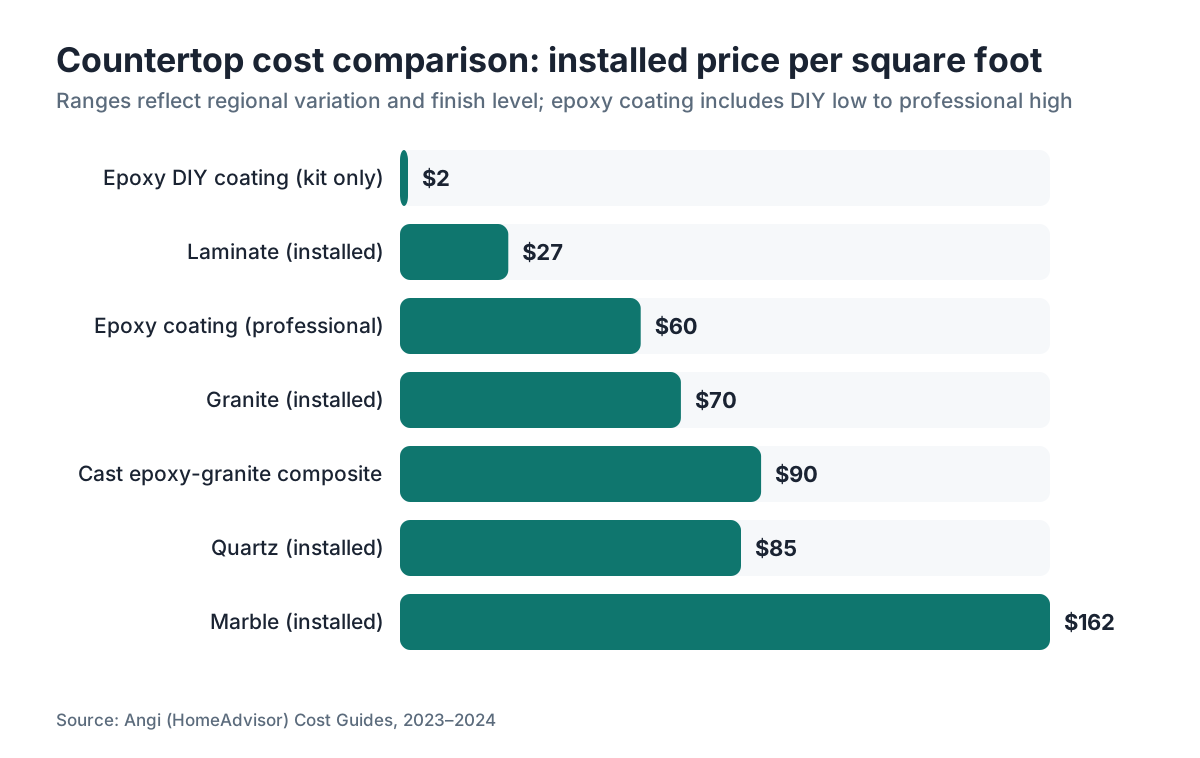
Cast epoxy-granite composite slabs are a specialty import product with limited domestic fabrication options. When you can find them, expect to pay $55, $125 per square foot installed, roughly the same range as mid-tier quartz or a premium granite [1]. The cost variation comes from slab thickness (standard is 20 to 30 mm), edge profiles, and shipping, since domestic suppliers are sparse.
DIY coating kits are dramatically cheaper but cover a much smaller surface area per kit than the marketing implies. A typical Rust-Oleum Countertop Transformations kit (covering 35 sq ft) retails for around $70, $90 at home centers [2], which works out to roughly $2, $2.50 per square foot in materials. A professional epoxy coating application, where a contractor handles surface prep, multiple coats, and a durable topcoat, runs $45, $75 per square foot depending on region and substrate condition [3].
Comparison to alternatives matters here. For context:
| Countertop type | Installed cost range (per sq ft) | Notes |
|---|---|---|
| Epoxy coating over existing top | $2, $75 | DIY kit vs. professional application |
| Cast epoxy-granite composite | $55, $125 | Specialty/import; limited availability |
| Laminate (laminate countertops) | $15, $40 | Widely available, easiest DIY |
| Granite (granite countertops) | $40, $100 | Natural stone, requires sealing |
| Quartz | $50, $120 | Non-porous, no sealing needed |
| Marble countertops | $75, $250 | Etches easily, premium look |
The DIY coating kit number looks appealing until you factor in prep work, multiple thin-coat applications, and the reality that professional results require professional surface preparation.
How does epoxy granite compare to real granite?
Natural granite is an igneous rock quarried from the earth, cut into slabs, and polished. Epoxy granite, in either form, is a manufactured product. That distinction drives most of the practical differences.
Stain resistance: Real granite is porous and requires periodic sealing to resist oil and water staining [4]. Epoxy coatings are non-porous by design. A properly applied epoxy surface will resist coffee, wine, and cooking oil better than unsealed granite. The tradeoff is that epoxy can itself stain from prolonged UV exposure, yellowing over time in kitchens with strong natural light.
Heat resistance: This is where epoxy loses badly. Granite handles heat from a pot or pan with no damage. Epoxy systems have glass transition temperatures (the point where the polymer softens and deforms) typically in the 120 to 150°F range for standard bisphenol-A epoxy systems [5]. Cooking surfaces routinely see higher surface temperatures from pots, pans, and heat lamps. Setting a hot pan directly on an epoxy countertop, whether coated or cast composite, risks permanent whitening, softening, or delamination. Every manufacturer of epoxy coating kits explicitly warns against this.
Scratch resistance: Granite scores 6 to 7 on the Mohs hardness scale [6]. Cured epoxy resins are typically 2 to 4 on the same scale, harder than your fingernail but softer than a steel knife. Daily use with knives and abrasive cleaning pads will eventually dull an epoxy surface in ways that don't affect granite.
Longevity: Well-maintained granite lasts the life of the house. Epoxy coatings typically need re-coating every 5 to 10 years depending on traffic, cleaning habits, and UV exposure. Cast epoxy-granite composites may last longer than coatings, but long-term field data for residential use is thin because domestic installations are still relatively uncommon.
Aesthetics: Natural granite has true depth and variation because the pattern goes all the way through the slab. Epoxy systems have a surface film. Under raking light or when the surface is damaged, that difference is visible. If you're standing in a kitchen looking at a well-photographed surface, the two can be indistinguishable. If you're a fabricator or a detail-oriented homeowner, you'll see it.
Are epoxy granite DIY kits actually any good?
Honest answer: they work, within narrow conditions, and most people push past those conditions.
The kits are genuinely useful for low-traffic applications where the substrate is in good condition and the look matters more than long-term durability. A laundry room counter, a bathroom vanity, a utility area, an office kitchen, these are reasonable use cases. For a primary kitchen with heavy daily cooking, they're a temporary fix you'll be redoing in 3 to 5 years.
The failure modes are predictable. First, surface prep is the whole game. Any grease, wax, or silicone left on the old surface causes adhesion failure, and peeling starts at those spots within months. Second, the chip broadcast layer has to be applied fast, before the epoxy starts gelling, and beginners almost always have uneven coverage. Third, the topcoat application over the chips requires multiple thin coats, not one thick one, and thick coats trap air bubbles that crack under thermal cycling. Consumer kit instructions are written optimistically.
Professional epoxy countertop installations solve most of these problems through proper diamond grinding of the substrate, primer coats, controlled application environments, and commercial-grade topcoats with better UV inhibitors than you'll find in a big-box kit. If you want an epoxy finish and have more than about 30 square feet to cover, getting a professional quote is probably the smarter move.
What are the real pros and cons of epoxy granite countertops?
This is where you need a realistic accounting rather than marketing language.
Pros:
- Non-porous surface means no sealing required and genuine stain resistance to common kitchen liquids
- Cast composites can be molded to shapes that would require expensive fabrication in natural stone (integrated sinks, curved sections)
- Cost of DIY coating is low relative to full countertop replacement
- Color and aggregate options are flexible since the appearance is engineered
- Cast composites have good vibration-damping properties (useful in some commercial and restaurant contexts)
Cons:
- Poor heat resistance is a genuine daily-use hazard in cooking environments
- UV yellowing affects clear or light-colored epoxy systems within years, sometimes months, in sun-exposed kitchens [5]
- Scratch resistance is significantly worse than granite, quartz, or even most laminates
- Coatings require re-application every 5 to 10 years; cast composites have limited domestic resale history
- Repairs to damaged areas are visible; unlike natural stone, you can't re-polish a chip back to the original look
- Some older epoxy formulations used bisphenol-A (BPA), which the FDA has noted raises concerns in the context of food-contact materials [7]
The BPA point deserves a sentence. The FDA states that "BPA is an industrial chemical that has been present in some hard plastic bottles and metal-based food and beverage cans since the 1950s" and that current evidence shows low-level exposure from food contact is safe for most people [7]. Many epoxy suppliers have moved to BPA-free or low-BPA formulations, especially for food-contact surfaces. If you're applying an epoxy coating to a countertop where food is prepared, confirm with the manufacturer whether the cured surface is rated for food contact.
How is an epoxy granite countertop installed?
Installation depends heavily on which product you're using.
For cast composite slabs, the process mirrors natural stone fabrication: template the space, cut the slab to size with a wet saw or CNC router using diamond tooling, profile the edges, dry-fit, then set in silicone and adhesive. Fabricators familiar with engineered stone (quartz composites) will find the process similar. The material is slightly more brittle than quartz at thin edges, so extra care during transport and installation pays off. See the general countertop installation process for the step-by-step.
For coating systems, the process has five phases: prepare the substrate (clean, degrease, sand or grind to create mechanical adhesion), apply a primer or base coat, broadcast the aggregate (stone chips, mica, granite granules), apply multiple sealer topcoats, and cure. Professional installers typically use a rotary buffer with diamond pads for surface prep, which the DIY kits don't include. Total cure time before the surface can be used is typically 24 to 72 hours for the topcoat, though full hardness develops over 5 to 7 days [8].
Substrate matters a lot for coatings. Laminate in good condition with no delamination or swelling is a reasonable substrate. Tile works but the grout lines telegraph through thinner coatings unless you skim-coat them first. Existing stone can be coated but rarely needs to be. Severely damaged or warped particleboard is not a good candidate: fix the substrate before coating it.
How do you maintain and clean epoxy granite countertops?
Maintenance for epoxy surfaces is simpler than natural stone in some ways and more demanding in others.
For daily cleaning, pH-neutral dish soap and warm water is the correct tool. The same advice applies to most stone surfaces; check the guidance for how to clean stone countertops for the general framework. Avoid abrasive scrubbers, bleach, and ammonia-based cleaners. Bleach in particular can cause epoxy to yellow or become cloudy over time, even in small concentrations.
No sealing is required. That's one genuine advantage over granite and marble, which need resealing every 1 to 3 years depending on the product and traffic.
For heat, the rule is simple: always use trivets or hot pads. No exceptions. A pan pulled from a 350°F oven will have a contact surface temperature well above the glass transition temperature of most epoxy formulations.
For scratch prevention, use cutting boards. This should be standard practice on any countertop, but with epoxy it's non-negotiable if you want the surface to look good past year two.
If the surface develops micro-scratches from normal use, a light automotive polishing compound on a soft cloth can improve clarity on glossy topcoats. Deep scratches or delamination patches require recoating that section, which usually means recoating the whole countertop for visual consistency.
Is epoxy granite a good option for resale value?
Real estate data specific to epoxy countertops doesn't exist in any study I can point to honestly. What does exist is data on countertop materials and kitchen renovation ROI generally.
The 2023 Cost vs. Value Report from Remodeling Magazine found that a minor kitchen remodel (which includes countertop replacement) returns roughly 85.7% of its cost at resale nationally [9]. That figure doesn't break out material type, but the implication from appraisers and real estate agents who discuss it is consistent: buyers respond to stone or stone-look surfaces as an upgrade signal, and they respond to visibly worn surfaces as a discount signal.
Epoxy coatings that are fresh and well-executed photograph as well as stone. Epoxy coatings that are 5 years old and showing heat marks or peeling tell a different story to a buyer who looks closely. If you're coating countertops specifically for a home sale and the coating will be less than 2 years old at sale time, the ROI math can work. If you're doing it as a long-term home improvement, you're signing up for periodic maintenance that natural stone and quartz don't require.
Cast composite slabs in good condition are less problematic for resale because buyers see a solid surface rather than a coating. The issue is explaining what it is: buyers and appraisers familiar with granite and quartz may not know how to categorize or value it.
How does epoxy granite compare to other non-stone countertop options?
If the real motivation for considering epoxy granite is budget or refreshing existing surfaces without full replacement, a few comparisons are worth having.
Laminate countertops cost $15, $40 installed and have improved substantially in look and durability in the last decade. High-pressure laminate is scratch-resistant, heat-resistant to a higher threshold than epoxy, and doesn't yellow. The edge is the giveaway, but with a full-overlay profile, it reads well in most kitchens.
Formica countertops (which are a type of laminate) hit the same cost range and offer the same advantages. The brand has stone-pattern options that are hard to distinguish from epoxy coatings at a glance.
Corian countertops are a solid surface at $45, $90 installed. They're repairable (scratches and burns can often be sanded out), they're non-porous, and they run without visible joints across large spans. That repairability advantage over epoxy is significant for a primary kitchen.
Butcher block countertops are an entirely different category but worth mentioning because many homeowners researching budget alternatives end up there. Wood is warm, repairable, and looks better with age if oiled. It's not for wet zones without proper sealing, but for islands and prep areas it outperforms epoxy coatings on durability in my view.
If you want the look of stone and long-term durability, the honest recommendation is to look at kitchen countertops options more broadly before committing to an epoxy coating. Sometimes the right answer is a granite remnant or a budget-tier quartz at a similar price point to a professional epoxy job.
What should fabricators know about working with epoxy granite?
Cast epoxy-granite composite material machines differently from natural stone and quartz, and getting that wrong wastes both material and time.
Tooling: Diamond tooling is still required, but epoxy composites are less abrasive than pure granite, so blade wear is lower. The material is more prone to delamination at cut edges if blade speed is too high or water cooling is insufficient. Keep blade RPM conservative and water flow adequate.
Edge fragility: Thin edges (pencil, eased, or knife) are more prone to chipping than the same profiles in granite. Ogee and other built-up profiles hold better. Communicate this to customers when they choose edge profiles.
Adhesion: Silicone adhesive bonds well to cured epoxy composite surfaces. Standard epoxy adhesive (two-part) also bonds well and is actually a better chemical match. Avoid polyurethane construction adhesives, which can cause slight surface staining at the joint line.
Quoting: If you're quoting epoxy composite slab jobs, the material cost, limited supplier options, and shipping weight (epoxy composites are slightly lighter than granite but still heavy) should all be in your cost model. Shops using quoting software like SlabWise can model the material as a custom stone type with adjusted waste factors to account for the brittleness at thin edges. That keeps the job profitable on the first ticket, more than in theory.
For shops doing epoxy coating work as a service, the variable that kills margin fastest is surface prep time. Budget prep time at 1.5x your first estimate until you have a reliable process. Prep on a 50 sq ft laminate countertop with multiple layers of old wax can easily run 2 to 3 hours before you touch any resin.
Are there health or safety concerns with epoxy granite countertops?
There are real concerns worth understanding, not dismissing and not catastrophizing.
Uncured epoxy resin is a skin sensitizer and potential allergen. OSHA's occupational exposure guidance flags epoxy systems as requiring skin and eye protection during application [10]. Once fully cured, the chemical reactivity is essentially gone, and the material is inert. The key phrase is "fully cured": most epoxy systems reach full cure in 5 to 7 days at room temperature, and using the surface heavily before that point can leave surface tackiness and increase off-gassing.
BPA in epoxy: As noted above, many standard epoxy formulations are based on bisphenol-A diglycidyl ether (BADGE), and the cured surface can theoretically leach trace BPA into acidic foods. The FDA's current position is that BPA in food contact materials "is safe at the very low levels that occur in some foods" [7], but if you're concerned, look for explicitly BPA-free epoxy systems certified for food contact. NSF International maintains a certification program for food-contact surface materials [11].
VOC emissions during application: Two-part epoxies used in professional coating applications can have significant volatile organic compound (VOC) emissions during the mixing and application phase. Proper ventilation, respiratory protection rated for organic vapors (more than a dust mask), and keeping ignition sources away from the work area are the right protocols. The EPA's guidance on VOC-containing products covers this framework [12].
Once a properly cured, food-contact-rated epoxy surface is installed and cleaned, daily use is not a health concern for the vast majority of people. The risks are concentrated in the application window.
Frequently asked questions
Are epoxy granite countertops heat-resistant?
No, not in any meaningful kitchen sense. Standard epoxy resins begin to soften and deform around 120 to 150°F, well within the temperature range of a pot or pan set directly on the surface. Always use trivets. This is the single biggest practical drawback of epoxy systems compared to natural granite or quartz, both of which handle direct heat without damage.
How long do epoxy granite countertops last?
DIY coating systems typically last 5 to 10 years before yellowing, scratching, or delamination requires recoating, though high-traffic kitchens may see degradation sooner. Professionally applied epoxy coatings can last 10 to 15 years with proper care. Cast composite slabs have longer expected service lives but limited field data from residential installations. Compare this to natural granite or quartz, which routinely last the lifetime of the home.
Can you apply an epoxy granite kit over tile countertops?
Yes, but the grout lines are a problem. Thin epoxy coatings will telegraph the texture of grout lines through the finished surface. Professionals typically skim-coat the grout lines with a skim-coat compound or use a thicker build-up coat first. On DIY kits, the results over tile are usually visibly uneven. It's doable, but tile-over results are consistently worse than flat-laminate-over results.
Do epoxy granite countertops need to be sealed?
No. The epoxy itself is the sealer. Unlike natural granite or marble, which are porous and require periodic resealing to resist staining, a cured epoxy surface is non-porous. The maintenance tradeoff is that when the topcoat itself wears or yellows over time, you're recoating the entire surface rather than simply applying a new sealer.
Is epoxy granite safe for food prep?
A fully cured, BPA-free epoxy rated for food contact is considered safe for food prep surfaces by the FDA. The concern is partial cure (surfaces used before the 5 to 7 day full-cure window) and older BPA-containing formulations. Look for products with NSF food-contact certification if this matters to you. During application, epoxy is a sensitizer and requires skin, eye, and respiratory protection.
What is the difference between epoxy granite and quartz countertops?
Quartz countertops (engineered stone) are roughly 90 to 95% ground quartz mineral bound with polymer resin under high heat and pressure. Epoxy granite uses an epoxy resin binder with granite or mixed stone aggregate, usually without the industrial pressing process. Quartz is harder, more heat-resistant, and has decades of residential field data behind it. Epoxy granite composites and coatings are less proven in residential settings.
Can epoxy granite countertops be repaired if they chip or scratch?
Small scratches in a glossy epoxy topcoat can sometimes be buffed out with automotive polishing compound. Deeper scratches, chips, or delamination patches are harder to fix invisibly. You can fill chips with matching epoxy, but color-matching is imperfect. Large repairs usually require recoating the full countertop for visual consistency. This is a significant disadvantage versus solid-surface materials like Corian, where damage can often be sanded flush.
Does epoxy granite yellow over time?
Yes, clear and light-colored epoxy systems yellow from UV exposure. This is a well-documented property of bisphenol-A epoxy formulations. Kitchens with significant natural light will see yellowing faster, sometimes within 12 to 18 months. UV-stabilized topcoats and non-yellowing (aliphatic or cycloaliphatic) epoxy formulations reduce but don't eliminate this. If your kitchen gets strong sun, ask specifically about UV stability before buying any epoxy product.
How much does a professional epoxy granite coating cost compared to replacing countertops?
A professional epoxy coating runs roughly $45, $75 per square foot, including prep and multiple coats. A full granite replacement in the same kitchen typically costs $40, $100 per square foot installed. The coating is often cheaper for smaller kitchens with good existing substrates, but for a kitchen needing both substrate repair and coating, the cost advantage narrows fast. Get quotes for both before deciding.
What's the difference between epoxy countertop coatings and cast epoxy-granite slabs?
Coatings are films applied over existing surfaces: you're painting your countertop with stone chips suspended in resin. Cast composites are solid slabs manufactured from granite aggregate and epoxy binder, then cut and installed like natural stone. Cast slabs are thicker, more durable, and more expensive. Coatings are thin, temporary by comparison, and accessible as a DIY project. They're sold under the same "epoxy granite" label but are fundamentally different products.
Can I use a Rust-Oleum countertop kit on kitchen countertops?
You can, and it works reasonably well in low-traffic kitchens or for short-term refreshes before a sale. In a primary kitchen with daily cooking, the heat sensitivity and scratch vulnerability of the topcoat will become apparent within a few years. The kit is best for bathroom vanities, utility areas, or anywhere that looks rough but doesn't see direct heat or heavy knife work.
Do epoxy granite countertops add value to a home?
A freshly coated, well-executed epoxy surface photographs like stone and can help a home show better for sale. The 2023 Remodeling Magazine Cost vs. Value Report pegs minor kitchen remodels at about 85.7% cost recoup nationally, though it doesn't isolate epoxy. Old, yellowed, or peeling epoxy actively signals deferred maintenance. Net: it can help at sale if new, but it doesn't have the lasting value signal that granite or quartz provides.
Is epoxy granite harder than natural granite?
No. Natural granite scores 6 to 7 on the Mohs hardness scale. Cured epoxy resin is typically 2 to 4 on the same scale. Granite is substantially harder and more scratch-resistant for daily kitchen use. The epoxy surface will show wear from knives and abrasive cleaning pads in ways that granite surfaces do not. Always use a cutting board on any epoxy countertop.
Sources
- HomeAdvisor (Angi), Countertop Installation Cost Guide: Installed countertop costs by material type, including mid-tier quartz and granite ranges of $50, $120+ per sq ft
- Rust-Oleum, Countertop Transformations product page: DIY countertop coating kits covering approximately 35 sq ft retail in the $70, $90 range at home centers
- HomeAdvisor (Angi), Epoxy Countertop Cost Guide: Professional epoxy countertop coating installation costs $45, $75 per square foot depending on region and substrate condition
- University of Minnesota Extension, Granite Countertop Care and Maintenance: Granite is porous and requires periodic sealing to resist oil and water staining
- U.S. Department of Energy, Office of Scientific and Technical Information: Epoxy Resin Systems Technical Review: Standard bisphenol-A epoxy systems have glass transition temperatures typically in the 120 to 150°F range, and UV exposure causes yellowing in clear epoxy formulations
- U.S. Geological Survey, Mineral Resources Program: Gemstones and Rock Properties: Granite scores 6 to 7 on the Mohs hardness scale
- U.S. Food and Drug Administration, Bisphenol A (BPA): Use in Food Contact Application: FDA states BPA is an industrial chemical present in some food-contact materials and that current evidence indicates low-level exposure is safe for most people; the FDA has noted concerns in certain contexts
- Rust-Oleum, Countertop Transformations application instructions: Topcoat cure time before surface use is typically 24 to 72 hours; full hardness develops over 5 to 7 days per manufacturer instructions
- Remodeling Magazine, 2023 Cost vs. Value Report: Minor kitchen remodels return approximately 85.7% of cost at resale nationally in 2023
- U.S. Occupational Safety and Health Administration (OSHA), Safety and Health Topics: OSHA guidance flags epoxy resin systems as skin sensitizers requiring skin and eye protection during application
- NSF International, NSF/ANSI 51 Food Equipment Materials standard: NSF International maintains a certification program for food-contact surface materials including polymer and resin surfaces
- U.S. Environmental Protection Agency, Volatile Organic Compounds' Impact on Indoor Air Quality: EPA guidance covers VOC emissions from paints, coatings, and resin products applied indoors and recommends ventilation during application
Last updated 2026-07-09