TL;DR
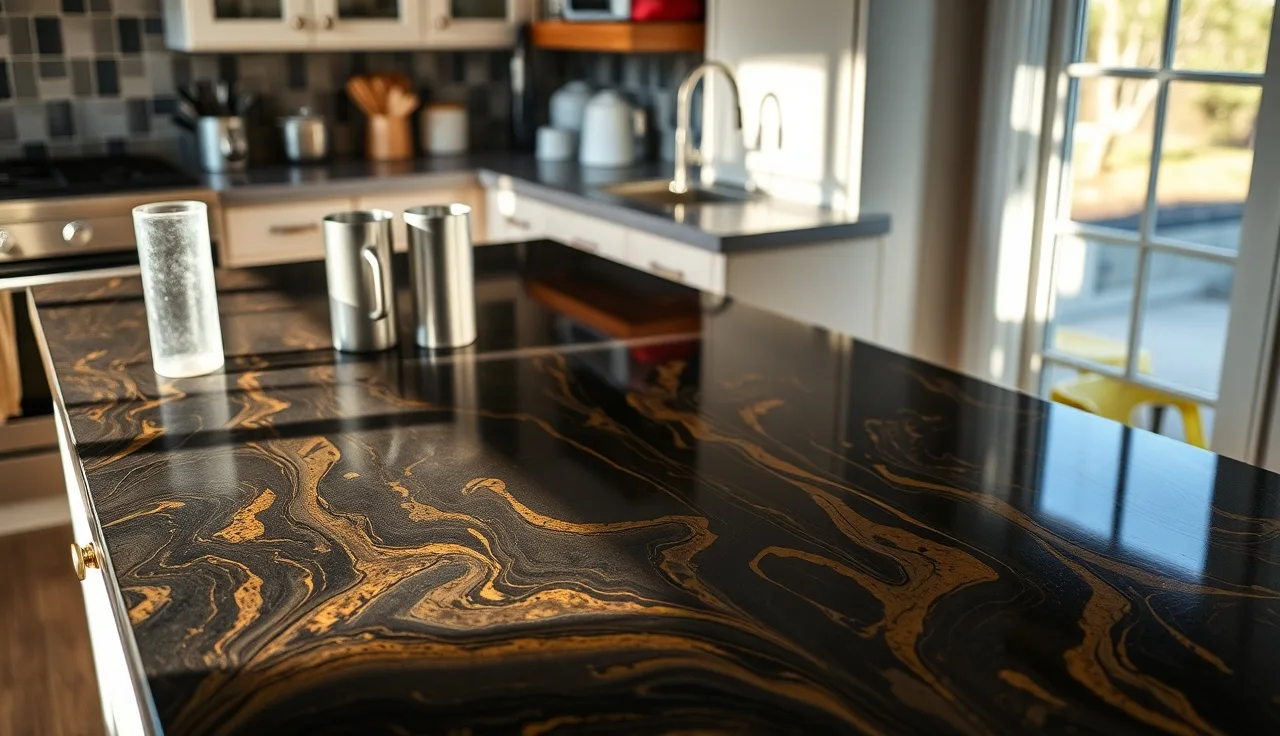
- Epoxy countertops are a poured or rolled resin coating that turns plywood, old laminate, or concrete into a glossy surface.
- Pros charge $50 to $150 per square foot installed.
- DIY kits cost $3 to $10 per square foot in materials.
- They look great but scratch and yellow with heat, so they work best in low-heat zones and struggle next to a hot stove.
What exactly is an epoxy countertop?
An epoxy countertop is a surface made from two-part epoxy resin, a base resin mixed with a hardener, that cures to a hard, glossy finish. It can be the whole countertop poured over a substrate like plywood or concrete board, or a thin coating applied over an existing surface like laminate, tile, or worn granite.
The chemistry matters here. When the resin and hardener combine, they set off an exothermic reaction that produces a thermoset plastic, meaning the cured material can't be re-melted. That's different from thermoplastic surfaces like acrylic solid surface, which can be re-softened. Once epoxy cures, it's hard. It's also unforgiving of mistakes made during application.
Most DIY kits sold today are designed as countertop coatings, not full poured surfaces. Products like Stone Coat Countertop and Leggari are typical. They come in quart or gallon kits with pigments and metallic powders you blend in to fake marble or granite. Fabricators who do professional poured epoxy use higher-volume commercial resins and build the surface up in multiple layers.
One thing to know upfront: epoxy countertops and concrete countertops get confused constantly. Concrete is a cementitious material. Epoxy is a polymer resin. Some concrete countertops use an epoxy sealer on top, which blurs the line, but the two are structurally different materials.
How much do epoxy countertops cost?
Cost splits into two very different paths: DIY and professional installation. The gap between them is huge.
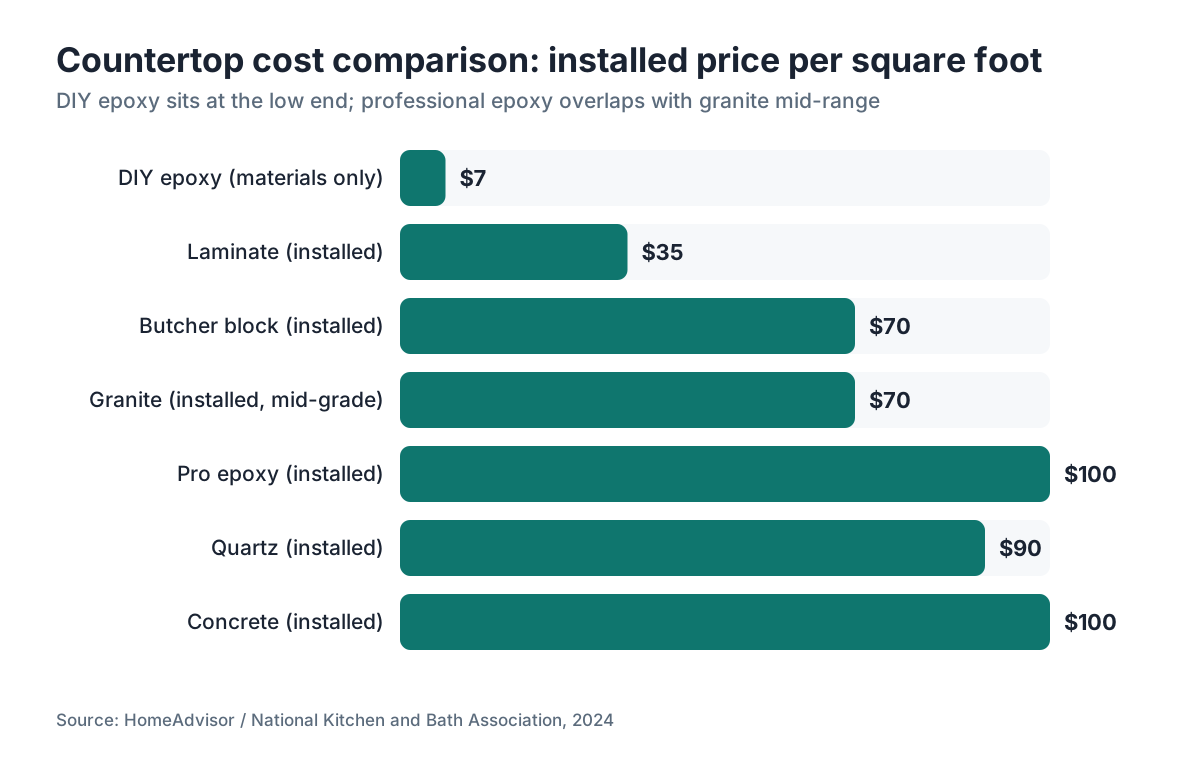
DIY epoxy countertop kits run $3 to $10 per square foot in materials, depending on the brand, the number of layers, and whether you buy pigments separately. A 30-square-foot kitchen project might cost $90 to $300 in materials alone. Add brushes, mixing cups, a heat gun or torch, and sandpaper, and budget another $50 to $100 in supplies if you don't already own them.
Professional epoxy countertop installation runs $50 to $150 per square foot installed, per cost data aggregated by HomeAdvisor [1]. The wide range reflects regional labor rates, the complexity of the pour (a simple solid color versus an elaborate river or marble effect), how much substrate prep is needed, and how many coats go on.
| Installation path | Material cost/sq ft | Total installed cost/sq ft |
|---|---|---|
| DIY kit (coating) | $3, $10 | $3, $10 (your labor) |
| Pro installation, basic | $8, $20 | $50, $80 |
| Pro installation, custom pour | $20, $40 | $80, $150 |
| Granite (for comparison) | $5, $20 | $40, $100 |
About that granite comparison. Granite countertop installation averages $40 to $100 per square foot fully installed, per National Kitchen and Bath Association data [2]. A typical 30-square-foot island in mid-grade granite runs $1,200 to $3,000 installed. High-end exotic granites push past $200 per square foot at the slab level. Professional epoxy competes head to head with mid-grade granite on price, without granite's lifespan.
For homeowners weighing options, granite countertops and quartz countertops are the two most common alternatives in this range. Both beat epoxy on heat and scratch resistance, which is what decides how long a countertop lasts.
How long do epoxy countertops last?
Honest answer: 10 to 15 years in a low-traffic spot with careful use, and 2 to 5 years before visible wear in a busy kitchen. Nobody has good peer-reviewed longevity data specific to countertop epoxy. That range comes from contractor experience and forum reports, not controlled studies.
The big failure modes are yellowing from UV and heat, scratching from abrasive cleaning or cutting on the surface, and edge chipping. Most consumer-grade epoxies aren't UV-stable, so kitchens with skylights or big sunny windows yellow within a year or two. Some makers sell UV-resistant formulas, but even those yellow eventually.
Heat is the other killer. Epoxy softens around 150 degrees F (65 C) depending on formulation [3]. A hot pan off the stove hits 400 to 500 degrees F on its bottom. Set it on epoxy without a trivet and you leave a permanent ring or white haze. That's not a warranty claim. That's physics.
Scratching happens. Epoxy runs about 3 to 4 on the Mohs hardness scale. Granite runs 6 to 7. Kitchen knives are harder than epoxy, so cutting on the surface will scratch it, and once scratched the surface is nearly impossible to spot-repair invisibly.
In bathrooms, on vanity tops, bar tops, and craft room surfaces, epoxy does much better. Less heat, less cutting, less daily abuse. A well-applied bathroom vanity coating can realistically look good for a decade.
Is epoxy safe for food contact countertops?
Once fully cured, most countertop epoxies are considered food-safe by their makers. The key word is cured. Partially cured epoxy can leach uncrosslinked bisphenol-A (BPA) or other reactive compounds. Full cure times vary, but figure 24 to 72 hours for hardness and up to 30 days for full chemical resistance [3].
The FDA doesn't certify countertop materials as food-safe the way it certifies food containers, so manufacturer food-safety claims aren't verified by a federal agency. The FDA does regulate epoxy resins used in food-contact materials under 21 CFR Part 175, which covers coatings on food-contact surfaces [4]. Whether a specific DIY kit meets those standards depends on its chemistry, and most consumer kits don't publish that data.
Unreacted epoxy components can also irritate skin and airways during application, which is why NIOSH flags epoxy resin components like bisphenol A diglycidyl ether as skin and respiratory sensitizers that call for gloves and ventilation [7].
If food safety is a real concern, laminate and solid surface materials like Corian have long track records and published compliance data. Choosing epoxy anyway? Use a cutting board and let the surface cure the full 30 days before heavy use.
How to epoxy countertops: a step-by-step guide
This covers a coating application over an existing surface, the most common DIY job. Pouring a full-depth epoxy counter from scratch is a different animal that means building molds, mixing large volumes, and managing the cure heat. Leave that to pros.
What you need:
- Two-part countertop epoxy kit (sized for your square footage, with 10 to 15% overage)
- Pigments or metallic powders if you want color
- 220-grit sandpaper and a sanding block or orbital sander
- Denatured alcohol or acetone for cleaning
- Mixing cups and stir sticks (disposable)
- Foam rollers and foam brushes
- A propane torch or heat gun (for popping bubbles)
- Painter's tape and drop cloths
- Nitrile gloves and eye protection (epoxy is a skin and eye sensitizer [7])
Step 1: Surface prep. This is where most DIY failures start. The surface must be clean, dry, and dull. Sand laminate, tile, or painted surfaces with 220-grit to give the epoxy something to grip. Wipe everything down with denatured alcohol and let it dry all the way. Fill cracks in old tile or laminate with an epoxy filler or a first thin coat of your epoxy mixed without pigment.
Step 2: Protect everything around the counter. Tape off the walls at the backsplash line, cover the floor, and remove or tape all hardware. Cured epoxy drips are nearly impossible to get off finished surfaces.
Step 3: Mix the base coat. Follow the manufacturer's ratio exactly. Most kits are 1:1 or 2:1 by volume. Wrong ratios or lazy mixing leave a surface that stays tacky forever. Mix slowly for the full recommended time (usually 3 to 5 minutes) and scrape the sides and bottom of the cup.
Step 4: Apply the base coat. Pour epoxy onto the surface and spread it with a foam roller. Work fast. Most countertop epoxies give you 20 to 45 minutes of working time. Coat edge profiles with a foam brush.
Step 5: Add color and effects. While the base coat is still wet, add pigmented epoxy, drop in metallic powders, or use a heat gun to pull movement and marble-like veining. This is the creative step and it takes practice. First time? Test your technique on a piece of cardboard first.
Step 6: Pop bubbles. Pass a propane torch briefly over the surface, 6 to 8 inches away, in one continuous motion. The heat drops surface tension and breaks bubbles. Never hold the torch in one spot.
Step 7: Apply the clear topcoat. After the base layer reaches a gel state (usually 4 to 8 hours), roll on a clear epoxy topcoat for depth and protection. Repeat the bubble-popping step.
Step 8: Cure and wait. Let the surface cure undisturbed at room temperature (65 to 85 degrees F is ideal) for at least 24 hours before light use, and 72 hours before anything heavier. Full chemical cure takes up to 30 days.
Total project time for a 30-square-foot kitchen counter: one full day of prep and application, plus waiting. Budget 6 to 8 hours of active work.
Managing several kitchen projects at once? A quoting tool like SlabWise can price out material waste and labor time for epoxy jobs the same way it handles stone, so you're not guessing at job costs.
What are epoxy granite countertops and how are they different?
"Epoxy granite countertops" means two different things, and the confusion causes real headaches for homeowners shopping around.
The first meaning is an epoxy coating over existing granite, usually to repair, refresh, or recolor a slab that's stained, etched, or dated. It works as a temporary fix, but it changes the feel from natural stone to the slightly plastic touch of cured resin. If the granite underneath has structural cracks or deep staining, coating over it fixes nothing.
The second meaning is DIY kits marketed to create a "granite look" through layered pigment and metallic flake. These aren't granite at all. The result is an epoxy surface that mimics granite's pattern. The best ones look convincing in photos. In person, they feel like plastic.
Real granite countertops are quarried stone slabs, cut to fit, and polished. Pricing sits at $40 to $100 per square foot installed for typical grades, higher for exotics, as covered in the cost section. If you're eyeing epoxy because you want granite at a lower price, the DIY epoxy granite route can hit $3 to $10 per square foot, but it takes real skill and time, and the surface won't hold up the same way over years of kitchen use.
For a genuine granite look with better durability, compare quartz countertops. They're engineered stone with granite-like patterns and a much harder surface.
How does epoxy compare to other budget countertop alternatives?
If budget is driving the decision, epoxy competes against a handful of other options.
Laminate countertops, including Formica countertops, run $20 to $50 per square foot installed. They install faster, stay more color-consistent, and shrug off daily kitchen abuse better than epoxy coatings. Modern laminate patterns fake stone surprisingly well now. The catch: you can't repair a cut or burn in laminate the way you can theoretically re-coat epoxy.
Butcher block countertops run $40 to $100 per square foot installed and give you real wood that epoxy approximates but never matches. They scratch and stain differently, and you can sand them back to fresh, which some people prefer.
Concrete countertops land in the same $50 to $150 per square foot installed range as professional epoxy. Concrete has more thermal mass and takes heat better, but it's porous, needs sealing, and can crack.
Corian countertops and other solid surface materials sit at $50 to $100 per square foot installed. Non-porous, repairable, backed by real manufacturer warranties. For kitchens, solid surface is almost always the smarter buy over epoxy.
Here's the honest read. Epoxy's real edge is the DIY price floor ($3 to $10 per square foot) and the ability to coat over an existing substrate without tearing anything out. Renting, flipping fast, or working with a tiny budget? DIY epoxy makes sense. For a kitchen you plan to keep, most other materials beat it.
For a broader look at options in this range, see our kitchen countertops overview.
What are the common mistakes people make with epoxy countertops?
Wrong mixing ratios top the list. Epoxy cures through a chemical reaction, not evaporation, so the resin-to-hardener ratio has to be exact. Most kits specify by volume (not weight), and guessing even 10% off can leave a surface that stays soft or tacky for good. Use measuring cups. Don't eyeball it.
Working in the wrong temperature range is the next big failure. Too cold (below 60 degrees F) and the epoxy thickens too fast, leaving texture and bubbles. Too hot (above 90 degrees F) and it cures before you finish spreading. The sweet spot for most countertop epoxies is 65 to 80 degrees F with low humidity [3].
Skipping surface prep is failure number three. Epoxy won't stick to greasy, dusty, or glossy surfaces. Sanding to dull the surface and cleaning with denatured alcohol isn't optional. It's the whole reason the coating stays down.
Pouring too thick in one coat builds heat. Thick pours generate real heat during cure, and deep pours in molds can crack or yellow from the internal temperature. Countertop kits are formulated for thin layers (typically 1/8 inch or less per coat), not single-pour builds.
Last one: rushing the cure. Walking away and coming back tomorrow is hard when your kitchen is torn apart. But use the counter too soon and you'll leave impressions, lift the uncured surface with cleaners, or blow the adhesion on your topcoat.
Can you put epoxy over existing granite or stone?
Yes, and fabricators do it sometimes for repair or resurfacing. The technique shows up more in commercial settings, where the labor cost of ripping out and replacing stone is very high. Coating over polished granite means real prep: deglossing the surface, cleaning it thoroughly, and often using an adhesion promoter.
The honest problem is that granite's value lives in the stone itself. Cover it with an epoxy coating that yellows and scratches, and you throw that value away. If your granite is etched from acidic cleaners, professional honing and re-polishing (typically $5 to $15 per square foot) is almost always the better move than coating it.
If the granite has severe damage, old staining that won't respond to poultices, or a color you genuinely can't live with, epoxy coating is a cheaper alternative to full replacement. Just go in knowing you're trading the stone's feel and lifespan for a lower short-term cost.
For cleaning and keeping stone surfaces without resurfacing, see how to clean stone countertops.
How do fabricators and shop owners price epoxy countertop work?
Run a fab shop and thinking about adding epoxy as a service? The pricing model is different from slab work. You're selling labor and materials, not a stone product, so the margin math shifts.
Material cost for a professional epoxy job runs $8 to $20 per square foot depending on resin brand, coat count, and pigment cost. Labor at $45 to $75 per hour, plus roughly 2 to 4 hours of active work per 30 square feet (not counting cure wait), puts labor around $3 to $10 per square foot on smaller jobs. Add shop overhead and a reasonable margin, and the $50 to $150 per square foot installed number holds up.
Scheduling is the harder problem. Epoxy jobs require you to be there for the application, then walk away for 24 to 72 hours, then come back for the topcoat or touch-up. That's two or three trips for one job. If your shop does stone work and quotes with a tool like SlabWise, you can track epoxy jobs through the same system, but the scheduling model looks more like a painter than a stone fabricator.
Waste is the other line item. Unlike stone, where cutout drops go back in inventory, mixed epoxy that doesn't get used inside the working time is trash. Over-ordering beats running short mid-application, so account for it. Experienced installers add 10 to 15% to the material estimate for waste.
Is DIY epoxy a good idea, or should you hire a pro?
Depends entirely on the stakes. Rental bathroom vanity, laundry room counter, garage workshop surface? DIY epoxy is a fine weekend project with acceptable downside. If it comes out rough, you're not out much money and the space is low-visibility.
Your primary kitchen countertops in a house you own? I'd hire a pro or pick a different material. The failure modes (yellowing, bubbles, tacky cure, fisheye from contamination) are hard to predict and expensive to fix. Redoing a bad application means grinding off the old coat, which is messy and chews up the substrate. A mediocre DIY result in the kitchen is something you stare at every single day.
Want to try DIY anyway? Do a test section first. Apply a small patch in a hidden spot, let it fully cure, then judge it. Most problems show up in that test before you commit the whole surface.
The one place DIY clearly wins is flipping a house on a tight timeline and budget. A $200 epoxy application on a worn laminate kitchen counter photographs dramatically better than the worn laminate did, and the buyer may swap the countertop within a few years anyway. The economics fit the situation.
Frequently asked questions
How much does epoxy countertop installation cost per square foot?
Professional epoxy countertop installation runs $50 to $150 per square foot installed, depending on region, design complexity, and number of coats. DIY kits cost $3 to $10 per square foot in materials. A typical 30-square-foot kitchen runs $1,500 to $4,500 professionally installed, or $90 to $300 in DIY materials alone, before supplies and your time.
How much is a granite countertop compared to epoxy?
Granite countertops run $40 to $100 per square foot installed for standard grades, per National Kitchen and Bath Association data. High-end exotic granite runs higher. That overlaps with professional epoxy at $50 to $150 per square foot. At the professional level, granite often makes more sense given its 25-plus-year lifespan versus epoxy's 10 to 15 years under careful use.
How long does epoxy take to cure on countertops?
Most countertop epoxies reach touch-dry hardness in 24 hours and full surface hardness in 48 to 72 hours. Full chemical cure, meaning final scratch and chemical resistance, takes up to 30 days. Light use like setting down a glass is fine after 72 hours. Skip heavy objects, cutting, and harsh cleaners for the full 30-day cure period.
Can epoxy countertops handle heat from pots and pans?
No, not reliably. Most epoxy formulations start to soften or haze around 150 degrees F. A hot pan off the stove hits 400 to 500 degrees F on the bottom. Set it directly on epoxy and you leave a permanent white haze or ring. Always use trivets. This is the most common complaint from homeowners who chose epoxy for kitchen countertops.
Do epoxy countertops yellow over time?
Yes. Most consumer-grade epoxy resins aren't UV-stable and develop a yellow tint over time, especially in kitchens with skylights or south-facing windows that get direct sun. Some makers sell UV-resistant formulas that slow the process, but yellowing is an inherent long-term trait of most epoxy resins. Bathrooms and low-light areas hold their color much longer.
How do you clean and maintain an epoxy countertop?
Use mild dish soap and warm water for daily cleaning. Skip abrasive scrubbers, bleach-based cleaners, acetone, and anything with ammonia, all of which can dull or damage the surface. Wipe spills fast, especially acidic liquids like vinegar or citrus. Apply a non-abrasive countertop wax every few months to keep the gloss. Never cut directly on the surface.
Can you repair scratches in an epoxy countertop?
Shallow scratches can sometimes be buffed out with automotive polishing compound or a fine-grit wet-sand followed by polishing. Deeper scratches that reach the substrate are hard to fix invisibly because the patched area rarely matches the surrounding layer's sheen. Prevention with cutting boards and careful use beats repair every time.
What surfaces can you apply epoxy countertop coating over?
Epoxy coatings adhere to laminate, wood, concrete, tile, MDF, and old epoxy if properly prepped. They don't stick well to highly polished or oily surfaces without an adhesion promoter. The surface must be clean, dry, dull from sanding, and free of grease. Glossy laminate needs to be scuffed with 220-grit before application.
How do you get a granite look on countertops using epoxy?
Epoxy granite effects start with a dark base coat (usually black or dark gray), then drops or swirls of lighter epoxy, metallic powders, and flakes while the base is still wet. A heat gun or torch pulls the pigments into veining. Multiple thin coats build depth. The results look convincing in photos. In person, the plastic feel stays.
Is epoxy safe for use in kitchens around food?
Once fully cured (30 days), most countertop epoxies are considered safe for incidental food contact by their makers. During and shortly after cure, unreacted epoxy components can be harmful. The FDA regulates epoxy coatings for food-contact surfaces under 21 CFR Part 175, but most consumer DIY kits don't publish compliance data against that standard. Use a cutting board regardless.
How do epoxy countertops compare to quartz or solid surface?
Quartz and solid surface (like Corian) both beat epoxy on scratch resistance, heat tolerance, and long-term durability. Quartz rates 7 on the Mohs scale versus epoxy's 3 to 4. Solid surface is repairable in ways epoxy isn't. Epoxy's edge is DIY access and the ability to coat over existing surfaces without demolition. For a permanent kitchen, quartz or solid surface are better investments.
How many coats of epoxy do countertops need?
Most countertop applications use at least two coats: a base coat (carrying the color and design) and a clear protective topcoat. Some pros apply three to four coats for extra depth and protection. Each coat must reach a gel state (usually 4 to 8 hours) before the next goes on. Don't rush between coats. Poor inter-coat adhesion causes delamination.
What's the difference between poured epoxy and epoxy coating countertops?
A poured epoxy countertop is built to full depth (typically 1 to 2 inches) in a mold, then installed like a slab. It's a fabrication process that takes serious skill and volume of material. An epoxy coating is a thin layer (usually 1/8 inch or less) applied over an existing substrate. Most DIY kits are coatings. Poured epoxy work is almost always done by professionals.
How much does it cost to put granite countertops in a kitchen?
A typical kitchen with 30 to 40 square feet of countertop costs $1,200 to $4,000 for mid-grade granite, fully installed. Larger kitchens with 50 to 70 square feet run $2,000 to $7,000. Premium exotic granite slabs can push total project costs past $10,000. Price depends on stone grade, edge profile, number of cutouts, and local labor rates.
Sources
- HomeAdvisor (Angi), Epoxy Countertop Cost Guide: Professional epoxy countertop installation runs $50 to $150 per square foot installed
- National Kitchen and Bath Association, Cost Vs. Value and Industry Data: Granite countertop installation national average is $40 to $100 per square foot fully installed
- U.S. Army Corps of Engineers, Engineering and Design: Epoxy Compounds (EM 1110-2-2002): Epoxy resin working temperatures, cure times, and thermal softening thresholds for countertop-grade formulations
- U.S. Food and Drug Administration, 21 CFR Part 175: Indirect Food Additives: Adhesives and Components of Coatings: The FDA regulates epoxy coatings used on food-contact surfaces under 21 CFR Part 175
- Remodeling Magazine, Cost vs. Value Report 2024: Kitchen countertop replacement project cost benchmarks by region for mid-range and upscale renovations
- U.S. Environmental Protection Agency, Indoor Air Quality: Volatile Organic Compounds: Epoxy resins release volatile organic compounds during application and cure that require ventilation
- National Institute for Occupational Safety and Health (NIOSH): Epoxy resin components including bisphenol A diglycidyl ether are skin and respiratory sensitizers requiring PPE
- ASTM International: Hardness and surface performance standards applicable to countertop coating materials
- HomeAdvisor (Angi), Granite Countertop Cost Guide: Granite countertop installation cost per square foot range and typical kitchen project totals
- U.S. Consumer Product Safety Commission: DIY epoxy products require ventilation and PPE; partially cured epoxy presents contact sensitization risks
Last updated 2026-07-09