TL;DR
- Discount granite countertops typically run $40 to $75 per square foot installed, compared to $75 to $175 for premium slabs.
- The savings are real but come from narrower color choices, remnant sizing, or thinner stone.
- Buy from a direct fabricator or wholesale yard, not a big-box store, and you'll get the most stone for your money.
What does 'discount granite' actually mean?
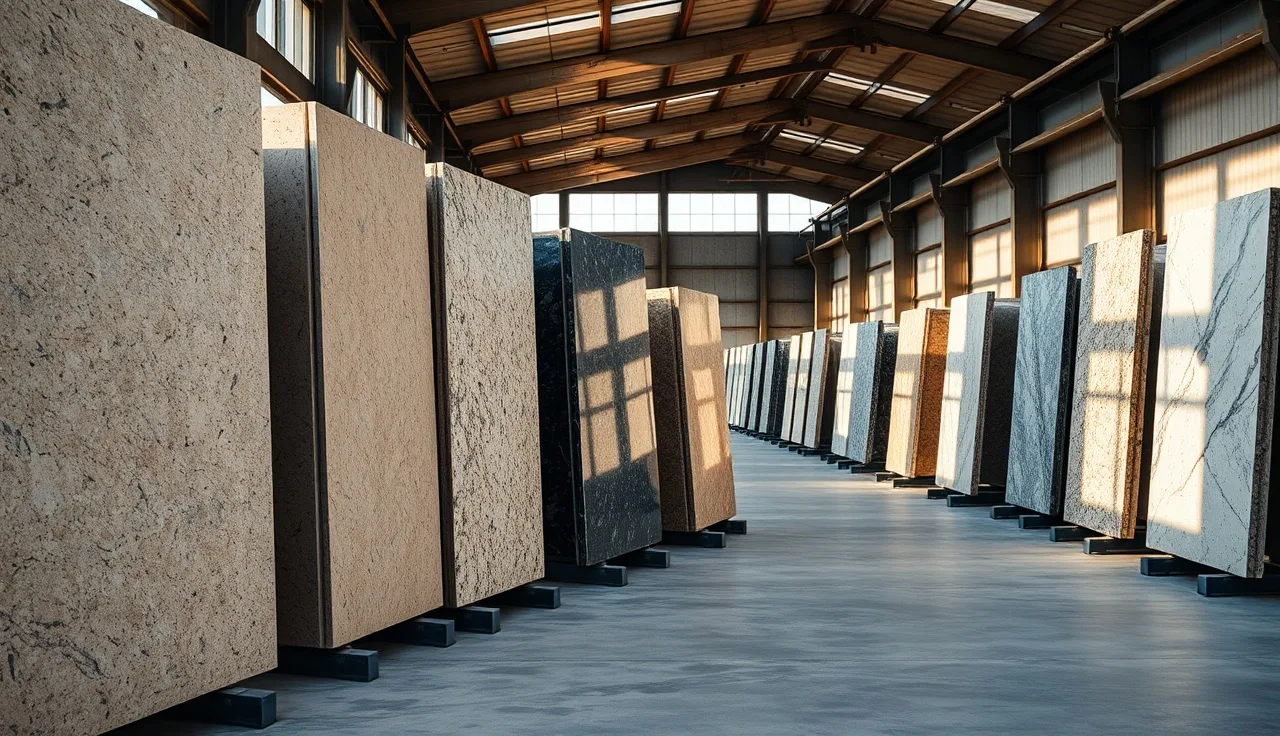
Discount granite is a real product category, not a marketing trick. It refers to granite slabs or tiles that cost less because of how they're sourced, graded, or sized, not because the stone itself is fake or dangerously weak.
Most fabricators grade granite into tiers. Level 1 (sometimes called "commercial grade" or "builder grade") is the bottom of that ladder. These are typically thin-cut slabs, often 3/4 inch (19mm) rather than the standard 1.25 inch (3cm), with simpler patterns and color ranges dominated by beige, black, and basic brown. Level 2 sits in the middle. Level 3 and above are the exotic imports with dramatic veining that you see in design magazines. Discount granite almost always means Level 1 or Level 2 stone.
Remnants are another major source of discount pricing. A remnant is the leftover piece from a previous job. Fabricators cut a full slab for a customer's kitchen island, and the remaining chunk sits on a rack in the yard. Those pieces are priced to move, sometimes 30 to 50 percent below the cost of ordering a new slab, because the fabricator paid for the full slab already. If your countertop run is short enough to fit a remnant, this is the single best deal in stone.
Close-outs and overstocked material from importers are a third source. A distributor orders 200 slabs of a particular color, the trend shifts, and those slabs sit in a warehouse. They sell them cheap to clear space. If you don't care about matching future replacements to the exact same lot, overstocked stone is legitimate value.
What does discount granite cost per square foot?
Price ranges in this industry are genuinely messy because they roll up so many variables: slab cost, fabrication labor, edge profile, sink cutouts, and installation. With that caveat stated plainly, here's how the tiers actually shake out in 2024 and 2025 for a typical kitchen in the continental United States.
| Tier | Material only | Installed (fab + install) |
|---|---|---|
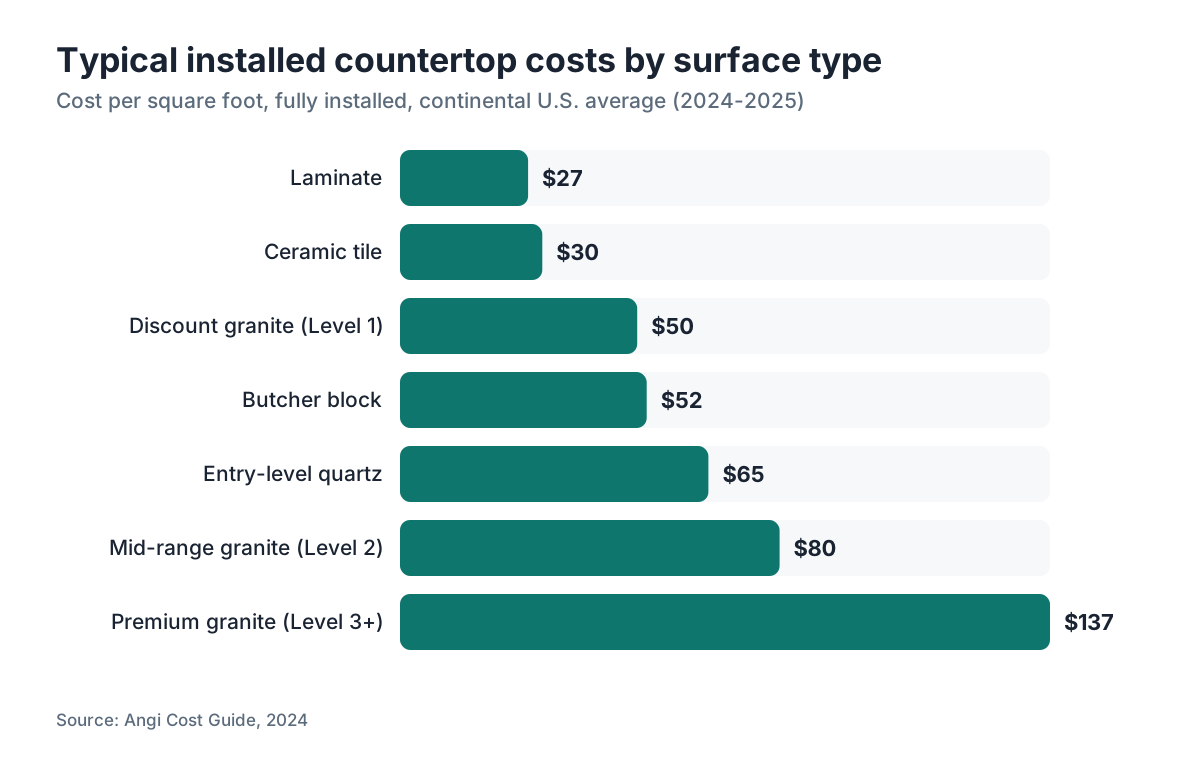
| Level 1 / builder grade | $5 to $15/sq ft | $40 to $60/sq ft |
| Level 2 / mid-range | $15 to $40/sq ft | $60 to $100/sq ft |
| Level 3 / premium | $40 to $100+/sq ft | $100 to $175+/sq ft |
| Remnants (any level) | Varies widely | $35 to $80/sq ft installed |
The installed price is what homeowners actually pay, and it's the number that matters. Raw material cost is only about 20 to 35 percent of the installed total. Fabrication labor, edge work, and installation make up the rest [1]. This is why shopping purely on slab price without getting a full fabrication quote is a trap. A fabricator quoting $8 per square foot for Level 1 stone can still end up more expensive than one quoting $20/sq ft if the first shop charges separately for every edge, sink cutout, and seam.
Regional variation is big. A kitchen in Atlanta or Houston runs cheaper than the same job in San Francisco or New York, sometimes by 25 to 40 percent, because fabrication labor rates and shop real estate costs differ a lot [1].
For a full comparison of what materials cost, the kitchen countertops guide has current pricing for every major surface.
Where are the best places to buy discount granite countertops?
The best value comes from cutting out middlemen and finding leftover stone. Here are your options, ranked honestly by what you get for the money.
Direct fabricators with their own yard. A shop that cuts and installs its own stone skips one or two middlemen. They buy slabs from importers or distributors and sell fabricated countertops directly. Their Level 1 pricing is usually the lowest you'll find outside of remnant sales, and you deal with one company for material, cutting, and installation. Find local ones by searching for "granite fabricator" rather than "granite dealer" or "countertop store."
Wholesale stone yards open to the public. Many wholesale importers that primarily sell to fabricators will also sell to homeowners, especially for larger orders. Prices are often 20 to 40 percent lower than a retail showroom, but you typically need to arrange your own fabrication separately. The tradeoff is worth it if you've already vetted a local fabricator and just need cheaper stone.
Remnant racks at any local fabricator. Ask specifically. Most shops have remnant pieces that aren't advertised online. The rack changes constantly. A piece perfect for a bathroom vanity or laundry room top might be sitting there for $150 total.
Big-box retailers (Home Depot, Lowe's). These are convenient but almost always more expensive than a direct fabricator for comparable quality. They source from national fabrication networks and mark up accordingly. Their value is standardized pricing and financing, not low cost per square foot. Their Level 1 pricing often matches what a direct fabricator charges for Level 2.
Online slab marketplaces. Sites like SlabMarket and similar platforms list overstock and distressed inventory from distributors. You can sometimes find genuine deals, but you'll need to handle shipping logistics and find a local fabricator willing to work with stone they didn't source. Some fabricators won't do it, or will charge a handling fee.
Discount granite suppliers worth checking vary by region, but the Natural Stone Institute keeps a member directory that lists fabricators and distributors by state [2].
What corners actually get cut with cheap granite?
Some cost reductions are totally benign. Others cause real problems. Knowing which is which is the whole game.
Benign cuts: Simpler color and pattern. Level 1 stone is less visually dramatic but just as durable. Thicker edges on Level 1 slabs are sometimes built with a laminated edge (two thin layers glued together) rather than a single thick slab. Done well, this is invisible and holds up fine.
Potentially problematic: Slab thickness. Standard residential countertops use 3cm (about 1.25 inch) stone. Some Level 1 material comes in 2cm (about 3/4 inch). Thinner stone needs a plywood substrate to support it, and it cracks more easily near cutouts like sinks and cooktops if the substrate isn't done right [8]. A 2cm slab installed over a properly built substrate is fine. A 2cm slab bridging unsupported spans is not.
Fabrication quality. The slab price is one thing. The cutting, polishing, and installation is another thing entirely. A bad seam, a poorly supported overhang, or a sink cutout with stress cracks costs a lot more to fix than you saved on the stone. Low-price fabricators cutting corners on labor are the real risk, not low-cost stone by itself.
Warranty and support. Big-box retailers offer clearer warranty processes than independent shops, though independent shops often do better work. Get any quality guarantees in writing before you sign.
For maintenance regardless of what you pay, see how to clean stone countertops for the basics that apply to every granite installation.
How do discount granite and laminate or other cheap countertop options compare?
The main competition for discount granite is laminate, tile, and butcher block. Here's a straight comparison.
| Surface | Installed cost (typical) | Heat resistance | Scratch resistance | Lifespan (typical) |
|---|---|---|---|---|
| Discount granite (L1) | $40-$60/sq ft | Excellent | Very good | 30+ years |
| Laminate | $15-$40/sq ft | Poor | Poor | 10-20 years |
| Butcher block | $35-$70/sq ft | Poor near heat | Poor | 20+ years (with care) |
| Ceramic tile | $20-$40/sq ft | Good | Good | 20+ years |
| Entry-level quartz | $55-$75/sq ft | Fair | Very good | 25+ years |
Laminate costs less upfront and has come a long way visually, but it won't survive a hot pan and it doesn't add home value the way stone does. Laminate countertops and Formica countertops are worth a look in rentals or temporary situations.
Butcher block countertops are a different trade-off. They're warm and beautiful and cheaper, but they need regular oiling and can't take standing water near the sink.
Discount granite's real advantage is simple. It delivers hard, heat-resistant stone for close to what the cheapest alternatives cost installed. The durability math favors granite on a 10-year or longer horizon, especially in a primary kitchen.
How can fabricators source and price discount granite without losing margin?
For shop owners reading this: discount granite jobs are not inherently low-margin jobs. The margin lives in efficient quoting and material yield, not in the slab price.
The trap with Level 1 and remnant jobs is that material costs are low but the same labor goes into every cut. If you quote a remnant job at the same markup percentage you'd apply to a $50/sq ft Level 3 slab, you're underpricing the labor component. Price labor and fabrication separately from material, and your margin survives even when the stone is cheap.
Nesting efficiency matters more on remnant jobs than anywhere else. A remnant piece has a fixed usable area, and a poor layout means the job doesn't fit. Shops using software to optimize slab layouts waste less material on complex jobs. SlabWise's quoting and nesting tools are built for exactly this, letting fabricators visualize cutouts and run accurate material calculations before committing to a price. Quote remnant jobs by hand and you're guessing.
Buying Level 1 slabs in volume from a single importer and keeping them in stock is another margin play. Customers asking about discount granite are often flexible on color. Stock a few popular Level 1 options in quantity, and your material cost drops further while you control the timeline.
For a full look at how stone selection affects fabrication business decisions, the granite countertops guide covers material grades in more detail.
Is discount granite less durable than expensive granite?
Short answer: not meaningfully.
Granite is an igneous rock. Its hardness, heat resistance, and scratch resistance come from its mineral composition, mostly quartz, feldspar, and mica. Level 1 granite has the same mineral structure as Level 3. The price difference reflects visual complexity and sourcing geography, not structural superiority.
Granite rates 6 to 7 on the Mohs hardness scale regardless of grade [3]. It's harder than most metals you'd put on it, including steel knives. It handles heat from a pot pulled off the stove without damage, though thermal shock from extreme temperature swings can theoretically stress any stone. Granite is porous and does need periodic sealing to resist staining, but that applies to every price tier equally.
The USDA Food Safety and Inspection Service notes that hard, non-porous surfaces are generally easier to keep sanitary, while stressing that any surface requires proper cleaning [4]. A sealed granite surface, even a Level 1 one, meets that standard.
Where cheaper jobs fail isn't the stone. It's thin slabs without proper support, fabrication errors near cutouts, or skipped sealing. Control those three variables and budget granite performs identically to expensive granite for 99 percent of kitchens.
What colors and styles are available in budget granite?
Level 1 granite clusters in a specific look: uniform or lightly varied patterns, tight mineral grain, and a limited palette. The most common options in this tier:
Baltic Brown. A dark brown to black base with amber and burgundy spots. One of the most widely available Level 1 granites globally, quarried primarily in Finland.
Uba Tuba. A very dark green-black with gold and silver flecks. Quarried in Brazil. Extremely popular in builder-grade kitchens and holds up visually well because the dark color masks wear.
Santa Cecilia. Light gold to cream base with dark burgundy and black flecks. Also from Brazil. Probably the single most common Level 1 granite in American tract homes over the past 20 years.
Black Galaxy. A black base with golden specks from feldspar crystals. Quarried in India. Very dramatic-looking for a Level 1 price.
Giallo Ornamental. A cream and light tan base with dark brown and grey speckling. Pairs well with white or off-white cabinets.
None of these are ugly. Uba Tuba and Black Galaxy look genuinely sophisticated. The limit is that you won't find the sweeping white-and-grey veining of Calacatta or the blue labradorite movement of exotic imports. If your design requires a specific look, Level 1 may not get you there. If you're open to what's available, the selection is more than adequate.
For context on where granite sits relative to other natural stones, marble countertops covers the trade-offs of choosing marble at a similar price point.
How do you get an accurate quote for discount granite installation?
Getting an accurate quote is harder than it should be because the industry has no standard on what's included.
Start by measuring your own square footage before you call anyone. Measure the length and depth of each countertop run, multiply them together, and add the totals. Most fabricators quote in square feet. Having your own number lets you immediately spot when a quote seems wrong.
Ask each supplier to quote an "all-in" price that includes: material at a specific grade, edge profile (specify which one, because ogee profiles cost more than eased edges), all sink and faucet cutouts, seams, and removal of your old countertops if applicable. Get this in writing. Verbal quotes shift.
Get at least three quotes. The range on identical jobs can be surprising, sometimes 40 to 60 percent between the lowest and highest bidder in the same city. The lowest isn't always wrong and the highest isn't always better.
Ask specifically whether the stone is 2cm or 3cm. If it's 2cm, ask about the substrate plan. Ask whether the edge is a solid edge or a laminated (built-up) edge. Ask whether sealing is included after installation.
For the fabricators quoting these jobs, accurate material takeoffs are where profit leaks happen on budget slab work. Tools like SlabWise let you run a precise quote with nesting calculations before you commit to a price, which matters more when margins on Level 1 stone are already thin.
The countertop installation guide covers what to expect during the install itself, including how to prep your kitchen and what installers need from you on the day.
Are granite tile countertops a true discount option?
Granite tiles, typically 12x12 or 18x18 inch tiles, are the cheapest way to get real granite on a countertop. Material can run as low as $3 to $10 per square foot [9]. Installed with proper substrate and grout, they're durable and heat-resistant.
But the drawbacks are real. Grout lines collect bacteria and staining over time regardless of sealing. A slab surface has no grout lines. The edge detail on a tile countertop is hard to execute cleanly without custom-cut pieces. Resale perception is lower than slab countertops. Most buyers today read tile countertops as a dated look.
Tile makes sense in specific situations: tight budget renovations where resale isn't a near-term concern, utility spaces like laundry rooms or outdoor kitchens, or DIY installations where hiring a fabricator isn't in the plan. For a primary kitchen you're remodeling for resale or long-term enjoyment, the incremental cost to move from tile to a Level 1 slab is usually worth it. The installed price gap between quality tile and Level 1 slab granite has narrowed a lot over the past decade as granite import volume grew [9].
What should you watch out for when buying discount granite?
A few specific things to verify before you sign anything.
View the actual slab, more than a sample chip. Color and pattern variation within a single granite type can be large. The 2-inch sample in the showroom doesn't tell you whether the slab in the yard has an ugly fissure running through it. Ask to see the specific slabs they plan to use for your job.
Fissures vs. cracks. Granite naturally has fissures, which are separations in the mineral structure that formed as the rock cooled. They're cosmetic and normal. Cracks are structural damage from handling or cutting. A fabricator should be able to show you the difference. Reject slabs with true cracks running through areas that will be near cutouts.
Check for fill. Some granite is epoxy-filled at the quarry to stabilize fissures or small voids. This is common and not inherently bad, but heavy fill can signal a slab that was borderline reject-quality. Ask.
Verify the fabricator's license and insurance. Most states require contractor licensing for countertop installation. You're having heavy stone cut and mounted over cabinets. An unlicensed installer working without liability insurance is a risk. Your state contractor licensing board is the right place to verify [10].
Read the contract for warranty terms. Labor warranties for seams, cutouts, and installation defects should be at least one year from a reputable fabricator. Material warranties pass through from the supplier.
Does discount granite hurt home resale value?
This is a real question homeowners ask, and the answer depends on what you're comparing.
Replacing laminate or tile with any granite, including Level 1, is a positive for resale value in most markets. Homebuyers consistently rank stone countertops as a desirable feature. Remodeling Magazine's Cost vs. Value Report, which surveys resale ROI for common renovations, shows that kitchen upgrades including countertop replacements recover a meaningful portion of their cost at resale [7].
The comparison between Level 1 and Level 3 granite at resale is marginal, though. A buyer walking through a home in a mid-range price bracket is unlikely to know or care whether the kitchen has Santa Cecilia at $45/sq ft installed or Calacatta Gold at $180/sq ft. Both read as "granite countertops" in the MLS listing and on a showing. The resale premium for exotic stone only really shows up in luxury price brackets where buyers have specific expectations.
So here's the takeaway. For most homeowners in most markets, Level 1 granite delivers nearly the full resale benefit of pricier stone at roughly one-third to one-half the cost. The exception is a high-end flip or luxury renovation where the finishes need to match buyer expectations at that price point.
Frequently asked questions
What is the cheapest type of granite countertop?
Level 1 or builder-grade granite is the cheapest, typically running $40 to $60 per square foot installed. Common options in this tier include Santa Cecilia, Uba Tuba, Baltic Brown, and Black Galaxy. Remnant pieces from any level of granite can sometimes undercut even Level 1 slab pricing if your countertop run is small enough to fit a leftover piece.
Can I get granite countertops for under $1,000?
For a full kitchen, almost certainly not, unless your kitchen is very small. A 30-square-foot kitchen at $40/sq ft installed is $1,200 before any add-ons. But a bathroom vanity, laundry room top, or small island using a remnant piece can easily come in under $1,000 total. Ask fabricators specifically about remnant availability for small projects.
Is granite from Home Depot or Lowe's actually cheaper than a local fabricator?
Usually no. Big-box retailers are convenient and offer financing, but their installed granite pricing often matches or exceeds what a direct local fabricator charges for comparable Level 1 or Level 2 stone. Get a quote from a local shop before assuming the big-box price is the market floor. Local fabricators with their own yards are typically the better value.
What is the difference between Level 1, Level 2, and Level 3 granite?
These tiers reflect visual complexity, rarity, and sourcing cost rather than structural quality. Level 1 is builder-grade: simple patterns, common colors, often thinner slabs. Level 2 sits in the middle with more variety. Level 3 and above includes exotic imports with dramatic veining and rare colors. All three tiers share the same basic hardness and heat resistance as natural granite.
How do I find discount granite countertop suppliers near me?
Search specifically for "granite fabricator" rather than "countertop store" to find shops that source and cut their own stone. Check the Natural Stone Institute member directory for vetted fabricators and distributors. Wholesale stone yards in industrial areas often sell to the public at below-retail prices. Calling and asking about remnant inventory is free and frequently turns up genuine deals.
Are there quality differences between discount granite and premium granite that affect daily use?
For daily kitchen use, the differences are minimal. Level 1 granite has the same hardness rating (6 to 7 on the Mohs scale), the same heat resistance, and the same scratch resistance as premium granite. The real differences are visual: simpler patterns, fewer dramatic colors. Sealing requirements and cleaning procedures are identical regardless of price tier.
How much does granite countertop installation cost beyond the material?
Fabrication and installation typically add $25 to $45 per square foot on top of raw material costs, depending on your region and complexity. Edge profiles, sink cutouts, cooktop cutouts, and seam placement all affect the final number. Material cost is only about 20 to 35 percent of the total installed price, so shopping only on slab price misses most of the cost picture.
What are granite remnants and where do I find them?
Remnants are leftover pieces from previous fabrication jobs, stored on racks at fabricator shops. They're priced to move because the shop already paid for the full slab. Discounts of 30 to 50 percent below new-slab pricing are common. Call local fabricators and ask about their remnant rack. Many shops don't advertise remnants online, so a phone call or visit is the only way to know what's available.
Does granite need to be sealed, and does that add to the cost?
Yes, granite is porous and needs periodic sealing to resist staining. An initial seal should be applied after installation. Many fabricators include this in their quote; ask explicitly. Resealing frequency depends on the specific stone and use, but annually is a safe general guideline for kitchen countertops. Sealer products run $15 to $40 per bottle for DIY resealing between professional jobs.
Is 2cm granite as good as 3cm for countertops?
Structurally, 2cm granite installed over a proper 3/4-inch plywood substrate is adequate for most kitchen applications. The risk is near cutouts like sinks and cooktops, where thinner stone has less material to support the span. If you're buying Level 1 stone in 2cm thickness, confirm the substrate plan with your fabricator. Standard residential granite today is 3cm, and most edge profiles look better at that thickness.
How do I compare quotes from different granite fabricators?
Request an all-in quote that explicitly includes: material at a named grade and thickness, your chosen edge profile, all sink and faucet cutouts, seam locations, demolition of old countertops if needed, and post-install sealing. Without those line items specified, quotes from different shops are comparing different scopes of work. Get at least three quotes and ask each one the same set of questions.
What's the difference between buying granite at a showroom versus a wholesale yard?
Showrooms offer a curated selection, design assistance, and a single point of contact for material and fabrication. Wholesale yards offer lower prices and more raw inventory but typically require you to arrange fabrication separately. If you've already found a fabricator you trust, buying from a wholesale yard and directing your fabricator to work with that stone can save 20 to 40 percent on material costs. Some fabricators charge a handling fee for outside stone.
Can I install granite countertops myself to save money?
DIY granite installation is technically possible but genuinely difficult. Granite slabs are extremely heavy, a typical kitchen run weighs several hundred pounds, and cutting them requires wet diamond blade saws not found in most households. Mistakes in cutting, especially near sink cutouts, can crack the slab. Hiring a fabricator for cutting and paying only for DIY countertop installation (setting and securing pre-cut pieces) is the safer middle ground if you want to reduce labor costs.
How does discount granite compare to budget quartz countertops?
Entry-level quartz runs $55 to $75 per square foot installed, slightly above most discount granite. Quartz is non-porous and needs no sealing. Granite has better heat resistance. Quartz patterns are more consistent because it's engineered. For budget buyers, Level 1 granite often wins on price; for buyers who want zero-maintenance stone, entry quartz may be worth the slightly higher cost. Neither choice is wrong.
Sources
- HomeAdvisor / Angi, Granite Countertops Cost Guide: Installed granite countertop pricing ranges and regional variation; fabrication labor as a percentage of total installed cost
- Natural Stone Institute, Member Directory: NSI maintains a directory of member fabricators and distributors by region
- U.S. Geological Survey, Granite Mineral and Rock Information: Granite hardness rating of 6 to 7 on the Mohs scale and its composition of quartz, feldspar, and mica
- USDA Food Safety and Inspection Service, Kitchen Surfaces and Food Safety: Hard, non-porous surfaces are generally easier to keep sanitary; all surfaces require proper cleaning
- Remodeling Magazine, 2024 Cost vs. Value Report: Kitchen upgrades including countertop replacements recover a meaningful portion of their cost at resale; midrange kitchen remodels recover roughly 49 percent of cost
- Natural Stone Institute, ANSI/NSI Standards for Natural Stone: Industry standards for slab thickness (2cm and 3cm) and substrate requirements for residential countertop installations
- U.S. Geological Survey, Mineral Commodity Summaries: Stone (Dimension): Import volume of dimension stone including granite to the United States; pricing trends related to supply increases
- National Association of the Remodeling Industry (NARI): Material cost as a percentage of total installed countertop costs; labor and installation as the majority of the installed price
Last updated 2026-07-09