TL;DR
- Custom stone fabrication in New York costs $55 to $150 or more per square foot installed.
- Price depends on the stone, the edge profile, how many cutouts you have, and where the shop sits.
- The job runs from template to installation in about 2 to 4 weeks.
- This guide covers pricing, materials, what to ask a fabricator, and the mistakes that cost people money.
What does custom stone fabrication in NY actually mean?
Custom stone fabrication means a shop takes a raw slab, measures your exact space, cuts the stone to fit, and installs it. No prefab pieces. No standard widths. The shop works from a template of your actual cabinets, walls and all.
New York fabricators range from one-man operations in Brooklyn warehouses to 30,000-square-foot CNC shops on Long Island or in the Bronx. Most buy slabs from distributors in the tri-state area. Those yards cluster around the industrial corridors of Queens, Hunts Point, and parts of New Jersey just across the river. Sitting near the ports and wholesale yards keeps slab prices down compared with, say, upstate.
The word "custom" carries more weight than people expect. Two kitchens with the same square footage can cost wildly different amounts. One has a peninsula with a waterfall edge and three sink cutouts. The other is a straight run with one simple cutout. Your fabricator is pricing labor complexity as much as square footage.
The process has four steps: measure and template, slab selection, CNC cutting and edge work, then installation. Some shops template with a laser device, which is faster and makes fewer errors. Others still use Luan strips or foam boards. Both work fine if the technician knows what he's doing.
How much does custom stone fabrication cost in New York?
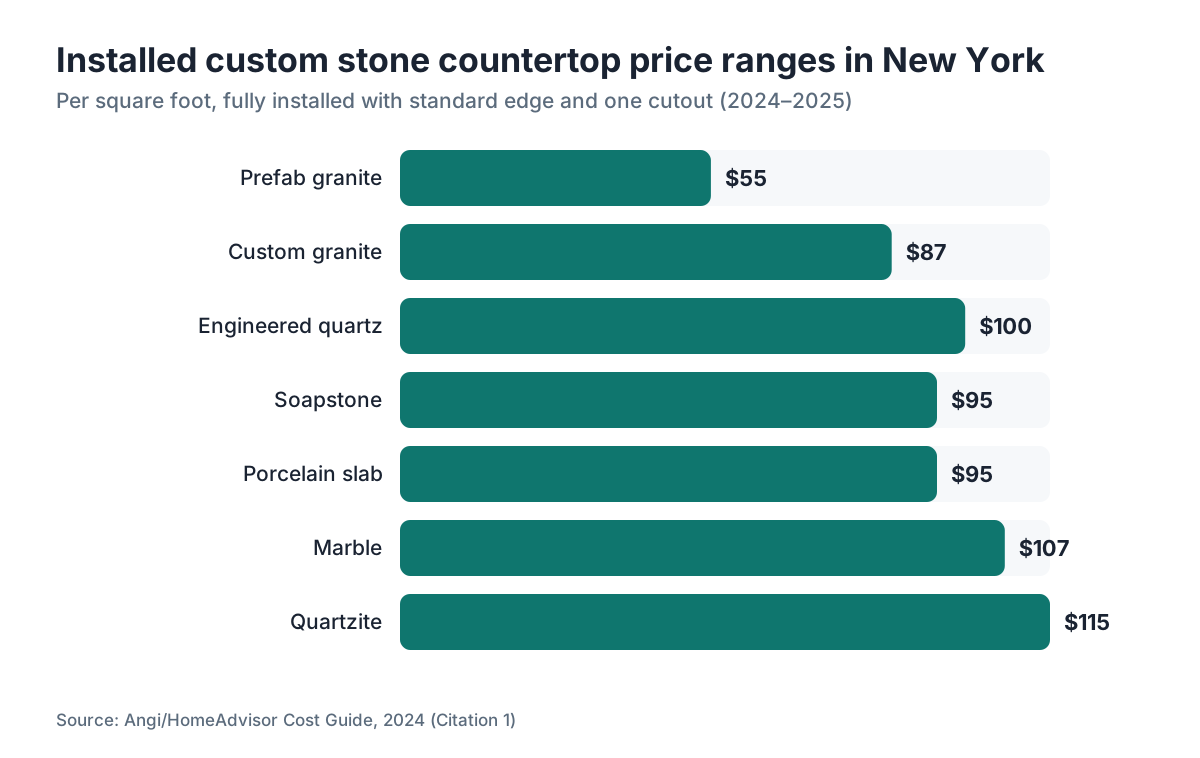
Custom stone fabrication in New York runs $55 to $150 per square foot installed, higher than the national average because of real-estate overhead, labor, and transport. Here is a realistic range by material, fully installed with a standard edge and one sink cutout:
| Material | NY installed price per sq ft |
|---|---|
| Prefab granite (limited colors) | $45, $65 |
| Custom granite (full slab) | $65, $110 |
| Marble (Carrara, Calacatta) | $75, $140 |
| Quartzite (natural) | $80, $150+ |
| Engineered quartz (Silestone, Caesarstone) | $70, $130 |
| Soapstone | $70, $120 |
| Porcelain slab | $65, $125 |
These figures track what multiple NY-area fabricators publicly post or quote as of 2024 to 2025 [1]. They cover material, fabrication labor, a standard edge profile, a basic sink cutout, and installation. They do not cover demo of your old countertops (usually $150 to $400), haul-away, or the plumber who reconnects your sink.
Edge profiles add cost fast. A standard eased or beveled edge is usually free. A mitered waterfall edge on a 10-foot island adds $500 to $1,500 or more depending on thickness and complexity. Ogee and dupont profiles run $15 to $30 per linear foot above the base price. Every seam adds labor, and most shops charge by the seam.
Here's the variable nobody warns homeowners about: slab yield. A shop has to buy a whole slab, usually 55 to 65 square feet for standard granite and up to 120-plus for a jumbo, even if your job only uses 30. You pay for the material used plus a share of the remnant waste. Some shops sell those remnants and pocket the difference. Ask two things upfront: how they handle remnants, and whether you get any credit when yield runs high.
Which stone material should you choose for a New York kitchen?
Pick based on how you actually live, not the mood board.
Granite countertops are still the most forgiving natural stone for a working kitchen. They shrug off heat, take a beating, and need sealing once every one to three years. The color and movement available through NY distributors is huge, because the metro area imports from Brazil, India, and Italy nonstop. Cook hard, have kids? Granite is tough to beat.
Marble countertops are gorgeous, and they will etch. Acid from lemon juice, vinegar, or wine leaves a dull mark on polished marble. Honed marble hides etching better than polished because the surface is already matte. Go in knowing this and treat the marks as patina, and marble is fine. Expect it to look showroom-perfect after five years of real cooking, and you'll be let down.
Quartzite is a natural metamorphic rock, not the engineered product called quartz. It's harder than marble and handles heat better, but it still needs sealing. Some quartzites, especially certain Brazilian slabs sold as "Super White," are actually dolomitic marble and etch just like marble. Ask the fabricator to confirm the species, not the trade name. Test it yourself with a drop of lemon juice on a hidden edge.
Engineered quartz (Silestone, Caesarstone, Cambria) needs no sealing, resists most stains, and comes in consistent color. The tradeoff is heat sensitivity, so keep trivets handy, and the resin content, which can discolor under sustained direct UV. For a rental or a kitchen that gets hard use without careful upkeep, engineered quartz is the practical call. Cambria countertops are made in the U.S. and carry a limited lifetime warranty [2].
Want something different? Soapstone countertops and quartzite each have their own maintenance profiles. Read up before you commit.
How does the fabrication and installation process work, step by step?
Knowing the sequence keeps your renovation from stalling. Countertops go in after cabinets. Always. That single rule drives the whole timeline.
Step 1: Measure and template. Once the cabinets are set and level, the fabricator sends a technician to measure. Digital templating takes 30 to 90 minutes. The template captures every wall angle, notch, and obstruction. Old NY buildings are full of walls that aren't square, and a good templater plans for that.
Step 2: Slab selection. You go to the distributor or the shop's yard and pick your actual slab. This matters enormously with natural stone, because two slabs of "Bianco Antico" granite can look nothing alike. Mark the slab you choose, photograph it, and get it in writing that your slab goes on your job. Some shops substitute if a slab gets damaged, and documentation protects you.
Step 3: Programming and CNC cutting. The shop loads your digital template into software, nests your pieces across the slab to cut waste, and the machines go to work. A waterjet or bridge saw does the rough cuts. The CNC router shapes edges and cutouts. Most NY shops run a 5-to-10 business day window from template to ready-to-install.
Step 4: Installation. Stone is heavy. Granite runs about 18 to 20 pounds per square foot at 3 cm [3]. A 25-square-foot island top weighs 450 to 500 pounds. NY jobs often mean elevators, narrow doorways, or tight staircases, and good fabricators ask about access before they show up. Pieces get set with epoxy at seams, siliconed to the cabinet, and any undermount sink gets clips or brackets per the shop's standard.
Step 5: Sealing and final inspection. Natural stone should be sealed before use. Some shops seal on-site in your home. Others seal in the shop during fabrication. Both are fine. Just ask which. You want at least one coat on granite, marble, or quartzite before the counter sees any water or food.
What should you ask a NY stone fabricator before signing a contract?
Plenty of homeowners skip the vetting and grab the lowest quote. In New York, where the gap between a well-run shop and a sloppy one is wide, that's usually a mistake.
The questions that surface real information:
-
"Are you licensed and insured in New York State?" New York City requires a Home Improvement Contractor license, and counties outside the city have their own rules [4]. Get the license number and check it on the NYC Department of Consumer and Worker Protection portal or your county's licensing body.
-
"Do you own your CNC equipment or outsource fabrication?" Some small shops farm out cutting and mark it up. That isn't automatically bad, but you should know who's actually cutting your stone.
-
"How do you handle seam placement, and can I see it on the drawing before you cut?" A good shop produces a seam layout drawing and gets your sign-off. Seam placement drives both looks and strength, especially on long spans.
-
"What happens if the slab cracks during installation?" It happens. Get it in writing whether they cover replacement material and labor.
-
"Who does your installation?" Some shops use in-house crews, others subcontract. Neither is automatically worse, but subcontracted crews may not carry the same insurance as the shop. Verify.
-
"Can you give me three references from jobs in the last six months?" Recent references beat old ones because crews turn over.
Get the quote in writing with line items: material (naming the slab), fabrication labor, edge profile and linear footage, number of cutouts, delivery, installation, and sealing. A quote that just reads "kitchen countertop $3,200" tells you nothing and gives you no way to compare.
How long does custom stone fabrication take in New York?
From the day you sign and pick your slab, most NY jobs finish in 2 to 4 weeks. Here's how the calendar breaks down.
Template appointment: usually 1 to 5 business days out, depending on backlog. Busy NYC shops in spring renovation season (March through June) sometimes run a two-week wait just for the template.
Fabrication: 5 to 10 business days after template for most shops. Complex jobs with mitered edges, multiple cutouts, or specialty materials can stretch to 14 business days.
Installation appointment: often 1 to 3 days after fabrication wraps, subject to crew availability.
Total elapsed time: 2 to 4 weeks from contract to installed counter is normal for a shop at typical capacity. During peak season, 4 to 6 weeks is common. If a fabricator promises one week from contract to install, ask exactly how, because either they have zero backlog or they're lowballing the estimate.
The biggest cause of delay is cabinets that aren't ready. Fabricators won't template until cabinets are fully installed and level. If your cabinet delivery or install slips, your countertop timeline slips right along with it. Build buffer.
NY throws its own logistics at you. Parking for a delivery truck or flatbed near your building. Building management approvals for elevator use. Certificate of insurance (COI) requirements that most Manhattan and Brooklyn co-ops and condos impose on contractors. Send your building's COI requirements to the fabricator early, because getting their carrier to issue an additional-insured certificate can take several days.
Are there licensing and permit requirements for stone fabrication in New York?
New York is stricter here than most states. NYC requires any contractor doing home improvement work, countertop installation included, to hold a Home Improvement Contractor (HIC) license from the NYC Department of Consumer and Worker Protection (DCWP) [4]. The license number has to appear on any contract over $200. Unlicensed contractors face fines, and you can lose certain consumer protections.
Outside the five boroughs, licensing is county-level. Westchester, Nassau, and Suffolk each set their own home improvement contractor rules. Westchester's Office of Consumer Protection handles registration there. Nassau and Suffolk register contractors through their Consumer Affairs offices [12].
Permits for a straight countertop swap are generally not required, since it counts as like-for-like work on an existing structure. Check with your building management or local building department if you're doing structural work, moving a sink, or touching plumbing rough-ins at the same time. Some NYC co-op buildings want board approval for any kitchen work even when no permit applies.
For the shop side, OSHA standards under 29 CFR 1910 and 29 CFR 1926 govern worker safety [9]. Stone shops also fall under OSHA's respirable crystalline silica standard, 29 CFR 1910.1053, which took full effect for general industry in 2018 [6]. This matters to you as a homeowner because it tells you whether a shop is run professionally. Do they have dust control? Workers in wet-cut and dry-cut shops without proper controls face real silicosis risk. OSHA's rule requires employers to "limit worker exposure to respirable crystalline silica," and a shop that ignores it is cutting corners you can't see.
What is the difference between a slab yard, a distributor, and a fabricator?
People confuse these three all the time, and knowing the difference saves money.
A slab yard or stone distributor imports and warehouses raw slabs. In New York, the biggest cluster sits in the tri-state industrial zone, with major distributors in Queens, the Bronx, and northern New Jersey. They sell to fabricators, and sometimes at retail to the public. Prices at a distributor are wholesale or close to it. Buy your slab directly from a distributor and have your fabricator pick it up, and you can sometimes save 15 to 25% on material. Not every fabricator allows this, though.
A fabricator is the shop that cuts, finishes, and installs. Some fabricators also stock slabs, playing both roles. Buying the whole package from one shop is simpler, but you'll likely pay a markup on the stone.
Big-box stores (Home Depot, Lowe's) run countertop programs that subcontract to regional fabricators. These can be cost-competitive on basic granite and quartz, but the selection is narrower, custom edge options are limited, and you have less visibility into which shop actually does the work. For a plain square kitchen with standard dimensions, that route can work. For anything complex, go straight to an independent fabricator.
Before you settle on stone, it pays to know what laminate countertops and Formica countertops or Corian countertops cost. The price gap is large, and the right choice depends on your budget, your timeline, and how long you plan to stay in the home.
How do fabricators in New York price and quote a job?
Most NY fabricators use one of two models: per square foot all-in, which bundles most costs, or itemized, which splits material, fabrication labor, and installation.
The per-square-foot model is easier to compare, but it hides a lot. A $90/sq ft quote from Shop A might include the edge, cutout, and standard sealing. An $85/sq ft quote from Shop B might exclude the ogee edge you want ($20/linear foot extra), your farmhouse sink cutout ($150 extra), and sealing ($75 extra). Add the same scope to both and Shop B costs more.
Always ask for a scope-matched quote. Give every shop the identical information: total square footage, number and type of cutouts, desired edge profile, slab grade or category, and access conditions. Then you're comparing apples to apples.
Fabrication software changed how well-run shops operate. Tools like SlabWise let a fabricator enter your layout, calculate yield from the real slab dimensions, and build a quote on actual material cost instead of a guess. When a shop can show you the nesting layout, how your pieces fit across the slab, you know they ran the math instead of ballparking it. Ask whether your fabricator uses digital quoting. It tends to mean fewer surprises when the invoice lands.
For the installation step itself, separate from the stone work, the broader guide to countertop installation covers what to expect from the crews who set the stone.
What are the most common mistakes NY homeowners make with stone countertops?
These come up again and again in fabricator conversations and consumer complaint filings.
Mistake 1: Measuring before cabinets are in. Countertops get templated from installed cabinets, not from drawings. Drawings carry tolerance errors. Real cabinets carry real walls. Any fabricator offering to cut your stone before cabinets are set is cutting from a drawing, and you're gambling on fit.
Mistake 2: Choosing stone from a tiny sample. A 4-inch tile of Calacatta marble looks nothing like a full slab of Calacatta marble. The veining on the real slab can differ wildly from the chip, and in natural stone that's expected, not a defect. Go see your actual slab before it's cut.
Mistake 3: Ignoring seam location until it's too late. Agree on seams before fabrication. Once the stone is cut, the seam is fixed. A seam running through the middle of your cooktop looks bad. A seam tucked near the back wall looks fine. Review the layout drawing.
Mistake 4: Skipping the support spec for an undermount sink. A heavy farmhouse sink on a poorly supported granite span can crack over time. Ask how they support undermount sinks and what the maximum unsupported overhang is for your stone and thickness.
Mistake 5: Assuming the cheapest quote is the same product. A $55/sq ft granite quote and a $90/sq ft granite quote are often different grades, different thickness (2 cm vs 3 cm), different edge specs, and different install quality. Shop on price, sure, but know what each number buys.
For care after the crew leaves, the guide to how to clean stone countertops covers the daily habits that keep the stone looking right for years.
How do you verify a NY stone fabricator's reputation and credentials?
New York hands you more public verification tools than most states.
In NYC, look up the contractor's Home Improvement Contractor license on the DCWP online portal [4]. It should be active, not expired or suspended. The complaint history is public. Read it.
For Nassau and Suffolk, the county Consumer Affairs offices run online contractor search tools where you can confirm registration and see filed complaints [12].
BBB ratings work for a first pass but aren't the final word. Google reviews give you volume. For a fabrication-specific gut check, Houzz and Yelp sometimes show photos of installed work with commentary far more useful than a star count.
Ask for their certificate of general liability insurance, and if they have employees, workers' compensation coverage. A legitimate NY shop carries at least $1 million in general liability. Hesitation to hand over a COI is a red flag. NYC building management demands it constantly, so any real shop has one on the shelf.
On a significant kitchen renovation, over $10,000 in total work, New York's Home Improvement Contractor law requires a written contract with specific disclosures, including a three-business-day right to cancel [4]. If a contractor won't put the job in writing or pushes you to skip that, walk away.
Is DIY stone countertop installation realistic in New York?
For most New York homes and apartments, no. Honestly.
The weight of 3 cm granite or quartzite needs multiple strong people and, often, real lifting equipment. In a typical NYC apartment or brownstone, you're fighting narrow doorways (sometimes 28 to 30 inches clear), at least one flight of stairs, and maybe an elevator with an 8-foot ceiling and a tight turn. Fabricators have dollies and suction lifters built for exactly this. A homeowner renting a suction cup and hauling a 200-pound piece up a brownstone staircase is asking for a broken slab and a trip to the ER.
Some suburban NY homeowners with good access, ground-floor kitchens, and experience handling heavy material have pulled off smaller jobs like a laundry room or a bathroom vanity. Small pieces, easy access, real construction chops? Not impossible. But the savings are smaller than people expect, because most of what you're paying for is labor that's genuinely hard.
If you want a countertop you can install yourself, butcher block countertops and laminate countertops are the practical options. Stone is a pro job in most New York situations.
For fabricators in this market, digital tools like SlabWise produce detailed cut sheets and slab nesting layouts that help smaller shops compete with better accuracy and faster turnaround. When margins are thin and material runs expensive, that operational visibility is what keeps a shop out of the red.
Frequently asked questions
How much does a custom granite kitchen countertop cost in New York City?
A custom granite countertop in NYC runs $65 to $110 per square foot fully installed, including a standard edge and one sink cutout. An average kitchen with 40 square feet of counter lands between $2,600 and $4,400. Islands, waterfall edges, and multiple cutouts push it higher. Manhattan shops often run 10 to 20% above outer-borough or Long Island shops because of overhead.
How long does stone countertop fabrication take from template to installation in NY?
Most NY fabricators finish in 2 to 4 weeks: a few days to schedule the template, 5 to 10 business days of fabrication, then 1 to 3 days for installation scheduling. Spring renovation season (March to June) often stretches that to 4 to 6 weeks. Complex work with mitered edges or unusual materials adds another week. Late cabinet installation pushes everything back.
Does a stone fabricator need to be licensed to work in New York?
Yes. In New York City, any contractor doing home improvement work, countertop installation included, needs a Home Improvement Contractor license from the NYC Department of Consumer and Worker Protection. Nassau, Suffolk, and Westchester counties have their own registration rules. Ask for the license number before signing anything. Working with an unlicensed contractor can void your consumer protections under NY law.
What is the difference between quartzite and quartz countertops?
Quartzite is a natural metamorphic rock that needs sealing and can etch if it carries marble-like minerals. Quartz (engineered) is a manufactured product of crushed stone and resin, needs no sealing, and resists most stains. Engineered quartz can't take high heat without trivets, while quartzite handles heat better. The names sound nearly identical, but the materials and their care are very different.
Can I buy my own slab and hire a fabricator to cut and install it?
Some NY fabricators allow this, and it can save 15 to 25% on material. The catch: the fabricator may add a material-handling fee and limit warranty coverage to fabrication labor, not the material. If the slab cracks during cutting, liability gets murky. Get the arrangement in writing before you buy, and confirm the fabricator has seen and approved the specific slab you picked.
What thickness of stone slab should I choose, 2 cm or 3 cm?
In New York, 3 cm (roughly 1.25 inches) is the standard and what most shops price by default. It's stronger, needs no substrate buildup on overhangs, and looks more substantial. 2 cm slabs (about 3/4 inch) cost less but need plywood backing for overhangs and crack more easily on long unsupported spans. For any island or peninsula with over 18 inches of overhang, go 3 cm.
How are seams placed and can I choose where they go?
Seam placement is a shared decision. Good fabricators produce a layout drawing before cutting and walk you through the options. Seams come partly from slab size and partly from looks. A seam should never land right at a sink or cooktop cutout edge, since those are stress points. Get the seam layout in writing and signed off before fabrication. Changes after cutting are expensive or impossible.
What edge profiles are available and do they cost extra?
Basic eased or slightly beveled edges are usually in the base price. Ogee, dupont, bullnose, and laminated mitered edges cost extra, typically $10 to $30 per linear foot depending on complexity. A waterfall island edge, where the stone wraps vertically to the floor, is a big add-on with precision miter cuts and can run $500 to $1,500 or more. Ask for a line-item price before choosing.
Do I need to seal stone countertops after installation?
Yes for most natural stone. Granite, marble, quartzite, and soapstone all benefit from sealing. Engineered quartz does not. Most quality fabricators seal before or right after installation. Reapply the sealer every 1 to 3 years depending on use and product. A simple test: drop a few beads of water on the surface. If it soaks in within a few minutes instead of beading, the stone needs sealing.
What happens if my stone countertop cracks after installation?
Liability depends on the cause. If the crack came from installation or a fabrication defect, a reputable shop should cover repair or replacement. If it came from a homeowner setting something extremely heavy at an unsupported overhang, or from a plumbing leak that ruined the cabinet structure, it's generally not covered. Get the warranty terms in writing before the job starts. Some NY fabricators offer a one-year labor warranty.
Are there health concerns I should know about with stone dust during fabrication?
Yes. Cutting granite, quartz, and other silica-bearing stone throws off respirable crystalline silica dust, which causes silicosis, a serious lung disease. OSHA's silica standard (29 CFR 1910.1053) requires shops to control dust through wet cutting, local exhaust ventilation, or respirators. You aren't exposed during normal counter use. But when you evaluate a fabricator, a shop with proper dust control is running a safer, more professional operation across the board.
What should a written contract from a NY stone fabricator include?
Under NYC law, home improvement contracts over $200 must be in writing with the contractor's license number, start and completion dates, a description of the work, total price, and payment schedule. It should also name the slab (supplier and color), the edge profile, the number of cutouts, seam locations (or a reference to an approved drawing), warranty terms, and who removes debris. The three-business-day right to cancel must be disclosed.
Can stone countertops be repaired if chipped or cracked?
Minor chips on granite or quartz often fill with color-matched epoxy resin done by a pro, leaving a repair that's hard to spot. Cracks are trickier. A hairline crack can be stabilized with epoxy, but a structural crack through a whole piece usually means replacement. Success depends heavily on the stone's color and pattern (busy patterns hide repairs better than solid colors) and on finding a fabricator with real repair experience.
What kitchen countertop materials are cheaper alternatives to custom stone in NY?
Laminate and Formica run $15 to $40 per square foot installed, a fraction of natural stone. Butcher block lands around $35 to $70 installed. Corian and other solid surfaces run $45 to $85. All of these trade off durability, heat resistance, or looks against stone. For a rental unit or a budget renovation where you won't stay long, they can be the smart financial call.
Sources
- HomeAdvisor (Angi), Countertop Installation Cost Guide 2024: Installed countertop prices by material type in major metro markets including New York
- Cambria, Warranty Information page: Cambria engineered quartz carries a limited lifetime warranty and is manufactured in the United States
- Natural Stone Institute, Stone Reference Manual: Granite at 3 cm thickness weighs approximately 18 to 20 pounds per square foot
- U.S. Occupational Safety and Health Administration, Silica Standard for General Industry (29 CFR 1910.1053): OSHA's respirable crystalline silica standard for general industry (including stone fabrication shops) took full effect in 2018 and requires dust control measures
- Marble Institute of America (Natural Stone Institute), Fabrication Standards: Industry standards for seam placement, overhang limits, and slab thickness recommendations for stone countertops
- OSHA, Law and Regulations (29 CFR 1926, Construction Industry Safety Standards): OSHA construction standards apply to fabrication and installation operations involving stone cutting and handling
- National Kitchen and Bath Association, Kitchen Design and Cost Survey 2023: Average kitchen renovation costs and countertop material preferences in major metro markets
- Suffolk County Department of Consumer Affairs, Home Improvement Contractor Registration: Suffolk County requires home improvement contractor registration and maintains a public searchable database
Last updated 2026-07-09