TL;DR
- Custom granite countertops run $40 to $200 per square foot installed, driven by slab grade, edge profile, cutouts, and region.
- Fabrication takes 1 to 3 weeks from template to install.
- Granite scores 6 to 7 on the Mohs scale, takes a hot pan without damage, and needs resealing every 1 to 3 years.
- This guide covers pricing, fabrication steps, stone grades, and costly mistakes to skip.
What does custom granite actually mean, and is it different from standard granite?
Custom granite means a slab cut, shaped, and finished to your kitchen's exact dimensions. Nothing is pre-sized. Your fabricator templates your space, digitizes the measurements, and programs a CNC bridge saw or waterjet to cut your specific pieces from a full slab. The word "custom" gets tossed around loosely in this industry, so it helps to pin down what it means on the shop floor.
Compare that with modular granite, which you sometimes see at big-box stores. Modular pieces come pre-cut to common sizes (26-inch or 36-inch sections) and get glued together on site. They cost less. You also get seams in odd places, and you can't match a unique layout or island shape.
For most kitchens, custom fabrication is the only real path to a clean result. An L-shaped kitchen with a 94-inch run, a 45-degree corner, a farmhouse sink cutout, and an integrated backsplash can't be assembled from modular pieces without looking patched together.
The other thing custom fabrication buys you is slab selection. You walk into a yard, pick the actual stone that will sit in your home, and your fabricator cuts from that exact slab. That matters more with granite than almost any other material. No two slabs are identical. Veining, color pockets, and mineral patterns shift even within one bundle from the same quarry.
How much do custom granite countertops cost?
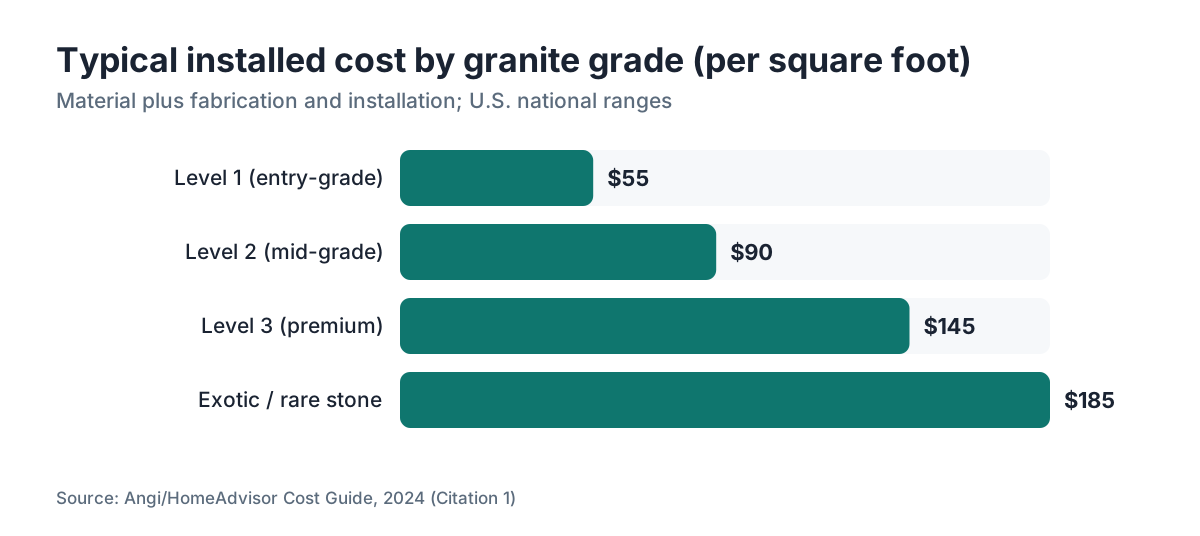
Installed cost across the U.S. usually lands between $40 and $200 per square foot, with the national average around $60 to $80 per square foot for a mid-grade slab, a standard edge, and a basic sink cutout [1]. The range is wide because several independent variables stack on top of each other.
Slab grade is the biggest lever. Low-tier commercial granite (colonial white, santa cecilia) might be $20 to $30 per square foot for material alone. Exotic imports like blue bahia, van gogh, or leathered calacatta gold granite can hit $80 to $120 per square foot before a fabricator ever touches the stone [1].
Fabrication and installation typically add $35 to $85 per square foot on top of material, depending on shop overhead. A shop in rural Tennessee quotes very differently than one in San Francisco or Boston.
| Cost component | Typical range (per sq ft) |
|---|---|
| Entry-level slab (material only) | $15, $30 |
| Mid-grade slab | $30, $60 |
| Exotic/premium slab | $60, $120+ |
| Fabrication and installation | $35, $85 |
| Edge upgrades (ogee, waterfall, etc.) | $10, $30 per linear foot |
| Sink cutout | $100, $250 flat fee |
| Cooktop or faucet holes | $50, $150 each |
Edge profiles add cost by the linear foot, not the square foot. A simple eased or beveled edge usually sits inside the base quote. An ogee, dupont, or full bullnose might add $10 to $30 per linear foot, which adds up fast across a 40-foot kitchen perimeter [2].
Don't forget demo and haul-away if you have existing counters. That runs $150 to $400 depending on what's coming out. Plumbing disconnect and reconnect is a separate trade. Some fabricators fold it in. Most don't.
What granite grades and slab types should you know about?
Granite grades vary by supplier, and no third party enforces an industry-standard scale. Fabricators and distributors commonly use a three- or four-tier label: Level 1 (commercial or builder grade), Level 2 (mid-grade), Level 3 (high-grade), and sometimes Level 4 or "premium exotic" [3].
The grade reflects a mix of things: rarity and origin of the stone, how uniform or unique the pattern is, slab thickness (2cm vs 3cm), and finish quality (polished, honed, leathered). It has little to do with hardness or durability. A Level 1 granite can be exactly as hard as a Level 3 one.
For a working family kitchen, Level 1 or Level 2 granite is completely defensible. Colonial white, ubatuba, and new caledonia are classics for a reason. They're durable, easy to seal, and widely stocked, which keeps lead times short. If your kitchen is a showpiece or you're renovating for resale in a high-value market, jumping to Level 3 moves the needle visually more than almost any other single choice.
Slab thickness matters structurally. Three-centimeter (1.25-inch) slabs are the current residential standard and need no plywood underlayment. Two-centimeter slabs need a plywood substrate to span longer unsupported runs, and they're now used mostly in vertical applications. If a quote specs 2cm for a countertop, ask why.
Leathered and honed finishes keep gaining ground on the classic high-gloss polish. Leathered granite has a lightly textured surface that hides fingerprints and micro-scratches better than polished. Honed is matte and flat. Both open up the surface pores a bit, so they generally need sealing more often than polished granite [3].
How does the fabrication process work from start to finish?
Fabrication runs in five stages: inspect the cabinets, template the space, select the slab, produce the pieces in the shop, and install. Understanding the sequence helps you set real expectations and catch problems before they're carved into stone.
Step one is the cabinet and structure inspection. Your fabricator has to confirm the cabinets are level, square, and fully installed. Granite goes in last. If your cabinets aren't done, don't schedule the template.
Step two is templating. A technician comes to your home and either builds a physical template or, in most modern shops, uses a digital laser templating device (a Laser Products Industries LT-55 or similar) to map every wall, corner, and cutout precisely [4]. Digital templates feed straight into the shop's CNC software with sub-millimeter accuracy. This appointment usually takes 1 to 3 hours.
Step three is slab selection, if you haven't done it already. Most shops want you at the distributor yard before or shortly after templating. You or your fabricator marks which part of the slab to use, watching where the best veining falls against your layout. A good fabricator talks seam placement with you right here.
Step four is shop production: sawing, CNC edge profiling, edge polishing, grinding sink and cooktop cutouts, drilling faucet holes. This usually takes 3 to 7 business days for a standard kitchen. Shops buried in backlog can run 2 to 3 weeks. If you're on a tight renovation schedule, ask about lead time before you commit.
Step five is installation. A two-person crew brings the finished pieces to your home and sets them on the cabinets with construction adhesive (for pieces spanning cabinets) and color-matched epoxy at the seams. Seams get ground flush and polished. The install itself usually takes 2 to 5 hours for a typical kitchen. Stay home for it. Final placement decisions happen in real time.
Shops that quote and nest digitally can cut material waste hard, sometimes 15 to 20 percent versus hand-templating, which matters when you're carving up an expensive exotic slab. SlabWise is one platform fabricators use for quote-to-cut work; if you run a shop and you're comparing software, it's worth a demo.
See our full countertop installation guide for what to expect on install day and how to prep your kitchen.
What questions should you ask a fabricator before signing a contract?
Ask to see the shop, pin down seam placement, get the full scope in writing, confirm the warranty, and pull references from the last six months. Most homeowners ask about price and then sign. The ones who end up unhappy almost always skipped the operational questions.
Ask to see the shop. Reputable fabricators will let you visit. You're looking for organized stone storage (slabs on A-frames or in cradles, not stacked flat), a visible CNC or bridge saw, and evidence of active work. A shop with no stone in progress is a shop with no work, which usually tells you something.
Ask specifically about seam placement. Most kitchens need at least one seam. Where it lands matters both to the eye and to the structure. It should fall at corners when possible, never over the dishwasher (steam and vibration stress it), and ideally not in the most visible straight run.
Ask what's in the quote. Get a written answer on each item: Demo? Plumbing? Sink cutout? Backsplash? Edge profile? How many faucet holes? Every item you assume is included and isn't is money you spend later.
Ask about the warranty. Most fabricators offer 1 year on workmanship (seams, polish, fit). The stone itself carries no fabricator warranty, though some distributors run satisfaction programs.
Ask how they handle cracks or damage found during installation. It's rare. It happens. You want the plan before there's a crisis.
Ask for references from jobs finished in the last 6 months, not the greatest hits from 2019.
How does granite compare to marble, quartz, and quartzite for countertops?
Granite scores 6 to 7 on the Mohs hardness scale, sitting between marble (softer) and quartzite (harder) among common natural stones [5]. Engineered quartz reads about 7 but can't take direct heat. That combination of hardness plus heat tolerance is where granite earns its place in a working kitchen.
Marble scores 3 to 5, which is why it scratches from everyday knife use and etches from acidic foods. Quartzite, a metamorphic rock people often confuse with quartz or marble, typically scores 7 or higher and runs harder than granite, though it varies by source.
| Material | Mohs hardness | Heat resistance | Acid resistance | Maintenance |
|---|---|---|---|---|
| Granite | 6 to 7 | Excellent | Good | Seal every 1 to 3 years |
| Marble | 3 to 5 | Good | Poor (etches easily) | Seal frequently, accepts patina |
| Quartzite | 7+ | Good | Varies by stone | Seal annually or more |
| Engineered quartz | 7 | Poor (heat can damage resin) | Excellent | Nearly none |
| Laminate | 2 to 3 | Poor | Fair | None, but irreplaceable |
Heat tolerance is one of granite's genuine advantages. You can set a hot pan straight on it without hurting the stone. The same move on engineered quartz can discolor or crack the resin binder [6]. If you cook hard, that matters.
Granite is porous and will absorb liquids over time if it's not sealed. Permeability swings widely by specific stone. Dense, dark granites like absolute black are nearly impermeable. Lighter granites with larger mineral crystals soak up liquid faster. Run a water test: drop water on an unsealed spot, and if it darkens in under 5 minutes, it wants sealing.
For marble countertops, the trade is obvious beauty against harder maintenance. For cambria countertops and other engineered quartz, you get consistency and near-zero upkeep but give up heat tolerance and the one-of-a-kind look of natural stone. Neither is wrong. They solve different problems.
Still weighing options? Our kitchen countertops comparison covers every major material in one place.
How do you seal and maintain custom granite countertops?
Seal granite with a penetrating (impregnating) sealer, reseal every 1 to 3 years, clean it with warm water and a drop of dish soap, and stay away from bleach, ammonia, and vinegar. Sealing is where homeowners lose the plot. They seal on install day and then forget about it for a decade. The stone pays for it.
Use a penetrating sealer, never a topical coating. Penetrating sealers soak into the pores and repel liquid from inside. Topical coatings sit on the surface, peel, and trap moisture. Any fabricator pushing a topical coating on granite is wrong.
How often to reseal depends on the stone and the sealer. The real-world range is 1 to 3 years for most residential granite [7]. High-traffic kitchens with dark, low-porosity granite can stretch to 5 years. Light granites in busy kitchens may want annual attention. The water test is your actual indicator, not the calendar.
For daily cleaning, warm water and a few drops of dish soap do the job. Skip bleach, ammonia, and vinegar. They won't destroy granite overnight, but repeated exposure to acidic or alkaline cleaners eats the sealer faster than normal use does. pH-neutral stone cleaners with no surfactant residue are worth it if you want the sealer to last.
Chips are the most common damage, usually at the edges near the sink. Small chips (under 5mm) can be filled with color-matched epoxy by a fabricator. Larger chips or breaks at seams need a pro. Don't DIY a seam repair. Color-matching epoxy is genuinely hard to get right.
For more on cleaning stone surfaces, see our guide on how to clean stone countertops.
What are the best edge profiles for granite countertops?
Eased and beveled edges are usually included and right for most kitchens. Bullnose, ogee, and waterfall profiles cost extra and belong where the edge actually shows. The edge profile is one of the most underrated design calls in a countertop project. It changes the visual weight of the counter, the cleaning effort at the counter-backsplash junction, and the price of the job.
Eased edge: a 90-degree top corner, very slightly softened. Clean, modern, almost always inside the base fabrication price. Good for contemporary kitchens.
Beveled edge: the top corner cut at 45 degrees. Still clean and simple, usually low-cost or included. A small step up visually from eased.
Bullnose: the top edge rounded into a full half-circle. Traditional and family-friendly (no sharp corners), easy to clean. Usually $5 to $15 per linear foot extra.
Ogee: an S-curve with a convex upper portion and concave lower. Classic, formal, ornate. Labor-heavy to cut and polish well. Expect $15 to $30 per linear foot extra.
Waterfall: the countertop material wraps vertically over the end of an island or cabinet, running from counter top to floor in one plane. Dramatic and modern. Material cost roughly doubles for the vertical panel, plus labor. This is one case where exotic slab selection really earns its keep, because the vein has to match (or be mitered) across the horizontal and vertical faces.
Dupont and cove ogee profiles land in between, adding detail with a bit less labor than a full ogee. For most kitchens, eased or beveled is exactly right and saves real money. Save the decorative profiles for spots where the edge shows and gets appreciated, like an island with seating.
How do you pick the right granite slab at the yard?
Go to the yard, stand the slab up, and walk back 10 feet before you decide. Buying granite from a website photo is a mistake you'll live with for 20 years. In person, you catch the color pockets, the vein direction, and the scale of the pattern that photos flatten out.
Distributors store slabs outdoors in mild climates or in warehouse bays on A-frames. Most will pull a slab with a forklift so you see it vertically in good light, which is much closer to how it reads on a counter than lying flat.
Bring a photo of your cabinet door and a flooring sample if you have one. Color perception shifts hard with different flooring underfoot, and most granite regret comes from choosing the stone in isolation.
Ask the distributor or fabricator to mark roughly where your pieces get cut. A kitchen with an island may need two or three slabs. Slabs from the same bundle (consecutive cuts from one block) sit closest in color and pattern. Ask whether matching bundles are in stock.
Check the slab dimensions against your square footage estimate, with a cushion for waste. A standard full slab runs roughly 55 to 65 square feet. Jumbo slabs reach 80 to 90 square feet [3]. Your fabricator should tell you exactly how much usable stone you need and which inventory works.
Look for existing cracks and fissures. Natural fissures (geological, filled by the earth over time) are different from structural cracks introduced by handling. Fissures are generally fine. A crack that opens when you press gently is a problem. Your fabricator's template confirms whether any fissure lands somewhere structurally sensitive, like over a seam or a cooktop cutout.
Are there any health or safety concerns with granite in the kitchen?
Granite in a home kitchen is safe for the people using it. EPA says granite countertops are unlikely to be a meaningful radon source in most homes, and radon from soil under the foundation is the far bigger risk. Silica dust during fabrication is a real hazard, but that falls on shop workers, not homeowners. The radon question comes up a lot because of media coverage from the late 2000s. The facts are calmer than that coverage suggested.
The U.S. Environmental Protection Agency acknowledges that some granite can emit low levels of radon, a naturally occurring radioactive gas that is the second-leading cause of lung cancer in the U.S. after smoking [8]. EPA also notes that the contribution from countertops to indoor radon is generally small next to radon entering from soil and building materials. In the agency's words: "EPA does not believe granite countertops are likely to be a significant source of radon in most homes" [8].
Want certainty? Test your home for radon. Test kits run under $30 at hardware stores and follow EPA protocols. The action threshold is 4 picocuries per liter (pCi/L) [8]. If your level is elevated, the source is almost always soil entry through the foundation, not the counters.
Silica dust during fabrication is a legitimate occupational hazard for workers cutting granite and engineered stone. OSHA sets a permissible exposure limit for respirable crystalline silica of 50 micrograms per cubic meter as an 8-hour time-weighted average [9]. Fabricators have to control that exposure with wet cutting, ventilation, and respiratory protection. As a homeowner, your exposure during installation is brief and negligible.
How do custom granite countertops affect home resale value?
Nobody has clean data isolating countertop material as a standalone driver of sale price. The honest answer: install granite because you want to live with it, not because you expect to bank the cost at resale. The direct evidence is thin and usually tangled up with the broader kitchen renovation effect.
The closest available proxy is the annual Cost vs. Value report from Remodeling magazine, which tracks kitchen remodel returns across markets [10]. The 2023 report found a mid-range major kitchen remodel recouped about 41.8 percent of its cost at resale, while a minor kitchen remodel (which includes countertop replacement) recouped roughly 85.7 percent [10]. That gap is large. Small, targeted upgrades tend to return more per dollar than full gut jobs.
Granite reads as a premium material to buyers, and listings lean on it as a selling point. That perception carries real weight in competitive markets. In move-up and luxury markets ($500,000 and above), granite or natural stone in the kitchen is often expected rather than remarkable. Its absence can hurt more than its presence helps.
Rental properties and value-segment homes flip the math. Spending $8,000 on granite in a home that sells for $180,000 is unlikely to return dollar for dollar. There, a well-installed laminate countertops or formica countertops option is often the smarter financial call.
So pick granite for the twenty years you'll spend cooking on it. The resale bump is a bonus, not the reason.
What are common mistakes homeowners make with custom granite projects?
The big ones: skipping the yard visit, not checking cabinet level before template day, confusing square footage with a flat-rate guess, forgetting the overhang math, signing off on seams without a plan, and going quiet after the deposit. Each one costs money or peace of mind, and every one is avoidable.
Skipping the slab yard visit tops the list. You see a photo, you love it, you order it, and the installed counter reads different enough from the image to bug you every morning for years. Select in person.
Not checking cabinet level before template day. If your cabinets slope more than 1/8 inch over 10 feet, the granite mirrors that slope and the scribe cuts at the wall look wrong. Fix the cabinets first.
Confusing square footage with a flat-rate guess. Fabricators calculate square footage from the actual template dimensions. A kitchen with 52 square feet of counter doesn't automatically need two 55-square-foot slabs. But an island that requires a specific vein match or a dramatic pattern drops the nesting efficiency, and you may need considerably more material. Ask your fabricator to show you the nesting layout.
Forgetting the overhang. Standard overhang over base cabinets is 1.5 inches. An eating ledge can run 12 to 15 inches (support anything over 12 inches with corbels or steel brackets). All of that overhang adds to your square footage.
Signing off on seam locations with no plan. Ask your fabricator to sketch seams on your layout before fabrication starts. Seam placement is a negotiation. Once the stone is cut, it's settled.
Paying a big deposit and then going silent on timeline. Fabricators work in production order. Disappear after paying and your job can drift back in the queue. Stay in contact. Confirm template and install dates in writing.
If you're a fabricator reading this and want to see how modern quoting and layout software handles seam planning and material nesting, SlabWise offers a free demo.
Frequently asked questions
How much should I budget for custom granite countertops in a typical kitchen?
A typical kitchen with 40 to 60 square feet of countertop runs $2,400 to $5,000 installed for mid-grade granite. Add $500 to $1,500 for a premium or exotic slab, and budget separately for demo, plumbing disconnect, and any tile backsplash work. Getting three quotes is standard; a spread of more than 25 percent between the lowest and highest usually signals a scope mismatch you need to resolve.
How long does it take to get custom granite countertops installed?
From signed contract to install, expect 2 to 4 weeks in most markets. Template day usually lands 3 to 5 business days after contract, shop production runs 3 to 7 business days, and scheduling the install crew adds a few more days. Shops at peak capacity in spring and summer can stretch to 5 to 6 weeks. Ask about current lead time before you lock in a renovation schedule.
Can I use custom granite in a bathroom instead of a kitchen?
Yes, and vanity tops are one of the most common granite applications. The same process applies: template, cut, edge, install. Bathroom projects are usually smaller in square footage, so material cost is lower, but per-square-foot fabrication cost often runs higher because fixed costs (template trip, saw setup) don't scale down with job size. Undermount sink cutouts in vanities are standard.
Does granite need to be sealed before it's used?
Most granite should be sealed before first use. Many fabricators apply a first coat during finishing, but confirm it. Use a penetrating impregnating sealer, not a topical coating. Apply it, let it soak for the manufacturer's recommended dwell time (usually 5 to 15 minutes), wipe off the excess before it dries on the surface, and let it cure 24 hours before putting the counter back in service.
How do I find seams in a granite countertop, and can they be avoided?
Seams show as a thin line where two pieces meet, usually 1 to 2 mm wide, filled with color-matched epoxy. They can't be avoided in kitchens with runs longer than a single slab (typically 65 to 90 inches). Good seams are nearly invisible from standing height. The fabricator chooses placement based on slab size, pattern flow, and structure. Ask to review the placement before fabrication begins.
What's the difference between granite and quartzite countertops?
Granite is an igneous rock formed from cooled magma, with a speckled mineral pattern. Quartzite is a metamorphic rock formed from sandstone under heat and pressure, and it often mimics marble with flowing veins. Quartzite generally runs harder than granite (7+ Mohs vs 6 to 7), but porosity varies by source. Both need sealing. Quartzite is usually priced higher. Many stones sold as quartzite are actually marble or dolomite, so ask for a scratch test.
How do I clean granite countertops without damaging the sealer?
Use warm water and a small amount of dish soap for daily cleaning. Rinse well and dry with a soft cloth to avoid water spots. Skip bleach, ammonia-based cleaners, vinegar, and anything strongly acidic or alkaline, since those degrade the sealer faster than normal use. For a deeper clean, pH-neutral stone cleaners work well. Blot spills right away, especially oils, red wine, and coffee, rather than wiping and spreading them.
Is it safe to cut food directly on granite countertops?
It's safe for the food but hard on your knives. Granite is harder than steel blades, so cutting directly on it dulls edges faster than a wood or plastic board does. The stone itself won't be harmed. So it depends on what you're protecting: the food is fine, but use a cutting board if you care about your knives. No food safety concern arises from cutting on a properly sealed granite surface.
Can granite countertops crack, and what causes it?
Granite can crack, though it's less common than with marble or engineered stone. The likely causes are impact (dropping something heavy on an unsupported edge or near a cutout), structural settling that shifts cabinet support, or thermal shock (rare, but pouring boiling water repeatedly in the same spot over time). Hairline fissures are natural and rarely spread under normal use. Edge chips near the sink are the most common damage in home kitchens.
What is the difference between Level 1, Level 2, and Level 3 granite?
Suppliers and distributors set these grades, not any independent standard. Level 1 is entry-grade: common patterns, often thinner (2cm), widely available. Level 2 is mid-grade with more visual interest and typically 3cm thickness. Level 3 and above covers rarer patterns, exotic origins, and distinctive colorways. Grade doesn't indicate hardness or durability. A Level 1 granite can outlast a Level 3 one in service. The grade mostly reflects rarity and looks.
Do I need permits or inspections for new countertop installation?
In most jurisdictions, countertop replacement alone needs no permit because it's cosmetic work that doesn't alter structure, plumbing rough-in, or electrical. But if you're moving plumbing locations or adding an outlet to the backsplash, those trades typically require permits. Rules vary by municipality. Check with your local building department if you're doing anything beyond a straight swap of countertop material on existing cabinets.
How do I know if a granite fabricator is reputable?
Ask for references from jobs finished in the past year and actually call them. Visit the shop if they allow it. Check Google and Yelp reviews specifically for comments about seam quality and whether the finished work matched the quote. Membership in the Natural Stone Institute is a positive signal; it means the shop has access to industry standards and training. Get everything in writing: scope, material spec, edge profile, seam locations, timeline, and payment terms.
Can granite countertops be repaired if they chip or crack?
Small chips (under about 5 to 8 mm) can be repaired by a fabricator using color-matched epoxy. The repair usually isn't invisible up close, but it's much less noticeable from normal standing distance. Larger structural cracks are harder to repair cleanly and may require partial slab replacement. Seam failures (the epoxy bond separating) are fairly straightforward for a fabricator to re-epoxy. Don't try to DIY seam or crack repairs; color-matching epoxy is a skill.
Is granite a good choice for outdoor kitchen countertops?
Granite handles outdoor use reasonably well. It's UV stable, so it won't fade the way some engineered materials do, and it takes temperature swings without complaint. The main concern is freeze-thaw cycling in cold climates: water in the pores expands when frozen and can cause spalling over many years. A high-quality penetrating sealer applied annually reduces that risk. Polished finishes may show weathering faster than honed or leathered finishes outdoors.
Sources
- HomeAdvisor (Angi), Granite Countertops Cost Guide: Installed granite countertop cost ranges from $40 to $200 per square foot nationally, with averages around $60 to $80 per square foot for mid-grade material
- Natural Stone Institute, Fabrication Standards: Edge profile upgrades (ogee, dupont, waterfall) add cost per linear foot above standard eased or beveled edges included in base fabrication quotes
- Natural Stone Institute, Consumer Resources: Granite grades (Level 1 through Level 3 and above) reflect rarity, pattern uniqueness, slab thickness, and finish quality; standard residential slab sizes run 55 to 65 square feet with jumbos reaching 80 to 90 square feet
- Laser Products Industries, Digital Templating Systems: Digital laser templating devices provide sub-millimeter accuracy for countertop templates, feeding directly into CNC cutting software
- U.S. Geological Survey, Mohs Hardness Scale: Granite scores 6 to 7 on the Mohs hardness scale; marble scores 3 to 5; quartzite typically scores 7 or higher
- Marble Institute of America (now Natural Stone Institute), Stone vs. Engineered Surfaces: Engineered quartz countertops can be discolored or cracked by sustained high heat due to the polymer resin binder; granite does not have this limitation
- Natural Stone Institute, Care and Maintenance of Natural Stone: Granite countertops should be sealed with a penetrating impregnating sealer and resealed every 1 to 3 years depending on porosity and use
- U.S. Environmental Protection Agency, Radiation Protection (granite countertops and radon): EPA states it does not believe granite countertops are likely to be a significant source of radon in most homes; radon action level is 4 pCi/L
- U.S. Occupational Safety and Health Administration, Crystalline Silica Rule (29 CFR 1910.1053): OSHA permissible exposure limit for respirable crystalline silica is 50 micrograms per cubic meter as an 8-hour TWA; requires wet cutting and respiratory controls in fabrication shops
- Remodeling Magazine, 2023 Cost vs. Value Report: A minor kitchen remodel recouped approximately 85.7 percent of its cost at resale; a mid-range major kitchen remodel recouped approximately 41.8 percent in the 2023 report
Last updated 2026-07-10