TL;DR
- Custom fabricated countertops run $50 to $200 per square foot installed.
- Pre-made options land at $10 to $40.
- The gap comes from skilled labor, precise templating, material waste of 15 to 35 percent, six-figure shop equipment, and the fact that every job gets built from scratch to fit one exact kitchen.
- Here's each cost driver, priced out honestly.
What actually makes custom countertops more expensive?
Someone is building something unique for one specific room, and that takes time, skill, tools, and material a factory slab never touches. That's the whole answer in a sentence. Everything below is the math behind it.
Pre-made countertops, the kind you buy at a home improvement store in standard 4-foot or 8-foot sections, get manufactured by the thousands in controlled factories. Same template, same cut, every day. Labor cost per unit drops to almost nothing because machines do the repetitive work.
Custom fabrication runs the other direction. A fabricator measures your actual kitchen, builds a paper or digital template of every wall angle and cabinet run, cuts stone or solid surface to those exact numbers, finishes the edges to your spec, then installs the result. No two jobs match. That individuality is the product, and individuality costs money.
Here's the piece homeowners miss. Custom stone jobs almost always start with pricier base material. The laminate countertops sold pre-made at retail use a substrate that costs very little per square foot. A fabricator working in granite countertops or marble countertops starts with material that costs $5 to $15 per square foot for the raw slab alone, before a single tool touches it. [1]
How much more does custom fabrication actually cost compared to pre-made?
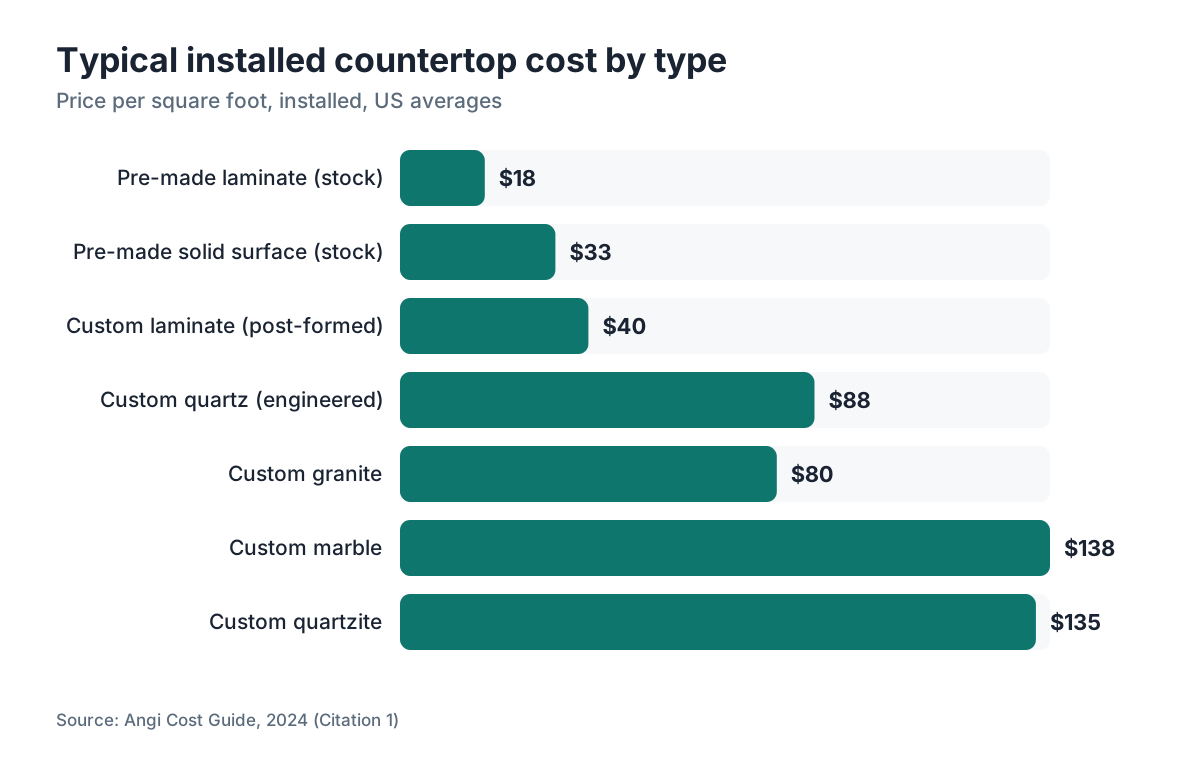
Custom runs roughly two to eight times the price of comparable pre-made, depending on material. A 40-square-foot kitchen in pre-made laminate costs $600 to $1,000 out the door. The same footprint in custom granite runs $2,000 to $4,400. These ranges come from published retail and industry data, and your local number shifts with material and shop overhead. [1][2]
| Type | Typical installed cost per sq ft | Who installs |
|---|---|---|
| Pre-made laminate (Formica/stock) | $10, $25 | DIY or handyman |
| Pre-made solid surface (Corian stock) | $25, $40 | Usually included |
| Custom laminate (post-formed) | $30, $50 | Fabricator |
| Custom quartz (engineered stone) | $55, $120 | Fabricator |
| Custom granite | $50, $110 | Fabricator |
| Custom marble | $75, $200 | Fabricator |
| Custom quartzite | $70, $200 | Fabricator |
The spread can feel like sticker shock. Every dollar of it maps to something specific, and the rest of this article walks through what.
One note on the high end. Cambria countertops, a premium engineered quartz brand, are always fabricated to order and typically run $80 to $130 per square foot installed, which puts them near the top of the quartz range. [2]
For a full picture of what different countertop types cost and require, the kitchen countertops overview has side-by-side breakdowns.
What does the templating process cost, and why is it necessary?
Templating is where a fabricator measures your kitchen, by hand or with a laser tool, to record every wall, cabinet, corner, and obstacle. It takes 30 minutes to two hours on-site, plus processing time back at the shop. No stock countertop needs this step at all.
A pre-made countertop ships in fixed lengths and you cut it to fit, or a contractor trims it on-site with a circular saw and a straightedge. Fine for a straight run of laminate. It fails badly on a stone countertop with an irregular peninsula, a farmhouse sink cutout, or walls that sit 2 degrees out of square.
Digital templating changed the accuracy game. A laser system like Prodim's Proliner measures a complex kitchen to within a fraction of a millimeter, and that data feeds straight into the CNC saw program at the shop. [3] The templating device alone costs $15,000 to $50,000, and fabricators spread that capital across every job they run.
Hand templating with cardboard or Lauan strips cuts the tool cost but adds labor time. Either way, someone spends 2 to 4 hours on your kitchen before any stone gets cut.
How much of the material cost is waste, and who pays for it?
Waste runs 15 to 35 percent of the slab you buy, and you pay for all of it. Stone slabs come in irregular shapes, usually 55 to 65 square feet of usable surface for most granite and quartz. Your kitchen almost never tiles perfectly into those shapes. Sink and cooktop cutouts and the L-shaped corners of an island all leave offcuts that can't be used on your job. [4]
The fabricator buys a full slab, uses part of it, and either stores the remnant or scraps it. That loss is built into your quote because the shop has no other choice.
Pre-made countertops get manufactured with almost zero waste at the factory. Material runs continuously, and any trim from your install is so cheap per foot it barely registers.
Nesting software lays out multiple jobs on one slab to cut waste, and shops that run digital nesting consistently push waste rates closer to 15 percent. SlabWise includes nesting tools so fabricators can quote more accurately and stop padding every job with worst-case waste. Even so, some loss is just the geometry of dropping irregular shapes onto irregular slabs. No software beats that.
What skilled labor goes into a custom fabrication job?
A pre-made job needs a retail associate and maybe a handyman. A custom stone job needs a template technician, a saw operator, an edge finisher, a polisher, and an install crew. Big shops staff each role; small shops have one or two people who do all of it.
The saw operator alone earns $20 to $40 per hour depending on market and experience. [5] Edge profiling on a CNC router takes someone who understands toolpaths, speeds, and how different stones react to different bits. Hand polishing, for edges the CNC can't reach, is a skill that takes years to build.
Installation is heavy and exact. Granite countertops weigh 15 to 20 pounds per square foot, and a single island top can top 300 pounds. [6] The crew lifts, positions, levels, and seams that stone without cracking it, then finishes any field seams on-site. A bad seam on a $4,000 job means starting over.
Compare the two timelines. A pre-made laminate top goes in during one afternoon by a competent DIYer. A custom granite install, template to final polish, spans 5 to 10 business days of elapsed time and 8 to 16 total labor hours across the whole crew.
What equipment does a fabrication shop run that adds to the cost?
The capital in a stone shop is serious money. A bridge saw for granite and quartz costs $30,000 to $150,000 new. A CNC edge profiling machine runs $50,000 to $250,000. Add polishing gear, suction lifters, water recycling for wet cutting, and a spray booth for sealers, and a well-equipped 3-person shop might carry $300,000 to $500,000 in equipment on the floor. [7]
That capital gets financed, depreciated, maintained, and eventually replaced. The cost spreads across every square foot the shop produces. A shop running 2,000 square feet of stone a month might carry $15 to $30 per square foot in equipment overhead alone.
Pre-made manufacturers run the same machine types, at scale. A factory producing 50,000 square feet a month spreads that same equipment cost down to pennies per foot. Scale is the whole game, and custom shops can't touch factory volume.
Custom shops have tightened their overhead over time, though. Digital templating feeds CNC programs directly and kills the hand-layout step. Better nesting trims slab waste. Those gains show up as slightly sharper prices over the long run, but they don't close the basic gap with factory production.
Does the material itself cost more for custom work, or just the labor?
Both. The proportions depend on the material.
For granite and marble, the raw slab is a big slice of the total. Natural stone gets quarried in limited places worldwide, and distinctive slabs with unusual movement or color command real premiums. A basic beige granite slab might cost a fabricator $200 to $300 for a bundle (usually 2 slabs, roughly 110 to 130 square feet). An exotic marble or quartzite can run $800 to $2,000 or more for the same quantity. [1]
Engineered quartz is steadier. Material comes in consistent slabs from makers like Cambria, Silestone, or Caesarstone, and prices are predictable. A fabricator buys quartz wholesale, typically $30 to $60 per square foot depending on the line and volume discount. Labor and overhead on top bring the installed price to $55 to $120.
The laminate in Formica countertops costs almost nothing at the material level. The manufactured substrate, the post-forming, and the retail markup make up most of the price on a stock countertop. No raw material scarcity is involved.
Corian countertops sit in between. The acrylic material has real cost, but solid surface fabrication needs less equipment than stone, which is why custom Corian jobs often price below stone even though they're fully custom work.
Why does an odd-shaped kitchen cost even more than a square one?
Complexity multiplies almost every cost driver at once. An irregular kitchen with angled walls, a curved island, multiple sink cutouts, or a cooktop opening takes more templating time, more complex CNC programming, and usually more material, because the geometric offcuts get larger and harder to reuse.
A mitered waterfall edge, where stone wraps vertically down the side of an island, needs 45-degree cuts that are tough to pull off in stone without chipping, and the finished edge has to match perfectly or the joint shows.
Shops quote complexity in different ways. Some use a flat per-piece price for cutouts ($50 to $150 each is common). Some charge by the linear foot for edge profiling, with fancy profiles costing more than a simple eased edge. Angled cuts, radius work, and book-matched slabs (two consecutive slabs mirrored for symmetrical veining) all add labor time that lands straight in the quote.
A straight-run kitchen with no island and one sink cutout is the cheapest custom job you can order. An L-shaped kitchen with a waterfall island, an undermount sink, a cooktop cutout, and an ogee edge is the opposite. In the same material, the gap between those two jobs runs $1,500 to $3,000 on a mid-size kitchen.
The countertop installation guide has more on how installers price complex jobs and what to watch for in a quote.
How do fabricators calculate their markup and overhead?
Most stone shops run gross margins of 40 to 60 percent on materials. [8] That sounds fat until you count the overhead behind it: rent on a space big enough to store slabs and run a bridge saw (often 3,000 to 8,000 square feet), equipment depreciation, labor burden (wages plus benefits, payroll tax, workers' comp), insurance, template and install trucks, and consumables like blades, CNC bits, and polishing pads.
A diamond saw blade for granite costs $300 to $800 and lasts 300 to 500 linear feet of cuts before replacement. [9] A CNC edge bit might cost $150 and last a fraction of that in hard stone. Those consumable costs are real and never stop.
Shops also carry every job through a 1 to 3 week lead time from template to install. During that stretch, capital sits tied up in purchased slabs in the yard. Larger shops might hold $50,000 to $150,000 in slab inventory at any moment. That working capital comes from a credit line (interest) or the owner's own pocket (opportunity cost).
The markup also covers the jobs that go sideways. A cracked slab during install, a seam that needs a redo, a measurement error that scraps a $600 piece of stone. These happen in every shop, and the cost lands on the business, not the homeowner.
Is custom fabrication always worth the extra cost, or does pre-made ever make more sense?
Pre-made makes sense in plenty of real situations. Rental properties, tight-budget renovations, and kitchens with simple straight layouts headed for another remodel in 10 years are all fair candidates for stock laminate or post-formed tops. The material holds up fine for daily use, the cost drops hard, and installation is faster.
Custom earns its price when the kitchen has irregular dimensions (nearly every older home), when you want a specific stone or thickness, when longevity matters (granite and quartz last decades without replacement), and when resale is on your mind. Remodeling Magazine's 2024 Cost vs. Value Report puts the resale return on a major kitchen remodel at roughly 38 percent in a typical market, which means the custom stone premium is partly offset, not fully recovered. [10] The rest of the value is the daily experience of using something built for your exact space.
Here's the honest call. If budget is the hard constraint and the layout is simple, buy good pre-made laminate from a reputable brand. It looks fine and lasts 10 to 15 years with normal care. If you're staying in the house, you want stone, or you have any non-standard dimensions, custom fabrication is the only practical path.
On longevity, butcher block countertops are a middle case worth knowing: often custom-cut to length but built without the heavy equipment of a stone shop, which keeps the cost down while still fitting unusual spaces.
How can homeowners verify they're getting a fair custom quote?
Get three quotes. That's still the best advice anyone can give, because regional labor rates and slab sourcing swing too much for a single national benchmark to mean anything.
Then ask each fabricator to break the quote into line items: material, fabrication labor, edge profile, cutouts, installation. A shop that won't itemize is harder to trust and harder to compare. An itemized quote lets you line up bids honestly, and it shows where you could save (a simpler edge profile, say) without changing the whole job.
Confirm the material is what's quoted. Ask to see the actual slabs before you sign, or at minimum get the specific slab lot number so you know what's coming. Swapping in a cheaper slab from the same color line is a genuine way corners get cut.
Ask about the workmanship warranty. Reputable shops warrant their seams and fabrication against defects for at least a year, and some go longer. Material warranty is separate and comes from the manufacturer.
Shops using digital quoting tools, including platforms like SlabWise, can turn out quotes faster and with more line-item detail than shops working off handwritten estimates. That makes your comparison easier.
What should fabricators say when clients push back on price?
This one's for fabricators. When a homeowner calls your quote too high, the reflex is to drop the price. Don't. Explain the cost drivers instead, because most people genuinely don't know what they're paying for.
Start with the material. Show them the slab. Tell them the stone they chose has a fixed wholesale cost, then walk the math: slab cost, plus expected waste for their layout, divided by usable square footage, equals raw material per foot before a machine even runs.
Move to equipment. Skip the balance sheet. Saying "our saw and CNC are about $200,000 in equipment we're paying off" is honest and concrete, and people get capital costs.
Explain the timeline. Template to install, their kitchen occupies space in your production queue, your slab yard, and your install schedule. That's a real resource with a real cost.
Offer a cheaper alternative instead of a discount. A simpler edge profile, a different material in the same color family, a smaller island, or a remnant for a small section can pull the price down without gutting your margin. That conversation builds trust and closes more jobs than a price cut does.
When a homeowner wants to understand the how to clean stone countertops side of the investment, point them to maintenance guides. It helps them see the stone as an asset worth caring for, which reinforces why they're paying for real fabrication.
Frequently asked questions
Why does the same granite countertop cost so much more at one shop than another?
Material sourcing, overhead, and shop efficiency all differ between fabricators. A shop with lower rent, paid-off equipment, and high job volume can quote thinner margins and still make money. A newer shop with a lease and equipment financing carries higher fixed costs per job. Regional labor rates matter too. Three quotes from local fabricators will show you the real range for your market.
Can I save money by buying the stone slab myself and hiring a fabricator to cut it?
Some fabricators allow customer-supplied material, but most add a surcharge of 10 to 25 percent to cover the warranty and liability of working on stone they didn't source. If the slab cracks during fabrication, the shop needs to know who's responsible. You also lose the fabricator's volume pricing from their distributor, so you often pay more retail than they pay wholesale, wiping out any savings.
How long does custom countertop fabrication take compared to buying pre-made?
Pre-made stock countertops can be bought and installed in a day or two. Custom fabrication typically takes 1 to 3 weeks from template appointment to installation. That lead time covers the template visit, programming the cuts, scheduling production, and fitting your install into the crew's calendar. Busy shops in peak season (spring and early fall) often run 2 to 4 week lead times.
Do custom countertops add more to home resale value than pre-made?
Yes, though the premium isn't fully recovered in most markets. Remodeling Magazine's 2024 Cost vs. Value Report found a major kitchen remodel returns roughly 38 percent of its cost on resale on average. Stone countertops are a visible upgrade buyers notice, but the return depends heavily on your local market, price tier, and competing homes. In a competitive market, stone is often expected rather than a premium differentiator.
Why is there a separate charge for sink cutouts on custom countertops?
Cutting a sink opening in stone takes a plunge cut, finishing the interior edge, and often routing a groove for the mounting clips on an undermount sink. That's 30 to 60 additional minutes of skilled labor plus consumable tooling. Most fabricators charge $50 to $150 per cutout. Pre-made countertops usually come with no cutout, or with a pre-cut hole in a fixed spot that may or may not match your sink.
What is a waterfall edge and why does it cost so much more?
A waterfall edge wraps stone vertically down one or both sides of an island so it looks continuous from countertop to floor. It needs mitered 45-degree cuts at the top corner, careful bookmatching of the vertical piece to the horizontal piece, and precise installation to keep the seam tight. Material cost roughly doubles for that section, and the cutting and seaming adds 2 to 5 hours to the job.
Is engineered quartz cheaper to fabricate than natural stone?
Usually not by much. Quartz slabs have consistent hardness and take the same CNC equipment as granite. Some fabricators find quartz slightly easier to polish and less prone to surprise cracking, which cuts rework risk. But premium quartz costs about the same raw as mid-range granite, and the labor steps are basically identical. Quartz is not a shortcut to lower custom fabrication costs.
Why do fabricators charge a minimum job size?
Template, programming, and install labor costs are largely fixed no matter how small the job. Driving a crew to template and install 8 square feet of stone is the same trip as 40 square feet. Most shops set minimums of $500 to $1,500 to make small jobs viable. If your project falls under a shop's minimum, look for fabricators that sell remnant pieces, pre-cut offcuts from larger jobs sold at a reduced price.
Can I install custom stone countertops myself to save on labor?
Fabricators almost never allow homeowner install on jobs they fabricate, because if the stone cracks during install they're liable and they lose the job revenue. Some will sell you a fabricated piece and disclaim all install warranty. Even then, granite and quartz weigh 15 to 20 pounds per square foot. A 6-foot island top weighs 200 to 250 pounds and needs 3 to 4 people to lift safely without cracking it.
What is book-matching and why does it add to the cost?
Book-matching takes two consecutive slabs from the same block and opens them like a book so the veining mirrors across a seam, creating a symmetrical pattern. It means buying two slabs instead of one, aligning them carefully during layout, and precision cutting so the seam looks intentional. Material cost alone doubles for the book-matched section, and the layout and alignment adds 1 to 3 hours to fabrication.
How much of a custom countertop price is labor versus material?
The split varies by material. For mid-range granite, material is typically 35 to 50 percent of the installed price and labor plus overhead is 50 to 65 percent. For exotic marbles where the slab itself is expensive, material can reach 60 percent of the total. For custom laminate, material is cheap and labor dominates. Asking your fabricator to itemize the quote is the only way to see the split for your specific job.
Are there ways to get a custom look without paying full custom fabrication prices?
Yes. Remnant pieces from a fabricator are fully custom-cut to your dimensions but priced 30 to 60 percent below full-slab pricing, because you're using stone that would otherwise sit unsold. They work well for small bathrooms, laundry rooms, or bar tops. Prefabricated granite and quartz pieces from home centers are another middle option, though the selection of sizes and edge profiles is very limited.
Do fabricators charge more in spring and summer because they're busier?
Most fabricators don't formally adjust prices by season, but lead times stretch a lot in peak remodeling season (roughly March through October in most of the US). A shop that installs in 10 days in January might quote 3 to 4 weeks in June. Some charge premium rates for rush jobs. If your schedule is flexible, booking a template in late fall or winter often means faster turnaround, though prices stay similar year-round.
Sources
- HomeAdvisor (Angi), Countertop Cost Guide: Granite countertops typically cost $50, $110 per square foot installed; marble runs $75, $200; engineered quartz $55, $120.
- Cambria, Official Pricing and Product Information: Cambria engineered quartz is sold exclusively through fabricators and typically installs at $80, $130 per square foot.
- Natural Stone Institute, Fabrication Best Practices: Material waste in stone countertop fabrication typically ranges from 15 to 35 percent of purchased slab area due to cutouts, irregular layouts, and slab geometry.
- U.S. Bureau of Labor Statistics, Occupational Employment and Wage Statistics: The median hourly wage for stone cutters and carvers in the US is in the $20, $35 range depending on region and experience.
- U.S. Occupational Safety and Health Administration, Ergonomics: Granite and quartz countertops weigh approximately 15 to 20 pounds per square foot, making large sections a significant manual lifting hazard.
- Stone World Magazine, Shop Equipment and Capital Investment Coverage: A well-equipped stone fabrication shop typically carries $300,000 to $500,000 or more in capital equipment including bridge saws, CNC routers, and water recycling systems.
- National Kitchen and Bath Association, Industry Financial Benchmarks: Stone fabrication shops typically operate on material gross margins of 40 to 60 percent to cover overhead, labor burden, and equipment depreciation.
- Braxton-Bragg, Diamond Blade and Tool Specifications: Diamond saw blades for cutting granite cost $300, $800 and last approximately 300 to 500 linear feet of cuts before needing replacement.
- Remodeling Magazine, 2024 Cost vs. Value Report: A major kitchen remodel recoups approximately 38 percent of its cost on resale in a typical US market, per the 2024 Cost vs. Value Report.
- U.S. Bureau of Labor Statistics, Consumer Price Index: Pre-made laminate countertop sections at home improvement retailers typically retail at $10, $25 per square foot including standard installation.
- Natural Stone Institute (formerly Marble Institute of America), Stone Weight Reference: Standard 3cm granite slabs weigh approximately 18 to 19 pounds per square foot, confirming the 15 to 20 lb/sq ft range for finished countertop sections.
Last updated 2026-07-11