TL;DR
- Countertop edge profiles range from a simple eased edge (flat, cheap, around $0 to $5 per linear foot upcharge) to decorative options like ogee or waterfall that add $10 to $30 or more per linear foot.
- Your choice affects price, safety, cleaning effort, material compatibility, and style.
- Thicker slabs open up more profiles; laminated edges can fake thickness on any slab.
What is a countertop edge profile?
An edge profile is the shape cut into the exposed front and side edges of a countertop slab. Every countertop has one. The question is only whether your fabricator applies a simple flat cut or shapes something more decorative.
The edge gets shaped by a CNC machine or a hand-held router with a diamond-tipped bit, depending on the shop. CNC routing produces consistent results across a long run of linear footage. Hand routing is still common in smaller shops for simple profiles and custom one-off shapes.
Edge profiles matter more than most homeowners think. They affect how easy a counter is to clean (rounded edges trap less grime), how safe it is around kids (sharp 90-degree corners can bruise hips and elbows), how much the fabrication costs, and whether the counter reads as budget or high-end at a glance. A mitered waterfall edge can completely change the visual weight of an island. A pencil round on a laminate counter is practically invisible but keeps the edge from chipping.
Fabricators measure edge work in linear feet of exposed edge. A standard kitchen with roughly 20 to 25 linear feet of exposed edge will feel the cost difference between profiles quickly.
What are the main types of countertop edge profiles?
There are eight profiles you will encounter at nearly every fabrication shop, plus a handful of specialty shapes that cost more and require thicker material or laminated builds.
Eased edge (also called straight or flat) The slab face is cut flat and the top corner is slightly softened, usually 1/8 inch or less, just enough to remove the razor sharpness. This is the default. Most fabricators include it in the base slab price without an upcharge. It looks clean and modern, and it works on any material thickness.
Beveled edge A flat angled cut across the top corner, typically 45 degrees. The bevel can be wide (1/2 inch) or subtle. It adds visual definition without curves, reads as modern or contemporary, and costs $2 to $6 per linear foot over the base [2].
Pencil round (bullnose-light) A small radius applied to the top corner only, about 1/8 inch to 1/4 inch. The underside stays square. This is common on laminate and tile because it protects the fragile top edge from chipping. Very low upcharge, sometimes zero.
Half bullnose The top edge is rounded into a smooth half-circle; the underside remains flat. Softer than eased, safer for families with young children. Common on granite and quartz. Upcharge typically $2 to $8 per linear foot [2].
Full bullnose Both the top and bottom corners are rounded into a continuous curve. This requires enough slab thickness to produce a visually satisfying curve, so it works best on 3 cm (1-3/16 inch) material. On 2 cm slabs it can look pinched. Upcharge $4 to $10 per linear foot.
Ogee An S-curve profile, concave at the top and convex below, borrowed from classical architecture. It reads as formal or traditional. Popular on granite in kitchens designed around raised-panel cabinetry. The shape has more surface area to clean than simpler profiles. Upcharge $8 to $20 per linear foot [2].
Dupont edge A flat top surface drops into a small radius, then flares outward to a slight undercut. Often confused with ogee. It is a bit more subtle and slightly less expensive, usually $6 to $15 per linear foot upcharge.
Waterfall / mitered edge The countertop surface flows continuously down the side of the cabinet to the floor, with the slab mitered at a 45-degree angle so no end grain shows. This is the most labor-intensive option. It requires additional slab material, precise CNC cutting, and careful alignment during installation. Budget $50 to $100 or more per linear foot for waterfall legs, not counting the extra material cost [2]. It looks stunning on a large island with a book-matched stone slab, and it is an expensive commitment if you change your mind later.
How much does each edge profile cost?
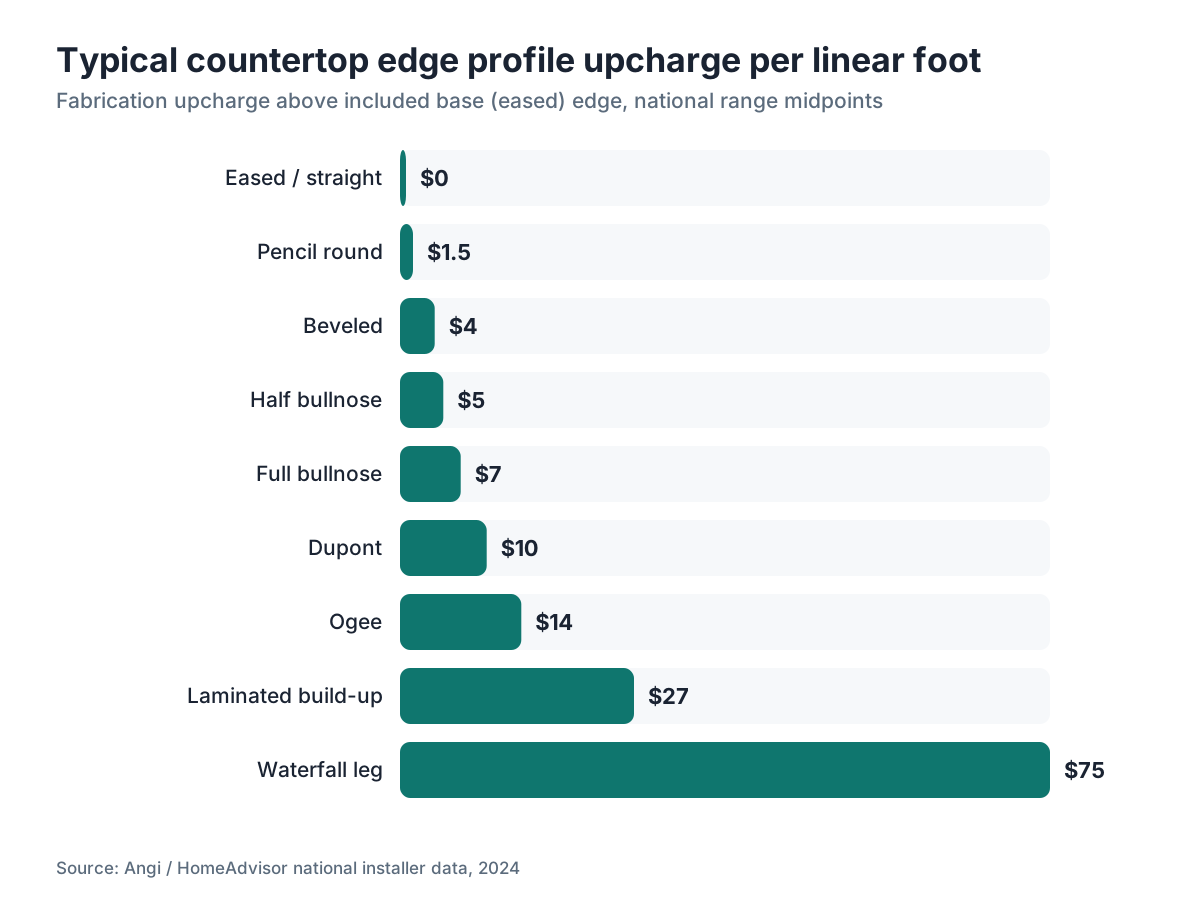
Costs vary by shop, region, and material, but the ranges below reflect what fabricators across the U.S. commonly charge as upcharges above the base edge included in the slab price. These are fabrication charges only and do not include the slab itself.
| Profile | Typical upcharge (per linear foot) | Notes |
|---|---|---|
| Eased / straight | $0 | Usually included |
| Pencil round | $0 to $3 | Often free on laminate |
| Beveled | $2 to $6 | Simple CNC pass |
| Half bullnose | $2 to $8 | Most common upgrade |
| Full bullnose | $4 to $10 | Needs 3 cm slab |
| Dupont | $6 to $15 | More polishing time |
| Ogee | $8 to $20 | Complex profile, more polish |
| Laminated / mitered build-up | $15 to $40 | Doubles apparent thickness |
| Waterfall legs | $50 to $100+ | High labor, extra material |
Those upcharges add up fast. A kitchen with 22 linear feet of exposed edge choosing ogee over eased could easily run $200 to $400 more. Fabricators also price islands separately because they often require four finished edges versus the two or three on a perimeter counter against walls.
Regional labor rates matter too. A shop in rural Tennessee may charge $5 for a half bullnose; a shop in the San Francisco Bay Area may charge $15 for the same cut. If you are getting multiple quotes, confirm whether the base edge is eased or pencil round and whether the quote assumes 2 cm or 3 cm material.
For fabricators running many jobs at once, edge upcharges are one of the line items most often quoted inconsistently or undercharged. Tools like SlabWise let shops set per-profile pricing that carries through every quote automatically, which catches the margin leak that piles up on back-to-back jobs with decorative edges [6].
Which edge profile works best for each countertop material?
Not every profile works on every material. Stone, engineered quartz, laminate, solid surface, and butcher block each have physical properties that favor certain cuts.
Granite and natural quartzite Granite takes almost any profile well because it is dense and hard [1]. Full bullnose, ogee, and dupont all polish beautifully. Coarser-grained granites can look rough in tight concave cuts, so ask your fabricator to show you a sample of the ogee in your specific stone before committing. See our full guide to granite countertops for more on fabrication considerations.
Quartz (engineered) Engineered quartz machines like a dream for CNC work. All profiles are available. Cambria, for instance, lists over a dozen standard edge options on their product pages [5]. The one risk is with very aggressive concave profiles on lighter-colored quartz: the resin can occasionally show slightly different from the slab face after polishing. Your fabricator should be able to show you a finished sample.
Marble Marble is softer than granite (Mohs 3 to 4 vs. Mohs 6 to 7) and can chip on sharp profiles if someone knocks a heavy pot against the edge [10]. A half bullnose or beveled edge is a practical choice. Ogee looks beautiful on marble but the thin tip at the top of the S-curve is a chip point. Read our guide to marble countertops for more on marble's durability quirks.
Laminate Laminate countertops can't be profiled on-site with a router the same way stone can, because the core is particleboard with a thin surface layer. Most laminate edges are either a self-edge (laminate wrapped to the front) with a pencil round, a post-formed rounded edge that is molded into the laminate sheet from the factory, or a hardwood edge strip. Post-formed laminate has its own gentle curve but no customization. See laminate countertops and Formica countertops for the full picture on what's possible.
Solid surface (Corian and similar) Solid surface material is consistent all the way through, which means it sands and shapes easily. Fabricators can create fully custom profiles, join a sink to the deck with no visible seam, and repair chips without the repair showing. Nearly every profile is possible. See Corian countertops for more.
Butcher block Wood counters are typically given a routed eased, round-over, or ogee in the wood shop before finishing. The wood grain means profiles look very different than on stone: warmer, more handcrafted. Sharp corners on butcher block tend to splinter over time. A round-over or eased edge with a small chamfer is the practical choice. More on this in our butcher block countertops guide.
Soapstone and other soft stones Soapstone is Mohs 1 to 2, softer than your fingernail on the Mohs scale. It scratches and nicks easily, so a simple eased or half bullnose is safer than a delicate ogee tip. Keep that fragile profile geometry away from a stone that naturally develops a patina of small marks.
Does slab thickness affect which edge profiles are available?
Yes, significantly. The two standard stone thicknesses are 2 cm (about 3/4 inch) and 3 cm (about 1-3/16 inch). A full bullnose on 2 cm material looks thin and slightly cheap. An ogee on 2 cm barely has room to express the S-curve properly.
The general rule: complex decorative profiles require 3 cm minimum. If your stone comes in 2 cm, you can still get those profiles by laminating the edge: the fabricator glues a strip of the same material to the underside of the front edge, effectively doubling the visible thickness. This adds material and labor cost (typically $15 to $40 per linear foot for the lamination) but gives you the full profile depth.
Laminated edges also let you create the look of a thick mitered waterfall even when the field slab is only 2 cm. The miter is cut through both the face piece and the laminated strip, which shows a consistent thickness when you look at the seam line on the leg.
Thicker slabs cost more per square foot to begin with, and the extra weight of 3 cm material can require cabinet reinforcement in some situations, though for most residential countertops on standard cabinetry, 3 cm is fine without modifications. Kitchen countertops articles go into the structural side in more detail.
Which edge profile is easiest to clean and most hygienic?
Flat and gently curved edges win on cleanability. An eased or half bullnose edge has minimal surface geometry for crumbs, grease, and moisture to hide in. You can wipe it in one stroke.
Ogee and dupont profiles have concave sections where buildup accumulates. It is not a dealbreaker, but you will need a small detail brush or a stiff sponge corner to clear those areas during routine cleaning. In a kitchen that sees heavy daily cooking, that adds up to a real difference in effort over years.
The U.S. Food and Drug Administration's Food Code (which governs commercial kitchens) requires surfaces in food prep areas to be "smooth and easily cleanable" [4]. Residential kitchens do not fall under FDA Food Code, but the principle is a useful guide: profiles with tight concave areas are harder to sanitize thoroughly. If you have a kitchen where hygiene is a high priority (someone in the household immunocompromised, for example), a simple eased or half bullnose is the genuinely practical choice.
For more on keeping surfaces clean regardless of profile, see our guides on how to clean stone countertops and how to clean quartzite countertops.
Are some edge profiles safer for households with kids or elderly adults?
Sharp corners are a genuine hazard. A standard 90-degree eased edge on a countertop at hip height is at exactly the right elevation to catch the head of a toddler who falls or the hip of an older adult who loses balance briefly.
The American Academy of Pediatrics does not publish guidance specific to countertop profiles, but its general home safety guidance consistently flags sharp furniture corners as an injury source and recommends padding or removing them when possible [3]. A half bullnose or full bullnose converts that 90-degree corner into a curve that, while still hard stone, distributes the impact force and has no sharp edge to cut skin.
The practical recommendation: in any kitchen or bathroom where a child under five or an adult with mobility challenges will spend time, spec a full bullnose or half bullnose as a minimum. The upcharge is modest ($4 to $10 per linear foot typically) compared to an emergency room visit. Beveled edges are better than squared but still leave a defined corner point.
Bathroom vanity tops are an especially important case because the counter height on a standard vanity (31 to 35 inches typically) puts the edge right at face height for small children. Full bullnose or pencil round on vanities is the sensible default.
What edge profiles work best for bathroom vanities?
Bathroom vanities follow the same profile options as kitchen countertops, but the use context shifts a few priorities.
Vanity tops are usually smaller in square footage and linear edge footage than kitchens, so even a premium profile like an ogee adds a modest total dollar amount. A 5-foot vanity might have only 5 to 6 linear feet of exposed edge, so the difference between eased and ogee might be $60 to $120 total. That's a reasonable spend for a bathroom where the edge is front and center at eye level when you walk in.
Water resistance matters more in bathrooms. An eased edge with a tight fit to the backsplash and wall leaves less gap for water to get behind the counter. Overly decorative profiles can create small ledges where standing water pools and eventually seeps.
For undermount sinks, the front lip of the cutout gets an edge profile too, and that is the edge your hands touch every time you reach into the sink. A gentle half bullnose on the sink cutout is comfortable. A sharp eased edge on a sink cutout you rest your forearms on dozens of times a day starts to feel uncomfortable over time.
For vanities with vessel sinks (where the sink sits on top of the counter), the deck edge is the most visible element in the room. This is where a waterfall edge or a bold ogee actually earns its price aesthetically, assuming the slab material has the veining or color to carry that presentation.
How do fabricators price and quote edge profiles?
The standard method is to charge a per-linear-foot upcharge above the included base edge (usually eased). The fabricator measures every exposed edge on the layout, categorizes each run by its profile, and multiplies by the per-foot rate for that profile.
Some shops quote a flat rate by profile regardless of linear footage (common for simple jobs). Others quote by zone: kitchen perimeters at one rate, island edges at another because islands have four exposed sides and more complex corner work. Corners add time because the CNC or router has to cut the miter or turn cleanly, and on decorative profiles, that transition needs hand finishing.
Fabricators that run high job volume need per-profile pricing built into their quoting system from the start, not figured out case-by-case on a spreadsheet. Inconsistent edge pricing is one of the more common sources of margin erosion in stone shops. A shop that quotes one job at $8/LF for ogee and another at $12/LF for the same work (based on whoever took the call that day) is leaving money on the table without knowing it. Software like SlabWise embeds profile pricing into the quote template so every estimator quotes the same rates [6].
Homeowners getting quotes should ask: what edge profile is included in this price, and what is the per-foot upcharge to change it? Get that in writing. A quote that says "includes decorative edge" without specifying the profile is a quote that can be disputed later.
Can you change your countertop edge profile after installation?
In most cases, no, not without removing the countertop. The edge profile is cut into the stone before or during installation. After the slab is glued to the substrate and siliconed into place, a fabricator cannot run a router or CNC along the edge without risk of cracking the slab, damaging the cabinets, or producing an uneven finish without the controlled support of the shop.
There is a narrow exception: a fabricator could theoretically grind down a bullnose to an eased edge in place, since you are removing material rather than adding it. But that still requires water cooling, containment of stone dust (a silica hazard OSHA regulates closely [8]), and careful skill. It is rarely done and not something to plan for.
The practical advice: decide your edge profile before fabrication begins, not after. If you are undecided between two profiles, ask your fabricator for samples of each on a piece of scrap stone. Many shops keep offcuts for exactly this purpose. Run your hand along the edge. Look at it under the lighting conditions of your actual kitchen or bathroom.
For homeowners doing a full kitchen renovation with a long timeline, locking in the edge profile early (at template, before the slab is processed) avoids any rush pressure. See our guide on countertop installation for a full timeline of the fabrication-to-installation sequence.
What is a laminated or mitered edge build-up, and when does it make sense?
A laminated or built-up edge means the fabricator bonds an additional strip of material to the underside of the exposed edge, creating a thicker visible profile at the front face of the counter. The top of the counter stays standard thickness (2 or 3 cm); only the edge face appears thicker.
The strip is cut from the same slab so the veining, color, and texture match. It is then glued with epoxy or a specialized stone adhesive, clamped, cured, and profiled and polished as one piece. Done well, you cannot see the seam line from normal viewing distance. Done poorly (or with slab material that has significant movement in pattern), the seam line is obvious.
Mitered edge build-up is a variation where the face piece and the strip are both cut at 45 degrees and joined at the miter, hiding the seam even more effectively. This is the same joint used on waterfall island legs [9].
When does it make sense? Three situations:
- You have 2 cm material and want a profile that requires 3 cm.
- You want the visual weight of a thick slab without paying the material cost for 3 cm across the whole countertop.
- You are building a waterfall feature and need the edge leg to look continuous.
Cost for edge lamination typically runs $15 to $40 per linear foot on top of the base edge upcharge, plus any additional material from the slab. On a 20-foot kitchen perimeter that is $300 to $800 extra. Whether that is worth it depends on whether the profile you want actually requires the thickness. If you are happy with half bullnose, a 2 cm slab handles it fine with no lamination.
How do edge profiles affect the perceived value and resale of a home?
Nobody has solid, peer-reviewed data on the exact resale dollar impact of a specific edge profile. Any claim that "ogee edges add X% to home value" is invented. What real estate appraisers and the National Association of Realtors do report is that kitchen and bath renovation returns vary widely by market and project scope, with mid-range kitchen remodels recouping around 49% to 96% of cost depending on region and year [7].
Within that context, edge profiles are a detail that reads as either "builder grade" or "custom" to a buyer walking through. An eased edge on cheap laminate signals builder grade. A well-executed mitered waterfall edge on a book-matched quartzite island signals premium custom work. Whether that translates to a specific dollar premium is market-dependent, but it does affect buyer perception during a showing.
The practical takeaway: choose an edge that fits your overall kitchen quality level. A fancy ogee on a laminate counter will confuse buyers because the materials are mismatched. A simple eased edge on a high-grade marble counter lets the stone speak. Coherence matters more than picking the most expensive profile.
Frequently asked questions
What is the most popular countertop edge profile?
The eased edge is the most common because it is included in most base fabrication prices and works on all materials and thicknesses. Among paid upgrades, half bullnose is consistently the most requested. It balances safety (no sharp corner), ease of cleaning, and a finished look without the extra cost of ogee or dupont profiles.
What is the difference between a bullnose and a full bullnose edge?
A half bullnose rounds only the top corner; the bottom edge stays flat and square. A full bullnose rounds both the top and bottom corners into one continuous curve. Full bullnose requires a thicker slab (3 cm) to look proportional. Half bullnose works fine on 2 cm material and is more common in residential kitchens.
What edge profile is best for quartz countertops?
Quartz machines cleanly for any profile. The most practical choices are eased or half bullnose for everyday kitchens. If you want a more decorative option, ogee and dupont both polish well on quartz. Cambria, for example, lists over a dozen edge options as standard on their quartz products. The choice is more about style and budget than material limitation.
How much does a waterfall countertop edge cost?
Waterfall legs (the vertical slab runs down the side of an island or cabinet) typically cost $50 to $100 or more per linear foot in fabrication labor, not counting the additional slab material needed. A two-leg waterfall island could add $800 to $2,500 or more to a project depending on stone choice, leg height, and how complex the miter work is at the corner.
Can you add an edge profile to an existing countertop?
Not practically. Reshaping a stone edge after installation requires power tools, water cooling, and silica dust containment in a space not designed for it. Fabrication shops do this work on the slab before or during templating and cutting. Some fabricators can grind down to a simpler shape in place, but adding material or a more complex profile requires removal. Decide before fabrication.
Do different edge profiles cost different amounts to polish?
Yes. Polishing time scales with profile complexity. An eased edge is one or two quick polishing passes. An ogee has a concave channel and two convex curves, each requiring a different pad angle and multiple passes. That labor difference is the main driver behind the price gap between simple and decorative profiles, more than the CNC routing time.
What countertop edge is easiest to keep clean?
Eased and half bullnose edges are easiest to clean because their geometry is simple and there are no concave channels where grease and crumbs collect. Ogee and dupont profiles have concave sections that accumulate debris and require a detail brush to clean thoroughly. For high-use kitchens, simpler profiles are a genuine quality-of-life decision over time.
What edge profile is best for an outdoor kitchen countertop?
Outdoors, a simple eased or half bullnose edge is the smart choice. Decorative profiles like ogee have more surface area to collect debris and standing water, which accelerates staining and erosion in outdoor conditions. Simpler profiles also reduce the number of polished facets that can lose their finish from UV exposure and cleaning chemicals over time.
Does the edge profile affect how a countertop overhang feels to sit at?
Yes. Bar overhangs and island seating areas are where edge comfort is most noticeable. A full bullnose or a waterfall edge is comfortable to lean arms against. A sharp eased edge at a bar height overhang gets uncomfortable quickly because the 90-degree corner digs into forearms. For seating overhangs, round the edge profile. This is a practical detail that is easy to overlook during planning.
What is an ogee edge profile?
Ogee is an S-curve profile with a concave section at the top transitioning to a convex curve below. It comes from classical architectural molding and reads as formal or traditional. It is most common on granite in kitchens with raised-panel cabinetry. Upcharge is typically $8 to $20 per linear foot above the base edge price. It requires more polishing time than simpler profiles.
How do I choose an edge profile that matches my kitchen style?
Match the profile geometry to the rest of the kitchen's design language. Flat, angular profiles (eased, beveled) suit contemporary and transitional kitchens. Curved profiles (half bullnose, full bullnose) are neutral and work in most styles. Decorative profiles (ogee, dupont) suit traditional or formal kitchens. Waterfall edges are a modern statement that works best in kitchens with flat-front cabinetry and book-matched stone.
Does edge profile choice affect the countertop quote significantly?
It can. On a kitchen with 25 linear feet of exposed edge, switching from an included eased edge to ogee at $12 per linear foot adds $300 to the fabrication price. A waterfall island with two legs could add $1,000 to $2,500 more. Edge upcharges are a real line item. Ask your fabricator to break out the per-foot rate for each profile option so you can compare.
What is a dupont edge on a countertop?
A dupont edge has a flat or slightly rounded top surface that drops into a small radius, then flares outward to a subtle undercut lip. It is sometimes called a French dupont. It is less dramatic than an ogee but more decorative than a plain bevel. Upcharge typically runs $6 to $15 per linear foot. It suits transitional kitchen styles where you want some visual interest without the full formality of an ogee.
Are there edge profiles specific to laminate countertops?
Laminate countertops have different edge options than stone. The three main types are: a self-edge (laminate wrapped around a square edge), a post-formed edge (factory-molded rounded front, built into the laminate sheet), and a hardwood edge strip applied to the front. Stone-style CNC profiles are not available on laminate because the particleboard core cannot be shaped the same way.
Sources
- USGS Mineral Resources Program, Stone Information: Granite is a dense, hard igneous rock commonly used in countertop fabrication and is compatible with a wide range of edge profiles.
- HomeAdvisor (Angi), Countertop Edge Profiles Cost Guide: Edge profile upcharges range from near zero for eased edges to $20+ per linear foot for ogee, and $50 to $100+ per linear foot for waterfall legs, based on national installer data.
- American Academy of Pediatrics, Home Safety and Child Injury Prevention: The AAP flags sharp furniture corners and edges as a source of child injury in the home and recommends padding or removing them.
- U.S. Food and Drug Administration, Food Code 2022: FDA Food Code requires food contact surfaces to be smooth and easily cleanable, a standard used as a practical benchmark for residential kitchen hygiene.
- Cambria Quartz, Edge Profiles Product Page: Cambria lists over a dozen standard edge profile options for its engineered quartz products.
- SlabWise, Countertop Fabrication Quoting Software: Fabrication quoting software can embed per-profile edge pricing into quote templates to ensure consistent pricing across estimators.
- National Association of Realtors, Remodeling Impact Report: Mid-range kitchen remodels recoup approximately 49% to 96% of cost depending on region and project scope, per NAR's remodeling impact data.
- Occupational Safety and Health Administration, Silica Dust in Construction: OSHA regulates silica dust exposure in stone fabrication, which is relevant when considering in-place edge reshaping on installed stone countertops.
- Natural Stone Institute, Technical Manual for Stone Fabrication: Industry fabrication standards address edge profile cutting requirements, slab thickness minimums for specific profiles, and laminated edge construction methods.
- Marble Institute of America (now Natural Stone Institute), Dimensional Stone Design Manual: Marble rates Mohs 3 to 4 compared to granite at Mohs 6 to 7, affecting chip risk on complex edge profiles.
Last updated 2026-07-09