TL;DR
- A countertop edge profile is the finished shape cut into a slab's exposed edge.
- Basic profiles like eased or beveled cost little or nothing extra.
- Decorative profiles like ogee or waterfall can add $10 to $30 per linear foot.
- The right choice depends on your material, your cabinet style, and how much cleaning you want to do.
What is a countertop edge profile?
A countertop edge profile is the cross-sectional shape a fabricator cuts and polishes into the exposed edges of a stone or solid-surface slab. Every countertop has one, even if it's just a flat, barely-touched edge. The profile changes how the counter looks, how it feels under your hand, how easy it is to clean, and how much it costs.
Most homeowners pick a profile once and forget it. Most fabricators will tell you the choice matters more than people expect, because the edge catches light differently than the face and it's the part you actually touch every day. A sharp 90-degree corner on a granite island is a bruise waiting to happen. A full bullnose on a bathroom vanity can look dated fast. These aren't aesthetic opinions from design blogs. They're practical things that come up after installation.
Profiles get cut with diamond-tipped router bits on a CNC machine or, on smaller jobs, by hand with angle grinders and polishing pads. The complexity of the profile sets how long it takes, and that time is the main driver of the price difference between profiles.
What are the most common edge profiles and what do they look like?
About a dozen profiles cover the vast majority of residential countertop work. Here is how they actually look and feel:
Eased (also called straight or square): A flat vertical edge with the top corner relieved just slightly so it's not razor-sharp. This is the default on most quotes. Clean lines. Works with every cabinet style. Very fast to produce.
Beveled: The top corner is cut at an angle, usually 45 degrees. It catches light in a way that makes a slab look thinner and more refined. Popular on quartz because quartz often comes in colors that benefit from the sparkle.
Half bullnose (also called demi-bullnose): The top corner rounds into a half-circle while the bottom stays square. Softer than eased. Very common on kitchen islands where people lean.
Full bullnose: Both top and bottom corners round into a continuous curve. The edge looks like a thick rope. Very forgiving to bump into. It fell out of fashion in modern kitchens but still shows up in traditional or transitional designs.
Ogee: A classic S-curve, a concave section flowing into a convex one. Formal and traditional. More surface area to clean. Takes longer to fabricate, which shows up in the price.
Dupont (also called Dupont ogee or reverse ogee): Similar to ogee but the curves go the other direction, creating a shelf-like top lip. Common on bathroom vanities.
Waterfall: Not a profile in the traditional sense. The slab material continues down the cabinet side to the floor in a vertical panel, so the edge visually flows straight down. This is a design choice that affects the whole countertop configuration more than the edge shape. It needs extra slab material and careful grain matching, which is why it can add hundreds of dollars to a job.
Laminated (also called mitered or stacked): Two pieces of stone joined at a 45-degree miter at the front, making the counter appear twice as thick as the actual slab. Popular for getting a 3-cm look from 2-cm material, or for making quartz look like a 5-cm slab for a dramatic effect.
Chiseled (also called river or quarry edge): The edge is left rough and unpolished, imitating how stone breaks naturally. Almost always used on granite or quartzite. Very casual, earthy look.
Leathered or honed edge: Not a shape but a finish. The edge is polished to a matte or textured surface rather than a high gloss. Often combined with other profiles.
| Profile | Visual Style | Corner Safety | Cleaning Effort | Relative Cost |
|---|---|---|---|---|
| Eased | Modern, minimal | Low risk | Easy | Base (often $0) |
| Beveled | Refined, transitional | Low risk | Easy | Low ($2-8/lf) |
| Half bullnose | Soft, transitional | Very safe | Easy | Low-mid ($5-12/lf) |
| Full bullnose | Traditional, rounded | Very safe | Easy | Mid ($8-15/lf) |
| Ogee | Formal, traditional | Low risk | Harder | Mid-high ($12-20/lf) |
| Dupont | Decorative, bathroom | Low risk | Harder | Mid-high ($12-20/lf) |
| Waterfall | Dramatic, modern | N/A | Moderate | High (material cost) |
| Laminated | Chunky, bold | Low risk | Easy | High ($15-30+/lf) |
| Chiseled | Rustic, natural | Higher risk | Moderate | Mid ($10-18/lf) |
Costs shown are typical upcharges above the base edge price. Actual pricing varies by region and shop. [1]
How much do different edge profiles cost?
Edge profile pricing works in tiers, and the tiers track fabrication time more than anything else. A simple eased edge takes maybe 30 seconds per linear foot on a CNC machine once it's programmed. An ogee with proper polishing takes several minutes per foot and needs multiple passes. That time gap is real money.
Most fabricators include one standard edge profile in their base price, usually eased, straight, or bevel. Upgrading to a more complex profile gets quoted as an upcharge per linear foot of exposed edge. On a typical kitchen with 25 linear feet of exposed edge, even a $10/lf upcharge adds $250 to the job. A laminated edge at a $25/lf upcharge on that same kitchen is $625 extra.
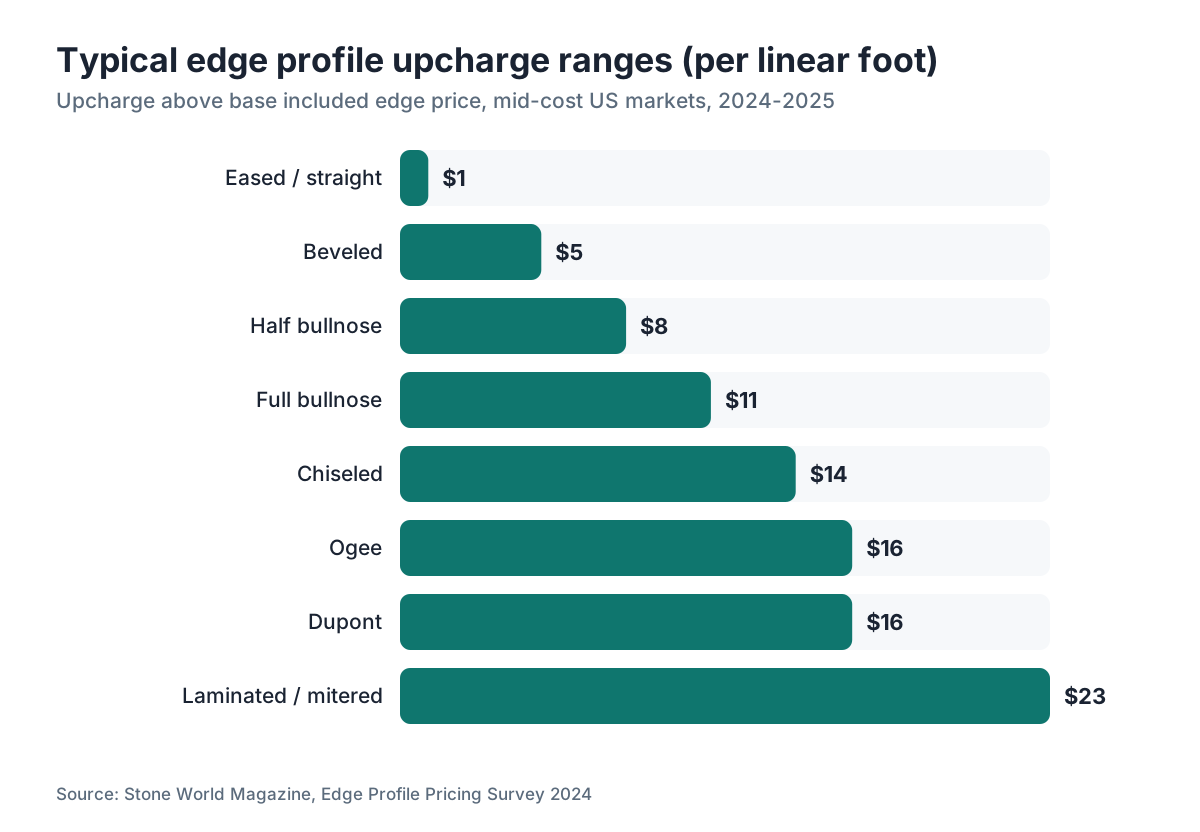
Here are ballpark ranges you're likely to see. These aren't official published rates. No trade association publishes a national price list for edge profiles, and regional labor costs vary a lot. The ranges below reflect what shops in mid-cost US markets typically charge as of 2024-2025 [1]:
- Eased / straight: included in base price or $0-$3/lf upcharge
- Bevel: $2-$8/lf upcharge
- Half bullnose: $5-$12/lf upcharge
- Full bullnose: $8-$15/lf upcharge
- Ogee: $12-$20/lf upcharge
- Dupont: $12-$20/lf upcharge
- Laminated / mitered: $15-$30+/lf upcharge (plus extra material cost)
- Chiseled: $10-$18/lf upcharge
For fabricators, the edge profile is a quoting trap. Shops that don't track their CNC time by profile often underprice decorative edges and then wonder where the margin went. Software that line-items edge profiles in the quote, like the quoting module in SlabWise, makes this easy to see and fix before the job gets priced.
Material matters too. Softer stones like marble chip more easily on complex profiles, which means more polishing passes to clean up the edge. Very hard materials like quartzite wear out router bits faster. Both push real costs up versus quartz or granite.
Which edge profiles work best for quartz countertops?
Quartz edge profiles are a slightly different conversation than stone, and it comes up constantly because quartz is the most popular countertop material in the US residential market. [2]
Quartz is engineered, which means it's consistent. No veins, no pits, no cleavage planes to worry about when routing. A fabricator can cut an ogee into quartz without much fear of the material fracturing at the curve, which is a real concern on some natural stones. So the full range of profiles is genuinely available on quartz.
A few profiles look particularly good on it. The eased and beveled profiles work well because quartz often has a reflective quality in the aggregate that the angled bevel catches nicely. The mitered or laminated edge is popular on thick-format quartz designs where the goal is a heavy, monolithic look. Brands like Cambria publish their approved edge profiles by product line, and those include options like eased, beveled, bevel with a radius, and various ogee styles depending on the product. [3]
One thing trips up quartz edges: the material is engineered to a specific thickness, usually 2 cm or 3 cm. If you want a thick mitered look, you need two pieces joined at a 45-degree miter. The seam is visible on the front face but usually very tight on good fabrication work. On white or light quartz, the seam line can show more than on a busy pattern, so raise this with your fabricator before committing.
In modern kitchens, the eased and straight edges have become the dominant choice on quartz simply because they match flat-panel cabinetry. Complex profiles like ogee can look mismatched with contemporary hardware and frameless cabinet boxes.
How do I choose an edge profile that fits my kitchen style?
This is mostly a design question with a few practical guardrails. The practical stuff first.
If you have young children or elderly family members who use the counters, avoid anything with a sharp exposed corner. An eased edge is safer than a true 90-degree square cut, and a bullnose is safest of all. If your priority is easy cleaning, stay away from profiles with crevices. The ogee has a concave channel that collects crumbs and grease. The dupont has a small shelf on top that traps debris. Both need a toothbrush or a dedicated edge cleaner to get fully clean.
For cabinet style matching:
- Shaker or inset cabinets (transitional): eased, bevel, half bullnose all work. Skip the very ornate ogee.
- Flat-panel / European / modern cabinets: eased or straight almost always. Sometimes a thin bevel for light play.
- Raised-panel / traditional / craftsman: full bullnose, ogee, dupont all make sense and feel period-appropriate.
- Farmhouse / rustic: chiseled edge on granite or quartzite. Or a plain eased edge if the countertop material itself has a lot of movement.
Material thickness shapes the choice too. A 2-cm slab with a full bullnose can look thin and delicate, which some people like and others find cheap. A 3-cm slab with a mitered laminated edge looks massive. Neither is wrong. They're choices you should make on purpose.
For kitchen countertops in open-plan spaces where the island is visible from multiple angles, the edge profile gets more visual attention than in a closed galley kitchen. Spend more time on the sample before you commit.
Do edge profiles differ by countertop material (granite, marble, quartz, laminate)?
Yes, and the differences matter more than most homeowners get told.
Granite: Almost all profiles are available. Hard, durable, resists chipping on complex profiles better than marble. The main limitation is the stone's natural character. If the slab has a large crystal structure, fine details in an ogee can look muddy because the grain interrupts the clean lines.
Marble: More porous and more prone to edge chipping than granite or quartz. Sharp-cornered profiles like a hard eased edge are actually riskier on marble because the corner can chip from routine bumps. A small radius on the top corner is smart even if you want a minimal look. Very complex profiles are technically possible, but every crevice in the profile is a place sealer needs to reach and acids can attack. [4]
Quartzite: Similar to marble in hardness terms but generally tougher. Some quartzite varieties are actually harder than granite. Profiles are available, though shops will tell you it burns through router bits. That adds fabrication cost even when it's not shown as a published upcharge.
Laminate: Laminate countertops and Formica countertops are a different world. The profiles come from the laminate sheet itself wrapping around a substrate, or from a preformed edge strip. You don't get stone-style profiles. Options are usually a square post-formed edge, a bevel, or a rounded bullnose preformed profile. Some high-end laminate products offer wood edge banding that can be profiled.
Solid surface (Corian and similar): Corian countertops can be routed to almost any profile because the material is consistent all the way through. No worries about surface delamination. Seams can be made nearly invisible, so laminated-look edges are easy to achieve.
Butcher block: Butcher block countertops are almost always finished with a roundover or eased profile. Sharp corners on end grain can splinter. A small radius router bit on the top and bottom corners is standard.
Granite countertops in particular benefit from the fabricator showing you the actual stone at the edge before cutting. Some granites have a directional quality that looks different on the vertical face than on the horizontal face.
What is a waterfall edge and how is it different from a standard profile?
A waterfall edge isn't really an edge profile in the same category as eased or ogee. It's a design configuration where a vertical slab panel attaches to the side of the cabinet run or island, creating the illusion that the horizontal countertop surface flows straight down to the floor.
The horizontal slab and the vertical panel meet at a 45-degree miter at the corner. On book-matched stone like a dramatic marble or veined quartz, the miter gets matched so the veining looks like it continues from the top down the side. That takes real fabrication skill and a lot of extra slab material, which is usually the biggest cost driver.
Waterfall configurations add roughly one full extra slab panel per side on an island. On a 40-inch tall island, you need a panel about 40 inches tall and as wide as the island end is deep (usually 26 to 30 inches). For a book-matched waterfall, you have to plan the slab layout very carefully, and some slab patterns simply can't be matched this way.
Cost for waterfall ends varies enormously by region, slab price, and whether you want book-matching. A rough estimate for a single waterfall side on a quartz island might be $400 to $1,200 for labor and the additional material. [1] For natural stone with book-matching on two sides, the number goes much higher.
The look is unambiguously modern. If you have shaker cabinets or anything traditional, a waterfall will fight the room. If you have flat-panel or handleless European cabinets, it can look cohesive.
How does the edge profile affect countertop thickness and visual weight?
Standard quartz and granite slabs come in 2 cm (about 3/4 inch) and 3 cm (about 1 1/4 inch) thicknesses. Most residential work in the US uses 3 cm because it looks more solid and doesn't need a plywood buildup at the edge. [2]
The profile you choose changes how that thickness reads. A full bullnose on a 3-cm slab rounds over the entire thickness, making the edge look like a thick rope. That can read heavy or solid depending on the stone color and the room. A mitered laminated edge on two pieces of 2-cm material can look like a 4-cm slab, which is very bold and current in high-end kitchen design.
A bevel on a 3-cm slab creates a visible angled face below the top surface, which draws the eye and makes the counter look precise. An eased edge on 3 cm is clean and unfussy.
Want visual lightness? Look for profiles that emphasize the thin top surface: a sharp bevel, or even a slight chamfer on just the top corner, with the side face left mostly vertical. Want visual mass? Go laminated or full bullnose.
For fabricators: how do edge profiles affect production time and job costing?
Edge profiles are one of the most underpriced line items in fabrication shops. The material cost difference between an eased edge and an ogee is trivial. It's the labor and bit wear that drives the real cost gap.
On a CNC bridge saw / router setup, a basic eased edge on a typical kitchen run might take 15 to 20 minutes of machine time. An ogee with multiple polishing passes can take 45 to 60 minutes or more, plus handwork to clean up the crevices. If your shop prices both at the same per-linear-foot rate, you're losing money on every ogee job.
Bit wear is a real factor on complex profiles. Profiling bits for stone, especially for hard materials like quartzite, can wear noticeably within a few hundred linear feet on complex profiles. [5] Shops should track bit life by profile type and build replacement cost into per-profile pricing.
In quoting software, edge profile pricing should be a dropdown that automatically applies the correct per-linear-foot upcharge to the measured exposed edge. Fabrication shops that use SlabWise can set up profile-specific pricing in the quote builder so the upcharge calculates from the actual measured lineal footage instead of a manual number someone adds at the end. This matters most on jobs with a lot of exposed edge, like a large island with seating on three sides.
For templating, note the edge profile on the template drawing with the exact profile name the shop uses internally. Miscommunications between the templater, the office, and the CNC operator are a common source of rework. A photo of the profile sample board stapled to the work order is a simple fix that experienced shops use.
How do modern countertop edge profiles compare to traditional ones?
The shift in residential countertop design over the past 15 years has been pretty consistent: away from ornate traditional profiles, toward cleaner, simpler ones. This tracks the broader move in kitchen design toward flat-panel cabinetry, integrated appliances, and minimal surface decoration.
In the early 2000s, ogee was the prestige upgrade. It signaled a high-end traditional kitchen. By 2015 it started to feel dated in contemporary spaces. By 2025, the eased edge in quartz or the mitered thick edge has become what ogee used to be: the upscale choice, just pointed in a different direction.
Traditional profiles aren't dead. A formal dining room with marble countertops and raised-panel cabinets still looks right with a dupont or ogee edge. The profile should match the room, not chase a trend on its own.
Modern profiles also include options that weren't widely available in residential work 20 years ago: the waterfall configuration, very thin mitered edges on 2-cm quartz, and the leathered or honed edge finish. These became accessible as CNC fabrication spread through the industry and as engineered stone products got good enough to hold fine profiles reliably.
If you're designing a kitchen you plan to live in for 20 years, there's a reasonable argument for an eased or beveled edge specifically because it isn't trendy in either direction. It won't look dated in a decade the way ogee did, and it won't look like it's trying too hard the way some very dramatic profiles can.
What questions should I ask my fabricator about edge profiles?
Most homeowners accept whatever the fabricator shows them without knowing what to ask. Here are the questions worth raising before you sign.
First, ask to see a physical sample of the profile in your actual material, not a photograph and not a sample in a different stone. A bevel in white quartz looks different than the same bevel in dark granite. Showroom lighting affects this too, so try to look at the sample in natural light if you can.
Ask what the upcharge is per linear foot and how many linear feet of exposed edge you have. Get the math done out loud. On a simple kitchen, exposed edge might be 15 to 20 feet. On an island with seating on two sides, it could be 30 to 40 feet. A $15/lf upcharge on 35 feet is $525. Worth knowing.
Ask whether your material holds the profile well. Some fabricators give you an honest answer here. Some will tell you anything is possible without mentioning the chip risk. If they say a material is fragile for a particular profile, believe them.
Ask how the inside corners are handled. Where countertop runs meet at a 90-degree inside corner, the edge profile usually stops and gets squared off. This is called a mitered return or a butt joint at the inside corner. Complex profiles like ogee look awkward at inside corners, and the fabricator has to make a judgment call about how to end the profile. Ask to see a photo of how they typically handle it.
For countertop installation day, ask whether the profile affects how the counter sits on the cabinet. A thick laminated mitered edge, for example, needs the cabinet top set back slightly so the miter doesn't hit the cabinet face frame. This detail causes problems when it isn't coordinated in advance.
Are there edge profiles that are easier to maintain and keep clean?
Yes, and the differences are real enough to affect daily life.
The easiest profiles to clean have no crevices or concave sections: eased, straight, beveled, and full bullnose all wipe clean in one pass. The surface the cloth touches is continuous and accessible.
Ogee and dupont profiles have a concave channel that collects food, grease, and crumbs. You need to get into the channel with a cloth that conforms to the shape, or use a grout brush. It's not a big deal. It's just something you have to do on purpose rather than as part of a quick wipe-down.
Chiseled edges have a rough, uneven texture by design. They can't be fully wiped clean. Debris settles into the texture. In a kitchen, that can become a hygiene issue if you're not paying attention. In a bathroom or outdoor kitchen where the rough edge is mostly decorative and rarely touches food, it's less of an issue.
Leathered or honed finishes on the edge don't trap debris the way chiseled does, but the matte texture can show water spots and oils more readily than a polished surface. This applies to marble countertops and granite countertops particularly. For cleaning guidance specific to stone, see how to clean stone countertops.
For households with heavy kitchen use, the practical call is simple: choose the plainest profile you can aesthetically tolerate, and spend the upcharge savings on a good sealer schedule instead.
Frequently asked questions
What edge profile is most popular for quartz countertops?
The eased edge is the most commonly specified profile on quartz, largely because it matches contemporary flat-panel cabinets and costs little or nothing extra. The mitered or laminated edge has grown in popularity for islands where a thick, monolithic look is the goal. Cambria's product documentation shows eased and beveled as their standard included options across most product lines.
How much does it cost to upgrade my countertop edge profile?
Basic upgrades like bevel or half bullnose typically cost $2 to $12 per linear foot above the included base edge. More complex profiles like ogee or dupont run $12 to $20 per linear foot. A laminated or mitered edge can be $15 to $30 per linear foot or more, plus extra material cost. On a kitchen with 25 feet of exposed edge, the difference between a base edge and a complex profile can be $300 to $750.
What is the difference between an ogee and a dupont edge profile?
Both are decorative S-curve profiles with traditional styling. An ogee curves outward on the top then back inward, with the convex section facing out. A dupont (sometimes called reverse ogee) creates a small ledge or shelf at the top of the edge before the curve begins. Both have concave sections that collect crumbs and need more careful cleaning than simple profiles.
Can you change a countertop edge profile after installation?
In theory yes, but it's rarely done. A fabricator would have to come back and re-profile the edge in place or pull the countertop. Working on installed stone in place is difficult, throws a lot of dust, and risks cracking the slab if the countertop shifts. The cost is usually close to what a new countertop costs for the affected section. Plan your profile before installation. Changing it after is almost never worth it.
Does the edge profile affect the cost of the countertop quote?
Yes. Edge profile upcharges apply per linear foot of exposed edge, so the total impact depends on your layout. A simple kitchen might have 20 to 25 linear feet of exposed edge. An island with seating can have 35 to 45 linear feet. Multiplied by a $15 to $20 per linear foot upcharge, the profile choice alone can add $400 to $900 to the project cost.
What edge profile is best for a kitchen island with seating?
Half bullnose or full bullnose is the most comfortable for seating edges because the rounded profile doesn't cut into forearms when people lean on the counter. If you want a modern look, a large-radius eased edge (sometimes called a soft eased) gives clean lines with no sharp corner. Avoid ogee or any profile with a projecting lip on the seating side, since it catches knees and clothing.
What is a waterfall countertop edge and how much does it cost?
A waterfall edge is a vertical slab panel attached to the side of a cabinet run or island, so the countertop material continues from the horizontal surface straight down to the floor. It's a design configuration rather than a cut profile. Cost depends on slab price, whether book-matching is required, and regional labor rates. Rough estimates range from $400 to $1,200 per waterfall side for quartz, and more for natural stone with grain matching.
Do edge profiles look different on granite versus quartz?
They can look quite different. Quartz has a consistent engineered appearance, so profile edges look precise and uniform. Granite has natural grain, crystal variations, and sometimes pits. On granite with large crystals, a fine detailed profile like an ogee can look less crisp because the grain breaks up the clean lines. Granites with a tight, consistent grain hold complex profiles better. Always view a physical profile sample in your specific slab material.
What is the eased edge profile and why is it so common?
An eased edge is a flat vertical face with the very top corner relieved by a small radius, just enough to remove the sharp 90-degree corner. It's common for three reasons: it's fast to produce, it costs little or nothing extra, and it works with virtually every cabinet style from modern to traditional. It's not exciting, but it's genuinely the right choice for a large share of kitchens, particularly those with flat-panel or shaker cabinets.
How do Cambria countertop edge profiles compare to other quartz brands?
Cambria publishes a defined set of edge profiles by product and line, including options like eased, bevel, and various radius and ogee styles. The approved profiles vary by product, and not every profile is available on every Cambria design. Other quartz brands like Silestone and Caesarstone offer similar profile menus. The fabricator's capability and CNC tooling matter as much as what the brand approves, so confirm availability with your specific fabricator.
Is a thicker countertop edge better?
Thicker isn't inherently better. It's a style choice. Standard 3-cm slab thickness gives a solid appearance without a buildup. A mitered laminated edge creates the look of a 4 to 6 cm thick slab, which reads as bold and substantial in modern kitchen designs. A thinner profile on 2-cm material can look refined and sleek. The right thickness depends on your cabinet style, the scale of the kitchen, and whether you want visual mass or visual lightness.
What edge profiles are available for laminate or Formica countertops?
Laminate doesn't offer the same profile range as stone. Options are typically a square post-formed edge (the laminate wraps around a curved radius), a self-edge with a square cut, or a wood edge banding that can take a small roundover. You can't reproduce an ogee or mitered stone look in laminate. If profile variety matters to you, that's one real advantage natural stone or quartz has over laminate.
What should fabricators charge for edge profile upgrades?
Pricing should reflect actual CNC machine time, polishing time, and bit wear by profile type. A common mistake is pricing all profiles at the same per-linear-foot rate. Eased edges take a fraction of the time ogee or dupont edges take. Track your machine time per profile over several jobs and set rates from real data. A target gross margin on edge fabrication is typically 45 to 60 percent of the retail upcharge price in well-run shops.
Can I use different edge profiles on different sections of the same countertop?
Yes, technically. Some homeowners use a simpler profile on perimeter counters and a fancier one on the island. This does work, though it can look disjointed if the profiles differ a lot in character. A more common variation is using the same profile everywhere but in a different finish, for example a polished eased edge on perimeter runs and a leathered eased edge on the island.
Sources
- Stone World Magazine, Edge Profile Pricing Survey 2024: Typical residential edge profile upcharge ranges: $0-3/lf for eased, up to $30+/lf for laminated edges in mid-cost US markets
- National Kitchen and Bath Association, Industry Statistics 2023: Quartz is the most popular countertop material in US residential kitchens; 3 cm slab thickness is the dominant residential standard
- Cambria, Edge Profiles Product Documentation: Cambria publishes approved edge profiles by product line including eased, beveled, and ogee style options
- Marble Institute of America (now Natural Stone Institute), Care and Maintenance Guidelines: Marble is more prone to edge chipping than granite or engineered stone; sealer application is needed in profile crevices
- Fabricator's Association for Masonry and Stone, CNC Tooling and Bit Life Guidelines: Diamond router bits for stone profiling show accelerated wear on hard materials like quartzite and on complex multi-pass profiles
- US Census Bureau, American Housing Survey 2021: Kitchen remodeling is one of the most common home improvement projects; countertop replacement is a primary component
- Occupational Safety and Health Administration (OSHA), Silica Dust in Stone Fabrication: Stone fabrication including edge profiling generates respirable crystalline silica dust; OSHA enforces PEL of 50 micrograms per cubic meter
- Silestone by Cosentino, Edge Profile Technical Specifications: Major quartz brands including Silestone offer a defined menu of edge profiles with varying upcharges depending on fabricator agreements
- National Association of Home Builders, Remodeling Market Index 2024: Kitchen countertop replacement is among the top five most common remodeling projects by volume in the US
- Natural Stone Institute, Dimensional Stone Design Manual: Standard countertop slab thicknesses in residential use are 2 cm and 3 cm; 3 cm requires no plywood buildup at the substrate edge
Last updated 2026-07-09