TL;DR
- Costa Esmeralda is a white-and-green Brazilian granite quarried mainly in Espírito Santo, Brazil.
- Installed prices typically run $65, $120 per square foot depending on slab grade and region.
- It polishes to a glass-like finish, requires annual sealing, and holds up well in kitchens.
- The green veining comes from the mineral fuchsite, which also makes it softer in spots than most gray granites.
What exactly is Costa Esmeralda granite?
Costa Esmeralda is a natural stone quarried primarily in Espírito Santo state, Brazil, though some material also comes from Minas Gerais. The name translates roughly to "Emerald Coast" and refers to the stone's defining feature: a creamy white or pale gray background shot through with soft green veining and swirling patterns.
The green color comes almost entirely from fuchsite, a chromium-rich variety of muscovite mica [1]. Fuchsite is softer than quartz (roughly Mohs 2 to 3 for mica versus 7 for quartz), so Costa Esmeralda has slightly lower scratch resistance in the green zones compared to a pure gray granite. That's a real tradeoff, not a dealbreaker, but it matters if you're deciding between this stone and something like an Absolute Black or a Giallo Ornamental.
Petrographically, it's classified as a granitoid, meaning it has the interlocking crystalline texture of granite even though its exact mineral blend (feldspar, quartz, fuchsite, and sometimes chlorite) would give a geologist pause. For the purposes of fabrication and care, treat it as granite. That classification is how every major stone distributor and fabricator handles it.
Slabs typically arrive at U.S. distribution yards in two thickness options: 2 cm (about ¾ inch) and 3 cm (about 1¼ inch). For kitchen countertops, 3 cm is the standard choice because it doesn't require lamination on the edges to look substantial. For bathroom vanities or furniture applications, 2 cm works fine.
The pattern varies considerably from slab to slab. Some slabs lean heavily green with bold, sweeping veins. Others are mostly white with subtle pale-green wisps. Slab selection in person, not from a catalog photo, is genuinely important for this stone.
How much does Costa Esmeralda granite cost installed?
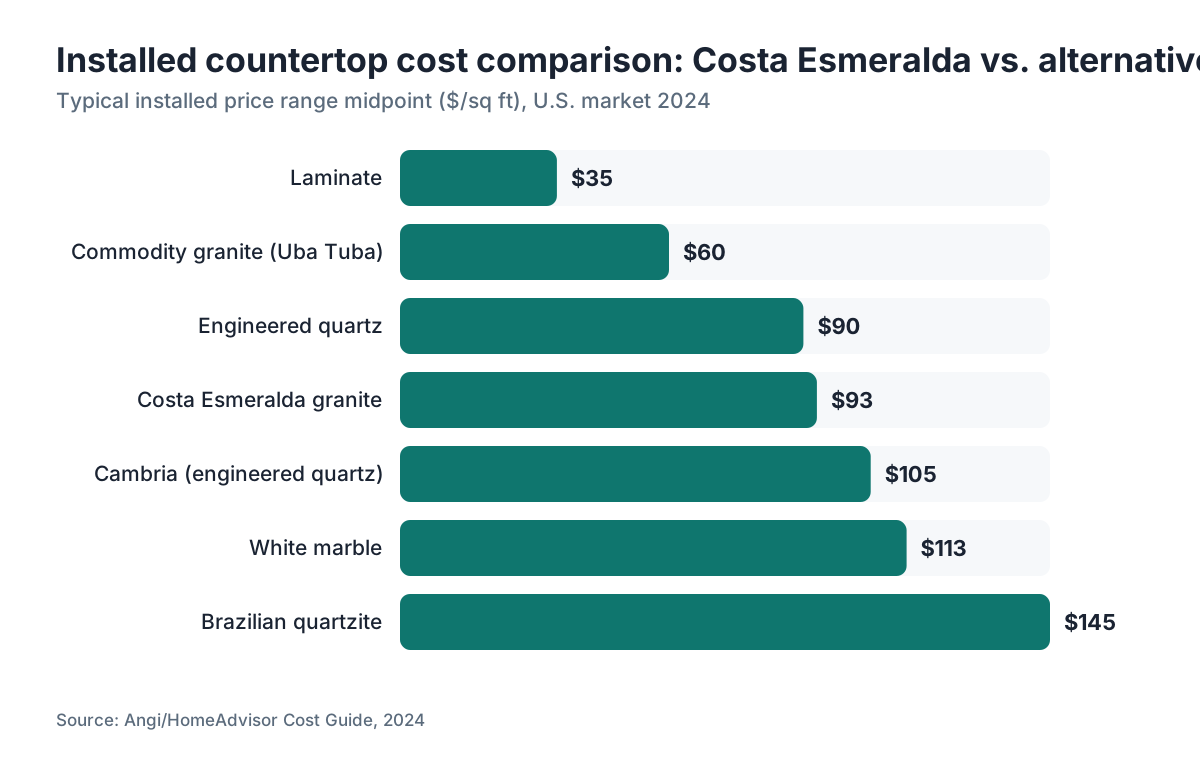
Installed cost in the U.S. generally falls between $65 and $120 per square foot for a standard kitchen job, including fabrication, basic edge profile, and installation [2]. That range is wide because the stone has a wide grade spread.
At the lower end you're looking at commercial-grade slabs with minor fissures, inconsistent color, or quarry-level cosmetic blemishes. Premium slabs, particularly those with consistent, dramatic green veining and minimal white calcium deposits, push toward the top of the range or above it.
For a typical 50-square-foot kitchen (about average for a U.S. kitchen remodel), expect a total installed cost of roughly $3,250, $6,000 before any extras. Extras that add cost fast: waterfall edges, bookmatching two slabs for symmetry, undermount sink cutout, complex curved edges, or a particularly hard-to-source premium slab.
For context, Costa Esmeralda runs modestly more than commodity granites like Uba Tuba or Santa Cecilia, which typically install for $45, $75 per square foot. It runs less than rare exotic marbles or Brazilian quartzites like White Macaubas, which can hit $150, $200 per square foot installed [2].
Here's where the real cost surprises happen: waste factor. Costa Esmeralda slabs run roughly 105 to 110 inches by 60 to 65 inches (around 45 to 48 square feet per slab face). A kitchen with multiple cutouts, angled corners, or a peninsula can waste 30 to 40 percent of a slab. You may need two slabs. Your fabricator should give you a nesting layout before you commit so you know exactly how much of that second slab you're paying for and how much ends up as a remnant.
Speaking of nesting, fabricators who use dedicated quoting and layout software (like SlabWise) can show you a digital cut plan before any stone gets touched, which cuts both material waste and the surprise of needing a second slab. Worth asking your fabricator if they offer this.
See our broader kitchen countertops guide for how Costa Esmeralda compares across the full material spectrum on cost.
How durable is Costa Esmeralda granite for kitchen use?
For day-to-day kitchen work, Costa Esmeralda holds up well. The bulk of the stone, the feldspar and quartz matrix, has a Mohs hardness of 6 to 7. That's harder than most knives (steel blades are typically Mohs 5.5 to 6.5), so the stone wins the scratch test in most situations. You can set a hot pan on it without cracking the surface. It won't burn.
The asterisk is the fuchsite zones. Mica minerals sit at Mohs 2 to 3, and the bright green areas in Costa Esmeralda are mica-rich [1]. A sharp knife dragged across a high-mica zone can leave a faint scratch. Most people don't notice this in normal cooking use, but it's worth knowing. Don't use your countertop as a cutting board, and you'll be fine.
The stone is dense enough that it resists staining better than marble. Its absorption rate is typically well below the ASTM C97 threshold of 0.4 percent that fabricators use as a benchmark for low-porosity granites [3]. Still, the feldspar-rich areas can absorb oil and acidic liquids if left to sit for hours. Annual sealing prevents this.
Chipping at edges is the most common damage claim on Costa Esmeralda, as with most granites. The fuchsite-rich zones are slightly more vulnerable here. A 3 cm slab with a beveled or eased edge profile is more chip-resistant than a sharp 90-degree edge, and that's generally the recommendation from any experienced fabricator.
For bathrooms, Costa Esmeralda is nearly indestructible in normal use. The lower traffic and the absence of heavy pots make the mica-softness a non-issue.
What does Costa Esmeralda look like, and what colors does it pair with?
The dominant visual is a white-to-light-gray background with flowing green veins and clouds. Some slabs have a slight gold or beige warmth in the background; others are cooler and nearly pure white. The green ranges from soft sage to a deeper, almost forest green depending on the fuchsite concentration. Small flecks of silver mica catch light across the whole surface.
This stone reads as both natural and dramatic. It doesn't blend into the background the way a speckled gray granite does. It's a statement piece, and that's the point of choosing it.
Cabinet pairings that work consistently: white shaker cabinets (classic, lets the stone carry the room), natural wood or walnut (the green and brown tones harmonize well), and warm cream or greige cabinets. It tends to fight with cool grays and navy cabinets because neither color gives the stone anything to play against.
For backsplash, the easiest win is a simple white subway tile or a warm marble mosaic. Avoid busy patterned backsplash tiles; the stone already has movement. Flooring in warm oak, travertine, or pale limestone carries the palette well.
Undermount sinks in stainless or brushed gold complement the stone without competing. Polished chrome can look cold against it.
The stone photographs extremely well in natural light, which is why you see it heavily featured in kitchen renovation content. That's both accurate and slightly misleading: it looks great under warm kitchen lighting, but under harsh cool LEDs it can look green in a way that surprises some homeowners. Ask your fabricator to show you a sample under the actual lighting conditions of your kitchen before finalizing.
How do you seal and maintain Costa Esmeralda granite?
Start with the water test: pour a few tablespoons of water on the surface and wait 15 to 30 minutes. If the stone darkens and the water doesn't bead, it needs sealing [4]. On a freshly fabricated slab, this test usually shows the stone is ready to seal right away.
For routine maintenance, seal once a year with a penetrating (impregnating) sealer rated for granite. Topical sealers that coat the surface are not recommended for polished granite; they peel, cloud, and change the surface feel. A fluorocarbon-based impregnating sealer is the standard professional choice [4].
Day-to-day cleaning is straightforward. Warm water and dish soap works fine for most messes. Avoid acidic cleaners (vinegar, citrus-based sprays), abrasive scrubs, and anything with bleach at full concentration. Acids attack the calcium-containing minerals in the background feldspar and can etch the surface over time, though granite resists etching far better than marble or limestone.
Oil spills are the main staining risk. Olive oil, butter, and cooking oil can penetrate an unsealed or under-sealed surface and leave a dark shadow. If this happens, a poultice of baking soda and water or a commercial stone poultice can draw the oil out. The Natural Stone Institute (NSI) publishes free care guides that cover poultice preparation in detail [5].
For more on cleaning natural stone surfaces, our guide to how to clean stone countertops covers the process across multiple stone types, including how to handle stains that have already set.
Avoid sitting, standing on, or dropping heavy cast iron on the edge overhangs. Granite is strong in compression but brittle under point loads on unsupported spans.
Is Costa Esmeralda a granite or a quartzite?
It's granite, or more precisely a fuchsite-bearing granitoid. You'll see it mislabeled as quartzite at some stone yards, particularly imported yards that loosely apply "quartzite" to anything that looks exotic. That's a commercial labeling issue, not a geological one.
True quartzite is a metamorphic rock formed when sandstone is subjected to heat and pressure, producing a stone that's almost entirely interlocking quartz grains with 97 to 99 percent quartz content. Costa Esmeralda has nowhere near that quartz content; it contains feldspar, mica, and chlorite alongside its quartz [1].
Why does it matter? Quartzite, particularly Brazilian quartzite, is generally harder and less porous than many granites. If a yard is selling Costa Esmeralda as quartzite and pricing it accordingly, you might be paying a quartzite premium for a granite product. Ask to see the lot's documentation or country of origin certificate. Brazilian stone distributors typically provide this.
The misclassification also affects care. Quartzite and granite have different sealing needs and different sensitivities to acid. Caring for Costa Esmeralda as granite (which it is) gives you the right answer.
For a comparison of how granite and quartzite actually differ in care, our how to clean quartzite countertops article lays out the distinctions clearly.
How does Costa Esmeralda compare to other countertop materials?
Here's an honest side-by-side on the materials homeowners most often consider alongside Costa Esmeralda:
| Material | Installed cost ($/sq ft) | Heat resistance | Scratch resistance | Stain resistance (unsealed) | Requires sealing |
|---|---|---|---|---|---|
| Costa Esmeralda granite | $65, $120 | Excellent | Good (mica zones: fair) | Good | Yes, annually |
| White marble | $75, $150 | Excellent | Fair | Poor (etches easily) | Yes, frequently |
| Quartzite (Brazilian) | $90, $200 | Excellent | Very good | Good | Yes, annually |
| Quartz (engineered) | $60, $120 | Fair (no hot pans) | Very good | Very good | No |
| Cambria (engineered quartz) | $80, $130 | Fair | Very good | Very good | No |
| Laminate | $20, $50 | Poor | Fair | Good | No |
Compared to marble countertops, Costa Esmeralda is considerably more durable. Marble etches under lemon juice, vinegar, and most household cleaners. Costa Esmeralda doesn't. If you want the white-and-green look without the etching anxiety of marble, Costa Esmeralda is the better kitchen choice.
Compared to engineered quartz, Costa Esmeralda loses on uniformity and maintenance simplicity but wins on heat resistance and the visual depth that only a natural stone can produce. Engineered quartz can look flat next to a well-veined granite slab. That's an aesthetic judgment, not a flaw, but it's a real difference.
Compared to Cambria countertops specifically, the gap in heat resistance is meaningful. Cambria, like all engineered quartz, contains polymer resins that can scorch or discolor under a hot pan. Granite tolerates direct heat without damage.
For homeowners who want a natural stone look at lower cost, laminate countertops now print convincing stone patterns, but the look doesn't hold up under close inspection and the durability gap is real.
What should you know before buying and installing Costa Esmeralda?
The single most important thing is slab selection in person. Costa Esmeralda varies more than most granites. Two slabs from the same quarry and same lot can look noticeably different. Go to the stone yard, have the slabs pulled vertical on the A-frame display rack, and look at them in daylight. Bring a photo of your cabinet color and flooring. This is not a stone you should spec from an online catalog.
For kitchens with islands or long runs, ask your fabricator about bookmatching. Bookmatching involves cutting two consecutive slabs from the same block and flipping one like a mirror image, so the veining creates a symmetrical pattern across a seam. Not every Costa Esmeralda lot produces bookmatched pairs, but when it works, the result is dramatic. It does add cost, typically 15 to 25 percent over a standard single-slab layout.
Seam placement matters more on a heavily veined stone. A seam running through a white zone is nearly invisible; a seam cutting through a green vein is obvious. Ask your fabricator to show you the proposed seam location on a cut diagram before work begins. A good fabricator runs this digitally now; if they're still just eyeballing it, that's a sign to ask harder questions.
Edge profiles: for Costa Esmeralda, a simple eased or beveled edge lets the stone speak for itself. Ogee and dupont profiles add visual complexity that competes with the stone's own pattern. Waterfall edges (where the stone runs vertically down a cabinet end) look exceptional on Costa Esmeralda if the slab has enough material and the veining direction is vertical-friendly.
For the installation itself, our countertop installation guide covers what to expect on job day, how to prep your kitchen, and the signs of a well-done versus a rushed installation.
Fabricators: if you're quoting Costa Esmeralda jobs, the irregular veining makes accurate nesting critical. Misaligned cuts waste material fast on this stone. SlabWise's nesting and quoting tools let you run a digital layout before cutting so you know exactly how much stone each job consumes. That matters most on premium exotics like this, where a wasted offcut can cost $200 or more.
Where is Costa Esmeralda granite quarried and how does it get to the U.S.?
The primary source is Espírito Santo state in southeastern Brazil, one of the world's most productive stone-quarrying regions. Brazil is the third-largest exporter of natural stone globally by volume, and Espírito Santo alone accounts for a significant share of that output [6].
From the quarry, rough blocks are transported to processing facilities, typically in the cities of Cachoeiro de Itapemirim or Vitória, where they're cut into slabs, calibrated to thickness, and polished. Finished slabs are containerized and shipped to U.S. ports, primarily Houston, Miami, and Los Angeles, depending on the distributor's regional warehouse locations.
Once at U.S. distribution yards (companies like MSI, Arizona Tile, Pental, or smaller regional importers), slabs are inventoried by lot and sold to fabricators or directly to designers and homeowners. Lead times from a well-stocked distributor to your fabricator are typically 1 to 2 weeks. If the lot you want is on back-order or special-order from Brazil, allow 8 to 14 weeks.
Brazilian granite imports enter the U.S. under HTS code 6802.93, which covers worked granite [7]. Import duties are currently low (zero under most trade conditions for Brazilian stone), though this can shift. Your fabricator's material cost already reflects whatever the current import situation is; you don't need to track this yourself.
One practical note: because slabs come in lots, the stone available at your local yard today may not match the stone available six months from now if you want to add a piece. Buy all your stone from the same lot for a single project. And if there's any chance you'll want to extend the kitchen later, buy and store an extra slab now.
What are the pros and cons of Costa Esmeralda for a kitchen or bathroom?
The honest pros:
The look is hard to replicate. The white-green combination is distinctive without chasing a trend. Homes with Costa Esmeralda countertops photographed in 2005 still look current. That's not true of many stone choices from the same period.
Heat resistance is real. You can set a cast iron pan fresh off the stove on Costa Esmeralda without risk to the stone. This is not true of engineered quartz.
Long-term cost of ownership is low once the stone is sealed. The maintenance routine is simple, the stone doesn't need replacement on any reasonable timeline, and natural stone generally holds resale value better than laminate or solid-surface alternatives.
The honest cons:
The fuchsite mica makes some zones softer. This isn't a daily-use problem, but it's real, and you should know going in.
Annual sealing is a requirement, not a suggestion. If you want zero-maintenance stone, look at engineered quartz. If you'll skip the annual sealer for years at a time, this stone will absorb oil stains.
Variation between slabs means you can't just reorder a match. If a section cracks five years from now (rare, but it happens in earthquakes or with structural movement), matching the stone exactly is not guaranteed.
Cost is mid-to-upper tier. You're paying for an imported natural stone with significant variation-dependent selection effort. For homeowners on a tight budget who want the natural-stone look, there are less expensive granites that perform comparably day-to-day. See our granite countertops overview for budget-friendlier options.
For bathrooms, nearly all the cons disappear. The mica softness is a non-issue with lighter use, sealing is less critical in a low-splatter environment, and the cost per square foot is more manageable in the smaller footprint of a vanity.
How do fabricators quote and cut Costa Esmeralda jobs accurately?
From a fabricator's perspective, Costa Esmeralda is a mid-difficulty stone to work. The hardness is manageable with standard diamond tooling. The main complication is veining direction and color consistency across seams.
Accurate quoting starts with slab verification. The nominal slab size from a distributor spec sheet is often different from the actual usable face area after you account for edge chips, fissures, and areas of the slab with unacceptable cosmetic variation. Fabricators who measure actual usable area rather than nominal slab dimensions quote more accurately and avoid material shortfalls.
For a typical kitchen with an island, the nesting problem is real: you need to orient pieces so veining flows in a consistent direction, place cuts so seams land in low-visibility zones, and maximize yield from each slab. A job that looks like it fits on one slab can easily require two if the nesting isn't optimized. This is where digital cut planning earns its keep.
Edge profiling on Costa Esmeralda runs normally with a CNC router. The fuchsite zones are softer and can occasionally show micro-chipping on very tight profiles (pencil edge, sharp eased). A standard bevel or 1-cm eased edge avoids this. Warn new operators before they profile this stone for the first time.
Installation difficulty is standard granite: heavy (3 cm slabs at roughly 18 to 20 lbs per square foot), requires two or more people, standard epoxy color-matched adhesive at seams. The fuchsite-mica speckling makes it moderately easy to color-match seam epoxy to the background.
The Natural Stone Institute's fabrication standards cover handling requirements for Brazilian granites [5], and OSHA's silica standard (29 CFR 1910.1053) applies to any dry cutting or grinding of stone in the shop [8].
Frequently asked questions
Is Costa Esmeralda granite expensive compared to other granites?
It's in the mid-to-upper tier of granite pricing. Installed cost runs roughly $65, $120 per square foot, which is more than commodity granites like Uba Tuba ($45, $75 installed) but less than rare Brazilian quartzites or exotic marbles. Premium bookmatched slabs can push higher. The price varies significantly by slab grade, region, and how much material your kitchen layout wastes.
Does Costa Esmeralda granite stain easily?
Not if it's properly sealed. The stone's absorption rate is low, and annual sealing with a penetrating impregnating sealer keeps oil and liquid from soaking in. The most common stains are cooking oil and wine left sitting for hours on unsealed stone. With sealing maintained, staining is uncommon in normal kitchen use. The green fuchsite zones are denser than the white background and actually resist staining well.
How often does Costa Esmeralda granite need to be sealed?
Once a year is the standard recommendation. Do the water test annually: pour a small amount of water on the surface and wait 20 minutes. If the stone darkens, the sealer has worn and it's time to reapply. Use a penetrating fluorocarbon or silane-based sealer, not a topical coating. The job takes about 30 minutes for an average kitchen and no professional help is needed.
Can you put a hot pan directly on Costa Esmeralda granite?
Yes. Granite tolerates direct heat without damage under normal cooking conditions. The stone won't scorch, discolor, or crack from a hot pan off the stove. This is one of the practical advantages over engineered quartz, which contains polymer resins that can be damaged by sustained heat. Standard caution: sudden extreme thermal shock (like dropping ice directly onto a very hot section) is theoretically a risk on any stone, though rare in practice.
What causes the green color in Costa Esmeralda granite?
The green comes from fuchsite, a chromium-bearing variety of muscovite mica. The chromium content is what produces the green color. Fuchsite is naturally occurring in some Brazilian granitoids and is the defining mineral in Costa Esmeralda. Incidentally, fuchsite is also the mineral that makes some Brazilian 'green aventurine' gems green. The same chromium chemistry, same mineral family.
Is Costa Esmeralda really granite or is it quartzite?
It's granite (technically a fuchsite-bearing granitoid). Some stone yards mislabel it as quartzite, which is commercially misleading. True quartzite is a metamorphic rock with 97 to 99 percent quartz content. Costa Esmeralda contains significant feldspar and mica alongside its quartz. For care and fabrication purposes, treat it as granite. If a yard is calling it quartzite and pricing it at quartzite rates, ask to see the documentation.
What cabinet colors look best with Costa Esmeralda granite?
White and off-white shaker cabinets are the most common pairing and work well because the stone carries the visual weight. Natural wood and walnut tones complement the green-and-white palette. Warm creams and greiges also work. Cool grays and navy tend to flatten the stone's warmth. For backsplash, simple white tile or warm marble mosaic lets the countertop stand out without visual competition.
How thick should Costa Esmeralda granite countertops be?
For kitchens, 3 cm (about 1¼ inch) is the standard recommendation. It looks substantial at the edge without needing lamination, and it's more resistant to chipping under normal use. Two-centimeter slabs are fine for bathroom vanities or furniture applications. If you're getting a 2 cm slab for a kitchen, your fabricator should laminate a second layer at the visible edge to achieve the look of a thicker slab.
What edge profile works best on Costa Esmeralda granite?
A simple eased, beveled, or small bullnose profile is the most common choice. These let the stone's natural veining read clearly at the edge. More ornate profiles like ogee or dupont add visual noise that can compete with the stone's own pattern. Waterfall edges look exceptional on Costa Esmeralda if the slab's veining runs in a direction that works vertically. Avoid very sharp 90-degree edges, which are more prone to chipping on any granite.
How long does Costa Esmeralda granite last?
Properly installed and maintained, effectively indefinitely. Granite is one of the hardest and most durable countertop materials available. The limiting factors are seam integrity (which depends on installation quality and the epoxy used) and edge chipping (which depends on use and edge profile). There are granite countertops installed in American homes in the 1970s still in service today. Annual sealing is the main maintenance task required to preserve the surface.
Can Costa Esmeralda granite be repaired if it chips or cracks?
Chips can often be filled with color-matched epoxy. Small cracks can be stabilized the same way. A skilled fabricator or stone restoration specialist handles this kind of repair routinely. The challenge with Costa Esmeralda is color-matching the fuchsite green zones: the repair material needs to blend with both the white background and the green veining. Results vary by the size of the damage and the skill of the repairer. Large cracks are harder to fix invisibly.
Is Costa Esmeralda granite good for outdoor kitchens?
Usable but not ideal. Granite tolerates outdoor conditions well in mild climates. In climates with hard freeze-thaw cycles, any porous natural stone can absorb water, freeze, and spall over time if not sealed consistently. Costa Esmeralda's relatively low porosity helps, but outdoor sealing should happen twice a year rather than annually. For outdoor installations in cold climates, a material with zero porosity (engineered quartz or porcelain tile) is a safer choice.
Where can I find Costa Esmeralda granite slabs in the U.S.?
Major stone distributors including MSI, Arizona Tile, Pental, and Dal-Tile carry or can order it. Regional stone yards in major metro areas often stock it as well. Availability varies by lot; because it's quarried in Brazil and shipped by container, the exact slabs in a yard today won't be there in six months. If you find a lot you like, buy all the material you need from that lot at once and store any extras at your fabricator's shop.
Sources
- Mindat.org, Fuchsite mineral data: Fuchsite is a chromium-rich variety of muscovite mica with a Mohs hardness of approximately 2 to 3, responsible for the green color in Costa Esmeralda granite
- HomeAdvisor (Angi), Granite Countertop Cost Guide: Installed granite countertop costs in the U.S. range from roughly $45, $200 per square foot depending on material grade and complexity
- ASTM International, ASTM C97 Standard Test Methods for Absorption and Bulk Specific Gravity of Dimension Stone: ASTM C97 is the standard test method for measuring water absorption in dimension stone; values below 0.4% indicate low porosity
- Natural Stone Institute, Granite Care and Maintenance: Penetrating (impregnating) sealers are the recommended type for polished granite; topical sealers are not recommended; annual sealing is standard guidance
- Natural Stone Institute, Stone Care Technical Bulletins: NSI publishes technical bulletins covering poultice stain removal, sealing protocols, and handling requirements for granite and other natural stone
- U.S. Geological Survey, 2022 Minerals Yearbook: Stone, Dimension: Brazil is among the world's leading exporters of dimension stone including granite slabs used for countertops
- U.S. International Trade Commission, HTS Chapter 68: Articles of Stone, Plaster, Cement: Brazilian granite slabs (worked) are classified under HTS code 6802.93 for U.S. import tariff purposes
- OSHA, 29 CFR 1910.1053 Occupational Exposure to Respirable Crystalline Silica: OSHA's silica standard 29 CFR 1910.1053 applies to fabrication shops cutting or grinding stone, requiring engineering controls and exposure monitoring
- Marble Institute of America (now Natural Stone Institute), Granite Porosity and Sealing: Granite porosity varies by mineral composition; feldspar-rich zones are more porous than quartz-rich zones, affecting sealing frequency recommendations
- U.S. Geological Survey, Mineral Resources Program: Mica: Muscovite mica (of which fuchsite is a variety) has a Mohs hardness of 2 to 3 and cleaves readily in sheet form
Last updated 2026-07-09