TL;DR
- A colonial edge profile is a router-cut decorative detail along the front of a countertop, usually a rounded top (bullnose) paired with a small cove or step below.
- Upcharges run $5 to $50 per linear foot over the base slab price, set by material and profile complexity.
- Shops cut them with CNC machines or handheld routers.
- The right one depends on your cabinet style, slab thickness, and budget.
What is a colonial edge profile on a countertop?
A colonial edge profile is a shaped, routed detail cut along the exposed front and side edges of a countertop. Instead of leaving the edge square (flat with a sharp corner), a fabricator runs the slab through a CNC machine or traces it by hand with a diamond router bit to carve a set contour. The result looks finished and deliberate, not like someone just sawed the stone off.
The word "colonial" in fabrication does not point to one locked-down shape. It names a family of traditional, symmetrical profiles that borrow from 18th-century American furniture and millwork. Think of the bead-and-cove details on a wooden chair rail or a fireplace mantel. Put those same proportions on a 2 cm or 3 cm slab and you get a countertop edge that reads as classic and quiet without being fussy.
The most common colonial profiles pair a rounded convex element (a bullnose arc) with a flat fillet and often a small cove underneath. Run your finger down the edge and you feel the round, then a little flat ledge, then a slight hollow, then the bottom. That sequence of curves and planes is the signature. Some shops call it a colonial bullnose. Others say ogee. A few use the term their own way depending on regional habit, which causes real confusion when you're trying to specify one off a catalog.
If a quote sheet says "colonial edge," ask to see a physical sample or a drawing. Never assume you both mean the same shape.
How many colonial edge profile styles are there?
There is no official registry that fixes these names, so the count depends on who you ask. Most shops recognize four to eight profile families under the colonial label, and each family shifts with the router bit set and the slab thickness [1].
Here are the profiles fabricators most often call "colonial" or list in the same tier:
| Profile Name | Shape Description | Typical Material Thickness |
|---|---|---|
| Colonial bullnose | Full round on top, small cove below, flat bottom | 2 cm or 3 cm |
| Ogee | S-curve (convex then concave), also called Roman ogee | 3 cm preferred |
| Eased colonial | Slightly softened top corner, flat face, small bevel at bottom | 2 cm or 3 cm |
| Double-step colonial | Two horizontal fillets with a bevel, more dramatic shadow line | 3 cm only |
| Cove-and-bevel colonial | Concave cove at top, angled bevel at bottom | 2 cm or 3 cm |
| Classical OG | Full ogee with an added top bead, heaviest looking | 3 cm |
The ogee is probably the most recognized. Its cross-section makes an S: the top curves outward (convex), rolls into a concave hollow, then finishes flat at the bottom. The Roman ogee adds a small flat step between the two curves. Both read formal and traditional, which is why they show up in so many granite kitchens with raised-panel cabinets.
The colonial bullnose is softer. Same family feel, no dramatic S-curve. It's easier to keep clean and a little cheaper to cut because it takes fewer router passes. If you want the colonial look but you've got young kids who will bang into that edge on repeat, the bullnose is the more practical call.
Double-step profiles are the most assertive. They only work on 3 cm slabs, because you need the thickness to carve two distinct ledge planes without the edge looking thin. On a 2 cm slab they look pinched.
How much does a colonial edge profile cost?
Edge profiles are almost always quoted per linear foot and added on top of the base countertop price. A basic eased or flat-polish edge is usually included in a shop's standard number. Colonial and decorative profiles are the upcharge.
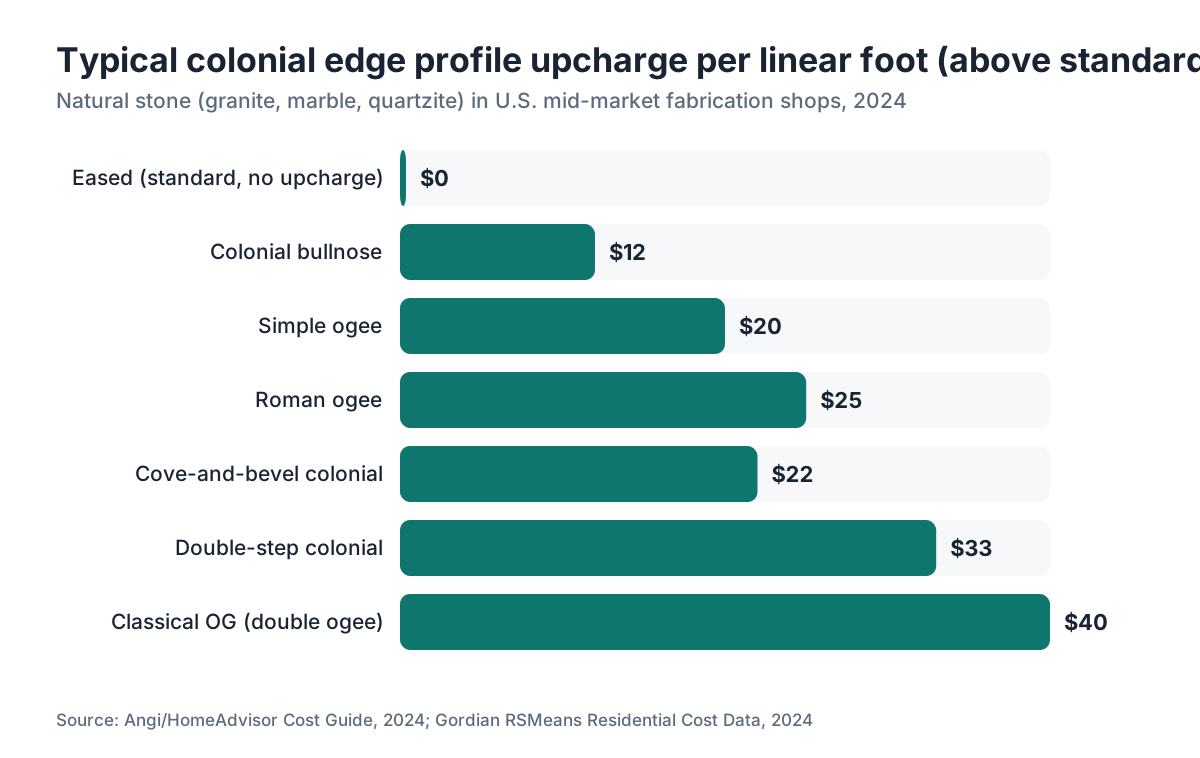
For natural stone (granite, quartzite, marble), colonial profile upcharges typically run $10 to $30 per linear foot above the included eased edge [2]. Ogee and double-step profiles land at the top of that range because they need more router passes and more hand-polishing to bring out the curves. A simple colonial bullnose might be $8 to $15 per linear foot over standard.
Engineered stone like quartz or Cambria prices about the same. Most brand-authorized fabricators apply the same upcharge scale. Check your Cambria or quartz brand's fabrication spec sheet before you assume the profile is even allowed, because some engineered stones limit how deep a router can cut before it exposes the polymer core or aggregate [3].
Laminate is a different animal. Most laminate products (Formica, Wilsonart, and the like) don't take traditional stone router profiles. You get a post-form rounded edge or a self-edge with a matching strip. Colonial stone profiles on laminate aren't a real comparison.
Run the math on a real kitchen. Forty linear feet of exposed edge with a colonial ogee at $20 per linear foot adds $800 to your total. That's real money. Whether it's worth it comes down to how close you are to your budget ceiling and how traditional the room is. Flat-slab cabinets and a concrete-look quartz will fight a colonial ogee. Shaker cabinets or raised-panel doors will make it look right at home.
Quoting software like SlabWise lets shops attach per-profile pricing to their templates, so the edge upcharge shows on the first quote instead of surfacing in a revision.
What materials work best with a colonial edge detail?
Granite is the traditional home for colonial profiles, and there are good structural reasons for that. It's hard and crystalline, so a diamond bit carves a crisp, repeatable curve without chipping or smearing. The polished edge on a colonial bullnose or ogee holds the same reflective shine as the slab face. That visual match is a big part of why the profile looks expensive.
Marble works too, but it needs more care during routing because it's softer and chips more easily at the cove transitions. A skilled hand can produce a gorgeous ogee on Carrara. A rushed one leaves micro-fractures at the concave bottom of the S-curve that catch light and read like scratches [4].
Quartzite (real metamorphic stone, not the soft "quartzite" that's actually sandstone) takes a colonial profile well. It's hard, often harder than granite, and polishes to a high sheen. If you're already weighing quartzite countertops, ask your fabricator point-blank whether they've cut your profile choice in that exact material.
Engineered quartz like Cambria countertops handles decorative profiles, but check the brand's guidelines. Some require a minimum flat land on the top face before the profile starts, which changes how the edge looks at certain thicknesses.
Soapstone is soft enough to carve but polishes differently, because its finish is oil-based rather than high-gloss. A colonial ogee on soapstone has a matte, handmade look instead of a mirror. Some people love that. If you're keeping up with soapstone countertops, the edge profile is one more surface that wants oil.
Butcher block countertops can carry a colonial routed edge in wood. A classical ogee bit is a standard woodworking operation. The finish holds well on end-grain, less so on face-grain if there's a lot of moisture cycling.
Laminate and solid surface (Corian) have their own edge systems, and the stone colonial profile doesn't translate directly. For Corian countertops, the edge is usually built up or seamed, not router-cut the way stone is.
How is a colonial edge profile actually cut?
Two methods: CNC machine or hand router. Most shops use both, often on the same job.
A CNC (computer numerical control) machine holds the slab flat and runs a spindle with diamond-impregnated router bits along the programmed edge path. It repeats the same profile to within fractions of a millimeter, pass after pass. For a shop cutting the same colonial ogee fifty times a week, CNC is the right tool. Consistent results, less hand-polishing time on the back end.
Hand routing still happens for radius corners, inside curves, and pieces that are hard to fixture on a CNC table. A skilled edge polisher uses a handheld wet grinder with a shaped diamond wheel, working through finer and finer grits (typically 50, 100, 200, 400, 800, 1500, 3000, then a polishing compound) to build the shine on each curve. On a tricky ogee, that polishing sequence can eat 20 to 45 minutes of hand time on a single piece. That labor is why complex profiles cost more per linear foot [5]. Edge routing and polishing also throw respirable silica dust, which is why OSHA requires engineering controls like water feed and dust capture in fabrication shops [11].
Some shops rough-cut on CNC and hand-finish. That combination is common in mid-to-upper shops and usually gives the best result: machine precision on the geometry, hand skill on the polish.
The quality gap between a well-calibrated CNC shop and a hands-only shop shows up in the cove of a complex profile. If the concave hollow of an ogee isn't fully polished, it catches light differently than the convex part and looks unfinished. Ask to see a sample piece, an actual piece you can hold, before you commit to a shop for a decorative profile [12].
How does a colonial edge compare to other popular edge profiles?
It helps to line colonial up against the four or five edges you'll see on most price sheets.
| Edge Profile | Style Family | Complexity | Relative Cost | Best For |
|---|---|---|---|---|
| Eased (flat) | Modern/minimal | Very low | Included | Contemporary, industrial |
| Beveled | Modern/transitional | Low | Included or +$2-5/LF | Most kitchen styles |
| Bullnose (full round) | Transitional | Low-medium | +$5-12/LF | Family kitchens, casual |
| Colonial bullnose | Traditional | Medium | +$8-18/LF | Shaker, classic colonial |
| Ogee / Roman ogee | Traditional/formal | Medium-high | +$15-30/LF | Formal kitchens, raised panel |
| Double ogee | Formal | High | +$25-40/LF | Grand kitchens, thick slabs |
| Waterfall (straight drape) | Modern | Low-medium | +$30-50/LF | Contemporary islands |
| Dupont / T-edge | Commercial | Medium | +$10-20/LF | Commercial, restaurants |
The eased edge isn't really a shaped profile. It's the square sawn edge with the top corner lightly knocked off. Most shops include it as standard.
A full bullnose (rounded top and bottom) is soft and approachable. It reads more casual than a colonial profile. The colonial version keeps that rounded top but finishes with a cove or step below, which adds visual weight and a bit of formality.
An ogee is bolder than a colonial bullnose. Its S-curve throws a shadow line across the face of the slab, especially under kitchen lighting, and that makes the edge look substantial. Some designers feel the ogee is dated now, tied to the granite-everything kitchens of the early 2000s. Others say it's a classic that comes and goes. My take: in a clearly traditional kitchen, the ogee still works. If you're blending contemporary with traditional, the colonial bullnose is the safer pick, because it keeps the traditional character without the heavy S-curve.
A waterfall edge runs the opposite direction. You wrap the slab down the side of the island so the face of the stone becomes the edge. Expensive and dramatic, and nothing like colonial in feel.
Which colonial edge profile is right for my kitchen style?
The edge profile has to agree with the rest of the room. Mismatching the profile to the cabinet style is one of the countertop regrets homeowners bring up most after installation [6].
For formal traditional kitchens with raised-panel doors and heavy molding, the Roman ogee or classical OG is the natural fit. These profiles echo the curved molding on the cabinet frames. They look intentional, not fussy.
For Shaker kitchens, the colonial bullnose or a simple eased colonial (softened top, small bottom bevel) beats a full ogee. Shaker design is clean and restrained. A heavy S-curve overloads the room.
For transitional kitchens, the eased colonial or a standard bullnose bridges both directions. Enough shape to feel finished, not enough to pin you to one era.
For truly contemporary or modern kitchens, skip the colonial family entirely. Flat eased, mitered, or waterfall edges belong in those rooms.
Color matters too. Dark, heavily veined granite can swallow a complex ogee. Light or white stone (white marble, pale quartz) shows every shadow line the profile throws, so a colonial ogee on white Calacatta will read loud in the room. That can be beautiful. Just make sure it's what you want.
Thickness is the last variable. If you're running 2 cm stone with a laminated (built-up) edge to fake 3 cm, check that the lamination seam doesn't land somewhere visible on your profile. A colonial bullnose that puts the seam in the middle of the convex arc will show the glue line. A good fabricator drops the lamination to the bottom flat so it hides below the profile.
Does a colonial edge profile affect countertop durability or safety?
Profiles with tight inside coves (the concave parts of an ogee) are a little harder to keep clean than a flat or eased edge. Grease, crumbs, and cleaner can pool in a concave channel and need a narrow brush or the tip of a sponge instead of a straight wipe. That's a real maintenance point, not a scare tactic.
Safety runs the other way on the top. The convex top of a colonial bullnose is safer for kids than a sharp square edge. A 90-degree corner at countertop height sits right at a toddler's eye level. A rounded profile takes that hazard away. The full bullnose and the colonial bullnose both beat a square or knife edge here.
Outdoors and at wet bars, profile choice affects drainage. A flat, slightly forward-sloped eased edge sheds water off the front and away from cabinet faces. A bullnose can steer water down the cabinet face if the install pitch is off. An ogee's cove can trap water, and in freeze-thaw climates that trapped moisture is a long-term problem for natural stone [7]. Putting granite or quartzite outside? A simpler profile with fewer water traps is the practical move.
A polished edge on natural stone is as hard as the polished face. The profile doesn't create a weak zone on its own, unless a router chip started a micro-crack during cutting. Ask your fabricator to check the finished profiles with a flashlight at a low, raking angle before delivery. Chips at cove transitions get repaired before installation, not accepted.
See countertop installation for what to inspect at delivery.
How do fabricators price and quote colonial edge profiles?
Most shops start with a base price per square foot for the material, then add line items for edge profiles, cutouts (sinks, cooktops), and installation. The edge profile line is nearly always priced per linear foot of finished edge [8].
Shops usually sort profiles into tiers:
- Tier 1 (included): eased, beveled, flat-polish
- Tier 2 (+$5 to $15/LF): bullnose, colonial bullnose, pencil round
- Tier 3 (+$15 to $30/LF): ogee, Roman ogee, cove-and-bevel, dupont
- Tier 4 (+$25 to $50/LF): double ogee, laminated mitered, waterfall
These boundaries shift by region. A shop in a high-cost metro charges more for the same profile than a rural shop, reflecting both labor and overhead.
When you measure linear footage, count only the exposed edge. The back edge against the wall and any interior edges hidden by backsplash are usually square-cut and not polished to a decorative profile. A standard kitchen with three sides exposed and one back wall might have 12 to 18 linear feet of profile edge. An island open on all four sides could run 20 to 30 linear feet.
Building a pricing system as a fabricator? Digital quoting lets you attach tier pricing to each profile so customers get an accurate number on the first touch. SlabWise does this in the quoting module: the edge upcharge calculates automatically against measured linear footage, which cuts back-and-forth revisions and the odds of a forgotten line item.
Get the total edge linear footage on your quote before you lock a profile tier. A colonial ogee at $25 per linear foot over standard on 14 linear feet is $350. That might be exactly what you budgeted. Or it pushes you over, and a colonial bullnose at $12 per linear foot is the smarter call.
Are colonial edge profiles available on granite, quartz, and marble countertops?
Yes. All three take colonial profiles, with differences in how the finished edge looks and how much care the cutting needs.
Granite countertops are the most forgiving for router work. Granite is hard and even enough that a CNC machine cuts a colonial ogee cleanly in one setup. The polished result is bright and crisp. Nearly every granite fabricator in the country can cut a standard colonial profile.
Marble countertops need a slower feed rate and more hand-polishing, because marble is softer and clouds at cove transitions if the grit sequence gets rushed. The result can be stunning, especially on white marbles where the profile casts a clear shadow. Budget more time and a small premium for marble colonial profiles.
Engineered quartz, including Cambria, Silestone, and Caesarstone, supports colonial profiles as long as the fabricator follows the brand's published guidelines. Quartz is polymer-bonded aggregate. Very deep coves can expose the aggregate, which looks patchy and unpolished. Most standard colonial profiles stay inside safe limits. Some heavy double-ogee profiles aren't recommended on thin 2 cm quartz.
Still choosing among kitchen countertops and haven't locked a material? Pick the material first on function and maintenance, then pick the profile. Don't let the profile dictate the material.
For tighter budgets, laminate countertops and Formica countertops have built-in edge options (post-form, self-edge) that fake a rounded look but aren't a stone-router colonial profile. The price gap is real: laminate installed runs roughly $20 to $40 per square foot all-in, against $60 to $150 per square foot for granite with a decorative profile [9].
What should I ask my fabricator before choosing a colonial edge profile?
Seven questions worth asking before you sign the shop drawing:
-
Can you show me a physical sample in my material? Photos lie about polish quality and shadow depth. A sample you hold under your own kitchen light tells you more than any catalog.
-
Is this profile cut on your CNC or by hand? Either can be excellent, but a hands-only complex ogee demands a skilled finisher. Ask how many of this profile they cut per week.
-
Where does the lamination seam land on the profile? On 2 cm stone with a built-up edge, seam placement decides the visual quality.
-
What's the exact upcharge per linear foot, and how many linear feet are on my plan? Get it as a line item, not buried in a total.
-
Can you polish inside radius corners in this profile? An ogee at an inside corner is hard to finish without visible flat spots. Some shops swap to a different profile at corners, which can show.
-
What's the lead time, and does the edge complexity change my timeline? A complex profile can add a day or two, which matters if you're coordinating a backsplash installer.
-
Is there a warranty on the edge finish? Chips or micro-cracks that show up after installation are a fabrication defect if impact didn't cause them. Know the policy before delivery.
A good fabricator expects these questions. If the answer to any of them is "don't worry about it," find a different fabricator.
How do colonial edge profiles affect resale value?
Nobody has clean, controlled data on edge-profile-specific resale lift, and anyone who quotes you a precise number is making it up. The broader remodeling data shows kitchen countertop upgrades generally return 60% to 80% of their cost at resale [10]. The profile choice inside that upgrade is about matching buyer expectations in your market, not about a measurable premium.
In markets where traditional architecture rules (New England colonial homes, Midwest craftsman bungalows, Southern traditional), a granite ogee edge looks like it belongs. Buyers there expect that language. A flat eased edge on granite in a formal traditional kitchen can actually read as unfinished to a buyer who expects the room to feel complete.
In markets that lean contemporary (urban condos, Pacific Northwest modern), the colonial family reads dated to a lot of buyers. An updated eased or mitered edge lands better.
So here's the practical advice. Match the design language of your market and your home's architecture, and the profile takes care of itself. Don't spend $500 extra on a double ogee expecting $500 back at the sale. Do spend enough to make the room feel finished and consistent.
Frequently asked questions
What is the most popular colonial edge profile for granite countertops?
The Roman ogee is the most requested colonial-family profile for granite. Its clear S-curve shows well on granite's polished surface and pairs naturally with traditional cabinets. The colonial bullnose runs a close second in shops that sell to families with children, because the rounded top is softer than the ogee's convex arc and easier to keep clean.
Is a colonial edge profile more expensive than a standard bullnose?
Usually yes. A full bullnose typically runs $5 to $12 per linear foot over the included eased edge. A colonial bullnose or ogee lands at $10 to $30 per linear foot over standard, depending on the shop and the complexity. The difference reflects more router passes and extra hand-polishing to bring the concave cove sections to a full shine.
Can I get a colonial edge on a 2 cm countertop?
Some colonial profiles work on 2 cm stone, others need 3 cm. The colonial bullnose and eased colonial fit a 2 cm slab. A double-step ogee needs the full 3 cm to look proportionate. If you're using 2 cm with a laminated (built-up) edge to simulate 3 cm, confirm the lamination seam lands in a concealed spot on your chosen profile.
How do I clean the cove area of an ogee or colonial edge?
The concave part of an ogee or colonial bullnose needs a narrow brush or the tip of a soft sponge rather than a flat wipe. Use your regular countertop cleaner or a pH-neutral stone cleaner and work the cove with a toothbrush-size detail brush weekly. Grease and soap residue collect in the concave hollow faster than on a flat edge, so a quick targeted scrub stops buildup.
What is the difference between a colonial edge and an ogee edge?
In common shop usage the terms overlap. Strictly, an ogee is the specific S-curve profile (convex rolling into concave). A colonial edge is a family label that includes ogee profiles plus other traditional shapes like the colonial bullnose, cove-and-bevel, and double-step. Every ogee is a colonial-style profile, but not every colonial profile is an ogee. Always ask your fabricator to show you the exact cross-section drawing.
How long does it take a fabricator to cut a colonial profile?
On a CNC machine the routing itself is fast, often 5 to 15 minutes per linear foot including setups. The hand-polishing takes longer, especially the concave sections of a complex ogee: 20 to 45 minutes of hand time per piece for a skilled finisher. A full kitchen with a colonial ogee typically adds half a day to a full day of production time over a simple eased-edge job.
Are colonial edge profiles still in style?
In traditional and transitional kitchens, yes. Colonial profiles have held their ground in homes with raised-panel cabinets, formal architecture, and classic materials like granite and marble. In contemporary or modern kitchens they look out of place. The Roman ogee peaked during the early 2000s granite boom and some designers now call it dated, but in a genuinely traditional room it still reads appropriate and well-made.
Can a colonial edge be applied to outdoor kitchen countertops?
You can, but think about water first. The concave cove of an ogee traps water, and in freeze-thaw climates that leads to stress cracking over time. Outdoors, a simpler colonial bullnose or eased colonial is more practical because it sheds water cleanly. Seal the stone and edge with an appropriate outdoor sealer, and inspect the profile once a year for developing micro-cracks.
Do fabricators charge by the linear foot or the piece for edge profiles?
Almost always by the linear foot. The price covers router cutting time and polishing time calculated against the running footage of exposed edge on your plan. Cutout edges (sink perimeters) are sometimes priced separately as a flat fee, because they involve inside curves and corners that take more hand time regardless of their linear measurement.
What edge profile works best with a farmhouse or colonial-style kitchen?
For a true colonial or farmhouse kitchen, the Roman ogee or a colonial bullnose are the most historically consistent choices. Farmhouse style is a bit more relaxed than formal colonial, so the colonial bullnose (rounded top, small cove below) often fits better than a heavy double ogee. Pair it with a dark or veined granite or soapstone for a period-right look. Skip contemporary profiles like waterfall or knife edge in these rooms.
What's the thinnest slab thickness that can carry a colonial ogee profile?
3 cm (about 1.25 inches) is the practical minimum for a full colonial ogee. At 2 cm the S-curve has to compress to fit the thickness, which flattens the shadow depth and makes the profile look thin and unresolved. If you only have 2 cm material, a laminated edge (two layers of 2 cm bonded to create a 4 cm-looking edge) gives enough depth to carry the profile correctly.
Can I change my countertop edge profile after installation?
In most cases, no. Recutting a polished stone edge after installation is technically possible but very hard. The fabricator has to remove the countertop, take it back to the shop, recut, polish, and reinstall. The labor cost usually approaches or exceeds the cost of new countertops. Choose the profile before fabrication. Order a sample first if you're unsure.
Is the colonial edge profile included in standard countertop quotes?
Almost never. Standard quotes include an eased edge (flat-polished square edge with a lightly knocked top corner) as the base. Colonial profiles, including bullnose, ogee, and double-step, are upcharges listed as line items. Some fabricators include a basic bullnose in their standard price. Get every profile detail spelled out in writing on the quote before you approve the shop drawing.
Sources
- Natural Stone Institute (formerly Marble Institute of America), Dimension Stone Design Manual: Industry-recognized edge profile families and naming conventions for natural stone fabrication
- Angi (HomeAdvisor), Countertop Installation Cost Guide: Colonial and decorative profile upcharges typically run $10 to $30 per linear foot above a standard eased edge for natural stone
- Cambria, Fabrication and Installation Guidelines: Engineered quartz brands publish fabrication specifications including edge profile restrictions by thickness
- Natural Stone Institute, Fabrication technical publications: Marble's softer crystalline structure requires slower router feed rates to avoid micro-chipping at cove transitions
- Natural Stone Institute, CNC and hand-finishing fabrication guidance: Hand-polishing a complex ogee profile can take 20 to 45 minutes of skilled labor per piece
- National Kitchen and Bath Association (NKBA): Profile-to-cabinet style mismatching is among the most commonly cited countertop installation regrets in consumer surveys
- Natural Stone Institute, consumer guidance on natural stone in exterior applications: Trapped moisture in edge coves can cause stress cracking in natural stone in freeze-thaw climates
- Gordian RSMeans, Residential construction cost data: Fabricators price decorative edge profiles per linear foot of finished edge as a line-item upcharge
- Angi (HomeAdvisor), Laminate vs granite countertop cost comparison: Installed laminate countertops cost approximately $20 to $40 per square foot versus $60 to $150 per square foot for granite with decorative profiles
- Remodeling Magazine, Cost vs. Value Report: Kitchen upgrades including countertops return approximately 60% to 80% of their cost at resale nationally
- Occupational Safety and Health Administration (OSHA), Respirable Crystalline Silica standard: Stone fabrication operations including edge routing and polishing generate respirable crystalline silica dust requiring engineering controls
- Natural Stone Institute, Consumer guide to selecting natural stone: Consumers advised to request physical edge profile samples rather than relying on catalog images due to lighting and photography variation
Last updated 2026-07-09