TL;DR
- Cement countertops cost roughly $65 to $135 per square foot installed, depending on thickness, color, and edge complexity.
- They're durable but porous, so plan on resealing every year.
- They crack more than granite or quartz, and no two slabs look identical.
- For the right kitchen, they're genuinely beautiful.
- For a busy household that wants zero maintenance, they're the wrong call.
What are cement countertops, exactly?
Cement countertops are cast from a mix of Portland cement, sand, aggregate, and water, sometimes with fiber reinforcement or polymer additives. They're not poured from a bag of Quikrete. A fabricator blends the mix to hit a specific workability, then casts it either in a mold at the shop (precast) or directly on your existing cabinets in your kitchen (cast-in-place). Both methods make a slab that cures over days to weeks before it reaches full strength.
The result looks nothing like a sidewalk. Good cement work has a warm, matte surface with subtle color variation. Pigments shift the base tone anywhere from pale cream to near-black. Acid staining after curing adds mottled, organic patterns that engineered stone can't fake.
Portland cement, the binder in nearly all cast concrete, is defined by ASTM International standard C150 [1]. That matters when you compare fabricator recipes, because the base chemistry is standardized even though the final mix varies a lot from shop to shop.
How much do cement countertops cost?
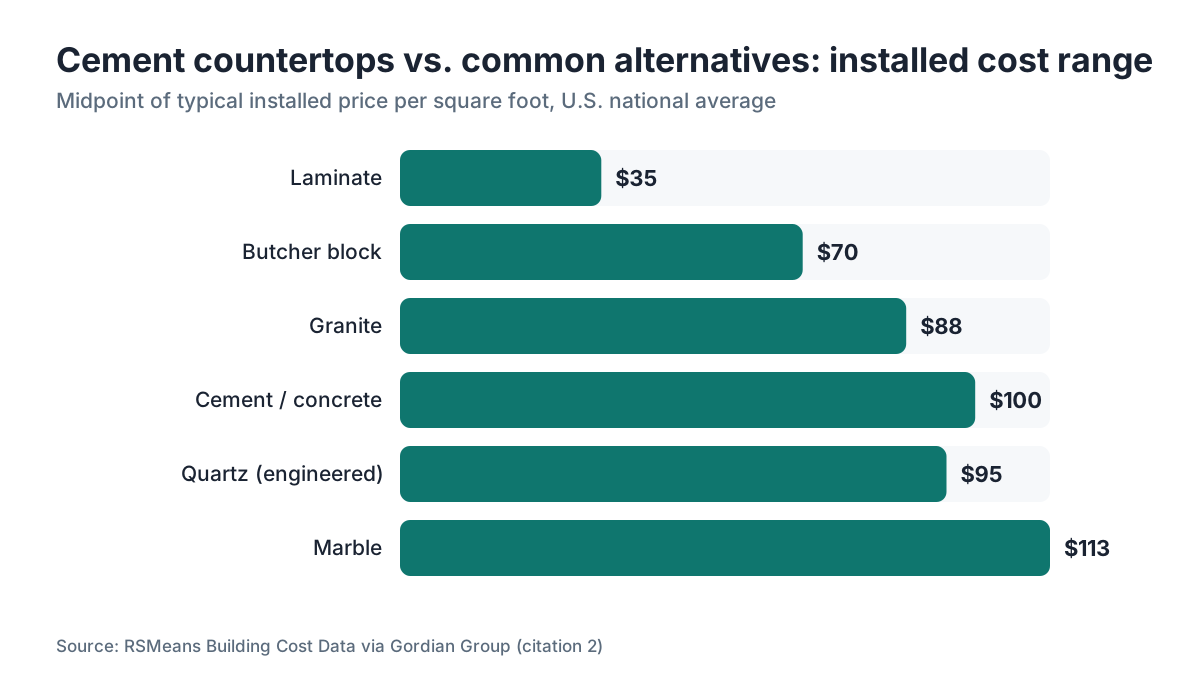
Installed prices usually land between $65 and $135 per square foot, with the national average clustering around $85 to $100 [2]. That range covers a basic precast slab in a single color up through a cast-in-place pour with integral drains, custom edge profiles, and decorative aggregate.
Here's what moves the price most:
- Thickness. Standard is 1.5 inches. Going to 2 inches adds weight (roughly 18 lbs per square foot at 1.5 in vs. 24 lbs at 2 in) and material cost. It also demands heavier cabinet support.
- Precast vs. cast-in-place. Cast-in-place is usually cheaper on labor for complex layouts because the fabricator pours around obstacles instead of cutting pieces. Precast tends to be more controlled and consistent.
- Integral sinks. A cast-in-one-piece integral sink runs $400 to $800 extra on average. You can't retrofit this later.
- Edge profiles. A simple eased edge adds nothing. An ogee or waterfall edge adds $15 to $35 per linear foot.
- Pigment and aggregate. Standard gray or off-white is cheapest. Multiple pigment layers, glass aggregate, or seeded stone on the face can add $10 to $20 per square foot.
A 40-square-foot island at $95/sq ft lands at $3,800 installed. That's real money, and it sits in the same neighborhood as mid-grade quartzite or leathered granite. See kitchen countertops for a broader cost comparison across all materials.
| Material | Installed cost range ($/sq ft) |
|---|---|
| Cement / concrete | $65, $135 |
| Granite | $55, $120 |
| Quartz (engineered) | $60, $130 |
| Marble | $75, $150 |
| Laminate | $20, $50 |
| Butcher block | $40, $100 |
Sources: RSMeans building cost data [2], fabricator pricing surveys. Ranges reflect regional variation. Coastal metro areas skew toward the top.
How durable are cement countertops compared to granite or quartz?
Cement runs around 3,000 to 6,000 psi compressive strength for typical countertop mixes, depending on water-to-cement ratio and curing conditions [3]. That sounds strong, and it is under direct downward pressure. The problem is tension. Concrete and cement crack in tension, and a kitchen counter sees plenty of it: point loads from heavy pots, thermal cycling near the range, and the slight flex of cabinets over time.
Granite rarely cracks in a kitchen install unless it's seriously undermined. Quartz (engineered stone) is just as forgiving. Cement is honest about its limits. Hairline cracks are common over the years, especially across long runs without control joints. A good fabricator adds glass fiber reinforcement or a wire mesh layer to cut that risk, but "cut" is not "eliminate."
Heat resistance is real. Cement takes hot pots without scorching the way laminate or some solid-surface materials would. But thermal shock, meaning a very hot pot set on a cold slab, can stress the surface. Acid etching is the bigger daily worry. Lemon juice, vinegar, tomato sauce, and most kitchen acids will etch an unsealed or under-sealed cement surface within minutes.
Compared to granite countertops, cement wants more active care. Compared to laminate countertops, cement handles heat and scratching far better but forgives chemistry far less. The honest summary: cement is tough where stone is tough and fragile where concrete is fragile.
What maintenance do cement countertops actually need?
Sealing is non-negotiable and recurring. Most fabricators apply a penetrating sealer before delivery plus a topical sealer or wax on the surface. The topical layer wears off with cleaning and use. Depending on the product and how hard you use the kitchen, you'll reapply every 6 to 12 months [4].
The EPA does not regulate countertop sealers directly, but its guidance on volatile organic compounds (VOCs) affects which solvent-based sealers are legal to sell in California and some other states [5]. If you live in one of those states, your fabricator should be using low-VOC or water-based formulas anyway.
Day-to-day care is simple: mild dish soap, soft cloth, no abrasive scrubbers. Bleach and vinegar-based cleaners attack the sealer and eventually the cement. Anything acidic gets wiped up now, not later. Hot pads are a good habit even though cement can technically handle heat.
The patina question matters here. Cement countertops develop a patina over the years: light scratches, small stains that survive resealing, slight color variation in heavy-use areas. Some owners love this. It reads as age and authenticity. Others find it maddening. This is not a material for people who want a surface that looks brand new at year 10.
For general stone-surface cleaning principles that also apply to cement, how to clean stone countertops has a useful primer on pH-safe products.
Do cement countertops stain or crack easily?
Staining and cracking are the two honest downsides, and they deserve separate treatment.
Staining: an unsealed or poorly sealed cement surface stains fast. Red wine, coffee, oil, and citrus can all leave permanent marks within minutes on bare cement. A well-maintained sealer cuts this risk a lot, but it doesn't make the surface stain-proof. Think of it like a well-oiled butcher block versus sealed wood. The sealer buys you time, not immunity. See butcher block countertops for a parallel comparison on natural porous surfaces.
Cracking: this is the more technical issue. Concrete shrinks as it cures, and cement mixes are no different. Fabricators control shrinkage cracking through proper water-to-cement ratios, fiber reinforcement, and controlled curing (keeping the slab moist and at a steady temperature while it gains strength). In the field, cracks happen anyway. The industry consensus is that hairline cracks (under 0.01 inch wide) are cosmetic and normal in cast cement work. Structural cracks wide enough to catch a fingernail are a quality or installation problem [3].
Control joints, narrow grooves cut into the slab at planned intervals, give the cement a place to "crack" that's invisible because it's designed in. This is standard practice for longer runs. If your fabricator isn't discussing control joints on a run over 48 inches, ask why not.
How is a cement countertop made? Precast vs. cast-in-place
There are two production methods, and they give you a genuinely different experience.
Precast (shop-cast): The fabricator builds a mold in the shop, pours the cement mix into it face-down (so the bottom of the mold becomes the visible surface), adds reinforcement, and cures the slab for 7 to 28 days. Then they grind and polish the face, apply color and sealer, and haul the finished piece to your home for installation. Quality control is better in a shop. The downside: seams show where pieces meet, since a precast slab has to fit through doorways and around corners.
Fabrication software like SlabWise helps shops quote precast cement work accurately by modeling slab dimensions, waste from cutouts, and material weight, all of which drive scheduling and pricing.
Cast-in-place: The fabricator builds forms directly on your cabinets and pours the mix in your kitchen. This makes continuous pours around corners and complex shapes possible with no visible joints. The cure happens on-site, which means your kitchen is out of commission for days. Finishing, grinding, and sealing happen in your home too, so expect dust and fumes. It takes more trust in the fabricator's field skills.
Most residential work today is precast. Cast-in-place shows up for unusual geometries, very thick countertops, or when a designer specifically wants that one-piece, monolithic look.
What does cement countertop installation involve?
Cabinet readiness matters more for cement than for almost any other countertop material. Cement slabs at 1.5-inch thickness weigh roughly 18 pounds per square foot, and 2-inch slabs hit 24 pounds per square foot [6]. A 30-square-foot counter at 2 inches comes in around 720 pounds. Most standard base cabinets handle this fine, but older cabinets, cabinets with water damage, or custom furniture-style bases may need added support.
The crew sets the precast slabs on shims and adhesive, then levels and secures them. Seams get filled with a color-matched cementitious caulk or epoxy. The final sealer coat often goes on-site after installation.
Plumbing and appliance cutouts get made in the slab, not in the field by a plumber. The fabricator handles sink cutouts, cooktop cutouts, and pop-up outlets when they build the mold or cut the precast piece. Changes after casting are expensive and sometimes impossible.
Read countertop installation for the general sequence of steps that applies across all slab materials, including what to expect from your installer on install day.
Can you DIY cement countertops?
You can. The question is whether you should.
The materials are easy to get. Portland cement, fine sand, and fiber mesh sit on the shelf at any building supply store. YouTube has thousands of tutorials. The actual pour isn't hard if you follow a solid recipe.
The hard parts are finishing and sealing. A smooth, flat, professional surface needs proper grinding equipment (a concrete grinder with diamond pads costs about $500 to rent or $1,500 to buy), the right progression of grits, and the experience to read when the surface is ready for each step. Skipped steps show up immediately in the finished product. Under-sealed DIY cement countertops can stain permanently within weeks.
Another real risk: cracking during cure from a bad water ratio. Too much water makes the mix workable but weak and prone to shrinkage cracks. Too little makes it unworkable. The sweet spot is tighter than most beginners expect. The water-to-cement ratio for countertop-grade mixes runs 0.35 to 0.45 by weight [3], much drier than a ready-mix bag's default.
My honest take: if you're handy, own the grinding equipment, and accept that your first attempt might not match a fabricator's work, DIY cement countertops are a legitimate project. If you want them to look a specific way and hold up reliably for 10 years, hire a specialist.
How do cement countertops compare to concrete countertops?
In the residential market, "cement countertops" and "concrete countertops" mean the same thing. This confuses people because cement is technically an ingredient in concrete (cement + aggregate + water = concrete). When fabricators say "cement countertops" they usually mean the same poured, cast, cured surface others call "concrete countertops."
Some fabricators do distinguish between mixes. A higher-cement, lower-aggregate formula (closer to a neat cement paste) makes a finer surface texture, while a concrete mix with larger aggregate shows visible stone or gravel in the finished face. The second one is sometimes called "exposed aggregate concrete" and shows up more in commercial or outdoor work.
For kitchen purposes, the terminology barely matters. Ask the fabricator what aggregate size they use, what fiber reinforcement they add, and what water-to-cement ratio they target. Those answers tell you far more about the final product than whether they call it cement or concrete.
If you want a stone-like look with natural variation but you're not sure cement is right, marble countertops and corian countertops cover the nearest alternatives on opposite ends of the price and maintenance range.
What do cement kitchen countertops look like over time?
This is the real question that separates buyers who end up happy from buyers who end up disappointed.
At installation: cement countertops look clean, consistent in color (with natural variation), and matte or low-sheen. The surface feels slightly cool and solid. It photographs beautifully.
At year 1: with proper sealing and care, they still look essentially new. Light-use areas may show slightly different sheen from wax reapplication. A few very faint scratches may catch a raking light angle.
At year 3 to 5: this is where cement tells its story. Hairline cracks are likely in one or two spots. Some color variation from use patterns. Maybe a small stain near the sink if the owner slacked on sealing. Areas near the range may show heat-induced variation.
At year 10 and beyond: a well-maintained cement countertop develops a genuine patina. Owners who chose cement for exactly this quality find it beautiful. Owners who hoped it would look like polished quartz are unhappy.
The comparison to engineered stone is instructive. Cambria countertops and similar quartz products look essentially the same at year 10 as they did on install day. That's a real advantage if consistency matters to you.
Are cement countertops good for outdoor kitchens?
Cement is one of the better countertop materials for outdoor kitchens, for a few reasons. It takes UV exposure without fading or delaminating the way some engineered surfaces do. It tolerates heat from grills and smokers better than most alternatives. The weight, a problem indoors on cabinets, matters less outdoors where concrete or masonry bases are common.
The challenges are freeze-thaw cycling in cold climates and water management. If water gets into micro-cracks and then freezes, it expands and widens the crack, a process called spalling. Sealing matters even more outdoors than indoors, and outdoor sealers often need reapplication every 6 months rather than annually [4].
Drainboard slopes and integral drains are easier to build into cast cement than into most other countertop materials, which is a real practical win for outdoor prep stations.
For any outdoor application, specify a mix with a lower water-to-cement ratio and add a silane or siloxane water repellent rather than a purely film-forming topical sealer. Penetrating sealers bond chemically to the cement substrate and don't peel through wet-dry cycles.
How to find a qualified cement countertop fabricator
This is an area where the fabricator's skill matters more than with most countertop materials. A mediocre granite installer still turns out a decent granite counter. A mediocre cement fabricator turns out a staining, cracking mess.
What to look for:
- At least three to five years of cement-specific work, meaning countertops specifically, more than general concrete.
- A portfolio of finished projects with photos taken at installation and, ideally, a year or more later. Any fabricator who only shows you fresh install photos can't show you how the work ages.
- A clear sealing specification. Ask what products they use, how many coats, and what they recommend for maintenance. Vague answers or "just use anything" are a problem.
- A warranty statement. Most reputable cement fabricators offer at least a one-year warranty against defects in workmanship. That usually excludes cracks from settling or customer-caused damage, but it should cover premature staining from sealer failure or structural cracks from a bad mix.
- References from past clients. Ask to talk with someone whose countertops are at least two years old.
For shops quoting cement work, variable mixes, multiple pigment options, and site-specific sizing make accurate quoting genuinely hard. SlabWise is built for exactly this kind of variable-dimension, custom-material quoting, and the demo shows how fabricators handle cement and other non-standard materials alongside stone.
The Concrete Countertop Institute [7] keeps educational resources and a fabricator directory that can help homeowners find trained specialists. It's the closest thing the trade has to a credentialing body.
Frequently asked questions
How long do cement countertops last?
With proper sealing and care, cement countertops last 20 to 30 years or more. The cement itself doesn't wear out. What degrades is the sealer and the aesthetic surface finish over time. Hairline cracks, color variation, and dull patches are the normal signs of aging. The structural slab outlasts most kitchens. It's the finish quality that decides whether you're happy with it at year 15.
Are cement countertops heat resistant?
Yes, the cement substrate handles heat well. You can set a hot pan on cement without scorching or melting it, unlike laminate or some solid surface materials. The risk is thermal shock cracking from extreme temperature differentials on a cold slab. The topical sealer is more vulnerable than the cement itself and can discolor or delaminate with repeated direct high-heat contact. Hot pads are still a reasonable habit.
Do cement countertops increase home value?
There's no solid appraisal data specific to cement countertops. Appraisers generally don't break out countertop material in their valuations; they assess kitchens as a whole. Custom cement countertops attract buyers who specifically want them and can put off buyers who prefer low-maintenance surfaces. Safe assumption: cement countertops don't hurt resale in design-forward markets and land neutral to slightly negative where buyers expect granite or quartz [9].
What is the best sealer for cement countertops?
A two-layer system works best: a penetrating silane or siliconate sealer to block water and acid from soaking into the substrate, followed by a topical polyurethane or epoxy-modified wax for surface sheen and daily stain resistance. The penetrating layer lasts years. The topical layer needs reapplication every 6 to 12 months. Skip purely film-forming epoxy sealers on their own, because they delaminate as hairline cracks develop.
Can cement countertops be repaired if they crack or chip?
Yes, cracks and chips are repairable. A color-matched cementitious filler or epoxy compound fills the void, and the fabricator blends pigment to match your slab. The repair is usually visible at raking light angles but doesn't affect function. Major structural cracks, meaning cracks wide enough to catch a fingernail, need a fabricator's assessment. Sometimes the cause (a weak cabinet support) has to be fixed before the surface repair will hold.
How heavy are cement countertops compared to granite?
Cement at 1.5-inch thickness weighs roughly 18 pounds per square foot. Granite at the standard 3/4-inch thickness runs about 13 pounds per square foot, and at 1.25 inches runs about 18 pounds per square foot. At equal thickness they weigh about the same. Cement is almost always cast thicker than stone slabs, so in practice a cement countertop puts more total weight on the cabinets than a granite one would.
Are cement countertops safe for food prep?
The cured cement substrate is inert and safe. The sealer matters more. A properly cured, food-safe polyurethane or epoxy-modified topical sealer is non-toxic once fully cured. Some solvent-based sealers off-gas during curing and shouldn't contact food until fully hardened, typically 72 hours. Ask your fabricator for the sealer's safety data sheet and confirm it's food-safe after cure. The FDA regulates food contact surfaces under 21 CFR [8].
Can you grind or polish cement countertops to a high gloss?
Yes. Diamond-pad grinding from coarse (50 grit) through fine (400 to 800 grit) makes a progressively smoother surface. A polished concrete finish at 1500 to 3000 grit reaches a glass-like sheen with no topical sealer layer. It looks dramatically different from the typical matte-waxed look. Polished cement resists surface scratches better than waxed cement but still needs a penetrating sealer for stain and acid protection.
What colors can cement countertops be made in?
Essentially any color, though earth tones and neutrals look most natural. Integral pigments, iron oxide-based colorants dispersed through the mix before casting, are the standard method. After curing, acid stains or water-based concrete dyes add mottled, reactive color on the surface. Combining both makes a depth you won't get from any other countertop material. Very saturated colors (bright red, royal blue) are possible but harder to keep consistent across a large pour.
How does cement compare to formica or laminate for a budget kitchen?
Laminate costs $20 to $50 per square foot installed, roughly one-third the price of cement. For a budget remodel, laminate is a far better value by any financial measure. Cement's advantages (custom color, integral sinks, unique texture) don't help a homeowner who needs a functional surface at minimum cost. See laminate countertops for a full comparison. Cement makes sense when its look or a specific feature like an integral drain justifies the premium.
How long does it take to get cement countertops installed?
From order to install, precast cement countertops typically take 3 to 6 weeks. The cement needs at least 7 days to reach initial working strength and usually 28 days to reach full design strength, though fabricators often do final finishing and deliver between day 14 and 21. Cast-in-place work can start installation sooner but ties up your kitchen for 3 to 7 days of on-site work plus cure time before you can use the surface.
Do cement countertops work in bathrooms?
Yes, and bathrooms are often more forgiving than kitchens. Bathrooms see less acid exposure (no citrus, vinegar, or tomato), lower mechanical stress, and usually lighter use. Cement vanity tops with integral sinks are popular in high-design bathrooms. The same sealing and maintenance rules apply. Vessels and drains have to be cast in before the slab cures, so plumbing coordination matters at the design stage.
Is there a difference between cement countertops and GFRC countertops?
GFRC stands for glass fiber reinforced concrete. It uses the same Portland cement base but disperses alkali-resistant glass fibers through the mix, which allows much thinner sections (3/4 inch versus the standard 1.5 inches) without giving up strength. GFRC weighs roughly half as much as standard cement at equal coverage, which solves the weight problem for older cabinets. The finished surface looks nearly identical. GFRC fabrication takes specialized mixing equipment and technique.
Sources
- ASTM International, Standard Specification for Portland Cement (C150): Portland cement used in countertop mixes is standardized under ASTM C150, defining composition and performance requirements.
- RSMeans Online, Gordian Group, Building Cost Data: Installed concrete countertop prices nationally range from approximately $65 to $135 per square foot depending on complexity and region.
- Portland Cement Association, Design and Control of Concrete Mixtures: Water-to-cement ratio for countertop-grade mixes is typically 0.35 to 0.45 by weight; compressive strength for typical countertop concrete ranges 3,000 to 6,000 psi.
- Concrete Countertop Institute, Sealer Selection and Maintenance Guide: Topical sealers on cement countertops need reapplication every 6 to 12 months indoors, every 6 months for outdoor installations.
- U.S. Environmental Protection Agency, Volatile Organic Compounds guidance: EPA VOC guidance affects which solvent-based sealers are legal to sell in California and other states that follow California Air Resources Board limits.
- Portland Cement Association, Concrete Weight and Density Reference: Standard concrete at 150 lb/cu ft yields approximately 18 lb/sq ft at 1.5-inch thickness and 24 lb/sq ft at 2-inch thickness.
- Concrete Countertop Institute, Fabricator Directory and Training Programs: The Concrete Countertop Institute maintains a fabricator directory and educational credentialing for concrete countertop specialists.
- U.S. Food and Drug Administration, 21 CFR Food Contact Surfaces: FDA regulates materials in contact with food under 21 CFR; properly cured food-safe sealers meet these requirements after full cure.
- National Association of Home Builders, What Home Buyers Really Want: NAHB buyer preference surveys show granite and quartz as the dominant countertop preferences; custom materials like cement represent a small but consistent design-driven segment.
- California Air Resources Board, Architectural Coatings SCM: California limits VOC content in concrete sealers sold in the state, affecting which products fabricators can legally use for cement countertop finishing.
Last updated 2026-07-09