TL;DR
- Discount butcher block countertops typically run $20, $60 per square foot for the slab alone, compared to $80, $200 for premium custom work.
- The savings are real.
- They come from thinner slabs, lower-grade wood species, and factory-edge-only finishing.
- This guide explains where the cuts happen, which trade-offs are fine for most kitchens, and when cheap butcher block will cost you more in the long run.
What does 'discount' actually mean for butcher block?
Discount covers a lot of ground. It can mean a big-box store selling a pre-made panel at a fixed size, a mill running overstock oak at the end of the season, or a fabricator offering a stripped-down spec: no custom edge, no sink cutout, standard thickness only. These are different products with different risks.
Three things drive the price of butcher block: wood species, construction type, and thickness. Most discount slabs are edge-grain red oak or hard maple, 1.5 inches thick, with a machine-applied oil or polyurethane finish. That is a perfectly serviceable countertop for most households. A premium slab might be end-grain walnut, 3 to 4 inches thick, custom-dimensioned, and hand-finished on all six faces. The price gap between those two is enormous, and most people do not need the latter.
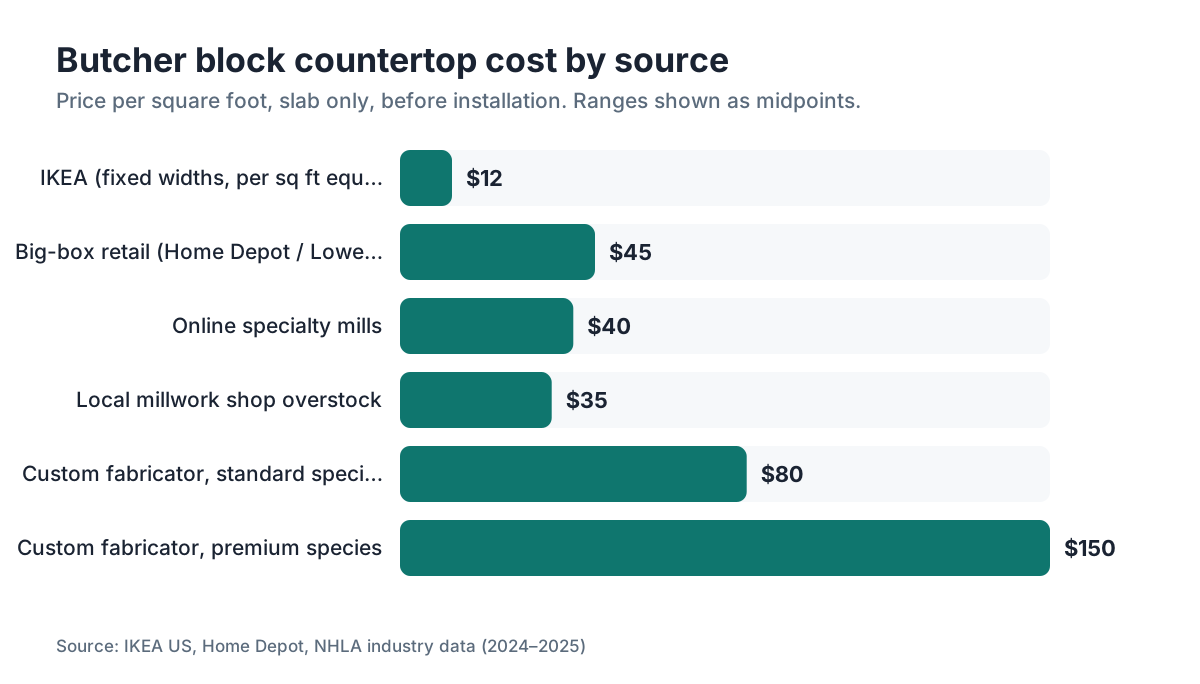
Home Depot and IKEA are the two biggest retail entry points for budget butcher block in the United States. IKEA's Badelunda and Karlby series (birch and oak) run roughly $8, $16 per linear foot in their standard widths [1]. Home Depot's Unfinished Birch Butcher Block from Hardwood Reflections typically retails at $35, $55 per square foot depending on size [2]. Both are edge-grain panels, factory-assembled with PVA glue, and sold unfinished or with a basic oil coat. They are thin (1.5 in.), the edges are square-cut, and you get no customization. That is where the savings come from.
How much do discount butcher block countertops cost in 2025?
Here is an honest range by channel. Prices move with lumber markets, so treat these as order-of-magnitude benchmarks rather than guarantees.
| Source | Price per sq ft (slab only) | Typical thickness | Customization |
|---|---|---|---|
| IKEA (Karlby, Badelunda) | $8, $16/lin ft (fixed widths) | 1.1 in. | None |
| Big-box retail (Home Depot, Lowe's) | $30, $60 | 1.5 in. | None |
| Online specialty mills (Lumber Liquidators, BR111) | $25, $55 | 1.5 to 2 in. | Limited |
| Local cabinet/millwork shop, overstock | $20, $50 | 1.5 to 3 in. | Sometimes |
| Custom fabricator, standard species | $60, $100 | 1.5 to 3 in. | Full |
| Custom fabricator, premium species | $100, $200+ | 2 to 4 in. | Full |
Installation adds $30, $50 per square foot if you hire a carpenter, or close to zero if you do it yourself. A typical 25-square-foot kitchen island done in retail butcher block with DIY install can come in under $1,200 all-in. The same island in custom end-grain walnut with professional install can easily hit $5,000 [3].
Lumber prices matter here. The USDA Forest Service tracks softwood and hardwood lumber prices, and hard maple and red oak saw big swings between 2020 and 2023 from supply chain disruptions. Retail butcher block prices followed [4]. If you see a big-box slab on clearance, the discount may simply reflect that mills overproduced a standard spec. That is fine to buy.
Edge-grain vs. end-grain vs. face-grain: which construction is cheapest and why?
Most discount butcher block is edge-grain. The wood strips are glued with the long edge facing up, which gives you visible parallel lines running the length of the counter. Edge-grain uses lumber efficiently, produces the least waste, and holds up well to daily use. It is a legitimate, durable construction.
End-grain is the checkerboard pattern you see on a traditional butcher's block. The wood fibers face up, which is gentler on knife edges and self-heals minor cuts better than edge-grain. It is also much heavier and needs more material and more glue joints, which is why it costs two to three times as much for the same surface area. You will rarely find genuine end-grain butcher block at discount prices. If you do, check the slab carefully for loose glue joints around the perimeter. That is the most common quality problem in lower-cost end-grain panels.
Face-grain panels (the wide flat face of the board faces up) are the cheapest to produce and the least stable. They cup and crack more easily with humidity swings. Most reputable sources avoid face-grain for countertops, but you will occasionally see it in very low-cost panels online. Avoid it for anything near a sink.
For a deeper look at how butcher block fits into the broader countertop landscape, the butcher block countertops guide covers maintenance, sealing, and long-term durability in detail.
What is a 'fake' butcher block countertop, and is it worth buying?
A fake butcher block countertop is a surface that looks like wood but is made from a different base material. The common versions are laminate sheets printed with a wood-grain photograph, vinyl or LVT panels with a wood texture, and engineered wood-core panels with a thin veneer of real wood on top.
Laminate fake butcher block (sold by Wilsonart, Formica, and similar brands) costs $3, $10 per square foot for the sheet, making it the cheapest option in this category by a wide margin [5]. You get the visual warmth of wood with zero maintenance: no oiling, no sensitivity to water, no knife marks (it scratches instead of self-healing). The trade-off is that it looks like a photograph of wood rather than actual wood. In a rental, a laundry room, or a budget kitchen remodel where the goal is visual impact for minimum dollars, laminate butcher block is a rational choice. See the laminate countertops guide for more on this.
Veneered wood-core panels are trickier. A real 1/16-inch maple veneer over an MDF or plywood core genuinely looks like wood because it is wood on the surface. But you cannot sand it down if it gets gouged, and water infiltration at the edges will swell the core quickly. These are not appropriate near a sink without extremely careful sealing of all end cuts.
The honest answer: if you want real butcher block but your budget is tight, buy the cheapest edge-grain maple panel you can find rather than a fake. If budget is the absolute constraint and you just want the look, laminate is fine and durable. The worst outcome is paying mid-range prices for a veneered panel that behaves like neither real wood nor laminate.
Where do quality shortcuts happen in budget butcher block?
Budget panels save money somewhere. Knowing where helps you decide if the trade-off matters for your kitchen.
Wood grade is the first place. NHLA (National Hardwood Lumber Association) grading goes from FAS (Firsts and Seconds, the top grade) down through Select, #1 Common, and #2 Common [6]. Discount butcher block is often made from #1 Common or Select-grade boards, which means more color variation, more small knots, and more sapwood (lighter-colored wood mixed in with the heartwood). For some people this is a plus. It gives the surface more character. For people who want a consistent, uniform look, it is a problem.
Glue joint consistency is harder to see. In a well-made panel, every glue line is tight and flat. In a hurried production run, you occasionally get micro-gaps that will trap food and widen over time. Run your hand across any panel before buying it. If you feel a ridge at a glue line, that panel was not clamped properly.
Thickness matters for overhangs and undermount sinks. A 1.5-inch slab can handle a small undermount sink cutout if it is reinforced, but a 3-inch slab is much more forgiving. If you need a large undermount sink in a budget butcher block countertop, get the fabricator to add a wood ledger support across the cutout, or buy a thicker slab.
Finishing quality is the final shortcut. Factory-applied oil finishes on budget panels are often a single thin coat. That is fine as a base, but you will want to apply two more coats of food-safe mineral oil or a board cream before the surface sees any water. This takes an hour and costs about $15 in materials.
Which wood species give you the best value?
Hard maple is the value leader. It is one of the hardest domestic hardwoods (1,450 lbf on the Janka scale [7]), grows abundantly in the Great Lakes and Northeast, and mills efficiently into edge-grain panels. Most budget butcher block is maple for exactly this reason. It takes stains and oils readily, and the light color brightens a kitchen.
Red oak costs slightly less than maple in many markets because it is abundant and fast-growing. The open grain is more porous, which means it soaks up oil faster and can hold bacteria in the grain channels if not sealed properly. It is still a popular choice for budget countertops. Just be more diligent with the finish.
Beech and birch are common in European-market budget panels (including IKEA's range). Both are hard, fine-grained, and attractive. Availability in US big-box stores is more limited than maple.
Walnut, cherry, and teak cost two to four times as much as maple and are not commonly found in true discount panels. If you see "walnut butcher block" at a price that seems too good, check whether it is real walnut heartwood or a walnut-stained maple. The stain will tell you nothing about the actual hardness and durability.
Acacia appears in a lot of online budget butcher block marketed as "exotic." It is genuinely hard (1,700+ lbf Janka) and looks striking. Quality control varies enormously between suppliers, and the boards can be thin-strip assemblies with many more glue joints than a domestic-wood panel of the same width. Inspect carefully.
How do you find legitimate deals on butcher block without getting burned?
Big-box clearance aisles are your first stop. Home Depot and Lowe's regularly discount butcher block panels that are scratched, slightly warped (often correctable when clamped to a flat cabinet base), or discontinued sizes. A 5-to-10 percent warp across a 96-inch panel sounds scary but will typically pull flat once the slab is screwed down to a level cabinet. Check it with a straightedge before buying.
End-of-run sales from online lumber mills are the second option. Companies like Woodcraft, Lumber Liquidators (now LL Flooring), and several direct-to-consumer mills run clearance sales on overstock panel sizes. Sign up for their email lists.
Habitat for Humanity ReStores occasionally have butcher block from kitchen tear-outs. The slabs are used, sometimes stained, but they are real wood and can be sanded back to fresh if they are thick enough (1.5 inches or more). Budget $50, $100 for sandpaper and a random-orbit sander if you go this route.
Local cabinet shops are underused. If a shop builds custom cabinets, they often have offcuts and short slabs of quality butcher block that do not fit a cabinet order. Call around. You may pay cash and carry, but the wood quality is often much better than retail.
For fabricators quoting butcher block jobs alongside stone, software like SlabWise can flag when butcher block components need different yield assumptions than stone, which matters when you are pricing a mixed-material kitchen with a quartz perimeter and a butcher block island. Running those two materials in the same quote without accounting for wood's different waste factors is a common pricing mistake.
Avoid Amazon third-party sellers for anything over $200 without verified reviews that include photos. Return shipping on a 50-pound slab is expensive and return policies vary wildly.
Can you DIY the installation, and what does that save?
Yes, and it is one of the most DIY-friendly countertop materials available. Butcher block cuts with a standard circular saw or jigsaw, takes standard router bits for edge profiles, and weighs 30 to 50 pounds per linear foot at 1.5-inch thickness, manageable for two people. Compare that to granite (roughly 18 pounds per square foot, kitchen countertops has more on stone weight) and butcher block is far more forgiving.
A typical DIY install saves $30, $50 per square foot in labor. On a 30-square-foot countertop run, that is $900, $1,500 back in your pocket. The tools you need: circular saw with a fine-tooth blade, jigsaw for sink cutouts, drill, countersink bit, and a random-orbit sander for finish prep. Most homeowners already own most of these.
The one place to be careful is undermount sink cutouts. The cutout needs to be smooth and sealed on all edges or water will wick into the wood. Cut it with a jigsaw, sand the cut edges to 220 grit, apply three coats of finish to the cut face before mounting the sink, and use silicone to seal the rim. A countertop installation guide like countertop installation covers the general sequence for any material.
Expansion is the other gotcha. Wood moves seasonally. Do not glue butcher block to the cabinet carcass. Use figure-8 fasteners or wooden clips in slots routed into the underside, so the slab can move a quarter inch or so without cracking.
How does discount butcher block compare to other budget countertop options?
If your goal is the cheapest functional countertop, laminate wins on pure cost. Laminate countertops (including fake butcher block laminate from Formica countertops) run $10, $40 per square foot installed, do not need sealing or oiling, and last 15 to 20 years with reasonable care. They cannot be refinished, but they are genuinely durable for the price.
Real butcher block in the $30, $55 per square foot range competes with entry-level tile and solid-surface options. Tile grout lines need maintenance. Corian countertops and similar solid-surface products start around $40, $80 installed and hide their seams, which butcher block does not.
Natural stone like granite countertops or marble countertops at the low end (prefabricated in standard sizes) starts around $40, $60 per square foot installed, putting it in direct competition with mid-range butcher block with professional installation. Stone is harder to DIY, which is where butcher block pulls ahead on total cost.
For a purely visual "I want the wood look" goal, fake butcher block laminate is the rational budget move. For an "I want real wood that I can sand and refinish every few years" goal, discount real butcher block is the answer. These are different products solving different problems, and conflating them leads to buyer's remorse.
One thing butcher block cannot do: survive like quartz or engineered stone. If you cook heavily, have kids who will gouge the surface, or hate the idea of annual oiling, look at laminate countertops or a budget engineered stone instead.
What finish should you apply to a discount butcher block countertop?
Discount slabs usually arrive with one thin coat of oil or nothing at all. You need to finish the slab before it sees water, food, or anything else.
Mineral oil is the simplest food-safe option. Apply three to four coats over 24 hours (each coat soaks in as the wood dries), then maintain with one coat every few months. Cost: about $5 per quart at any pharmacy. The downside is that oil finishes leave the wood looking natural but not protected against deep staining. Red wine and beet juice will stain oiled maple.
Hardwax oil (brands like Rubio Monocoat or Osmo Polyx) penetrates and leaves a thin protective layer that resists stains better than straight mineral oil. Rubio Monocoat specifically claims a one-coat application cures the wood in a single pass [8]. It costs about $80, $120 for enough to do a standard kitchen, which erodes some of your discount savings but produces a noticeably better result.
Polyurethane gives the hardest, most water-resistant surface. It sits on top of the wood rather than penetrating it, so if it chips or scratches you see the wood exposed at the edge of the chip. It is not food-safe while wet (cured polyurethane is generally considered safe). Use water-based polyurethane for less yellowing. This finish is best for areas that see a lot of water (near the sink) and are not used as a cutting surface.
If you want to use the surface as an actual cutting board, oil or hardwax oil finishes are the right call. Polyurethane and the surface of a knife do not get along well. The knife will lift small chips of finish over time.
For reference, the FDA has guidance on food-contact surfaces in commercial settings under 21 CFR Part 117, though residential butcher block is not regulated the same way [9].
How long will a discount butcher block countertop last?
A properly finished and maintained edge-grain maple panel should last 20 years in a typical home kitchen. HGTV and various home improvement sources commonly cite 20+ years, and that tracks with what carpenters report in practice, though nobody has a controlled longitudinal study on residential countertop longevity.
The failure modes for budget butcher block are predictable. Water damage at the sink cutout is the most common: the wood swells, the glue joints open, and you get a soft spot that eventually grows mold. This happens because the cut edges were not sealed properly during install, not because the wood itself is poor quality. Seal every cut edge with three coats of finish before the sink goes in.
Delamination of glue joints is the second failure mode. It shows up as a crack running the length of the panel, often at the seam between two strips. Low-quality panels use less glue or skip the clamping time. If you see a glue joint that feels proud (raised) rather than flush when you run your hand across a new panel, that panel was not clamped flat. Return it.
Surface wear is not usually a structural problem. Heavy cutting marks can be sanded out. A 1.5-inch slab can be sanded three to five times over its life before you start losing structural thickness. That is a real advantage over stone and laminate, which cannot be refinished at all.
The bottom line: the longevity gap between a $40/sq ft edge-grain maple panel and a $150/sq ft custom end-grain walnut panel is real but smaller than the price gap suggests. Both last a long time with proper care.
Are there any safety or regulatory issues with cheap butcher block?
Two legitimate concerns come up regularly: formaldehyde emissions from the adhesive, and food safety of the finish.
Most butcher block panels use PVA (polyvinyl acetate) glue, which has very low formaldehyde emissions. Some lower-cost panels use urea-formaldehyde (UF) adhesives, which off-gas more. The California Air Resources Board (CARB) sets the strictest limits in the US under the Airborne Toxic Control Measure for composite wood products. Phase 2 limits hardwood plywood at 0.05 ppm [10]. Panels sold in California must comply. If a panel does not specify CARB Phase 2 compliance, it may have higher emissions. Look for the label or ask the manufacturer. IKEA and most major US retailers have confirmed CARB compliance across their butcher block lines.
Food safety of the finish is a common question. Mineral oil (USP grade) is explicitly listed as food-safe by the FDA [11]. Fully cured linseed oil and hardwax oil products that are certified food-safe by the manufacturer are generally accepted. Raw polyurethane is not food-safe while wet. Fully cured water-based polyurethane is generally considered safe for incidental food contact, though the FDA does not specifically certify residential countertop finishes. If food safety is your priority, stick to mineral oil or a purpose-made food-safe board finish.
For commercial kitchens, the rules are different. The FDA Food Code (administered at the state level) requires food-contact surfaces to be smooth, nonabsorbent, and easily cleanable. Raw wood typically does not qualify in a commercial inspection context [12]. This article is focused on residential kitchens, where those commercial standards do not apply.
Frequently asked questions
What is the cheapest butcher block countertop you can buy?
IKEA's Badelunda and Karlby panels are the lowest entry point, running roughly $8, $16 per linear foot in fixed widths. Big-box stores like Home Depot follow at $30, $60 per square foot for unfinished edge-grain maple or birch. These are real wood panels, not veneer or laminate, and they are a legitimate choice for most kitchens if you finish them properly before installation.
Is fake butcher block laminate worth buying?
Yes, in the right context. Laminate that mimics butcher block costs $3, $10 per square foot for the sheet, needs no oiling or sealing, and lasts 15 to 20 years. It looks like a photograph of wood rather than real wood, but in a rental, a low-budget remodel, or a laundry room, that trade-off makes sense. It is not refinishable, and it is obviously not wood up close, but it is durable and cheap.
Can I use cheap butcher block near a kitchen sink?
Yes, but you must seal every cut edge with three coats of oil or finish before the sink goes in, and caulk the sink rim with silicone. Skipping this step is the primary reason budget butcher block fails near sinks. The wood itself is fine. It is unsealed cut edges that let water wick into the glue joints. With proper sealing, butcher block can last 20 years next to a sink.
What wood species is best for a discount butcher block countertop?
Hard maple is the best value. It scores 1,450 lbf on the Janka hardness scale, mills efficiently into edge-grain panels, is widely available, and resists surface cuts well. Red oak is slightly cheaper but has more open grain pores, which absorb bacteria if not sealed carefully. Birch (common in IKEA panels) is also a solid, hard-wearing option. Acacia is popular online but quality control varies widely between suppliers.
How do I install discount butcher block countertops myself?
You need a circular saw with a fine-tooth blade, a jigsaw for sink cutouts, a drill, and a random-orbit sander. Cut the panel to size, finish all cut edges, secure the slab with figure-8 fasteners (not glue) so the wood can expand seasonally, and caulk seams. Two people can handle a standard run. DIY installation saves $30, $50 per square foot in labor compared to hiring a carpenter.
How often does butcher block need to be oiled?
A freshly installed slab needs three to four coats of mineral oil over the first 24 hours. After that, most professionals recommend re-oiling every one to three months depending on how much the surface is used and washed. If the wood starts looking dry or lighter in color, that is the signal to apply another coat. It takes about 10 minutes. Skipping regular oiling makes the wood more vulnerable to cracking.
Can you sand and refinish discount butcher block to remove damage?
Yes, and this is one of butcher block's biggest advantages over stone or laminate. A 1.5-inch edge-grain slab can be sanded three to five times over its life before the thickness becomes a structural concern. A random-orbit sander at 80 grit removes deep gouges. Follow with 120, 180, and 220 grit, then reapply finish. One afternoon of work returns a heavily used surface to near-new condition.
Is end-grain butcher block available at discount prices?
Rarely. End-grain construction requires more material and more glue joints, which makes it expensive to produce. Genuine end-grain butcher block typically starts at $80, $120 per square foot even from budget suppliers. If you see end-grain panels advertised under $60, inspect the glue joints carefully. Rushed production on end-grain panels is where quality problems concentrate. Edge-grain is the realistic discount option.
What is CARB Phase 2 compliance, and does it matter for butcher block?
CARB Phase 2 is California's formaldehyde emission standard for composite wood products, limiting hardwood plywood to 0.05 ppm. It matters if you are buying a panel that uses glue in its assembly, which includes essentially all butcher block panels. Most major US retailers sell CARB-compliant panels. Look for the label or confirmation from the manufacturer, particularly when buying from smaller online sellers.
How does discount butcher block compare to prefab granite in total cost?
Prefabricated granite in standard sizes starts around $40, $60 per square foot installed at big-box stores, putting it in direct competition with mid-range butcher block with professional installation. DIY butcher block installation pulls the total cost well below prefab granite. Stone cannot be DIY'd as easily, does not need oiling, and holds up better to water long-term. Butcher block wins on upfront DIY cost. Stone wins on maintenance simplicity.
Are cheap butcher block countertops food-safe?
Real wood panels assembled with PVA glue and finished with USP-grade mineral oil are food-safe for residential use. The FDA lists mineral oil as food-safe. Fully cured polyurethane is generally considered safe for incidental food contact in residential settings, though it is not rated for commercial food preparation surfaces. Avoid raw or unfinished butcher block in direct food contact. Apply a proper finish before using the surface.
Can I stain discount butcher block to match dark kitchen cabinets?
Yes, but results vary by species. Maple (the most common discount species) has a fine, tight grain that takes stain unevenly. Applying a pre-stain wood conditioner before staining gives more consistent color. Oak takes stain more readily and evenly due to its open grain. Any oil-based stain works. Apply before the final protective finish. Avoid staining near the sink edge because stain trapped in the joint can be hard to touch up.
What thickness should a discount butcher block countertop be?
1.5 inches is the standard thickness for almost all retail and discount butcher block panels, and it is enough for most residential kitchens. Go thicker (2 to 3 inches) only if you need a large undermount sink cutout or want the slab to function as a true butcher's block for heavy chopping. Thicker slabs cost more and are harder to find at discount prices. 1.5 inches is the practical default.
Sources
- IKEA US, Countertops product category: IKEA Karlby and Badelunda butcher block countertops in birch and oak run roughly $8, $16 per linear foot in fixed widths.
- Home Depot, Hardwood Reflections Butcher Block Countertops: Home Depot's unfinished birch butcher block panels typically retail at $35, $55 per square foot.
- National Kitchen and Bath Association, NKBA Design Report 2023: Custom end-grain walnut countertops with professional installation commonly reach $5,000 for a standard kitchen island.
- USDA Forest Service, Forest Products Laboratory, Timber Products Output: Hard maple and red oak lumber prices saw significant volatility between 2020 and 2023 due to supply chain disruptions.
- Wilsonart, Laminate Product Catalog: Laminate countertop sheets, including wood-grain butcher block patterns, retail at approximately $3, $10 per square foot.
- National Hardwood Lumber Association, Grading Rules for Hardwood Lumber: NHLA grading classifies hardwood lumber from FAS (top grade) through Select, No. 1 Common, and No. 2 Common, with lower grades including more knots, color variation, and sapwood.
- USDA Forest Service, Wood Handbook: Wood as an Engineering Material (Chapter 4): Hard maple has a Janka hardness rating of approximately 1,450 lbf, making it one of the harder domestic hardwoods suitable for countertops.
- FDA, Code of Federal Regulations Title 21, Part 117: Current Good Manufacturing Practice: 21 CFR Part 117 covers food safety requirements for commercial food facilities; residential butcher block is not regulated under the same framework.
- California Air Resources Board, Airborne Toxic Control Measure for Composite Wood Products: CARB Phase 2 limits formaldehyde emissions from hardwood plywood to 0.05 ppm; panels sold in California must comply.
- FDA, CFR Title 21, Part 172.878: White Mineral Oil: The FDA lists USP-grade white mineral oil as food-safe and approved for use as a food-contact lubricant.
Last updated 2026-07-09