TL;DR
- Blue granite countertops run $40 to $200 per square foot installed, depending on stone rarity and fabrication complexity.
- True blue granites like Blue Pearl, Azul Bahia, and Volga Blue are igneous or metamorphic stones quarried mainly in Norway, Brazil, and Ukraine.
- Blue is the rarest granite color family, so prices skew higher than gray or black options.
- Most blue granites are dense, low-porosity stones that need sealing once a year at most.
What makes a granite countertop look blue?
Blue granite gets its color from minerals locked inside the stone. The main players are iridescent feldspar crystals called labradorite or anorthite, plus occasional deposits of sodalite, hauyne, and riebeckite. When light hits those feldspar crystals at the right angle, you get a metallic shimmer called adularescence. Most people describe it as a silver-blue or electric-blue flash. That optical effect, not a dye, is why blue granite looks like one color under showroom fluorescents and a different one under your kitchen pendants.
Most stones sold as "blue granite" are not granite in the strict geologic sense. Real granite is a coarse-grained igneous rock with at least 20 percent quartz by volume and a specific ratio of feldspar to other minerals [1]. Many blues, including Azul Bahia and Sodalite Blue, are anorthosite, larvikite, or syenite. Those are related igneous and plutonic rocks with far less quartz. In the countertop trade, "granite" loosely means any hard, crystalline stone that isn't marble, quartzite, or soapstone, so you'll see these stones sold as granite without anyone lying to you. It's trade language, nothing more.
Why does this matter in your kitchen? Lower quartz content often means slightly lower hardness and, in some stones, higher porosity. Sodalite-based blues can be more porous than true quartz-heavy granites, so ask your fabricator for a water-drop absorption test before you commit. A drop of water should bead or absorb very slowly. If it spreads and darkens the stone right away, that slab drinks, and you'll be sealing it more often.
For a broader look at how granite performs as a countertop surface, the granite countertops guide covers hardness, maintenance, and fabrication basics in detail.
Which blue granite varieties are most popular, and how do they differ?
Here's a quick comparison of the stones you'll actually find at most stone yards:
| Stone | Origin | Dominant color | Porosity | Relative price |
|---|---|---|---|---|
| Blue Pearl | Norway | Silver-blue with metallic flash | Very low | $ (budget-mid) |
| Volga Blue | Ukraine | Deep navy, coarse crystal | Low | $ (mid) |
| Azul Bahia | Brazil | Vivid royal blue, white veins | Medium | $$$$ (premium) |
| Sodalite Blue | Canada/Brazil | Bold cobalt blue | Medium-high | $$$ (premium) |
| Blue in the Night | Brazil | Dark blue-gray, fine grain | Low | $$ (mid) |
| Labrador Antique | Norway/Finland | Blue-gray with orange/red sparkle | Very low | $$ (mid) |
| Blue Eyes | Brazil | Light blue with white quartz veins | Low-medium | $$ (mid) |
Blue Pearl granite countertops are the most widely available blue in North America. The stone is quarried in Larvik, Norway by a small number of licensed operators, and it's technically a larvikite, an alkali syenite valued for its blue-gray labradorescence [2]. The quarry region is geologically unique, so you can't get this particular shimmer anywhere else on Earth. Slabs run roughly 3/4 inch to 1.25 inches thick in standard residential cuts.
Azul Bahia is the showstopper. Single raw slabs can cost $1,000 to $2,000 before anyone touches them with a saw, because quarry output is small and demand from luxury residential and hospitality work never lets up. That jaw-dropping blue island you saw in a magazine kitchen? Good chance it was Azul Bahia.
Volga Blue comes out of Ukraine, which creates supply chain uncertainty. Before 2022, it was one of the more affordable mid-range blues. Availability now varies by importer, so expect your stone yard to have inconsistent stock.
Sodalite Blue (sometimes called Princess Blue or Royal Blue) contains the mineral sodalite, which gives it a saturated cobalt color rather than the metallic shimmer of the Pearl types. It's beautiful. The higher porosity means you need to be more disciplined about annual sealing.
What do blue granite countertops cost per square foot?
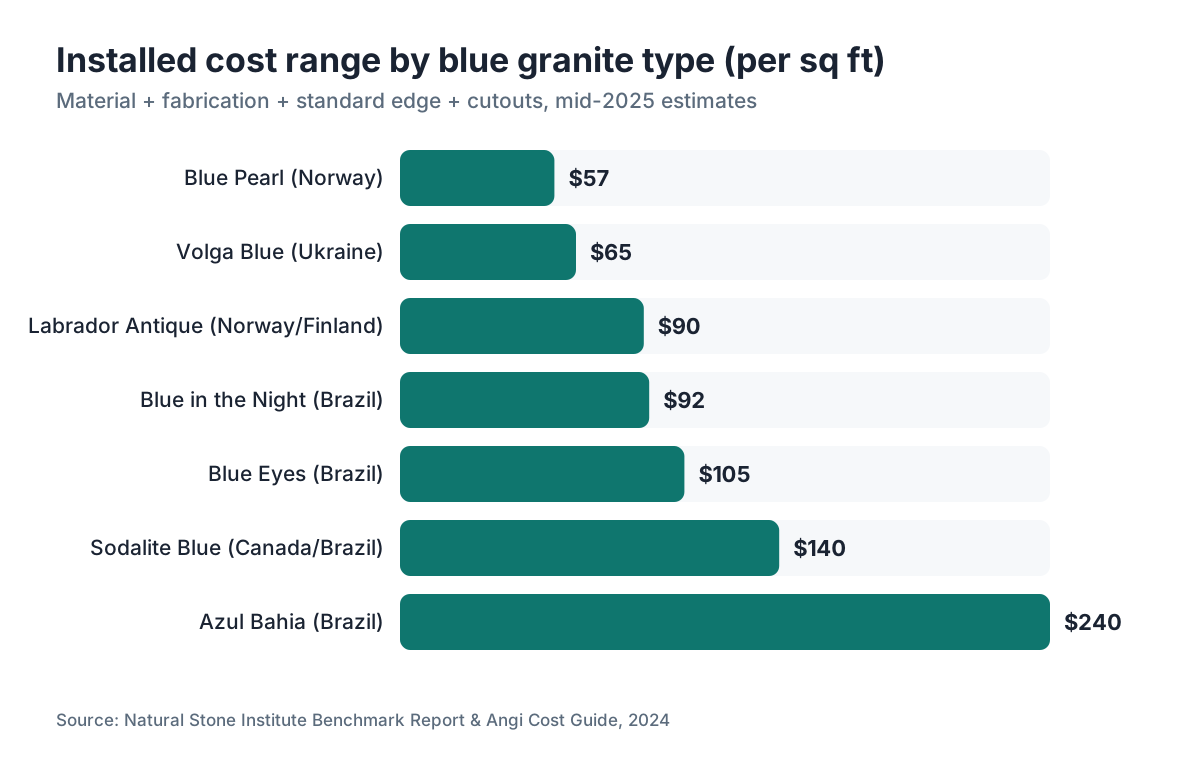
Installed cost depends on the stone, your region, edge profile complexity, and job size. Based on wholesale and retail pricing reported by stone industry trade sources and distributor price lists, here are realistic ranges as of mid-2025 [3]:
Material only (per sq ft, at the stone yard):
- Blue Pearl: $12, $30
- Volga Blue: $15, $35
- Blue in the Night: $20, $45
- Labrador Antique: $25, $55
- Sodalite Blue: $60, $120
- Azul Bahia: $150, $400+
Installed (material + fabrication + basic edge profile + standard cutouts), per sq ft:
- Budget blues (Blue Pearl, Volga Blue): $40, $75
- Mid-range blues (Blue in the Night, Labrador Antique): $65, $120
- Premium blues (Sodalite, Blue Eyes): $100, $160
- Ultra-premium (Azul Bahia): $180, $300+
The gap between material cost and installed cost exists because fabrication is labor-heavy. Cutting, polishing, templating, transport, and installation typically add $35 to $60 per square foot no matter what the stone itself costs [4]. An average kitchen island of roughly 25 square feet in Blue Pearl might run $1,000 to $1,875 installed. The same island in Azul Bahia could top $7,500.
Edge profiles add money. A standard eased edge is usually included. An ogee or waterfall edge can add $10 to $25 per linear foot, and that adds up fast on a long perimeter.
Want to see how those variables stack up for your project? Fabricators using quoting software like SlabWise can generate itemized estimates that break out material, edge work, and cutout costs line by line. That makes comparing bids apples-to-apples much easier.
For context on how granite pricing sits next to other countertop materials, the kitchen countertops guide has a full material comparison.
How does blue granite compare to black pearl granite?
"Black Pearl" and "Blue Pearl" are two different stones that get confused constantly in showrooms and online searches. Granite countertops black pearl (sometimes called Black Pearl, Steel Grey, or Silver Pearl depending on the importer) is usually a larvikite or gabbro quarried in India or Scandinavia. It has a dark gray to black base with a subtle silver-blue shimmer. Blue Pearl reads distinctly blue in most lighting. Black Pearl reads dark gray to nearly black with just a hint of iridescence.
The practical differences:
- Black Pearl is generally cheaper than Blue Pearl, running $10 to $25 per square foot for material.
- Black Pearl is slightly harder and denser on average, with very low absorption.
- Blue Pearl works better with lighter cabinetry (white, cream, light gray) because the blue tones pop. Black Pearl pairs naturally with dark cabinetry and industrial or minimalist kitchens.
- Choosing between them from photos alone is a mistake. Order samples and hold them under your actual kitchen light. The shimmer shifts hard between daylight, halogen, and LED.
One honest note: importer naming in the natural stone trade is a mess. The same quarry block can sell as "Blue Pearl," "Silver Pearl," or "Nordic Pearl" from different distributors. Ask for the country of origin and quarry name, not the trade name.
Is blue granite durable enough for kitchen countertops?
Yes. Most blue granites score between 6 and 7 on the Mohs hardness scale [10], which means a kitchen knife won't scratch the stone surface (though the stone will dull the knife). Glass scores about 5.5 for comparison, so granite shrugs off everyday scratching. It's not indestructible. Dropping a cast iron skillet on a thin edge profile can chip it, and thermal shock from setting a red-hot pan on cold stone can cause micro-fractures over time, though that's less common than people fear.
Density and porosity matter more than hardness in a kitchen. Blue Pearl and Volga Blue are dense, low-absorption stones. The ASTM C615 standard for granite dimension stone sets a maximum water absorption of 0.40 percent by weight, and most commercial blue granites fall well below that threshold, which is what makes them stain-resistant when sealed [5].
Sodalite-rich blues like Sodalite Blue absorb slightly more water and acid, so a lemon juice spill left for an hour can start to etch the surface. Prompt cleanup, annual sealing with a penetrating impregnator, and basic common sense handle 95 percent of kitchen use without drama.
Heat resistance is genuinely good. Granite forms at temperatures above roughly 1,200 degrees Fahrenheit, so a hot pan won't hurt the stone itself [6]. The risk is the sealer, which can haze or discolor under sustained high heat. Use trivets anyway. It's a cheap habit.
For cleaning and caring for your stone once it's installed, the how to clean stone countertops guide covers sealers, cleaners to avoid, and what to do when something spills.
How do you seal and maintain blue granite countertops?
Sealing granite is not optional, but it's also not hard. A penetrating impregnator sealer soaks into the pores of the stone and repels oil and water-based stains without leaving a surface film. Most residential blue granites need resealing every 1 to 3 years depending on use and the stone's porosity [7].
The test is simple. Put a tablespoon of water on the countertop and wait 15 minutes. If it beads up and wipes off without darkening the stone, the sealer is still working. If the stone darkens around the puddle, reseal.
For daily cleaning, use pH-neutral dish soap diluted in warm water or a dedicated stone cleaner. Skip vinegar, lemon juice, bleach, and ammonia-based cleaners. Those acidic or alkaline products don't visibly damage granite the way they etch marble, but they strip sealer over time and leave the stone more open to stains.
Azul Bahia and Sodalite Blue owners should seal more aggressively, twice a year to start, then test more often. Blue Pearl and Volga Blue owners can often go 2 to 3 years between applications.
Color-enhancing and epoxy-based sealers exist, and some fabricators offer them. They deepen the blue noticeably. The trade-off is that they sit on the surface instead of penetrating, so they scratch, haze over time, and need reapplication more often. If the natural color satisfied you in the showroom, stick with a penetrating impregnator.
What cabinet colors and kitchen styles work best with blue granite?
Blue is a real commitment in a kitchen. It reads one way in morning light and another in the evening, and it can clash hard with warm wood tones if you're careless. Here's what actually works:
White and off-white cabinets: The most reliable pairing. White pulls the blue in the stone forward and makes the shimmer more visible. It's the combination you see most often in magazine kitchens with Azul Bahia, for exactly this reason.
Light gray cabinets: Works well with Blue Pearl and Volga Blue, where the stone has silvery undertones. The look feels contemporary without turning cold.
Navy or deep blue cabinets: Counter-intuitive but effective. A lighter blue granite on navy cabinets reads layered and sophisticated instead of overwhelming, as long as you have enough natural light and a lighter floor or backsplash to break it up.
Natural wood (medium tone, like maple or birch): This can work with Blue in the Night or Labrador Antique, where the stone has enough brown or rust flecks to echo the wood. Avoid pairing Azul Bahia's pure cobalt with red oak or cherry. The undertones fight each other.
Dark wood (walnut, espresso): Risky with vivid blues. Blue Pearl or Labrador Antique can work here because their silver-gray base bridges the gap. Pure cobalt blues tend to vanish against very dark wood.
On backsplashes, white subway tile, light quartzite, or simple gray glass mosaic all let the countertop stay the focal point. Skip busy patterned backsplashes that compete with the movement in the stone.
Where does blue granite come from and why is supply limited?
Blue granite is rarer than gray, white, or black granite for a simple geological reason: the conditions that create labradorescent feldspar crystals or sodalite deposits are specific and don't occur across large areas. The main quarry regions:
- Norway (Larvik region): Produces Blue Pearl and Labrador Antique. The Larvik formation covers a small area of southeastern Norway, and quarry operations are regulated under Norwegian mineral and environmental law [8].
- Brazil (Bahia and Minas Gerais states): Produces Azul Bahia, Blue Eyes, and Blue in the Night. Brazil is the world's largest exporter of ornamental stone, but the specific Bahia formation producing true Azul Bahia is limited [9].
- Ukraine (Zhytomyr Oblast): Produces Volga Blue. Supply disruptions since 2022 have cut North American availability sharply.
- Canada and Brazil: Produce Sodalite Blue (also called Lapis Blue or Princess Blue). The Canadian deposits sit in Ontario.
Quarry output is finite and not scalable. You can't open a new Azul Bahia quarry by finding blue rocks somewhere else. The geology has to be right. That's why ultra-premium blues hold and gain value, and why a large matched slab set for a showpiece kitchen should be reserved (put a deposit on it) the day you decide, not after you measure.
Most exotic blues reach North American buyers through Miami or New York port facilities and move through regional stone wholesalers [11]. Your local fabricator usually doesn't own inventory. They order from a wholesaler or take you to a slab yard to pick. Always select slabs in person for high-visibility surfaces.
How do fabricators cut and work with blue granite?
Fabricating blue granite uses the same CNC bridge saws and waterjet cutters as any other granite. A few traits of specific blues need attention, though.
Volga Blue and Labrador Antique have coarse, interlocking crystal structures that can micro-chip at the edge of a cut if the saw blade is worn. Fabricators running serious volume on these stones keep fresh diamond blades on hand for the edge passes.
Azul Bahia is one of the harder stones to fabricate cleanly because its crystal structure is less uniform than a fine-grained granite. Cutting an Azul Bahia slab to a complex shape with internal cutouts takes patience and good tooling. Fabrication labor for Azul Bahia often runs 10 to 20 percent higher than for standard granite.
Sodalite Blue can have natural fissures that need epoxy stabilization before cutting. A good fabricator inspects the slab and fills any visible fissures before templating starts. That's normal practice, not a sign of a bad slab.
Templating (creating the exact physical or digital template of your counter space before any cutting happens) matters most on blue granite because of cost. A mistake on a $200-per-square-foot slab is not one you absorb easily. Most professional shops use digital templating tools that kill the measurement errors common with older manual methods.
Fabrication software like SlabWise helps shops nest slab cuts efficiently, which matters most on expensive or limited-supply stones where waste costs the customer directly or eats the shop's margin.
If you're planning a project and want to understand what goes into a fabricator's quote, the countertop installation guide walks through the full process from template to install.
How does blue granite compare to quartz, quartzite, and marble for countertops?
Here's the honest comparison across the four main premium countertop materials:
| Property | Blue granite | Engineered quartz | Quartzite | Marble |
|---|---|---|---|---|
| Scratch resistance | High (Mohs 6-7) | High (Mohs 7) | Very high (Mohs 7+) | Low-medium (Mohs 3-4) |
| Heat resistance | Very high | Low-medium (resin can burn) | Very high | High |
| Stain resistance (sealed) | High | Very high (non-porous) | Medium-high | Low |
| Acid resistance | Good | Very good | Medium | Poor |
| Color/pattern uniqueness | Each slab unique | Consistent repeating | Each slab unique | Each slab unique |
| Blue color options | Many natural options | Many (Silestone, Cambria) | Limited | Very limited |
| Price range installed | $40, $300+/sq ft | $55, $150/sq ft | $60, $200/sq ft | $75, $250/sq ft |
Engineered quartz (like Cambria countertops) gives you consistent blue color from slab to slab, which matters if you need matched pieces across a large kitchen. Natural granite's variation is a feature for some buyers and a headache for others. There's no wrong answer here, only which trade-offs you value.
Blue marble is extremely rare and very soft by comparison. Blue quartzite exists (Azul Macaubas from Brazil, for one) but gets misidentified often and varies widely in hardness by quarry. For low-maintenance blue counters, natural blue granite beats marble and most quartzites on durability. For zero-maintenance, engineered quartz wins.
For a different angle, the marble countertops article explains where marble outperforms granite and where it doesn't.
Are there common complaints or problems with blue granite countertops?
Yes, and you should know them before you buy.
Color variation within a slab lot. Blue Pearl shows batch variation especially. Two slabs from different shipments can look noticeably different in color intensity or shimmer direction. Ordering multiple slabs? Have the yard pull them all from the same lot and view them together.
Fading in direct sunlight. This is a real concern for outdoor kitchens or counters near large south-facing windows. Sodalite-based blues can fade gradually under UV exposure over several years. Blue Pearl and Volga Blue hold up better. For outdoor applications, ask specifically about UV stability.
The "blue" looks gray in some lighting. Blue Pearl can read as a cool medium gray rather than blue under warm incandescent or certain LED spectrums. This surprises buyers who picked from showroom photos. Take a physical sample home before you order.
Seams on bold blues. On a busy stone like Azul Bahia with strong veining, seam placement decides everything. A seam dropped through a vein interrupts the visual flow. Talk through seam location with your fabricator during templating, not after cutting starts.
Resale misidentification. Some homeowners and real estate listings call Volga Blue or Blue Pearl "sapphire granite" or invent a trade name. This bites at resale if the next buyer wants to match the stone for a repair. Keep your fabrication paperwork and the stone's real name.
What should you ask before buying blue granite countertops?
Walking into a stone yard without a list of questions is how you end up with a stone that looks amazing in the showroom and confusing in your kitchen. The questions that actually matter:
-
What is the stone's real trade name and country of origin? more than "blue granite." Ask for the specific name and where it was quarried. That tells you whether supply will stay consistent for future repairs.
-
Can I see the actual slabs I'll be buying? The answer should always be yes. Never order blue granite from a 2-inch sample alone. Variation within a stone type is too large.
-
Has this stone been tested for porosity? Ask for the absorption data or do the water test yourself in the yard.
-
Are all the slabs from the same lot? For a kitchen needing two or more slabs, lot matching prevents obvious color mismatch.
-
What edge profiles work with this stone's crystal structure? Some coarse-crystal blues chip more easily on sharp profiles like a hard mitered edge.
-
What sealer do you recommend, and what does the maintenance schedule look like? Any good fabricator has a specific answer ready.
-
What's your seam placement plan? Ask to see it in the template before cutting.
-
What happens if I need to match a piece in five years for an extension or repair? Availability of exotic blues is not guaranteed.
For a broader checklist of installation questions, see the countertop installation guide.
Frequently asked questions
Is blue granite more expensive than other granite colors?
Yes, generally. Blue is the rarest granite color family because the geology that creates blue-producing minerals like labradorite and sodalite is uncommon. Blue Pearl is the affordable exception at $40 to $75 installed per square foot. Exotic blues like Azul Bahia run $180 to $300+ per square foot installed. By comparison, common black, gray, or white granites often start at $35 to $55 installed.
How do I know if my blue granite is real granite or something else?
Most blue countertop stones sold as granite are technically larvikite, anorthosite, or syenite, not true granite in the geologic sense. This is normal in the trade. What matters practically: ask for the quarry of origin, check porosity with a water-drop test, and get the real stone name in writing. True granite has at least 20 percent quartz; many blues have very little. The differences affect porosity and, to a lesser degree, scratch resistance.
Can blue granite countertops fade or change color over time?
Blue Pearl and Volga Blue are very stable and unlikely to fade noticeably indoors. Sodalite-based blues like Sodalite Blue can fade gradually under direct sunlight over several years. For outdoor installations or very sunny kitchens, confirm UV stability with your supplier. Sealer doesn't prevent fading; it prevents staining. These are separate issues.
How often do you need to seal blue granite countertops?
Most blue granites need resealing every 1 to 3 years. Dense, low-porosity stones like Blue Pearl can go 2 to 3 years. More porous blues like Sodalite Blue benefit from twice-yearly sealing, at least at first. Use the water test: if a tablespoon of water absorbs into the surface within 15 minutes, reseal. If it beads, you're fine. Always use a penetrating impregnator sealer, not a topical coating.
What is the difference between Blue Pearl and Volga Blue granite?
Blue Pearl is quarried in Larvik, Norway and is a larvikite with a distinctive silver-blue metallic shimmer from labradorescent feldspar. Volga Blue comes from Ukraine and is a gabbro with a deeper, more uniform navy-to-indigo color and larger crystal structure. Blue Pearl has more sparkle and a lighter base tone; Volga Blue is darker and richer. Both are low-porosity and durable. Volga Blue supply has been less reliable since 2022.
Does blue granite scratch easily?
No. Most blue granites score 6 to 7 on the Mohs hardness scale, which means standard kitchen knives (typically Mohs 5.5 to 6.5) won't scratch the surface. They will dull on it. The more realistic damage risk is chipping at edges from impact, or micro-fractures from dropped heavy objects on unsupported spans. Don't use the countertop as a cutting board, not for the stone's sake, but because it will ruin your knife edge fast.
Is Blue Pearl granite still being quarried?
Yes, as of 2025 Blue Pearl is still actively quarried in the Larvik region of Norway. The quarry area is geologically limited, and output is regulated under Norwegian mineral law, which constrains total volume. Supply is generally steady but not abundant. Large projects needing many matched slabs should order with lead time. Availability at your local stone yard depends on your importer's current stock.
Can I use blue granite on an outdoor kitchen countertop?
Blue Pearl and Volga Blue are reasonable choices for outdoor kitchens because of their low porosity and UV stability. Sodalite-based blues are riskier outdoors due to potential UV fading and higher water absorption. Any outdoor granite installation needs a sealant rated for exterior use and more frequent resealing, typically annually, because sun and rain break down sealers faster than indoor conditions do. Skip honed finishes outdoors; polished surfaces shed water better.
How does Azul Bahia compare to Blue Pearl for a kitchen?
Azul Bahia is a vivid royal blue with bold veining and costs 3 to 6 times more than Blue Pearl installed. Blue Pearl is a silver-blue with metallic shimmer and is widely available. Azul Bahia is a statement stone best suited to small high-impact surfaces like islands where you want maximum drama. Blue Pearl is practical for full kitchens where material cost matters. Both are durable and low-maintenance, but Azul Bahia needs more careful seam planning because of its bold patterning.
What cleaning products should you avoid on blue granite?
Avoid vinegar, lemon juice, bleach, ammonia-based cleaners like Windex, and abrasive scrubbers. Acids and alkalis strip the sealer over time, leaving the stone open to staining. For daily cleaning, use pH-neutral dish soap and warm water, or a cleaner made for natural stone. The stone itself is acid-resistant compared to marble, but the sealer is not, so protecting the sealer is the real goal.
Can you put a blue granite countertop in a bathroom?
Absolutely. Blue granite works well in bathrooms, especially Blue Pearl and Volga Blue as vanity tops. The surface is durable, water-resistant when sealed, and the metallic shimmer looks striking in a bathroom. Moisture and humidity are less of a concern with low-porosity blues than with more porous stones. Reseal annually in bathrooms, since standing water near fixtures is common and can work its way into any small unsealed spot.
How heavy is blue granite, and will my cabinets support it?
Standard 3/4-inch (2 cm) granite weighs roughly 12 to 13 pounds per square foot. The more common 1.25-inch (3 cm) thickness weighs about 18 to 19 pounds per square foot. A 25-square-foot island in 3 cm granite weighs roughly 450 to 475 pounds. Standard residential cabinets built to normal specs handle this load, but older or custom furniture-style cabinetry may need reinforcement. Ask your fabricator to assess the base before install.
Are there quartz or engineered alternatives that look like blue granite?
Yes. Several engineered quartz makers produce blue options with similar looks. Silestone, Cambria, and MSI Q all make blue countertop surfaces. Engineered quartz is consistent from slab to slab, non-porous, and needs no sealing. The trade-off is that it lacks the random crystal variation and depth of natural stone. For homeowners who want the blue look without the maintenance, quartz is a legitimate alternative worth comparing in person.
Sources
- U.S. Geological Survey, Mineral Resources Program, Granite definition: True granite is defined as a coarse-grained igneous rock with at least 20 percent quartz by volume; many blue countertop stones are larvikite, anorthosite, or syenite
- Norwegian Geological Survey (NGU), Larvik Plutonic Complex: Blue Pearl is a larvikite (alkali syenite) quarried in the Larvik region of Norway, valued for its blue-gray labradorescence
- Natural Stone Institute, 2024 Stone Industry Benchmark Report: Wholesale and retail price ranges for granite by type; exotic granites including select Brazilian blues run significantly higher than domestic or Scandinavian blues
- HomeAdvisor (Angi), Granite Countertop Cost Guide 2024: Fabrication, templating, transport, and installation typically add $35, $60 per square foot to the material cost of granite countertops
- ASTM International, ASTM C615 Standard Specification for Granite Dimension Stone: ASTM C615 sets a maximum water absorption of 0.40 percent by weight for granite dimension stone; most commercial blue granites meet or exceed this threshold
- U.S. Geological Survey, Volcano Hazards Program, igneous rock formation temperatures: Granite forms at temperatures above approximately 1,200 degrees Fahrenheit, making it highly heat-resistant as a countertop surface
- Natural Stone Institute, Care and Maintenance of Natural Stone: Most residential granite countertops need resealing every 1 to 3 years depending on use and porosity; the water-absorption test confirms when resealing is needed
- Norwegian Ministry of Trade, Industry and Fisheries, Mineral Resources Act: Quarry operations in Norway, including the Larvik larvikite region, are regulated under Norwegian mineral resource and environmental law, constraining total output
- Brazilian Mining Association (IBRAM), Ornamental Stone Export Statistics: Brazil is the world's largest exporter of ornamental stone; the Azul Bahia formation in Bahia state has a geographically limited quarry area
- Natural Stone Institute (formerly Marble Institute of America), Dimension Stone Design Manual: Granite hardness ranges from 6 to 7 on the Mohs scale; kitchen knives typically rate 5.5 to 6.5, confirming granite resists scratching from normal kitchen use
- USGS National Minerals Information Center, Minerals Yearbook: Stone (Dimension): Natural stone imports to the United States, including granite slabs from Norway, Brazil, and other origins, are tracked annually by USGS minerals statistics
Last updated 2026-07-09