TL;DR
- A mirror polish on black granite comes from wet-sanding through diamond pads in order, usually from 50 or 100 grit up to 3000 grit, then buffing with a polishing compound.
- Pros charge about $5 to $15 per square foot to refinish granite in place.
- DIY works too, but you need the right variable-speed polisher, steady water, and patience.
What exactly is a mirror polish, and can black granite achieve it?
A mirror polish is a surface finish that reads 90 or above on the Distinctness of Image (DOI) scale, where the stone throws back a clear, undistorted image of whatever sits in front of it. Absolute black granites hold this finish better than almost any stone on earth because they carry very little visible quartz grain, and quartz grain is the main thing that breaks up clean light reflection in lighter granites.
Not every black granite gets there. Some dark stones sold as "black granite" are actually gabbro or basalt, which run softer and more porous than true igneous granite. Absolute Black is almost all pyroxene and plagioclase feldspar with barely any quartz, and that tight, even crystal structure is exactly what a high-DOI finish needs [1]. Coarser black granites like Black Galaxy, with its gold or copper flecks of bronzite, take an excellent polish, but the speckling blocks a true mirror because each inclusion bounces light at its own angle.
Short version. If your countertop is Absolute Black, Blue Pearl, Black Mist, or another fine-grained dark granite, a mirror finish is well within reach. If it has visible mineral inclusions bigger than about 1mm, you can still get a high polish, but you'll see that texture in the reflection.
What tools and materials do you need to polish black granite?
You need a variable-speed wet polisher rated for stone, a backer pad that matches your arbor size (5-inch is most common), a set of wet diamond polishing pads in the right grit order, a spray bottle with clean water, and a granite polishing compound for the last stage. Optional but genuinely useful: a water-feed attachment, low-nap microfiber cloths, and a gloss meter if you want to check your work.
The tool matters more than most guides admit. A cheap single-speed 4.5-inch grinder spinning at 11,000 RPM builds so much heat at coarse grits that you risk micro-fracturing the stone surface, and at fine grits you lose all control of the finish. A variable-speed wet polisher in the 600 to 3000 RPM range, like the ones from Stadea, Makita, or Metabo, gives you low speed for coarse pads and higher speed for finishing. A decent variable-speed tool runs $80 to $200. OSHA's silica standard applies here too: grinding stone dry throws crystalline silica dust that wet methods are designed to knock down [12].
For diamond pads, a working set covers 50, 100, 200, 400, 800, 1500, and 3000 grit. Heavily scratched stone sometimes gets a 30 or 50 grit resin pad added at the front. A seven-pad set from Alpha, Weha, or Stadea runs $40 to $90. No-name pads wear out faster and cut unevenly, which drags out your time and leaves swirl marks you'll spend hours chasing [3].
Materials checklist:
| Item | Typical Cost | Notes |
|---|---|---|
| Variable-speed wet polisher | $80 to $200 | 5-inch, 600 to 3500 RPM |
| 5-inch backer pad | $15 to $25 | Velcro/hook-and-loop |
| 7-pad diamond grit set (50-3000) | $40 to $90 | Wet-use resin bond |
| Polishing compound / stone polish | $10 to $25 per bottle | Granite-specific, no wax |
| Spray bottle | $3 to $5 | |
| Microfiber cloths | $8 to $15 per pack | |
| Stone sealer (after polishing) | $15 to $40 | Penetrating, not topical |
Total DIY material cost lands around $170 to $360 if you buy everything new. Already own a grinder? You're looking at $65 to $130 for pads and compound.
What grit sequence gives the best mirror finish on black granite?
Run the full sequence and don't skip. Skipping grits is the number-one reason DIY polishing jobs fail. Each pad erases the scratches left by the pad before it. Jump from 100 grit to 800 grit and you leave deep 100-grit scratches that 800 grit can't fully lift no matter how long you work them. The finish looks fine dry, then catches light badly under a direct overhead fixture.
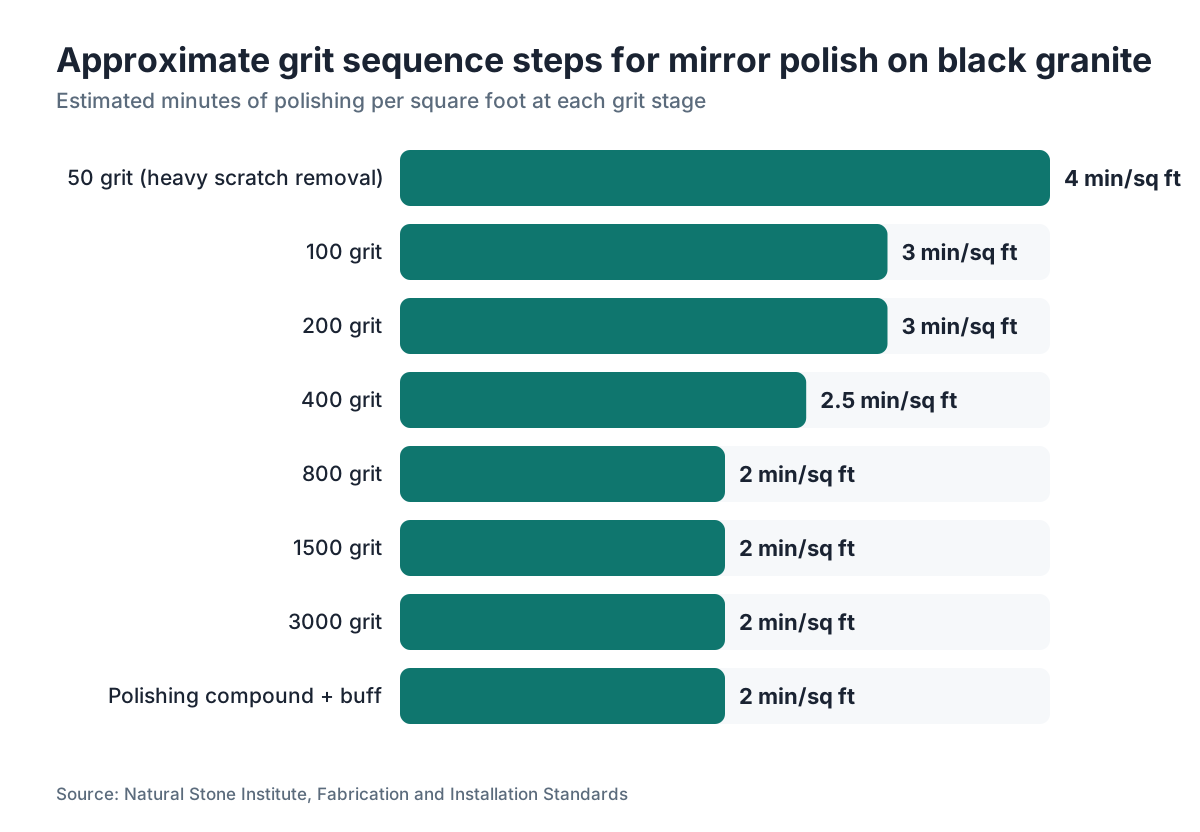
Here's the standard professional sequence for a countertop that has dull scratches or a hazy finish, not deep gouges:
- 50 grit (if the surface has visible scratches or an uneven profile)
- 100 grit (or start here if the stone is in decent shape)
- 200 grit
- 400 grit
- 800 grit
- 1500 grit
- 3000 grit
- Polishing compound + soft pad (final buff)
A countertop that just lost its shine with no visible scratches can often start at 400 grit and run through to the compound stage. That cuts real time off the job. Two to three minutes per square foot at each pad, with overlapping passes and continuous water, is a fair benchmark. The only real mistake is rushing.
Fabricators run this same sequence in the shop. The final buff uses a tin oxide compound or a cerium oxide compound on a felt or foam pad at low speed. Cerium oxide earns its place in the glass and stone trade because it polishes by a chemical-mechanical action that fills micro-pits as it abrades, which gives a clearer reflection than tin oxide alone [4].
How much does professional granite polishing cost?
In-place polishing of granite countertops runs about $5 to $15 per square foot, depending on how much refinishing is needed and where you live [5]. A standard kitchen with roughly 40 square feet of counter costs $200 to $600. That price usually covers labor, all abrasives through the final compound, and a light sealer at the end. It doesn't cover repair of deep chips or cracks, which get quoted separately.
If a fabricator has to haul the slab back to the shop for heavy grinding or edge repolishing, expect more. Edge repolishing alone often runs $50 to $150 per linear foot because of the handling and labor.
Full replacement of black granite runs $60 to $150 per square foot installed, depending on material grade, edge profile, and location [6]. So polishing almost always wins for a slab that's structurally sound. The one case where refinishing doesn't pencil out is deep structural cracks or thermal spalling that reached past the surface layer.
For fabricators quoting these jobs, software like SlabWise prices polishing work alongside new installs without a separate spreadsheet.
How do you actually polish the countertop step by step?
Clear and clean the whole countertop first. Dry grit under a spinning diamond pad scratches worse than whatever you started with. Wipe it down with a neutral stone cleaner or plain warm water and a microfiber cloth. Tape off your backsplash and cabinet faces with painter's tape if you're working close to them.
Attach your 50 or 100 grit pad to the backer. Set the polisher to low speed, roughly 600 to 900 RPM for coarse pads. Wet the surface all the way and work in overlapping circular or figure-eight passes, pad flat on the stone, moving steadily. The water should stay a cloudy gray-black the whole time. If it dries out, stop and re-wet. Dry polishing builds heat that can micro-crack the surface and glazes your pad fast.
Work one two-foot-by-two-foot section at a time. Finish that section at your starting grit, wipe it clean, and inspect it under a raking light (a work light held nearly parallel to the surface shows everything). Then move up to the next grit. Any deep scratch still visible at 200 grit means you drop back to your starting grit on that spot.
As you reach 1500 and 3000, slow down and let the pad do the work. The gap between a hazy shine and a true mirror often happens entirely in this last 20 minutes. At 3000 grit the surface looks glossy but may still hold very fine swirl marks under strong light.
The final buff uses polishing compound on a felt or foam pad at low to medium speed. Work it in overlapping passes until the compound is nearly gone, then wipe off any residue with a clean microfiber cloth. Under an overhead light you should now see a clear reflection. If you spot haze, go back to 3000 grit for another two minutes per section and buff again.
Once it's polished, apply a penetrating granite sealer per the maker's instructions. Polishing opens the stone's micro-texture a little, and sealing within an hour or two keeps oil and water out of those micro-pores [7].
Can you use a random orbital sander instead of an angle grinder?
Technically yes, but plan on longer times and less even results. A standard random orbital sander tops out around 12,000 OPM (orbits per minute), which doesn't map cleanly to grinder RPM, and the real problem is that most orbital sanders aren't built for wet use. Water gets into the motor seals and they fail fast.
Random orbital polishers made for stone and automotive paint, like the Rupes or Porter-Cable 7424XP, can run wet diamond pads on a proper backer. They handle the finishing stages fine, starting around 400 or 800 grit through the compound, but they lack the torque for real material removal at 50 or 100 grit. For a countertop that just needs its shine back with no real scratches, an orbital polisher with pads from 400 grit up is a reasonable route.
For anything heavier, use an angle grinder or a dedicated variable-speed wet polisher. The price gap ($80 to $200 for a good wet polisher versus $60 to $120 for a quality orbital) isn't big enough to justify the hours you'll lose fighting the wrong tool.
Why does my black granite look dull after cleaning or sealing?
Three different problems cause this, and each has its own fix.
First, many sealers leave a slight haze if you apply them over residual moisture or wipe them off too late. Most penetrating sealers want to be wiped to a dry surface within 5 to 10 minutes, before they start to film. Leave them longer and the haze is dried sealer sitting on top of the stone instead of soaking in. Acetone on a microfiber cloth usually clears it without re-polishing [7].
Second, some household cleaners carry soaps or surfactants that film over polished stone. Dish soap is a common offender. The film doesn't harm the stone, but it scatters light and kills the mirror. A streak-free stone cleaner or a 50/50 isopropyl alcohol and water mix takes it off.
Third, real surface etching or micro-abrasion from abrasive cleaners or dragged grit dulls the polish for good. No amount of cleaning fixes that. You re-polish. Most household use won't cause it for years, but kitchens near entryways, where foot traffic tracks in sand, are genuinely at risk.
Black granite is less forgiving than lighter stone about hard water. A water spot on Absolute Black looks dramatically worse than the same spot on a beige granite because the contrast is so high. Dilute white vinegar removes calcium deposits, but regular use will etch any polished stone over time, so save it for stubborn spots and rinse hard right after.
For a full cleaning routine that won't risk your finish, see the how to clean stone countertops guide.
How is a mirror polish different from a honed or leathered finish?
These are three different surface textures, and you can't reverse one without reprocessing the stone.
A mirror or high polish comes from working diamond abrasives all the way to 3000 grit and past it, leaving a surface so smooth it reflects light without scattering. Gloss readings usually run 90 to 100+ on the DOI scale. Black granite at this finish looks almost like a panel of black glass.
A honed finish stops the abrasive sequence around 400 grit. The surface feels smooth, not rough, but it scatters enough light to look matte or satin with no real reflection. Honed finishes are popular on kitchen islands because fingerprints and smudges hide far better and the surface reads more natural. The tradeoff: honed stone is more porous at the surface than polished stone and drinks up liquid faster if left unsealed [8].
A leathered or brushed finish uses diamond brush wheels instead of flat pads to leave a slightly textured surface that keeps the natural topography of the crystals. It sits between matte and polished, resists fingerprints well, and has become common on darker granites over the last decade. Going from leathered back to mirror means starting over at coarse grit, because you're grinding off the raised texture.
If your countertop arrived with a mirror polish and you want to keep it, that's maintenance polishing, which starts at 800 or 1500 grit depending on condition. If someone honed or leathered a slab you wanted polished, you're doing full refinishing from 50 or 100 grit.
| Finish | Grit endpoint | Gloss (DOI) | Fingerprint visibility | Porosity |
|---|---|---|---|---|
| Mirror / High Polish | 3000+ grit + compound | 90 to 100+ | High | Low |
| Honed | ~400 grit | 20 to 40 | Low | Higher |
| Leathered | Diamond brush | 30 to 60 (variable) | Very low | Medium |
| Satin | ~800 grit | 50 to 70 | Medium | Low-medium |
How long does a mirror polish last on black granite countertops?
With good care, a professionally applied mirror polish on black granite lasts 10 to 20 years before it needs serious rework. The stone itself doesn't degrade. What happens is that surface micro-abrasion from daily use, abrasive cleaners, and stray grit builds up and slowly drops the DOI reading.
Counters near cooktops dull faster because grease works into the micro-scratches and scatters light. Counters used as cutting surfaces (never do this, but people do) lose their polish quickly. A bathroom vanity or laundry room top in black granite can hold a mirror finish for decades on basic care.
A practical schedule most stone care pros suggest: reseal every one to three years with a penetrating impregnator sealer (frequency depends on the stone's porosity and the sealer brand), and do a light maintenance buff with a 3000 grit pad and compound every two to five years if the reflection starts losing clarity [9]. That buff is about a one-hour job on an average kitchen if the stone is in decent shape.
What are the most common mistakes people make polishing black granite?
Skipping grits is the biggest one, as covered above. Second biggest: letting the surface dry while you polish. Dry grinding builds heat that stresses the grain boundaries and opens fine radial cracks around existing micro-flaws. It also glazes the diamond pad and kills its cut. Keep water on the surface the entire time.
Wrong pad type is a real issue too. Dry diamond pads are made for tile cutting and grout removal, not stone polishing. Wet resin-bond pads are built for the polishing sequence. They look alike and behave completely differently. Wet pads use a more flexible bond that conforms to the surface and leaves a more even scratch pattern.
Overworking one grit is less common but it happens. Three to five minutes per section per grit is usually plenty. Twenty minutes at 100 grit doesn't beat four minutes at 100 grit. It just removes extra material and burns through pads.
Last, polishing right up to the edge without addressing the edge profile is a mistake when the edges are scratched or dull. The flat and the edges have to match. Edge polishing needs smaller pads or hand pads for the curved parts of the profile. A gorgeous flat surface next to dull, scratched edges looks worse than a counter that's honed all the way across.
For how black granite stacks up against other stone and how fabricators price it, the granite countertops guide covers material grades and typical installed costs.
Should you hire a pro or polish black granite yourself?
It comes down to what you're starting with. If your black granite has a few dull spots from cleaning products and you're comfortable with power tools, a DIY touch-up starting at 800 grit is totally reasonable. Figure a couple of hours and under $100 in supplies.
If the counter has visible scratches, a hazy or chalky look across the whole surface, or was honed and you want to convert it to a mirror, that's a heavier job. A first-time DIYer will likely spend five to eight hours on an average kitchen and still leave some uneven sections. A pro team does the same job in two to three hours with more even results, because they work these surfaces every day.
My honest take: for a full-kitchen refinish, hire a stone restoration pro the first time. Watch what they do, ask them to walk you through it, and handle your own maintenance between their visits. Most stone restoration companies are listed through the Natural Stone Institute or local tile and stone associations.
If you're a fabricator running polishing as a service, the margin on in-shop edge polishing is good, but the profit really rides on quoting the time right. Shops that track polishing labor with job-costing tied to quoting (a demo of SlabWise shows how this fits the slab workflow) stop underquoting restoration work that would otherwise eat their install margin.
Frequently asked questions
Can I use car polishing compound on black granite?
Some car polishes work, but most carry silicone or wax that leaves a temporary shine, not a true surface polish. They also skip the surface micro-scratches that a cerium oxide or tin oxide stone compound removes. For a genuine mirror finish, use a granite-specific compound. A car polish might look great for a week, then haze over as the wax wears off.
What grit sandpaper do I start with for black granite?
Use diamond abrasive pads, not sandpaper. Silicon carbide sandpaper cuts too irregularly for stone and won't give you a consistent scratch depth you can work through. Start at 50 or 100 grit wet diamond pads for a heavily scratched surface, or 400 grit if the stone just needs refreshing. Regular sandpaper leaves swirl marks you'll fight even at fine grits.
How do I polish the edges of black granite to match the flat surface?
Edges need smaller hand pads or finger pads that conform to the profile. For straight edges, a 3-inch diamond pad on a right-angle attachment works. For bullnose, ogee, or eased profiles, use flexible hand pads and run the same grit sequence as the flat surface. The edge and flat both have to finish at the same grit to match gloss levels.
Does polishing granite remove the sealer?
Yes. Any abrasive polishing process strips the penetrating sealer, so you reseal after polishing. Apply a penetrating impregnator sealer once the surface is clean, dry, and at room temperature. Follow the maker's dwell time and wipe-off instructions exactly, or you'll leave a haze on your freshly polished surface.
Why does my black granite show fingerprints so easily after polishing?
Mirror-polished black granite is one of the most fingerprint-prone surfaces in any kitchen. The high-gloss surface reflects skin oil clearly against the dark background. That's no defect, it's a direct result of the finish quality. Regular wiping with a clean microfiber cloth is the only real fix. Some homeowners switch to a leathered or honed finish specifically to dodge this.
Can you polish black granite countertops without removing them?
Yes, and this is how nearly all professional stone restoration gets done. In-place polishing with a variable-speed wet polisher and good water management is standard practice. The main challenge is protecting cabinets, appliances, and walls from water and compound splatter, handled with plastic sheeting and painter's tape. Heavy grinding near the sink cutout or close to walls is harder but still doable in place.
How do I know if my black stone is actually granite or a different rock?
The simplest field test is hardness. True granite scores 6 to 7 on the Mohs scale and scratches glass easily but won't be scratched by a steel knife. If a steel knife leaves a white scratch, your stone is softer than granite, likely gabbro or soapstone. The USGS notes that many stones marketed as granite are technically gabbro or other plutonic rocks but polish the same way. For practical purposes, the method is identical.
How long does it take to polish 40 square feet of black granite?
A pro team with proper equipment usually finishes 40 square feet in two to four hours, including setup and sealing. A careful DIYer doing the same work, no major mistakes, starting at 100 grit, should budget six to ten hours across one or two sessions. Time per section drops sharply as you move to finer grits, since you're removing less material.
Does granite polish make black granite waterproof?
No. Polishing closes surface micro-texture and cuts liquid penetration compared to a honed or leathered finish, but granite is still porous. Only a penetrating sealer applied after polishing reduces water absorption. The ASTM C97 test for water absorption shows granite typically absorbs 0.1 to 0.4 percent by weight, and sealing lowers that further without eliminating it.
What is the cost difference between DIY polishing and hiring a professional?
DIY material costs run $65 to $360 depending on what you already own. Professional in-place polishing costs $5 to $15 per square foot, so $200 to $600 for an average kitchen. DIY saves money if you already have tools and plan to maintain the surface yourself over time. For a one-time refinish with no ongoing polishing, professional work is competitive once you count your time.
Can I use a buffer or floor polisher on granite countertops?
Floor-style rotary buffers spin too fast for countertop stone and can overheat the surface. They're also awkward to control at counter height. A dedicated variable-speed wet polisher in the 600 to 3500 RPM range is the right tool. Some restoration pros run 7-inch machines on large flat surfaces, but 5-inch variable-speed polishers move easier and are the standard for kitchen work.
Will polishing black granite fix scratches from knives or pots?
Depends on depth. Knife marks on granite are usually white scratches in the surface layer, which polishing from 200 or 400 grit lifts easily. Deep gouges from dropped cast iron or heavy impact may need a 50 grit start and more passes, and very deep chips may need diamond grinding or professional chip repair before polishing. Polishing removes material, so deep damage means more starting-grit work.
How do I maintain a mirror polish on black granite long-term?
Clean with a pH-neutral stone cleaner or water only. Skip abrasive pads, scouring powders, and bleach. Reseal every one to three years with a penetrating impregnator sealer. Every two to five years, do a light maintenance buff starting at 1500 or 3000 grit to restore DOI if the reflection loses clarity. Keeping grit off the surface (trivets under cookware, a mat by the sink) slows degradation a lot.
Is a mirror polish safe for a kitchen countertop, or does it show every imperfection?
Mirror-polished black granite works fine in kitchens and shows fingerprints and water spots clearly, which most homeowners either accept or manage with frequent wiping. It resists heat up to about 480 degrees Fahrenheit (though thermal shock from rapid temperature swings can cause stress fractures over time), resists scratches compared to most surfaces, and is easy to sanitize. The main downside is appearance upkeep, not durability.
Sources
- U.S. Geological Survey (USGS), National Minerals Information Center, Dimension Stone: Absolute Black granite is a fine-grained igneous rock composed primarily of pyroxene and plagioclase with minimal quartz, suitable for high-gloss polish
- OSHA, Crystalline Silica page: Angle grinder use on stone requires wet methods and appropriate RPM management; OSHA guidance on silica dust from stone fabrication
- Natural Stone Institute, Fabrication and Installation Standards: Professional diamond pad grit sequences and pad quality standards for stone polishing
- The American Ceramic Society, Cerium Oxide Polishing Mechanisms: Cerium oxide polishes by a combined chemical-mechanical action that fills micro-pits as it abrades, producing higher gloss than tin oxide alone
- Angi, Countertop Polishing Cost Guide: Professional in-place granite polishing typically costs $5 to $15 per square foot nationally
- Angi, Granite Countertop Installation Costs: Full granite countertop replacement costs $60 to $150 per square foot installed depending on material grade and region
- Natural Stone Institute, Care and Maintenance of Stone: Penetrating sealers must be applied to clean dry stone and wiped off within 5 to 10 minutes to prevent surface film haze; polishing opens surface micro-texture requiring re-sealing
- Natural Stone Institute, Surface Finish Definitions: Honed stone surfaces are more porous at the surface than polished stone because the final crystal-closing step of polishing has not been performed
- Natural Stone Institute, Sealing and Maintenance Recommendations: Most penetrating impregnator sealers should be reapplied every one to three years depending on stone porosity and product brand
- USGS, National Minerals Information Center, Stone Commodity Summaries: Many dimension stones marketed commercially as granite are technically gabbro or other plutonic rocks; polishing methodology is the same for both
- ASTM International, ASTM C97 Standard Test Methods for Absorption and Bulk Specific Gravity of Dimension Stone: Granite typically absorbs 0.1 to 0.4 percent water by weight under ASTM C97 test conditions
- OSHA, Crystalline Silica standard summary (29 CFR 1926.1153): Wet grinding methods reduce silica dust exposure during stone fabrication; OSHA's silica standard applies to fabrication shop and field work
Last updated 2026-07-10