TL;DR
- Wood countertops run $40 to $100 per square foot installed, more for teak or end-grain walnut.
- They're warm, DIY-friendly, and repairable in ways stone never is.
- The trade-off: regular oiling, visible water rings, and dents over time.
- Your species and finish choices decide whether wood holds up in a working kitchen or turns into a maintenance headache.
What do wood countertops actually cost?
Installed wood countertops in the U.S. generally land between $40 and $100 per square foot. Premium species like teak or end-grain walnut push past $150 at some fabricators [1]. The range is that wide because 'wood countertop' covers a lot of ground. A face-grain pine slab from a local mill is a completely different product than a commercial-grade end-grain maple butcher block.
Materials alone, before any labor, typically run $20 to $60 per square foot. Fabrication and install add another $20 to $40, depending on your region, edge profile, and cutouts. A single sink or cooktop cutout adds $100 to $200 to the job.
Here's a rough breakdown by wood type and construction method:
| Style | Material cost (per sq ft) | Typical installed cost |
|---|---|---|
| Edge-grain maple or birch (prefab) | $20, $35 | $40, $60 |
| Face-grain oak or cherry | $25, $45 | $50, $75 |
| End-grain maple or walnut | $45, $80 | $80, $120 |
| Teak or exotic hardwood | $60, $100+ | $100, $160+ |
| DIY face-grain (lumber yard boards) | $5, $15 | $15, $35 (labor = yours) |
For context, granite countertops run $50 to $120 installed, and laminate countertops start around $15 to $40. Wood sits in the middle. But it offers something neither material does: you can sand out a bad scratch yourself with 120-grit paper and a Saturday afternoon.
Labor rates swing hard by region. The Bureau of Labor Statistics reports carpenters' median hourly wage was $24.05 nationally as of May 2023, though custom fabricators in high-cost metros charge far more [2]. Get at least three quotes where you live.
What are the different types of wood countertops?
The three constructions are edge-grain, face-grain, and end-grain. The difference matters more than most buyers realize. It drives price, durability, and how the surface reacts to moisture.
Edge-grain countertops glue boards together so the long edge faces up. This is the standard for prefab butcher-block panels at home improvement stores. It's dimensionally stable, affordable, and holds up well under daily kitchen use. The grain runs in clean parallel lines.
Face-grain countertops expose the wide face of the board, showing the most dramatic figure. Beautiful. Also the least stable of the three. The face expands and contracts more with humidity swings, and the surface is more prone to checking (small surface cracks) in dry climates. Face-grain belongs on furniture more than on a hard-working kitchen surface near the sink.
End-grain countertops cut across the growth rings, so you see the wood's circular cross-section. This is the classic checkerboard butcher block. End-grain is self-healing in one real sense: knife cuts go between fibers rather than across them, and the surface looks nearly new after a good sanding and re-oil. It's also the most expensive and the heaviest, weighing 10 to 15 percent more than the equivalent edge-grain panel. It drinks liquids faster, so finish maintenance is more demanding.
For a deeper look at construction, species, and how prefab panels stack up against custom slabs, the butcher block countertops guide covers that ground in detail.
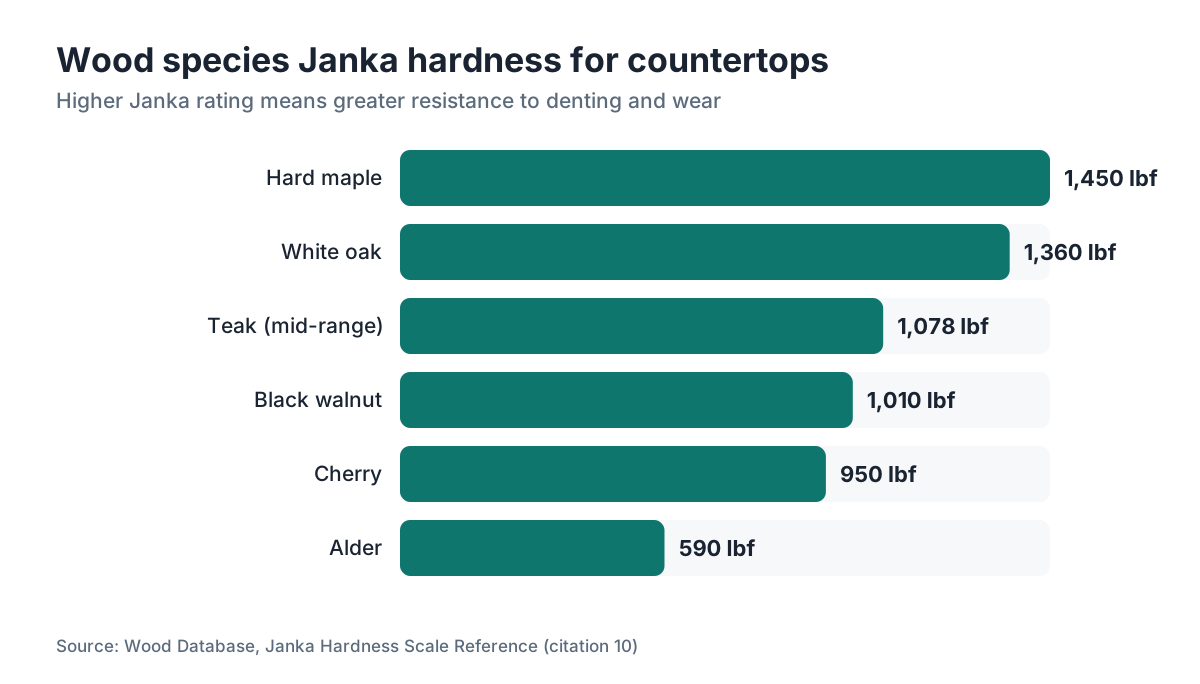
Species changes the whole character of a wood top. The Janka hardness scale measures resistance to denting and wear. Soft species like pine (Janka 870) and alder (Janka 590) mark up fast. Harder ones like maple (Janka 1450), white oak (Janka 1360), and walnut (Janka 1010) hold up far better to daily use. Teak (Janka 1,000 to 1,155 depending on source) has the added advantage of high natural oil content, which makes it water-resistant without heavy finish work [3].
What are the real pros and cons of wood countertops in a kitchen?
Let's be honest about both sides.
The genuine advantages. Wood is warm in a way no stone can copy, visually and literally. It's a real food-prep surface, more than a decorative one. You can repair it at home. It's lighter than stone, which matters if your cabinet boxes or floor joists aren't built for a full granite slab. And for DIY, wood is far more forgiving than stone. You cut it with a circular saw, not a wet saw with a diamond blade.
End-grain maple, the material used for commercial cutting boards for a century, is more knife-friendly than stone or ceramic. Research from the University of California, Davis found that wood cutting surfaces can hold fewer recoverable bacteria than plastic under real-world conditions when properly maintained, because bacteria drawn into the grain don't multiply and die off [4]. That doesn't make a wood countertop a substitute for cleaning. It does push back on the myth that wood is inherently dirtier than a hard surface.
The real disadvantages. Water is wood's enemy. A wood top near a sink that isn't sealed right, or that loses its seal and goes untreated for months, will swell, warp, or grow mold. This isn't a scare tactic. It happens constantly when people pick wood for the look and then skip maintenance. The zone around the sink takes the most abuse, and wood there demands real attention.
Wood also moves. Solid wood expands and contracts with the seasons, which is why fabricators fasten it with Z-clips or elongated screw slots instead of rigid fasteners. Over-fasten it, or butt it hard against a wall with no expansion gap, and you risk cracking.
Heat is the third problem. A hot pan on an oiled wood surface leaves a mark. Every time. Use trivets. Some finishes (polyurethane, for one) blister and peel under sustained heat, and mineral oil won't stop scorching either.
And wood is not granite. It dents. It scratches where you can see it. If you want a surface that looks pristine for twenty years with almost no care, buy quartz or granite. If you want a surface that earns honest character and can be refinished when it gets rough, wood makes a lot of sense.
What's the best finish for wood countertops, and how often do you need to maintain them?
Finish is the biggest decision after species, and it sets your entire maintenance life with the countertop.
Penetrating oil finishes (mineral oil, linseed oil blends, Danish oil, or commercial products like Waterlox and food-safe tung oil blends) soak into the wood instead of forming a film on top. They give a natural matte look and are easy to keep up: when the surface looks dry or dull, you wipe on another coat. The catch is less water resistance than a film finish. For a countertop near a sink, expect to oil monthly for the first year, then a few times a year once the wood is well-saturated.
Hardwax oil finishes (Rubio Monocoat, Osmo Polyx) are penetrating finishes that also carry wax. They cure harder than straight mineral oil, shed water better, and are food-safe once cured. Rubio Monocoat markets its product as a one-coat application that finishes the wood in a single pass, though you still need maintenance coats down the road.
Film finishes (polyurethane, lacquer, conversion varnish) build a hard plastic-like layer on top. They give the best protection against water and stains while intact, but they chip, peel, and scratch where you can see it. Once a film finish fails, the wood under it is exposed, and you can't spot-treat. You strip and refinish the whole surface. Film finishes also make the top feel less like wood. Most custom fabricators building tops for real food prep pick penetrating oils for that reason.
For any surface used for direct food prep or cutting, stick to food-safe options: USP-grade mineral oil, beeswax blends, food-grade tung oil, or finishes labeled food-safe after cure. Pure linseed oil (not boiled linseed oil, which carries metal driers) is technically food-safe but dries painfully slowly.
A reasonable maintenance schedule for an oiled hardwood countertop:
| Period | Task |
|---|---|
| First month after installation | Oil every 1 to 2 weeks until wood stops absorbing |
| Months 2 to 12 | Oil once a month |
| After year 1 | Oil every 2 to 3 months or when surface looks dry |
| Every 3 to 5 years | Light sand (150 to 220 grit) and full re-oil if surface is rough or stained |
One real-world note: that schedule assumes average humidity and use. A countertop in a very dry climate (say Arizona at 15% indoor humidity in winter) needs oil more often. One in a humid climate needs it less.
How does wood compare to stone, quartz, and other countertop materials?
It depends entirely on what you're optimizing for. There's no single winner here.
| Material | Installed cost (per sq ft) | Repairability | Heat resistance | Water resistance | Hardness |
|---|---|---|---|---|---|
| Wood (edge-grain maple) | $40, $80 | High (sand + refinish) | Low (trivets required) | Moderate (finish-dependent) | Medium |
| Granite | $50, $120 | Low (cracks are permanent) | High | High (sealed) | Very high |
| Quartz | $60, $130 | Low | Moderate | Very high | Very high |
| Marble | $60, $150 | Low (etches easily) | High | Low (etches) | Medium |
| Butcher block (prefab) | $20, $50 | High | Low | Moderate | Medium |
| Laminate | $15, $40 | Low | Low | Moderate | Low |
| Corian/solid surface | $40, $80 | High (can be sanded) | Moderate | High | Low-medium |
Wood's real competition is solid surface (like Corian) on repairability, and butcher block on price and character. Against granite or quartz, wood asks for more maintenance but costs less in many builds, and you can install it without specialty tools or a pro crew.
If you're comparing purely on durability with zero appetite for maintenance, wood isn't your material. If you're comparing on warmth, workability, and the freedom to fix your own mistakes, wood is hard to beat.
For the kitchen countertops overview that lines up every material side by side, that guide goes deeper on total cost of ownership across categories.
Can you install wood countertops yourself, and how hard is DIY actually?
DIY wood countertops are genuinely doable for anyone comfortable with a circular saw, a router, and basic woodworking. Wood is one of the few countertop materials where doing it yourself often beats a rushed professional job.
The typical DIY process for a prefab butcher-block panel (the most common route):
- Measure carefully. Leave 1/8" to 1/4" of overhang on the front and exposed sides, and a 1/8" gap at walls for expansion.
- Cut to length with a circular saw and a straight-edge guide. Use a fine-tooth blade (40+ teeth) to cut tear-out.
- Cut the sink opening with a jigsaw off the template that comes with the sink. Cut just inside the line and clean up with a file or trim router.
- Round or profile the front edge with a router and a roundover or chamfer bit, or leave it square.
- Sand to 150 or 180 grit. Wipe clean with a tack cloth.
- Apply your first coat of mineral oil or hardwax oil. Let it absorb, wipe the excess. Repeat several times before the top goes into service.
- Fasten with Z-clips or figure-8 fasteners through the cabinet rail, not screws through fixed holes, so the wood can move.
The trickiest parts are the sink cutout and inside corners. An inside corner joins two runs of countertop at 90 degrees. With stone, a fabricator miters it. With wood, you can do a butt joint or a miter, but the seam opens and closes slightly with the seasons. Most people run wood glue and food-safe caulk in that joint and accept the occasional touch-up.
Total material cost for a basic DIY project with prefab edge-grain maple: roughly $15 to $35 per square foot, depending on species, panel thickness (1.5" is standard, 2" is premium), and big-box pricing [1].
Going custom, cutting from rough lumber and gluing up your own panels, adds time and skill but cuts material cost further. A rough-sawn walnut slab from a local sawmill runs $5 to $12 per board foot depending on region, grade, and availability.
For countertop installation more broadly, including what pros do differently for stone versus wood versus solid surface, that guide covers the full process.
What wood species are best for kitchen countertops?
Species selection comes down to three things: hardness (Janka rating), water resistance, and cost.
Hard maple (sugar maple) is the industry standard, and for good reason. Janka hardness of 1,450 lbf, consistent grain, takes oil evenly, and sells at predictable prices. Most commercial butcher-block panels are hard maple. Not the most dramatic species, but dependable.
White oak has surged in kitchen design over the last decade. Janka 1,360 lbf, with more character than maple. Its open grain drinks oil fast, so you'll burn through more finish on the first application. It's also a bit more prone to visible staining near a sink when maintenance slips.
Black walnut is the showpiece. Rich chocolate-brown tones, Janka 1,010 lbf (softer than maple or oak), and expensive. A custom walnut top costs well above an equivalent maple, and it dents more easily under direct impact. Use it, and commit to the care routine.
Cherry starts light and darkens a lot over time through oxidation in light. Janka 950 lbf. Soft enough to show wear if you're rough on it. A beautiful material for lower-use zones.
Teak is the pick for durability and water resistance. High silica content and natural oils make it almost uniquely moisture-resistant among countertop woods. Janka 1,000 to 1,155 lbf depending on source. The downside is price, plus real sourcing concerns around legality and sustainability with some teak products [5]. Look for FSC-certified teak if that matters to you.
Here's a quick comparison:
| Species | Janka hardness (lbf) | Relative cost | Water resistance | Notes |
|---|---|---|---|---|
| Hard maple | 1,450 | $ | Moderate | Best all-around workhorse |
| White oak | 1,360 | $$ | Moderate | Trendy, open grain |
| Black walnut | 1,010 | $$$ | Moderate | Beautiful, softer, expensive |
| Cherry | 950 | $$ | Moderate | Darkens over time |
| Teak | 1,000 to 1,155 | $$$$ | High | Best moisture resistance |
| Bamboo (engineered) | 1,380 to 1,800 | $ | Moderate-high | Not true wood, technically grass |
A note on bamboo: it's not wood, but it sells right alongside wood countertops. Strand-woven bamboo can be harder than maple, grows fast, and costs less. The catch is that many bamboo panels use urea-formaldehyde adhesives, and off-gassing has been a concern with lower-quality products. Look for CARB Phase 2 compliant panels [6].
How do you clean and maintain wood countertops day to day?
Daily cleaning is simple. A few habits make or break the surface over the years.
For oiled (penetrating finish) countertops, clean with a damp cloth and mild soap. A little dish soap is fine. Don't soak the surface, don't use bleach, and don't leave standing water. Then dry it. That last step, drying, is the one most people skip before they wonder why the wood is darkening near the sink.
For film-finished (polyurethane) countertops, you can use slightly stronger cleaners, but skip abrasives that scratch the finish coat. Once a film finish scratches, the bare wood below is exposed and vulnerable.
Things that wreck wood fast: hot pans without trivets, cutting directly with heavy cleavers (normal chef knives on oiled end-grain are fine), wet sponges or dish racks left sitting for hours, and acidic liquids like citrus juice or vinegar left to sit.
For a stained or discolored spot, fine steel wool (0000 grade) with a little mineral oil scrubs out many surface stains without cutting through the finish. For cuts, gouges, or deeper stains, a light hand-sand with 150-grit paper and a re-oil usually brings it back. This is wood's edge over stone: mistakes are fixable.
If you want care guidance across material types, the how to clean stone countertops guide has useful comparisons on which cleaning agents to avoid on different natural surfaces.
Do wood countertops work near a sink, or should you avoid that?
This is the question most homeowners ask. The honest answer: yes, with caveats.
Wood near a sink works, but it needs the right species, the right finish, and consistent care. A poorly sealed wood top within six inches of a wet kitchen sink will have problems inside a year. A properly finished teak or hard maple top in the same spot, oiled on schedule, can last decades. The USDA Forest Products Laboratory has documented wood's durability in high-moisture uses when properly finished and maintained, noting that end-use conditions and finish upkeep are the main drivers of service life [7].
Practical steps for the sink zone:
Use a hardwax oil or a waterborne finish with better water resistance than straight mineral oil. Waterlox Original, for example, is a tung-oil-based varnish that gives a harder, more water-resistant surface than plain penetrating oils and stays repairable.
Install an undermount sink instead of a drop-in if you can. A drop-in creates a lip where water pools against the grain. An undermount kills that junction entirely.
Caulk the joint between the countertop and backsplash with a paintable, flexible silicone or wood-compatible caulk, and refresh it every year or two.
Dry the area around the sink daily. It takes thirty seconds. People who say wood countertops 'don't work' near sinks almost always skipped this.
Some fabricators run a different material at the sink zone and transition to wood elsewhere. A granite or quartz insert at the sink with wood on either side is a legitimate design and it removes the maintenance worry entirely. Cutting boards in the wood zone, hard stone at the sink. That's what I'd do with small kids around, or if regular maintenance wasn't realistic.
How long do wood countertops last, and when do they need replacing?
A properly maintained solid hardwood countertop can last 20 to 50 years. That's not marketing copy. It's the normal service life of well-kept hardwood in furniture and flooring, and countertops are no different if you keep the finish up [7].
The real lifespan question is about refinishing cycles, not replacement. An oiled hardwood top can be sanded and refinished every 5 to 10 years as needed, taking off up to 1/8" of material each time. A 1.5"-thick panel handles roughly 10 full refinishes before it gets too thin to stay structurally solid. A 2"-thick panel gives you even more.
Compare that to a laminate countertop, which can't be refinished at all. Once the surface wears through or chips, replacement is your only move. Quartz cracks and is very hard to repair invisibly. Wood's ability to renew in place is its real long-term cost edge, even when upfront installation runs similar.
So when does wood need replacing instead of refinishing? When it has deep structural cracks through the panel, when it warps badly enough to gap from the cabinet below, or when moisture damage lets mold penetrate more than a surface deep. Those cases almost always trace back to a finish that failed completely and went unrepaired for a long stretch. None of them happen to a maintained countertop.
Fabrication shops that track warranties report the same pattern: callbacks on wood countertops almost always trace to installation errors (over-fastened tops that can't move) or finish maintenance that was never done. The wood itself rarely fails.
How do fabricators quote and build wood countertops?
For fabricators reading this: wood is a different workflow than stone, and quoting it accurately takes some care.
Material costs move more than granite or quartz because you're buying natural lumber, priced against housing markets and supply chains. Hardwood lumber prices track the Random Lengths Hardwood Report, and they can swing 20 to 40% over a calendar year [8]. Build that variability into your quotes, or at least flag it to the customer.
Fabrication time per square foot is generally lower than stone (no wet saw, no waterjet), but the finish schedule adds time. A top that ships with two coats of Rubio Monocoat, each needing 24 hours of cure, adds two days to your schedule. Account for it.
Sink cutouts in wood happen with a jigsaw or router, faster than a stone cutout. But edge profiling on thick 2" stock can run longer than CNC work, because plenty of wood shops are still router-table operations. A point-to-point CNC cuts edge-profiling time way down.
For quoting software that handles material costs, cutouts, and edge profiles across multiple counter materials including wood, SlabWise (slabwise.com) is built for fabrication shops and handles the material yield and pricing logic that generic job-costing tools miss. It's especially useful on mixed-material jobs where part of a kitchen is stone and part is a wood prep area.
Nesting matters less with wood panels than with stone slabs, but it still applies when you're cutting several sections from one glued-up panel or a wide plank. Plan the cut sequence before any blade touches the wood and your offcuts shrink.
Are there any health or safety concerns with wood countertops?
A few real ones are worth knowing.
Formaldehyde in adhesives. Many prefab wood panels use urea-formaldehyde (UF) or melamine-formaldehyde (MF) adhesives in their laminated construction. These can off-gas formaldehyde, especially when new. California's Air Resources Board (CARB) regulates composite wood products under the Airborne Toxic Control Measure (ATCM), and products sold in California must meet CARB Phase 2 emission standards [6]. Those are among the strictest limits anywhere, and most reputable manufacturers now meet or beat them. If formaldehyde worries you, look for products labeled 'CARB Phase 2 compliant' or built with phenol-formaldehyde (PF) or MDI (methylene diphenyl diisocyanate) adhesives, which emit far less.
Food safety of finishes. Only use finishes labeled food-safe for surfaces that touch food directly. Fully cured polyurethane is generally considered non-toxic by the FDA, but it isn't labeled food-safe because the surface is hard to repair without a full strip and refinish [9]. USP-grade mineral oil, beeswax, and food-grade tung oil are the safest picks for a surface you'll roll dough on or cut vegetables on.
The bacteria question. The 1994 UC Davis research found that bacteria on wood surfaces died off more readily than on plastic under natural conditions, though that testing used unfinished wood, not finished countertops [4]. FDA food safety guidance for commercial prep still recommends smooth, non-porous surfaces. In a home kitchen, sanitation is less about the material and more about your cleaning habits. A frequently cleaned oiled wood countertop is not a health risk.
If VOCs from finishes concern you during installation, ventilate well, keep kids and pets out of the kitchen for 24 to 48 hours after oil-based finishes, and choose water-based hardwax oils.
Frequently asked questions
How much do wood countertops cost per square foot installed?
Installed wood countertops typically cost $40 to $100 per square foot. Edge-grain maple sits at the low end, end-grain walnut or teak at the high end. DIY with prefab butcher-block panels from a home improvement store drops material cost to $20 to $35 per square foot, with your labor free. Get quotes from at least three local fabricators, since regional labor rates swing hard.
What is the most durable wood for kitchen countertops?
Hard maple (Janka 1,450 lbf) is the most practical pick for durability and cost. Teak offers the best moisture resistance thanks to its natural oil content. White oak (Janka 1,360) runs a close second to maple for hardness. Skip softer species like cherry (Janka 950) or pine (Janka 870) for a heavily used surface near the sink.
Can wood countertops be used next to a sink?
Yes, with the right approach. Use a harder species like maple or teak, apply a water-resistant hardwax oil finish, install an undermount sink to avoid a water-trapping lip, and dry the area around the sink daily. Drop-in sinks against wood are riskier. With consistent maintenance, a wood countertop near a sink performs well for many years.
How do you seal or finish wood countertops?
Two main paths: penetrating oils (mineral oil, hardwax oil like Rubio Monocoat or Osmo) and film finishes (polyurethane, Waterlox). Penetrating oils are easier to maintain and repair but less water-resistant. Film finishes protect better while intact but chip and require a full strip-and-refinish when they fail. For most kitchens, a quality hardwax oil is the best balance of protection and repairability.
How often do you need to oil or refinish a wood countertop?
In the first year, oil every 1 to 4 weeks until the wood stops absorbing. After that, oiling every 2 to 3 months is typical, or whenever the surface looks dry. A full light sanding and re-oil is needed every 3 to 5 years depending on use. Film-finish countertops need complete stripping and refinishing when the surface shows wear, usually every 5 to 10 years.
Are wood countertops sanitary and safe for food prep?
Research from the University of California, Davis found bacteria on wood surfaces die off naturally without multiplying, unlike on plastic. The key is using a food-safe finish (USP mineral oil, food-grade tung oil, or a fully cured hardwax oil) and cleaning regularly. Wood countertops are not inherently less sanitary than stone for a home kitchen with normal cleaning habits.
What are the disadvantages of wood countertops?
Wood scratches, dents, and shows water rings if you neglect it. It's not heat-resistant, so always use trivets. The finish needs ongoing attention, unlike quartz or granite that can go months without care. Wood near a perpetually wet sink that goes unmaintained will warp or mold. If you want a no-maintenance surface, wood is the wrong choice.
Can you DIY wood countertops?
Yes. Wood countertop installation is one of the most accessible DIY countertop projects. Prefab butcher-block panels from home improvement stores cut to size with a circular saw, profile with a router, and install with Z-clips. A standard kitchen runs $15 to $35 per square foot in materials. The trickiest parts are sink cutouts and inside corner seams.
How long do wood countertops last?
A properly maintained solid hardwood countertop can last 20 to 50 years. Unlike laminate, wood can be sanded and refinished every 5 to 10 years as it wears. A 1.5"-thick panel handles roughly 10 full refinishing cycles. Premature failure almost always traces to neglected finish maintenance or improper installation (over-fastening that blocks seasonal movement).
What's the difference between edge-grain and end-grain wood countertops?
Edge-grain countertops show the long side of the board and are the standard for most prefab butcher-block panels. They're stable and affordable. End-grain countertops expose the cut ends of the boards (the checkerboard look). End-grain is more knife-friendly, more self-healing with sanding, and more expensive. It also absorbs liquids faster and needs more frequent finishing.
Do wood countertops add value to a home?
There's no clean data separating wood countertops from other kitchen features in valuation studies. Remodeling Magazine's Cost vs. Value report tracks kitchen remodels broadly and consistently shows mid-range remodels recouping 60 to 80% of costs at resale, but material-specific countertop breakouts aren't published. Wood countertops in good condition read positively to buyers, especially in farmhouse or craftsman kitchens.
Can you put hot pans on wood countertops?
No. Hot pans scorch or blister any wood finish and can char the wood itself. This applies to all finishes, including mineral oil. Always use trivets or pot holders. Wood's low heat tolerance is one of its real disadvantages against granite or quartz, which handle brief contact with hot cookware without damage.
Are wood countertops more expensive than butcher block?
Butcher block is a type of wood countertop. The distinction people usually mean is custom solid-wood fabrication (more expensive) versus prefab butcher-block panels from a store (less expensive). Prefab edge-grain maple panels run $20 to $35 per square foot in materials. Custom end-grain walnut from a fabricator can hit $80 to $150 per square foot installed. So yes, custom wood work costs well above prefab panels.
What thickness should wood countertops be?
1.5 inches is the standard thickness for most countertop applications and what most prefab panels are built to. 2-inch panels are premium and allow for more refinishing cycles over the countertop's life. Thinner panels (1 inch or less) work for decorative or overlay uses but aren't ideal for a primary work surface that takes cutting and impact.
Sources
- HomeAdvisor (Angi), 'How Much Do Butcher Block Countertops Cost?': Wood and butcher block countertops cost $40, $100+ per square foot installed, with materials running $20, $60 per square foot
- U.S. Bureau of Labor Statistics, Occupational Employment and Wage Statistics, Carpenters (SOC 47-2031): Carpenters' median hourly wage was $24.05 nationally as of May 2023
- Wood Database, 'Teak (Tectona grandis)' species entry: Teak Janka hardness is approximately 1,000 to 1,155 lbf and the species has high natural oil content that contributes to moisture resistance
- Cliver, D.O. and Ak, N.O., 'Killing of Bacteria on Wood and Plastic Cutting Board Surfaces,' Journal of Food Protection, 1994, University of California, Davis: Bacteria introduced onto wood surfaces were not recoverable after several minutes, while bacteria on plastic surfaces survived and could be recovered; the bacteria drawn into wood grain did not multiply and died off
- USDA Forest Service, 'Imported Wood Products and the Lacey Act': Teak sourcing raises legality and environmental sustainability concerns; FSC certification is the primary third-party verification of responsible sourcing
- California Air Resources Board, Airborne Toxic Control Measure for Composite Wood Products (ATCM), Title 17 CCR: CARB Phase 2 standards regulate formaldehyde emissions from composite wood products including panels used in countertops; products sold in California must comply
- USDA Forest Products Laboratory, Wood Handbook: Wood as an Engineering Material (General Technical Report FPL-GTR-282): Wood's durability in high-moisture applications depends primarily on end-use conditions and finish maintenance; well-maintained hardwood can provide service lives of decades
- U.S. Food and Drug Administration, Code of Federal Regulations Title 21, Section 175.300 (Resinous and Polymeric Coatings): Fully cured polyurethane and certain film finishes are not labeled food-safe under FDA regulations for direct food-contact surfaces
- Wood Database, Janka Hardness Scale Reference: Hard maple Janka hardness is 1,450 lbf; white oak 1,360 lbf; black walnut 1,010 lbf; cherry 950 lbf; teak 1,000 to 1,155 lbf
- Remodeling Magazine, Cost vs. Value Report 2024: Mid-range kitchen remodels consistently recoup 60 to 80% of costs at resale nationally; material-specific countertop breakouts are not published
- California Air Resources Board, ATCM for Composite Wood Products: Phase 2 Formaldehyde Emission Standards: Strand-woven bamboo panels and composite wood countertop products using urea-formaldehyde adhesives must meet CARB Phase 2 standards to be sold in California
Last updated 2026-07-09